
Ask ten HR managers what makes an employer family-friendly and most of them will start with benefits: parental leave, flexible hours, perhaps a child care stipend. Ask ten working parents or caregivers and the answers change. They talk about whether they can leave at 4:30 to collect a child without a look from the team lead, whether next week’s shifts are posted early enough to book a sitter, and whether the colleague who took twelve weeks of leave still got the promotion she was in line for.
Both groups describe the same thing from different ends. An employer is family-friendly when employees can meet their work and caregiving responsibilities through policies they can actually use, managers who back them, fair treatment and predictable working conditions, and when using that support does not cost them later in their career. A long benefits list helps. Whether people can use it without a penalty decides whether it works.
This guide brings together the research on what makes the difference, the U.S. legal and tax framework as it stands in late 2026, and a practical way to measure progress. It is written for employers and HR teams with 10 to 10,000 employees, and for job seekers who want to tell a real commitment from a careers-page promise.
In short, a family-friendly employer offers flexible and predictable working time, paid leave for birth, adoption and care, practical help with child care and elder care, and support for pregnancy and breastfeeding. Managers are trained to apply these policies fairly, careers do not stall when people use them, and the company checks with confidential employee feedback and hard data whether the support reaches every group of workers.
Why family-friendly work matters more than it used to
Work and care compete for the same hours, attention and money. An employee may need to collect a sick child from school, take a parent to a cardiology appointment or arrange support for a relative with a disability. When schedules are unpredictable, even a generous benefit becomes hard to use. That is why employers should look at the whole employment experience, not only the weeks around a birth.
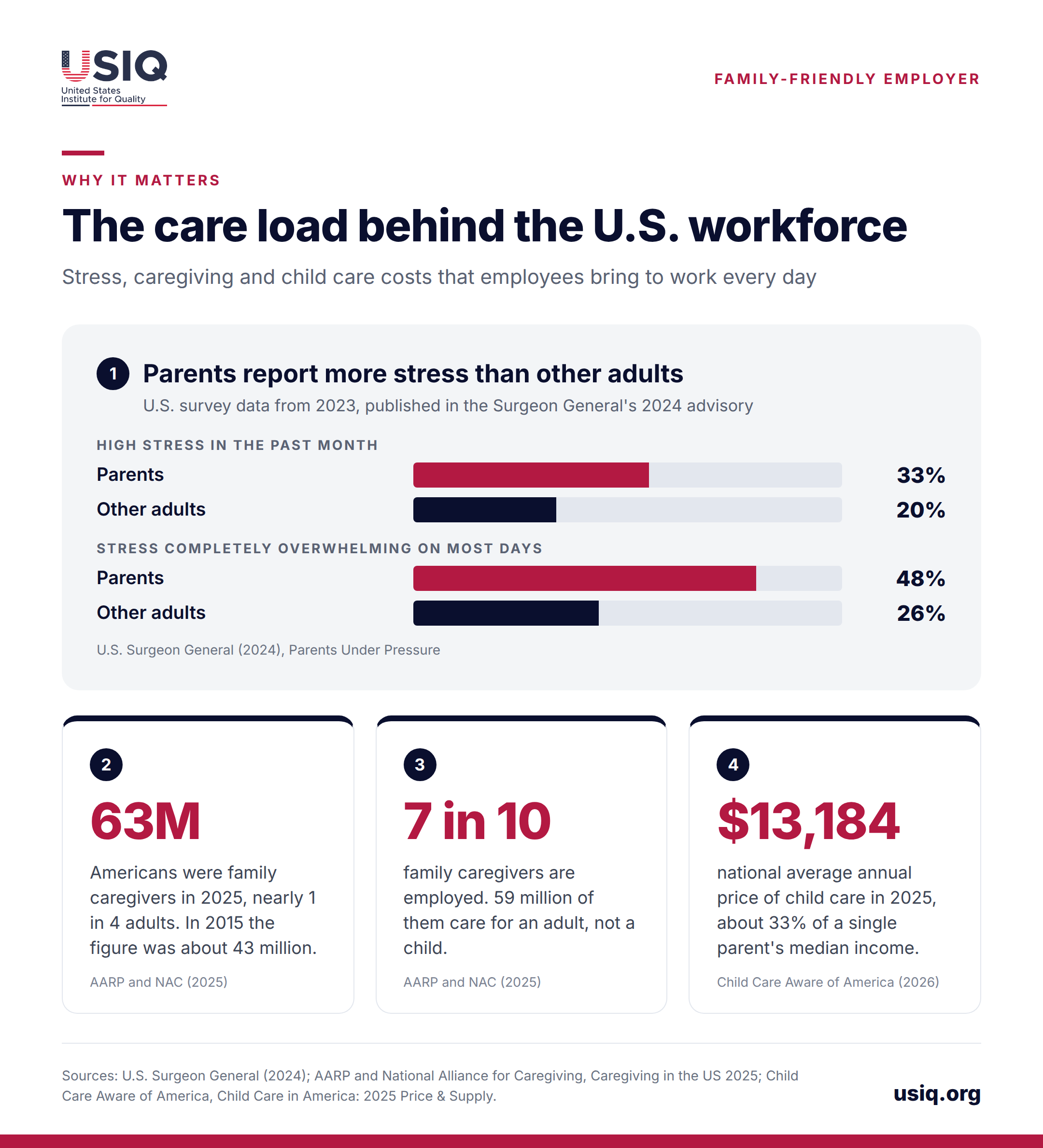
Parents report far more stress than other adults
In August 2024 the U.S. Surgeon General issued an advisory on the mental health of parents. Based on 2023 survey data, 33% of parents reported high stress in the past month, compared with 20% of other adults, and 48% said that on most days their stress is completely overwhelming, compared with 26% of other adults (U.S. Surgeon General, 2024). Among its recommendations for employers, the advisory calls for workplace policies that support parents and caregivers and for training managers on stress and work-life balance.
These numbers describe a social problem across the whole population. They do not show that working conditions alone caused the gap. They do show that a large share of any workforce arrives at work already carrying a heavy load.
Care is not only about children
Caregiving reaches well beyond parenting. AARP and the National Alliance for Caregiving estimate that 63 million Americans, nearly one in four adults, provided ongoing care to an adult or a child with a complex medical condition or disability in 2025. That is about 20 million more than in 2015, when the figure stood near 43 million, and up from roughly 53 million in 2020. Of the 63 million, 59 million cared for an adult. Seven in ten family caregivers are employed, and the report points to 18 million hourly workers who often lack access to supportive benefits (AARP and NAC, 2025).
For employers this has a direct consequence. A policy written only for new parents misses a large group of employees: the 50-year-old warehouse lead whose mother has dementia, the analyst who manages her brother’s medical care, the father in his twenties raising a child with a chronic illness.
Child care costs as much as rent in most states
Child Care Aware of America puts the national average annual price of child care at $13,184 in 2025, up from $13,128 in 2024. That equals about 10% of the median income of a married couple with children and 33% of the median income of a single parent (Child Care Aware of America, 2026).
Employers feel the gap as well. An earlier ReadyNation study estimated that the shortage of infant and toddler care costs the U.S. economy $122 billion a year in lost earnings, productivity and tax revenue. Employers alone lose an estimated $23 billion a year through productivity problems tied to their employees’ child care struggles (ReadyNation, 2023).
What international guidance says: UNICEF’s ten recommendations
UNICEF places strong weight on early childhood, when nutrition, responsive care and stable relationships shape a child’s development. Its guidance asks businesses to create conditions that let parents provide that care, and its 2025 toolkit with Dalberg Advisors applies the approach to offices, factories, farms and service workplaces (UNICEF; UNICEF and Dalberg Advisors, 2025).
Its ten recommendations are a useful starting point for company policy. The summary below groups them into practical responsibilities. They are voluntary guidance, not binding law.
| Area | Employer responsibility |
|---|---|
| Equal treatment | Protect employees against discrimination linked to pregnancy and parenthood. |
| Paid leave | Aim for substantial paid parental leave; UNICEF recommends at least six months. |
| Breastfeeding | Provide suitable facilities, time and practical support. |
| Child care | Help families find affordable, good-quality care. |
| Flexibility | Adapt when or where work happens, wherever the job allows it. |
| Decent work | Look at living costs and working conditions, not only at legal minimums. |
| Vulnerable workers | Address the needs of migrant, seasonal and informal workers. |
| Parent support | Offer resources that help caregivers support their children. |
| Business partners | Encourage family-supportive practices in the supply chain. |
| Awareness | Promote understanding of what young children need. |
A company operating in several countries can turn these principles into a global minimum standard, for example a company-wide target for paid leave, and then adapt payroll and administration to each national law. It should also check whether contractors or employees with short tenure run into practical barriers.
Why leadership decides whether policies work
A policy helps only when employees can actually use it, and the person who usually decides that is the direct supervisor. Researchers call the relevant management style family-supportive supervisor behavior (FSSB). Leslie Hammer and colleagues described four dimensions in 2009: emotional support, practical help with scheduling and workload, role modeling, and creative solutions that work for both the employee and the business (Hammer et al., 2009).
The evidence on this style has grown quickly:
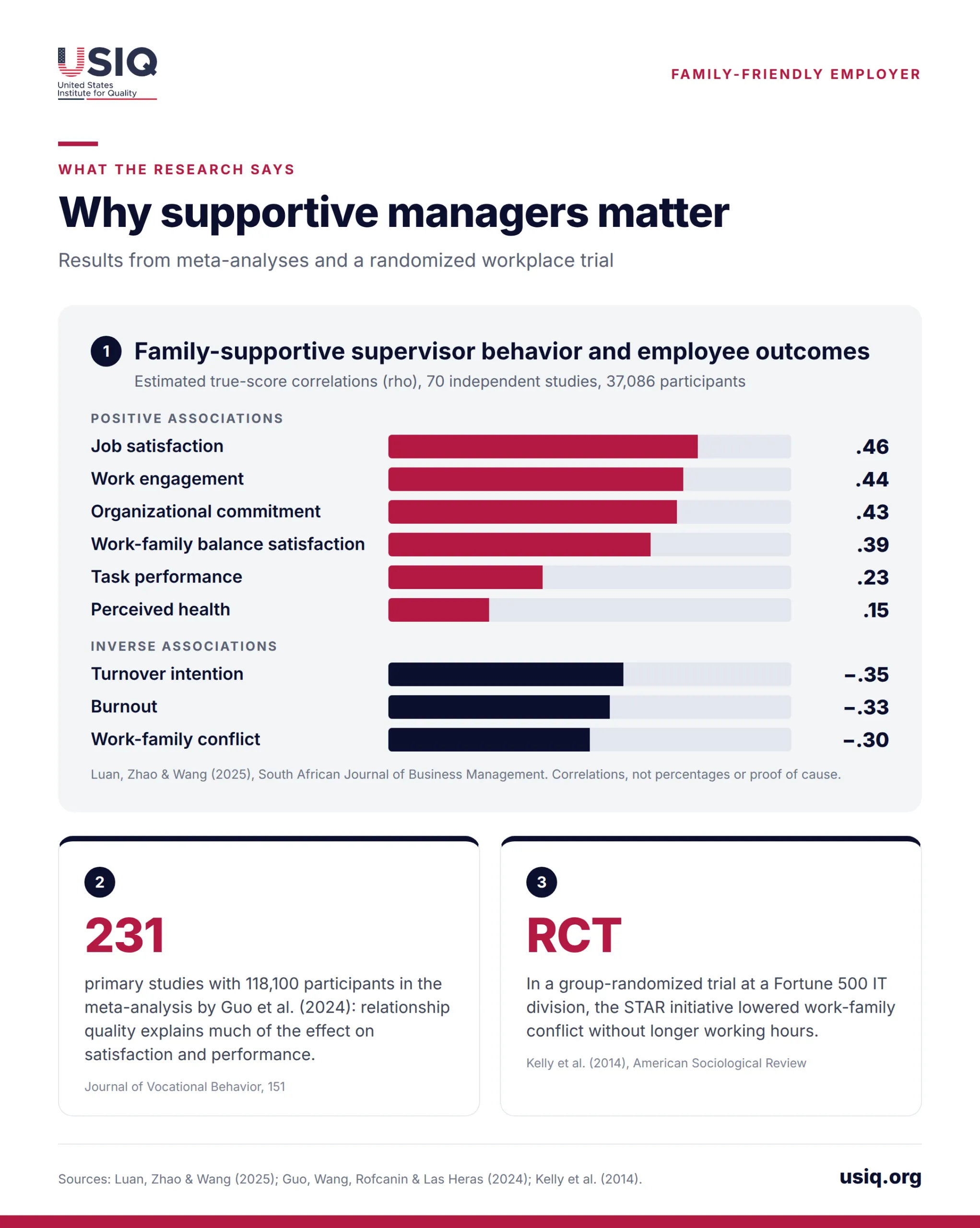
- Guo, Wang, Rofcanin and Las Heras (2024) synthesized 231 primary studies from 213 sources with 118,100 participants. Their analysis found that the quality of the relationship between manager and employee explained more of the effect on job satisfaction and performance, while the resources employees gained mattered more for well-being outcomes such as burnout (Guo et al., 2024).
- Luan, Zhao and Wang (2025) examined 17 outcomes, based on 158 correlations from 70 independent studies with 37,086 participants (Luan et al., 2025). Among work attitudes, the strongest associations appeared for job satisfaction (.46), work engagement (.44) and organizational commitment (.43). Turnover intention, burnout and work-family conflict were lower where supervisors were supportive.
- Hao and colleagues (2025) analyzed 126 independent samples from 122 articles with 59,068 participants. Among the mechanisms they tested, intrinsic motivation carried the largest indirect effect, followed by self-efficacy and autonomy (Hao et al., 2025).
The coefficients in the chart below are correlations, not percentages and not proof of cause. They show how consistently the same pattern appears across many workplaces.
Earlier work explains why general friendliness is not enough. A meta-analysis by Ellen Kossek and colleagues found that support aimed specifically at work-family issues was more strongly related to lower work-family conflict than general support from supervisors or the organization (Kossek et al., 2011). A manager can be pleasant and still make it clear that leaving early for a school meeting is a career risk.
Stronger causal evidence comes from the Work, Family and Health Network. In a group-randomized trial in the IT division of a Fortune 500 company, some teams took part in an initiative called STAR. It trained supervisors to support employees’ family and personal lives and changed team practices toward more control over when and where work was done. Employees in the STAR teams reported less work-family conflict and more control over their schedules, without an increase in working hours (Kelly et al., 2014). A follow-up study with 867 IT workers found that STAR reduced burnout and perceived stress over twelve months among employees surveyed before a company merger was announced (Moen et al., 2016). Both studies come from one office-based company, so results in a hospital or on a production line may differ.
For daily management the conclusion is practical. Train managers to listen, to discuss scheduling alternatives and to apply policies the same way for everyone. A team lead who praises flexibility in the all-hands meeting but rewards only those who answer emails at 10 p.m. cancels the policy. Training also needs adequate staffing and clear decision rules behind it, or managers will say yes in principle and no in practice.
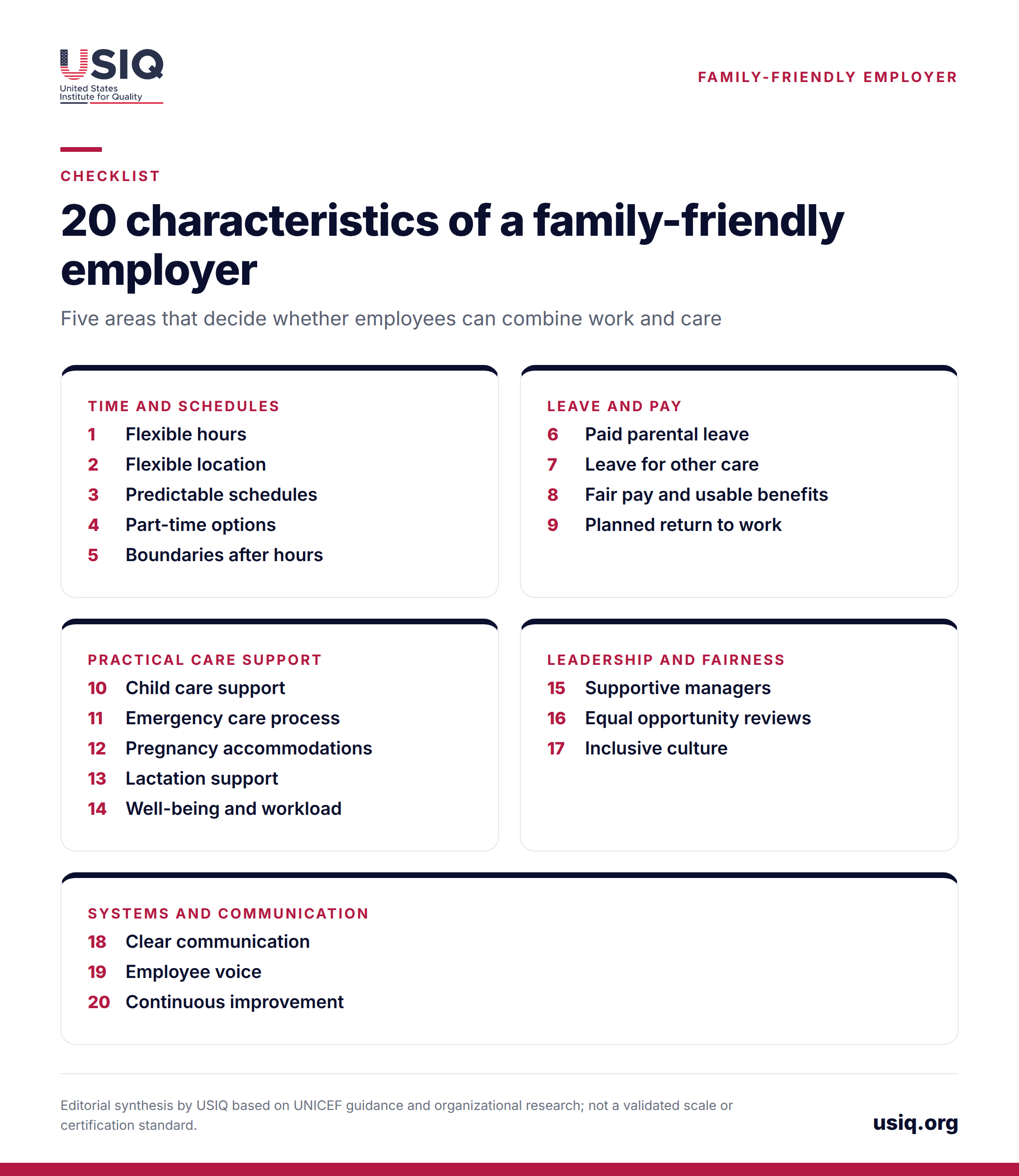
20 characteristics of a family-friendly employer
The following criteria are an editorial synthesis of the research and guidance above. They are not a validated psychometric scale and not a copy of any certification standard. How much each one matters depends on the workforce, so an employer should first find out which barriers its people actually face.
Time and schedules
- Flexible hours. Allow predictable adjustments around care duties, with clear coverage rules.
- Flexible location. Use remote or hybrid work where the job permits, with equal access to information for everyone.
- Predictable schedules. Publish shifts early and keep last-minute changes rare.
- Part-time options. Offer reduced-hour roles that do not block promotion without reason.
- Boundaries. Set clear expectations about contact outside working hours.
Leave and pay
- Paid parental leave. Define eligibility, wage replacement and the return process in writing.
- Leave for other care. Cover elder care and care for relatives with an illness or disability.
- Fair pay. Check that benefits are usable for lower-paid employees, not only for salaried staff.
- Return to work. Plan handovers, a reorientation and, where needed, a phased return.
Practical care support
- Child care support. Check local supply and prices before choosing subsidies, partnerships or a referral service.
- Emergency care. Have a clear process for sudden gaps in child care or elder care.
- Pregnancy support. Assess workplace risks and arrange accommodations quickly.
- Lactation support. Provide a private, suitable room and workable breaks.
- Well-being. Offer confidential support and deal with workload, not only individual stress.
Leadership and fairness
- Supportive managers. Train supervisors to respond constructively and consistently.
- Equal opportunity. Review promotions and pay for hidden penalties linked to care.
- Inclusive culture. Recognize different family structures and care situations.
Systems and communication
- Clear communication. Make eligibility and request procedures easy to find and understand.
- Employee voice. Collect confidential feedback across teams and job groups.
- Continuous improvement. Assign an owner, track results and review policies on a fixed cycle.
If you want more ideas for individual measures, our overview of work-life balance examples and the guide to employee benefits for U.S. employers go deeper into specific options.
Family-friendly work without a home office
A hospital, a warehouse or a restaurant cannot promise remote work to everyone. It can still offer autonomy and predictability. For a shift worker, a roster published three weeks in advance may be worth more than a remote-work policy that only applies at headquarters. Fairness means comparable chances to manage care, not identical benefits for every job.
| Office-based role | On-site or shift-based role |
|---|---|
| Flexible start and end times | Rosters published early, with shift preferences |
| Hybrid work | Transparent shift swaps |
| Online meetings | Meetings within scheduled hours |
| Flexible breaks | Enough relief staff to cover breaks |
| Remote work during disruptions | Emergency leave and backup staffing |
Management has to plan for coverage. If every accommodation adds hours for colleagues, support for the whole system erodes. Cross-training, a relief pool and a transparent rotation of unpopular shifts help keep arrangements workable. The aim is to treat flexibility as an operational capability the business plans for, instead of a favor granted case by case.
What U.S. law requires, and what it leaves to employers
Federal law sets a floor for leave and pregnancy protection, and it leaves most decisions about paid support to employers and states. Legal compliance is the starting point. It is not, on its own, evidence of a supportive workplace.
Federal rules
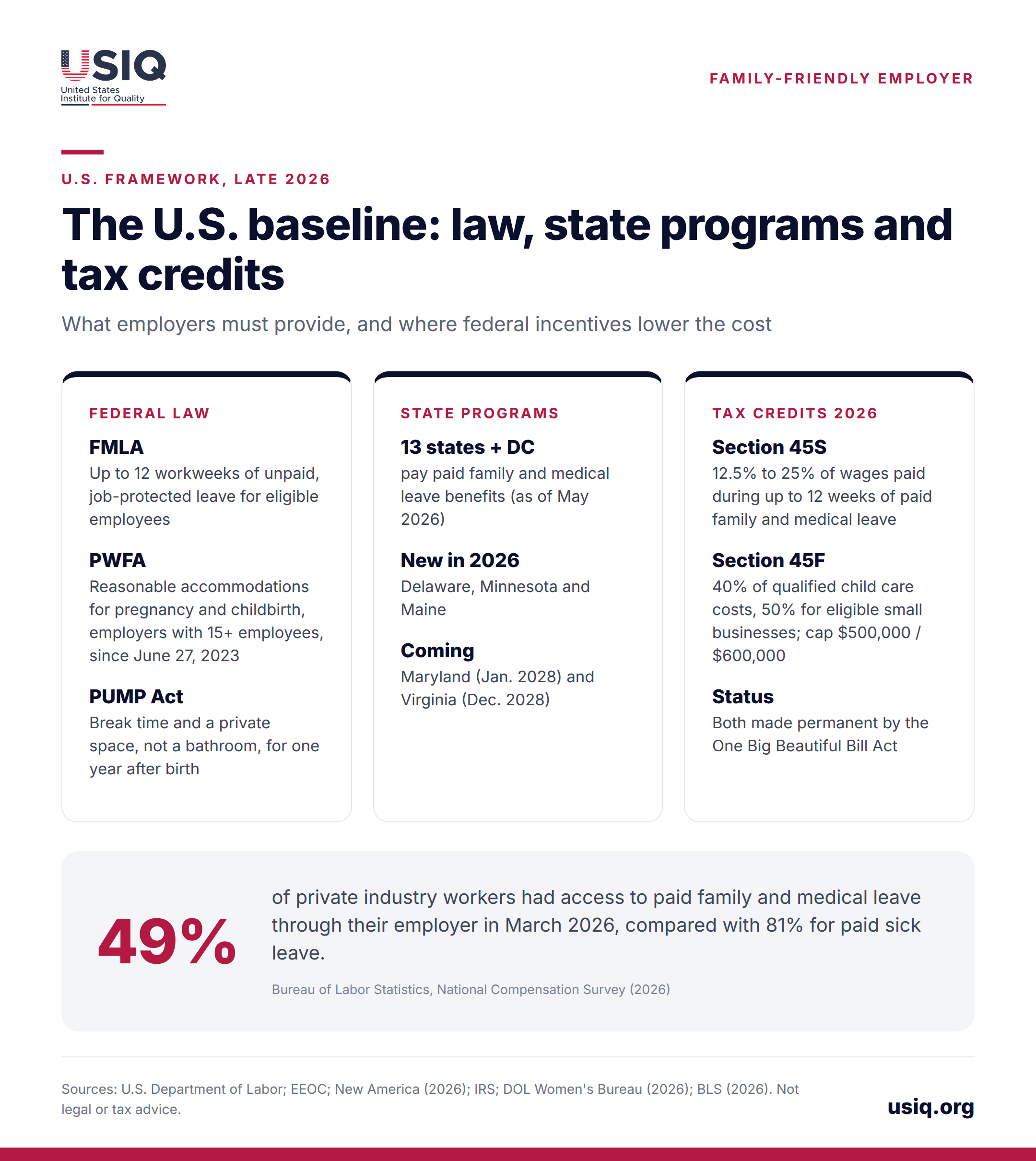
- Family and Medical Leave Act (FMLA). Eligible employees of covered employers can take up to 12 workweeks of unpaid, job-protected leave per year for qualifying reasons, including the birth or adoption of a child and the serious health condition of a spouse, child or parent. Special rules allow up to 26 weeks for military caregiver leave. Coverage generally requires an employer with at least 50 employees within 75 miles, and the employee must have worked 12 months and at least 1,250 hours (U.S. Department of Labor).
- Pregnant Workers Fairness Act (PWFA). In effect since June 27, 2023, it requires employers with 15 or more employees to provide reasonable accommodations for known limitations related to pregnancy, childbirth or related medical conditions, unless this would cause undue hardship. The EEOC’s final regulation took effect on June 18, 2024 (EEOC).
- PUMP for Nursing Mothers Act. It extends earlier rules to almost all employees covered by the Fair Labor Standards Act, including most salaried staff. Employees are entitled to reasonable break time and a private space other than a bathroom to express breast milk for one year after the child’s birth. Employers with fewer than 50 employees may be exempt if compliance would cause undue hardship (U.S. Department of Labor).
State paid leave programs
There is no federal paid family leave program. States fill part of the gap. As of May 2026, California, Colorado, Connecticut, Delaware, the District of Columbia, Maine, Massachusetts, Minnesota, New Jersey, New York, Oregon, Rhode Island and Washington pay paid family and medical leave benefits. Maryland plans to start paying benefits in January 2028, and Virginia, which enacted its program in April 2026, in December 2028 (New America, 2026). Delaware, Minnesota and Maine only went live in 2026, so many employers with staff in those states are still adjusting their policies.
Employer-provided benefits remain uneven. In March 2026, 49% of private industry workers had access to paid family and medical leave through their employer, while 81% had paid sick leave (Bureau of Labor Statistics, 2026).
New federal tax credits since 2026
Two federal tax credits became more valuable in 2026. Many smaller employers have not yet looked at them.
- Paid family and medical leave credit (Section 45S). The One Big Beautiful Bill Act made this credit permanent and expanded it for tax years beginning after December 31, 2025. Employers that offer qualifying employees at least two weeks of paid family and medical leave per year, at no less than 50% of normal wages, can claim 12.5% to 25% of the wages paid for up to 12 weeks of leave. Employers that insure the benefit can now base the credit on qualifying premiums. Leave required by state law counts toward meeting the requirements but not toward the credit amount. The IRS issued guidance in Notice 2026-28 in August 2026, and the credit is claimed on Form 8994 (U.S. Department of Labor, Women’s Bureau, 2026; IRS Form 8994).
- Employer-provided child care credit (Section 45F). For expenses paid after December 31, 2025, the credit equals 40% of qualified child care expenditures, or 50% for eligible small businesses, plus 10% of qualified resource and referral expenses. The annual cap rose from $150,000 to $500,000, or $600,000 for eligible small businesses, with inflation adjustments after 2026 (IRS). Qualified expenses can include contracts with licensed child care programs, so an employer does not need to build its own center.
Eligibility details are technical, and state rules interact with federal ones. Before a policy is finalized, HR should review it with a tax advisor and employment counsel. A company may always offer more than the legal minimum.
A good written policy names eligibility, notice procedures, wage replacement, continuation of health benefits, job protection and a contact person for problems. Employees should get this information before a crisis, not in the middle of one.
The business case, with honest numbers
Possible returns include lower replacement costs, keeping experienced people and a stronger position in recruiting. None of this happens automatically. Employers should compare costs with observed results and separate the effect of family policies from changes in pay, staffing or the labor market.
Turnover is the easiest place to start. Gallup estimates that replacing an employee costs between one-half and two times that person’s annual salary, and calls this a conservative estimate (Gallup).
Take a hypothetical employer with 250 employees. If annual turnover falls from 15% to 12%, that means 7.5 fewer departures a year. At $20,000 per departure, which is below the low end of Gallup’s range for any salary above $40,000, the avoided costs come to $150,000. If the program costs $50,000 a year, the modeled net benefit is $100,000. Under these assumptions the program breaks even once turnover drops by a single percentage point.
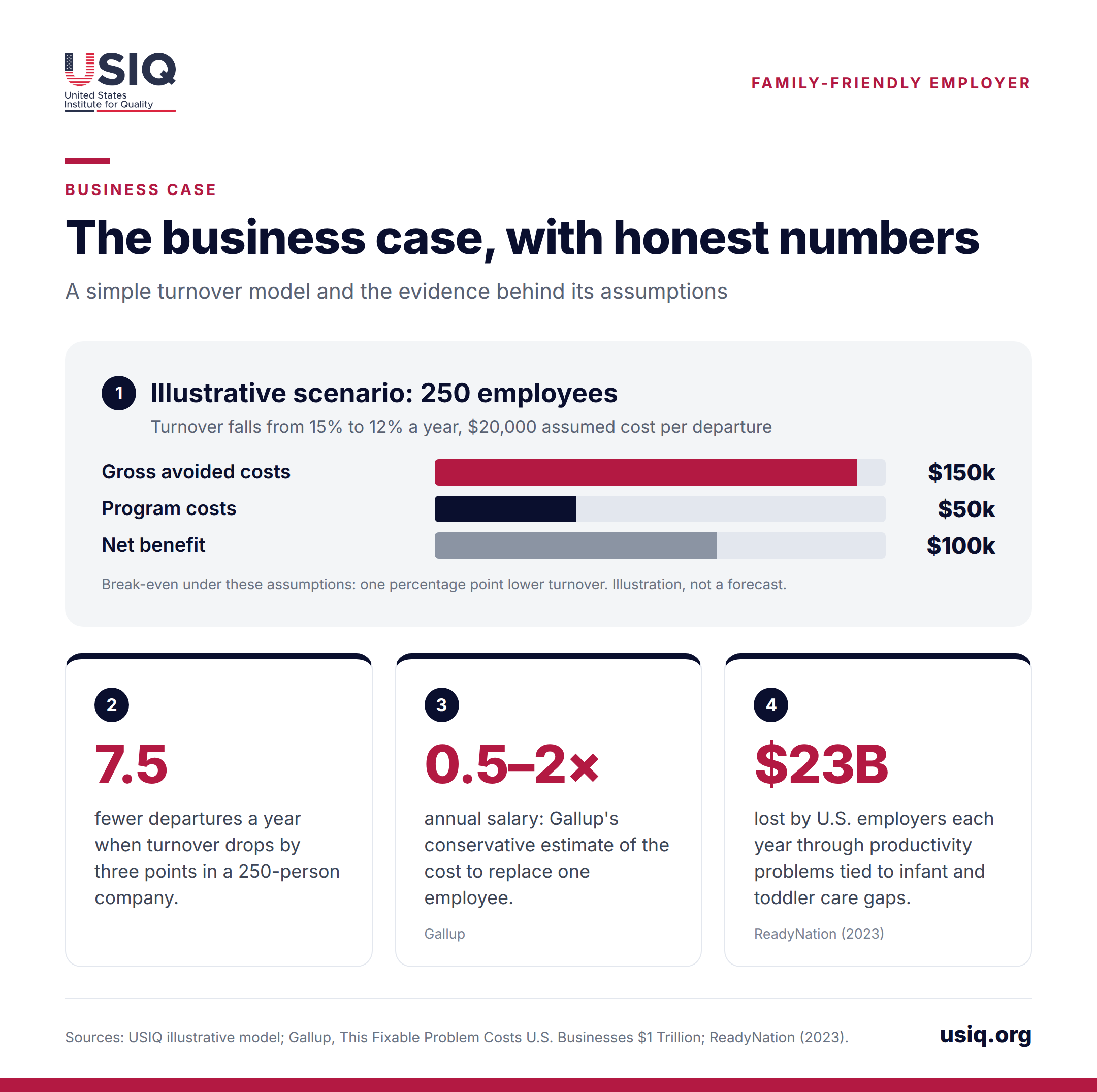
The scenario is an illustration, not a forecast. Tax credits under Sections 45S and 45F can lower the net cost further, but only once eligibility has been confirmed. Our article on employee retention strategies shows how to connect such measures with other retention levers.
How to measure family-friendliness: a four-layer framework
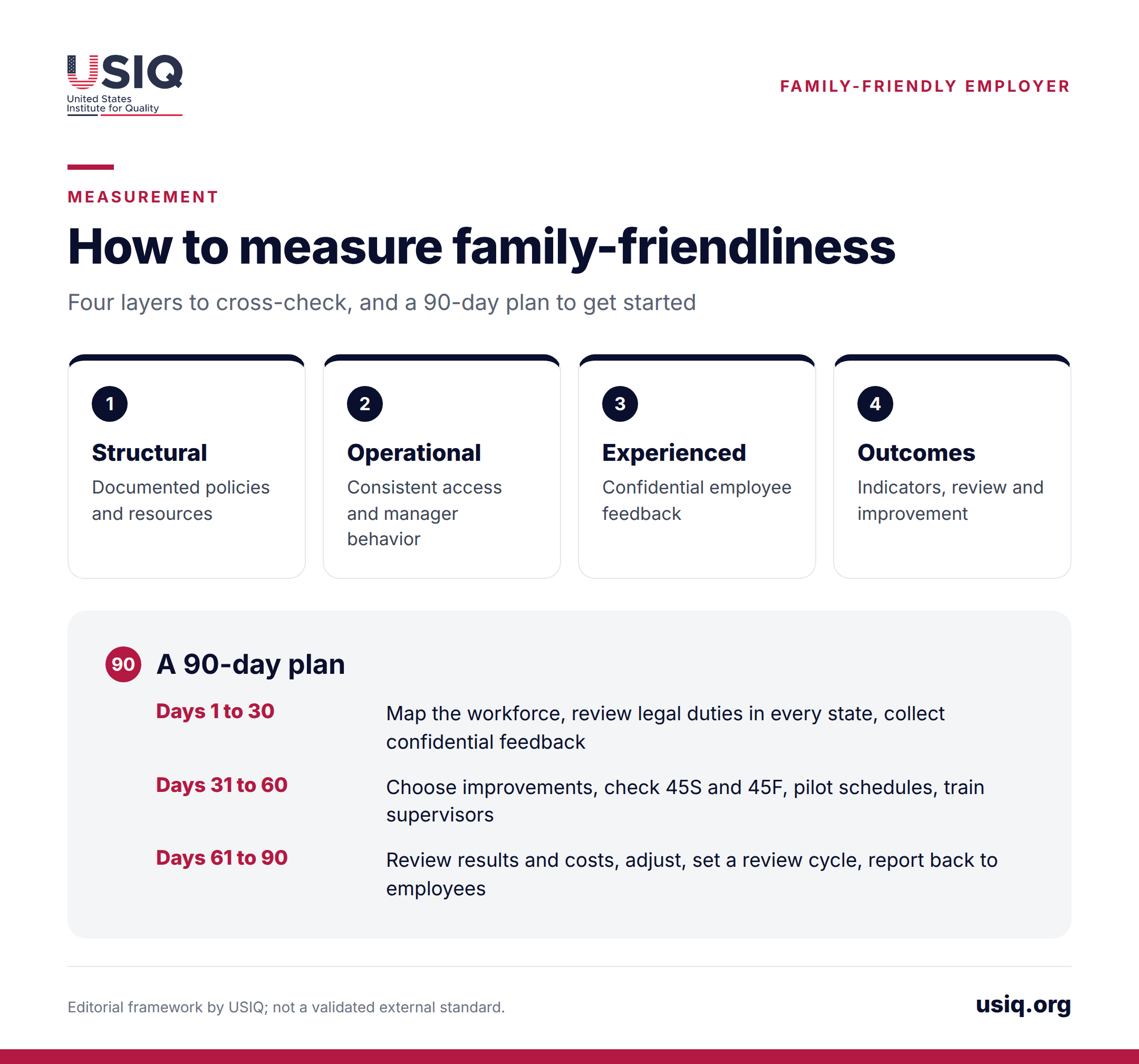
Many employers can point to a policy. Far fewer can show that it works. An assessment becomes credible when it cross-checks four layers:
- Structural: documented policies and resources.
- Operational: consistent access and manager behavior in daily practice.
- Experienced: what employees report in confidential feedback.
- Outcomes: indicators tracked over time, with regular review and improvement.
A written benefit can be generous and still go unused because people fear what happens afterward. Positive survey averages can hide large differences between departments or between salaried and hourly staff. Looking at all four layers lowers the risk of trusting a single source.
| Indicator | How to read it, and its limits |
|---|---|
| Leave uptake | Compare among eligible employees; low uptake may reflect free choice or barriers. |
| Return after leave | Use a fixed time window and a defined group. |
| Retention after leave | Compare similar roles and tenure; avoid causal conclusions. |
| Schedule predictability | Track notice periods and late changes, not only the written policy. |
| Work-family satisfaction | Use confidential surveys with the same questions each time. |
| Manager support | Compare teams while protecting anonymity. |
| Career progression | Review promotions and pay with the right context. |
| Benefit awareness | Test whether employees know how to access support. |
Set a baseline, assign an owner and review results at fixed intervals. Report response rates, missing data and the makeup of the workforce. A high response rate alone does not guarantee that the results are representative, and small-group results should never be published if they could identify individuals. Our guides to employee surveys and HR dashboards explain how to set up both.
Six mistakes that undermine family-friendly policies
The policy exists, the penalty does too. If people who use parental leave or part-time work are promoted less often, everyone notices, and uptake drops. Compare career data before and after leave.
Designing only for office staff. Remote work and flexible hours are easy to offer at headquarters. If production, care or retail staff get nothing comparable, the company has a two-tier system.
Defining family too narrowly. Policies limited to newborns miss employees caring for parents, partners or relatives with a disability. AARP’s numbers show how large that group is.
Reading uptake without context. Low use of a benefit can mean nobody needs it, or that people are afraid to ask. Only confidential feedback tells you which.
Relying on one champion. When one committed HR manager leaves, informal arrangements often go with her. Write processes down and give them an owner.
Treating flexibility as a personal favor. If each request depends on the mood of the manager, employees experience flexibility as arbitrary. Clear criteria and a way to appeal decisions make it fair.
A 90-day plan to turn commitments into action
Days 1 to 30. Map the workforce, review legal obligations in every state where you employ people, check existing policies and collect confidential feedback. Find the most common sources of conflict and the roles where support is hardest to reach.
Days 31 to 60. Choose feasible improvements, assign owners and set a budget. Check whether the 45S or 45F credits apply. Pilot scheduling changes, train supervisors and publish simple request procedures. Create a way for employees to challenge inconsistent decisions.
Days 61 to 90. Review the pilot results, employee feedback and costs. Adjust what did not work and set a regular review cycle. Tell employees what changed and why, including the areas where more work is needed.
Questions job seekers should ask
Careers pages rarely show how family support works in practice. In interviews, concrete questions get more useful answers than general ones:
- How many people in this team currently work flexible hours or part time?
- What happens when a child or relative suddenly needs care?
- Have managers here taken parental leave themselves?
- How far ahead are shifts or project deadlines set?
- How is the return from leave organized?
- Does part-time work affect eligibility for promotion?
Ask for examples instead of reassurances. Our article on family-friendly jobs in the U.S. covers which roles and industries tend to fit family life.
If an employer shows a family-friendly award or seal, check the published criteria of the issuing organization, how the assessment works, whether employees were surveyed and how long the result is valid. A seal can be useful evidence, but it does not replace direct questions about the specific job and team. What research says about employer seals and applicants is summarized in Do employer seals work?.
Where certification fits
A certification can give an employer a structured way to compare its policies and employees’ experience against defined requirements. USIQ offers the Family Friendly Employer (USIQ) certification, which combines an employee survey with an HR interview. Readers should check the current criteria and methodology directly before relying on any statement about eligibility or assessment. USIQ has a commercial interest in certification, and the external research cited in this article does not validate any particular award.
For a broader view of what this means for U.S. employers, see what a family friendly employer does and the family-friendly policies employees value most.
Frequently asked questions
What makes an employer family-friendly?
An employer is family-friendly when employees can combine work and caregiving without career penalties. In practice this means flexible and predictable working time, paid leave for birth, adoption and care, help with child care and elder care, support for pregnancy and breastfeeding, and managers who apply these policies fairly.
Is a family-friendly employer only relevant for parents?
No. AARP and the National Alliance for Caregiving count 63 million family caregivers in the U.S., and 59 million of them care for an adult. Good policies cover care for parents, partners and relatives with an illness or disability as well as children.
Do U.S. employers have to offer paid parental leave?
Federal law does not require it. The FMLA provides unpaid, job-protected leave for eligible employees. Thirteen states and the District of Columbia pay paid family and medical leave benefits through state programs, and employers can claim the Section 45S tax credit for qualifying paid leave they provide.
How can a small business be family-friendly on a tight budget?
Many measures cost little: publishing schedules early, clear rules for shift swaps, a written process for care emergencies, manager training and a confidential feedback channel. The Section 45F credit can cover up to 50% of qualified child care expenses for eligible small businesses.
How do you measure whether a workplace is family-friendly?
Look at four layers: written policies, how they are applied in practice, what employees report in confidential surveys, and outcomes such as leave uptake, return and retention after leave, and promotion rates. Track the same indicators over time and compare teams and job groups.
Conclusion
Family-friendly employers create conditions in which work and care can coexist. What sets them apart is practical access to support, predictable working arrangements, fair treatment and managers who back employees without penalizing them later. The most convincing evidence combines written policies, consistent practice, confidential employee feedback and measured results, reviewed year after year.


Sources
- AARP and National Alliance for Caregiving (2025). Caregiving in the US 2025.
- Bureau of Labor Statistics (2026). Employee Benefits in the United States, March 2026.
- Child Care Aware of America (2026). Child Care in America: 2025 Price & Supply.
- EEOC. What You Should Know About the Pregnant Workers Fairness Act.
- Gallup. This Fixable Problem Costs U.S. Businesses $1 Trillion.
- Guo, Y., Wang, S., Rofcanin, Y. and Las Heras, M. (2024). Journal of Vocational Behavior, 151, 103988.
- Hammer, L. B. et al. (2009). Journal of Management, 35(4).
- Hao, L., Zong, Z., Zhao, T., Meng, W. and Meng, H. (2025). Journal of Occupational and Organizational Psychology, 98(1).
- IRS. Employer-provided child care credit, tax year 2026 and later; Form 8994.
- Kelly, E. L. et al. (2014). American Sociological Review, 79(3), 485 to 516.
- Kossek, E. E. et al. (2011). Personnel Psychology, 64(2).
- Luan, Y., Zhao, G. and Wang, N. (2025). South African Journal of Business Management, 56(1), a4642.
- Moen, P. et al. (2016). American Sociological Review, 81(1), 134 to 164.
- New America (2026). Explainer: Paid Leave Benefits and Funding in the United States.
- ReadyNation (2023). $122 Billion: The Growing, Annual Cost of the Infant-Toddler Child Care Crisis.
- U.S. Department of Labor. FMLA; PUMP Act; Women’s Bureau fact sheet on the employer credit for paid family and medical leave (2026).
- U.S. Surgeon General (2024). Parents Under Pressure.
- UNICEF. 10 ways companies can be more family-friendly; UNICEF and Dalberg Advisors (2025). Building Family-Friendly Workplaces.
Related Articles
What makes an employer family-friendly? 20 criteria, research on supportive managers, U.S. law, 2026 tax credits and a framework to measure progress.
A practical, research-based guide for managers at U.S. employers: nine steps from goal setting to follow-up, bias checks, sample wording, a one-page template and the EEOC rules for critical reviews.
Our quality management system passed an independent ISO 9001:2015 audit by QRO Certification LLP. What the audit covered and what it means for companies we certify.
What research says about the effects of employer seals on current employees, potential applicants and employer image, from independent experiments and field data to the limits of the evidence.