
CERTIFICATION RULES · FTC GREEN GUIDES · EU EMPCO
A Seal That Holds Up in the U.S. and in Europe
In the United States, the FTC looks closely at what a seal tells people and who stands behind it. In the EU, stricter rules for labels have applied since September 27, 2026. USIQ seals are designed with both in mind.
This page summarizes how our seals are awarded and used, which requirements of the FTC Green Guides, the FTC Endorsement Guides and EU Directive 2024/825 they address, and what happens when a seal is misused. The binding details are in each program’s published certification criteria.
AT A GLANCE
Built for two rulebooks
UNITED STATES – FTC
✓
No self-certification: USIQ never certifies itself or a company it controls.
✓
Every seal states its basis and links to its verification record.
✓
Fixed, published fees, disclosed with every seal.
EUROPEAN UNION – EMPCO
✓
Published criteria open to every eligible applicant on equal terms.
✓
Suspension and revocation under a written procedure with appeal.
Two rulebooks, one standard
USIQ certifies the U.S. operations of an organization. But careers sites and job ads are read worldwide, and many of our clients belong to European groups. Where the two rulebooks differ, we follow the stricter one.
UNITED STATES
FTC Green Guides and Endorsement Guides
Section 5 of the FTC Act prohibits deceptive practices. The Green Guides (16 CFR Part 260) explain how the FTC applies this rule to environmental claims; Section 260.6 deals directly with certifications and seals of approval. It refers to the Endorsement Guides (16 CFR Part 255), which apply to every seal, environmental or not.
The guides are not regulations, but the FTC relies on them when it enforces Section 5. The current Green Guides date from 2012 and remain in effect while the review the FTC opened in 2022 continues.
EUROPEAN UNION
Directive (EU) 2024/825 (EmpCo)
Since September 27, 2026, a sustainability label shown to consumers in the EU must be based on a certification scheme or set up by a public authority. Otherwise, it counts as an unfair practice in every member state. The definition covers social characteristics as well as environmental ones.
A scheme must be open to all on fair terms, developed with experts and stakeholders, able to suspend or withdraw labels, and monitored by an independent third party. Its terms must be freely available online.
SIDE BY SIDE
What the FTC expects, what the EU requires and what USIQ does
Seven topics on which both rulebooks set expectations for a seal. The USIQ column refers to the Top Employer Certification Criteria, version 2026-3.2; the other programs follow the same principles.
| Topic | FTC (U.S.) | EmpCo (EU) | USIQ |
|---|---|---|---|
| Independence | A seal must not suggest independent certification that did not happen. A self-awarded seal is deceptive unless clearly disclosed. Industry members who can veto standards undermine independence.16 CFR 260.6(a), Examples 1–4 | Compliance is monitored by a third party independent of the scheme owner and the trader; self-certification does not establish quality.Directive 2005/29/EC, Art. 2, as amended by 2024/825 | USIQ does not certify itself or entities it controls. No paid HR consulting for an employer during its assessment or certification. Reviewers are not paid by result, and a second reviewer checks every award. External monitoring: INDEPENDENT REVIEW BODY.Criteria Part 1, §7 |
| What the seal says | A seal that does not explain its basis implies broad benefits. Clear qualifying language, or a link to a page listing what was evaluated, avoids this.16 CFR 260.6(d), (e), Examples 6–7 | Scheme terms must be publicly available. A claim may not go beyond what was certified. | The artwork carries “Based on Employee Survey & HR Assessment” and the tier symbol. Every promotional use names the tier, employer, U.S. scope and period, and links to the verification page and criteria.Part 4, §3; Annex D |
| Standards | An endorsing organization must rely on standards adopted in advance and suited to the qualities judged, or on experts it recognizes.16 CFR 255.3, 255.4 | Requirements are developed by the scheme owner in consultation with relevant experts and stakeholders. | Criteria, scored questions and formulas are published before any assessment, reviewed every year, and material changes are announced six months ahead. Scientific Advisory Board and public consultation; see section 6.Part 1, §7, §9 |
| Fees | A reasonable certification fee is not a material connection that must be disclosed. Paying for a better ranking is deceptive, even with a disclosure.16 CFR 260.6 Example 3; 255.4 Example 3 | Access on transparent, fair and non-discriminatory terms. | A fixed package fee, agreed in advance and the same for every tier, is payable only if an award is issued. Without an award, only the $990 exam fee applies, including a detailed evaluation in table form; anything paid in advance beyond that is refunded. The fee arrangement is disclosed with every seal.Part 4, §5; Annex C |
| Evaluation vs. membership | A seal that only shows membership in an association implies an evaluation that never took place.16 CFR 260.6 Example 5 | A label must rest on verification that the requirements are met. | No membership seals. Applying, paying or taking part in an assessment gives no right to claim certification.Part 4, §2; Annex D1 |
| Substantiation | A certification does not relieve the marketer of the duty to back up every claim the seal conveys.16 CFR 260.6(c) | The company that displays the label is responsible toward consumers. | An officer of the employer signs a declaration on the accuracy of all answers. The employer receives the evaluation and must keep records of its seal uses and the basis of its claims.Part 3; Annex E, §8.3 |
| Misuse and withdrawal | No set procedure, but continued use of an invalid or misleading seal can be pursued under Section 5 of the FTC Act. | The scheme must have procedures for non-compliance, including suspension or withdrawal of the label. | Written notice with at least 14 days to respond, interim suspension in urgent cases, revocation, appeal within 30 days. Digital uses removed within 5 business days, physical displays within 30 days.Part 4, §6 |
LESSONS FROM 16 CFR 260.6
Four cases from the Green Guides and where USIQ stands
The FTC illustrates its approach with examples. These four show the most common ways a seal misleads.
EXAMPLE 1
The self-awarded seal
A manufacturer designs its own seal and puts it on its product.
USIQ: We never certify ourselves or a company we control.
EXAMPLE 4
The industry veto
Industry members can block changes to the standard, even as a minority on the board.
USIQ: Certified employers have no say in the criteria. USIQ alone sets them and publishes them.
EXAMPLE 5
The membership seal
The logo of an association suggests a test that never happened.
USIQ: No seal without a completed assessment and an award decision.
EXAMPLE 7
The all-round seal
A seal covering many attributes suggests the company is better in every way.
USIQ: “Top Employer” is a program name, not a ranking. The criteria link shows exactly what was assessed.
Clear and conspicuous
One statement next to the seal
The Green Guides recommend clear, prominent language that tells people what a seal is based on. The EU expects the same: no claim beyond what was certified.
Under our license terms this statement is mandatory in every advertisement and public promotional use. It has to be readable in the medium used, not hidden in small print or unrelated terms.
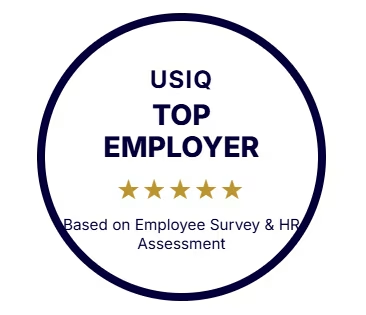
Schematic only. Employers use the original artwork released by USIQ.
Summary of the rules
USIQ Transparency and
Certification Rules
This summary is for orientation. If it differs from the certification criteria and license terms accepted with an order, those documents prevail.
Using your seal the right way
Allowed
Not allowed
What happens after a report
Every report goes through the same documented steps, no matter who the organization is or how long it has worked with us.
Step 1
Screening
Relevance, credibility, conflicts of interest and urgency are checked and recorded.
Step 2
Evidence check
Sources and context are verified. Allegations are kept apart from findings.
Step 3
Notice
Grounds, a summary of the evidence and the proposed measure go to the employer.
Step 4
Response
At least 14 calendar days; at least 5 business days after an urgent interim suspension.
Step 5
Decision
In writing, with reasons, normally within 30 days after the response period.
Step 6
Appeal
Within 30 days, free of charge, decided by someone not involved before.
Possible measures
Stakeholder consultation
We publish the current USIQ criteria and ask organizations outside USIQ to suggest improvements. This table shows who was invited and whether a response came in.
Would your university or association like to contribute? Write to
mail@usiq.org.
| Organization | Invited | Response |
|---|---|---|
| [University] | [Date] | [Comments received] |
| [Business association] | [Date] | [No response yet] |
| [HR professional body] | [Date] | [Comments received] |
| [Employee organization] | [Date] | [Declined] |
Check whether a seal is valid
Every certificate has its own ID and a public verification page showing the employer, covered U.S. locations, tier, assessment period, methodology version, exact issue and expiry dates, current status and the fee disclosure.
Questions about the FTC, EmpCo and USIQ seals
Contact
METHODOLOGY & CERTIFICATION
REPORTS & COMPLIANCE
INDEPENDENT REVIEW BODY