

- What Is an Employee Survey?
- Types of Employee Surveys Used in U.S. Employment
- Building Employee Trust with Anonymous Employee Surveys
- How Employers Should Analyze Employee Survey Results
- Taking Action on Feedback to Establish Trust with Employers
- Employee Survey Response Rates: What’s Good and How to Improve Them
- Employee Surveys as a Trust Strategy in the Long Run
Employee surveys are the most common way for employers to ask a whole workforce the same questions and compare the answers over time. For a company with 10 to 250 employees, they can replace guesswork about morale, workload and trust in leadership with something measurable.
The tool is simple, but doing it well is harder. Staff must believe their answers are safe, the questions must be fair, and someone must change something afterward. Surveys that skip the last step can do more harm than no survey at all.
Quick answer: An employee survey is a structured, repeatable set of questions that lets employers compare how staff see their work over time. It works when questions are neutral, anonymity is real, reporting groups are not too small, and leaders share results and act on a few clear priorities.
Key takeaways
- A survey differs from a poll or informal feedback because it is structured, repeated and comparable across teams and time.
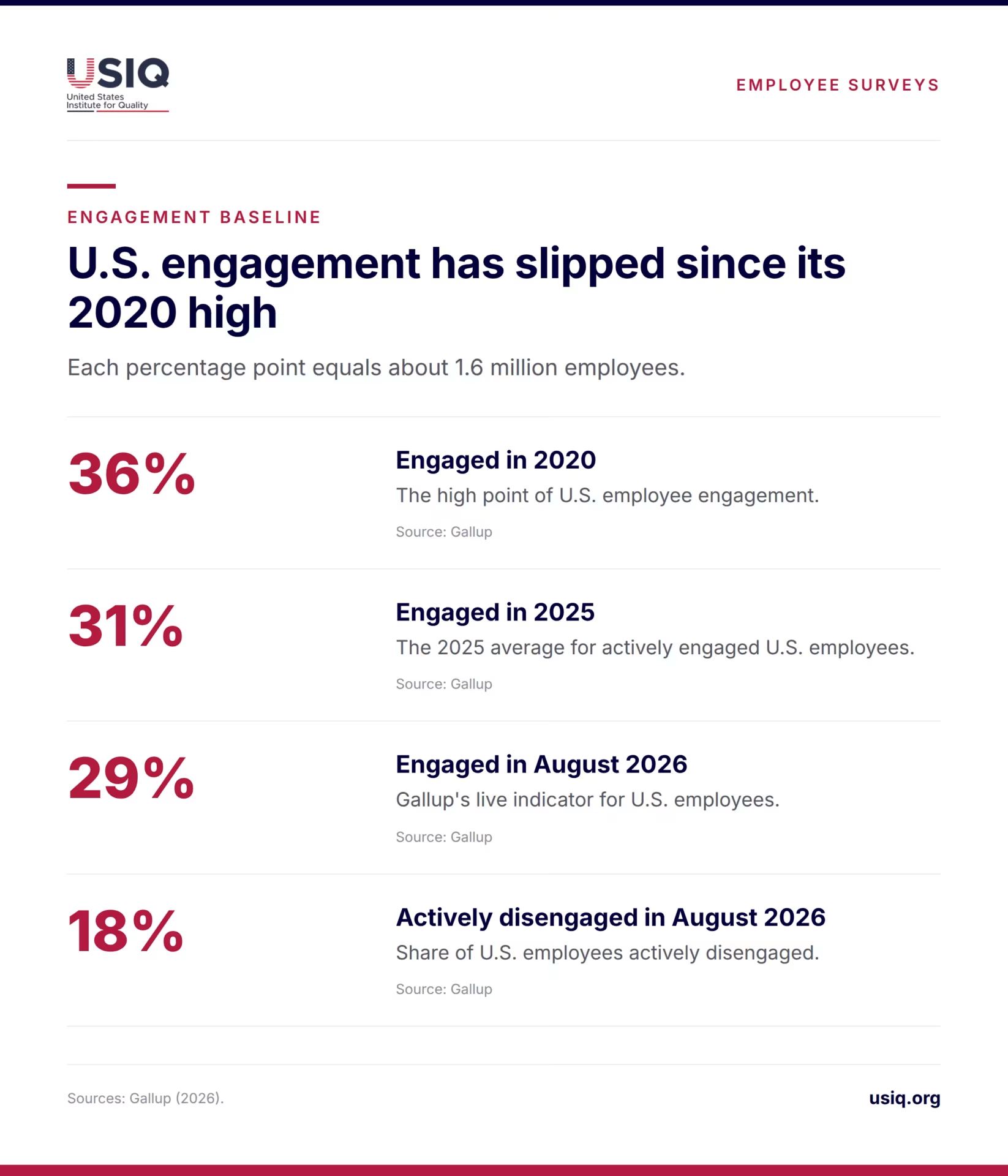
- Gallup reports that actively engaged U.S. employees averaged 31% in 2025, down from a 36% high in 2020.
- Only 8% of employees strongly agree that their organization acts on survey results, so follow-through is where most employers fall short.
- Gallup’s suggested timing is a semiannual engagement survey plus quarterly or monthly pulses; a small company can start with one or two short surveys a year if it acts on them.
- Reporting only groups with a minimum number of responses, such as five or more, protects anonymity; in small companies this limits team-level reporting.
- Response-rate benchmarks are rules of thumb, and a rate near 100% can signal a mandatory or manipulated survey.
- General surveys should avoid questions about union activity, and employers that call a survey anonymous should not try to identify respondents.
What is an employee survey, and how is it different from a poll?
An employee survey is a planned series of questions about day-to-day work, support, leadership and overall satisfaction. It uses the same wording for everyone and repeats it on a schedule, so results can be compared between teams and across years.
That separates it from a quick poll, which usually asks one or two informal questions. It also differs from suggestion boxes or comment forms, which collect opinions but rarely in a form that can be scored or tracked. Because a survey is structured, an employer can say whether trust in leaders moved from one year to the next.
Which types of employee surveys exist?
Employers choose a type based on the decision they need to make. Gallup’s overview of workplace survey types, tools and practices covers most of the formats below.
| Survey type | What it asks | Typical use in a smaller company |
|---|---|---|
| Engagement | Connection to work, motivation, intent to stay | One or two full surveys a year |
| Satisfaction | Pay, benefits, hours, the job itself | Reviewing benefits or scheduling changes |
| Pulse | A handful of repeated questions | Quarterly or monthly check-ins on one topic |
| Inclusion and DEI | Fairness, respect, belonging | Spotting gaps between groups of employees |
| Onboarding | The first weeks and hiring experience | Fixing training and orientation |
| Exit | Reasons for leaving | Finding patterns behind resignations |
| Culture and trust | Honesty of leaders, teamwork, values | Tracking long-term shifts |
Why should a company with 10 to 250 employees run employee surveys?
Because engagement has slipped nationally, and small employers feel that in turnover and productivity. Gallup reports that actively engaged U.S. employees averaged 31% in 2025, unchanged from 2024 and down from a 36% high in 2020. Each percentage point equals about 1.6 million employees, so the decline since 2020 represents about 8 million fewer engaged workers.
Gallup’s live indicator shows 29% of U.S. employees engaged and 18% actively disengaged as of August 2026. In 2000 the figures were 26% engaged and 18% actively disengaged. Worldwide, 20% were engaged and 16% actively disengaged in 2025, while the U.S. and Canada region stood at 31%.
| Measure (Gallup) | Engaged | Actively disengaged |
|---|---|---|
| U.S., 2000 | 26% | 18% |
| U.S., 2020 (high) | 36% | Not stated in source |
| U.S., 2025 average | 31% | Not stated in source |
| U.S., August 2026 | 29% | 18% |
| Worldwide, 2025 | 20% | 16% |
Sources: Gallup, U.S. Employee Engagement Declines From 2020 Peak, and Gallup’s employee engagement indicator.
What does the business case look like?
Gallup client data shows business units in the top quartile of engagement had 78% less absenteeism and 23% higher profitability than the bottom quartile. That is a comparison of Gallup’s clients, not a promise that a survey will deliver those results for any one company.
Managers matter most. Gallup says managers account for at least 70% of the variance in team engagement, and that best-practice organizations average 70% engagement. In a 40-person firm, a survey is largely a read-out on how supervisors lead.
Retention is the other pressure. The U.S. Bureau of Labor Statistics reported 3.2 million quits in June 2026, a rate of 2.0%, unchanged from May, alongside 1.8 million layoffs and discharges (1.1%). BLS describes the quits rate as a measure of workers’ willingness or ability to leave jobs, and quits are generally voluntary separations. A survey can show what is driving that willingness before a resignation letter arrives. See the BLS JOLTS release for June 2026.
What should employee surveys ask?
Most employers do best with a focused set of topics rather than a long questionnaire. Typical areas include clarity of expectations, feeling cared about, growth, trust in leaders, workload and burnout, recognition, and whether people feel safe speaking up. The USIQ guide to employee survey questions offers more examples.
Gallup’s engagement data shows why the first two matter. Among Gen Z and younger millennials, strong agreement with “my supervisor, or someone at work, seems to care about me as a person” fell from 54% in 2020 to 41% in 2025. Agreement on “opportunities to learn and grow” fell from 48% to 37%.
How should questions be worded?
- One idea per question. “My manager communicates clearly and recognizes my work” mixes two topics; split it.
- Neutral wording. “How great is your manager?” pushes toward praise. “How satisfied are you with the support of your manager?” does not.
- One consistent scale. A five-point Likert scale from strongly disagree to strongly agree keeps answers comparable.
- Plain language. Short sentences at an everyday reading level reduce skipped items and misreadings.
- A few open-text questions. Scores show where the problem sits; comments show why.
Survey themes can also point to training needs and planned changes. If low scores on growth cluster in one department, that is a training conversation. If scores drop after a reorganization, that shapes how leaders communicate the next step.
How often should employers run employee surveys?
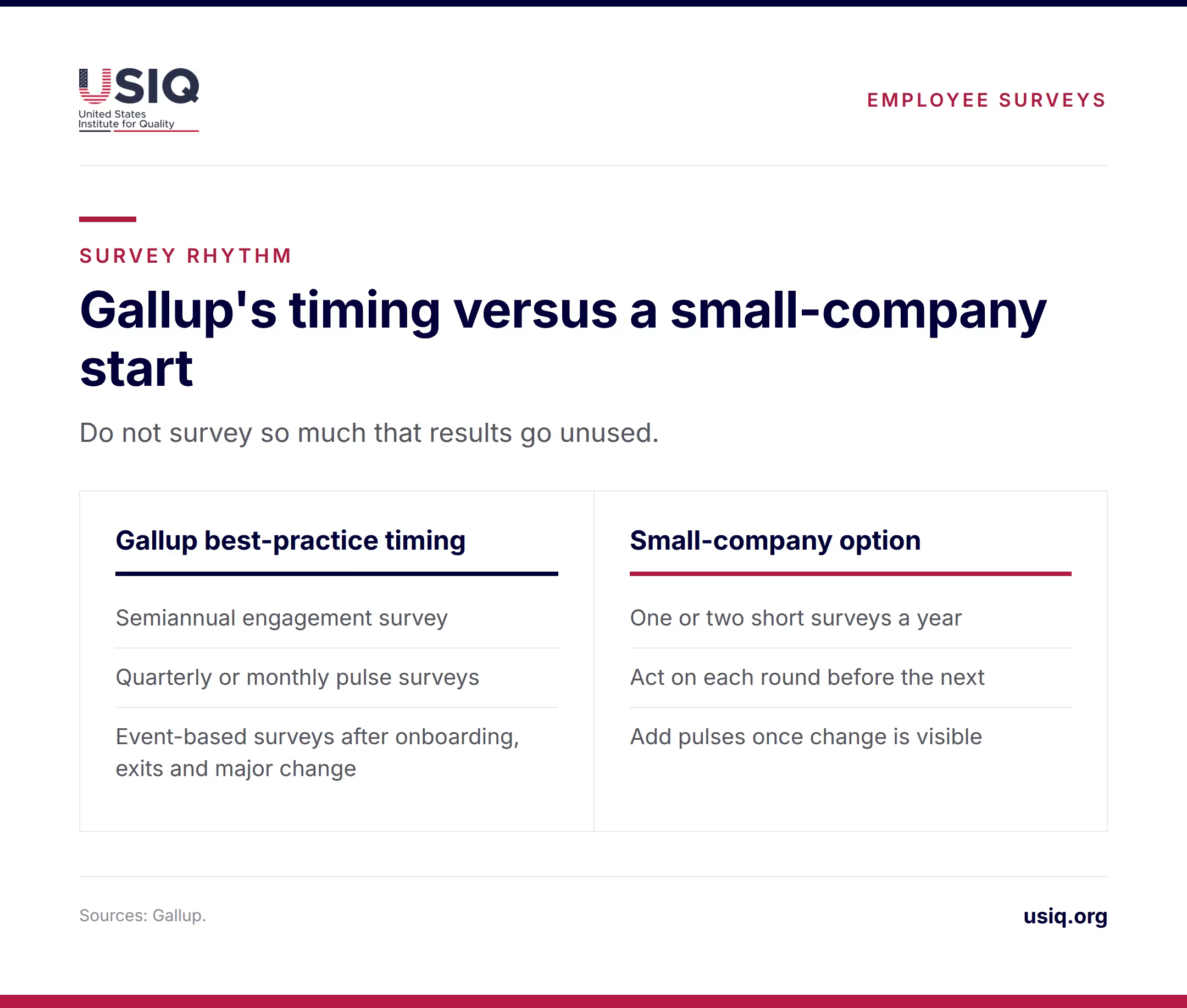
Gallup’s best-practice timing is a semiannual engagement survey, quarterly or monthly pulse surveys, and event-based surveys after onboarding, exits or major change. It also warns against surveying so much that results go unused.
| Format | Gallup-described rhythm | Realistic option for a small employer |
|---|---|---|
| Full engagement survey | Semiannual | Once or twice a year, kept short |
| Pulse survey | Quarterly or monthly | A few questions on one topic, only if the last results were acted on |
| Event-based | After onboarding, exits, major change | A short form after onboarding, plus an exit form |
For a company of 30 people without an HR department, one or two short surveys a year can be enough if each leads to visible changes. Over-surveying breeds fatigue when staff see no result, while under-surveying lets burnout and distrust build unseen. The practical limit is how fast the company can respond with action.
Are employee surveys anonymous, and can they be?
Some are, many are only confidential. In an anonymous survey, no personal data is stored, so nobody can trace an answer to a person. In a confidential survey, managers cannot see who said what, but the survey system may still be able to link responses to individuals.
Gallup stresses that employees need to trust the process, not only the promise of anonymity. If staff suspect they can be identified, they give safe answers, and the data stops reflecting reality.
How do reporting thresholds work in a small company?
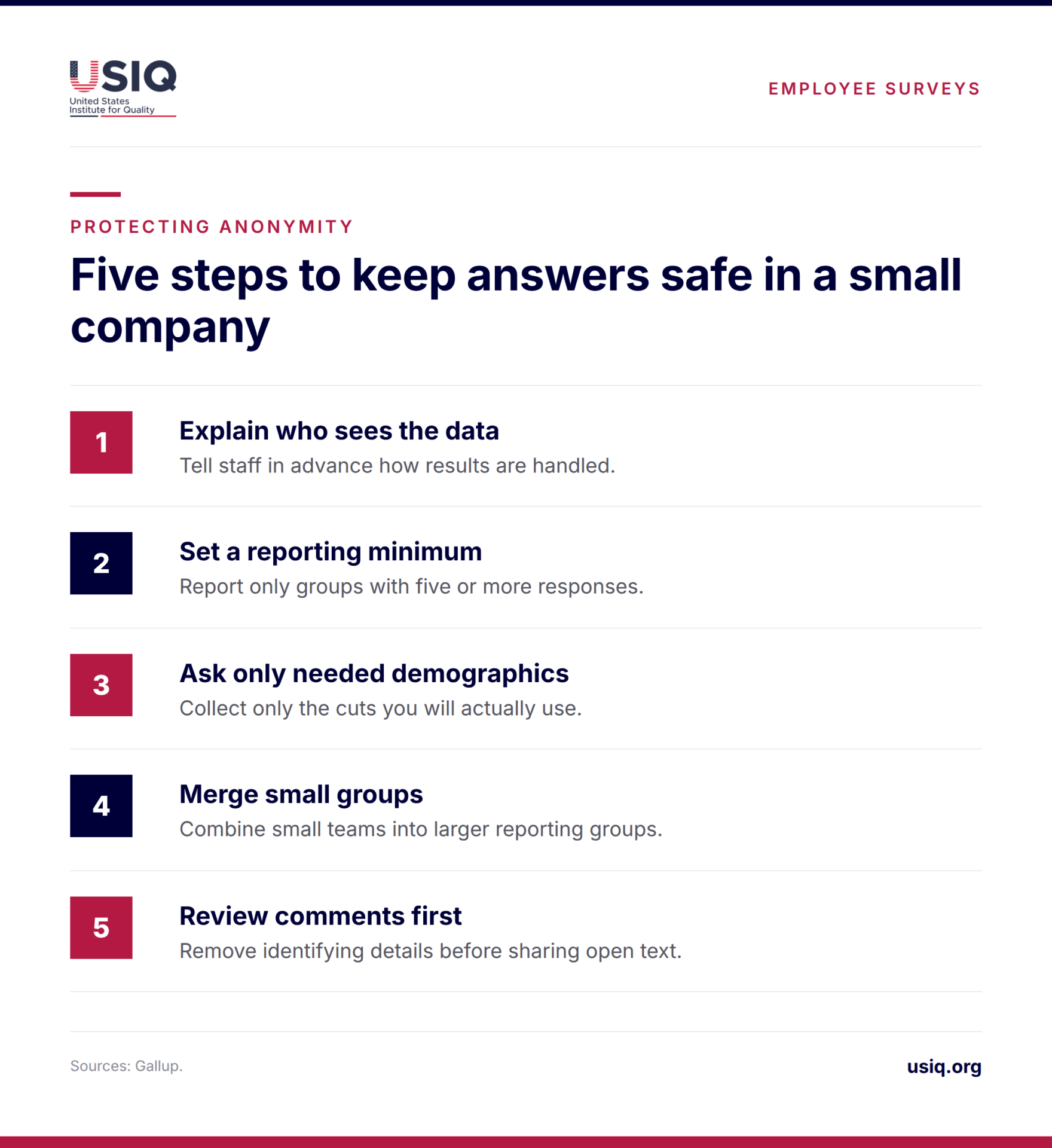
Gallup describes survey results as typically aggregated, with a minimum number of responses, for example five or more, before a group is reported. In a company of 20, that rule means a three-person team gets no separate report. A 12-person office may only be reportable as a whole.
Demographic questions cause the most damage. Asking for department, tenure band, shift and age group together can single out the only night-shift supervisor under 30. Ask only for the cuts you will use, and combine small groups into larger ones.
Free-text comments need the same care. A comment mentioning a specific shift, client or event can reveal its author. Read comments before sharing them and remove identifying details, and ask counsel how to handle comments that report misconduct.
What is a good employee survey response rate?
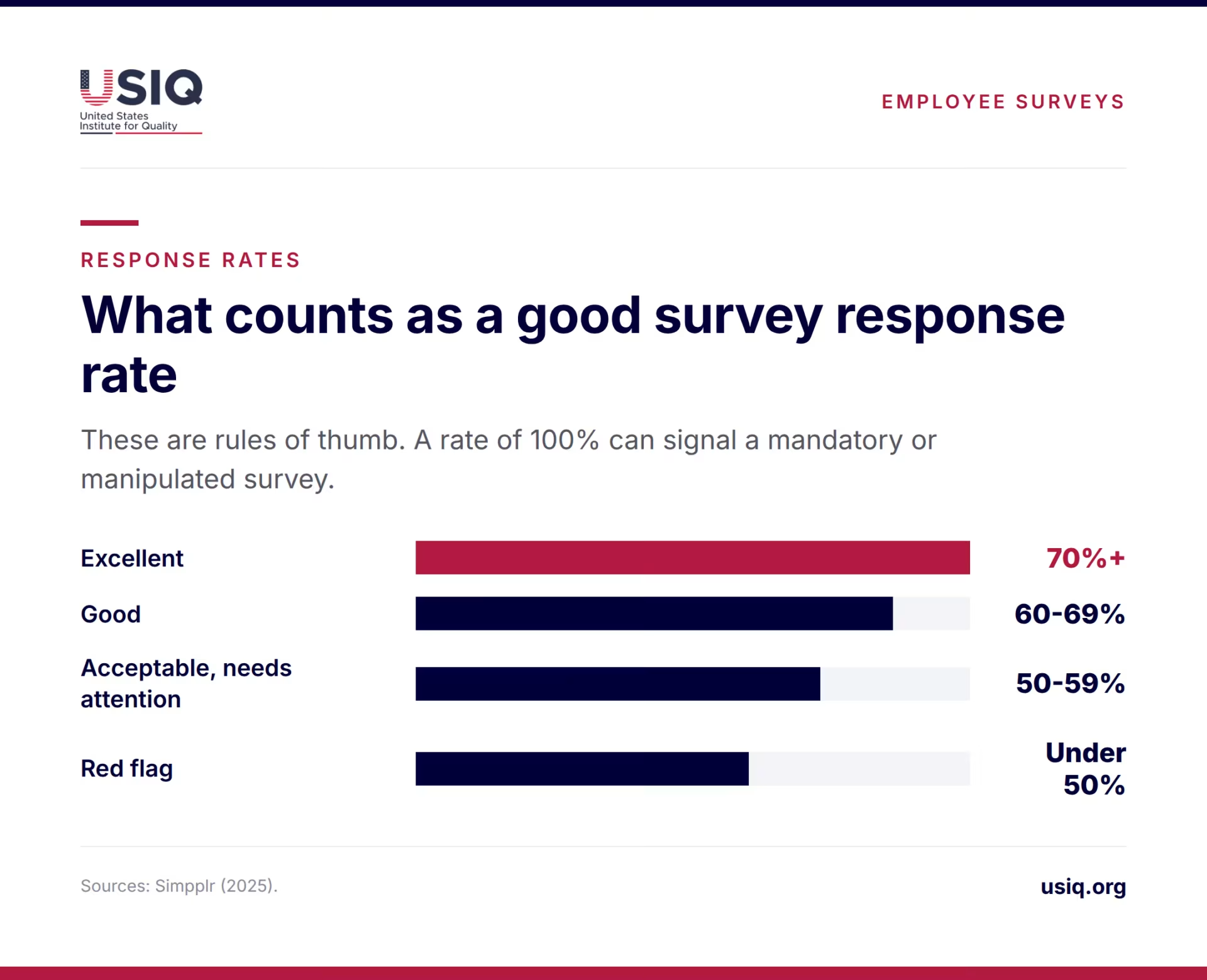
No federal rule or universal standard sets one. Vendor Simpplr offers rules of thumb that many HR teams use as a starting point.
| Response rate | Rule-of-thumb reading (Simpplr) |
|---|---|
| 70% or more | Excellent |
| 60% to 69% | Good |
| 50% to 59% | Acceptable, needs attention |
| Under 50% | Red flag |
The same page adds context: what counts as good depends on company and survey type. A 30% response can be excellent for an annual survey of mostly frontline manufacturing staff, yet a serious problem for a tech pulse survey. A rate of 100% can signal a mandatory or manipulated survey. See Simpplr’s survey benchmark guide.
How can employers raise participation?
- Give paid time to complete the survey, especially to hourly staff.
- Offer phone, tablet or shared kiosk access for people without a company email address or desk.
- Explain the purpose, the time needed, who sees the data and when results will be shared.
- Share results and actions from the last survey before launching the next one.
What makes results representative?
A survey is representative when the people who answered resemble the whole workforce. If responses come mostly from office staff while warehouse and field employees stay silent, the average score describes only one part of the company. Check response by location, shift and role, and use extra channels for groups that lag.
What does the law say about employee surveys?
The most relevant federal rule is Section 7 of the National Labor Relations Act. It protects employees’ right to act together on working conditions, and the National Labor Relations Board states that interfering with, restraining or coercing that right is unlawful. Whether questioning is coercive depends on who asks, where and how, what is sought and the surrounding context. The NLRB explains this on its page about interfering with employee rights.
Questions about union sympathies or union activity can create risk. The NLRB says employers may poll on union support only with safeguards: no unfair labor practices or coercive atmosphere, a stated purpose of gauging majority support, assurances against reprisal and a secret ballot. A general engagement survey should therefore stay away from union-related questions.
One practical rule follows from this and from Gallup’s guidance on trust: if a survey is described as anonymous, the employer should not try to identify respondents. Tools differ in what they store, so verify what the platform can and cannot do before making any promise. State rules, and how to treat comments that report harassment or other misconduct, vary by situation; check them with employment counsel before launch.
How do you turn employee survey results into action?
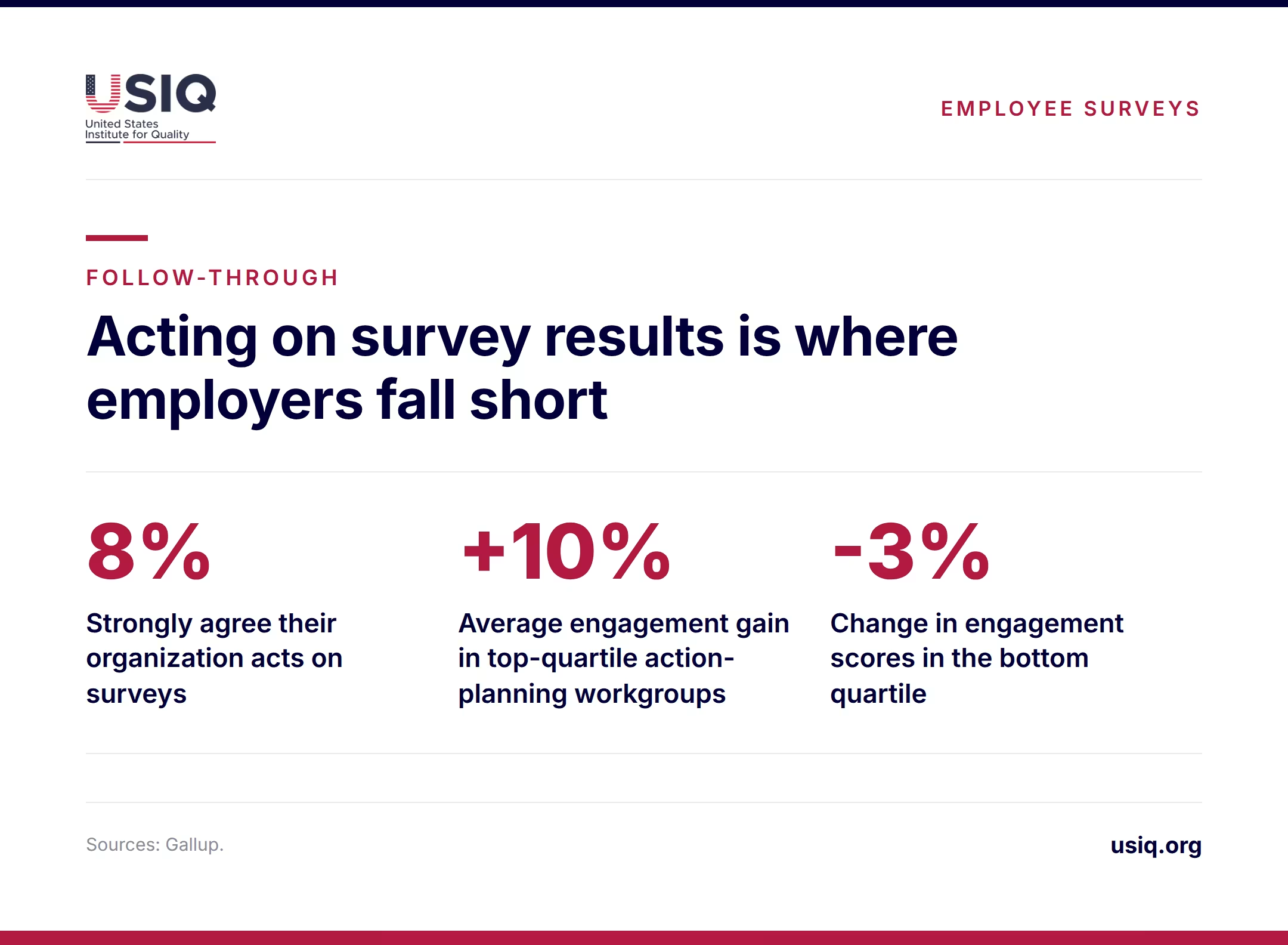
Follow-through is where most surveys fail. Gallup reports that only 8% of employees strongly agree that their organization takes action on surveys. It also states that if an organization surveys and does nothing more, engagement will likely decrease and turnover will increase.
Older Gallup research on what to do with results found that workgroups in the top quartile on the item “action plans from the last survey have had a positive impact” raised engagement scores by an average of 10%. The bottom quartile saw a 3% decrease. Gallup describes these steps in what to do after an engagement survey and what to do with survey results.
What does a workable follow-up look like?
- Share the results. Present the main scores to everyone, including weak ones. Silence after a survey tells staff their answers vanished.
- Pick two or three priorities. Fixing everything at once means fixing nothing.
- Name owners and dates. State what will change, who is responsible and when progress will be reviewed.
- Share accountability. Gallup notes a team’s manager is accountable for up to 70% of its engagement and suggests someone other than the manager also share responsibility for acting on results.
- Report back. On the review date, tell staff what changed, even if the change is small, and then run the next short survey.
USIQ has written more on turning engagement data into change and on the difference between employee experience and employee engagement.
How do you analyze results without overdoing it?
Start with themes. If many employees raise the same issue in comments or low scores, it likely needs attention. Then look for priority gaps: the items that most affect trust, fairness and daily working life, not the ones that are simply easiest to fix.
Compare departments, roles or periods only where group sizes allow it, and never in a way that exposes individual answers. Track the same items across survey rounds so trends are visible. Avoid spending months on perfect reports, because delay tells employees nothing is happening. A one-page summary with three findings and three actions is often enough.
What are the limits of employee surveys, and which misconceptions persist?
Survey fatigue is real. Asking too often, or asking long questionnaires, trains employees to click through or skip. Gallup’s warning against surveying so much that results go unused addresses exactly this.
A survey is not a fix. It measures perceptions, and those can be shaped by one bad week or one strong personality. Treat scores as a prompt for conversation with teams, not a verdict.
Scores can be gamed. Managers who pressure staff to answer positively, or who make the survey mandatory, damage the data. A response rate that looks too perfect should raise questions.
Frontline and desk workers differ. Staff without email, a company laptop or time at a screen need paper, kiosk or phone access, or their view will be missing. That gap is also a sign of weaker response rates in some industries, such as manufacturing.
Anonymous does not mean candid. Trust in the process matters more than the label on the survey. A small team that doubts anonymity will answer cautiously regardless.
What are the practical steps for a first survey?
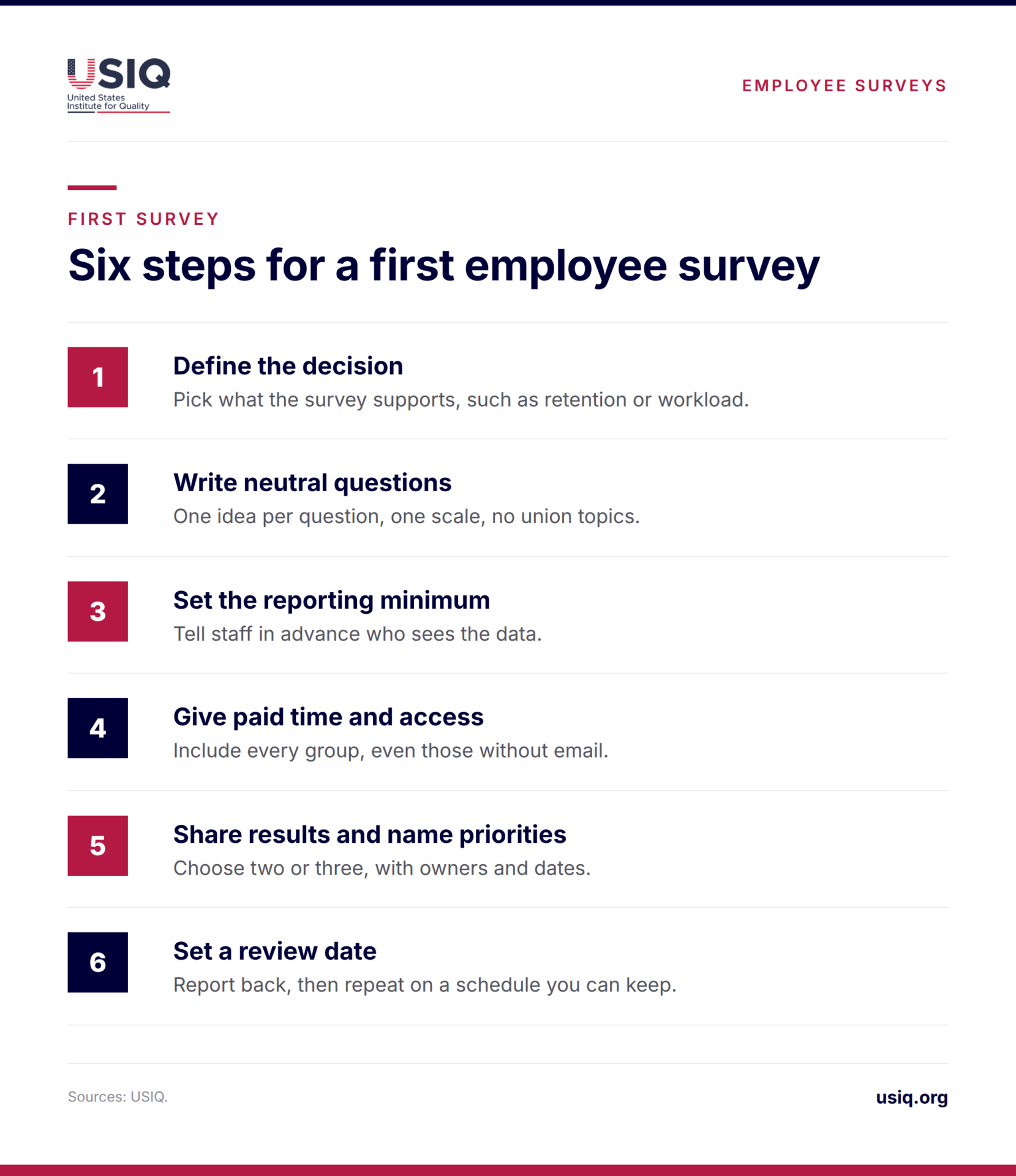
- Decide what decision the survey should support, such as retention, workload or manager support.
- Write neutral, single-idea questions on one scale, add a few open-text items, and leave out union-related topics.
- Set the minimum reporting group and tell staff in advance who sees the data.
- Provide paid time and access for every employee group, including those without email.
- Share results promptly, name two or three priorities with owners and dates, and set a date to review progress.
- Repeat on a schedule you can keep, then add short pulses only once the first round produced visible change.
What is the outlook for employee surveys?
With engagement at 29% in August 2026 and quits steady at 2.0% in June, employers have reason to keep listening. The direction of travel is toward shorter, more frequent check-ins and event-based surveys, which only work when results lead to visible decisions. Small employers have an advantage here: a short feedback loop between survey and change is easier to build in a 50-person company than in a 5,000-person one. USIQ’s overview of what high-performing employers do differently on engagement covers the wider picture.
Conclusion
Ask fewer, fairer questions, protect anonymity honestly, report only groups large enough to be safe, and commit to two or three visible changes that staff can see.
FAQ
What is the difference between an employee survey and a poll?
A poll asks one or two informal questions and rarely repeats them. An employee survey is planned, uses the same wording for everyone and is repeated on a schedule. That structure lets employers compare teams and track trends over time, which a one-off poll cannot do.
How often should a small company survey its employees?
Gallup describes semiannual engagement surveys plus quarterly or monthly pulses and event-based surveys as best-practice timing. A small company can begin with one or two short surveys a year. The deciding factor is whether leaders can act on each round before the next begins.
Is an anonymous survey the same as a confidential one?
No. In an anonymous survey, no personal data is stored. In a confidential survey, managers cannot see individual answers, but the system may still link responses to people. Employers should describe their survey accurately and not promise anonymity the tool cannot deliver.
How can a 15-person company keep surveys anonymous?
Report only company-wide results, since Gallup cites a minimum of about five responses per reported group and a team of three would fall below it. Skip demographic questions you will not use, and read open-text comments before sharing them so details do not reveal who wrote them.
What is a good response rate for an employee survey?
There is no official standard. Vendor Simpplr treats 60% to 69% as good and 70% or more as excellent, with under 50% a red flag. It also notes that 30% can be excellent for a frontline manufacturing survey, and that 100% may signal a mandatory or manipulated survey.
Can an employer ask about unions in an employee survey?
A general survey should avoid it. The National Labor Relations Board says questioning about union sympathies or activity can interfere with employees’ Section 7 rights, depending on context. Union-support polling is allowed only with specific safeguards, so employers should consult counsel before asking.
What happens if employers run a survey and do nothing?
Gallup states that if an organization surveys and does nothing more, engagement will likely decrease and turnover will increase. Gallup also reports that only 8% of employees strongly agree their organization acts on surveys, so silence after a survey is the common experience.
Who should own the action plan after a survey?
Managers carry much of the weight, since Gallup says a team’s manager is accountable for up to 70% of its engagement. Gallup also suggests that someone other than the manager share accountability for acting on results, which adds a check and spreads the workload.
Sources
- Gallup, “U.S. Employee Engagement Declines From 2020 Peak,” January 27, 2026: https://www.gallup.com/workplace/701486/employee-engagement-declines-2020-peak.aspx
- Gallup, “Global Indicator: Employee Engagement”: https://www.gallup.com/394373/indicator-employee-engagement.aspx
- Gallup, “Employee Surveys: Types, Tools and Best Practices”: https://www.gallup.com/workplace/692474/workplace-employee-surveys.aspx
- Gallup, “So You Administered an Employee Engagement Survey. Now What?”, January 4, 2023: https://www.gallup.com/workplace/467504/administered-employee-engagement-survey.aspx
- Gallup, “What to Do With Employee Survey Results”: https://www.gallup.com/workplace/238001/employee-survey-results.aspx
- Simpplr, “Employee Survey Benchmarks: What’s a Good Response Rate?”, September 2, 2025: https://www.simpplr.com/blog/survey-benchmarks-response-rates/
- U.S. Bureau of Labor Statistics, “Job Openings and Labor Turnover Survey News Release (June 2026),” August 4, 2026: https://www.bls.gov/news.release/archives/jolts_08042026.htm
- National Labor Relations Board, “Interfering with Employee Rights (Section 7 and 8(a)(1))”: https://www.nlrb.gov/about-nlrb/rights-we-protect/the-law/interfering-with-employee-rights-section-7-8a1

Related Articles

What research says about the effects of employer seals on current employees, potential applicants and employer image, from independent experiments and field data to the limits of the evidence.
Employee experience and customer experience are linked, but the link is weaker and more conditional than popular slogans suggest. This article reviews the evidence on staffing, training and workplace conditions and shows how employers can test the connection in their own business.
Most HR dashboards show too many metrics and trigger too few decisions. This guide defines ten employee experience metrics, shows a one-page layout and explains how to read your numbers against U.S. data.
A practical guide to calculating marketing ROI for small and mid-sized U.S. companies, including long B2B sales cycles, offline leads, a spreadsheet walkthrough and common errors.


