

Employee Experience and Employee Engagement, HR Often Confuses These Critical Terms. Many HR professionals treat “employee experience” and “employee engagement” as interchangeable terms. Although the two concepts connect closely, they represent distinctly different aspects of workplace dynamics. This common misunderstanding leads HR teams astray, causing them to target the wrong problems and deploy solutions that fail to deliver meaningful results.
Understanding their difference is important as each concept impacts employees in a different manner.
Two Ideas That Are Often Confused
Understand Employee experience as the entire journey that an employee has with an organization – from their hiring and onboarding through to day-to-day work life, growth, and even exit. Engagement, on the other hand, describes how the employees feel about that experience. It explains their degree of motivation, commitment, and willingness to put in extra effort. When HR teams combine these ideas, they may be able to improve one of these areas to the exclusion of the other.
Knowing the difference creates better retention, performance, and overall employee experience for organizations. The good news is that employee experience and engagement can both be measured and improved. Structured surveys transform opinions and feelings into data. When organizations take action based on this data, they can build better workplaces and better cultures.
Over the long term, these insights are also beneficial for employer branding. Certifications and quality seals, like USIQ – use engagement and experience data to demonstrate a company is actually walking the talk about valuing their people – not just in words, but with proof.

What is Employee Experience?
Employee experience is the end-to-end journey an employee experiences with an organisation. It encompasses all the interactions, feelings, and impressions an employee makes from the time they apply for a job until the day they leave. Put simply, employee experience is how work actually feels over time.
This journey begins with the hiring and onboarding process. Clear job roles, fair interviews, and helpful onboarding are the kinds of things that set the tone for everything that comes after. Next comes the day-to-day working environment: tools, workload, teamwork, and flexibility. These daily moments either support employees or increase their stress.
Employee experience involves growth and development, too. Companies demonstrate investment in employees’ futures through learning opportunities, career paths, and skill-building programs. Leadership and culture also play a huge role. Fair treatment, trust, and open communication have a significant impact on how employees feel at work. Lastly, the exit experience is important, too. Respectful offboarding impacts how employees talk about the company afterwards.
Employee experience is long-term and structural. It isn’t quick fixes, but built-in systems, policies, and leadership behaviors. Poor experience has real consequences. According to Gallup, employees who have a poor experience during their onboarding period are about twice as likely to seek out another job. This demonstrates why a better employee experience is so crucial to retention and future success.
What is Employee Engagement?
Employee engagement is the emotional and mental connection an employee has to their work. It shows whether people feel motivated, committed, and willing to do more than do the minimum. In common language, engagement refers to the degree to which employees decide to invest their effort into their work, how much they care about performing a good job, and whether employees identify with their team and organization.
Unlike employee experience, which is a build-up of experiences that occur over months and years, engagement reflects how employees feel and act today. Managers and HR teams often use employee engagement surveys to measure this. These surveys consist of simple questions regarding satisfaction, motivation, feedback, and work climate. The answers are converted into data points that indicate where engagement is high and low.
Engaged employees are relevant as they have a direct influence on performance. Research has shown that teams with high engagement have 41% less absenteeism; in other words, they are more present and ready to work when they are present. Engaged business units report 8% less absenteeism and 14% higher productivity as compared to disengaged ones. Engaged workers are also responsible for improved customer service and positive business outcomes.
Using employee engagement surveys on a regular basis allows organizations to understand how everyone feels at the current time and make sure that they take action to improve that motivation and result.
Employee Experience vs Employee Engagement: Key Differences
Employee experience and employee engagement are closely related, but they are not the same. Understanding how they are different is helpful for HR teams in designing better strategies and not solving the wrong problem.
The environment and systems that employees work in are the focus of employee experience. It incorporates policies, tools, processes, leadership style, and workplace culture.
Employee experience reveals what it’s truly like to work at your company over time. Onboarding, performance management, and learning programs actively build this experience as employees progress through their journey with the organization. Changes to experience usually take time, but have long-lasting effects.
Employee engagement, on the other hand, is about employee response and behavior. It reflects the way employees feel about their work at that moment and the willingness of employees to put extra effort into their work. Engagement answers the question: How are employees feeling and acting today? Engagement can shift rapidly depending on leadership actions, feedback, workload, or recognition.
Ownership also differs. HR and senior leadership predominantly dictate employee experience by defining systems, policies, and culture. Engagement has a strong influence from managers, as it is the daily interactions, support, and communication that will have the greatest impact on motivation and commitment.
Both concepts matter. A great employee experience is what creates the conditions for engagement, while engagement signals whether those conditions are working or not.
| Area | Employee Experience | Employee Engagement |
| Focus | Environment and systems | Feelings and behaviors |
| Time frame | Long-term | Short-term, changeable |
| Main owners | HR and leadership | Managers |
| What it shows | What employees go through | How employees respond |
| Measurement | Experience surveys | Employee engagement surveys |
Understanding these differences helps organizations improve both areas in a more focused and effective way.
Where Employee Experience and Engagement Overlap
Employee experience and employee engagement are not the same, and yet, there is a strong influence between the two. A positive employee experience establishes the basis for engagement. When the systems, policies, and leadership practices are working well, employees will have better chances of feeling motivated and committed.
For example, clear career paths help employees understand their future in the organization. People invest more and willingly exert extra effort when companies offer growth opportunities. Fair and consistent policies are also important. When employees feel that decisions are fair, trust will grow, and so will commitment. This trust significantly determines how strongly employees connect to their work.
A good workplace culture brings these things together. Open communication, respect, and support help to make employees feel valued and included. This emotional connection goes hand in hand with engagement.
Employees respond to their working environment through engagement, making improved employee experience one of the surest ways to boost engagement. Strong experience provides the conditions, and engagement demonstrates if those conditions are working in practice.
Initiatives that Improve each Area
Organizations often improve employee experience and employee engagement at the same time, but their purpose for each initiative is different. Some of the actions change systems and structures, and others influence day-to-day feelings and behavior.
Improving Your Employee Experience
Employee experience improves with a well-designed and consistent workplace. Better onboarding programs ensure new employees feel prepared and supported in their roles from the very start. Clear role design helps to reduce confusion by defining responsibilities and expectations. Fair performance systems are systems that ensure that employees are evaluated and rewarded in a transparent manner.
Learning and development programs demonstrate to employees that their future is important to the organization. As time passes, the skills and confidence improve through these programs. Manager capability building is also critical. As managers are trained to guide justly and communicate clearly, the overall experience of employees improves on a team-to-team basis.
Ways to Boost Employee Engagement
Employee engagement improves through interactions that happen on a day-to-day basis. Regular feedback and recognition make employees feel valued and motivated. Manager check-ins enable problems to be efficiently addressed and build relationships. Pulse surveys capture what employees are feeling now and enable leaders to respond with greater speed. Clear goals and communication help employees understand what is important and where their effort should be directed.
Many initiatives take place in support of both areas, but in different ways. Good systems enhance the experience the longer we engage with them, while regular feedback and communication create engagement in the moment.
Measuring Both with Surveys and Data
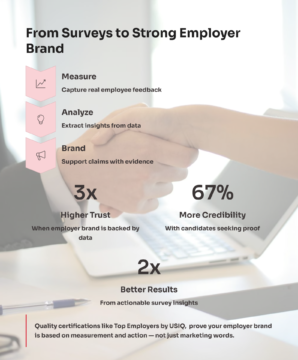
Organizations need to have structured surveys to clearly have a picture of both the employee experience and employee engagement. Without surveys, leaders are operating on assumptions rather than facts. Experience surveys are for systems, policies, and processes such as the onboarding process, tools, and career development. Engagement surveys are based on feelings, motivation, and intent, such as feeling committed, effort, and willingness to stay.
When used in combination, these surveys are a complete picture. Experience data is part of how employees feel, while engagement data is part of how they respond. Tools such as USIQ surveys capture both dimensions, helping organizations translate insights into tangible actions and credible employer branding results.
From Insight to Employer Branding
Survey results are directly involved in creating a strong and credible employer brand. When organizations measure employee experience and engagement, they extract real proof about how employees feel and what they go through at work. This data helps to support employer branding claims by moving away from the vague and more towards the clear evidence.
Strong survey results also create trust with candidates. Job seekers are more likely to accept messages sent by employers when these messages are supported by employee feedback and third-party assessments. Internally, data from the survey creates credibility with employees. When people see that feedback is measured, shared, and acted on, there is an increase in trust in leadership.
Quality seals and certifications such as USIQ, Best Workplace, and Top Employers are also based on experience and engagement data. These certifications demonstrate that a company’s employer brand is based on measurement and action – it’s more than just words in a marketing campaign.
Conclusion: Designing Work that Works
Employee experience and employee engagement have different purposes, but are linked. Experience involves what employees live through on a day-by-day basis – systems, policy, and culture. Engagement is how the employees respond and is displayed through motivation, commitment, and effort. Strong employers have both in balance. By quantifying experience and engagement using structured surveys, organizations have clear insights into what works and what needs to be improved. The next step is action. Use the data and focus on the things that matter the most, and keep improving. When the management of experience and engagement is combined, organizations create workplaces that truly work for people and for business.
Ready to boost your employer brand? Contact USIQ for HR quality seals.

Related Articles
What research says about the effects of employer seals on current employees, potential applicants and employer image, from independent experiments and field data to the limits of the evidence.
Employee experience and customer experience are linked, but the link is weaker and more conditional than popular slogans suggest. This article reviews the evidence on staffing, training and workplace conditions and shows how employers can test the connection in their own business.
Most HR dashboards show too many metrics and trigger too few decisions. This guide defines ten employee experience metrics, shows a one-page layout and explains how to read your numbers against U.S. data.
A practical guide to calculating marketing ROI for small and mid-sized U.S. companies, including long B2B sales cycles, offline leads, a spreadsheet walkthrough and common errors.