

- What Is Employee Engagement?
- Engagement Metrics That Matter in the USA
- Role of Employee Surveys in Engagement
- Engagement vs Retention & Performance
- How Certifications Validate Employee Engagement
- Who Benefits Most from Employee Engagement Programs
- Growing and Scaling Companies
- Large Enterprises
- Remote and Hybrid Workplaces
- Regulated and Client-Facing Industries
- How U.S. Employers Can Improve Employee Engagement
- Focus on Strong Managers
- Act on Employee Feedback
- Promote Growth and Development
- Create Clear and Fair Work Practices
- Build Consistency Over Time
- Conclusion: Engagement as a Performance System, Not a Feel-Good Effort
Employee engagement in the workplace describes how committed, involved and motivated people are in their jobs. Engaged employees care about the result, look for ways to improve it and are more likely to stay. Disengaged employees do what is required and little more.
Many employers still treat engagement as a mood to be lifted with snacks, events or a game table. Those things are pleasant, but they rarely change how people work. A smaller set of habits does: capable managers, clear goals, honest feedback and visible follow-through on what employees say.
This guide is written for owners, HR leaders and managers of companies with roughly 10 to 250 employees. It covers what engagement is and is not, how to measure it, what drives it, how it differs by company type and where the practice reaches its limits.
Quick answer: Employee engagement in the workplace is the commitment, effort and involvement people bring to their jobs. It differs from satisfaction or perks. Employers build it through capable managers, clear goals, fair workloads, growth opportunities, regular listening and visible follow-through on the feedback they receive.
Key takeaways
- Engagement means commitment and involvement, not happiness or free perks.
- Managers shape the daily experience more than any program, so manager quality is the first lever.
- Surveys only help if employees see changes afterward. Asking without acting damages trust.
- Combine survey scores with behavior data such as turnover, absence and participation.
- Small employers can start with a short annual survey, quarterly check-ins and stay interviews.
- An independent review can make engagement practices visible to candidates, but it does not replace the work itself.
What is employee engagement in the workplace?
Engagement is the degree to which employees are involved in, and enthusiastic about, their work and their workplace. It shows up in behavior. Engaged people take ownership, help colleagues, raise problems early and care how customers are treated.
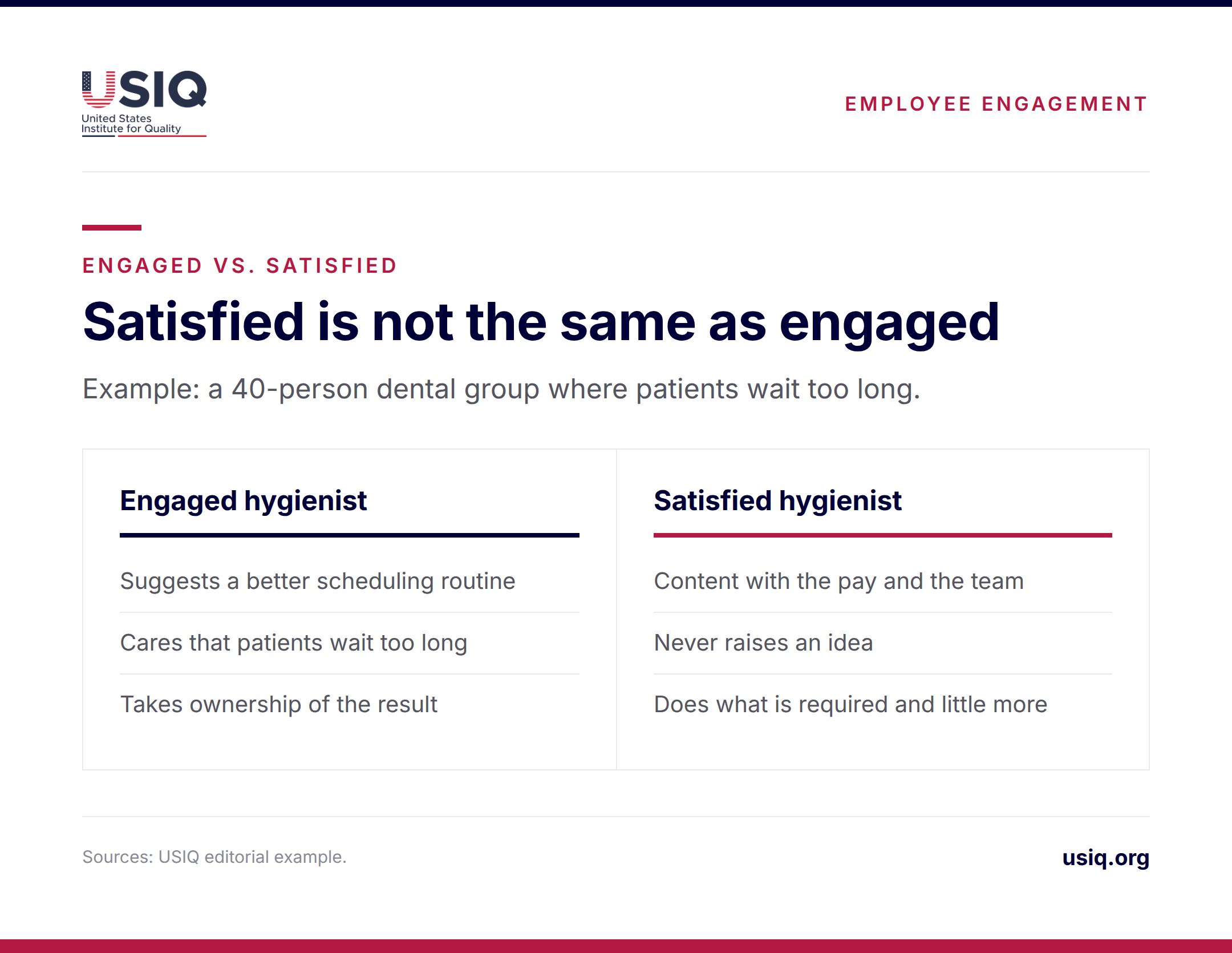
Take a 40-person dental group. A hygienist who suggests a better scheduling routine because patients wait too long is engaged. A hygienist who is content with the pay and the team but never raises an idea may be satisfied without being engaged.
How is engagement different from satisfaction and happiness?
Satisfaction describes how people feel about conditions such as pay, hours and benefits. Engagement describes how much effort and commitment they bring. The two often move together, but they can separate. The article on employee experience versus employee engagement looks at the distinction in more detail.
| Concept | What it describes | Typical signal |
|---|---|---|
| Satisfaction | Contentment with pay, hours, benefits and conditions | “I am fine with my job.” |
| Happiness | Short-term mood | Enjoying the event or the office |
| Engagement | Commitment, effort and involvement | Initiative, ownership, intent to stay |
What does engagement not mean?
It does not mean constant positivity. Telling people to think positively does not solve unclear goals, weak leadership or unmanageable workloads. It also does not mean working more hours: an engaged employee in an overloaded team burns out like anyone else.
Why does employee engagement matter for U.S. employers?
Engagement affects results that owners already track: turnover, absence, service quality, safety and productivity. When people are committed, customers usually notice. When they are not, the costs show up as vacancies, rework, complaints and the time managers spend replacing people.
The national baseline is weak. Gallup found that 31% of U.S. employees were engaged in 2025, the same share as in 2024 and well below the 2020 peak of 36%, while 17% were actively disengaged. The sharpest declines since 2020 were in clarity of expectations, down 9 points, and in feeling that someone at work cares, down 8 points (Gallup, January 2026). Both depend on daily management more than on budget.
Disengaged employees also have options. In September 2026 the Bureau of Labor Statistics counted 3.4 million quits, a quits rate of 2.1%, against 7.5 million job openings (BLS JOLTS).
For smaller employers the effect is amplified. In a company of 30 people, one disengaged team lead or two unexpected resignations can change how the whole business runs. There is no large HR department to absorb the shock.
Engagement also interacts with the labor market. Employers that listen and respond tend to keep people longer and find it easier to explain to candidates what working there is like. The quiet quitting trend shows what happens when employees withdraw effort without leaving.
What drives employee engagement?
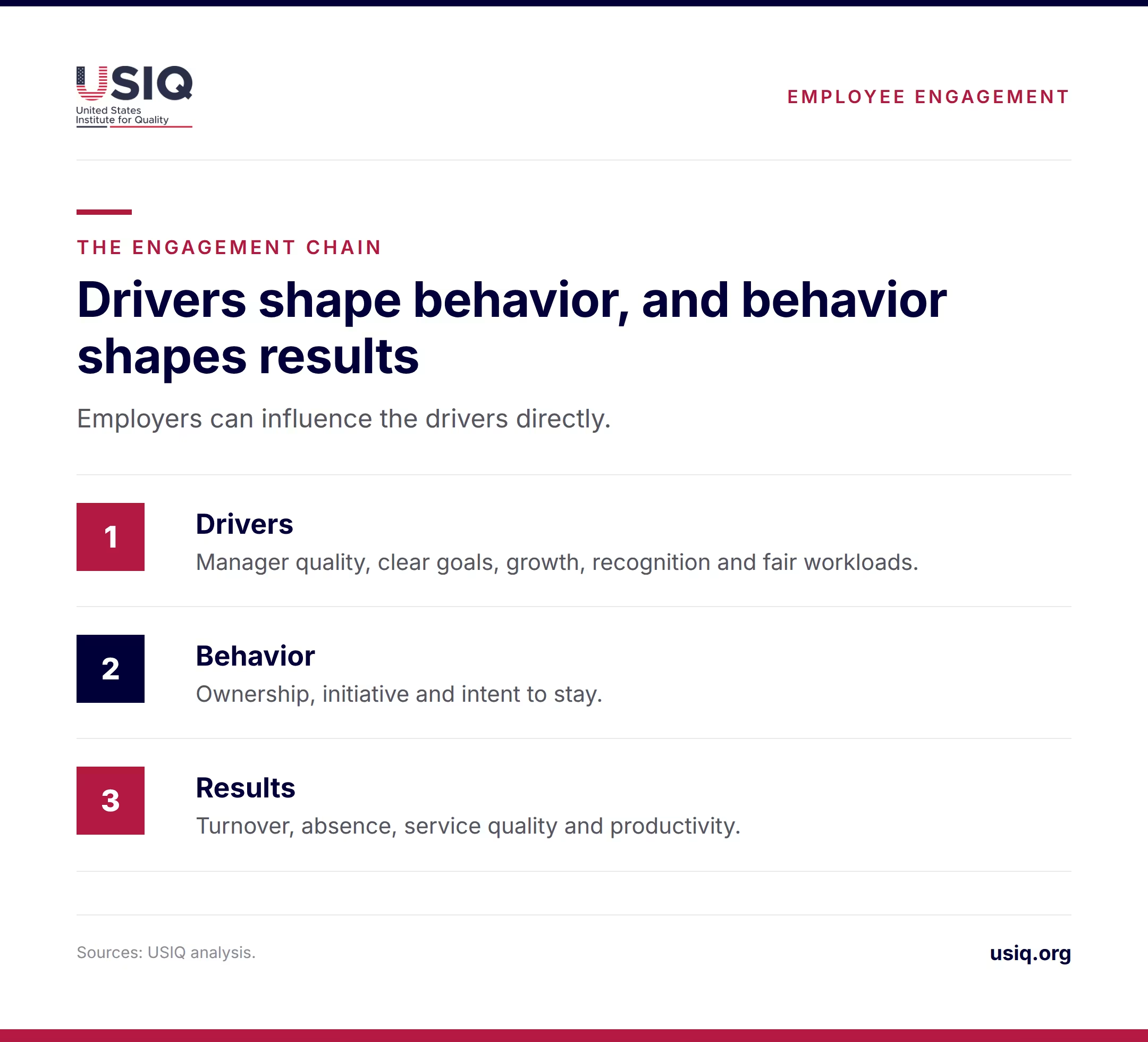
Engagement does not appear by accident. Think of it as a chain: drivers shape how employees feel and behave, and behavior produces business results. Employers can influence the drivers directly.
Manager quality
Employees have more daily contact with their manager than with anyone else in the company. Clear expectations, regular conversations and fair treatment come from that relationship. Gallup estimates that managers account for at least 70% of the variance in team engagement (Gallup, Employee Engagement indicator). Promoting the best technician or salesperson into management without training is a common cause of weak engagement in small companies.
Clarity of role and goals
People engage more readily when they know what is expected and how their work connects to the company’s goals. A one-page description of priorities for each role, reviewed twice a year, often does more than a large program.
Growth and development
Growth does not have to mean promotion. Training, mentoring, rotation across tasks and new responsibilities all signal that the employee has a future in the company. Employees who feel stuck tend to disengage first and leave later.
Recognition and feedback
Specific, timely recognition tells people their work matters. “Thanks for staying late” is fine, but “your note to the client prevented a missed deadline” is better because it shows what was noticed.
Fair workloads and flexibility
Chronic overload erodes engagement however good the culture is. Realistic staffing, predictable schedules where the work allows, and flexibility on how and when tasks get done reduce stress and protect commitment.
How do you measure engagement?
Without measurement, leaders rely on impressions, and impressions are often wrong. Measurement turns feelings into data that can be compared across teams and over time. The strongest approach combines what employees say with what they do.
Which survey types work for smaller employers?
| Method | Purpose | Typical rhythm | Best used for |
|---|---|---|---|
| Annual engagement survey | Full picture and year-over-year trend | Once a year | Setting priorities |
| Pulse survey | Quick read on mood, workload and trust | Quarterly or more often, a few questions | Checking whether actions work |
| Stay interview | Why people remain and what could make them leave | One-on-one, once or twice a year | Retention of key people |
| Exit interview | Why people left | At departure | Spotting patterns in turnover |
For a company of 20 to 50 people, a 15-question annual survey plus a three-question quarterly pulse is usually enough. Questions should be neutral and plain, and should cover leadership trust, growth, workload, support and intent to stay. The guide to employee surveys goes deeper.
Which metrics should you track?
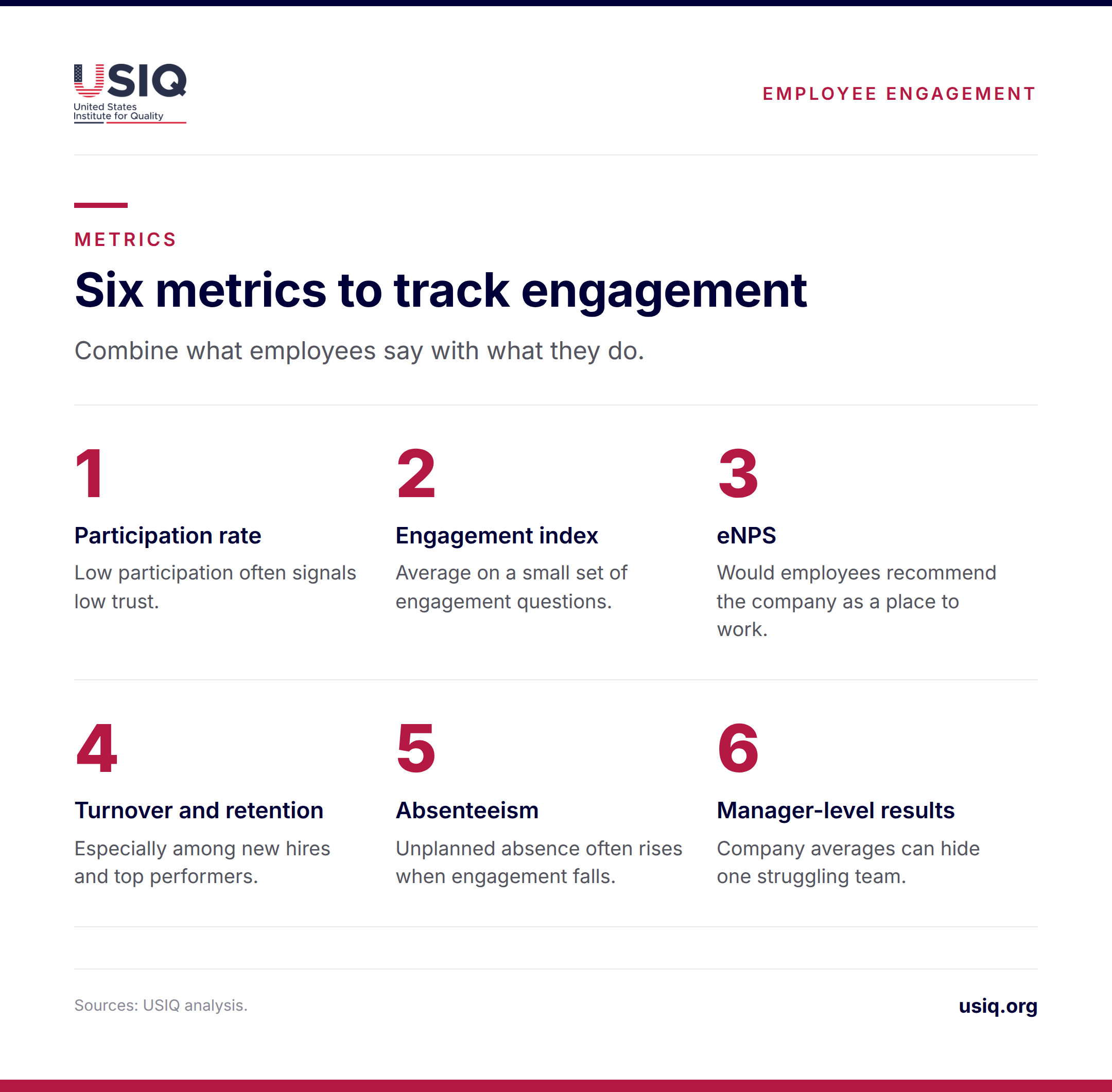
- Survey participation rate: low participation often signals low trust.
- Engagement score or index: the average on a small set of engagement questions.
- Employee Net Promoter Score (eNPS): whether employees would recommend the company as a place to work.
- Turnover and retention: especially among new hires and top performers.
- Absenteeism: unplanned absence often rises when engagement falls.
- Manager-level results: company averages can hide a single struggling team.
Teams that already collect HR data can combine these in a simple dashboard; the article on HR dashboard examples shows layouts. With fewer than about ten respondents per team, protect anonymity by reporting only at department level.
How do you turn survey results into action?
Collecting data is the easy part. Employees judge a survey by what happens next, and when nothing changes, the next survey gets fewer and less honest answers. Two habits separate employers who improve from those who do not: they share results quickly, and they commit to a few visible changes.
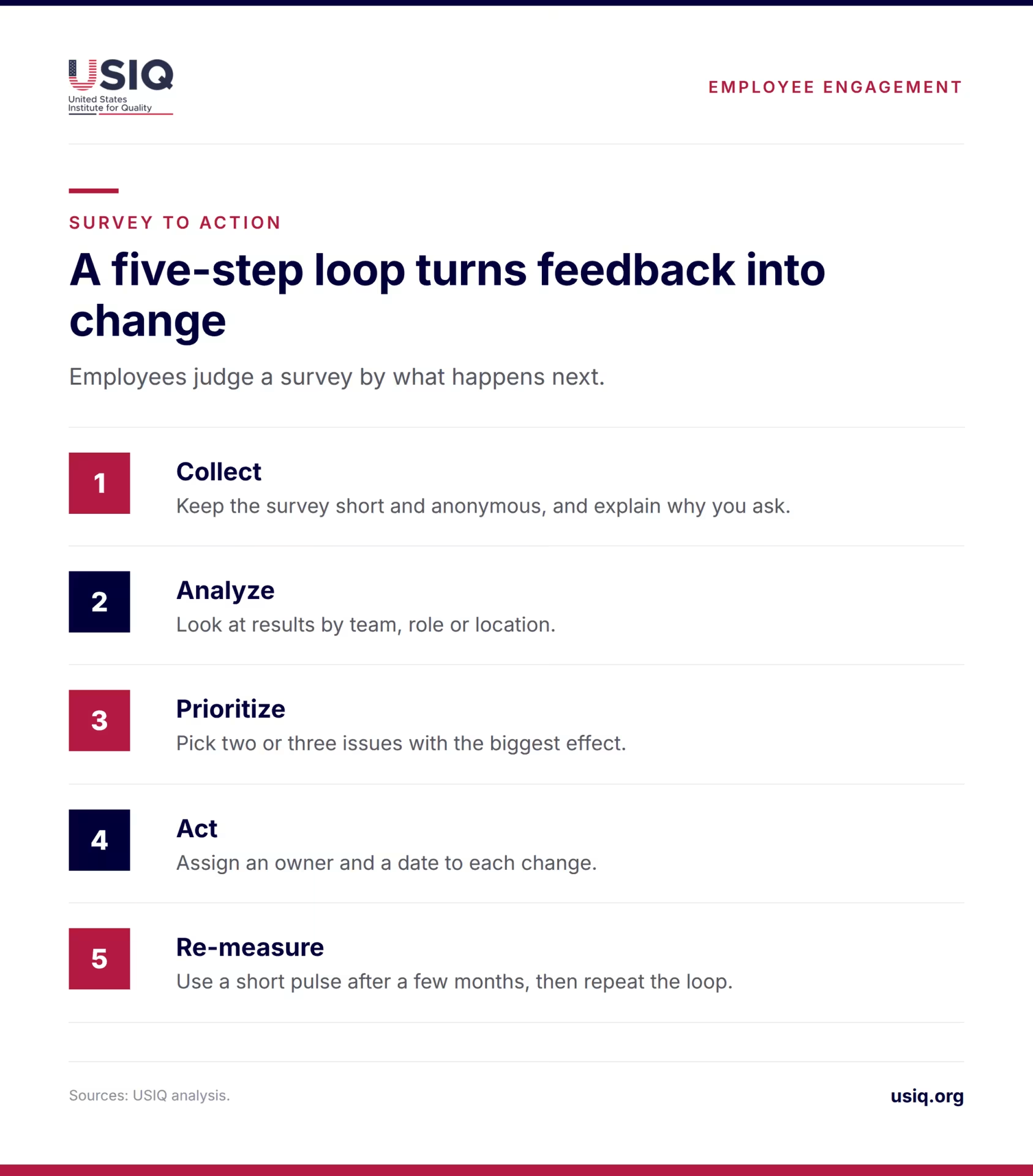
A five-step loop
- Collect: run the survey, keep it short and anonymous, and explain why you are asking.
- Analyze: look at results by team, role or location, not only the company average.
- Prioritize: pick two or three issues with the biggest effect, such as manager communication, growth paths or workload.
- Act: assign an owner and a date to each change, and say openly what you will not change and why.
- Re-measure: use a short pulse after a few months to see whether the changes registered.
Honesty about limits builds more trust than promises. If the company cannot raise pay this year, saying so while fixing scheduling or training is better than silence. Small, finished improvements convince employees more than large plans that stall.
Common mistakes include surveying too often without acting, collecting feedback and never reporting back, treating low scores as a problem with the employees rather than the conditions, and holding managers accountable for scores without giving them training or authority.
How does engagement work differ by company type?
The principles are the same everywhere, but the practical emphasis changes with size, work model and industry.
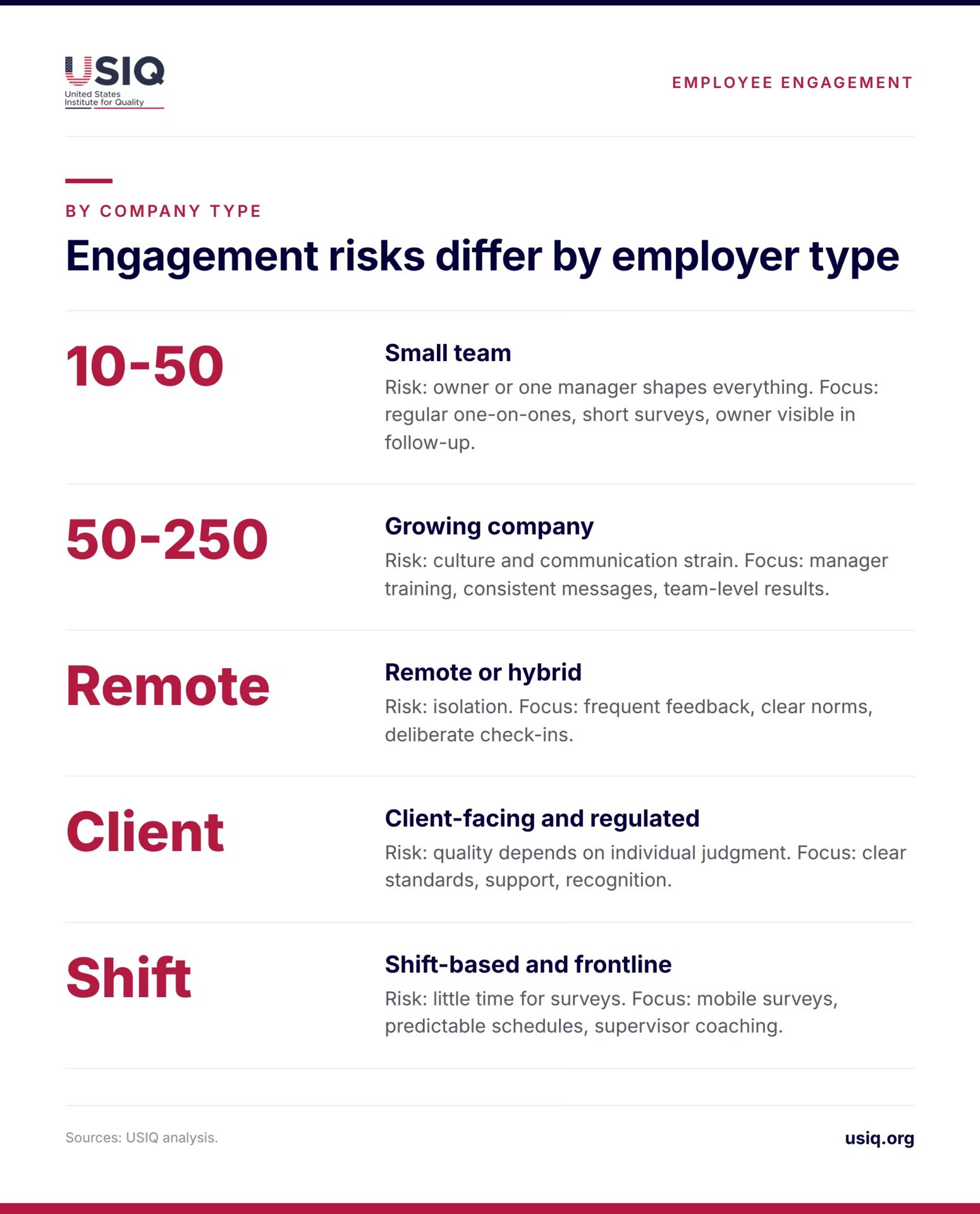
| Employer type | Main engagement risk | Practical focus |
|---|---|---|
| Small team (10 to 50) | Owner or one manager shapes everything; little formal structure | Regular one-on-ones, short surveys, owner visible in follow-up |
| Growing company (50 to 250) | Culture and communication strain as teams multiply | Manager training, consistent messages, team-level results |
| Remote or hybrid teams | Isolation and weaker connection to leaders | Frequent feedback, clear norms, deliberate check-ins |
| Client-facing and regulated industries | Service quality and compliance depend on individual judgment | Clear standards, support, recognition of careful work |
| Shift-based and frontline work | Limited time for surveys and meetings; unpredictable schedules | Mobile or on-shift surveys, predictable schedules, supervisor coaching |
Surveys sent only by email often miss frontline employees. Giving them paid time to respond, or a short paper or mobile option, matters for both participation and honesty.
Can an independent review show that engagement practices are real?
Claims of caring about people are cheap, so some employers choose an independent review of their practices. Credible employer certifications typically look at what employees report in a survey and at the employer’s HR practices, such as feedback handling, development and fairness. The value is an outside check rather than an internal claim.
Visibility matters to applicants, who often have little else to go on when judging how an employer treats its people. A seal still does not substitute for real engagement work. USIQ, the publisher of this article, runs certification programs of this kind, such as Top Employer; the article employer certification explained describes the general process and costs.
What are the limits and common misconceptions?
- “Perks create engagement.” Snacks, events and gadgets can improve mood, but they do not fix unclear goals or poor management.
- “Engagement is HR’s job.” HR designs the process, but line managers create the daily experience.
- “A high score means success.” Scores are signals. Behavior, retention and results confirm whether they are real.
- “More surveys mean more insight.” Over-surveying causes fatigue and lower response without better decisions.
- “Everyone should be fully engaged.” People differ in what they want from work. The goal is a workplace where committed people can do good work, not uniform enthusiasm.
Engagement also has a downside when it is pushed without attention to workload. Asking highly committed employees to give more without adding capacity leads to burnout. The article on burnout and wellbeing covers the warning signs.
What should employers do first?
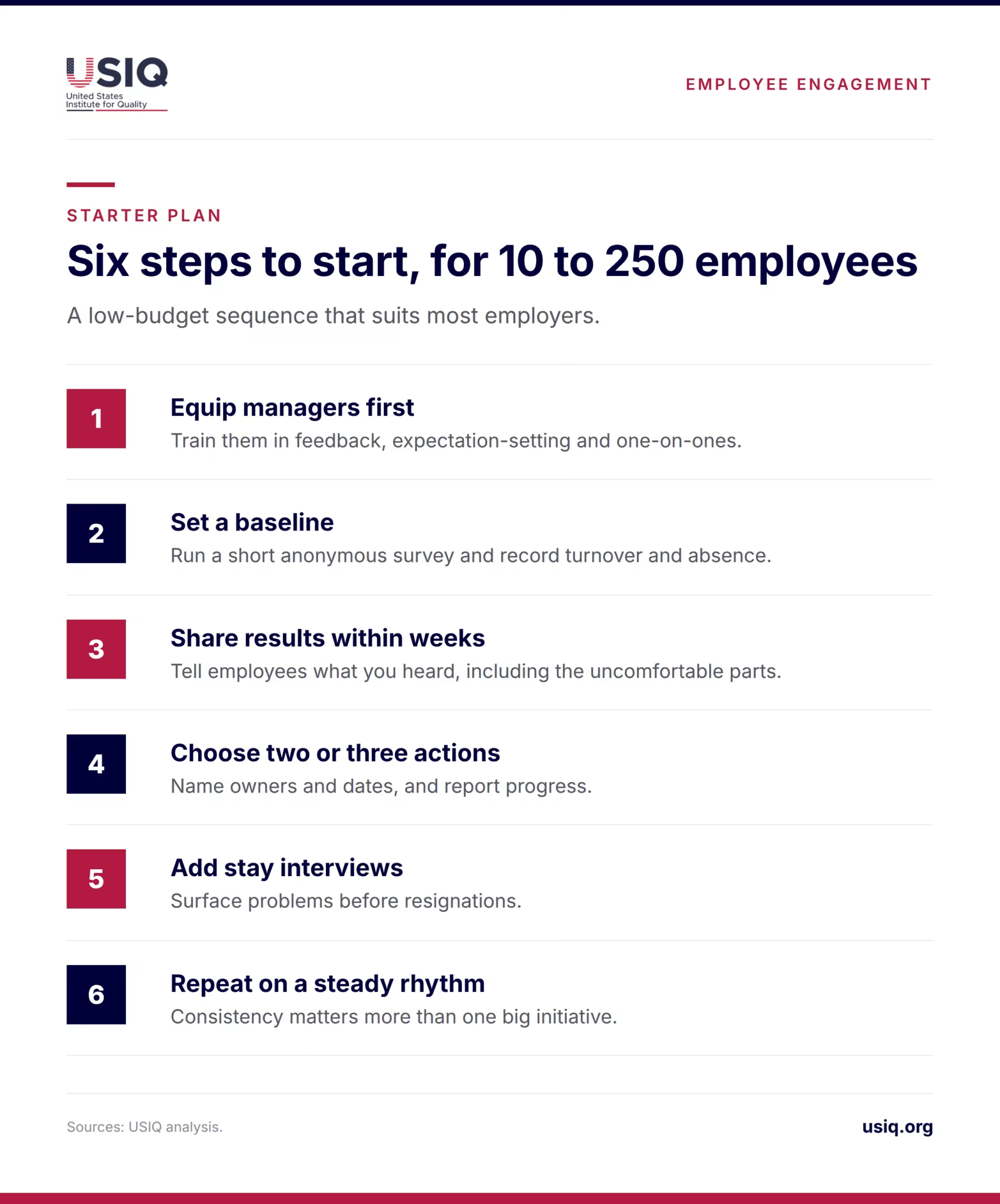
The sequence below suits most employers with 10 to 250 employees and needs little budget.
- Equip managers first. Train them in feedback, expectation-setting and one-on-one conversations before launching anything else.
- Set a baseline. Run a short anonymous survey and record turnover and absence for the same period.
- Share results within weeks. Tell employees what you heard, including the uncomfortable parts.
- Choose two or three actions. Name owners and dates, and report progress.
- Add stay interviews for key employees so problems surface before resignations.
- Repeat on a steady rhythm. Consistency over time matters more than a single big initiative.
Frequently asked questions
What is the difference between employee engagement and job satisfaction?
Job satisfaction describes how content someone is with pay, hours and conditions. Engagement describes how involved and committed they are to the work and the organization. A person can be satisfied yet do only the minimum. Engaged employees show initiative, ownership and a stronger intent to stay.
How often should a small company survey its employees?
A common approach is one short annual survey plus a brief pulse survey every quarter. The right frequency is the one where you can still share results and act before the next round. Surveying more often than you can respond tends to lower participation and trust.
Who is responsible for employee engagement?
Leadership sets the direction, HR designs measurement and support, and line managers shape the daily experience. In smaller companies the owner often plays all three roles. Managers have the most direct influence, so training them is usually the first and most effective step.
Which metrics show whether engagement is improving?
Track survey participation, an engagement index, eNPS, turnover, absenteeism and results by manager or team. No single metric is enough. Rising scores combined with lower unplanned turnover and absence are a stronger sign of real improvement than a higher survey average alone.
Do perks and office events improve engagement?
They can improve mood and team spirit, but they rarely change commitment on their own. Engagement depends more on clear expectations, fair workloads, growth and trust in leaders. Perks work best as a complement to those basics, not as a replacement for them.
How can remote or hybrid teams stay engaged?
Remote and hybrid employees need more deliberate communication: regular one-on-ones, clear norms for availability and feedback, and visible recognition. Short pulse surveys help leaders notice isolation early. Without these routines, distance can weaken connection to colleagues and managers.
What should we do when survey results are poor?
Share the results openly, listen to the reasons in follow-up conversations, and choose two or three concrete actions with owners and dates. Poor results are useful information. Hiding them, or reacting defensively, usually does more damage than the scores themselves.
Does an employer seal replace engagement work?
No. A seal can make practices visible to candidates, and an independent review can highlight gaps. But the underlying engagement still depends on management, listening and follow-through. A seal without those habits is a claim that employees and applicants will eventually test.
Sources
- Gallup, “U.S. Employee Engagement Declines From 2020 Peak,” January 27, 2026. https://www.gallup.com/workplace/701486/employee-engagement-declines-2020-peak.aspx
- Gallup, “Employee Engagement,” global indicator. https://www.gallup.com/394373/indicator-employee-engagement.aspx
- U.S. Bureau of Labor Statistics, “Job Openings and Labor Turnover – September 2026,” November 3, 2026. https://www.bls.gov/news.release/jolts.nr0.htm

Related Articles

What research says about the effects of employer seals on current employees, potential applicants and employer image, from independent experiments and field data to the limits of the evidence.
Employee experience and customer experience are linked, but the link is weaker and more conditional than popular slogans suggest. This article reviews the evidence on staffing, training and workplace conditions and shows how employers can test the connection in their own business.
Most HR dashboards show too many metrics and trigger too few decisions. This guide defines ten employee experience metrics, shows a one-page layout and explains how to read your numbers against U.S. data.
A practical guide to calculating marketing ROI for small and mid-sized U.S. companies, including long B2B sales cycles, offline leads, a spreadsheet walkthrough and common errors.


