

- What a performance review is, and what it is for
- What research says before you start
- How to conduct a performance review in 9 steps
- Step 1: Set standards and goals at the start of the period
- Step 2: Keep notes throughout the year
- Step 3: Ask for a self-assessment
- Step 4: Gather input from other sources
- Step 5: Draft ratings with evidence and check for bias
- Step 6: Share the draft in advance and book uninterrupted time
- Step 7: Run a two-way conversation
- Step 8: Agree on goals and development
- Step 9: Document and follow up
- Performance review examples: wording that describes behavior
- A simple performance review template
- Underperformance, improvement plans and legal guardrails
- Remote and hybrid performance reviews
- Performance reviews in small companies without an HR department
- How reviews connect to engagement, retention and employer reputation
- Common mistakes to avoid
- Frequently asked questions
- What should a manager say in a performance review?
- What should you not say during a performance review?
- How often should performance reviews be done?
- Should employees write a self-evaluation?
- Can an employee ask for a disability accommodation during a performance review?
- Do performance reviews actually improve performance?
- Sources
Knowing how to conduct a performance review is a management skill that touches pay, development, retention and legal exposure in a single meeting. Most managers learn it by copying whatever their own boss did. Anyone who has sat on either side of the desk knows the result: a rushed December meeting with a rating the employee did not see coming, and a form nobody opens again until the next cycle.
This guide gives managers and HR teams at U.S. employers a method that holds up against the research. It covers what decades of studies say about feedback and ratings, a nine-step process from goal setting to follow-up, sample wording, a one-page template, and the EEOC rules that apply when a review turns negative. It is written for companies with 10 to 10,000 employees, including small firms where the owner is the only reviewer.
In short, to conduct a performance review, set clear standards at the start of the period, collect evidence all year, ask the employee for a self-assessment, draft ratings with specific examples and check them for bias, share the draft before the meeting, hold a two-way conversation about results and behavior, agree on a few goals for the next period, document what was decided, and follow up within weeks.
What a performance review is, and what it is for
A performance review (also called a performance appraisal or evaluation) is a structured assessment of how well an employee met the expectations of a role over a defined period, followed by a conversation about the results and the next period. It is one part of performance management, the wider cycle of planning, monitoring, developing, rating and rewarding work.
Most organizations use reviews for three purposes at once:
- Development: telling people what to keep doing and what to change, and planning training or new assignments.
- Administrative decisions: raises, bonuses, promotions and, sometimes, terminations.
- Documentation: a dated record of expectations and performance.
These purposes pull in different directions. An employee who knows the rating drives a raise has every reason to argue about the number instead of listening to the coaching. Angelo DeNisi and Kevin Murphy, who reviewed 100 years of appraisal research in the Journal of Applied Psychology in 2017, list the purpose of rating as one of eight areas the field has studied, next to scale formats, rater training, rating sources, reactions to appraisal, demographic differences in ratings, cognitive processes and the criteria for judging ratings. Their review also calls for more research on performance management as a whole, beyond the rating form (DeNisi & Murphy, 2017).
In practice, decide before the cycle which purpose comes first for your company, and say so in writing. Some employers hold the development conversation and the pay conversation on different days so that the first one gets a fair hearing.
What research says before you start
Most articles on this topic skip the evidence. That is a pity, because a few well-replicated findings explain why so many reviews fail and what to do about it.
Feedback helps on average but sometimes backfires
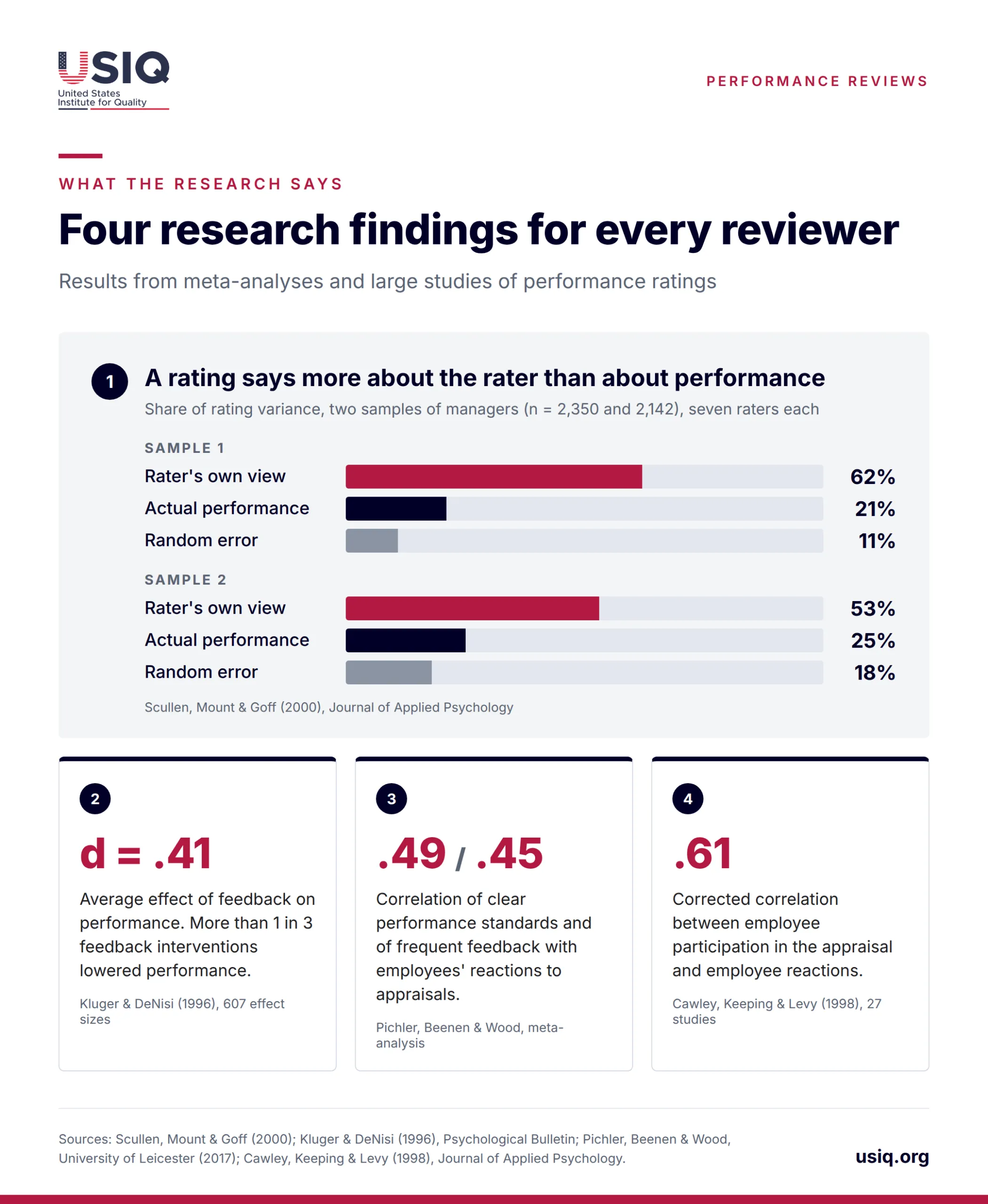
Avraham Kluger and Angelo DeNisi pooled 607 effect sizes from 23,663 observations in a meta-analysis published in Psychological Bulletin in 1996. Feedback interventions improved performance on average (d = .41). Yet more than one third of the interventions they analyzed made performance worse. Their preliminary theory points to where the feedback directs attention: effectiveness drops as attention moves away from the task and toward the self (Kluger & DeNisi, 1996).
For a review meeting, comments about the work ("the client report went out two days after the agreed date") are safer than comments about the person ("you are disorganized"). Labels invite a defense of self-image. Descriptions of tasks and outcomes leave room to fix the task.
A rating says a lot about the rater
Steven Scullen, Michael Mount and Maynard Goff analyzed ratings of two large samples of managers (2,350 and 2,142 people), each rated by seven raters. Idiosyncratic rater effects, meaning the individual rater’s personal way of seeing and scoring, accounted for 62% and 53% of the variance in ratings in the two data sets. Actual performance, general and dimension-specific combined, accounted for 21% and 25%, less than half as much. Random error added 11% and 18% (Scullen, Mount & Goff, 2000).
Kevin Murphy later concluded that raters need both the tools and the incentive to act as good measurement instruments (Murphy, 2008). For a manager, a rating is partly a measurement of the rater, so it needs evidence, a second view and a bias check before it reaches the employee.
Clear standards and frequent feedback make reviews feel fair
A meta-analysis by Shaun Pichler, Gerard Beenen and Stephen Wood tested what drives employee reactions to appraisals. Knowing the performance standards correlated .49 with overall reactions (19 samples, 5,317 responses), and frequent feedback correlated .45 (18 samples, 5,227 respondents) (Pichler, Beenen & Wood). In the University of Leicester’s 2017 summary of the study, the authors describe the two factors as synergistic: feedback has a greater effect when standard setting is good (University of Leicester, 2017).
Employees who take part react better
Brian Cawley, Lisa Keeping and Paul Levy combined 27 field studies with 32 samples on employee participation in the appraisal process. The corrected relationship between participation and employee reactions was .61, and participation was most strongly related to satisfaction (Cawley, Keeping & Levy, 1998). Participation can mean a self-assessment, a voice in setting goals, or simply time in the meeting to respond and disagree.
Self-ratings run higher than supervisor ratings
Heike Heidemeier and Klaus Moser analyzed 128 independent samples comparing self-ratings with supervisor ratings. The overall correlation was .22 (.34 after correction; 115 samples, 37,752 people), so employees and their bosses often see the same year quite differently. In Western samples, self-ratings were more lenient than supervisor ratings (d = 0.32; 89 samples, 35,417 people) (Heidemeier & Moser, 2009). Expect the gap and plan the conversation around it.
Rater training improves accuracy
Frame-of-reference training teaches raters a shared definition of each performance dimension and what different levels look like, usually through practice cases and feedback on their ratings. An updated meta-analysis by Sylvia Roch and colleagues, built on more than four times as many studies as the previous review from 1994, found it to be an effective way to improve rating accuracy (Roch, Woehr, Mishra & Kieszczynska, 2012).
How to conduct a performance review in 9 steps
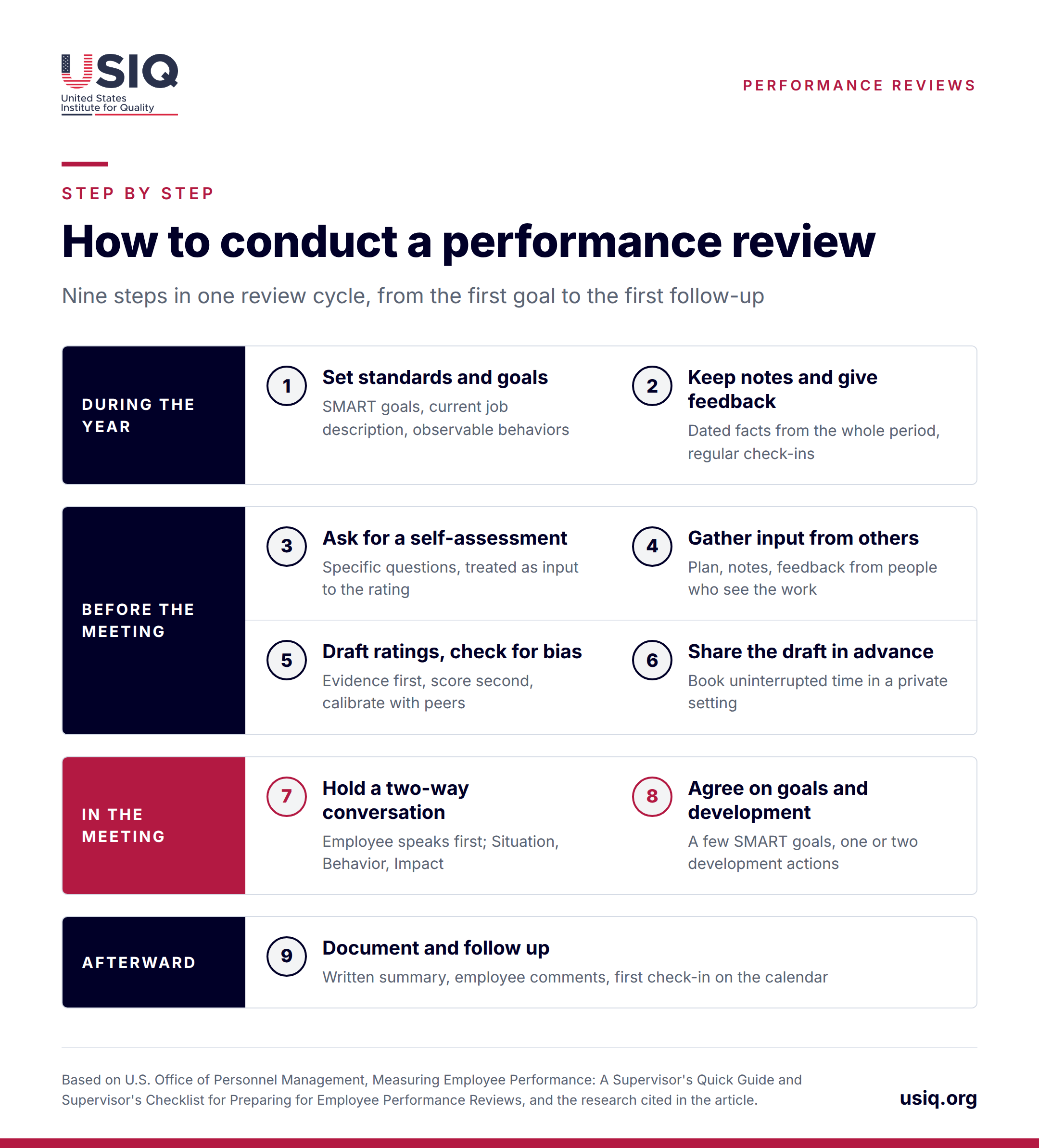
The steps below follow the order of a review cycle. Steps 1 and 2 happen during the year, steps 3 to 6 in the weeks before the meeting, steps 7 and 8 in the meeting, and step 9 afterward. The structure draws on the U.S. Office of Personnel Management’s guidance for supervisors and on the research above.
Step 1: Set standards and goals at the start of the period
A review can only be as fair as the expectations it measures. OPM’s quick guide for supervisors recommends defining performance expectations first, keeping the job description current so that it reflects responsibilities, expectations and indicators, and writing goals that are specific, measurable, achievable, relevant and time-bound (SMART). Its own example: raise customer satisfaction survey ratings by 10% within three months by improving response times to inquiries (OPM, Measuring Employee Performance).
Use both kinds of measures. Quantitative results (sales, error rates, cycle times) show what was achieved. Qualitative criteria such as teamwork and communication show how. Write down two or three observable behaviors for each qualitative criterion so that "communication" means the same thing to you and to the employee. If your company already tracks people metrics, the HR dashboard examples on this blog show which indicators are worth reusing.
Step 2: Keep notes throughout the year
Memory favors the last few weeks. A fair review covers the whole period, and OPM’s quick guide lists monitoring, tracking and documenting performance as ongoing tasks for supervisors. The easiest way is a running file per employee with dated, factual entries: a project delivered, a customer complaint, a colleague’s praise, a missed deadline and what caused it.
Share feedback when it happens. The Pichler meta-analysis links frequent feedback to better reactions, and an annual review that brings up a problem from February for the first time in December will feel like an ambush. A short monthly or quarterly check-in keeps the formal review free of surprises.
Step 3: Ask for a self-assessment
OPM’s quick guide includes an employee self-assessment in the review, and the participation research supports it. Ask specific questions instead of handing over a blank page:
- Which results from this period are you most proud of, and what evidence shows them?
- Which goals did you miss, and what got in the way?
- What support from me or the company would have helped?
- What would you like to learn or take on next?
Treat the answers as input. Because self-ratings tend to be more lenient, a self-score is a starting point for discussion and never the final rating. The self-assessment often surfaces work the manager did not see, which is reason enough to ask for it.
Step 4: Gather input from other sources
Before writing, collect the goals or performance plan, notes from earlier check-ins, the employee’s self-assessment and feedback from other people who saw the work. These can include project leads, internal customers, or a second manager who worked with the employee.
Given how much of a rating reflects the individual rater, a second perspective is one of the cheapest safeguards available. In very small firms, ask the person who sees the employee’s work most often, even if that is a peer. Tell employees in advance who will be asked for input.
Step 5: Draft ratings with evidence and check for bias
Write the narrative first and the score second. For each goal or criterion, note what was expected, what happened, two or three examples, and the effect on the team or customer. Then choose the rating that matches the evidence.
Before you finalize, run the draft against the common rating errors described in appraisal research:
| Rating error | What it looks like | A practical check |
|---|---|---|
| Recency | The last month outweighs the other eleven | Do your examples come from every quarter of the period? |
| Halo or horns | One strong or weak trait colors every other score | Rate each criterion separately, one criterion at a time across all your employees |
| Leniency | Almost everyone is rated above standard | Compare your distribution with peers’ distributions in a calibration meeting |
| Central tendency | Everyone lands in the middle to avoid hard conversations | Can you name specific evidence for each "meets expectations"? |
| Similarity | Higher ratings for people who think or work like you | Would the same evidence earn the same score for someone with a different style? |
| Attribution | Blaming the person for a problem caused by tools, staffing or unclear goals | What was within the employee’s control? |
A calibration meeting, where managers compare draft ratings and the evidence behind them before anything is shared, is a common way for employers with several managers to apply standards more consistently. Combine it with frame-of-reference training: give managers two or three anonymized case descriptions, ask them to rate each one, and discuss why ratings differed.
Step 6: Share the draft in advance and book uninterrupted time
Book uninterrupted time and give the employee a copy of the written draft before the meeting. Sending the draft a day or two ahead lets the employee read it alone, absorb any disappointment, and come prepared with facts. The meeting then becomes a discussion instead of a reading.
Choose a private room or, for remote staff, a video call with cameras on. Avoid Friday afternoons and the day before a holiday, when nobody has time to ask follow-up questions.
Step 7: Run a two-way conversation
A workable agenda for the meeting:
- Open by stating the purpose and how the time will be used.
- Ask the employee to start: how do they see the period, and what stood out?
- Walk through results against goals, beginning with strengths.
- Discuss areas to improve, one at a time, with examples.
- Invite disagreement and record it.
- Agree on goals and development for the next period.
- Summarize decisions and next steps.
For feedback on specific events, OPM’s quick guide recommends the Situation, Behavior, Impact model (SBI): name the situation, describe the observable behavior, and explain its impact. It also gives a simple rule: praise in public, correct in private. Both fit what Kluger and DeNisi found about keeping attention on the task.
Listen more than you talk. When the employee disagrees, ask for the evidence and write it down. If new facts change the picture, say that you will revise the rating and do it. A manager who never changes a draft rating teaches employees that participation is for show, which undercuts the reactions the Cawley meta-analysis measured.
Step 8: Agree on goals and development
End with the future. Agree on a small number of SMART goals for the next period and one or two development actions, such as a course, a stretch assignment or mentoring. Prepare a few skill and training ideas before the meeting, then ask the employee what they want to work on. Goals the employee helped shape are easier to commit to, and they become the standards for the next review.
Recognition belongs here too. Specific thanks for specific contributions costs nothing, and a structured program makes it consistent. Our guide on designing employee recognition awards explains how to set one up.
Step 9: Document and follow up
Within a day or two, send a written summary of the rating, the main points discussed, any disagreement the employee raised, the agreed goals and the follow-up dates. Ask the employee to acknowledge receipt; acknowledgment does not have to mean agreement. Store the record where it can be found later.
Then put the first check-in on the calendar. OPM lists regular monitoring and tracking as a core step of measuring performance, and the feedback-frequency research shows why: the formal review works best as the summary of a year of conversations.
Performance review examples: wording that describes behavior
Search engines are full of lists with hundreds of review phrases. Most of them are adjectives ("excellent communicator", "needs to be more proactive") that tell the employee nothing they can act on. Strong review language names a behavior, an example and an effect. The pairs below are illustrations you can adapt; replace the details with facts from your own notes.
| Vague phrase | Specific version |
|---|---|
| Great team player. | When two colleagues were out in March, you took over their client calls without being asked and kept every scheduled appointment. |
| Needs to improve communication. | In three of the last four project updates, the client heard about delays from the delivery team first. Starting next quarter, please send a status note to the client every Friday. |
| Strong results this year. | You closed 14 renewals against a goal of 12, and your average response time to support tickets fell from two days to one. |
| Lacks attention to detail. | Two invoices in October went out with the wrong tax rate. Let’s add a second check for invoices above a set amount until the error rate is back at zero. |
| Shows leadership potential. | You trained the two new hires on the scheduling system and both worked independently within their first month. I would like you to lead the onboarding of the next group. |
| Should be more proactive. | Over the last quarter, issues in the order system reached me through customers before they reached me through you. When you see a recurring error, please flag it the same day. |
Knowing what not to say is just as useful. Avoid comparisons with named coworkers, guesses about motives ("you don’t seem to care"), comments about personal life, health, age, family plans or other protected characteristics, and promises about raises or promotions you cannot guarantee. If a serious problem was never raised before the review, raise it now, acknowledge the delay, and set a fair timeline to address it.
A simple performance review template
Small and mid-sized employers rarely need complex software to run good reviews. A one-page form with these fields covers what the research and the OPM guidance call for:
| Section | What to fill in |
|---|---|
| Employee, role, review period, reviewer | Names, job title, dates covered, manager and any second reviewer |
| Goals from last period | Each goal, the result achieved, evidence, and a rating |
| Core responsibilities | Main duties from the current job description, with examples |
| Behavioral criteria | Two to four criteria (for example teamwork, customer focus), each defined by observable behaviors |
| Employee self-assessment | Summary of the employee’s answers, attached in full |
| Strengths | Two or three, each with a dated example |
| Areas to improve | One to three, each with an example and the support offered |
| Overall rating | Rating on your scale with a short justification |
| Goals and development for next period | SMART goals, training or assignments, check-in dates |
| Employee comments | Space for agreement, disagreement or additions |
| Acknowledgment | Signatures and date, noting that signing confirms receipt |
Keep the rating scale short and define each level in words. "Meets expectations" should describe what meeting expectations looks like in that role, so that two managers reading the same evidence reach the same score.
Underperformance, improvement plans and legal guardrails
Most reviews are routine. The ones that end in a warning, a performance improvement plan (PIP) or a termination are where documentation and consistency matter most. The points below summarize federal guidance; state laws may add requirements, and this section is general information, not legal advice.
Running a fair improvement plan
OPM’s quick guide describes addressing underperformance through clear expectations, support and resources, regular check-ins and enough time and support to improve. In practice, a PIP should name the specific gaps, the standard the employee must reach, the support the company will provide, the check-in schedule, the length of the plan and what happens at the end. If the company has already decided to let the employee go, a PIP only delays that decision and damages trust with the rest of the team.
Disability and accommodation requests during a review
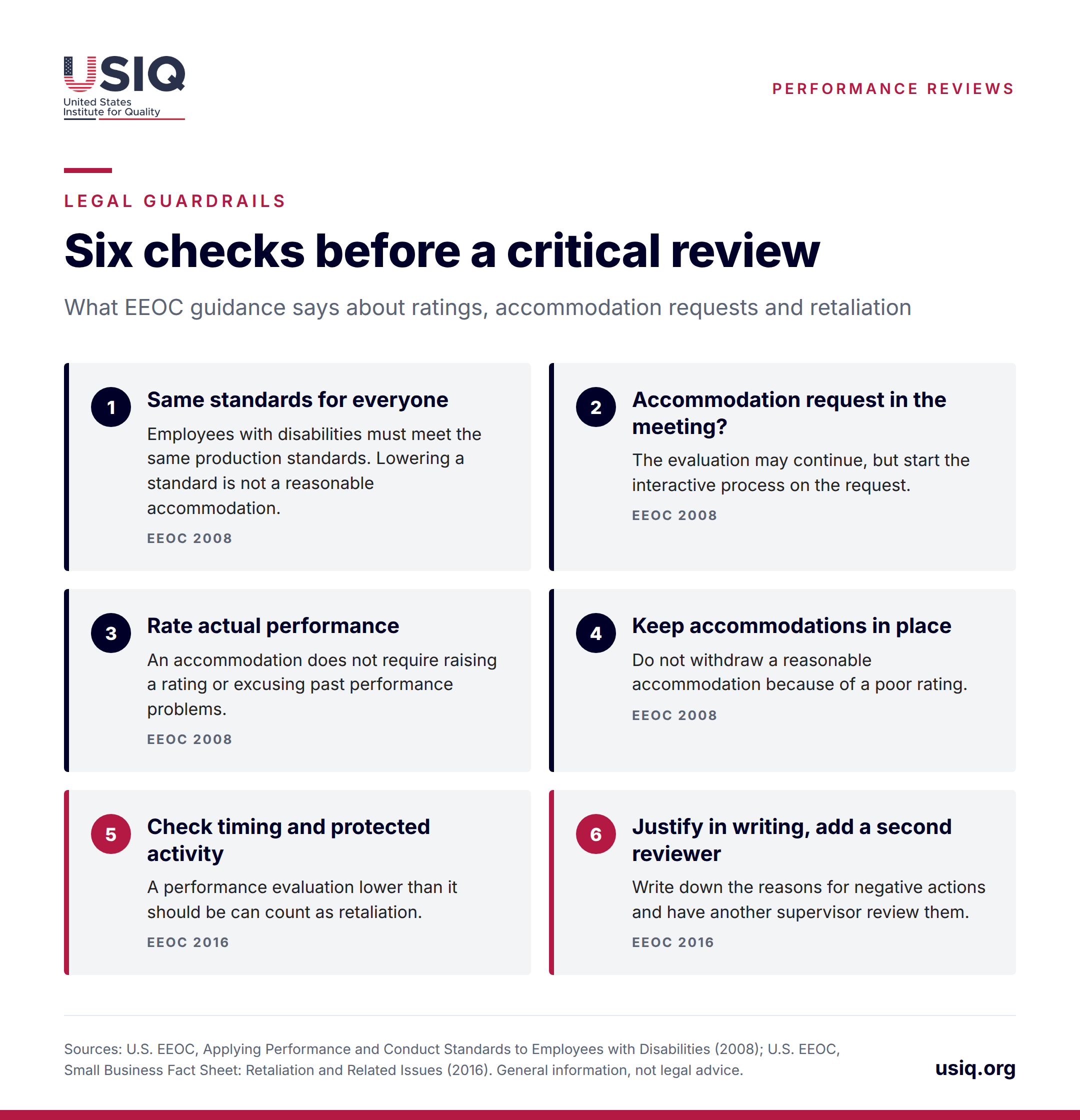
The EEOC’s technical assistance document on performance and conduct standards (issued in 2008) applies to employers covered by Title I of the Americans with Disabilities Act, which covers private employers with 15 or more employees. Its main points for reviews (EEOC, 2008):
- Employees with disabilities must meet the same production standards, quantitative or qualitative, as other employees, and lowering a production standard is not considered a reasonable accommodation. An accommodation may still be required to help the employee meet the standard.
- Employers should evaluate the performance of an employee with a disability the same way they evaluate others.
- If an employee asks for an accommodation during a performance discussion, the employer may continue the discussion or evaluation but should begin the interactive process, and may ask for appropriate medical documentation.
- An accommodation does not require the employer to excuse past poor performance, raise a rating, or give an evaluation that does not reflect actual performance.
- An employer may not withdraw a reasonable accommodation as punishment for a poor rating, and should handle accommodation requests promptly. In one of the EEOC’s examples, the employer postpones a 60-day improvement plan while it processes a request.
The document states that it does not have the force of law; it explains how the EEOC reads the ADA.
Retaliation
Federal equal employment opportunity laws prohibit punishing employees or applicants for asserting their rights, for example by filing a complaint, testifying in a coworker’s case or requesting an accommodation. The EEOC’s small business fact sheet lists a performance evaluation that is lower than it should be, and increased scrutiny, among the actions that can be retaliation. It also states that EEO activity does not shield an employee from discipline or discharge for legitimate reasons such as poor job performance (EEOC, 2016).
The EEOC’s retaliation brochure gives a direct example: an employee who testifies in a coworker’s discrimination case and then receives a negative review that could affect career advancement may have been retaliated against. Timing matters, because evidence that a decision came soon after protected activity can support a claim (EEOC brochure). Two of the fact sheet’s practical suggestions fit the review process well: require supervisors to justify negative employment actions in writing, and have another supervisor review those actions.
Remote and hybrid performance reviews
Reviews of remote employees follow the same nine steps, with a few adjustments:
- Hold the meeting by video, not phone or chat, and send the draft beforehand so nobody reads a long document on a shared screen.
- Base ratings on documented outputs and agreed goals. Remote work makes effort less visible, so a rating built on impressions of who seems busy is even less reliable than usual.
- Check for proximity bias in calibration: compare ratings for on-site and remote employees doing similar work and ask whether the evidence explains any gap.
- Schedule across time zones so the meeting falls inside the employee’s normal working hours.
- Follow up in writing the same day, since hallway clarifications do not happen remotely.
Employers who are still deciding how much remote work to offer can find a summary of the evidence in our article on the benefits of remote work for employers.
Performance reviews in small companies without an HR department
In a company with 10 or 30 employees, the owner often writes every review, and there is no calibration committee. A few adjustments keep the process fair without adding bureaucracy:
- Use one short template for everyone and write down what each rating level means for each role.
- Ask a second person (a co-founder, a team lead or an external advisor bound by confidentiality) to read the drafts for consistency before they go out.
- Replace the once-a-year event with a short quarterly check-in and one annual summary.
- Keep the notes from step 2 even if they are brief. In a dispute, a small employer’s dated notes carry the same weight as a large company’s software records.
- Know which laws apply as you grow. Title I of the ADA, for example, applies once an employer has 15 or more employees.
Small firms also have an advantage: the reviewer usually sees the work directly, which makes every example easier to make concrete.
How reviews connect to engagement, retention and employer reputation
For many employees, the annual review is the most visible moment in the relationship with their manager. A review that feels fair supports the engagement and retention work most companies already do; one that feels arbitrary can undo it. Our guides on employee engagement and on employee retention strategies cover the wider picture.
To find out how employees experience your reviews, ask them. A few anonymous questions in your next employee survey ("I understand how my performance is evaluated", "I receive useful feedback from my manager during the year") show whether the process works outside the HR handbook. Employer assessments look at the same territory. The Top Employer (USIQ) methodology, for example, scores a confidential employee survey with seven dimensions, including "Your manager" (16 of 100 survey points) and "Learning and development" (10 points), alongside an HR assessment with areas for leadership and direction and for people development.
Common mistakes to avoid
- Saving all feedback for the annual meeting.
- Rating without written standards, so the employee learns the expectations only when they are missed.
- Letting the most recent weeks decide the rating.
- Talking for most of the meeting and calling it a conversation.
- Commenting on personality instead of observable work.
- Mixing a pay announcement into a development discussion without warning.
- Writing a softer review than the evidence supports, then trying to discipline the same employee a month later.
- Forgetting the follow-up, so the agreed goals disappear until next year.
Frequently asked questions
What should a manager say in a performance review?
Start by explaining the purpose of the meeting and inviting the employee’s view of the period. Then discuss results against agreed goals with specific examples, describe strengths and areas to improve using the situation, behavior and impact of real events, invite disagreement, and close with agreed goals and next steps. Keep comments on the work, not on the person.
What should you not say during a performance review?
Avoid labels about personality, comparisons with named coworkers, guesses about motives, remarks about age, health, family or other protected characteristics, and promises about pay or promotions you cannot keep. Do not raise serious problems for the first time without acknowledging that they should have come up earlier.
How often should performance reviews be done?
Continuity matters more than the calendar. An annual or semiannual formal review works well when it summarizes regular check-ins held during the year. Research on appraisal reactions links frequent feedback and clear standards to better employee reactions.
Should employees write a self-evaluation?
Yes, in most cases. Participation in the appraisal process is strongly related to employee satisfaction with it, and self-assessments often surface work the manager did not see. Because self-ratings tend to be more lenient than supervisor ratings, treat them as input to the discussion, not as the rating.
Can an employee ask for a disability accommodation during a performance review?
Yes. According to the EEOC’s guidance, the employer may continue the evaluation but should start the interactive process on the request. The accommodation applies going forward; the employer is not required to raise a rating or excuse past performance problems, and it may not withdraw an accommodation to punish a poor rating.
Do performance reviews actually improve performance?
They can. Kluger and DeNisi found that feedback improved performance on average, but more than one third of feedback interventions lowered it. Reviews work better when they rest on clear standards, include frequent feedback, invite employee participation and focus on the task rather than on the person.


Sources
- Cawley, B. D., Keeping, L. M., & Levy, P. E. (1998). Participation in the performance appraisal process and employee reactions: A meta-analytic review of field investigations. Journal of Applied Psychology, 83(4), 615-633. doi.org/10.1037/0021-9010.83.4.615
- DeNisi, A. S., & Murphy, K. R. (2017). Performance appraisal and performance management: 100 years of progress? Journal of Applied Psychology, 102(3), 421-433. University of Limerick record
- Heidemeier, H., & Moser, K. (2009). Self-other agreement in job performance ratings: A meta-analytic test of a process model. Journal of Applied Psychology, 94(2), 353-370. doi.org/10.1037/0021-9010.94.2.353
- Kluger, A. N., & DeNisi, A. (1996). The effects of feedback interventions on performance: A historical review, a meta-analysis, and a preliminary feedback intervention theory. Psychological Bulletin, 119(2), 254-284. Hebrew University record
- Murphy, K. R. (2008). Explaining the weak relationship between job performance and ratings of job performance. Industrial and Organizational Psychology, 1(2), 148-160. Cambridge Core
- Pichler, S., Beenen, G., & Wood, S. Feedback frequency and appraisal reactions: A meta-analytic test of moderators. University of Leicester repository; summary: University of Leicester news, November 2017
- Roch, S. G., Woehr, D. J., Mishra, V., & Kieszczynska, U. (2012). Rater training revisited: An updated meta-analytic review of frame-of-reference training. Journal of Occupational and Organizational Psychology, 85(2), 370-395. doi.org/10.1111/j.2044-8325.2011.02045.x
- Scullen, S. E., Mount, M. K., & Goff, M. (2000). Understanding the latent structure of job performance ratings. Journal of Applied Psychology, 85(6), 956-970. doi.org/10.1037/0021-9010.85.6.956
- U.S. Equal Employment Opportunity Commission (2008). Applying Performance and Conduct Standards to Employees with Disabilities. eeoc.gov
- U.S. Equal Employment Opportunity Commission (2016). Small Business Fact Sheet: Retaliation and Related Issues. eeoc.gov
- U.S. Equal Employment Opportunity Commission. Retaliation/Reprisal (brochure). eeoc.gov
- U.S. Office of Personnel Management. Measuring Employee Performance: A Supervisor’s Quick Guide. opm.gov (PDF)
Related Articles

What makes an employer family-friendly? 20 criteria, research on supportive managers, U.S. law, 2026 tax credits and a framework to measure progress.
A practical, research-based guide for managers at U.S. employers: nine steps from goal setting to follow-up, bias checks, sample wording, a one-page template and the EEOC rules for critical reviews.
Our quality management system passed an independent ISO 9001:2015 audit by QRO Certification LLP. What the audit covered and what it means for companies we certify.

What research says about the effects of employer seals on current employees, potential applicants and employer image, from independent experiments and field data to the limits of the evidence.
