
A seal on a careers page takes up perhaps two square inches. Employers who earn one tend to expect a lot from that small space: more applications, prouder employees, maybe a mention in the local business press. The expectations are understandable. But do employer seals work the way their holders hope? Researchers have studied that question more closely than most HR teams realize.
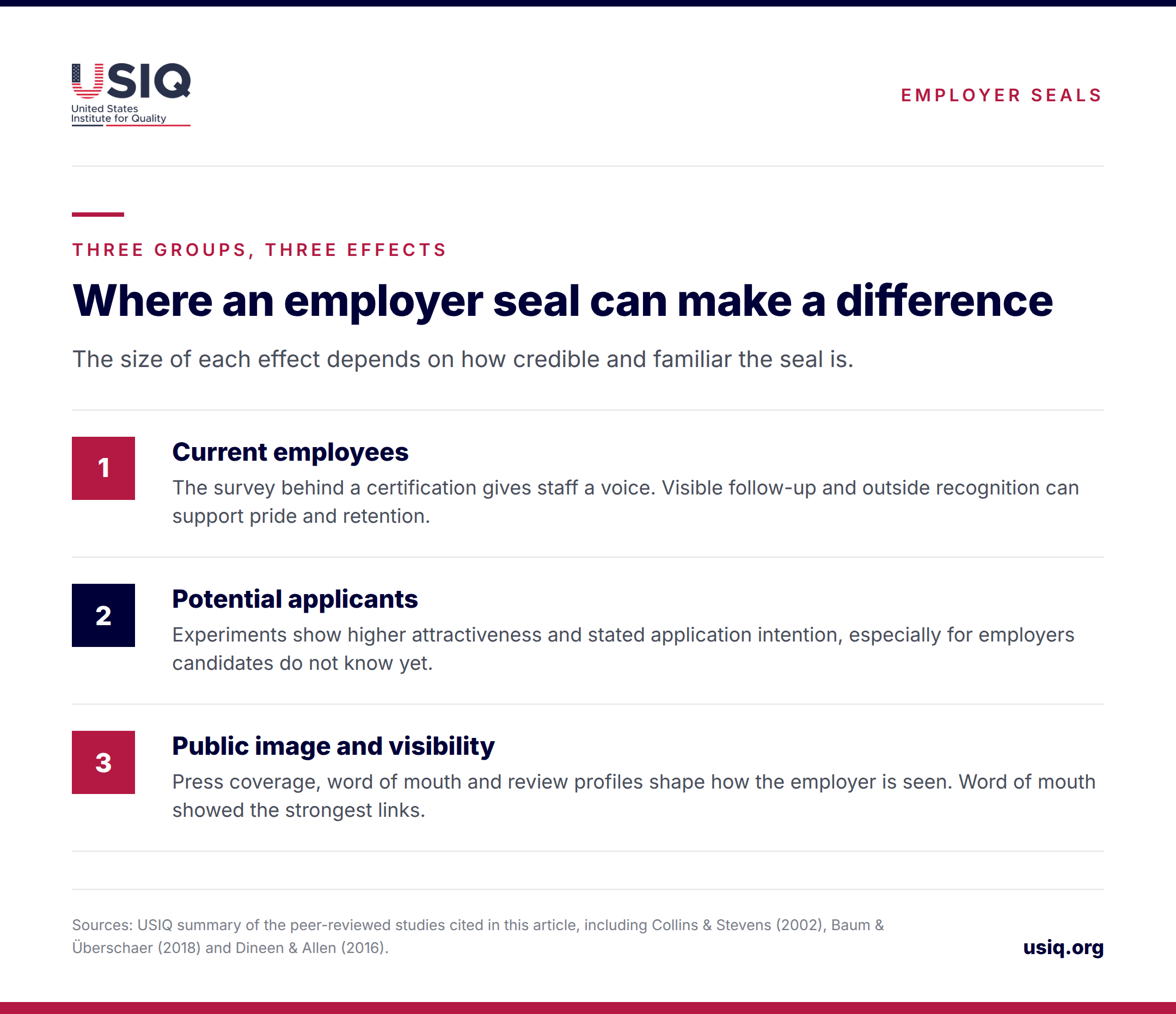
This article brings together what peer-reviewed research says about the effects of employer seals, awards and certifications. It looks at three groups in turn: the people who already work for the company, the people who might apply, and the wider public that forms a picture of the employer through news coverage, online reviews and word of mouth. Where the evidence is strong, we say so. Where it rests on hypothetical job ads, small samples or correlations, we say that as well. Marketing figures from seal providers that have never been tested independently are left out.
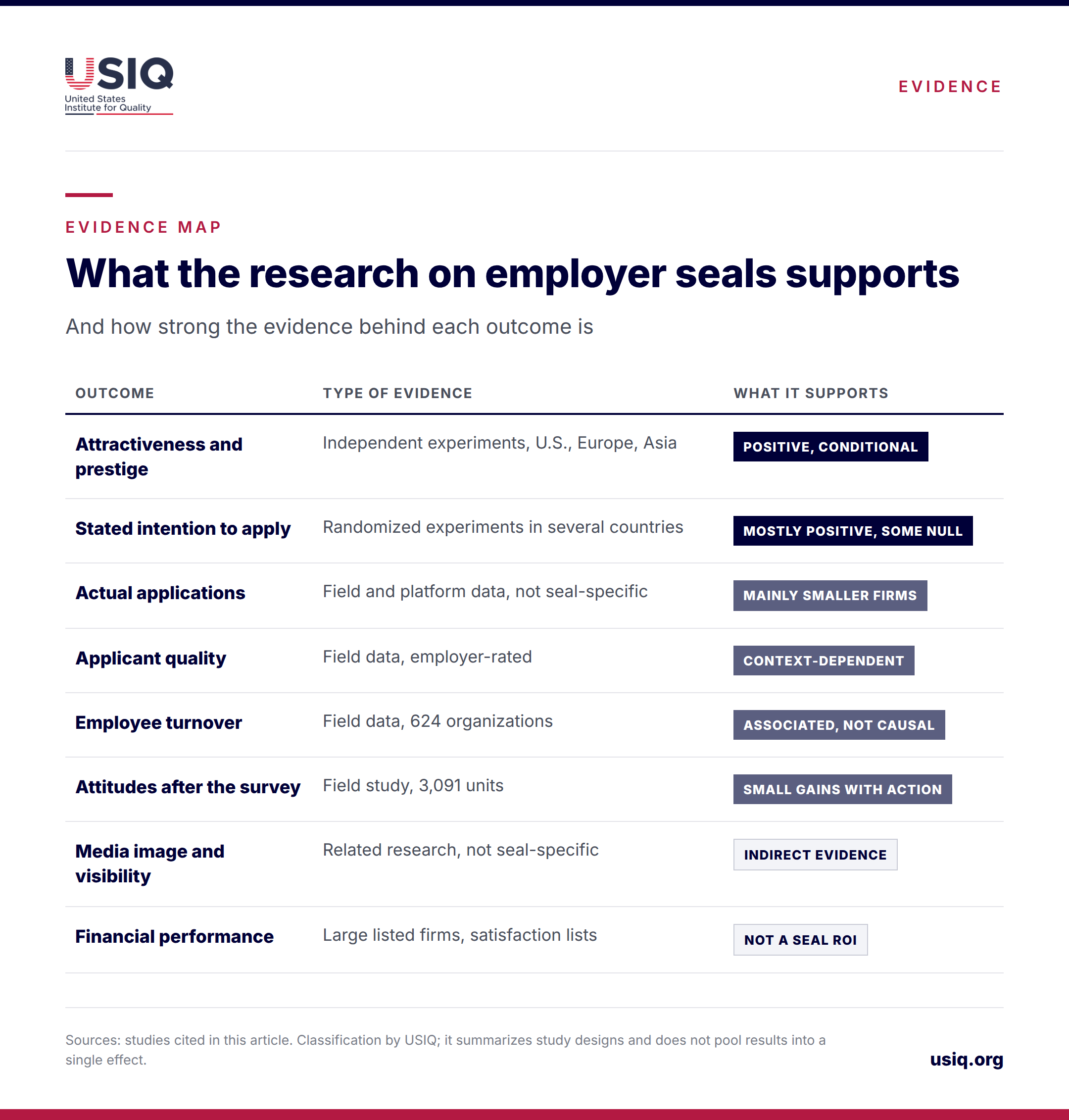
Quick answer: Independent experiments show that employer awards and certifications can make an employer more attractive and raise stated willingness to apply, mainly through perceived prestige and fit. The effects are conditional. They are largest for employers that candidates do not know yet, depend on whether the seal itself is familiar and credible, and in some studies did not appear at all. Field data from 624 organizations link certification to lower turnover. No study supports a single, universal percentage gain in hiring.
Key takeaways
- A seal is only as informative as the method behind it. A survey of the whole workforce, a ranking and a process audit measure different things.
- The employee survey behind a certification can influence staff on its own, through voice and visible follow-up, before any logo is published.
- Independent experiments in several countries found that awards and certifications raise attractiveness, mostly through prestige and perceived fit. Some found no benefit, and in one study an employee endorsement mattered more than the certification.
- Awards help most when the award is familiar and the employer is not. An unfamiliar award can even hurt a well-known employer.
- Across 624 organizations, certification was associated with lower turnover, with smaller additional gains from each repeat certification.
- Publicity improves general attitudes toward an employer, but word of mouth showed the strongest links to employer image and was also related to actual application decisions.
- Employers that want proof of the effect in their own hiring can measure it, for example with a randomized job ad comparison.
What does an employer seal actually tell people?
Job seekers face a basic problem. They can see the job title, the location and often a pay range. What makes a job good or bad from day to day, such as how managers behave, whether schedules are predictable and whether promises are kept, only becomes visible after the first weeks on the job. Economists call this an information asymmetry: the employer knows far more about working conditions than any applicant can.
Signaling theory describes how one side of a market can narrow that gap by sending information the other side can observe. In their widely cited review, Connelly and colleagues (2011) explain that a signal is useful when it can be observed and when it is actually connected to the quality it claims to show. Applied to employer recognition, that means a seal helps only if candidates notice it and if the assessment behind it says something real about working conditions. The theory explains why a seal might work. It does not prove that any particular seal does.
This is where programs differ sharply. A ranking places organizations in order within a comparison group. A process audit checks whether certain HR policies exist. A survey of the workforce captures how employees themselves experience their jobs. Some awards are based on nominations or on applications written by the company itself. These procedures answer different questions, and a seal cannot carry more meaning than its method supports. USIQ has looked at how to tell these approaches apart in its guide to what an employer seal is and how to vet one.
A review by Lievens and Slaughter (2016) adds a helpful distinction. People are drawn to employers by instrumental attributes such as pay, benefits and location, and by symbolic ones such as prestige or the impression that a company is honest or innovative. A seal can work on both levels. It can suggest concrete facts about working conditions, and it can add prestige. How persuasive a seal is and how accurately it describes the workplace are separate questions, however. A familiar badge can attract attention while saying little, and a rigorous assessment can go unnoticed if nobody explains it.
U.S. rules point in the same direction. The Federal Trade Commission’s Endorsement Guides state that an endorsement by an organization must be “reached by a process sufficient to ensure that the endorsement fairly reflects the collective judgment of the organization” (16 CFR § 255.4). Examples in the same section describe a review website that falsely appears independent as deceptive, and they say that selling better rankings is deceptive even when the payments are disclosed. For employers, this is one more reason to ask how a seal was awarded before featuring it. For job seekers, it helps explain why an independent assessment can carry more weight than a company describing itself. USIQ summarizes the FTC and EU rules that apply to certification claims on a separate page.
How does the employee survey affect the current workforce?
Discussions of employer seals usually start with the logo. For the people already on the payroll, the effect often begins earlier, with the assessment itself. When a certification is based on an employee survey, every employee is asked how they experience their work. That process has consequences of its own, and they can be positive or negative depending on how the survey is run.
Why a representative survey matters
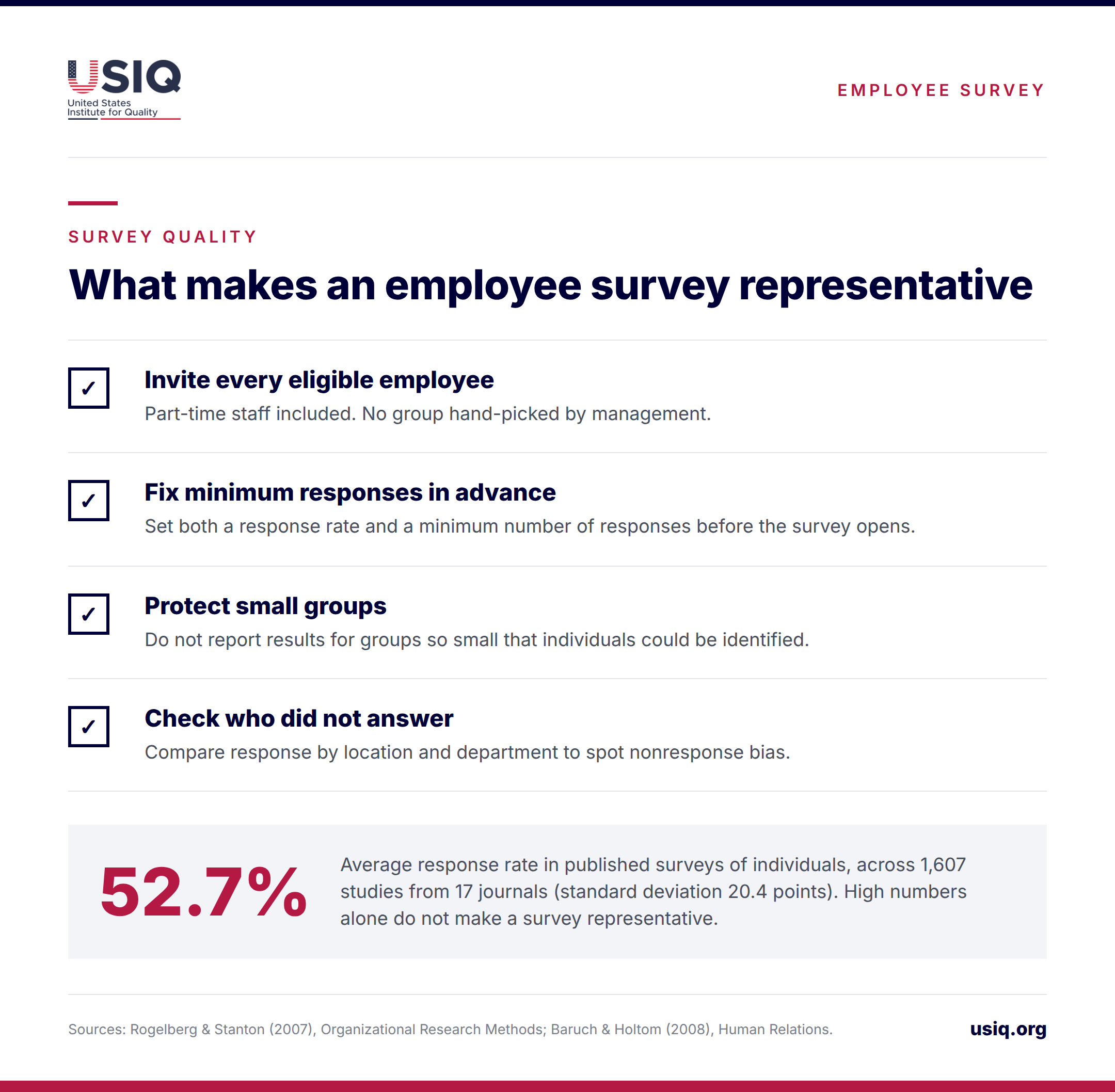
A survey can support a credible seal only if its results reflect the workforce, rather than just the most enthusiastic or the most frustrated employees. Organizational researchers have long warned about nonresponse: when the people who answer differ systematically from those who do not, the results are biased, no matter how many responses come in (Rogelberg & Stanton, 2007). Response levels vary a great deal. In an analysis of 1,607 studies from 17 refereed journals, Baruch and Holtom (2008) found an average response rate of 52.7% for surveys of individuals, with a standard deviation of 20.4 points.
In practice, a representative employee survey has a handful of features. All eligible employees are invited, part-time staff included, rather than a group selected by management. Minimum response rates and response counts are fixed before the survey opens. Results are not reported for groups so small that individuals could be identified. And the analysis checks whether some locations or departments are underrepresented. The USIQ Top Employer methodology is one example of how such rules can be written down: it invites all eligible payroll employees at the covered U.S. locations and sets thresholds that depend on company size, from 50% and five responses for employers with 10 to 39 employees to 20% and 200 responses for employers with 1,000 or more. No subgroup result is released with fewer than five valid responses.
These rules are more than paperwork. They decide whether a seal tells applicants something about the typical employee experience or only about a vocal minority. They also decide whether employees recognize their own workplace in the result, which matters because staff who see a seal as undeserved are unlikely to take pride in it. The general quality standards behind this, objectivity, reliability and validity, are covered in USIQ’s article on quality criteria for market research.
Being asked is part of the effect
Having a say matters to employees in its own right. In a study of 129 U.S. hospitals, Spencer (1986) found that hospitals with more channels for employee voice, such as grievance procedures and suggestion systems, had lower voluntary turnover among nurses. A follow-up survey of nurses at four of those hospitals showed that more voice channels went along with higher expectations that problems would actually be resolved. The study is old and correlational, so it does not prove that adding a survey reduces turnover. It does show a pattern that later research on employee voice has kept finding: people are more likely to stay when they believe that raising a concern leads somewhere.
Follow-up decides whether a survey helps or backfires
Asking without acting carries a real risk. Thompson and Surface (2009) studied 236 military and civilian employees who took part in a recurring climate survey. Those who saw visible follow-up, meaning shared results, identified problems and actions based on the data, were more likely to find the survey useful. Respondents rated action as more important than feedback alone, and perceived usefulness shaped whether they intended to fill out future surveys. In plain terms, employees who see nothing happen stop answering.
A larger field study by Huebner and Zacher (2022) followed 3,091 organizational units of a large German company from 2016 to 2018. Units that developed action plans after the survey tended to improve on later survey scores, although the effects were small. Only units that planned actions in both years improved overall across the period. The same authors’ systematic review notes that survey follow-up is often neglected in practice and that research on it is still limited. Their practical advice is to treat managers as change agents and give them the time and resources to act.
For an employer seeking certification, the implication is clear enough. The survey should not end with a score. Sharing results with the workforce, choosing a few concrete improvements and reporting back on them turns the assessment into something employees experience, not just something marketing uses. USIQ’s guide to running employee surveys that staff trust goes into the practical steps, and its overview of employee survey questions covers what to ask.
There is also a business case for paying attention to what the survey measures. A meta-analysis of 7,939 business units in 36 companies found generalizable relationships between unit-level employee satisfaction and engagement and outcomes such as customer satisfaction, productivity, profit, turnover and accidents (Harter, Schmidt & Hayes, 2002). The authors suggest that management practices that raise satisfaction may also improve these outcomes. The data are correlational, but they show why survey results are useful as a management tool long after the seal has been printed.
Does certification make employees prouder and more likely to stay?
Once a seal is awarded and communicated, it reaches employees in a different way: as outside confirmation that their employer is a good place to work. Research on organizational identification helps explain why that can matter. In a study across three organizations, Smidts, Pruyn and van Riel (2001) found that employees’ identification with their organization depended partly on perceived external prestige, meaning what employees believe outsiders think of their employer, and on the communication climate inside the company. An external recognition is one possible source of that perceived prestige. The study did not test seals directly, so this link is an inference, though a plausible one.
The most direct evidence on retention comes from the field. Dineen and Allen (2016) combined archival and survey data from 624 organizations that took part in 16 “Best Places to Work” competitions over three years. Certification was associated with lower turnover, even after controlling for earlier turnover rates. Repeat certifications brought diminishing additional reductions. That pattern makes intuitive sense: the first recognition is news, the third confirms what people already know.
The authors are careful about what their data can show, and readers should be as well. Organizations with better working conditions are more likely to win recognition and also more likely to keep their people. Certification may reveal existing quality, add to it, or both. Statistical controls narrow the gap to a causal reading but do not close it.
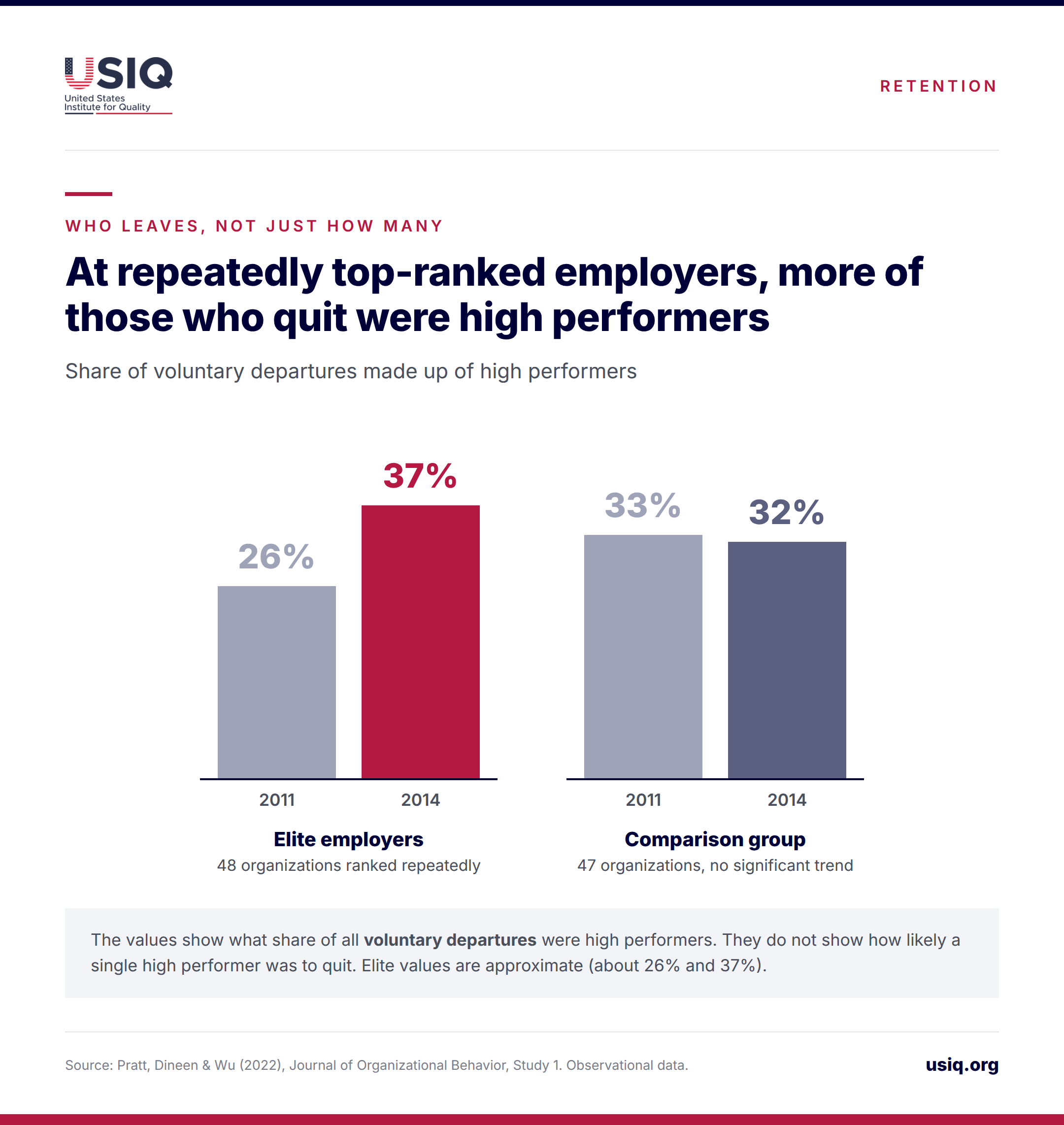
A second study from the same research group adds a warning. Pratt, Dineen and Wu (2022) tracked 48 elite employers that repeatedly ranked highly in such competitions. Among them, the share of voluntary departures made up of high performers rose from about 26% in 2011 to 37% in 2014. Interviews pointed to one reason: some strong performers saw the company’s success as limiting their own room for promotion, while others saw the employer’s reputation as a way to strengthen their résumé. The percentages describe who left, not the likelihood that any single high performer would quit. The lesson for employers is to look beyond total turnover at who is leaving and why.
Expectations matter too. A meta-analysis on psychological contract breach links the feeling that an employer has broken its promises with lower job satisfaction, lower commitment and stronger intentions to leave (Zhao et al., 2007). The study did not examine seals, but the connection is easy to see. A seal that promises more than new hires later experience could raise expectations the workplace does not meet. Research on realistic job previews points the same way. In a meta-analysis of 52 studies with about 17,000 participants, perceived honesty of the organization was a central mechanism linking realistic previews with lower voluntary turnover (Earnest, Allen & Landis, 2011). A seal works best next to an honest description of the job, demanding parts included. USIQ’s article on employee retention strategies covers retention more broadly.
How do employer seals affect potential applicants?
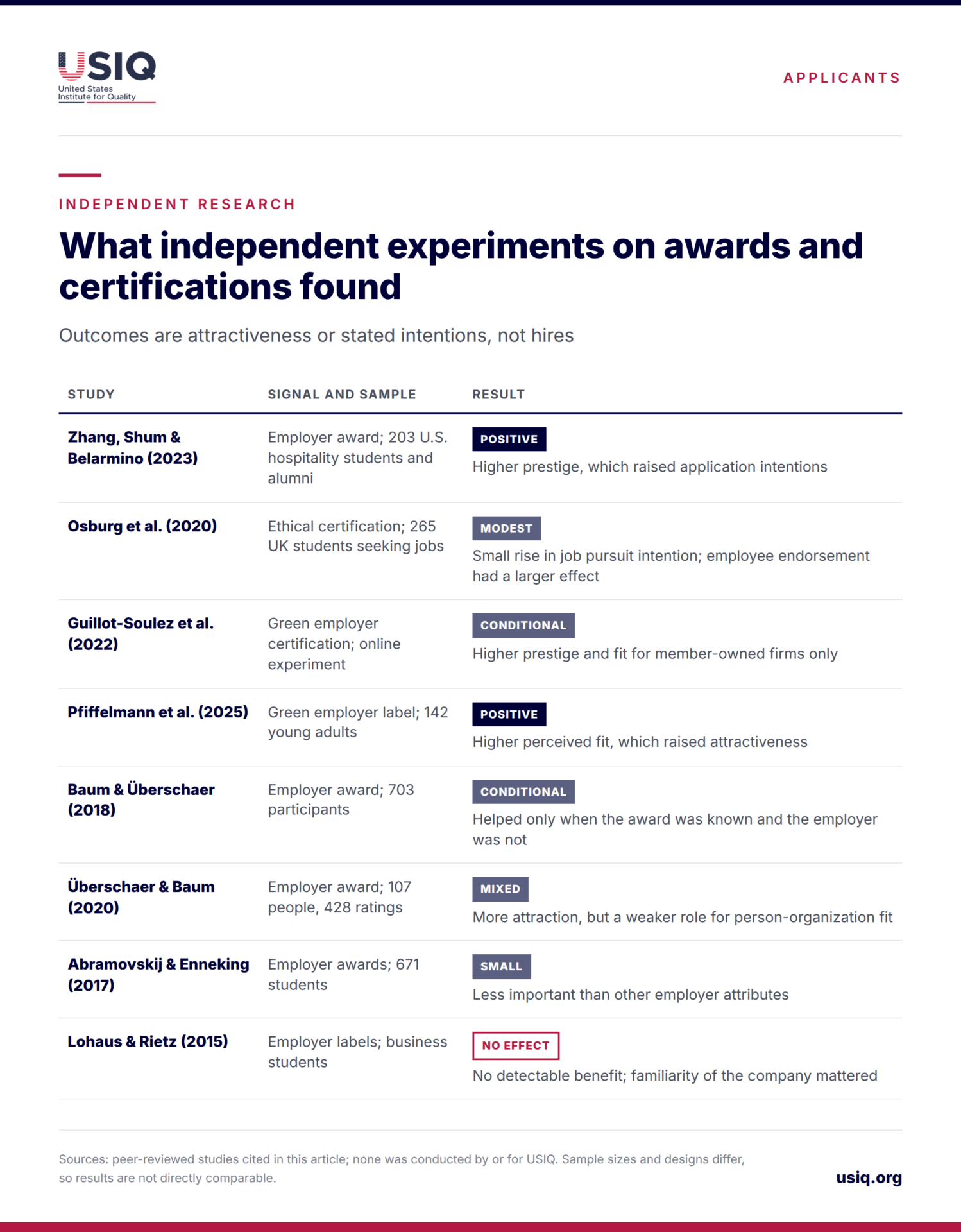
This is the question most employers care about first, and it is also where the research is richest. Independent research teams in North America, Europe and Asia have tested awards, labels and certifications in controlled experiments. Researchers group these signals under the term third-party employment branding: “communications, claims, or status-based classifications generated by parties outside of direct company control” (Dineen et al., 2019). Taken together, the studies point in a positive direction, but the effects are conditional, often modest, and in some studies absent.
What independent experiments show
In a hospitality recruitment experiment with 203 students and alumni of two U.S. programs, Zhang, Shum and Belarmino (2023) found that both employee review ratings and employer awards were positively related to organizational prestige, and prestige in turn increased application intentions. The reported indirect effect of the award through prestige was 0.26 on the study’s rating scale, with a 95% confidence interval from 0.01 to 0.50. That is a model coefficient, not a 26% increase in applications, and the wide interval shows how uncertain the size of the effect still is.
A British experiment put certifications and employee voices side by side. Osburg and colleagues (2020) showed 265 students who were about to apply for jobs, or were already applying, mock graduate job ads with or without an ethical business certification, combined with either a neutral or a positive endorsement on LinkedIn. The certification raised job pursuit intentions, but only modestly. The positive online endorsement had a clearly larger effect. Both signals worked through the same route: they improved how participants saw the company as an employer.
Two studies by French research teams tested environmental certifications. Guillot-Soulez, Saint-Onge and Soulez (2022) found in an online experiment that a green employer certification in a recruitment ad made the company more attractive indirectly, by raising perceived prestige and person-organization fit. That happened only for member-owned firms such as cooperatives. For investor-owned firms, the same certification did not significantly change prestige or fit. In an eye-tracking experiment with 142 young adults, Pfiffelmann and colleagues (2025) found that a green employer label increased perceived fit and, through it, employer attractiveness, especially among people with strong environmental concerns. In both studies the job ads were fictitious and real applications were not measured.
Research on corporate social performance explains why such signals can matter. In an experiment with 180 participants and a field study with 171 job seekers at a job fair, Jones, Willness and Madey (2014) found three mechanisms behind the attraction: job seekers anticipated being proud to work there, saw a fit with their own values, and expected the company to treat its employees well. Older reputation research points the same way. In a study with 339 participants, Cable and Turban (2003) found that a firm’s reputation shaped what people assumed about the job and how proud they expected to be as members. Participants also said they would accept a somewhat lower salary to work for a firm with a strong reputation, although these were stated preferences, not payroll savings. Prestige, fit and expected treatment are, in short, the routes through which a credible seal can work.
Familiar awards help unfamiliar employers
Familiarity turns out to be decisive. Baum and Überschaer (2018) found that employer awards raised job pursuit intentions only when the award was well known and the employer was not. Well-known employers gained nothing from displaying an award, and an unfamiliar award could even lower interest in a familiar employer.
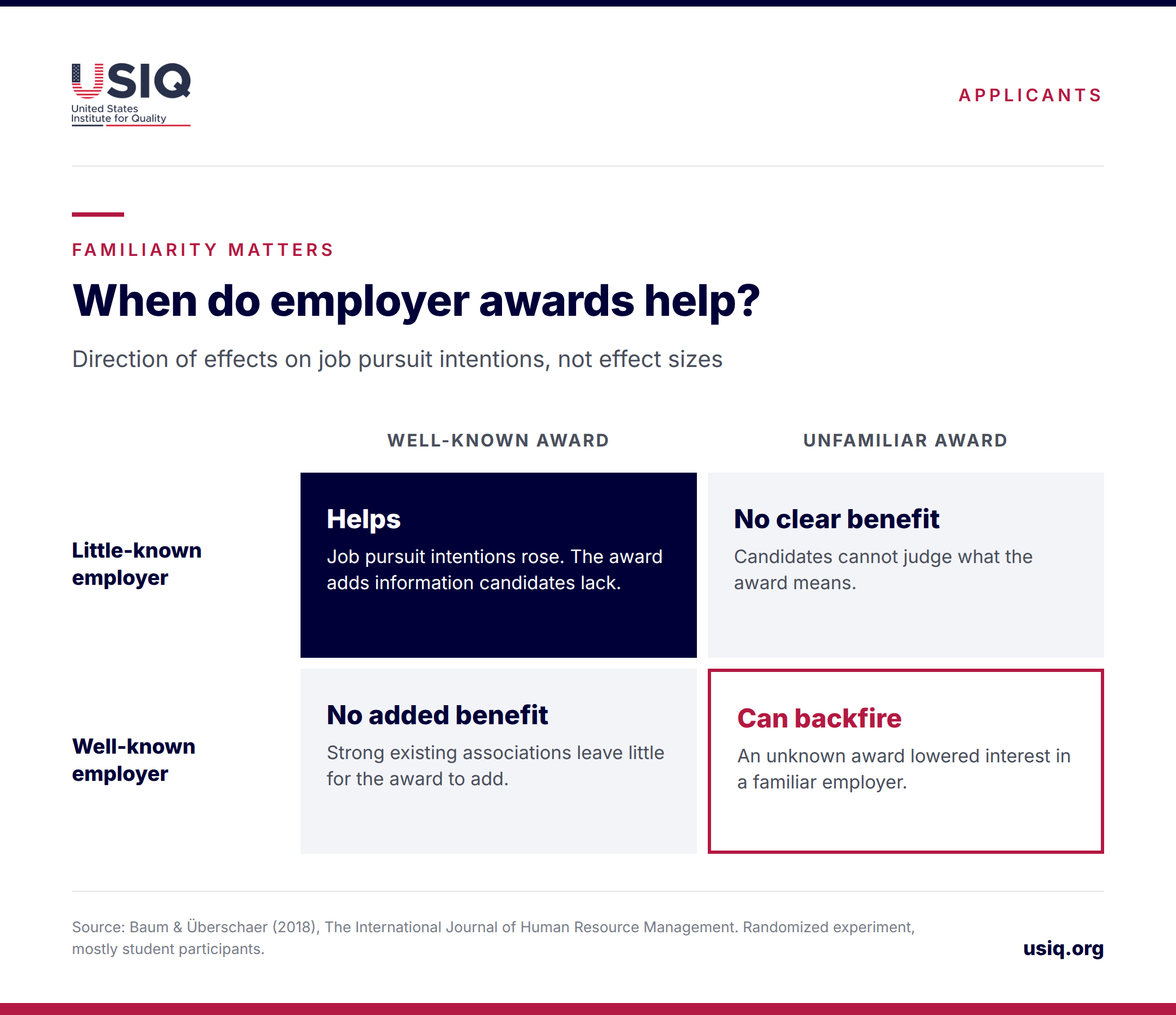
This fits the logic of signaling. A small or regional company that few candidates know has little else to show them, so a recognizable third-party signal adds information. A household name already triggers strong associations, and a seal on top of them adds little. A seal nobody recognizes, in turn, can look like self-promotion. A field study of 99 organizations points in a similar direction: simple, low-involvement recruitment practices worked better for firms with lower levels of corporate advertising and reputation (Collins & Han, 2004).
Evidence from India adds a time dimension. Saini, Rai and Chaudhary (2014) compared 12 firms that had appeared in best employer surveys between 2007 and 2011. Firms listed consistently or recently drew higher intention to apply than firms listed only once or only in an older survey, and familiarity with the organization was one of the strongest predictors. A recognition that is several years old appears to lose much of its pull.
When a seal does not help, or helps the wrong way
The picture is not uniformly positive, and an honest review has to give these results the same weight. In two experiments with business students, Lohaus and Rietz (2015) found that company familiarity affected how attractive job offers seemed, while the employer labels they tested added no detectable benefit. A discrete choice study with 671 students at six German universities found that awards influenced choices between hypothetical job ads from medium-sized food companies, but they mattered less than other employer characteristics, and the effect stayed significant only among respondents who did not know the award (Abramovskij & Enneking, 2017). That result differs from the familiarity finding above, which is a reminder that measures, comparison attributes and participants are not interchangeable across studies.
Überschaer and Baum (2020) identified a more subtle trade-off. Awards increased attraction, but for well-known companies they weakened the role that person-organization fit played in attraction and, indirectly, in simulated application choices. In other words, some candidates may respond to the badge rather than asking whether the job suits them. That concerns self-selection, not later job performance, but it is a good reason to place a seal next to concrete information about the role.
Add the ownership effect in the green certification study and the stronger effect of employee endorsements in the British experiment, and a pattern emerges. A seal is one piece of information among many. It helps when it fills a gap in what candidates know, and it helps less when other, more personal sources already speak for the employer.
A larger test with 1,093 participants
One of the larger direct tests of a seal on job ads comes from a doctoral thesis by Scharfenberg (2024). In the interest of transparency: the author, Oliver Scharfenberg, sits on USIQ’s Scientific Advisory Board, so the study is not independent of USIQ. Participants recruited through an online panel were asked to imagine themselves as IT specialists and were randomly shown one of two versions of the same IT job ad: one without a seal, the other with an employer seal based on an employee survey. Of the 548 people who saw the ad without a seal, 37.96% rated their likelihood of applying at 8 to 10 on a 0 to 10 scale. Of the 545 who saw the ad with the seal, 53.94% did, a difference of about 16 percentage points. For perceived attractiveness, the share of high ratings rose from 36.86% to 59.63%.
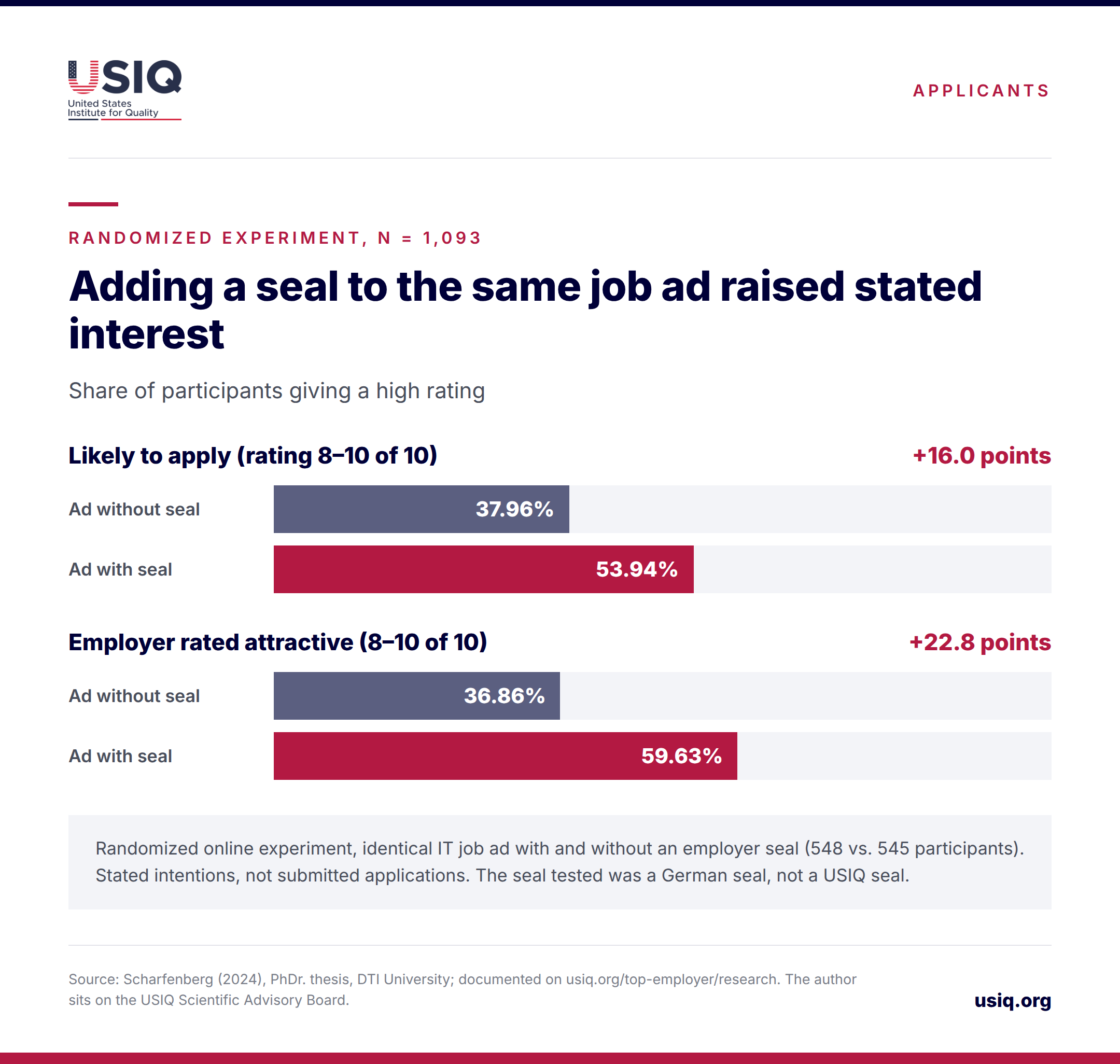
The direction matches the independent experiments described above. The size of the effect cannot be compared with them directly, because the outcome measures, samples and seals differ. Several limits apply. The outcome is a stated intention, not a submitted application. The participants were panel members imagining a job, not active candidates. The seal tested was a German seal (the DIQP “Top Arbeitgeber” seal), not a USIQ seal. The thesis was not published in a peer-reviewed journal, and the raw data have not been independently reanalyzed. USIQ’s employer seal research overview documents the study in detail, including small inconsistencies in the thesis. A 16-point difference is also not the same as 16% more applications, and neither figure can be turned into a forecast for a real job opening.
Specific seals send specific signals
Seals that focus on one topic reach the people who care about that topic. The green label studies above show this for environmental concerns. A certification such as Family Friendly Employer speaks to a different audience than a general workplace seal, and it needs supporting details that matter to that audience, such as how scheduling, leave and return to work are actually handled. Research on message specificity backs this up. In an experiment with 171 job-seeking students, more detailed recruitment messages improved perceptions of the employer and of fit, and perceived fit explained the link to application intentions (Roberson, Collins & Oreg, 2005).
Do seals lead to more and better applicants in real hiring?
Most experiments measure intentions. Employers need applications, interviews and hires. The step from one to the other is not automatic. A meta-analysis of 71 studies separated organizational attraction, job pursuit intentions, acceptance intentions and actual job choice, and found that the factors linked to each stage were not identical (Chapman et al., 2005). An improvement in attractiveness is a promising sign, not a proof of additional hires.
Field studies that measure real behavior are therefore valuable, even when they do not isolate the seal. In a study that tracked 456 student job seekers and 123 recruiting companies, Collins (2007) found that simple, low-information recruitment practices were linked to actual applications through familiarity with the employer and its reputation, mainly when the company’s products were little known. Using data from business school career services offices, Turban and Cable (2003) found that firms with better reputations attracted more applicants, and there was some evidence that they could select higher-quality applicants. In the Dineen and Allen field data, employers rated their applicant pools as higher in quality as certifications accumulated, especially in smaller companies and when job openings were scarce. Applicant quality was judged by the companies’ own informants, so it is a subjective measure.
Platform data show a similar size pattern. Using data from a large employer review site, Sockin and Sojourner (2023) found that higher employer ratings increased applications only for smaller firms. Ratings are not seals, but the finding is consistent with the experiments: outside information helps most where candidates know least.
For small and mid-sized companies this is an important point. Smaller and lesser-known employers are exactly the ones for which independent third-party information can add the most, provided the seal itself is credible and recognizable. Employers who want to know whether this holds in their own hiring should measure it directly, an approach described later in this article.
How do seals improve visibility and employer image?
A seal rarely works only on the careers page. Most employers announce it in a press release, on social media, in email signatures and in job ads. This raises a separate question: does the public attention around a seal improve how the employer is seen?
What research says about publicity
The best-known study on this question comes from Collins and Stevens (2002). They asked graduating engineering students about their exposure to four early recruitment activities, publicity, sponsorships, word-of-mouth endorsements and advertising, for up to ten companies each, and later checked whether they applied. Publicity was related to general attitudes toward the company. Word-of-mouth endorsements showed the strongest links to both dimensions of employer image they measured, general attitudes and perceived job attributes, and they were also related to actual application decisions. Brand image, in turn, was linked to intentions and to applications. The activities also worked together: employer image was stronger when firms combined publicity with other recruitment activities.
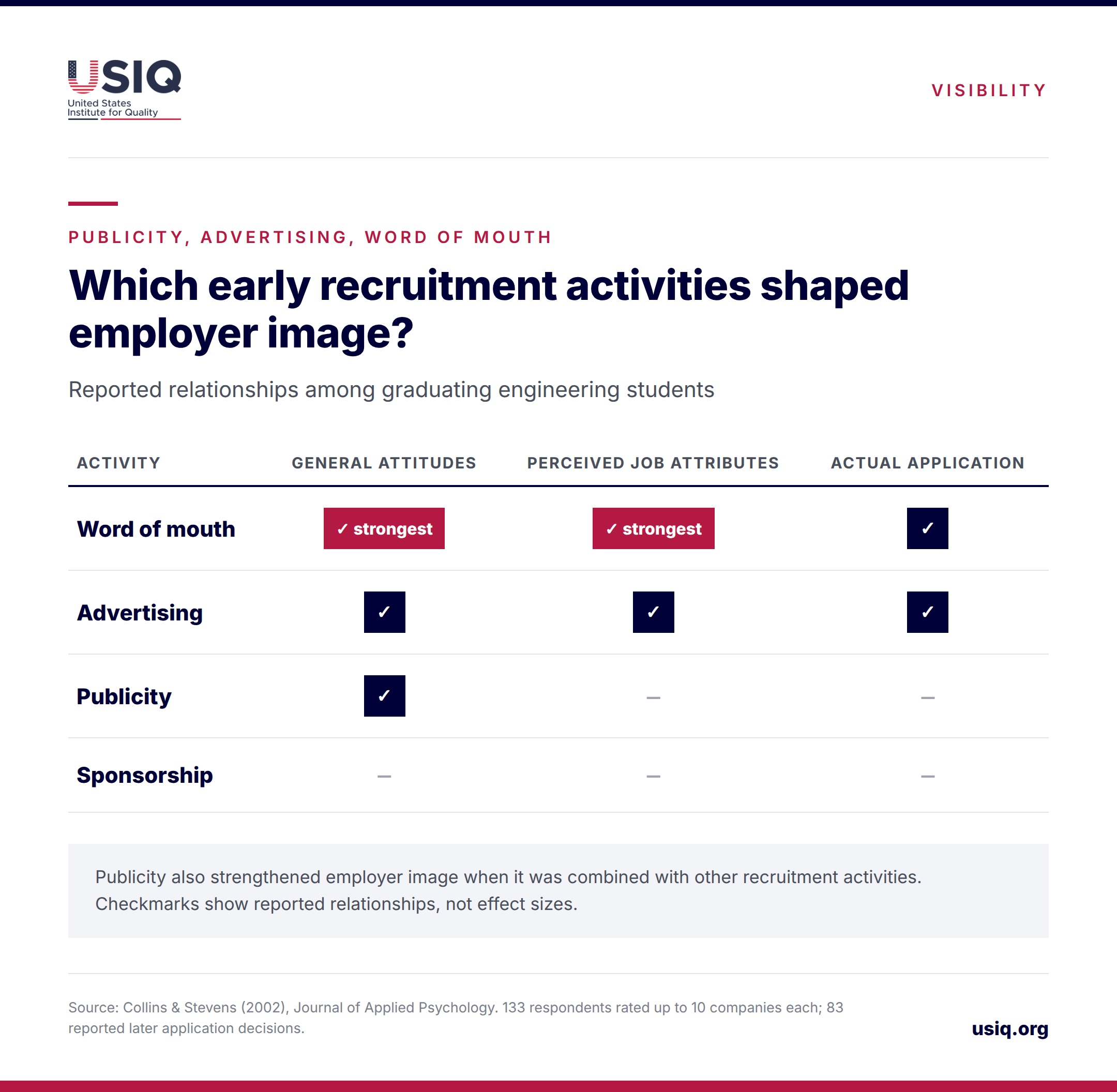
Two points stand out for employers planning a press release about a seal. First, publicity on its own improved attitudes but was not directly related to application decisions in that study. A news item builds awareness and a favorable impression; it does not replace job ads, referrals or a good careers page. Second, publicity amplified the other activities. A seal announcement is most useful as part of a broader effort, not as a one-time event.
Word of mouth from your own employees
The Collins and Stevens finding on word of mouth has been confirmed elsewhere. In a study of 612 potential applicants to the Belgian armed forces, Van Hoye and Lievens (2009) found that positive word of mouth received early in recruitment was associated with both organizational attractiveness and actual application decisions, beyond exposure to other recruitment sources. Who spoke mattered: the perceived expertise of the source and the strength of the relationship made a difference.
This is where the employee survey and the public image meet. Employees who recognize their workplace in a seal, and who saw that their survey answers led to changes, are more likely to speak well of the company to friends and on social media. A seal that employees consider undeserved can have the opposite effect. Online reviews show how much this matters. In an experiment with 725 people with job search experience, favorable reputations on employer rating platforms raised application intentions, and they could help even organizations with weak general reputations (Schaarschmidt, Walsh & Ivens, 2021). A large study of 298,269 reviews of 21,099 employers on a German review platform found that after employers began responding to reviews, they received longer and more varied reviews compared with employers that did not respond (Höllig, Ademi & Tumasjan, 2025). A seal and an online profile describe different sides of the same employer, and candidates increasingly see both.
Third-party recognition and reputation
Research outside HR helps explain why outside recognition can build reputation over time. Studying the early U.S. automobile industry from 1895 to 1912, Rao (1994) showed that firms that won more reliability and speed contests, the certification events of that era, survived longer. He described such contests as a way of making reputation visible when buyers had few other means of judging quality. In banking, Deephouse (2000) found that media reputation, meaning how favorably firms were covered in the press, functioned as a strategic resource linked to better performance.
Visibility work also tends to generate coverage. When smaller listed companies hired investor relations firms, they saw significant increases in press coverage and analyst following compared with a matched control group (Bushee & Miller, 2012). That study concerns investors, not job seekers, but it supports a simple point: news does not spread by itself. A certification gives an employer a legitimate, verifiable reason to contact local media, trade publications and industry associations, and the announcement is more credible when it names the independent body, the method and the result.
Visibility in AI search
Candidates increasingly ask AI assistants which employers in their area are good places to work. These systems draw on what is published about a company across the web, including news items, review profiles and independent recognitions. We are not aware of peer-reviewed research on how employer seals specifically affect AI answers, so no figures are given here. The practical implication is modest but real: verifiable third-party information about an employer, published consistently, is the kind of material such systems can find and cite. USIQ has written about how candidates use AI to research employers and why trust signals matter for visibility.
What other benefits can a certification bring?
Some benefits have less to do with the logo and more to do with what the assessment produces.
A structured diagnosis. A survey-based certification gives management a measured view of how employees experience leadership, workload, development and pay, often for the first time. That data has value even if the recruiting effect turns out to be small. The Harter meta-analysis cited above and the follow-up research by Huebner and Zacher both suggest that acting on such data can pay off, though usually in modest steps.
Customer-facing effects. Unit-level employee satisfaction and engagement have been linked to customer satisfaction in large datasets. The evidence is mostly correlational, as USIQ discusses in its article on employee experience and customer experience.
Financial associations. In finance research, a value-weighted portfolio of U.S. companies on a published list of best employers earned an annual four-factor alpha of 3.5% from 1984 to 2009 and beat industry benchmarks by 2.1% (Edmans, 2011). These are two alternative measures of the same historical result and should not be added together. A later study covering 30 countries found that the link between employee satisfaction and stock returns was stronger in countries with more flexible labor markets, such as the United States (Edmans et al., 2024). These studies concern employee satisfaction at large listed companies. They say nothing about the financial return on a seal license for a 40-person firm.
Willingness to work for the employer. In two randomized field experiments on online labor markets, information about an employer’s social responsibility changed workers’ wage requirements for short online jobs (Burbano, 2016). In the second experiment, mean bids were $130.59 without the message and $73.10 with it. The message was about corporate social responsibility, not certification, and the jobs were short gigs, so this cannot be used to forecast salaries. It does show that information about an employer can change real economic decisions, not just survey answers.
Where is the evidence still thin?
An honest summary has to name the gaps. Most direct studies of awards and seals use students or panel participants, hypothetical job ads and stated intentions. Field studies that observe real turnover and applicant quality cannot rule out that better employers are simply more likely to be certified. Effects depend on how well known the seal and the employer are, which means the same seal can help one company and do nothing for another. Several studies are small, and confidence intervals are wide.
None of this makes seals worthless. It means that claims such as “a seal doubles your applications” or “certified companies have X% less turnover” go beyond what the research supports. The defensible statement is narrower and, for many smaller employers, still attractive: a credible, recognizable seal based on a sound employee survey can make an employer more attractive to people who do not yet know it, and certification is associated with better retention. USIQ’s article on employer certification costs, process and value looks at how to weigh these benefits against cost.
How can employers get the most out of a seal?
The research points to a few practical steps.
Choose a method you can explain. Before applying, find out who is surveyed, what response rate is required, how results are scored and who makes the final decision. If you cannot explain the method to a candidate in two sentences, the seal will struggle to carry meaning. USIQ publishes the full criteria for its Top Employer certification for this reason, so employees and applicants can check how a seal was awarded.
Close the loop with employees first. Share the survey results internally, pick a few improvements and report back on them before the seal goes public. Employees who see their feedback reflected are the people whose word of mouth candidates trust most.
Explain what the seal stands for. Place the seal next to a short description of what was assessed and when, and add concrete details about the role. This addresses the fit trade-off found by Überschaer and Baum and makes it easier for candidates to judge whether the job suits them. USIQ’s seal usage guidelines and its tips on displaying certificates cover the practical side.
Use the news value, then keep going. A press release, a post on the company’s social channels and a note to local media make the most of the moment. The Collins and Stevens results suggest that the announcement works best alongside ongoing recruitment activity.
Measure the effect in your own hiring. The cleanest method is a randomized comparison: show half of the visitors to a job ad a version with the seal and half the identical ad without it, then compare completed applications and, ideally, qualified applications per visitor. The figure below uses invented numbers to show how such a result should be read.
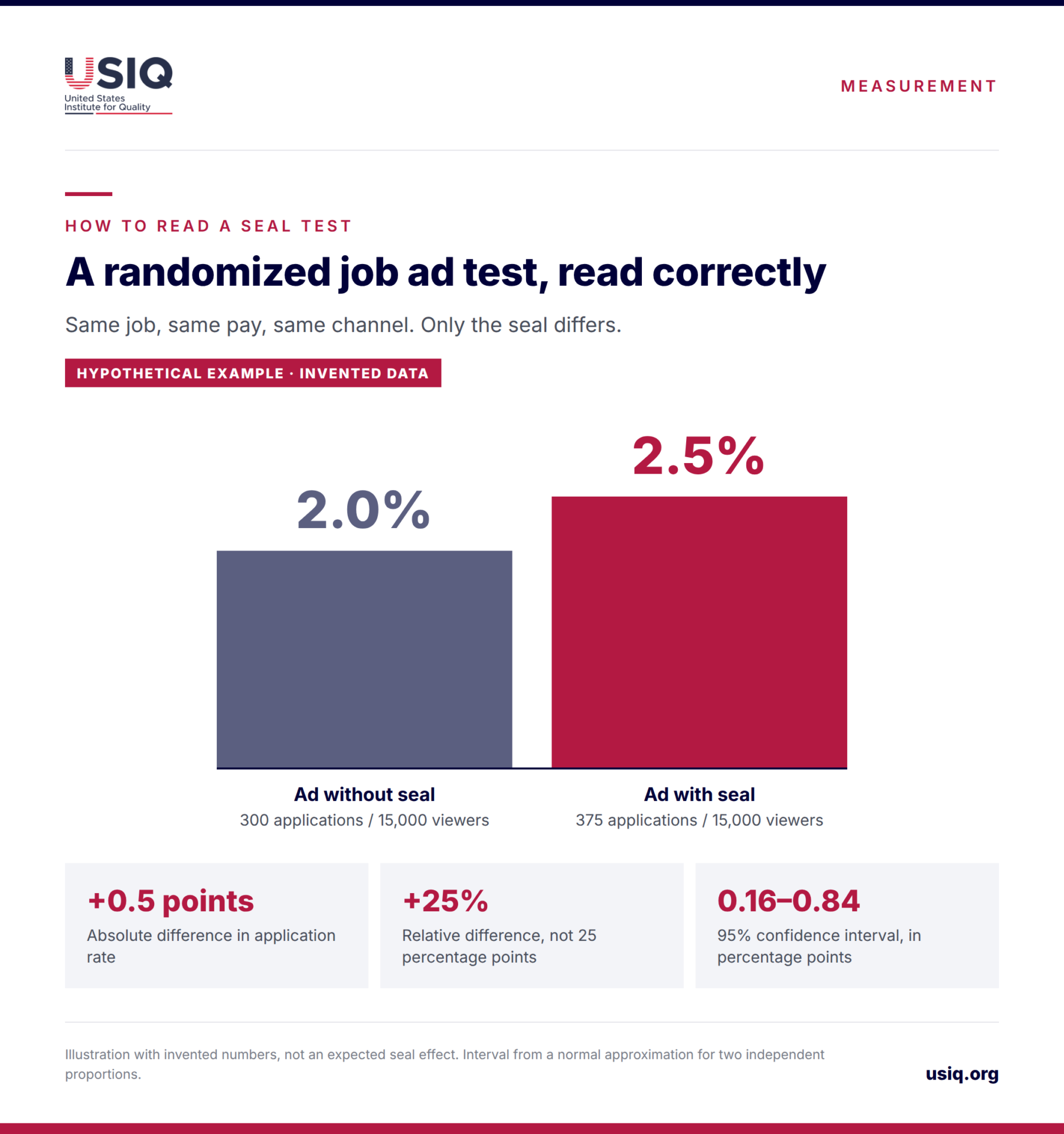
In this hypothetical example, each version reaches 15,000 different people. The version without the seal produces 300 applications (2.0%), the version with the seal 375 (2.5%). That is a difference of 0.5 percentage points, or 25% in relative terms, and 75 additional applications. With a simple normal approximation, the 95% confidence interval for the difference runs from about 0.16 to 0.84 percentage points. These are not expected results. They are a reminder that small absolute differences can still matter for hard-to-fill roles, and that the uncertainty should always be reported next to the headline figure. For roles with few applicants, a before-and-after comparison with a similar control location is a workable alternative, as long as other changes, such as a pay increase or a new recruiting channel, are recorded. USIQ’s guide on measuring marketing ROI for small businesses explains how to connect such results to cost.
So, do employer seals work?
Employer seals are not magic, and the research does not support promises of a fixed increase in applications. It does support a more specific conclusion. A seal based on a sound, representative employee survey can affect three groups. Employees experience voice and, if the employer follows up, visible change. Applicants, especially those who do not yet know the employer, get independent information that makes the company more attractive. And the wider public gets a verifiable reason to hear about the employer, through the media and through employees who speak well of their workplace. Each of these effects depends on the credibility of the method and on what the employer does with the result. For a small or mid-sized company competing with better-known names for the same people, that is often enough to make the effort worthwhile.
FAQ
Do employer seals increase the number of applications?
They can increase interest, but the evidence is mostly about attraction and stated intentions, not counted applications. Independent experiments found positive effects through prestige and perceived fit, some found none, and effects were strongest for employers candidates did not know. Field and platform data suggest that outside information helps smaller and lesser-known employers most.
Which employers benefit most from an employer seal?
Research suggests that lesser-known employers benefit most, especially when the award itself is familiar to candidates. Baum and Überschaer (2018) found that well-known employers gained nothing from an award, and Sockin and Sojourner (2023) found that higher employer ratings increased applications only for smaller firms.
Can an employer seal hurt an employer?
Yes, in some situations. An unfamiliar award reduced job pursuit intentions for well-known employers in one experiment. For familiar companies, awards also weakened the role of person-organization fit in candidates’ choices. A seal that employees consider undeserved can also damage trust internally.
Does certification reduce employee turnover?
In field data from 624 organizations, certification was associated with lower turnover, even after controlling for earlier turnover rates, with smaller additional effects from repeat certifications. The data are observational, so better employers may simply be more likely to be certified. Employers should also watch which employees leave, not just how many.
Why does the employee survey matter for the seal’s credibility?
A seal can only describe the workplace as accurately as the survey behind it. If only a small, self-selected group responds, the result may reflect a vocal minority. Inviting all eligible employees, setting minimum response rates and protecting small groups make the result more representative and more believable to employees and applicants.
Is a press release about a seal worth it?
Research suggests publicity improves general attitudes toward an employer and strengthens other recruitment activities, but on its own it was not directly linked to application decisions. A press release works best as part of a broader effort that includes job ads, a strong careers page and employees who recommend the company.
How can an employer measure the effect of its seal?
The most reliable method is a randomized test: show half of the visitors the job ad with the seal and half the identical ad without it, then compare applications and qualified applications per visitor. Report the absolute difference and its confidence interval, not just a relative percentage.
Sources
- Abramovskij, M., & Enneking, U. (2017). The influence of employer awards on the decision making process of prospective applicants in medium-sized companies: An empirical analysis with special emphasis on the food industry. German Journal of Agricultural Economics, 66(3), 172–187. https://doi.org/10.52825/gjae.v66i3.2064
- Baruch, Y., & Holtom, B. C. (2008). Survey response rate levels and trends in organizational research. Human Relations, 61(8), 1139–1160. https://doi.org/10.1177/0018726708094863
- Baum, M., & Überschaer, A. (2018). When do employer awards pay off and when do they not? The impact of award familiarity on applicants’ job pursuit intentions and the moderating role of corporate brand awareness. The International Journal of Human Resource Management, 29(21), 3093–3117. https://doi.org/10.1080/09585192.2016.1254101
- Burbano, V. C. (2016). Social responsibility messages and worker wage requirements: Field experimental evidence from online labor marketplaces. Organization Science, 27(4), 1010–1028. https://doi.org/10.1287/orsc.2016.1066
- Bushee, B. J., & Miller, G. S. (2012). Investor relations, firm visibility, and investor following. The Accounting Review, 87(3), 867–897. https://doi.org/10.2308/accr-10211
- Cable, D. M., & Turban, D. B. (2003). The value of organizational reputation in the recruitment context: A brand-equity perspective. Journal of Applied Social Psychology, 33(11), 2244–2266. https://doi.org/10.1111/j.1559-1816.2003.tb01883.x
- Chapman, D. S., Uggerslev, K. L., Carroll, S. A., Piasentin, K. A., & Jones, D. A. (2005). Applicant attraction to organizations and job choice: A meta-analytic review of the correlates of recruiting outcomes. Journal of Applied Psychology, 90(5), 928–944. https://doi.org/10.1037/0021-9010.90.5.928
- Collins, C. J. (2007). The interactive effects of recruitment practices and product awareness on job seekers’ employer knowledge and application behaviors. Journal of Applied Psychology, 92(1), 180–190. https://doi.org/10.1037/0021-9010.92.1.180
- Collins, C. J., & Han, J. (2004). Exploring applicant pool quantity and quality: The effects of early recruitment practice strategies, corporate advertising, and firm reputation. Personnel Psychology, 57(3), 685–717. https://doi.org/10.1111/j.1744-6570.2004.00004.x
- Collins, C. J., & Stevens, C. K. (2002). The relationship between early recruitment-related activities and the application decisions of new labor-market entrants: A brand equity approach to recruitment. Journal of Applied Psychology, 87(6), 1121–1133. https://doi.org/10.1037/0021-9010.87.6.1121
- Connelly, B. L., Certo, S. T., Ireland, R. D., & Reutzel, C. R. (2011). Signaling theory: A review and assessment. Journal of Management, 37(1), 39–67. https://doi.org/10.1177/0149206310388419
- Deephouse, D. L. (2000). Media reputation as a strategic resource: An integration of mass communication and resource-based theories. Journal of Management, 26(6), 1091–1112. https://doi.org/10.1177/014920630002600602
- Dineen, B. R., & Allen, D. G. (2016). Third party employment branding: Human capital inflows and outflows following “Best Places to Work” certifications. Academy of Management Journal, 59(1), 90–112. https://doi.org/10.5465/amj.2013.1091
- Dineen, B. R., Van Hoye, G., Lievens, F., & Rosokha, L. M. (2019). Third party employment branding: What are its signaling dimensions, mechanisms, and sources? In M. R. Buckley et al. (Eds.), Research in Personnel and Human Resources Management (Vol. 37). Emerald. https://doi.org/10.1108/S0742-730120190000037006
- Earnest, D. R., Allen, D. G., & Landis, R. S. (2011). Mechanisms linking realistic job previews with turnover: A meta-analytic path analysis. Personnel Psychology, 64(4), 865–897. https://doi.org/10.1111/j.1744-6570.2011.01230.x
- Edmans, A. (2011). Does the stock market fully value intangibles? Employee satisfaction and equity prices. Journal of Financial Economics, 101(3), 621–640. https://doi.org/10.1016/j.jfineco.2011.03.021
- Edmans, A., Pu, D., Zhang, C., & Li, L. (2024). Employee satisfaction, labor market flexibility, and stock returns around the world. Management Science, 70(7), 4357–4380. https://doi.org/10.1287/mnsc.2023.4889
- Federal Trade Commission. Guides Concerning the Use of Endorsements and Testimonials in Advertising, 16 CFR § 255.4 (Endorsements by organizations). https://www.ecfr.gov/current/title-16/chapter-I/subchapter-B/part-255/section-255.4
- Guillot-Soulez, C., Saint-Onge, S., & Soulez, S. (2022). Green certification and organizational attractiveness: The moderating role of firm ownership. Corporate Social Responsibility and Environmental Management, 29(1), 189–199. https://doi.org/10.1002/csr.2194
- Harter, J. K., Schmidt, F. L., & Hayes, T. L. (2002). Business-unit-level relationship between employee satisfaction, employee engagement, and business outcomes: A meta-analysis. Journal of Applied Psychology, 87(2), 268–279. https://doi.org/10.1037/0021-9010.87.2.268
- Höllig, C. E., Ademi, E., & Tumasjan, A. (2025). Employer responsiveness to online reviews: A signal of caring about employees. Human Resource Management, 64(5), 1481–1502. https://doi.org/10.1002/hrm.22316
- Huebner, L.-A., & Zacher, H. (2021). Following up on employee surveys: A conceptual framework and systematic review. Frontiers in Psychology, 12, 801073. https://doi.org/10.3389/fpsyg.2021.801073
- Huebner, L.-A., & Zacher, H. (2022). Effects of action planning after employee surveys. Journal of Personnel Psychology, 21(1), 23–36. https://doi.org/10.1027/1866-5888/a000285
- Jones, D. A., Willness, C. R., & Madey, S. (2014). Why are job seekers attracted by corporate social performance? Experimental and field tests of three signal-based mechanisms. Academy of Management Journal, 57(2), 383–404. https://doi.org/10.5465/amj.2011.0848
- Lievens, F., & Slaughter, J. E. (2016). Employer image and employer branding: What we know and what we need to know. Annual Review of Organizational Psychology and Organizational Behavior, 3, 407–440. https://doi.org/10.1146/annurev-orgpsych-041015-062501
- Lohaus, D., & Rietz, C. (2015). Arbeitgeberattraktivität: Der Stellenwert von Bekanntheit und Labels in der frühen Rekrutierungsphase. Zeitschrift für Arbeits- und Organisationspsychologie, 59(2), 70–84. https://doi.org/10.1026/0932-4089/a000175
- Osburg, V.-S., Yoganathan, V., Bartikowski, B., Liu, H., & Strack, M. (2020). Effects of ethical certification and ethical eWoM on talent attraction. Journal of Business Ethics, 164(3), 535–548. https://doi.org/10.1007/s10551-018-4018-8
- Pfiffelmann, J., De Pelsmacker, P., Guillot-Soulez, C., & Soulez, S. (2025). Do green employer labels matter? A study of the impact of advertising environmental responsibility on recruitment. International Journal of Advertising, 44(6), 985–1016. https://doi.org/10.1080/02650487.2025.2511352
- Pratt, B. R., Dineen, B. R., & Wu, L. (2022). Nowhere to grow: Ranking success and turnover composition in elite employers. Journal of Organizational Behavior, 43(4), 584–603. https://doi.org/10.1002/job.2587
- Rao, H. (1994). The social construction of reputation: Certification contests, legitimation, and the survival of organizations in the American automobile industry: 1895–1912. Strategic Management Journal, 15(S1), 29–44. https://doi.org/10.1002/smj.4250150904
- Roberson, Q. M., Collins, C. J., & Oreg, S. (2005). The effects of recruitment message specificity on applicant attraction to organizations. Journal of Business and Psychology, 19(3), 319–339. https://doi.org/10.1007/s10869-004-2231-1
- Rogelberg, S. G., & Stanton, J. M. (2007). Introduction: Understanding and dealing with organizational survey nonresponse. Organizational Research Methods, 10(2), 195–209. https://doi.org/10.1177/1094428106294693
- Saini, G. K., Rai, P., & Chaudhary, M. K. (2014). What do best employer surveys reveal about employer branding and intention to apply? Journal of Brand Management, 21(2), 95–111. https://doi.org/10.1057/bm.2013.10
- Schaarschmidt, M., Walsh, G., & Ivens, S. (2021). Digital war for talent: How profile reputations on company rating platforms drive job seekers’ application intentions. Journal of Vocational Behavior, 131, 103644. https://doi.org/10.1016/j.jvb.2021.103644
- Scharfenberg, O. (2024). Marktanalyse bestehender Gütesiegel für Arbeitgeber in Deutschland [PhDr. thesis, DTI University]. Study summary: https://www.usiq.org/top-employer/research/
- Smidts, A., Pruyn, A. T. H., & van Riel, C. B. M. (2001). The impact of employee communication and perceived external prestige on organizational identification. Academy of Management Journal, 44(5), 1051–1062. https://doi.org/10.2307/3069448
- Sockin, J., & Sojourner, A. (2023). What’s the inside scoop? Challenges in the supply and demand for information on employers. Journal of Labor Economics, 41(4), 1041–1079. https://doi.org/10.1086/721701
- Spencer, D. G. (1986). Employee voice and employee retention. Academy of Management Journal, 29(3), 488–502. https://doi.org/10.5465/256220
- Thompson, L. F., & Surface, E. A. (2009). Promoting favorable attitudes toward personnel surveys: The role of follow-up. Military Psychology, 21(2), 139–161. https://doi.org/10.1080/08995600902768693
- Turban, D. B., & Cable, D. M. (2003). Firm reputation and applicant pool characteristics. Journal of Organizational Behavior, 24(6), 733–751. https://doi.org/10.1002/job.215
- Überschaer, A., & Baum, M. (2020). Top employer awards: A double-edged sword? European Management Journal, 38(1), 146–156. https://doi.org/10.1016/j.emj.2019.06.004
- Van Hoye, G., & Lievens, F. (2009). Tapping the grapevine: A closer look at word-of-mouth as a recruitment source. Journal of Applied Psychology, 94(2), 341–352. https://doi.org/10.1037/a0014066
- Zhang, Y. C., Shum, C., & Belarmino, A. (2023). “Best Employers”: The impacts of employee reviews and employer awards on job seekers’ application intentions. Cornell Hospitality Quarterly, 64(3), 298–306. https://doi.org/10.1177/19389655221130741
- Zhao, H., Wayne, S. J., Glibkowski, B. C., & Bravo, J. (2007). The impact of psychological contract breach on work-related outcomes: A meta-analysis. Personnel Psychology, 60(3), 647–680. https://doi.org/10.1111/j.1744-6570.2007.00087.x


Related Articles
What research says about the effects of employer seals on current employees, potential applicants and employer image, from independent experiments and field data to the limits of the evidence.
Employee experience and customer experience are linked, but the link is weaker and more conditional than popular slogans suggest. This article reviews the evidence on staffing, training and workplace conditions and shows how employers can test the connection in their own business.
Most HR dashboards show too many metrics and trigger too few decisions. This guide defines ten employee experience metrics, shows a one-page layout and explains how to read your numbers against U.S. data.
A practical guide to calculating marketing ROI for small and mid-sized U.S. companies, including long B2B sales cycles, offline leads, a spreadsheet walkthrough and common errors.