
An employer seal is a public badge that tells job seekers and employees an outside party has reviewed a workplace. Owners and HR leads at companies with 10 to 250 employees meet the question sooner or later: is an employer seal worth pursuing, and how do you tell a serious one from a badge anyone can buy?
The answer has several parts. A seal can help, but the evidence for specific hiring and retention effects is thinner than many vendor pages suggest. It works only when the workplace behind it is real. And once a seal appears in a job ad, federal advertising rules apply to it.
This article defines the term, looks at current U.S. labor-market data by company size, reviews what research shows and does not show, and walks through earning, costing, vetting and advertising a seal.
Quick answer: An employer seal is time-limited, third-party recognition of workplace practices, usually based on employee feedback and HR information. Controlled experiments suggest that certification signals and employer seals raise job seekers’ interest, but no verified U.S. data shows lower turnover. Credible seals publish criteria, rely on employee surveys, and keep the award independent of payment.
Key takeaways
- An employer seal is recognition of workplace practices from an outside party. It differs from a ranking, an award or a review-site rating.
- In September 2026, U.S. employers had 7.5 million job openings, and 3.4 million people quit. Firms with 10 to 249 employees saw higher quits rates than large employers.
- Experimental evidence shows that certification signals can raise job seekers’ intention to pursue a job. A retention effect is plausible but unproven.
- The employee survey is the main trust signal. A seal without employee input says little about daily work.
- Ask about criteria, fees, the independence of the award decision, term and renewal before you sign anything.
- The FTC’s Endorsement Guides treat an organization’s seal as a possible endorsement. Claims must be truthful, and a hidden relationship with the certifier needs disclosure.
What is an employer seal?
An employer seal is third-party recognition that a company meets stated standards for how it treats its people. It is usually based on employee feedback and information from HR, and it is valid for a limited period.
The term is often mixed up with related things. A ranking orders companies against each other and usually admits only a fixed number. An award honors a single achievement or initiative. A review-site rating reflects whoever chooses to post. A seal answers a yes-or-no question: did this employer meet the criteria during this period?
Seals can cover the whole employer experience or one theme, such as family-friendly policies. USIQ, the publisher of this article, runs certification programs of this kind, including Top Employer and Family Friendly Employer. For a wider view of standards and processes, see this explainer on employer certification.
The legal status matters too. The Federal Trade Commission’s revised Endorsement Guides state that “the name or seal of an organization can be endorsements.” A seal on your careers page is advertising content, not decoration.
Why does an employer seal matter in today’s U.S. labor market?
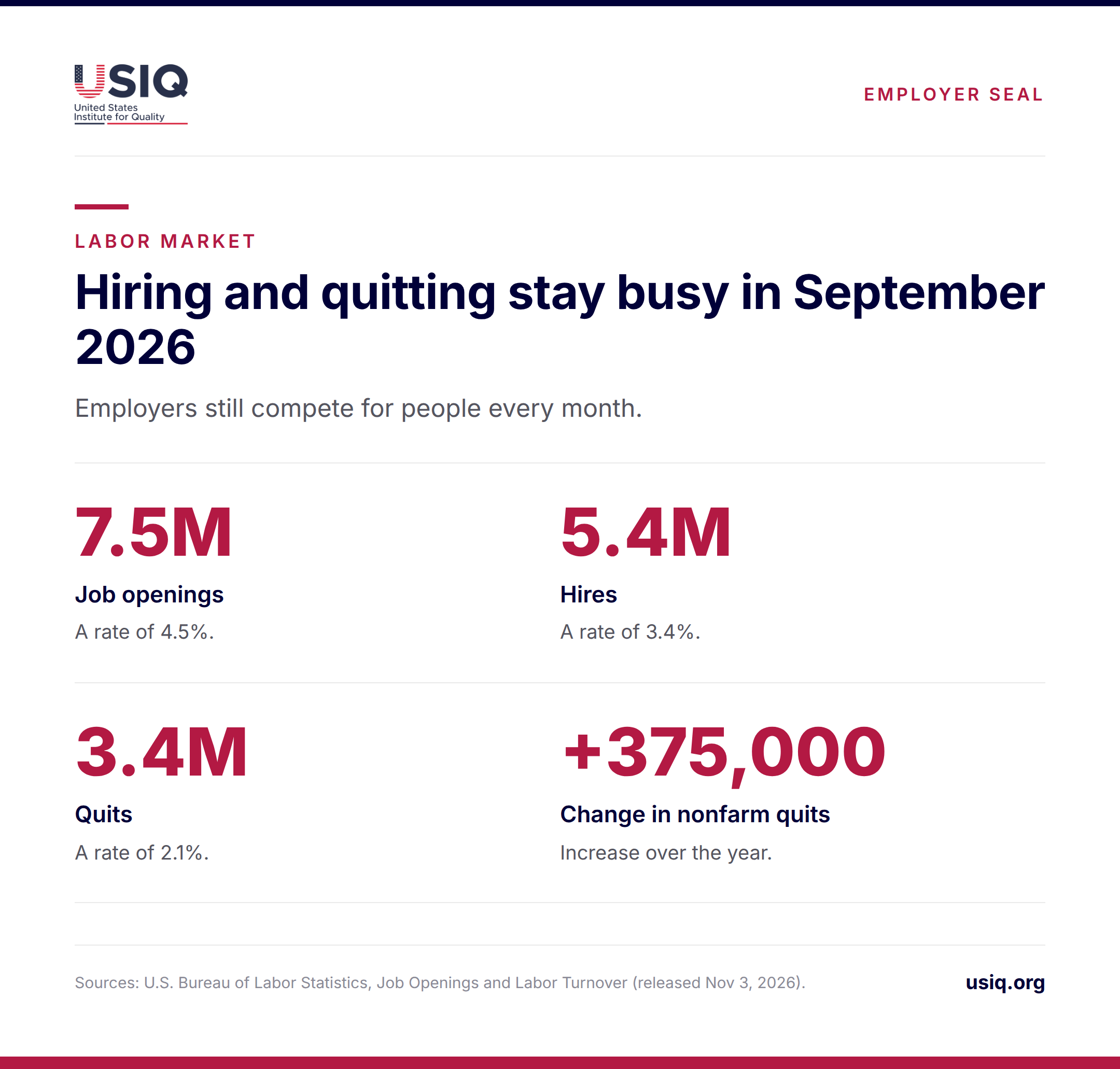
Hiring and keeping people remains a daily task. The Bureau of Labor Statistics reported 7.5 million job openings (a rate of 4.5%) for September 2026. Employers made 5.4 million hires (3.4%), and total separations reached 5.3 million (3.3%), of which layoffs and discharges were 1.6 million (1.0%).
Quits, which BLS defines as generally voluntary, employee-initiated separations, rose to 3.4 million, a rate of 2.1%. Over the year, nonfarm quits increased by 375,000.
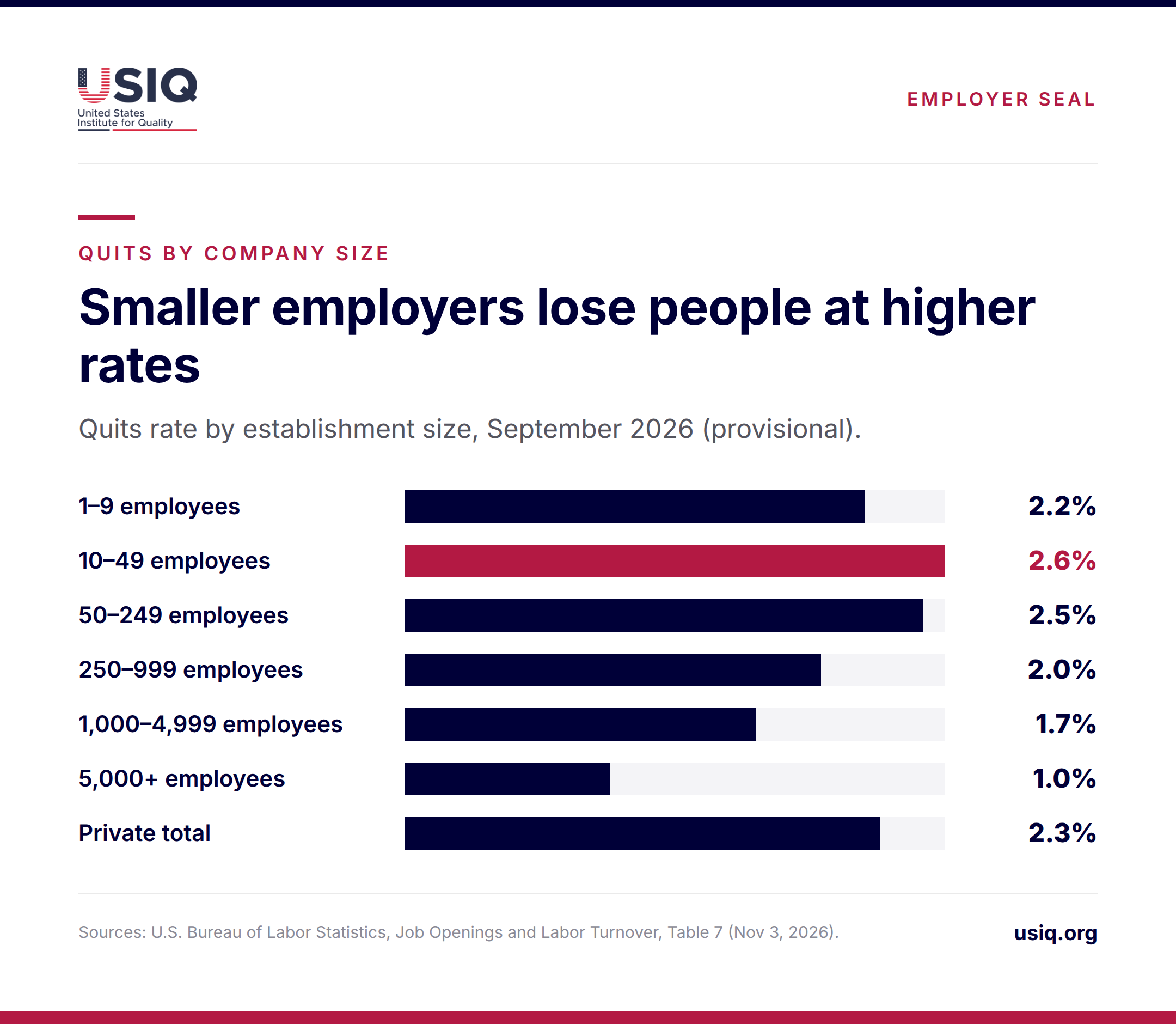
Company size changes the picture. In the same release, the private-sector quits rate was 2.3%, but it varied widely by establishment size. Employers in the 10 to 49 and 50 to 249 brackets, the size of most readers’ companies, lose people at a higher rate than large employers.
| Establishment size | Quits rate, September 2026 (provisional) |
|---|---|
| 1–9 employees | 2.2% |
| 10–49 employees | 2.6% |
| 50–249 employees | 2.5% |
| 250–999 employees | 2.0% |
| 1,000–4,999 employees | 1.7% |
| 5,000+ employees | 1.0% |
| Private total | 2.3% |
The year-over-year shift stands out for the smaller bracket. The quits rate at firms with 10 to 49 employees was 1.8% in September 2025 and 2.6% in September 2026. At firms with 50 to 249 employees it held at 2.5% in both months. The openings rate also differs: 4.8% for 10 to 49 employees and 3.7% for 50 to 249.
JOLTS is a monthly, provisional snapshot, and single-month size-class figures move. They show that smaller employers compete for staff against larger ones, not that any one measure will fix it. For a small or mid-size firm, a credible seal is one way to give candidates an outside reference point. That is a reasoned argument, not a measured effect.
Does an employer seal actually help recruiting and retention?
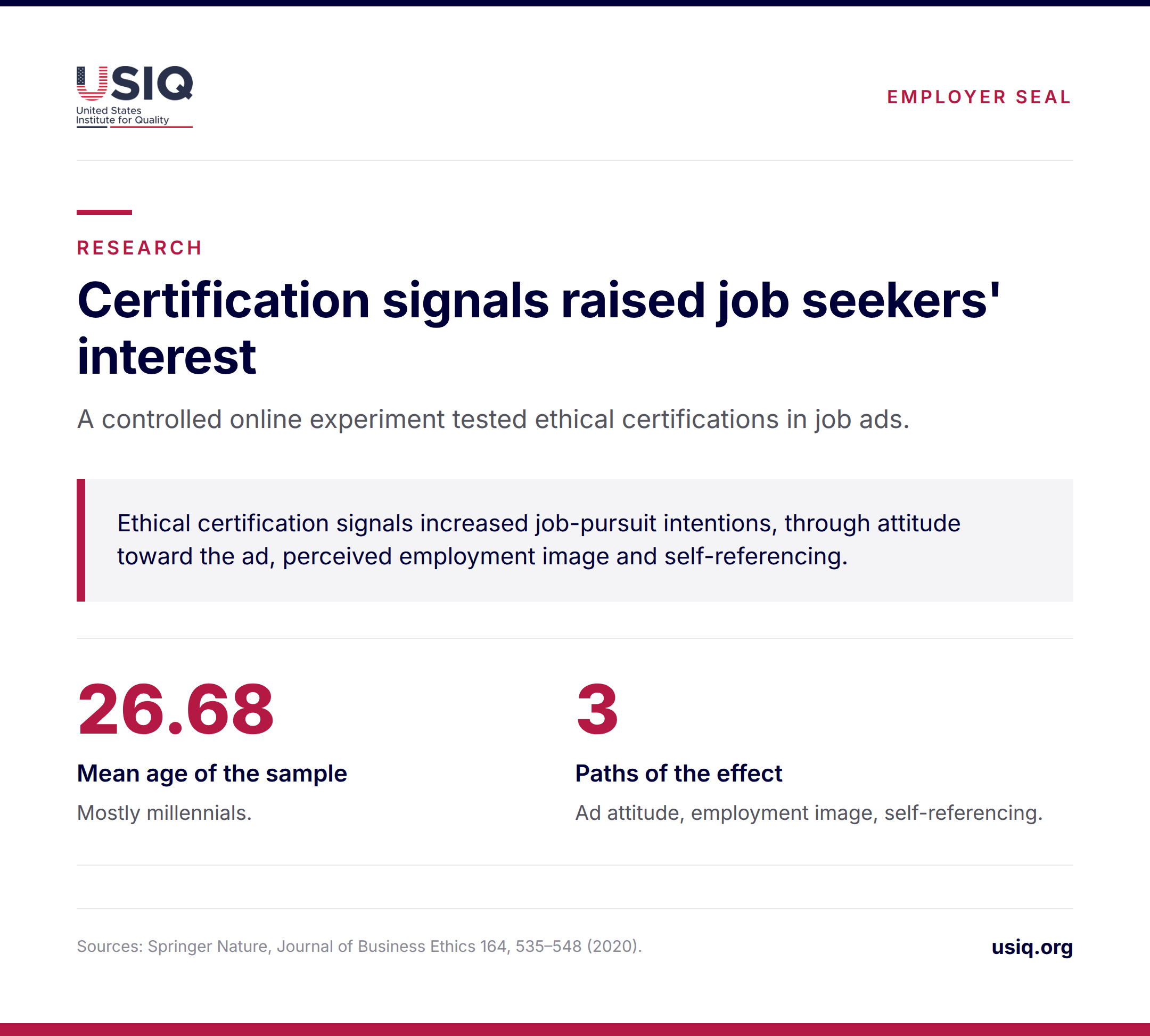
There is some experimental evidence on recruiting and little verified evidence on retention. A controlled online experiment published in the Journal of Business Ethics found that company-controlled ethical market signals, such as ethical certifications, increased job seekers’ job-pursuit intentions. The effect ran through their attitude toward the ad, the perceived employment image and self-referencing.
The study has limits. Its sample had a mean age of 26.68 and consisted mostly of millennials. The certifications tested were ethical certifications, not employer certifications. The authors held all other job-ad features constant and note that the weight of such signals relative to other drivers of job choice needs further research.
A second experiment looked at employer seals directly. In a randomized experiment with 1,093 participants, Oliver Scharfenberg, CEO of USIQ, found that an employer seal raised the stated likelihood of applying for a job by about 16 percentage points. Like the first study, it measured intentions rather than actual applications. The design and its limits are described on USIQ’s research page.
What about retention, and where does a seal fall short?
Many circulating claims, such as exact percentages for lower turnover or higher productivity, trace back to no identifiable study, and this article does not repeat them. A retention benefit is plausible. The more likely route is indirect: a survey surfaces problems, management fixes them, and people have fewer reasons to leave.
A seal does not offset weak pay or poor management. It will not decide every candidate’s choice, though it may help a company clear a candidate’s first screen. A seal that outruns daily reality can backfire, because employees and applicants compare the claim with their own experience. Employees may feel more pride and loyalty when an outside party confirms what they already experience, though that is a plausible internal effect, not a measured one.
How do you earn an employer seal?
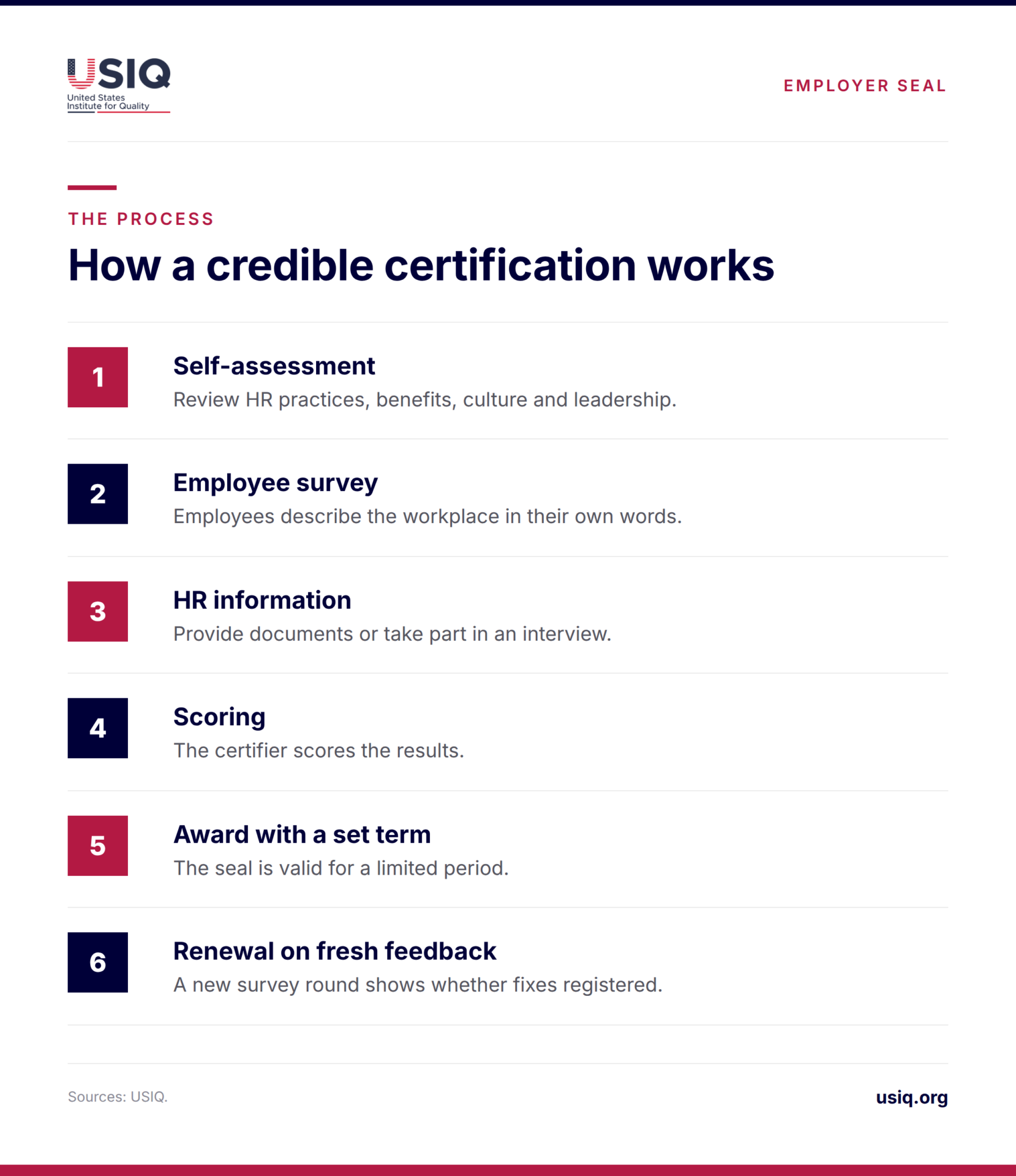
Processes differ by provider, but a credible one follows a recognizable sequence. It starts with a self-assessment of HR practices, benefits, culture and leadership. Then comes an employee survey, followed by information from HR through documents or an interview. The certifier scores the results, decides on the award, and sets a term after which the seal expires and must be renewed.
USIQ’s Top Employer certification combines a confidential survey of all eligible employees with an online HR assessment of 39 criteria, and each part is worth up to 100 points. The scoring rules and minimums are published in the Top Employer methodology. The survey is the central trust signal, because it records how employees describe the workplace, not how management describes it. A look at how employee surveys work explains why that distinction matters.
What should you prepare before you apply?
Check first that internal practice matches what you plan to claim. If it does not, the review will expose the gap instead of validating the claim. Be ready to receive weak scores and to say what you will change. Review your pay and benefits against the market, how managers handle feedback, and whether flexible schedules or training budgets work in practice.
Treat renewal as an improvement cycle. A new survey round shows whether last year’s fixes registered with employees. The same logic applies when preparing for awards and rankings, as this guide on what sets the best employers apart describes.
How much does an employer seal cost?
Prices vary by provider, and no neutral, current cost benchmark is available. Common models are a fee by headcount, a flat rate, or a base fee plus renewal charges. Quotes that look similar can cover different things, so compare scope before price.
Ask for the total cost in writing before starting, and cover these points:
- Does the fee include the employee survey, the evaluation and a results report?
- Are logos, badges and marketing assets included, or billed separately?
- How long does the seal stay valid, and what does renewal cost?
- What happens to the fee if you do not meet the criteria?
Also count internal time: HR hours for the interview, a manager’s time to communicate the survey, and follow-up work on the results. These hours often matter as much as the fee. Weigh the total against the hiring spend it may support, for example your recruiting costs.
How can you tell a credible employer seal from a pay-to-play badge?
A fee alone does not make a seal unreliable. The FTC’s revised Endorsement Guides discuss a non-profit third party that charged a reasonable fee for evaluating a product (Example 10). The seal could be used without disclosing the fee, because consumers would reasonably expect to pay for certification. The FTC added that non-profit status may make it less likely that payment influenced the award. The test is whether payment decides the outcome.
| Check | Credible sign | Warning sign |
|---|---|---|
| Criteria | Published and specific | Vague or shared only after payment |
| Employee input | Survey of your own employees is required | Self-reported form only |
| Award decision | Independent of payment | Everyone who pays receives the seal |
| Fees | Stated up front, with scope | Unclear or revealed late |
| Term and renewal | Clear validity period, renewal on new feedback | No expiry date, or automatic renewal |
| Process fit | Tailored to your company and the seal type | One-size-fits-all questionnaire |
| Communication | Responsive throughout | Weeks of silence |
| Promises | No guaranteed outcome | Guaranteed results or applicant numbers |
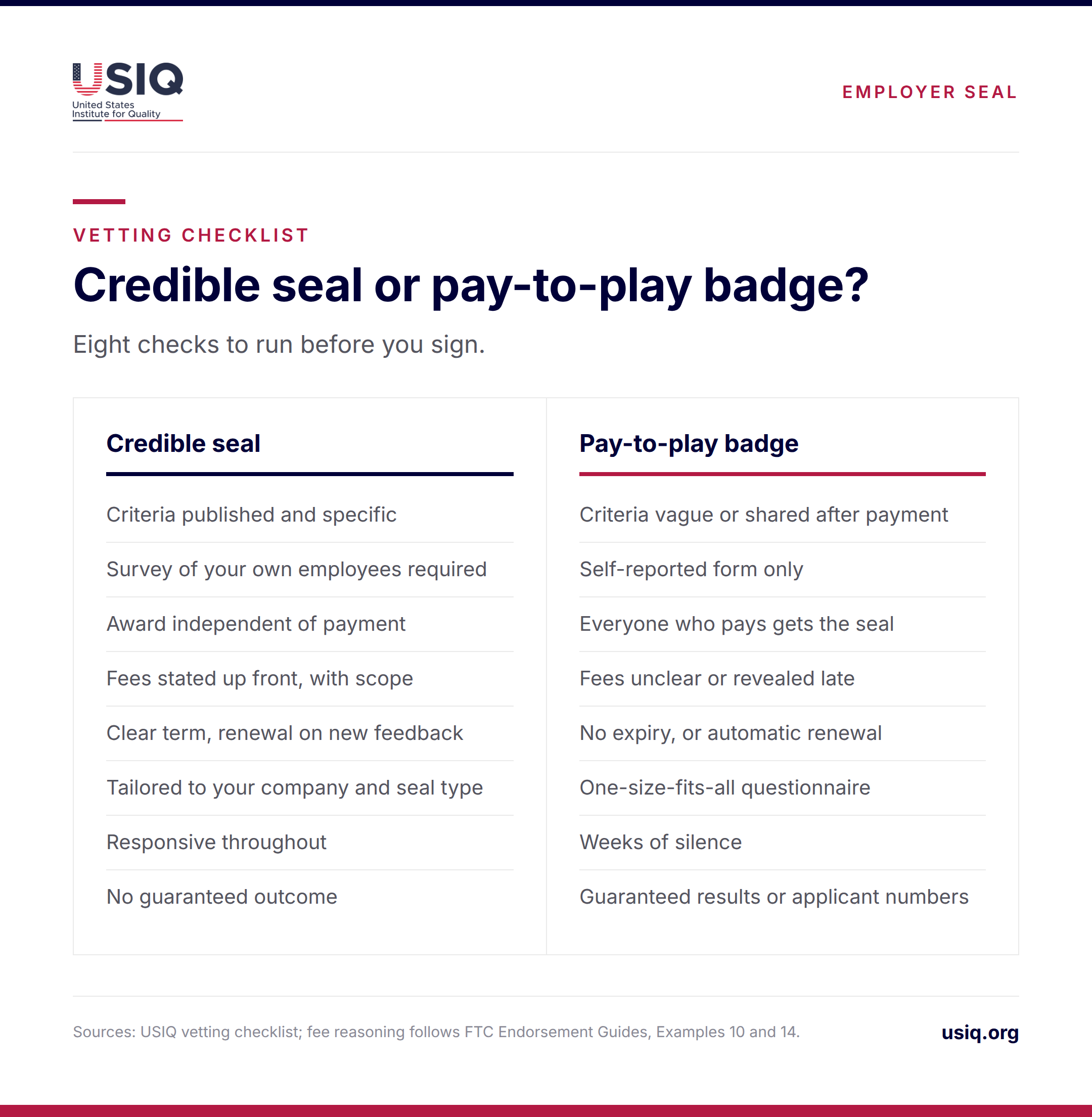
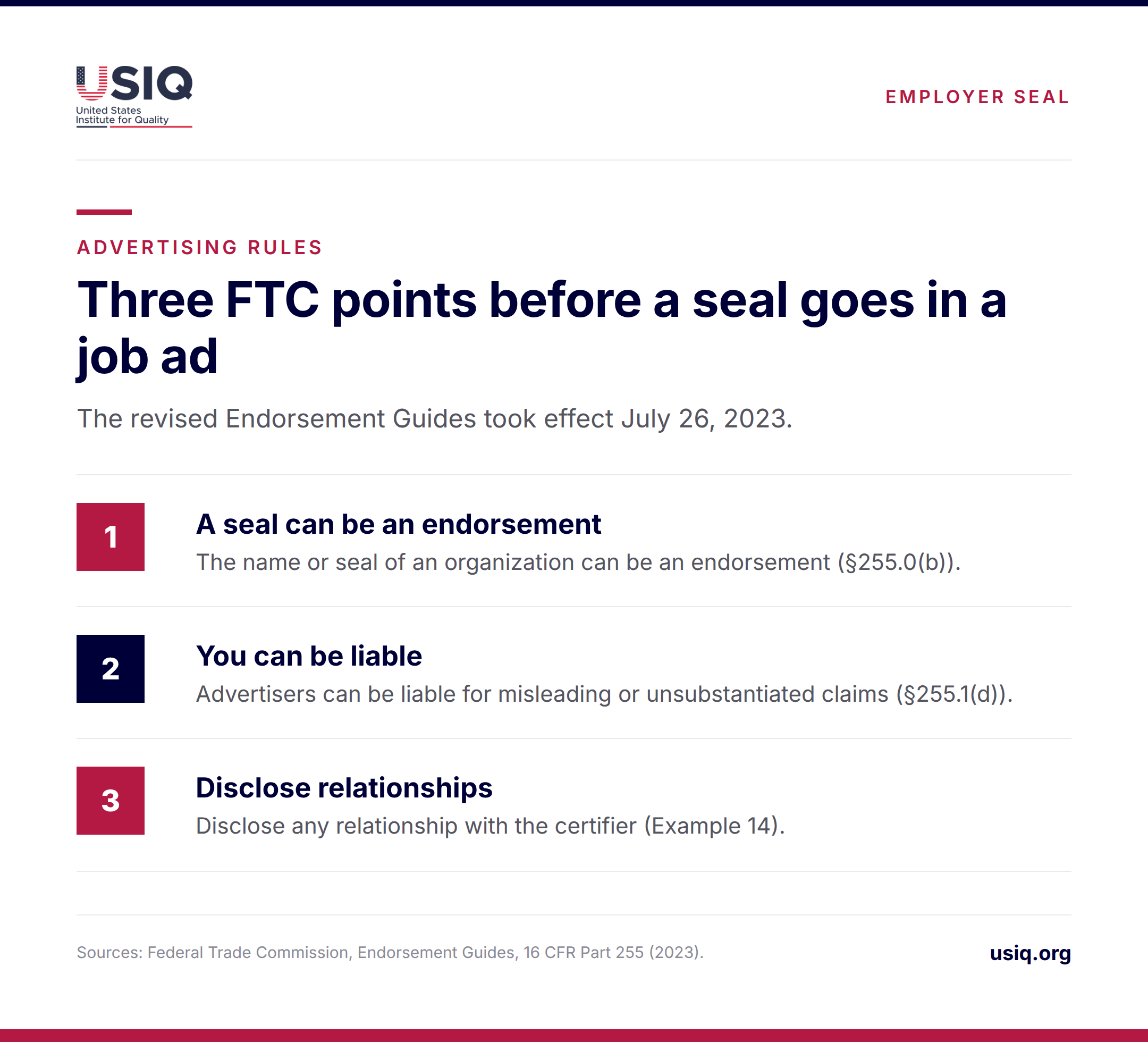
The FTC also added Example 14: where a testing company has a relationship with the company that commissioned the analysis, disclosure of that relationship is necessary. Applied here, ask whether the certifier has any financial or ownership tie to you, and whether anyone else has such a tie to the certifier. The guide to employer certification explains how certifications differ from rankings.
Can you advertise an employer seal legally?
Yes, but the seal counts as advertising content. The FTC’s revised Endorsement Guides (16 CFR Part 255) were published as a final rule at 88 FR 48092 and took effect July 26, 2023. They state that the name or seal of an organization can be an endorsement (§255.0(b)). The seal must therefore reflect the certifier’s real findings.
The advertiser can be liable for misleading or unsubstantiated statements made through an endorsement, and the FTC discusses this where a connection exists between advertiser and endorser (§255.1(d)). The FTC also says that a defendant who received a Notice of Penalty Offenses on endorsements and then engaged in certain deceptive endorsement practices could face substantial civil penalties. The FTC’s page on endorsements, influencers and reviews links to further guidance, including its Q&A on fake or procured reviews.
Some practical consequences follow. Do not display an expired seal, and tie words like “certified” to the actual certification period and scope. A seal for one program or location should not be presented as covering the whole company. State unfair-and-deceptive-practices laws also apply, so check them with legal counsel before a campaign.
How should you use an employer seal after you earn it?
Outside, put the seal where candidates look: the careers page, job ads, email signatures and the LinkedIn company profile. Show the certification year and what it covers. Guidance on displaying certificates effectively covers placement in more detail.
Many employers stop at the careers page, but the bigger effect on staff usually comes from inside the company. Share the survey results with the team, including the weaker scores, and say what you plan to change. Mention the seal during onboarding so new hires know what it stands for. Tie the criteria to everyday policies, such as how flexible schedules or training budgets are handled. Then renew on the basis of fresh employee feedback, which tells people their opinion keeps counting. An old badge nobody talks about tells them the opposite.
What are common misconceptions about employer seals?
- “A seal guarantees more applicants.” Experiments show an effect on intention to pursue a job, not a guaranteed result for any company.
- “More seals always rank you higher with candidates.” No source supports this, and a few well-understood seals beat a wall of logos.
- “Paying for certification makes it fake.” Not by itself. What counts is independence of the award decision and clear disclosure of any relationship.
- “A seal fixes a weak workplace.” It reports on the workplace. It does not repair it.
What practical steps should you take next?
- Run an honest internal review of pay, benefits, culture and leadership, and fix obvious gaps first.
- Shortlist certifiers that publish criteria and require an employee survey.
- Request written pricing that states scope, term and renewal.
- Ask how the award decision stays independent of payment and whether any relationship exists between the certifier and you.
- Plan how you will communicate results to employees before you tell the outside world.
- Have counsel review how the seal will appear in job ads and marketing.
FAQ
What is an employer seal in simple terms?
An employer seal is a badge awarded by an outside organization to show that a company meets defined standards for how it treats employees. It is usually based on employee feedback and HR information, and it is valid for a limited time. It is not a ranking or a review-site score.
Does an employer seal reduce turnover?
No verified source proves that a seal lowers turnover. A benefit is plausible, mainly because the survey behind a seal reveals problems that management can fix. Treat any promised turnover percentage with suspicion unless the provider names a traceable study.
Does an employer seal help attract job applicants?
Experimental evidence suggests it can. A controlled study published in the Journal of Business Ethics found that ethical certification signals raised job seekers’ pursuit intentions. A second randomized experiment with 1,093 participants, run by USIQ’s CEO Oliver Scharfenberg, found that an employer seal raised the stated likelihood of applying by about 16 percentage points. Neither result guarantees anything for an individual employer.
How long does it take to earn an employer seal?
Timelines depend on the provider, and no neutral benchmark exists. The main steps are a self-assessment, an employee survey, an HR interview or document review, scoring and the award. Ask for a written timeline, and allow extra time to respond to survey results.
Is a paid employer seal automatically untrustworthy?
No. The FTC’s Endorsement Guides discuss a reasonable fee for a genuine evaluation and treat it as acceptable, since people expect to pay for certification. The warning sign is an award that follows payment automatically, or an undisclosed relationship between certifier and company.
Does the FTC regulate how I display an employer seal?
The FTC’s revised Endorsement Guides, effective July 26, 2023, say an organization’s name or seal can be an endorsement. Advertisers can be liable for misleading or unsubstantiated claims made through it. State laws may add requirements, so consult legal counsel before running a campaign.
Can a small company with 10 to 50 employees benefit from a seal?
It can. BLS data show a quits rate of 2.6% for establishments with 10 to 49 employees in September 2026, against 1.0% at those with 5,000 or more. A seal gives smaller employers an outside reference point when competing with larger names. That is a reasoned argument, not a measured effect.
What happens when an employer seal expires?
Remove it from job ads, the website and signatures, or replace it after a successful renewal. Displaying an expired seal risks a misleading claim. Renewal usually requires fresh employee feedback, which also shows whether earlier improvements made a difference.
Sources
- U.S. Bureau of Labor Statistics. “Job Openings and Labor Turnover – September 2026.” Nov 3, 2026. https://www.bls.gov/news.release/pdf/jolts.pdf
- Federal Trade Commission via Federal Register. “Guides Concerning the Use of Endorsements and Testimonials in Advertising.” Jul 26, 2023. https://www.federalregister.gov/documents/2023/07/26/2023-14795/guides-concerning-the-use-of-endorsements-and-testimonials-in-advertising
- Federal Trade Commission. “FTC’s Endorsement Guides: What People Are Asking.” https://www.ftc.gov/business-guidance/resources/ftcs-endorsement-guides-what-people-are-asking
- Federal Trade Commission. “Endorsements, Influencers, and Reviews.” https://www.ftc.gov/business-guidance/advertising-marketing/endorsements-influencers-reviews
- Springer Nature. “Effects of Ethical Certification and Ethical eWoM on Talent Attraction.” Journal of Business Ethics 164, 535–548. 2020 (online 2018). https://link.springer.com/article/10.1007/s10551-018-4018-8

Related Articles
What research says about the effects of employer seals on current employees, potential applicants and employer image, from independent experiments and field data to the limits of the evidence.
Employee experience and customer experience are linked, but the link is weaker and more conditional than popular slogans suggest. This article reviews the evidence on staffing, training and workplace conditions and shows how employers can test the connection in their own business.
Most HR dashboards show too many metrics and trigger too few decisions. This guide defines ten employee experience metrics, shows a one-page layout and explains how to read your numbers against U.S. data.
A practical guide to calculating marketing ROI for small and mid-sized U.S. companies, including long B2B sales cycles, offline leads, a spreadsheet walkthrough and common errors.