

Ask ten managers what makes a great employer and nine will name the same list: fair pay, respect, growth, good leadership, flexibility. The list is not wrong. It just does not say which items matter most, or what a company with 40 or 150 employees can realistically do about them.
This article ranks great employer qualities by the evidence. It draws on Gallup engagement research, Bureau of Labor Statistics (BLS) benefit and turnover data, and a Pew Research Center survey of workers who quit. It also shows where small firms differ from large ones and how to measure your own standing.
Quick answer: A great employer is measurably good for its people, not just well known. The evidence points to trusted managers, clear expectations, fair pay, a path to grow, respect and stability. Gallup finds managers account for at least 70% of the variance in team engagement, so management quality outweighs perks.
Key takeaways
- Only 31% of U.S. employees were engaged in 2025, so a great employer stands out against a weak baseline.
- Workers who quit in 2021 named low pay, no advancement and disrespect as the main reasons, each cited by well over half.
- Managers account for at least 70% of the variance in team engagement, which makes manager quality the largest single lever.
- Small firms offer fewer benefits: 59% of private-sector workers at firms with 1 to 99 employees have retirement access, versus 87% at firms with 100 or more.
- Losing an employee can cost one-half to two times annual salary, and 52% of voluntary leavers said their manager or organization could have prevented the exit.
- Clear expectations, development and a say in decisions cost little and can be started this quarter.
- Reputation and quality are different things. Measure quality with an anonymous survey and a few retention numbers.
What makes a great employer?
A great employer delivers an employee experience that can be measured and repeated: people know what is expected of them, feel cared about, are paid fairly, see a future and trust their managers. Fame is not part of the definition. A company can have a polished careers page and a poor workplace, and the reverse is just as common.
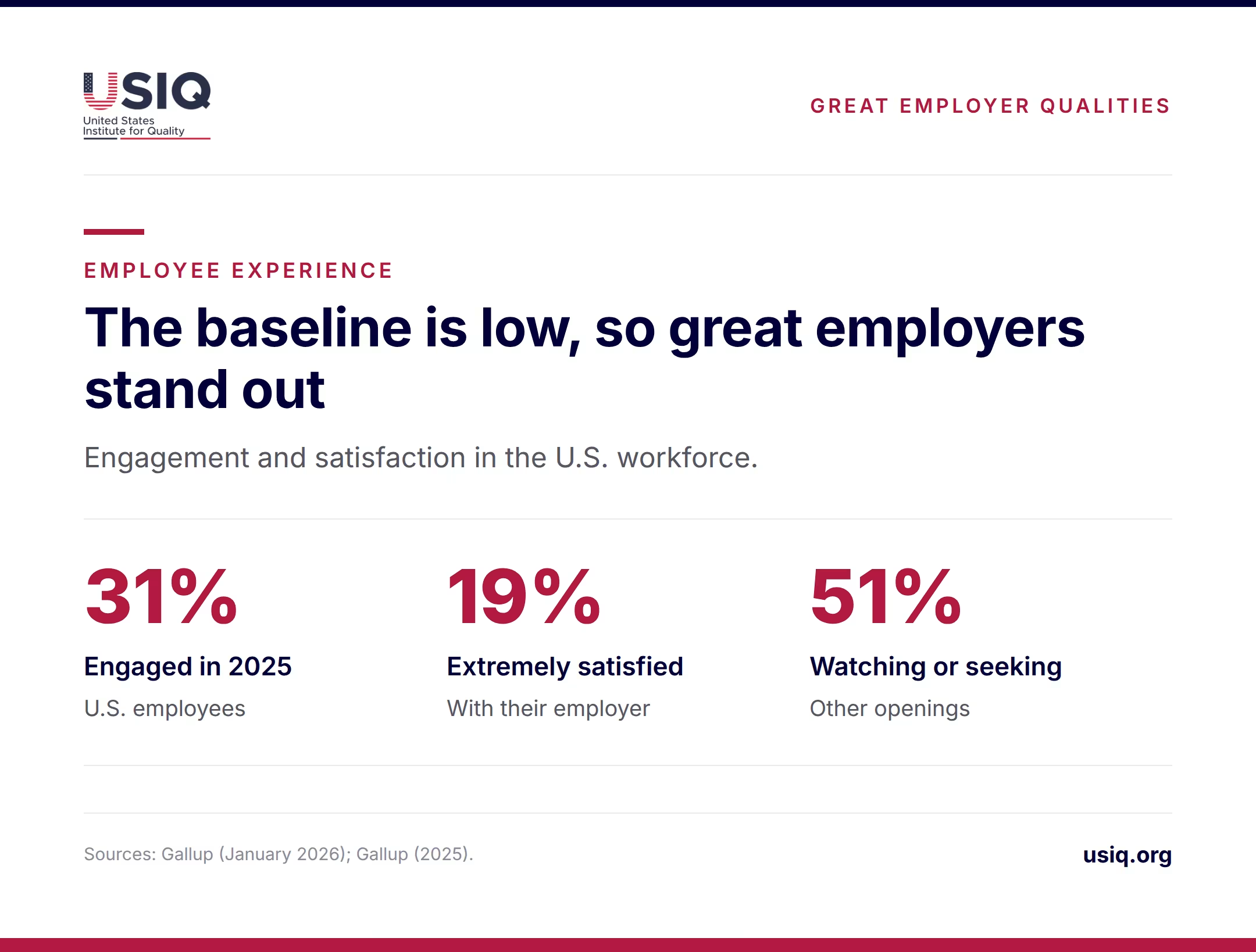
The baseline is low. Gallup found that 31% of U.S. employees were engaged in 2025, unchanged from 2024 and down from a high of 36% in 2020. Each point equals about 1.6 million employees, so the drop since 2020 represents roughly 8 million fewer engaged workers (Gallup, January 2026).
Satisfaction looks similarly thin. In Gallup’s 2025 midyear data, 19% of employees were extremely satisfied with their employer, and 51% were watching for or seeking other openings (Gallup). For an employer with 10 to 250 people, that means half the workforce may already be listening to recruiters.
Which great employer qualities matter most to employees?
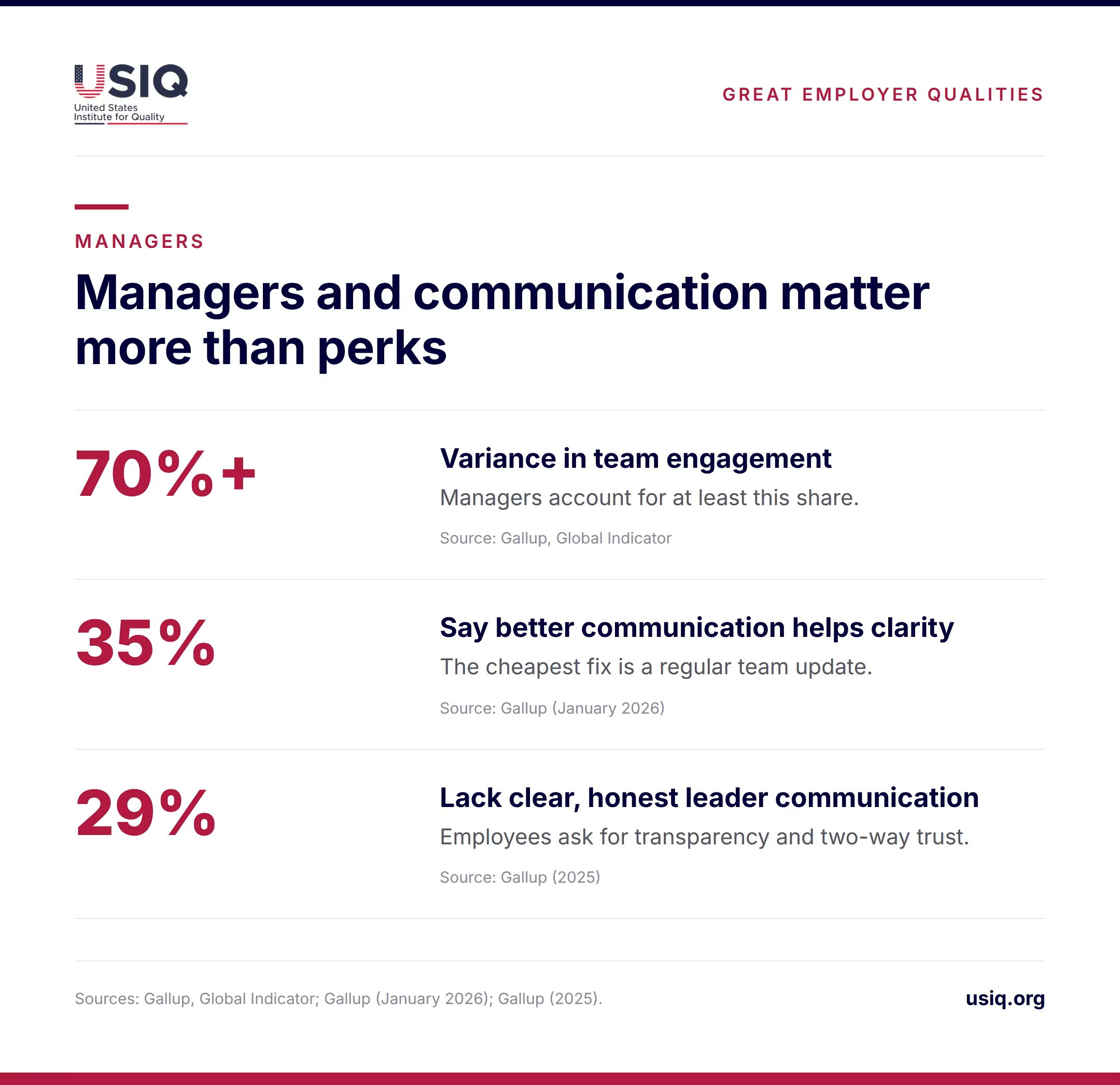
Two kinds of evidence help here: why people leave, and what is eroding engagement. Pew Research Center surveyed workers who quit a job in 2021. Of those, 63% cited low pay, 63% cited no opportunities for advancement and 57% cited feeling disrespected. A further 31% pointed to COVID-related disruption (Pew Research Center, March 2022).
Gallup’s engagement data adds the human side. Clarity of expectations and feeling cared about showed the largest declines since 2020, down 9 and 8 points. Among Gen Z and younger millennials, strong agreement that “someone at work cares about me” fell from 54% to 41%, and strong agreement on opportunities to learn and grow fell from 48% to 37% (Gallup, January 2026).
Employees also say what would help. Asked how they would feel more cared about, 34% cited supportive relationships, communication and respect, while 23% cited pay, benefits and security. Pay matters, but relationships were named more often.
| Quality | What the evidence shows | Small-business action |
|---|---|---|
| Fair pay | 63% of 2021 quitters cited low pay (Pew Research Center) | Review pay against local market data once a year and explain how raises are decided |
| Growth | 63% cited no advancement; only 31% strongly agree someone encourages their development (Gallup, Q2 2025) | Hold a development conversation with every employee at least twice a year |
| Respect | 57% of quitters felt disrespected; 28% strongly agree their opinions count (Gallup, Q2 2025) | Ask for input before decisions that affect a team, then report back what changed |
| Clear expectations | 47% strongly agree they know what is expected; 35% said better communication would help most | Write down the top three priorities for each role and review them monthly |
| Feeling cared about | Down 8 points since 2020; 34% name relationships, communication and respect | Train managers in regular one-to-one meetings |
Why do managers matter more than perks?
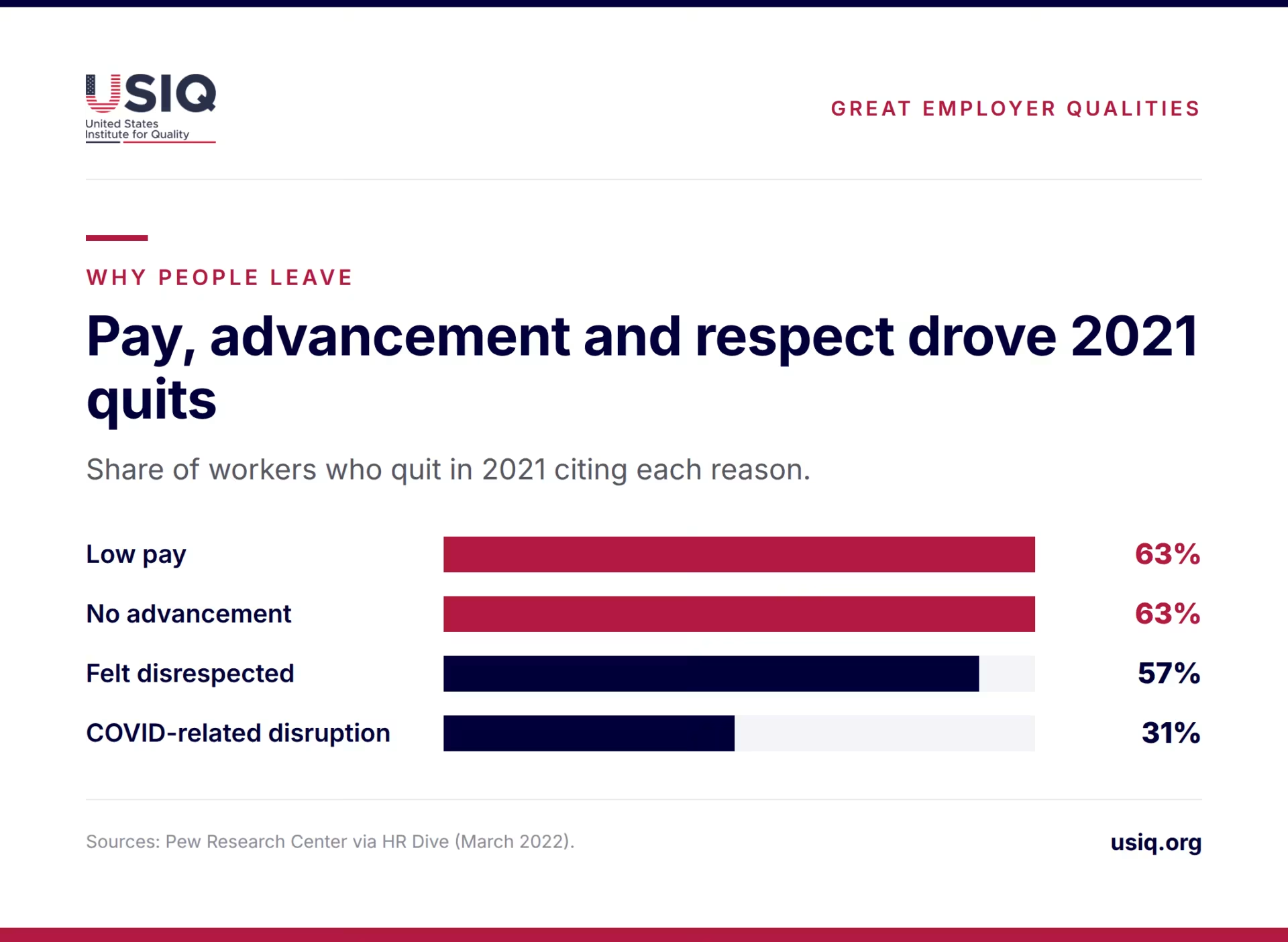
Gallup attributes at least 70% of the variance in team engagement to managers (Gallup, Global Indicator). In a 50-person company, a handful of supervisors shape the daily experience of nearly everyone. A free lunch program will not offset a supervisor who never sets priorities or listens.
What do employees want from leaders? Not more direction from above. In Gallup’s open-ended answers, they asked for transparency and two-way trust. Among the themes of missing experience, 29% lacked clear, honest communication from leaders, 32% described their workplace as isolated or impersonal and 25% said their organization underinvests in people, pay, tools or staffing (Gallup).
Perks and benefits do matter when they are missing, and underinvestment is one of the three themes above. But they work as a floor, not a ceiling. Once pay and benefits are reasonable, the gap between a good and a mediocre employer is mostly management behavior.
Communication is the cheapest fix. Of employees asked what would most improve clarity, 35% said better communication. Managers can start with a short weekly team update and a standing slot for questions. The survey side is covered in employee surveys explained.
What pay and benefits do U.S. employers offer?
The BLS March 2026 benefits survey gives the market baseline for private industry. Retirement means mainly a 401(k) or similar plan: 72% of workers have access and 52% participate. Defined contribution plans are available to 70%, defined benefit pensions to only 14% (BLS, September 2026).
Health coverage is the other large item. Some 71% of private-industry workers have access to a medical plan and 46% participate. Dental access is 44% and vision 29%. Employers paid 80% of the premium for single coverage and 69% for family coverage among participants.
Paid time away is common but not universal. Access to paid sick leave is 81%, paid vacation 80%, paid holidays 81% and paid family and medical leave 49%. An employer offering paid family leave therefore matches fewer than half of its peers, which makes it a visible differentiator. For ideas beyond the basics, see 30 types of employee benefits.
How do small firms compare with large ones?
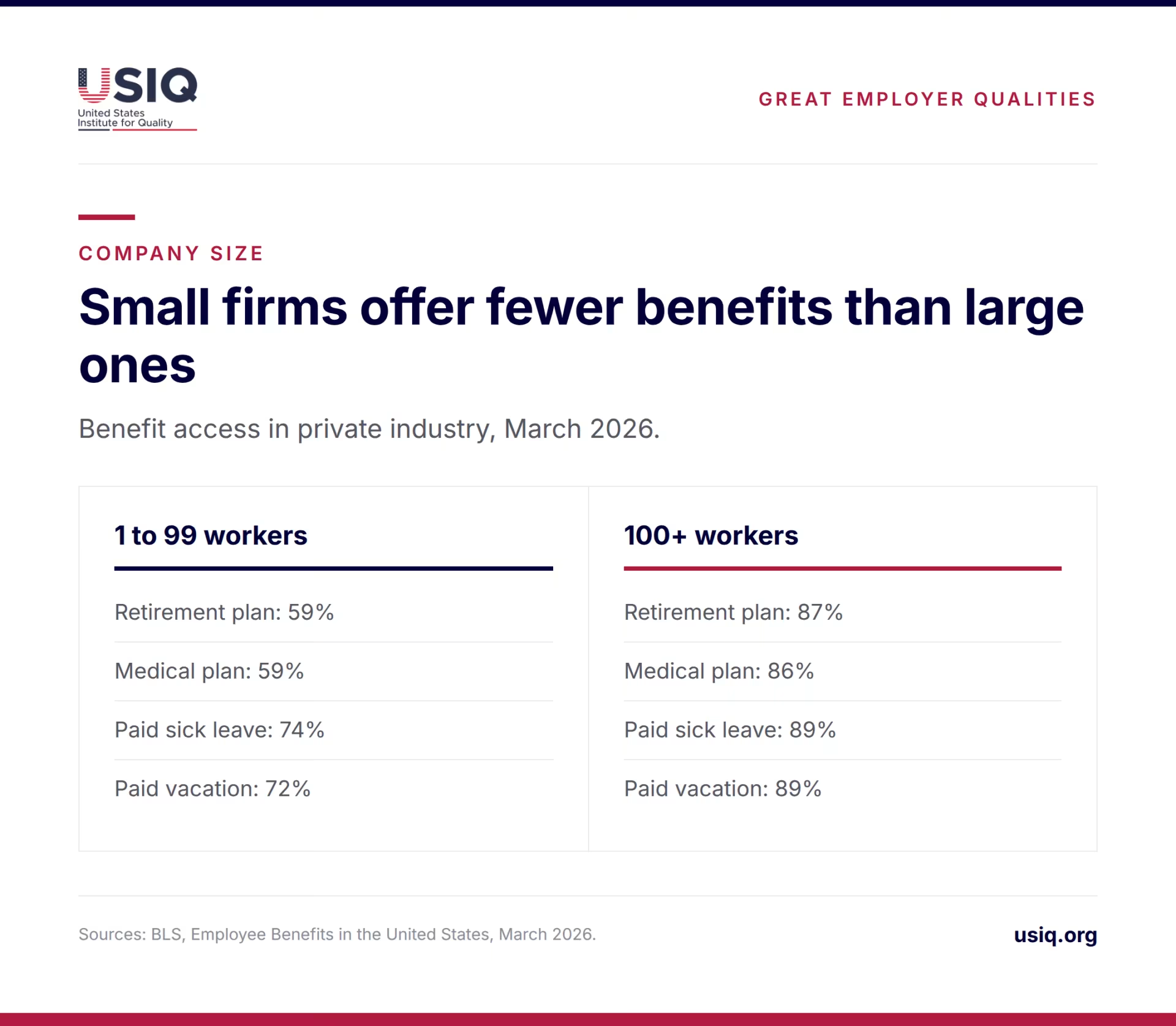
Company size changes the picture sharply. A 60-person firm cannot copy the package of a 5,000-person employer, and candidates usually know it.
| Benefit access, private industry, March 2026 | 1 to 99 workers | 100+ workers |
|---|---|---|
| Retirement plan | 59% | 87% |
| Medical plan | 59% | 86% |
| Paid sick leave | 74% | 89% |
| Paid vacation | 72% | 89% |
Source: BLS, Employee Benefits in the United States, March 2026.
A smaller company can close part of the gap without matching big-company budgets. Paying a larger share of the health premium, adding a simple retirement plan, offering flexible scheduling and publishing clear raise paths all signal investment. Legal duties such as leave and anti-retaliation rules vary by employer size and state, so check current requirements with the U.S. Department of Labor and your state labor department before designing a policy. Practical, low-budget options are collected in tips to attract and retain employees.
How do growth, recognition and well-being keep people?
Growth is a retention issue, not a perk. In Gallup’s Q2 2025 data, only 31% of employees strongly agreed that someone at work encourages their development, and among Gen Z and younger millennials strong agreement on learning and growth opportunities fell to 37%. With 63% of 2021 quitters citing no advancement, the gap is easy to read.
Small firms often cannot promise a ladder of titles. They can still offer a bigger role, a cross-training assignment, a funded course or a mentor. What counts is that someone talks with each employee about the next step.
Recognition works the same way. It should be regular and specific, not an annual ritual. A short note naming what a person did and why it mattered fits the finding that feeling cared about is among the fastest-falling engagement items. Employee-of-the-month plaques add little by themselves. For program design, see employee recognition awards.
Flexibility belongs here too: flexible hours, hybrid options, generous time off and parental leave. Not all of this fits every business, and a shop floor cannot work remotely. Even there, predictable schedules and fair shift swaps count as flexibility.
What does it cost when an employer gets it wrong?
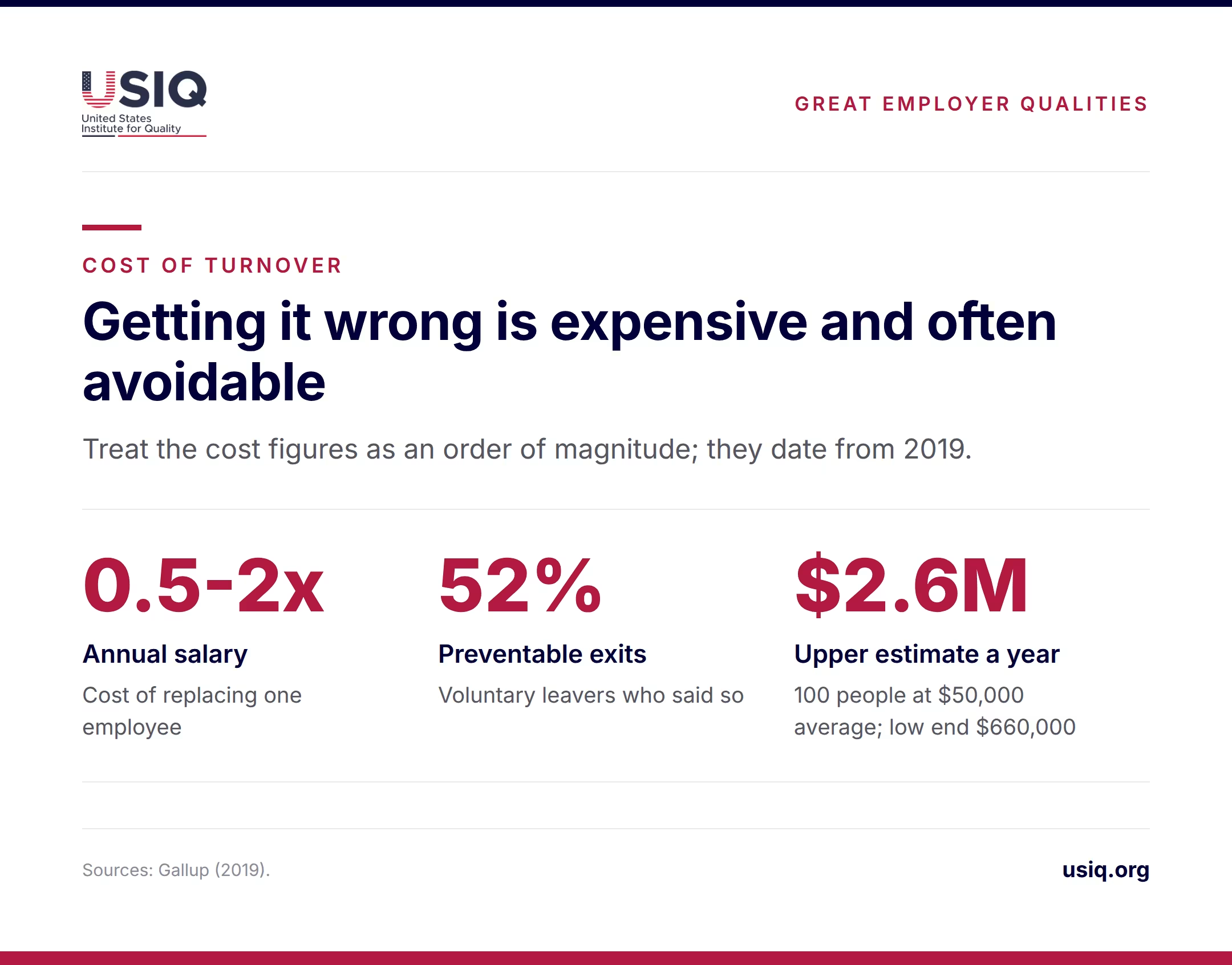
Gallup estimates that replacing an employee can cost one-half to two times the person’s annual salary. Its illustration: a 100-person company with an average salary of $50,000 could face roughly $660,000 to $2.6 million a year in turnover costs. The U.S. annual turnover rate was 26.3% in 2017 (Gallup, 2019). These figures date from 2019 and rest on older data, so treat them as an order of magnitude.
More useful is the share that is avoidable: 52% of voluntary leavers said their manager or organization could have prevented their exit. Gallup also puts the U.S. cost of disengagement at about $2 trillion in lost productivity (Gallup, 2025).
The labor market keeps the pressure on. In September 2026, BLS reported 7.5 million job openings, 5.4 million hires and 3.4 million quits, a quits rate of 2.1% (BLS JOLTS). Workers still have options, and the 51% who are watching for other openings know it.
What do employers commonly get wrong?
Perks fix culture. They do not. Pay and benefits are cited in 23% of employee answers on feeling cared about; relationships, communication and respect in 34%.
Strong leaders give firm direction. Employees describe the opposite: transparency and two-way trust. Leaders who explain decisions and listen earn more than those who simply instruct.
Reputation equals quality. A good name helps in hiring, but it does not show whether people are engaged. Culture and engagement data are harder to fake than a careers page, because they come from employees themselves. Rankings and lists vary in method and often favor firms that can afford to take part and promote the result, so they say little about a given workplace.
The same package fits every company. Industry and size matter. A 20-person firm that matches a large employer’s benefits is rare; one that matches its clarity and respect is realistic.
How can a small or mid-sized company become a great employer?
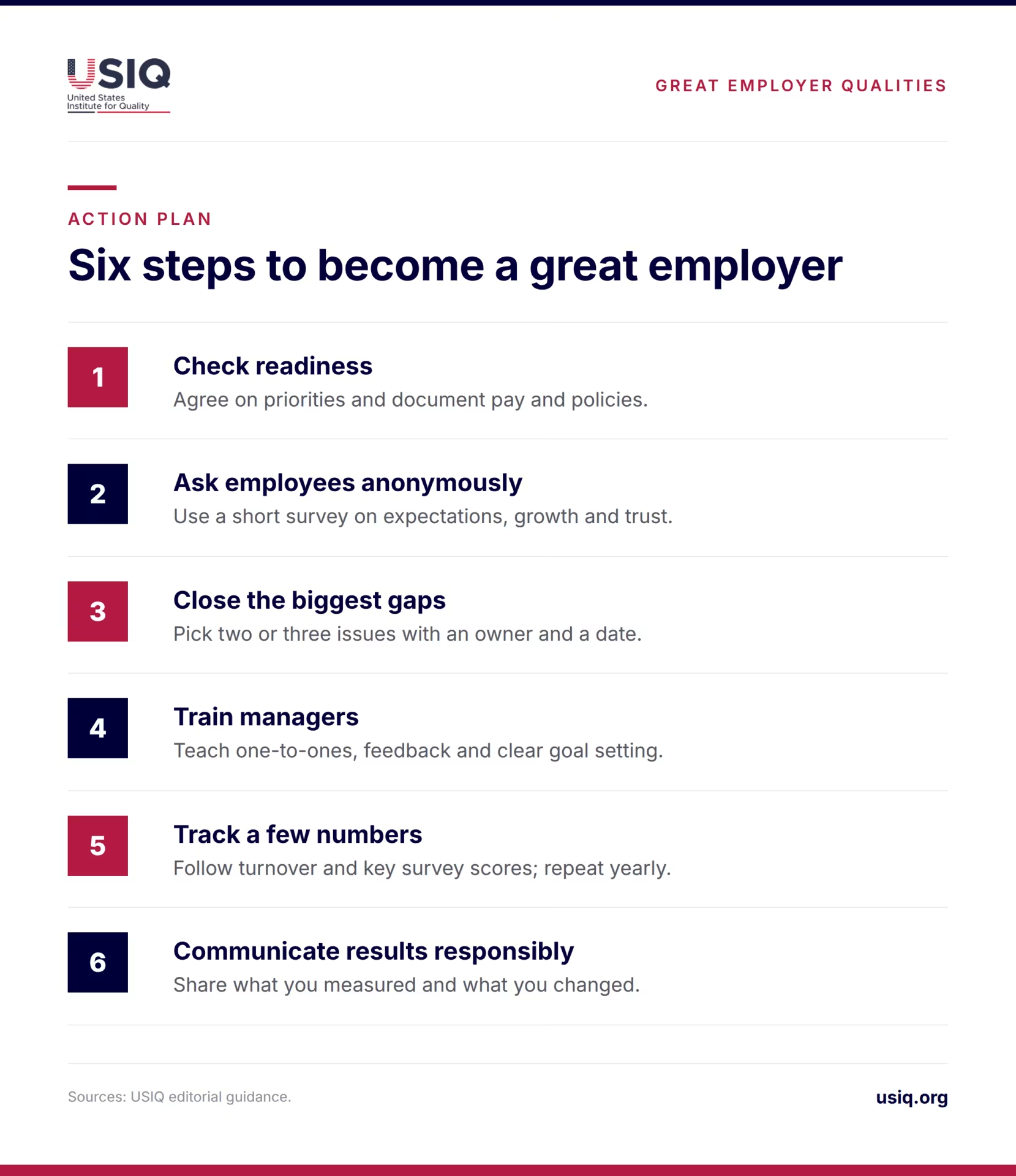
The sequence below keeps the effort proportionate for companies with 10 to 250 employees.
- Check readiness. Do leaders agree on priorities, and are pay and policies documented? Fix obvious inconsistencies before asking employees for opinions.
- Ask employees anonymously. Use a short survey covering expectations, development, voice, trust in leaders and feeling cared about. Anonymity encourages honest answers, and enough participation keeps a few loud voices from skewing results.
- Close the biggest gaps first. Pick two or three issues, name an owner and a date for each, and report progress to staff.
- Train managers. Teach one-to-one meetings, feedback and clear goal setting, since managers drive most of the variance in engagement.
- Track a few numbers. Voluntary turnover, early-tenure exits, and survey scores on clarity, development and voice are enough. Repeat the survey once a year.
- Communicate results responsibly. Tell candidates and staff what you measured and what you changed, not just what you intend.
For deeper guidance on turning feedback into action, see what high-performing U.S. employers do differently.
How do certification and rankings differ as proof?
Rankings compare employers with one another. Certification tests whether an employer meets a defined standard. The difference matters because a ranking can change with the field of participants, while a threshold-based assessment checks performance against fixed criteria.
Disclosure: USIQ, the publisher of this article, runs certification programs of this kind. Such a program typically combines an anonymous employee survey with an HR interview and awards a seal when the thresholds are met, rather than placing companies on a competitive list. A fuller explanation is in employer certification explained, and everything you need to know about employer seals covers how seals work. A seal only documents quality that already exists. It does not create it.
Where is employer quality heading?
Engagement has slipped since 2020, and the sharpest falls are in clarity and feeling cared about, both of which depend on daily management rather than budget. Younger workers show the steepest declines, so employers hiring Gen Z and younger millennials have the most to gain from fixing them.
Small employers hold a quiet advantage. Relationships, communication and respect are easier to deliver in a company where the owner knows everyone by name, and employees rank them above pay when asked what makes them feel cared about.
Conclusion
Great employer qualities are mostly ordinary: fair pay, respect, a path to grow, clear expectations and managers people trust. What separates good employers from the rest is consistency, and the data suggests starting with manager quality before adding perks.
FAQ
What are the most important qualities of a great employer?
Evidence points to fair pay, advancement opportunities, respect, clear expectations, supportive relationships and trusted managers. In Pew’s survey of 2021 quitters, 63% cited low pay, 63% no advancement and 57% disrespect. Gallup attributes at least 70% of team engagement variance to managers, so leadership quality ranks first.
Is pay or culture more important?
Both matter, in different ways. Low pay was cited by 63% of workers who quit in 2021, so it works as a floor. When employees were asked what would make them feel more cared about, 34% named relationships, communication and respect, and 23% named pay, benefits and security.
Can a small company be a great employer without big benefits?
Yes. BLS shows 59% of workers at firms with 1 to 99 employees have retirement access, against 87% at larger firms. Small companies can offset this with clear expectations, development conversations, flexibility, listening to employees and a meaningful share of health premiums. Relationships and communication are among the top things employees name.
How do I know whether my company is a great employer?
Ask employees through an anonymous survey and track voluntary turnover. Useful survey items include whether people know what is expected, whether someone encourages their development and whether their opinions count. Gallup found only 47%, 31% and 28% strongly agree with those statements, which gives a point of comparison.
How much does employee turnover cost?
Gallup estimates replacing an employee can cost one-half to two times annual salary. For a 100-person company with a $50,000 average salary, that illustrates roughly $660,000 to $2.6 million a year. These figures are from 2019, and 52% of voluntary leavers said their exit could have been prevented.
What benefits do most U.S. private employers offer?
According to BLS data for March 2026, private-industry access is 81% for paid sick leave, 80% for vacation, 72% for a retirement plan and 71% for a medical plan. Paid family and medical leave is available to 49%. Employers paid 80% of single-coverage premiums for participants.
Do employer rankings show which employers are best?
Not reliably on their own. Methods differ, and visibility is not the same as workplace quality. Employee survey results, retention data and independent verification against a fixed standard give a clearer view than a list position, and they show how an employer actually performs for its people.
Sources
- Gallup, “U.S. Employee Engagement Declines From 2020 Peak,” January 27, 2026. https://www.gallup.com/workplace/701486/employee-engagement-declines-2020-peak.aspx
- Gallup, “Anemic Employee Engagement Points to Leadership Challenges,” 2025. https://www.gallup.com/workplace/692954/anemic-employee-engagement-points-leadership-challenges.aspx
- Gallup, “Global Indicator: Employee Engagement,” 2026 update. https://www.gallup.com/394373/indicator-employee-engagement.aspx
- Gallup, “This Fixable Problem Costs U.S. Businesses $1 Trillion,” March 13, 2019. https://www.gallup.com/workplace/247391/fixable-problem-costs-businesses-trillion.aspx
- U.S. Bureau of Labor Statistics, “Employee Benefits in the United States, March 2026,” September 25, 2026. https://www.bls.gov/News.Release/Pdf/Ebs2.Pdf
- U.S. Bureau of Labor Statistics, “Job Openings and Labor Turnover Summary, September 2026.” https://www.bls.gov/news.release/jolts.nr0.htm
- Pew Research Center, “Majority of workers who quit a job in 2021 cite low pay, no opportunities for advancement, feeling disrespected,” March 9, 2022. https://www.pewresearch.org/short-reads/2022/03/09/majority-of-workers-who-quit-a-job-in-2021-cite-low-pay-no-opportunities-for-advancement-feeling-disrespected/

Related Articles

What research says about the effects of employer seals on current employees, potential applicants and employer image, from independent experiments and field data to the limits of the evidence.
Employee experience and customer experience are linked, but the link is weaker and more conditional than popular slogans suggest. This article reviews the evidence on staffing, training and workplace conditions and shows how employers can test the connection in their own business.
Most HR dashboards show too many metrics and trigger too few decisions. This guide defines ten employee experience metrics, shows a one-page layout and explains how to read your numbers against U.S. data.
A practical guide to calculating marketing ROI for small and mid-sized U.S. companies, including long B2B sales cycles, offline leads, a spreadsheet walkthrough and common errors.


