

A certificate hung in a hallway does little, because buyers and candidates rarely walk down that hallway. If you want to display business certifications so that they help, the work is less about frames and more about placement, wording and accuracy.
Accuracy matters because a badge is a claim. A mark that implies more than the certificate covers, or one that has lapsed, can mislead customers. A good display tells people what is certified, by whom and until when.
Quick answer: Show certifications first where buyers and candidates make decisions: a credentials page, proposals, profiles and job pages. Name the standard, the scope, the certifier and the expiry date, link to proof, and remove anything that has lapsed. Wall displays come last. Never claim more than the certificate covers.
Key takeaways
- A certification is an independent audit against a standard. An award is a one-off recognition. A seal can be either, or neither.
- Every certificate has a scope. Showing a mark so that it implies the whole company is covered, when only one site or service is, is the most common mistake.
- FTC guidance on certifications and seals, which sits in the Green Guides for environmental marketing claims, treats a misrepresented third-party certification as deceptive. Certification does not excuse unsubstantiated claims.
- Unfamiliar seals do little on their own. Add one plain-language line that says what the mark covers.
- For hiring, candidates cite pay, flexibility and clear job information far more often than any badge. Use certifications as supporting proof.
- Assign an owner, check expiry dates against the audit calendar, and test the effect over a set period.
What is the difference between a certification, a seal and an award?
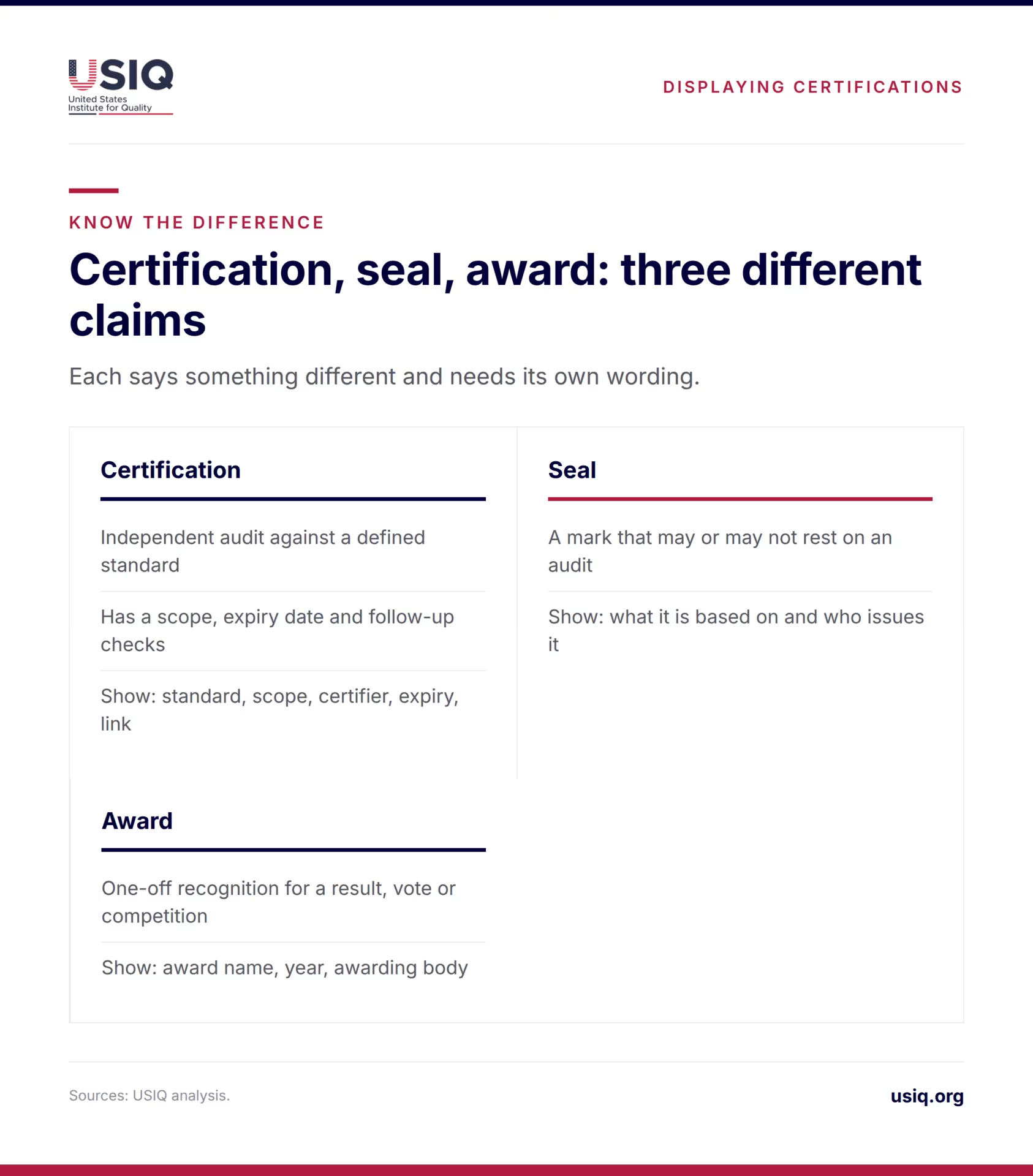
The terms get mixed up, and the mix-up leads to wrong claims. A bakery that wins a local “best bakery” vote has an award. A bakery whose food safety system passes an independent audit has a certification. Both can be shown, but they say different things and need different wording.
| Type | What it is | What to show alongside it |
|---|---|---|
| Certification | An independent audit against a defined standard, with a scope, an expiry date and follow-up checks | Standard name, scope, certifier, expiry date, link to the certificate |
| Seal | A mark that may or may not rest on an audit or an assessment | What the seal is based on and who issues it |
| Award | A one-off recognition for a result, a vote or a competition | Name of the award, year and the awarding body |
For a deeper look at the main types, see what a business certificate is and which types build trust. A plain-language explanation of the standard behind many B2B certifications is in the ISO 9001 explainer.
Where should you display business certifications?
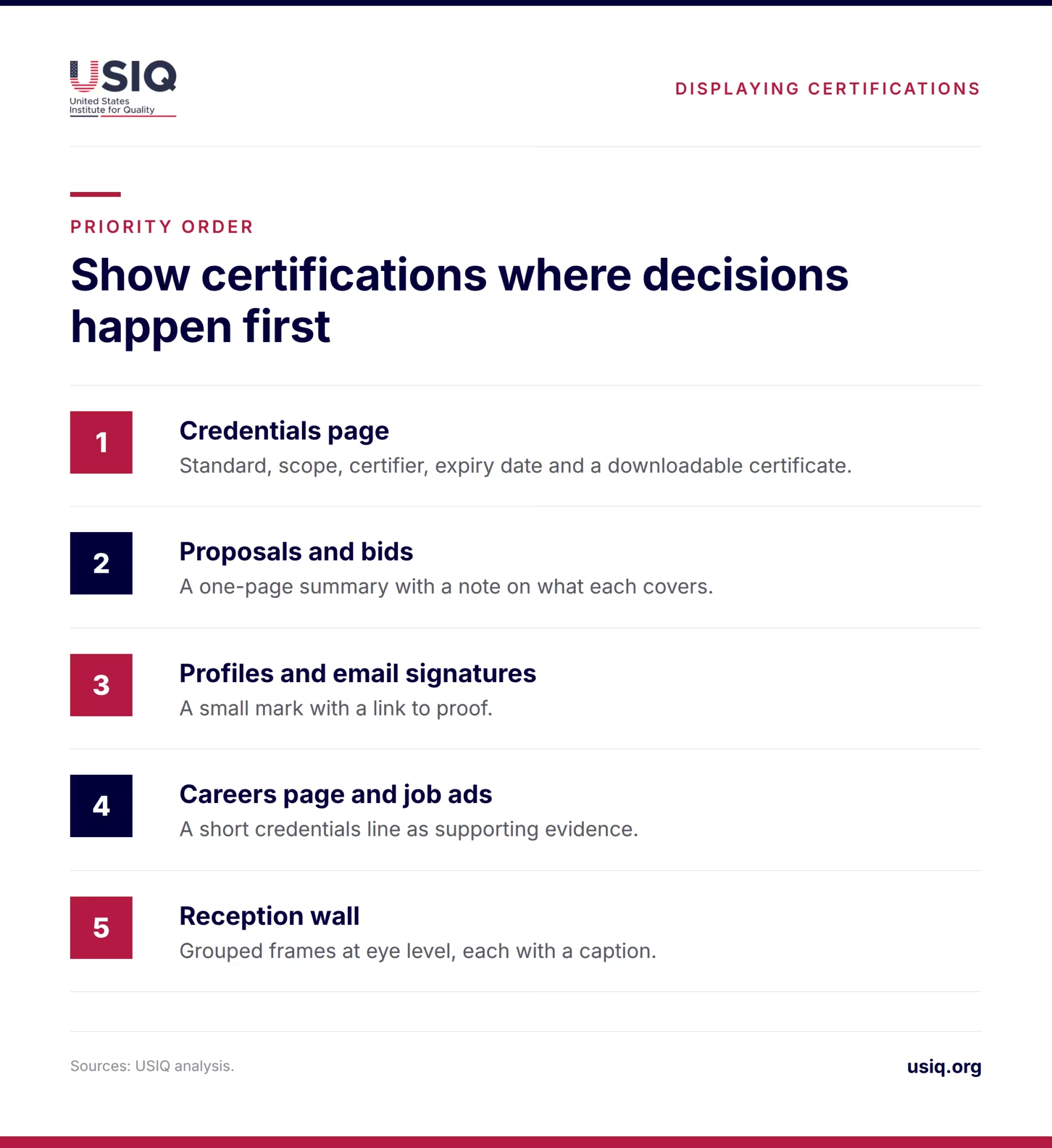
Start where decisions happen. A buyer comparing three vendors and a candidate weighing an offer both look online first, long before they see your lobby. The reception wall still has a role, but it comes last in the order of priority.
| Priority | Place | What works |
|---|---|---|
| 1 | Credentials page on your website | One entry per credential: standard, scope, certifier, expiry date and a downloadable certificate |
| 2 | Proposals and bids | A one-page summary of your credentials with a one-line note on what each covers |
| 3 | Profiles and email signatures | Google Business, LinkedIn and B2B marketplace profiles; a small mark with a link to proof |
| 4 | Careers page and job ads | A short credentials line as supporting evidence, never the headline |
| 5 | Reception and meeting rooms | Grouped frames at eye level, each with a short caption |
The credentials page
Build one page that lists the standard, the scope, the certification body, the expiry date and a downloadable certificate, so buyers can verify the claim themselves. Add a sentence for each item that tells a visitor why it matters to them. “Our quality management system is certified to ISO 9001 for our Ohio assembly site” says more than a logo row.
Proposals, profiles and signatures
A one-page credentials summary fits into any bid or capability statement. Add the same credentials to your Google Business, LinkedIn and B2B marketplace profiles. In an email signature, keep the mark small and link it to the credentials page, not to the certificate image alone.
The physical wall
Put frames where visitors naturally pause, such as reception, the waiting area and meeting rooms. Group related items, such as quality, safety and training, and hang the most important one at eye level. Keep paper copies out of direct sunlight, which can fade them, and light the wall evenly to avoid glare. A rotating slideshow on a screen at the front desk suits companies with many credentials and keeps the wall uncluttered.
Why a caption beats a logo
Visitors often do not know what a mark means. A 2013 Baymard Institute survey of U.S. adults asked which checkout site seal people trusted most. The top seal drew about 36% of votes and the second about 23%, and the two went to Norton and McAfee. The survey covered online checkout, but the lesson carries over: familiarity drives trust, so an unfamiliar mark needs an explanation. Baymard’s authors also note that users react to perceived security, not technical security.
What can you legally say about your certifications?
The FTC’s guidance on certifications and seals of approval, 16 CFR 260.6, is part of the Green Guides, which cover environmental marketing claims. It applies directly when a certification backs an environmental claim, such as a sustainability seal. For other certifications it shows how the agency thinks about third-party endorsement. This section describes that guidance and is not legal advice; have counsel review any claim you are unsure about, and check your state’s consumer-protection rules as well.
Do not misrepresent a certification
Under the section, it is deceptive to misrepresent, directly or by implication, that a product, package or service has been endorsed or certified by an independent third party. A certificate you never earned is the clear case. A lapsed certificate, or one that does not cover the activity you show it next to, may misrepresent the same thing.
Treat a certifier’s logo as an endorsement
The same FTC page notes that using a third-party certifier’s name, logo or seal may count as an endorsement that has to meet the Endorsement Guides in 16 CFR part 255. That includes the rules on endorsements by organizations (§255.4) and on disclosing material connections (§255.5). Read the part itself before you rely on it.
Certification does not replace proof
According to the FTC, third-party certification does not remove the marketer’s duty to substantiate all claims the certification reasonably communicates. A quality badge next to the phrase “zero defects” does not make that phrase true. If a mark suggests more than the audit covered, you need your own evidence for the broader claim.
Follow the certifier’s rules for its mark
Ask your certifier what rules apply to its mark, such as logo size, colour and permitted uses, and follow them. Get the answer in writing and file it with the certificate.
| Do | Avoid |
|---|---|
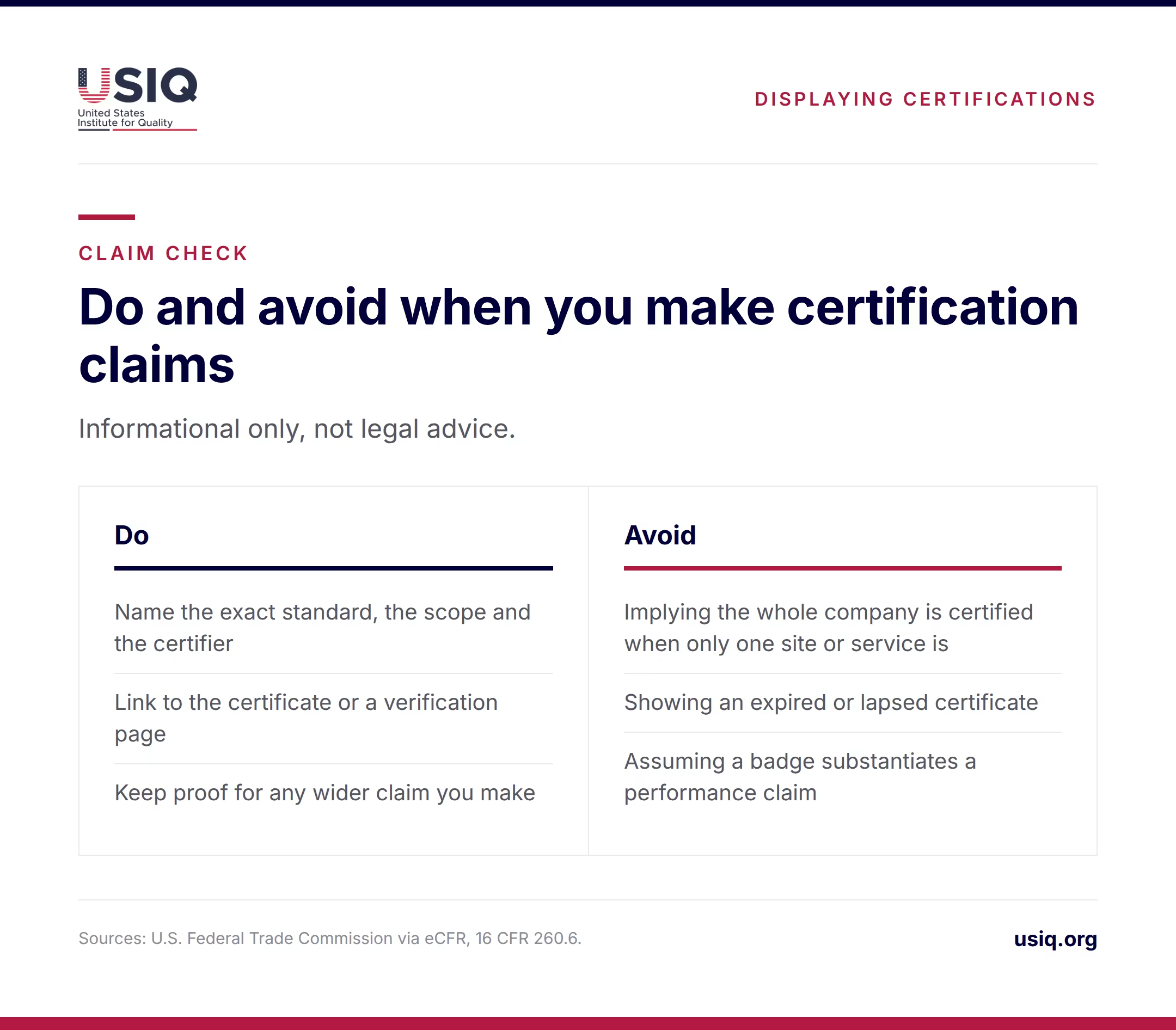
| Name the exact standard, the scope and the certifier | Implying the whole company is certified when only one site or service is |
| Link to the certificate or a verification page | Showing an expired or lapsed certificate |
| Keep proof for any wider claim you make | Assuming a badge substantiates a performance claim |
Do certifications and seals help you hire?
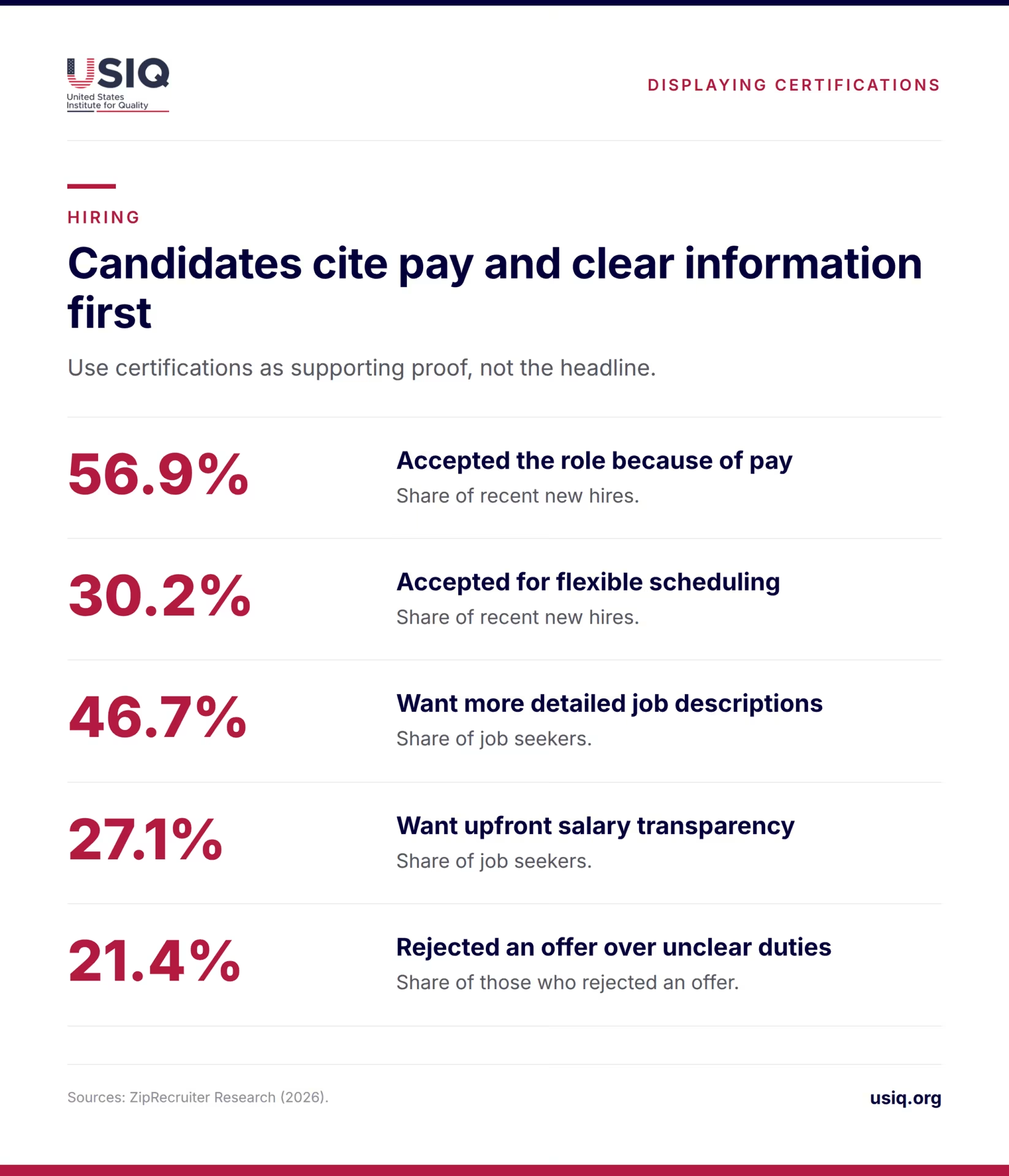
They can support a hiring pitch, but they rarely carry it. Current U.S. job-seeker data points to practical factors. In ZipRecruiter’s New Hire Survey of 1,500 new hires, fielded in November and December 2025, 56.9% accepted their role because of pay and 30.2% because of flexible scheduling. The typical new hire in that survey submitted 19 applications before landing the current job.
Clear information matters as well. In ZipRecruiter’s job-seeker survey of 1,500 people, fielded in February 2026, 46.7% said they would feel more seen if job descriptions were more detailed, and 27.1% named upfront salary transparency. Among those who rejected an offer, 21.4% cited unclear job duties, and 28.2% of job seekers reported receiving multiple offers.
Speed counts too: 49% of job seekers expect to hear back within 3 days of applying, and 67.9% want a quick response even if it is a no. iHire’s State of Online Recruiting report, based on a survey of 1,300+ employers and job seekers, points to a growing need for trust and transparency in recruiting, which is where verifiable credentials can help.
One experiment speaks to employer seals specifically. In a randomized experiment with 1,093 participants, a German study by Oliver Scharfenberg found that the DIQP “Top Arbeitgeber” employer seal raised the stated likelihood of applying for a job by about 16 percentage points (USIQ research page). It measured stated intentions in a hypothetical recruitment scenario, not actual applications. USIQ, the publisher of this article, runs certification programs of this kind. For a broader look, see whether employer seals work.
In practice, place a short credentials line on the careers page and in job ads, below the pay range, the schedule and the duties. If an employer seal comes from a program with a public verification page, link to it, so a candidate can confirm the claim. USIQ’s Top Employer program works this way, with a certificate valid for 24 months.
What are the limits of displaying certifications?
Three misconceptions come up repeatedly. The first is that a logo raises brand value on its own. Whether it does depends on whether the buyer recognizes and values the credential, and the Baymard results show that recognition shapes trust.
The second is that a badge can stand in for substance. If service is slow or job ads are vague, a mark will not repair that, and a mismatch between claim and experience can hurt more than having no mark at all. The third is that more is better. A row of ten logos makes each one count less; show the few that matter to the audience in front of you.
Awards need extra care. A recognition for a single year should carry that year, and it should not be described as an ongoing certification. Employee recognition programs inside the company are a separate matter, covered in this guide to employee recognition awards.
How do you keep displays current and credible?
Give the task an owner, usually the quality manager or the HR lead in a smaller company. Tie expiry checks to the audit calendar, since surveillance audits and renewals set the dates that matter. When a certificate lapses, remove the mark from the website, profiles, signatures and walls the same week.
Replace worn paper copies with a fresh copy from the issuer, and keep frames clean and legible. Add alt text to badge images on the website so screen-reader users understand what each one means.
Front-line staff should be able to answer “What’s that for?” in one sentence, for example: “That’s our quality management certification; an outside auditor checks our processes every year.” A one-page internal sheet with the standard, the scope and the expiry date for each credential keeps answers consistent and accurate.
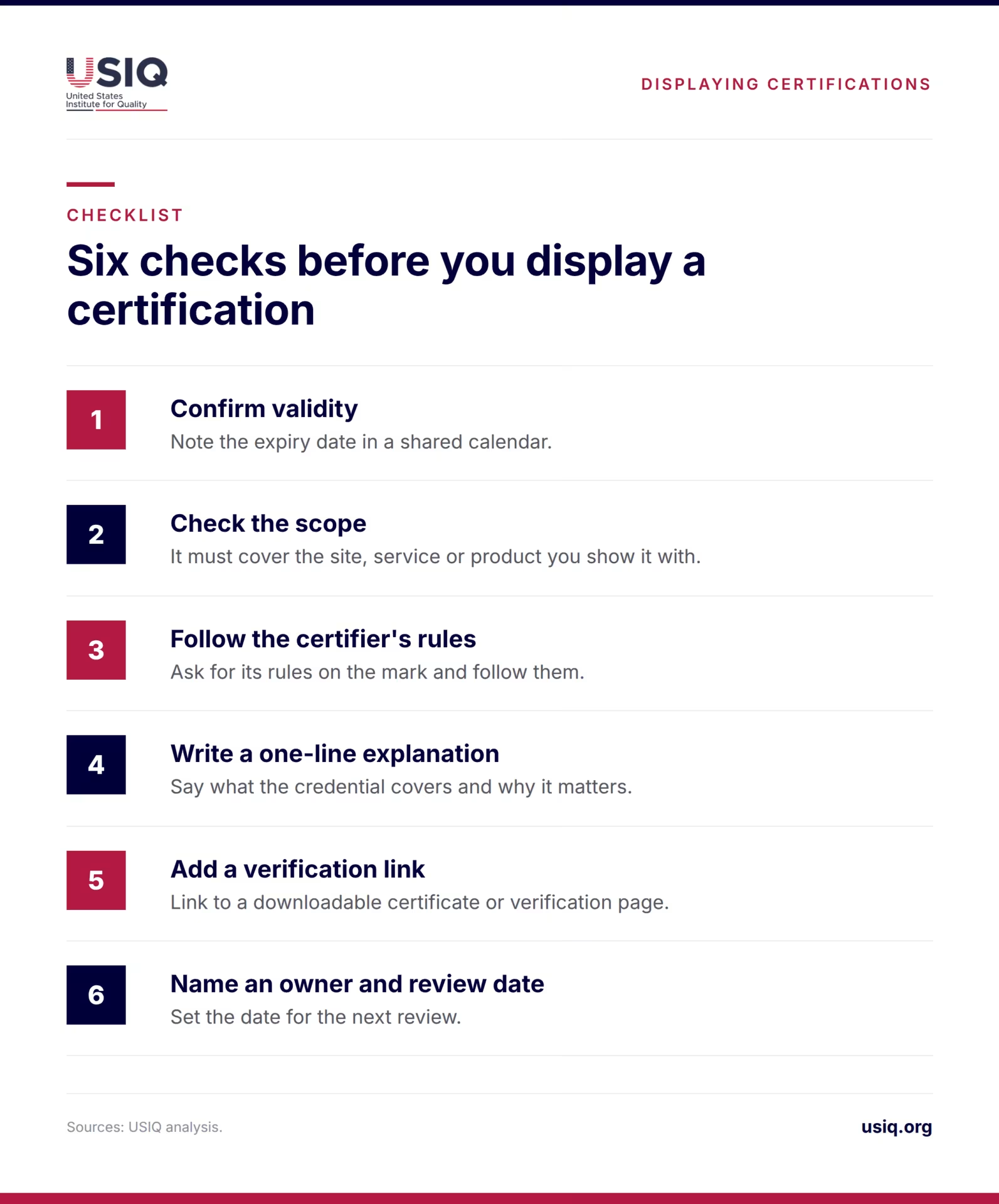
A short checklist
- Confirm the certificate is valid and note the expiry date in a shared calendar.
- Check that the scope covers the site, service or product you show it with.
- Ask the certifier for its rules on the mark and follow them.
- Write a one-line explanation of what the credential covers and why it matters.
- Link to a downloadable certificate or verification page.
- Name an owner and a date for the next review.
How can you tell whether displaying a certification works?
Measure your own results. Pick one or two metrics, add the credentials block, and compare a 90-day period against the 90 days before.
| Goal | Metric to watch |
|---|---|
| Win more business | Bid win rate; requests for proof of certification from buyers |
| Build web trust | Conversion on pages with and without the credentials block |
| Hire | Application rate on job pages and time to fill |
Change one thing at a time, or you will not know what moved the numbers. For a method that fits a small budget, see how to measure marketing ROI for a small business.
What should you do first?
Audit what you show today. Remove anything lapsed or out of scope, build a credentials page with standard, scope, certifier, expiry date and proof, and add a one-line explanation to every mark. Frames on the wall can follow.
FAQ
Can I still show a certificate that has expired?
No. A lapsed certificate tells customers that an outside body currently certifies you when it does not, which can mislead them. Remove expired marks from the website, profiles, email signatures and walls the same week, and show the new certificate once you renew.
Do I need permission to use a certifier’s logo?
Ask the certifier what rules apply to its mark, such as size, colour and permitted uses, and follow them. The FTC also notes that using a certifier’s name or logo may count as an endorsement subject to its Endorsement Guides. When in doubt, ask counsel before publishing.
Is an award the same as a certification?
No. A certification is an independent audit against a standard, with a scope and an expiry date. An award is a one-off recognition. Show each for what it is: name the award and the year, and describe a certification by standard, scope and certifier.
What should a credentials page include?
List the standard, the scope, the certification body, the expiry date and a downloadable certificate, so buyers can verify the credential. Add one plain-language sentence per item on what it covers and why it matters to the reader, and keep the page current.
Will a certification make candidates apply?
It may help, but it is not the main driver. In ZipRecruiter’s New Hire Survey, pay (56.9%) and flexible scheduling (30.2%) were the leading reasons new hires accepted a role. A German study by Oliver Scharfenberg found the DIQP “Top Arbeitgeber” seal raised stated intent to apply by about 16 percentage points in a hypothetical scenario, not in real applications.
How many certifications should I display?
Show the few that matter to the audience in front of you. A buyer cares about quality and safety credentials; a candidate cares about employer-related ones. A long row of logos makes each one count less. Keep the full list on the credentials page and feature only the most relevant on each page.
Sources
- U.S. Federal Trade Commission via eCFR: “16 CFR 260.6 Certifications and seals of approval,” up to date as of 6/09/2026. https://www.ecfr.gov/current/title-16/chapter-I/subchapter-B/part-260/section-260.6
- ZipRecruiter Research: “How Employers Win Top Talent in 2026,” Apr 7 (New Hire Survey, Nov 11 to Dec 9, 2025; job-seeker survey, Feb 7-23, 2026). https://www.ziprecruiter-research.org/economic-insights-research/how-employers-win-top-talent-in-2026
- Baymard Institute: “Which Site Seal do People Trust the Most?,” Jan 22, 2013. https://baymard.com/blog/site-seal-trust
- iHire: “The State of Online Recruiting 2026,” Sep 22, 2026. https://www.ihire.com/resourcecenter/employer/pages/the-state-of-online-recruiting-2026
- USIQ: Employer seal research, a German study by Oliver Scharfenberg on the DIQP “Top Arbeitgeber” seal. https://www.usiq.org/top-employer/research/

Related Articles
What research says about the effects of employer seals on current employees, potential applicants and employer image, from independent experiments and field data to the limits of the evidence.
Employee experience and customer experience are linked, but the link is weaker and more conditional than popular slogans suggest. This article reviews the evidence on staffing, training and workplace conditions and shows how employers can test the connection in their own business.
Most HR dashboards show too many metrics and trigger too few decisions. This guide defines ten employee experience metrics, shows a one-page layout and explains how to read your numbers against U.S. data.
A practical guide to calculating marketing ROI for small and mid-sized U.S. companies, including long B2B sales cycles, offline leads, a spreadsheet walkthrough and common errors.