

Most employee survey questions fail for one of two reasons. They are vague, so the answers cannot be acted on, or they are loaded, so the answers cannot be trusted. A small employer rarely has an analytics team to sort that out afterwards, so the work has to happen when the questions are written.
This article gives owners and HR leads a set of employee survey questions grouped by theme and written in a consistent format. It also covers what to leave out, how U.S. law affects survey design, how to protect anonymity in a small team and what to do once the results arrive. The questions to ask and the questions to avoid sit side by side, so each weak item comes with a better alternative.
Quick answer: A good employee survey uses 15 to 25 single-topic statements grouped by theme: clarity, manager, communication, recognition, growth, workload, pay, belonging and intent to stay. Use one five-point agree/disagree scale, add one recommend question and one open comment, keep responses anonymous and share results with actions.
Key takeaways
- Group questions by theme and keep each one to a single idea. Double-barreled and leading wording makes results hard to use.
- Use one five-point agree/disagree scale for most items so results can be compared across questions and over time.
- Pay is one factor among several. In Gallup’s open-ended data, relationships, communication and respect were named more often than pay, benefits and security.
- Avoid questions about protected characteristics or medical information. Be careful with union-related topics and have counsel review the survey if in doubt.
- In small teams, anonymity depends on a minimum reporting group size and on dropping demographic fields you do not need.
- A survey without visible follow-up damages trust. Choose two or three actions and report back.
What are the best employee survey questions to ask?
The best employee survey questions measure experiences an employee can judge from their own seat, one topic at a time. The table below offers 25 examples across 21 themes. Most are statements rated on a five-point scale from “strongly disagree” to “strongly agree.”
Treat the list as a menu, not a checklist. A company with 30 employees will usually get more from 12 to 15 well-chosen items than from all 25.
| Theme | Example question | Scale | What it shows |
|---|---|---|---|
| Role clarity | I know what is expected of me at work. | Agree/disagree (5-point) | Whether goals and priorities are clear |
| Resources | I have the tools and training I need to do my job well. | Agree/disagree | Gaps in equipment, software or training |
| Manager | My manager gives me feedback that helps me improve. | Agree/disagree | Quality of day-to-day coaching |
| Manager | My manager supports me when I need help. | Agree/disagree | Practical manager support |
| Communication | Company leaders explain decisions that affect my work. | Agree/disagree | Whether information reaches the team |
| Leadership | I trust company leaders to make sound decisions about our future. | Agree/disagree | Confidence in senior leaders |
| Recognition | I receive appropriate recognition when I do good work. | Agree/disagree | Whether effort is noticed |
| Care | Someone at work cares about me as a person. | Agree/disagree | Personal connection at work |
| Voice | I can voice a different opinion without fear of negative consequences. | Agree/disagree | Psychological safety |
| Voice | My opinions count at work. | Agree/disagree | Perceived influence on decisions |
| Growth | I have opportunities to learn and grow here. | Agree/disagree | Access to development |
| Growth | I can see a path to develop my career at this company. | Agree/disagree | Visible advancement options |
| Workload | My workload is manageable in a normal week. | Agree/disagree | Overload and burnout risk |
| Wellbeing | I can switch off from work outside my working hours. | Agree/disagree | Boundaries and recovery |
| Work setup | The way we work (on-site, remote or hybrid) lets me do my job effectively. | Agree/disagree | Fit of the work arrangement |
| Pay | My pay is fair for the work I do. | Agree/disagree | Perceived pay fairness |
| Benefits | Our benefits meet my needs. | Agree/disagree | Fit of the benefits package |
| Team | People on my team cooperate to get work done. | Agree/disagree | Teamwork quality |
| Conflict | Conflicts at work are handled fairly. | Agree/disagree | Trust in conflict resolution |
| Belonging | I feel that I belong at this company. | Agree/disagree | Connection to the organization |
| Inclusion | I am treated with respect, whatever my background. | Agree/disagree | Respect and fair treatment |
| Intent to stay | I expect to still be working here in two years. | Agree/disagree | Retention risk indicator |
| Recommend | How likely are you to recommend this company as a place to work? | 0 to 10 | Overall advocacy (eNPS-style) |
| Open comment | What is one change that would most improve your work here? | Free text | Issues the other items miss |
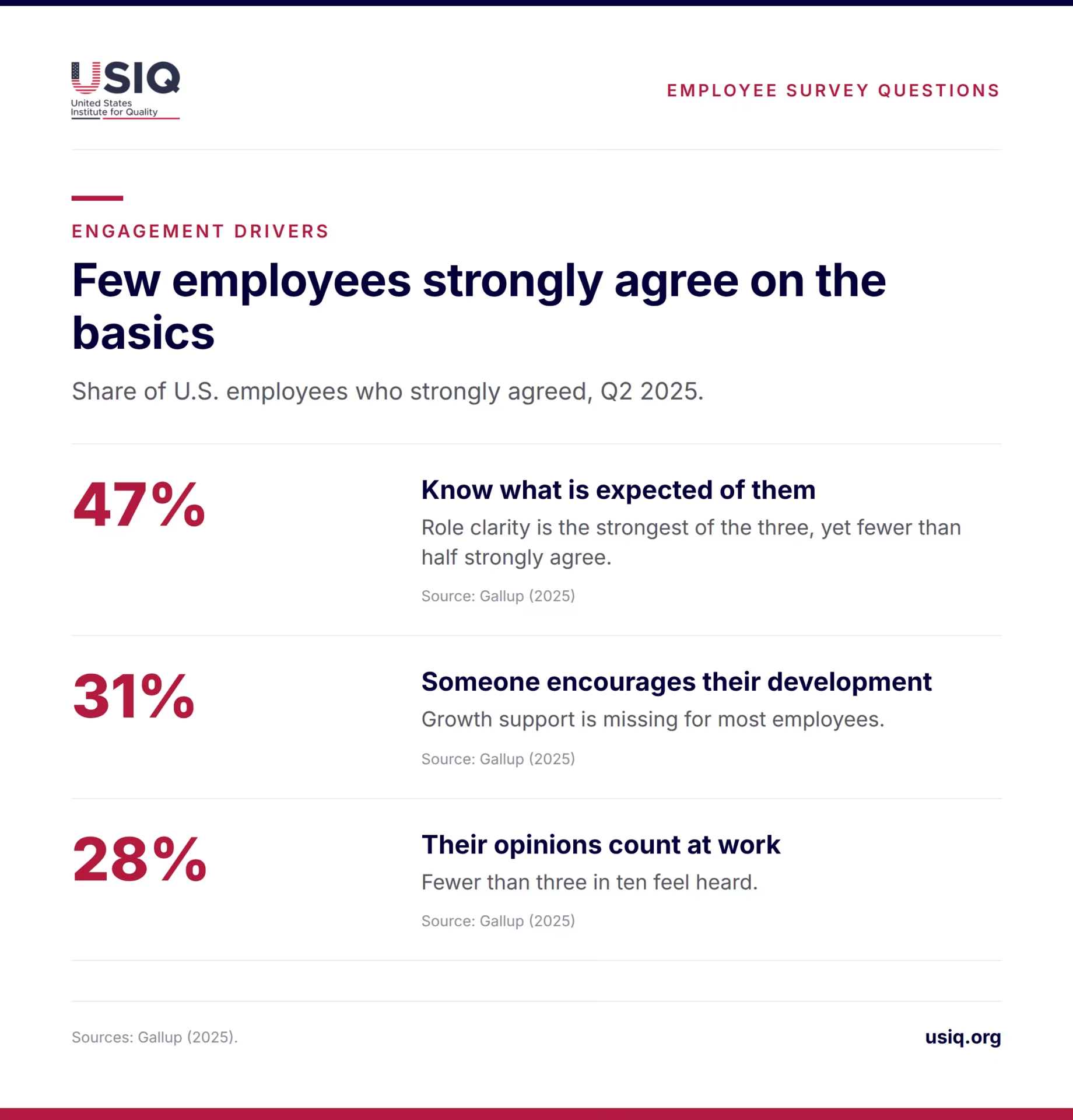
Several of these items map to well-documented engagement drivers. In Gallup’s second-quarter 2025 data, 47% of U.S. employees strongly agreed that they know what is expected of them, 31% that someone encourages their development and 28% that their opinions count at work (Gallup, 2025). A short survey can locate those gaps inside your own team.
Why do employee survey questions matter for a company with 10 to 250 employees?
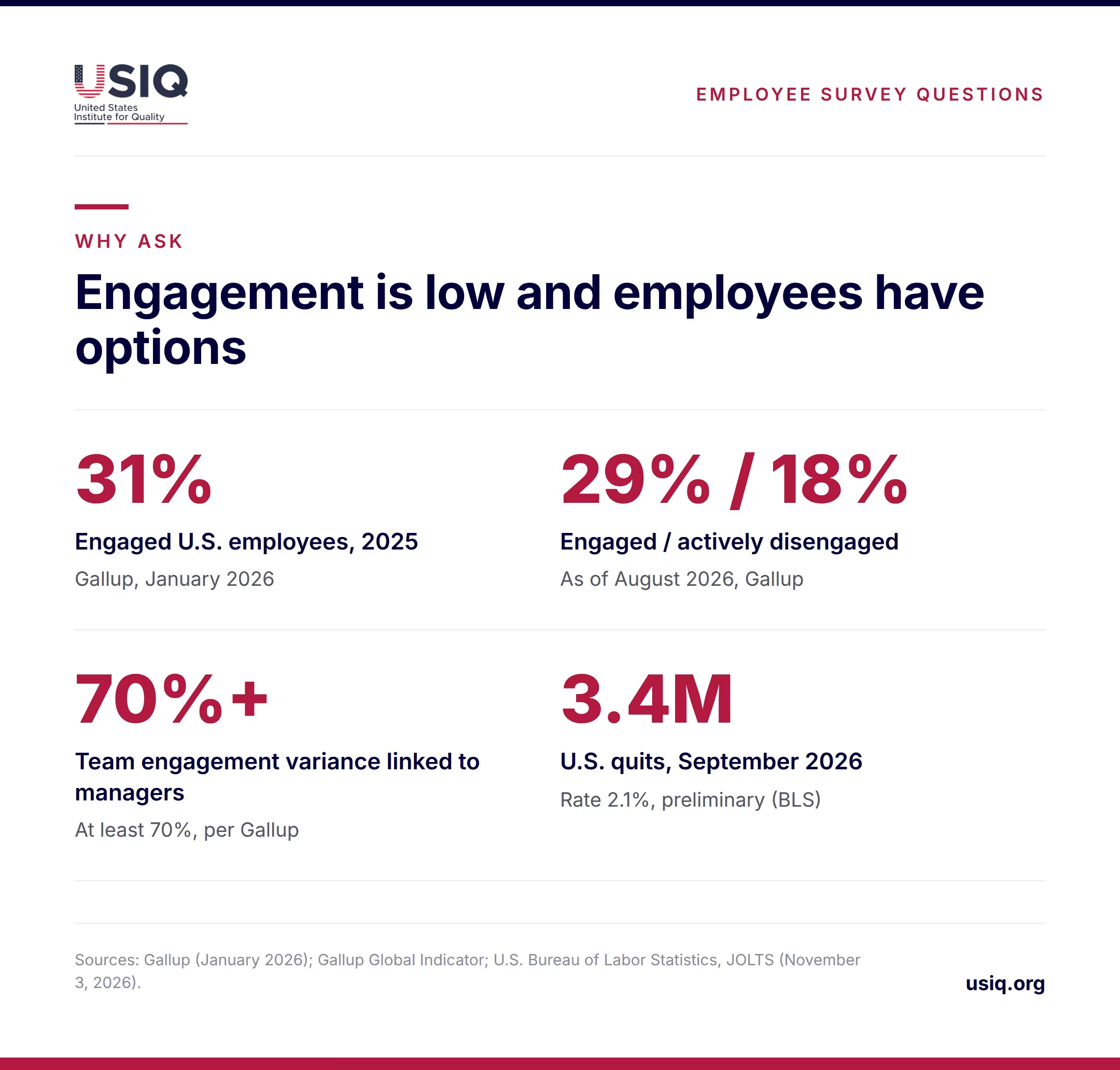
Engagement is not high, and it is not rising. Gallup reports that 31% of U.S. employees were actively engaged in 2025, unchanged from 2024 and down from a 2020 high of 36%. Each percentage point equals about 1.6 million employees, so the decline since 2020 represents roughly 8 million fewer engaged workers (Gallup, January 2026). As of August 2026, Gallup showed 29% of U.S. employees engaged and 18% actively disengaged (Gallup Global Indicator).
The labor market adds a practical reason to ask. In September 2026, 3.4 million U.S. workers quit their jobs, a quits rate of 2.1% (preliminary), with 7.5 million job openings (U.S. Bureau of Labor Statistics, JOLTS, November 3, 2026). Those numbers are national, not a forecast for your firm, but they show that employees have options.
For a company of 10 to 250 people, the manager relationship deserves most of the attention. Gallup states that managers account for at least 70% of the variance in team engagement, and that Gallup Exceptional Workplace Award winners average 70% engagement (Gallup). Small firms also have an advantage: a short survey, read by the people who can act on it, can produce changes within weeks. For a broader view of how feedback links to engagement, see USIQ’s guide to employee surveys and employer trust.
| Indicator | Figure | Source |
|---|---|---|
| Actively engaged U.S. employees, 2025 | 31% (2020 high: 36%) | Gallup, January 2026 |
| Engaged / actively disengaged, August 2026 | 29% / 18% | Gallup Global Indicator |
| Share of team engagement variance linked to managers | At least 70% | Gallup Global Indicator |
| U.S. quits, September 2026 | 3.4 million (rate 2.1%, preliminary) | BLS JOLTS |
How should you word questions about managers, communication and clarity?
Ask about observable behavior, not general feelings. “My manager gives me feedback that helps me improve” tells you more than “How do you feel about your manager?” because an employee can answer it from experience and a manager can change it.
Clarity and communication belong in almost every survey. Gallup found that clarity of expectations and feeling cared about showed the largest declines in its Engagement Index since 2020 among all U.S. employees, 9 and 8 points respectively. Among respondents asked about clarity of expectations, 35% said better communication would help most (Gallup, January 2026).
The same report shows a drop among Gen Z and younger millennials. Agreement that “my supervisor, or someone at work, seems to care about me as a person” fell from 54% in 2020 to 41% in 2025, and agreement on opportunities to learn and grow fell from 48% to 37%. If your workforce is young, keep the care and growth items in the table.
Use one question per leader group. Ask about the direct manager separately from senior leadership, and ask about communication separately from trust. Each topic should appear once; repeated leadership and inclusion items only lengthen the survey.
How do you ask about pay, growth, workload and wellbeing?
Ask about pay, but do not assume it explains everything. In Gallup’s open-ended responses, 23% of respondents named pay, benefits and security as what helps them feel cared about, compared with 34% who named supportive relationships, communication and respect (Gallup, January 2026). Pay matters, but a survey should measure the other factors too.
Keep pay questions about fairness and benefits fit, as in the table. They should not ask employees to disclose their salary or compare themselves with named colleagues.
For workload and wellbeing, one workload item and one boundary item are usually enough. If you run remote or hybrid arrangements, add a question on whether the work setup lets people do their jobs effectively. Phrase these neutrally: “My workload is manageable in a normal week” invites a plain answer, while “Are you overwhelmed by too much work?” pushes people toward one. More on this area is in USIQ’s article on burnout and employee mental health.
Inclusion items should ask about experience, not awareness. “I am treated with respect, whatever my background” asks whether employees feel respected and treated fairly. “Are you aware of how inclusive the company is?” only tests whether someone has noticed a policy. For context, see USIQ’s piece on making diversity and inclusion measurable.
Which answer scale should you use?
Use one scale for nearly everything. A five-point agree/disagree scale (strongly disagree to strongly agree) works for most statements and lets you compare themes against each other. Mixing 1-to-10 ratings, 1-to-5 ratings and yes/no items makes results impossible to line up.
Two exceptions are worth making. First, add a single 0-to-10 recommend question, often called an eNPS-style item. SurveyMonkey lists yearly eNPS surveys among the rhythms it suggests, though that is vendor guidance, not a standard (SurveyMonkey, 2026). Second, close with one open-ended question such as “What is one change that would most improve your work here?” It catches what a closed list misses.
Yes/no is rarely the right format for a complex topic. “Does the company promote the growth of its employees?” hides whether the problem is training, promotions or time. A scaled item on career development, plus a short follow-up on what would help, shows far more.
What questions should you not ask in an employee survey?
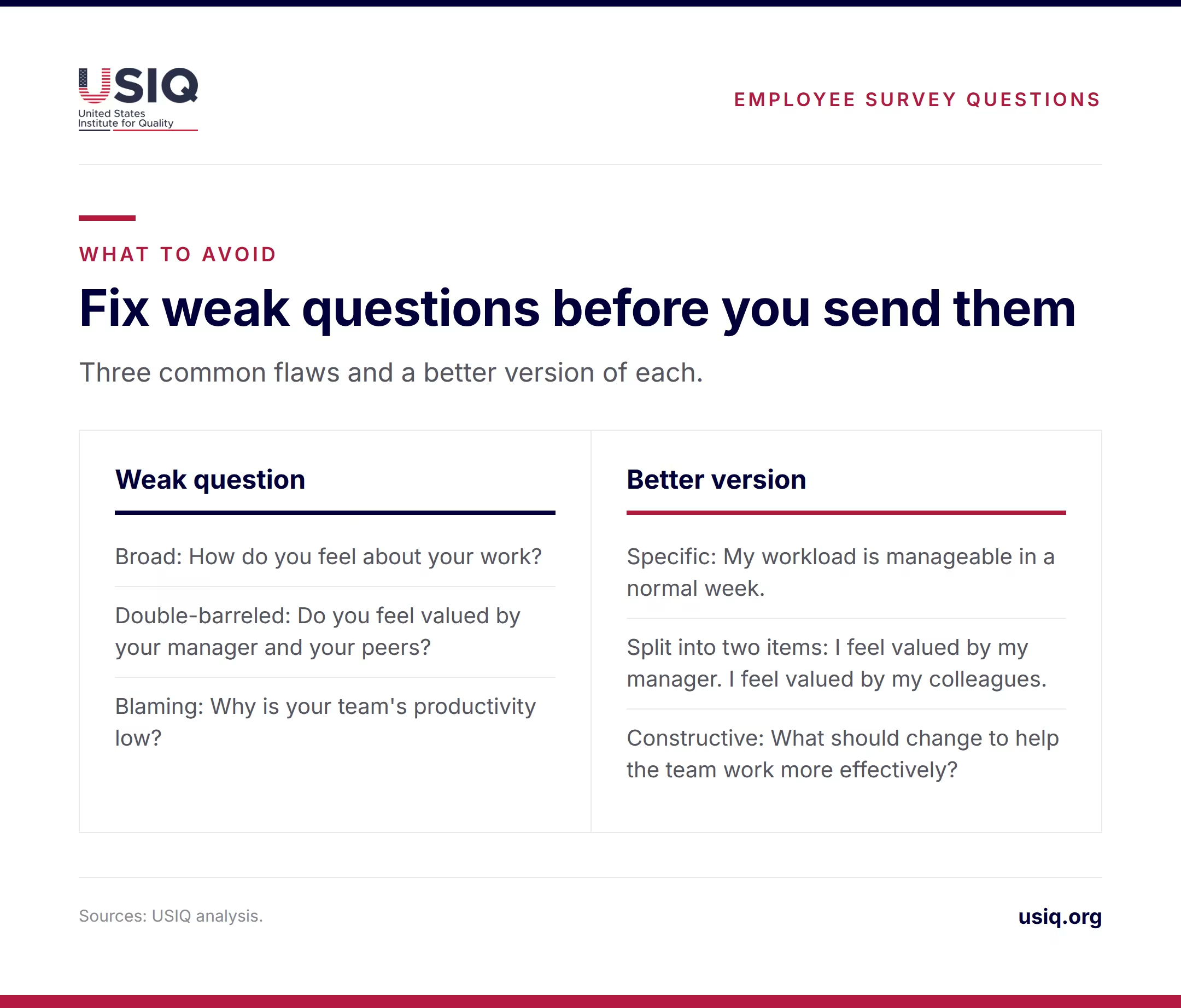
Avoid questions that steer the answer, bundle two ideas, use jargon, assign blame, pry into private life or cannot be answered by the person reading them. Each flaw weakens either the data or employees’ willingness to answer honestly. The table lists the most common problems with a fix for each.
| Weak question | Problem | Better version |
|---|---|---|
| How do you feel about your work? | Too broad; cannot be acted on | My workload is manageable in a normal week. |
| Don’t you think management communicates effectively? | Leading; suggests the right answer | Company leaders explain decisions that affect my work. (agree/disagree) |
| Do you feel valued by your manager and your peers? | Double-barreled; two answers in one | Two items: “I feel valued by my manager.” and “I feel valued by my colleagues.” |
| How would you rate cross-functional integration in your department? | Jargon | Teams in my department work well together. |
| Why is your team’s productivity low? | Blaming; invites defensiveness | What should change to help the team work more effectively? |
| Do you have financial problems affecting your work? Are you planning to start a family? | Invasive; erodes trust and carries legal risk | I can balance my work and personal life. |
| Does the company promote employee growth? (yes/no) | Binary answer to a complex topic | I have opportunities to learn and grow here. (agree/disagree) |
| How efficient is our global marketing strategy? | Most employees lack the information to answer | Ask only about work the person experiences directly. |
| I feel valued at work. / I feel valued by my manager. (both asked) | Repetition; invites hasty answers | Keep one item per idea. |
| Do you like working here and feel part of it? | Double-barreled | I feel that I belong at this company. |
Two further rules apply. Every question should serve a goal you can name; if you cannot say what you would do with the answer, cut it. And keep the survey short, because long surveys tire respondents and invite hasty or skipped answers.
What does U.S. law mean for survey design?
Three points matter most. First, avoid collecting protected-class or medical information beyond what you need. The EEOC lists race, color, religion, sex (including transgender status, sexual orientation, and pregnancy), national origin, age (40 and older), disability and genetic information as protected, and it is illegal to harass an employee because of any of them (U.S. EEOC). A survey that asks for such data without a clear reason creates risk without insight.
Second, if the survey surfaces harassment, you have to act on it. The EEOC also states that it is illegal to harass someone for complaining about discrimination or taking part in an investigation. A survey can reveal problems, but it does not replace a complaint procedure, and nobody should be penalized for raising a concern.
Third, take care with union and “concerted activity” topics, meaning employees acting together about pay or working conditions. According to a Proskauer summary of the NLRB’s Mercedes-Benz U.S. International decision (369 NLRB No. 38, 2020), employer polling of employees is not automatically unlawful interrogation. The Board applies a fact-specific test that looks at the background, the information sought, who asks and whether the employee is an open union supporter. It found no violation where there was a real business need and no threat (Proskauer Labor Relations Update, March 5, 2020). A voluntary engagement survey with a business purpose is lower risk than questions about union sympathies, but the outcome depends on the facts. Have employment counsel review the survey if you have any doubt. State privacy rules and medical or wellbeing questions are separate matters that also call for counsel.
How do you keep an employee survey anonymous?
Separate the answers from the names, and make sure small groups cannot be picked out. Use an external survey tool or a separate form that does not record log-in details, and tell employees exactly who sees what.
In a team of eight, a single demographic field can identify a respondent. Workhuman notes that demographic questions can hinder anonymity and lower response rates (Workhuman, 2026). Drop any field you will not use, and set a minimum group size below which results are not reported. Choose that number in advance and tell employees what it is.
Avoid questions that point to a specific person or decision, for example one about a named team lead’s restructuring plan. They make identification likely and can discourage honest answers. Decide in advance what happens to comments that name individuals, and what you will do if a comment describes harassment or another serious allegation. Do not promise anonymity you cannot keep.
- Keep it anonymous: say clearly who can see the data and how answers are protected.
- Use simple language: skip technical terms so everyone understands the questions.
- Make it accessible: offer online and paper options so that frontline and desk-based staff can both take part.
- Be transparent: explain the purpose and how the results will be used.
- Follow up: share the findings and the changes you will make.
How often should you survey, and what response rate is good?
There is no single standard, only vendor guidance. Workhuman notes that most employers survey annually and that yearly surveys suffer from recency bias, meaning recent events weigh too heavily in answers. SurveyMonkey suggests monthly pulse surveys, quarterly reviews or a yearly eNPS survey (SurveyMonkey, 2026). For a small employer, a fuller annual survey plus a short pulse of five to eight questions mid-year is a workable rhythm.
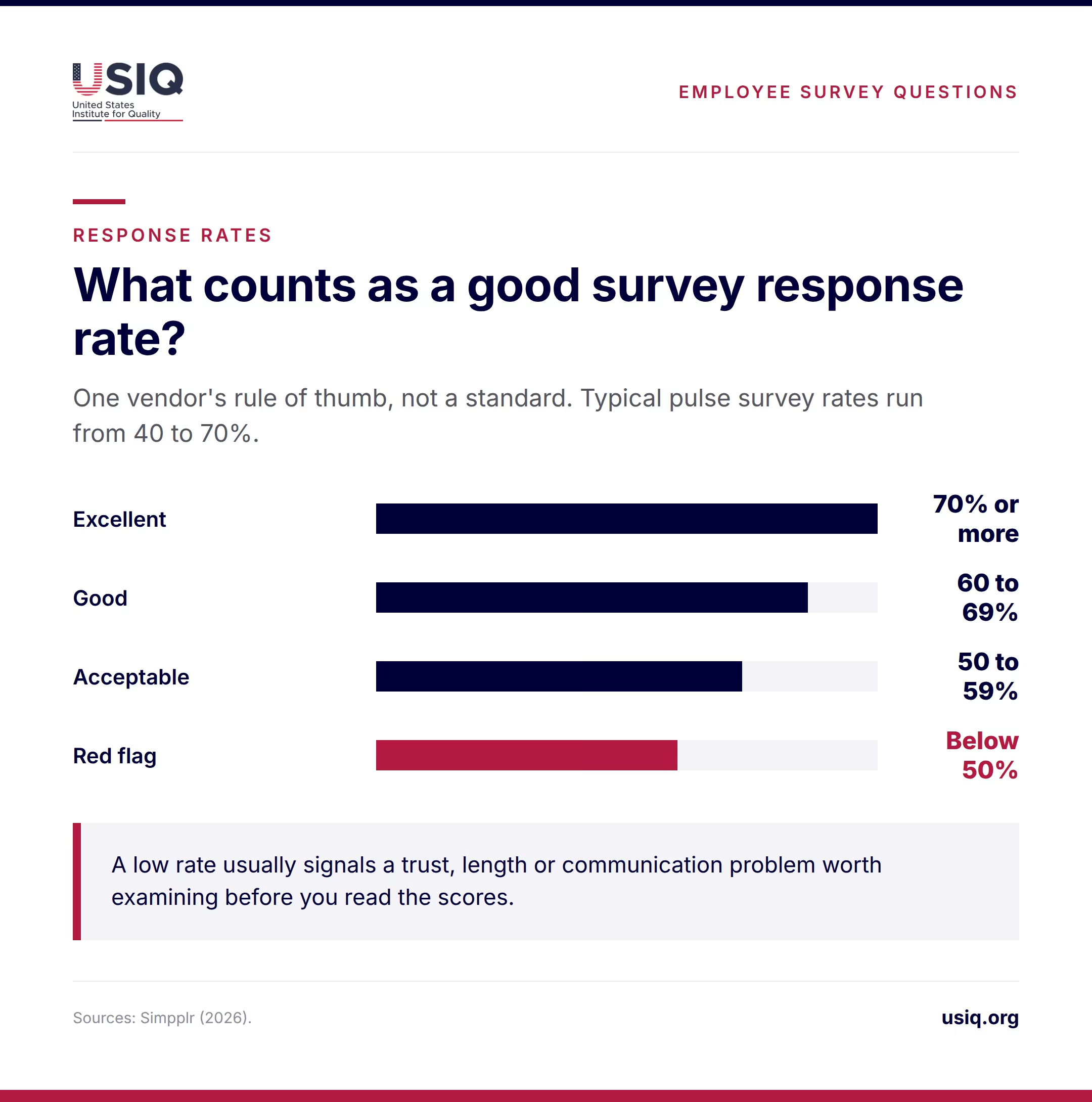
Response-rate bands are also one vendor’s rule of thumb. Simpplr treats 70% or more as excellent, 60 to 69% as good, 50 to 59% as acceptable and below 50% as a red flag. It also says typical pulse survey rates run from 40 to 70%, and that a 100% rate can itself be a warning sign (Simpplr, 2026). These bands are not a standard, but a low rate usually signals a trust, length or communication problem worth examining before you read the scores.
| Response rate (Simpplr guide) | Reading |
|---|---|
| 70% or more | Excellent |
| 60 to 69% | Good |
| 50 to 59% | Acceptable |
| Below 50% | Red flag |
What should you do with the results?
Share the results quickly and commit to a few actions. A survey that produces no visible change tells employees their input did not count, which is worse than not asking. Gallup’s finding that only 28% of U.S. employees strongly agreed that their opinions count (Q2 2025) shows how much room there is to improve.
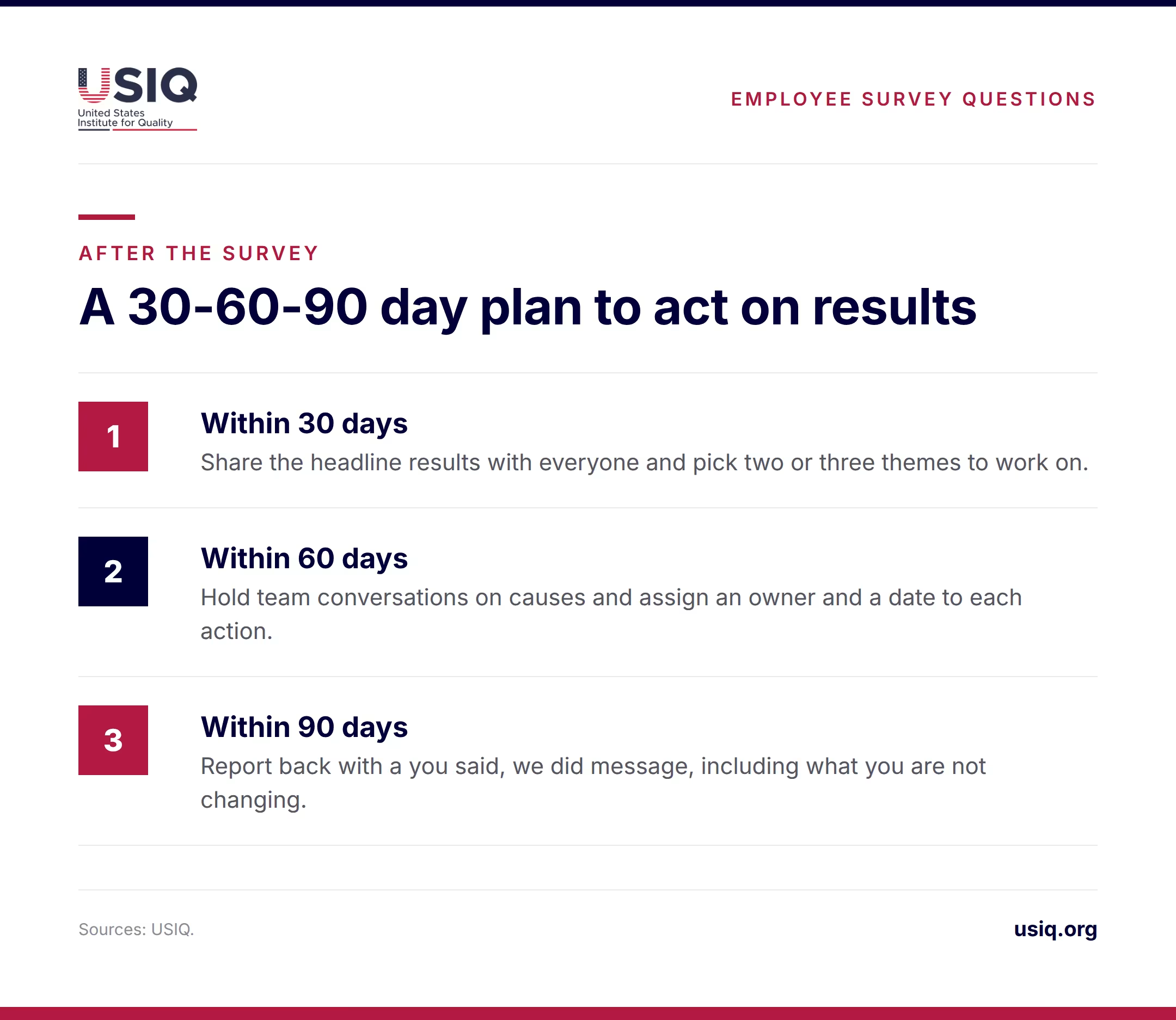
A simple 30-60-90 day plan is enough for most small firms:
- Within 30 days: share the headline results with everyone, including the weak spots. Name the two or three themes you will work on.
- Within 60 days: hold short team conversations to understand the causes. Assign an owner and a date to each action.
- Within 90 days: report back in a “you said, we did” message, and say what you are not changing and why.
USIQ’s article on what high-performing employers do with engagement data goes deeper, and the guide to employee surveys explains why who answers matters as much as what is asked.
What are the limits of an employee survey, and what do people get wrong?
A survey is a snapshot of perceptions, not a diagnosis. Annual surveys can overweight recent events, and too many surveys cause fatigue. Employees who see no change after one round will answer less honestly in the next.
Some common claims go further than the evidence. A survey does not prevent bullying; it can surface problems, and it does not replace a complaint procedure. Pay is not automatically the deciding factor in retention, as the Gallup figures above show. And a high score does not prove a healthy workplace if the response rate is low or employees do not trust the process.
Very small firms can add something a survey cannot: a short skip-level conversation, where the owner or a senior leader talks directly with team members. It works as a complement, particularly when a team is too small to report results anonymously.
What are the practical recommendations?
- Pick 15 to 25 questions from the table, covering clarity, manager, communication, recognition, growth, workload, pay, belonging and intent to stay.
- Use one five-point agree/disagree scale, one 0-to-10 recommend item and one open comment.
- Check each item for leading wording, double-barreled phrasing, jargon and blame.
- Remove protected-class and medical questions, and ask counsel to review anything touching union topics.
- Announce the purpose, the anonymity rules and the date results will be shared before launch.
- Commit to two or three actions and report back within 90 days.
Conclusion
The questions you choose set the ceiling on what a survey can tell you, and what you do afterwards decides whether employees answer again. A short, single-topic, consistently scaled survey with a clear follow-up plan beats a long list that nobody acts on.
FAQ
How many questions should an employee survey have?
For most companies with 10 to 250 employees, 15 to 25 questions is enough, including one recommend item and one open comment. Long surveys tire respondents and lower the quality of answers, so keep only items you can act on and cut anything without a clear purpose.
Should an employee survey be anonymous or confidential?
Anonymous means nobody can link answers to a person; confidential means someone can, but promises not to share it. In small teams, anonymity depends on a minimum reporting group size and on dropping demographic fields you do not need. Explain to employees which model you use.
Can you ask employees about pay in a survey?
Yes. Ask whether pay feels fair and whether benefits fit employees’ needs, using the same agree/disagree scale as other items. Avoid asking people to disclose their salary. Pay is one factor among several: in Gallup’s open-ended data, more respondents named relationships, communication and respect than pay and security.
Is it legal to ask employees about union activity in a survey?
It carries risk. Under the NLRA, employer polling is not automatically unlawful interrogation, but the Board applies a fact-specific test, as reported by Proskauer. A voluntary survey with a business purpose is lower risk than questions about union sympathies. Have employment counsel review the survey if you are unsure.
What should you do if a survey comment describes harassment?
Treat it as a report and follow your complaint procedure. The EEOC says harassment based on a protected characteristic is illegal, as is retaliation against someone who complains. Decide before launch how serious comments will be handled, and do not promise anonymity if that would prevent you from acting.
What can you do about a low response rate?
Read it as a signal. Simpplr, a vendor, treats rates below 50% as a red flag. Check survey length, access for frontline staff, trust in anonymity and whether earlier surveys led to action. Shorten the survey, explain the purpose and show what changed after the last round.
Which scale works best for employee survey questions?
A five-point agree/disagree scale works for most statements, since one format lets you compare themes and track change over time. Add a single 0-to-10 recommend question and one open-ended comment. Avoid yes/no for complex topics because they hide the reason behind an answer.
How often should a small company run an employee survey?
Vendors suggest anything from monthly pulses to a yearly survey. For a small employer, one fuller survey a year plus a short mid-year pulse is practical. Too many surveys cause fatigue, and each round needs visible follow-up before the next one begins.
Sources
- Gallup. “U.S. Employee Engagement Declines From 2020 Peak.” January 27, 2026. https://www.gallup.com/workplace/701486/employee-engagement-declines-2020-peak.aspx
- Gallup. “Global Indicator: Employee Engagement.” https://www.gallup.com/394373/indicator-employee-engagement.aspx
- Gallup. “Anemic Employee Engagement Points to Leadership Challenges.” 2025. https://www.gallup.com/workplace/692954/anemic-employee-engagement-points-leadership-challenges.aspx
- U.S. Bureau of Labor Statistics. “Job Openings and Labor Turnover Survey (JOLTS), News Release.” November 3, 2026. https://www.bls.gov/jlt/
- U.S. Equal Employment Opportunity Commission. “Prohibited Employment Policies/Practices.” https://www.eeoc.gov/prohibited-employment-policiespractices
- Proskauer Labor Relations Update. “Employer’s Poll of Workforce Not Unlawful Mass Interrogation, NLRB Rules.” March 5, 2020. https://www.laborrelationsupdate.com/2020/03/employers-poll-of-workforce-not-unlawful-mass-interrogation-nlrb-rules/
- Simpplr. “Employee Survey Benchmarks: What’s a Good Response Rate?” 2026. https://www.simpplr.com/blog/survey-benchmarks-response-rates/
- Workhuman. “122 Best Employee Survey Questions To Ask.” 2026. https://www.workhuman.com/blog/employee-survey-questions/
- SurveyMonkey. “36 Employee Survey Questions for Better Engagement.” 2026. https://www.surveymonkey.com/learn/employee-feedback/employee-surveys/

Related Articles
What research says about the effects of employer seals on current employees, potential applicants and employer image, from independent experiments and field data to the limits of the evidence.
Employee experience and customer experience are linked, but the link is weaker and more conditional than popular slogans suggest. This article reviews the evidence on staffing, training and workplace conditions and shows how employers can test the connection in their own business.
Most HR dashboards show too many metrics and trigger too few decisions. This guide defines ten employee experience metrics, shows a one-page layout and explains how to read your numbers against U.S. data.
A practical guide to calculating marketing ROI for small and mid-sized U.S. companies, including long B2B sales cycles, offline leads, a spreadsheet walkthrough and common errors.