
Employee benefits are the part of pay that does not show up in a paycheck: health coverage, retirement plans, paid time off, insurance and similar programs. For a company with 10 to 250 employees, the hard question is rarely which benefits exist. It is which ones to offer first, what they cost, and which ones the law actually requires.
Many lists of “must-have” perks blur the line between legal duty and competitive choice. Federal law requires very little. Yet benefits already make up 30.0% of what private employers spend on compensation, and smaller companies are far less likely than large ones to offer the core packages.
Below, mandatory and voluntary benefits are separated, access and cost data are broken out by company size, and a sequence is laid out that a growing employer can follow.
Quick answer
No federal law requires most employee benefits. Two thresholds matter: FMLA unpaid leave applies from 50 employees, and the ACA coverage mandate from 50 full-time equivalents. Below that, health insurance, retirement plans and paid leave are choices. Add them in order of cost, legal trigger and what your staff say they value.
Key takeaways
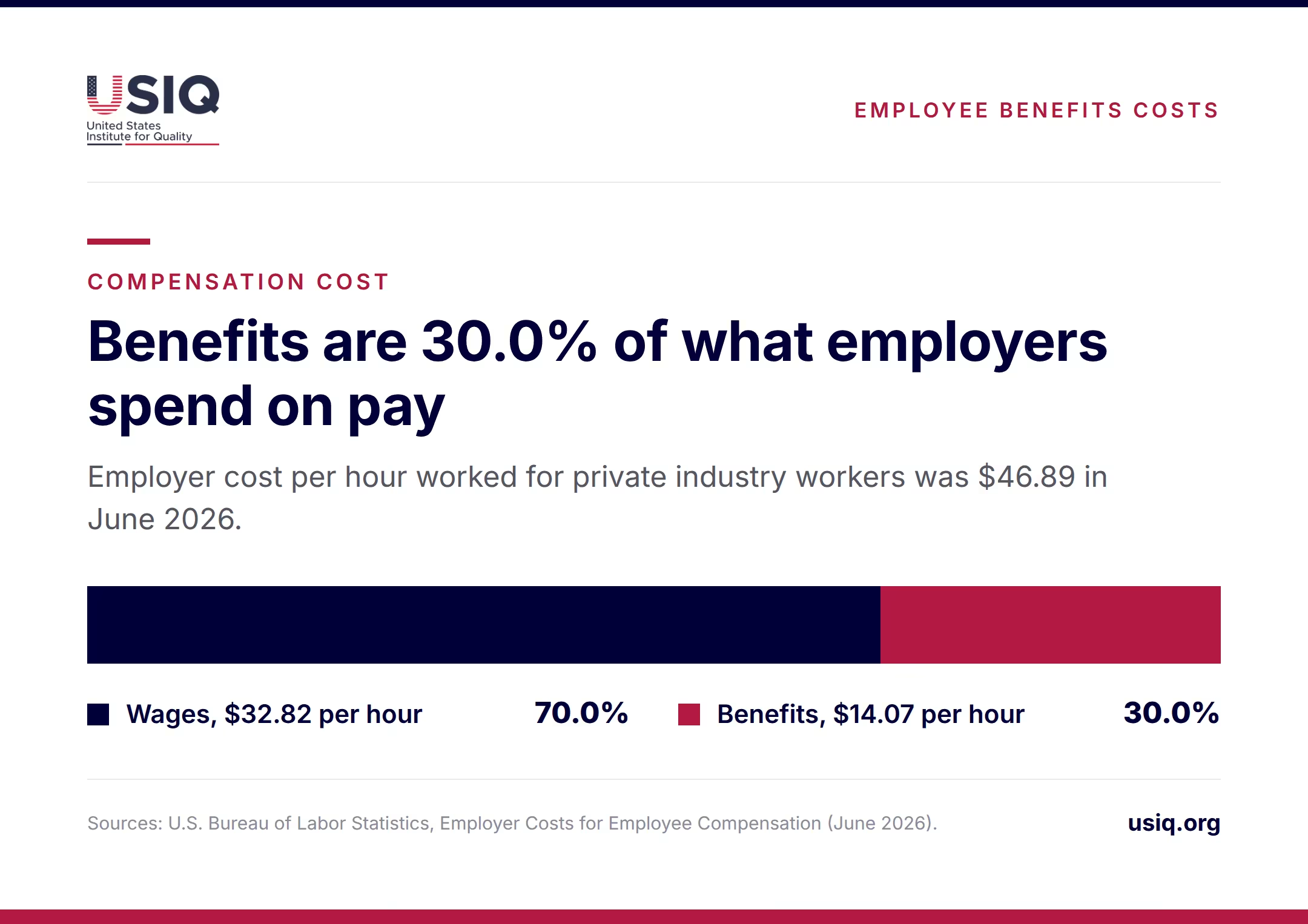
- Benefits cost private employers $14.07 of every $46.89 spent per hour worked in June 2026, or 30.0% of compensation.
- Federal law mandates unpaid FMLA leave (50+ employees) and ACA coverage offers (50+ full-time equivalents). It does not require paid vacation, holidays or family leave.
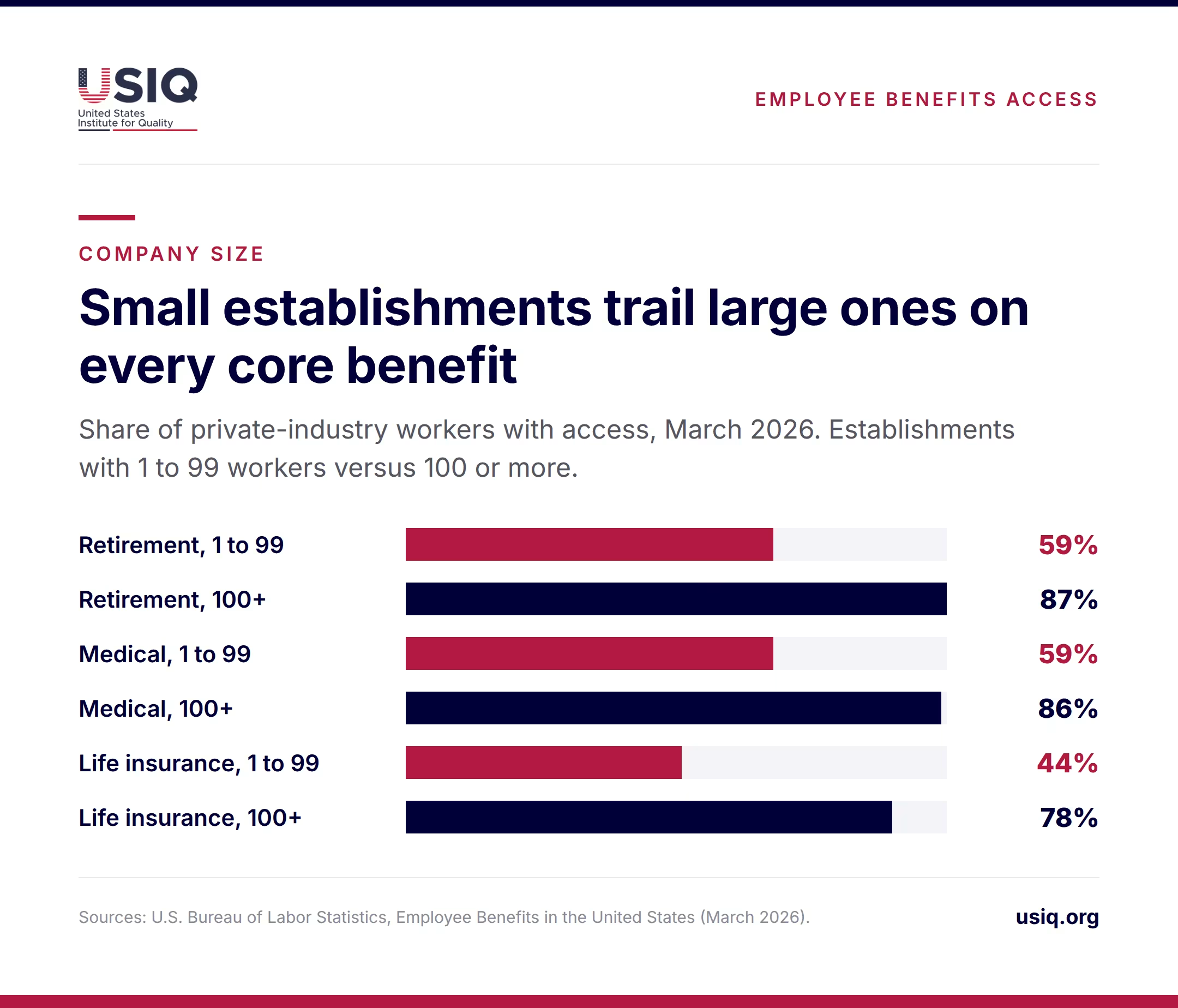
- Small employers lag on access: 59% of workers at establishments with 1 to 99 employees can get a retirement plan, against 87% at establishments with 100 or more.
- Average 2026 premiums for firms with 10 to 199 workers are $9,593 for single and $27,288 for family coverage, and premiums grew faster than wages.
- Part-time workers are largely left out: 23% have access to a medical plan, compared with 87% of full-time workers.
- A sensible sequence is health contribution, retirement plan, paid time off, then income protection and flexibility. Niche perks come last.
- A short annual staff survey shows which benefits people value before a budget is committed.
What are employee benefits, and which ones does U.S. law require?
Employee benefits are non-wage compensation: insurance, retirement contributions, paid leave and other programs the employer funds in whole or in part. They are a large line item. The Bureau of Labor Statistics (BLS) reports that employer costs for private industry workers averaged $46.89 per hour in June 2026, of which wages were $32.82 (70.0%) and benefits $14.07 (30.0%). For all civilian workers the total was $49.46, with benefits at $15.61.
“Benefits every company should offer” is a common phrase, but it overstates the legal position. Only a few obligations exist at the federal level, and they depend on company size.
FMLA: unpaid leave from 50 employees
The Family and Medical Leave Act covers private employers with 50 or more employees in 20 or more workweeks of the current or prior year. An employee is eligible after 12 months of tenure and 1,250 hours worked, if the employer has 50 employees within 75 miles. Eligible employees receive up to 12 workweeks of unpaid, job-protected leave per year, and up to 26 weeks for military caregiver leave, according to the U.S. Department of Labor fact sheet on the FMLA.
ACA: health coverage offers from 50 full-time equivalents
An applicable large employer (ALE) has an average of at least 50 full-time employees, counting full-time equivalents, in the preceding year. ALEs must offer affordable coverage that meets minimum value to full-time employees or may owe a payment, as explained in the IRS guidance on employer shared responsibility provisions. Employers below 50 full-time equivalents are not subject to this mandate.
What the federal government does not require
No federal law requires paid vacation, paid holidays or paid family leave. Some states and cities add their own paid sick-leave or paid-leave rules, so check the requirements where your employees work. Other federal and state rules, such as plan administration and nondiscrimination requirements for retirement and insurance plans, also apply once you offer certain benefits. A benefits adviser or attorney can confirm which apply to you.
| Benefit | Legal status (federal) | Private-industry access, March 2026 |
|---|---|---|
| Medical plan | Offer required from 50 full-time equivalents (ACA) | 71% (59% at 1 to 99 workers, 86% at 100+) |
| Retirement plan | Voluntary | 72% (59% at 1 to 99, 87% at 100+) |
| Paid holidays | Voluntary | 81% |
| Paid sick leave | Voluntary at federal level; check state law | 81% |
| Paid family and medical leave | Voluntary at federal level; FMLA unpaid from 50 employees | 49% |
| Life insurance | Voluntary | 59% (44% at 1 to 99, 78% at 100+) |
| Short-term / long-term disability | Voluntary | 44% / 37% |
Which employee benefits do most U.S. employers offer today?
Two sources give a consistent picture. The BLS measures what share of workers can actually access a benefit. SHRM surveys HR professionals about what their organizations offer and rate as important.
Access among private-industry workers
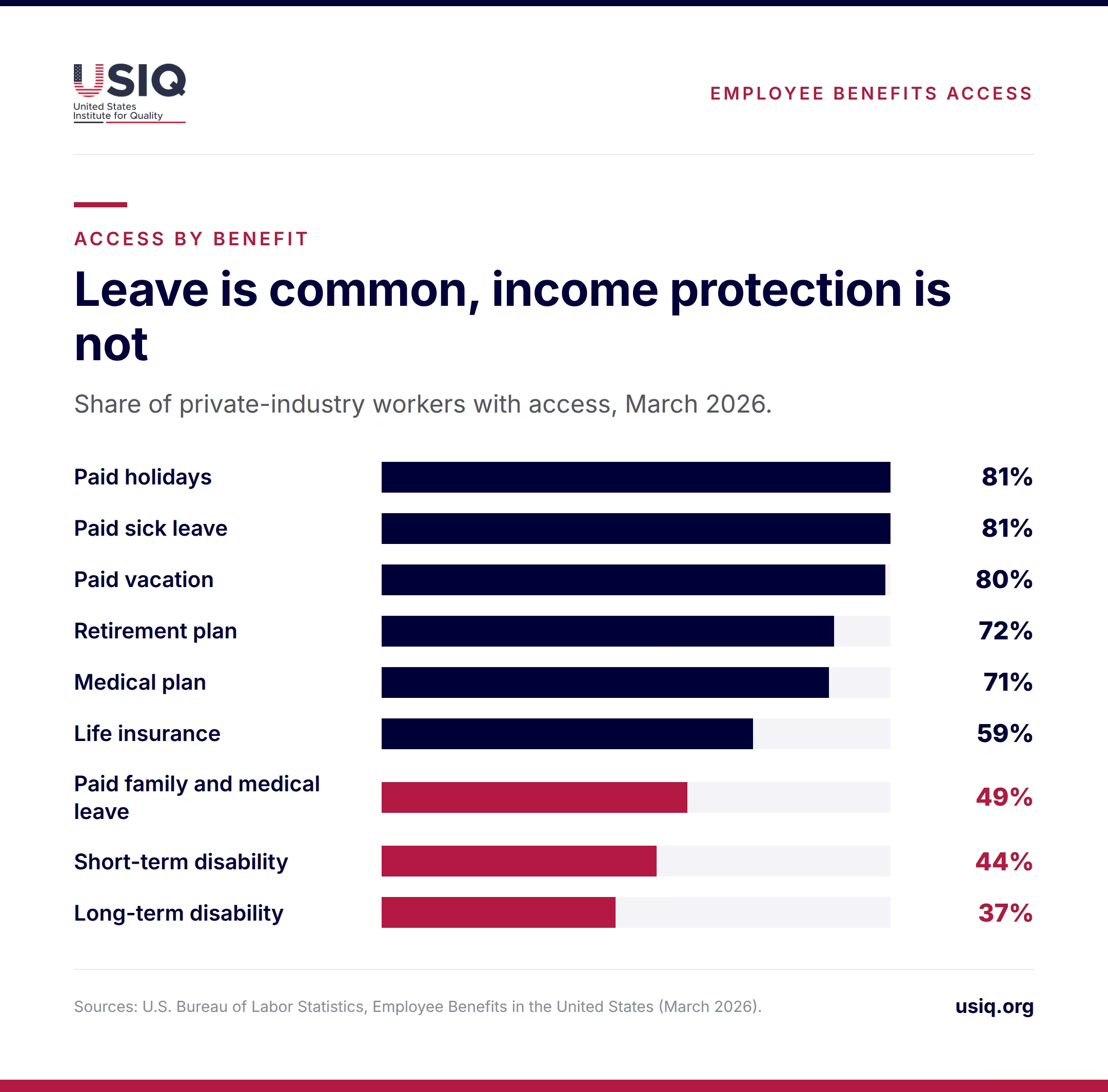
In March 2026, the BLS Employee Benefits in the United States release reported that 72% of private industry workers had access to retirement benefits. Seventy percent had access to a defined contribution plan, such as a 401(k), and 14% to a defined benefit pension. Access is not use: 52% of workers participated in any plan.
Seventy-one percent had access to a medical plan and 46% participated. Dental access was 44% (32% participating) and vision access 29% (22%). On leave, 80% had paid vacation, 81% paid holidays and 81% paid sick leave. Paid family and medical leave reached 49% and personal leave 51%. For income protection, 59% had life insurance, 44% short-term disability and 37% long-term disability.
What HR leaders say they offer and value
The SHRM 2025 Employee Benefits Survey, based on 3,969 HR professionals, found that 97% of responding employers offer health coverage and 88% of HR leaders rate health care as very or extremely important. Leave benefits and retirement savings were each rated that important by 81%. Flexible working followed at 68%, family care at 67% and professional development at 65%.
These are employer views, not employee preferences. They show what HR teams prioritize, which helps with benchmarking but does not replace asking your own staff.
Why do part-time workers have so little access?
Medical plan access among private industry workers was 87% for full-time employees and 23% for part-time employees in March 2026. Take-up was 67% and 47% respectively. Employers with many part-time roles, such as retail, hospitality and care services, should treat eligibility rules as a design choice, not an afterthought.
How do employee benefits differ for companies with 10 to 250 employees?
Size is the strongest dividing line in the data. Establishments with 1 to 99 workers trail those with 100 or more on every core benefit the BLS reports.
| Benefit (private industry, March 2026) | 1 to 99 workers | 100+ workers |
|---|---|---|
| Retirement plan access | 59% | 87% |
| Retirement participation | 39% | 68% |
| Retirement take-up | 66% | 77% |
| Medical plan access | 59% | 86% |
| Medical participation | 37% | 58% |
| Life insurance access | 44% | 78% |
Health coverage shows the same pattern from the employer side. The KFF 2026 Employer Health Benefits Survey found that 67% of firms with 10 or more workers offer health benefits. That compares with 61% in 2025, 65% two years earlier and 73% five years earlier. Among firms with fewer than 200 workers, 66% offer coverage, and the top reason non-offering firms give is that insurance costs too much.
Employees at smaller firms also carry more of the cost. KFF reports that the average worker contribution for family coverage is $9,687 at smaller firms against $6,840 at larger ones. At smaller firms, 32% of covered workers must pay more than half of the family premium, compared with 6% at larger firms. A plan that exists on paper can still be out of reach for a household if the employer share is thin.
How much does health insurance cost a small employer, and how can it be controlled?
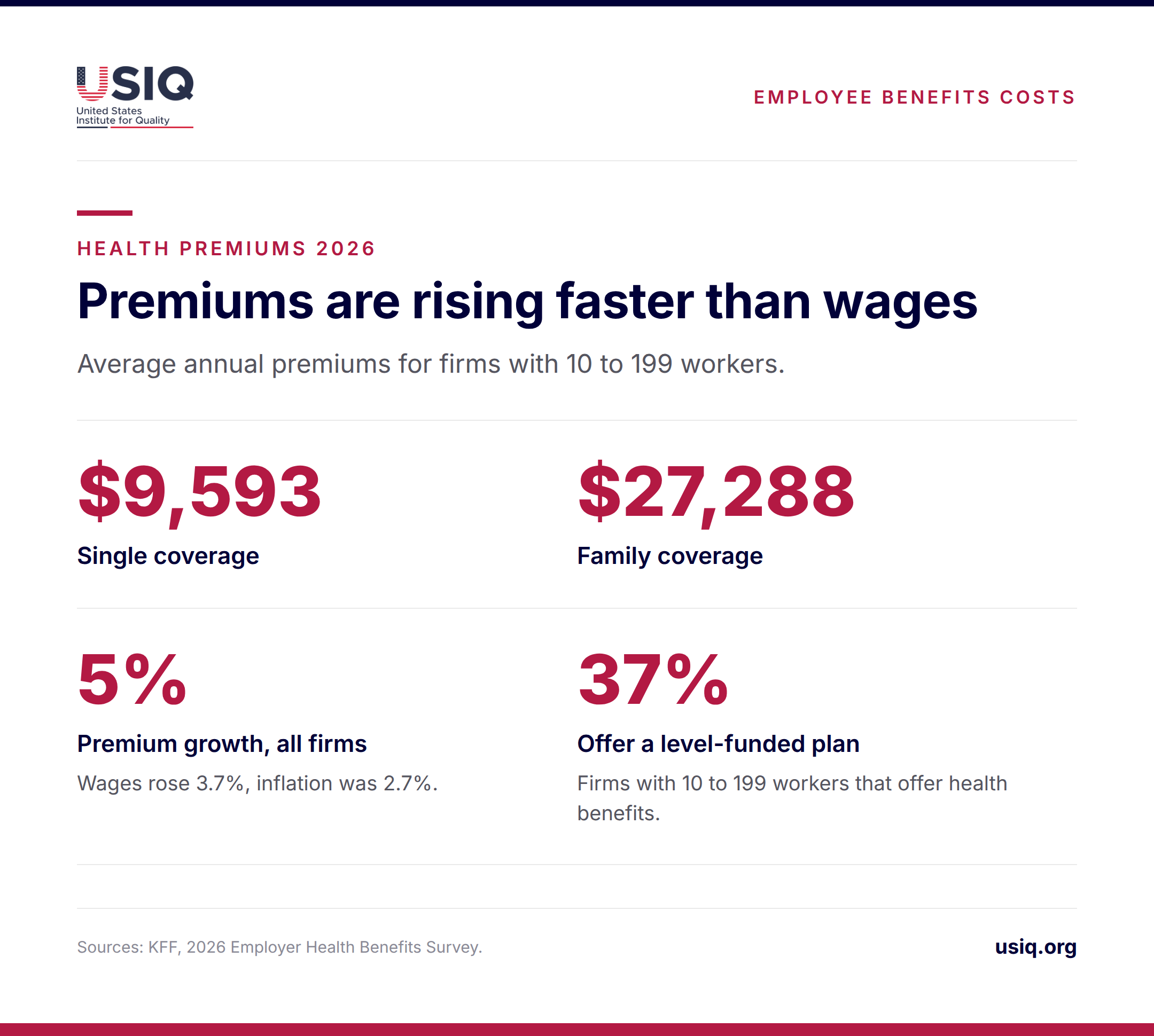
Health insurance is the largest single benefit decision. KFF reports 2026 average annual premiums of $9,804 for single and $28,303 for family coverage across all firms, each up 5% from 2025. Firms with 10 to 199 workers averaged $9,593 for single coverage (larger firms: $9,865) and $27,288 for family coverage (larger firms: $28,592). Workers pay an average of $1,672 for single and $7,471 for family coverage.
Premiums are climbing faster than the pay that funds them. In the same period, wages rose 3.7% and inflation was 2.7%. For a 40-person company covering most employees, a 5% premium increase compounds quickly, which is why cost control belongs in the plan design from the start.
Cost tools worth knowing
- High-deductible plans with an HSA. KFF finds average premiums for covered workers in HSA-qualified plans are lower, at $8,989 for single and $26,450 for family coverage. The average general annual deductible for single coverage across plans is $1,955. Lower premiums come with higher out-of-pocket exposure for employees.
- Level-funded plans. In 2026, 37% of firms with 10 to 199 workers that offer health benefits offer a level-funded plan, unchanged from 2025.
- Plan mix. SHRM reports that 81% of employers offer a PPO and 64% an HDHP linked to a savings or spending account. Offering a choice lets employees trade premium against deductible.
- The small-business tax credit. Employers with fewer than 25 full-time equivalents, average annual wages below an indexed limit, and a uniform contribution of at least 50% of the employee-only premium may qualify. The maximum credit rate is 50% (35% for tax-exempt employers) for two consecutive years, and the credit must be claimed through the SHOP Marketplace, per the IRS questions and answers on the credit.
Which employee benefits should a small company add first?
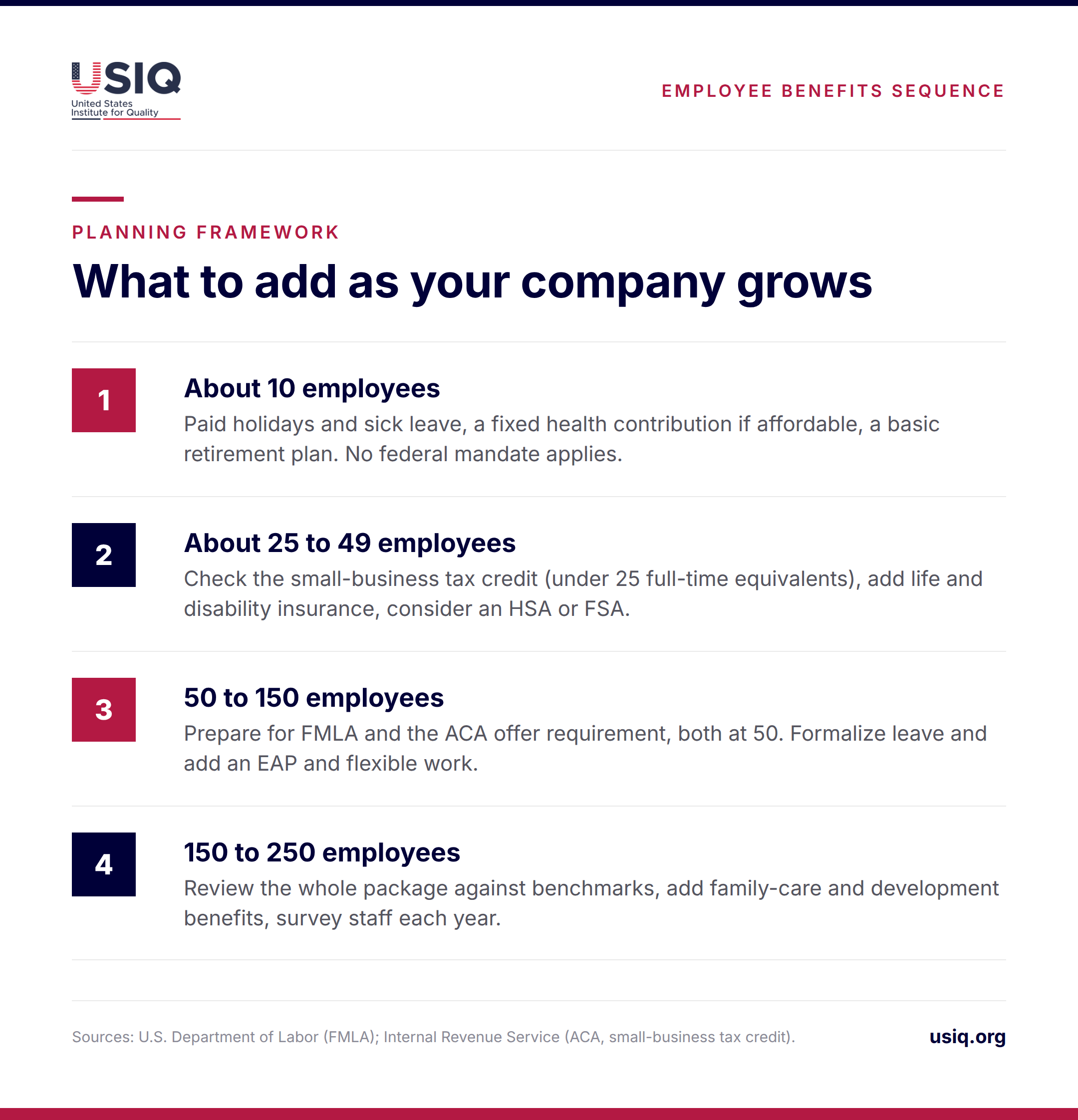
No data source ranks benefits by return for a company of a given size, so the sequence below is a planning framework built on legal triggers, cost and the benefits most employers already offer. Adjust it to your industry, your workforce and what your own employees tell you.
| Company stage | Priorities | Reason |
|---|---|---|
| About 10 employees | Paid holidays and sick leave; a fixed employer contribution to health coverage if affordable; a basic retirement plan | No federal mandate applies. Holidays and sick leave are offered to 81% of private-industry workers, and smaller firms trail larger ones on health and retirement. |
| About 25 to 49 employees | Check the small-business tax credit (under 25 full-time equivalents); add life and disability insurance; consider an HSA or FSA | Life insurance access is 44% at small establishments against 78% at large ones. SHRM reports 61% of employers offer an HSA and 60% a medical FSA. |
| 50 to 150 employees | Prepare for FMLA and the ACA offer requirement; formalize leave policies; add an employee assistance program and flexible work options | Both federal thresholds sit at 50. SHRM finds flexible working rated important by 68% of employers. |
| 150 to 250 employees | Review the whole package against benchmarks; add family-care and development benefits; survey staff each year | Larger employers set the comparison point: retirement access is 87% and medical access 86% at 100 or more workers. |
Spending accounts and supplemental coverage
According to SHRM, 61% of employers offer an HSA and 14% a health reimbursement arrangement. A medical FSA is offered by 60% (63% in 2024, 68% in 2021) and a dependent care FSA by 54% (58% and 65%). Critical illness insurance is moving the other way: 53% of employers offer it, up from 51% in 2024, 48% in 2023 and 47% in 2022.
These accounts and voluntary products often cost the employer little beyond administration, because employees fund much of them. That makes them a practical second layer once core coverage is in place.
Life and disability insurance
Life insurance pays a death benefit to an employee’s beneficiaries. Employers often fund a basic amount and let employees buy more at their own expense, sometimes with accidental death and dismemberment (AD&D) coverage added. Short-term and long-term disability insurance replace part of income when illness or injury keeps someone from working. With access at 44% for short-term and 37% for long-term disability, a group policy can set a small employer apart.
Are paid leave and flexibility worth offering without a mandate?
Paid sick leave and paid holidays are already the norm, each offered to 81% of private-industry workers. Paid family and medical leave is less common, at 49%. SHRM reports that 31% of employers offer paid leave to care for immediate family (33% in 2024) and 17% for extended family (19%), so this benefit is slipping, not spreading.
For employers with 50 or more employees, FMLA adds an unpaid baseline that managers must administer correctly. Below that threshold, a written leave policy is still worth having, because it removes guesswork when someone needs time off. State and local laws may require more than federal law, so check them before setting policy.
Flexibility costs little in cash. SHRM finds 68% of employers rate flexible working as very or extremely important. Remote and hybrid options also widen the pool of candidates a small employer can reach. Floating holidays give employees room for cultural or religious observances without adding a fixed day to the calendar. For more on the trade-offs, see this overview of work-life balance examples and this look at family-friendly employer policies.
Work-enablement and commuter stipends
Home-office equipment, internet and utility reimbursements, and transit or parking support all cover the cost of getting to work or working from home. Treat them as one stipend category with one budget and one set of rules. Decide who qualifies, set a cap, and review the tax treatment with your accountant.
Mental health support and employee assistance programs
An employee assistance program (EAP) offers confidential counseling and referrals, and often covers legal, financial and crisis support as well. Therapy coverage within the medical plan and wellness apps serve a similar purpose. Judge them by use rates and employee feedback. Related reading: burnout and mental health in HR.
Are trendy perks like GLP-1 coverage, AI tools and pet insurance worth it?
Newer benefits get headlines, but evidence of their effect on hiring or retention is thin. SHRM measured two of them for the first time in 2025: 23% of employers cover GLP-1 drugs, and 16% offer AI chatbot subscriptions. Pet insurance, identity theft protection, legal plans, volunteer time off and sabbaticals belong in the same optional group.
The cost-risk trade-off differs by item. A voluntary pet or legal plan is usually employee-paid and carries little cost for the employer. Covering a high-cost drug class can raise claims in a small, self-insured or level-funded group in ways that are hard to predict. Ask your carrier or broker for an estimate before adding it, and add these perks only after core coverage, retirement and leave are in place.
Common misconceptions about benefits
- “Every employer must offer health insurance.” Not at the federal level below 50 full-time equivalents. Above that, an ALE that fails to offer affordable, minimum-value coverage to full-time employees may owe a payment.
- “Offering a benefit means employees use it.” Retirement access is 72% but participation is 52%. Medical access is 71% but participation is 46%.
- “More perks always win candidates.” The data measure what employers offer, not what changes employee decisions. Cost, eligibility rules and the employee share of the premium matter as much as the length of the list.
- “Cheaper plans are always better.” HSA-qualified plans carry lower premiums, but employees pay more before coverage begins. Whether that suits your workforce depends on its income and health needs.
How do you find out which benefits your employees actually value?
Benchmarks from the BLS and SHRM tell you what others offer. They do not tell you what your own people need. A short anonymous survey closes that gap: ask which benefits employees use, which they would trade for another, and where cost or eligibility rules block them. Include part-time staff and recent hires, the groups most likely to be left out.
Keep the questionnaire short and repeat it every year, so you can see whether changes move the answers. Practical guidance is available in this explainer on employee surveys and a list of questions to ask in an employee survey. Once the package is in place, make it visible to candidates, as covered in this guide to building an employer brand on a small budget.
Practical recommendations
- Count your full-time equivalents each year, so you know when FMLA and the ACA offer requirement apply and whether you can still claim the small-business tax credit.
- Write down paid holidays, sick leave and time off in one policy, and check state and local rules.
- Compare health plan designs (PPO, HDHP with HSA, level-funded) using the premium benchmarks for firms with 10 to 199 workers, and set a fixed employer contribution.
- Decide who is eligible. Write the rules for part-time and new employees on purpose, because the access gap there is large.
- Add retirement, then life and disability coverage, then flexibility and assistance programs.
- Survey your staff before adding niche perks, and review the package each year.
Conclusion
Federal law sets a short list of duties, and everything else in a benefits package is a business decision. Small employers face higher costs per worker and lower access rates than larger firms, so sequencing matters more than volume. Start with the benefits tied to legal thresholds and everyday needs, then ask your employees what to add next.
FAQ
Which employee benefits are legally required in the U.S.?
Federal law requires unpaid, job-protected FMLA leave from employers with 50 or more employees, and requires employers with 50 or more full-time equivalents to offer affordable, minimum-value health coverage or risk a payment. It does not require paid vacation, holidays or paid family leave. State and local laws may add requirements, so check where your staff work.
What is the minimum a 15-person company should offer?
Federal law sets no minimum for a company that size. In practice, paid holidays and sick leave are the baseline, offered to 81% of private-industry workers. Add a fixed health contribution and a basic retirement plan as budget allows, and check state sick-leave rules, since some states require paid sick leave.
When does the ACA employer mandate apply?
The mandate applies to applicable large employers, defined as those averaging at least 50 full-time employees, including full-time equivalents, in the preceding year. Such employers must offer affordable, minimum-value coverage to full-time employees or may owe a payment. Companies below 50 full-time equivalents are not subject to this mandate.
Does a small business have to offer health insurance?
Under federal law, not below 50 full-time equivalents. Many still do: KFF reports that 66% of firms with fewer than 200 workers offer coverage. Those that do not most often cite cost. Employers under 25 full-time equivalents may qualify for a tax credit if they contribute at least 50% of the employee-only premium.
Are part-time employees eligible for benefits?
That depends on the employer’s plan rules. In March 2026, 23% of part-time private-industry workers had access to a medical plan, compared with 87% of full-time workers. The ACA offer requirement for large employers focuses on full-time employees. Employers that want part-timers covered must set that eligibility in the plan.
How much do benefits cost an employer?
Benefits averaged $14.07 per hour worked for private industry in June 2026, about 30.0% of total compensation cost of $46.89. For health coverage alone, firms with 10 to 199 workers averaged premiums of $9,593 for single and $27,288 for family coverage per year, with employees paying a share.
What is a level-funded health plan?
It is a health plan option that some smaller employers use to manage cost. KFF reports that 37% of firms with 10 to 199 workers that offer health benefits offered one in 2026. Terms differ by carrier, so ask your broker how it handles claims risk before choosing it over a traditional insured plan.
How often should an employer review its benefits?
At least once a year, ideally before renewal quotes arrive. Premiums rose 5% in 2026 while wages rose 3.7%, so cost shifts quickly. Pair the review with a short employee survey on use and satisfaction, and recount full-time equivalents to check whether any legal threshold has been crossed.
Sources
- Employee Benefits in the United States – March 2026 (News Release). U.S. Bureau of Labor Statistics, Sept. 25, 2026. https://www.bls.gov/news.release/ebs2.htm
- Employer Costs for Employee Compensation – June 2026. U.S. Bureau of Labor Statistics, Sept. 9, 2026. https://www.bls.gov/news.release/ecec.htm
- 2026 Employer Health Benefits Survey. KFF, Oct. 22, 2026. https://www.kff.org/health-costs/2026-employer-health-benefits-survey/
- Workers Now Pay $7,471 on Average Annually for Family Health Coverage (news release). KFF, Oct. 22, 2026. https://www.kff.org/private-insurance/workers-now-pay-7471-on-average-annually-for-family-health-coverage-up-9-or-621-from-2025-benchmark-employer-health-benefits-survey-finds/
- 7 Major Takeaways from SHRM’s 2025 Employee Benefits Survey. SHRM, survey released June 30, 2025. https://www.shrm.org/topics-tools/news/benefits-compensation/top-takeaways-shrm-2025-employee-benefits-survey
- Fact Sheet #28: The Family and Medical Leave Act. U.S. Department of Labor, Wage and Hour Division, revised March 2025. https://www.dol.gov/agencies/whd/fact-sheets/28-fmla
- Employer Shared Responsibility Provisions. Internal Revenue Service. https://www.irs.gov/affordable-care-act/employers/employer-shared-responsibility-provisions
- Small Business Health Care Tax Credit: Questions and Answers – Who Gets the Tax Credit. Internal Revenue Service. https://www.irs.gov/newsroom/small-business-health-care-tax-credit-questions-and-answers-who-gets-the-tax-credit

Related Articles
What research says about the effects of employer seals on current employees, potential applicants and employer image, from independent experiments and field data to the limits of the evidence.
Employee experience and customer experience are linked, but the link is weaker and more conditional than popular slogans suggest. This article reviews the evidence on staffing, training and workplace conditions and shows how employers can test the connection in their own business.
Most HR dashboards show too many metrics and trigger too few decisions. This guide defines ten employee experience metrics, shows a one-page layout and explains how to read your numbers against U.S. data.
A practical guide to calculating marketing ROI for small and mid-sized U.S. companies, including long B2B sales cycles, offline leads, a spreadsheet walkthrough and common errors.