

Lists of family-friendly jobs usually rank professions: teacher, nurse, accountant, graphic designer. The trouble is that two people with the same title can have very different lives. One has paid sick days, a predictable schedule and a family health plan. The other has none of those.
This article, updated in November 2026, looks at family-friendly jobs through the features that matter to parents and caregivers: schedule control, paid leave, and access to health coverage. It uses federal data from the U.S. Bureau of Labor Statistics (BLS) and the U.S. Department of Labor (DOL). Owners and HR leaders at companies with 10 to 250 employees will also find a list of what they can offer.
USIQ, the publisher of this article, runs certification programs for employers, including a Family Friendly Employer program. The data below comes from federal sources, not from USIQ.
Quick answer: A family-friendly job combines a predictable or controllable schedule, paid sick and family leave, affordable health coverage, and some flexibility in hours or location. Employer size and full-time status often matter more than the profession. In March 2026, only 49% of private industry workers had access to paid family and medical leave.
Key takeaways
- Family-friendliness depends on the employer and the contract at least as much as on the occupation.
- The U.S. has no national paid family leave. The federal Family and Medical Leave Act (FMLA) is unpaid and covers private employers with 50 or more employees, plus public agencies and schools of any size.
- Workers at establishments with 1 to 99 employees have less access to paid sick leave, paid vacation and medical plans than workers at larger ones.
- Part-time workers have far lower access to paid leave and medical coverage than full-time workers.
- Teachers have near-universal paid sick leave but little paid vacation. Summer break is unpaid time off, not a benefit.
- Small employers can stand out by closing benefit gaps that larger employers already cover.
What makes a job family-friendly?
Family-friendly jobs are positions in which the schedule, the leave policy and the benefits let employees meet family obligations without risking their income or their position. The definition has four parts: a schedule that is predictable or that the employee can influence, paid leave and sick time, affordable health coverage, and the option to adjust hours or location when needed.
Remote work is not part of the core definition. It can help, but a remote job without paid sick leave or health coverage leaves a parent exposed the first time a child falls ill. Likewise, a fixed daytime schedule helps only if the pay covers child care.
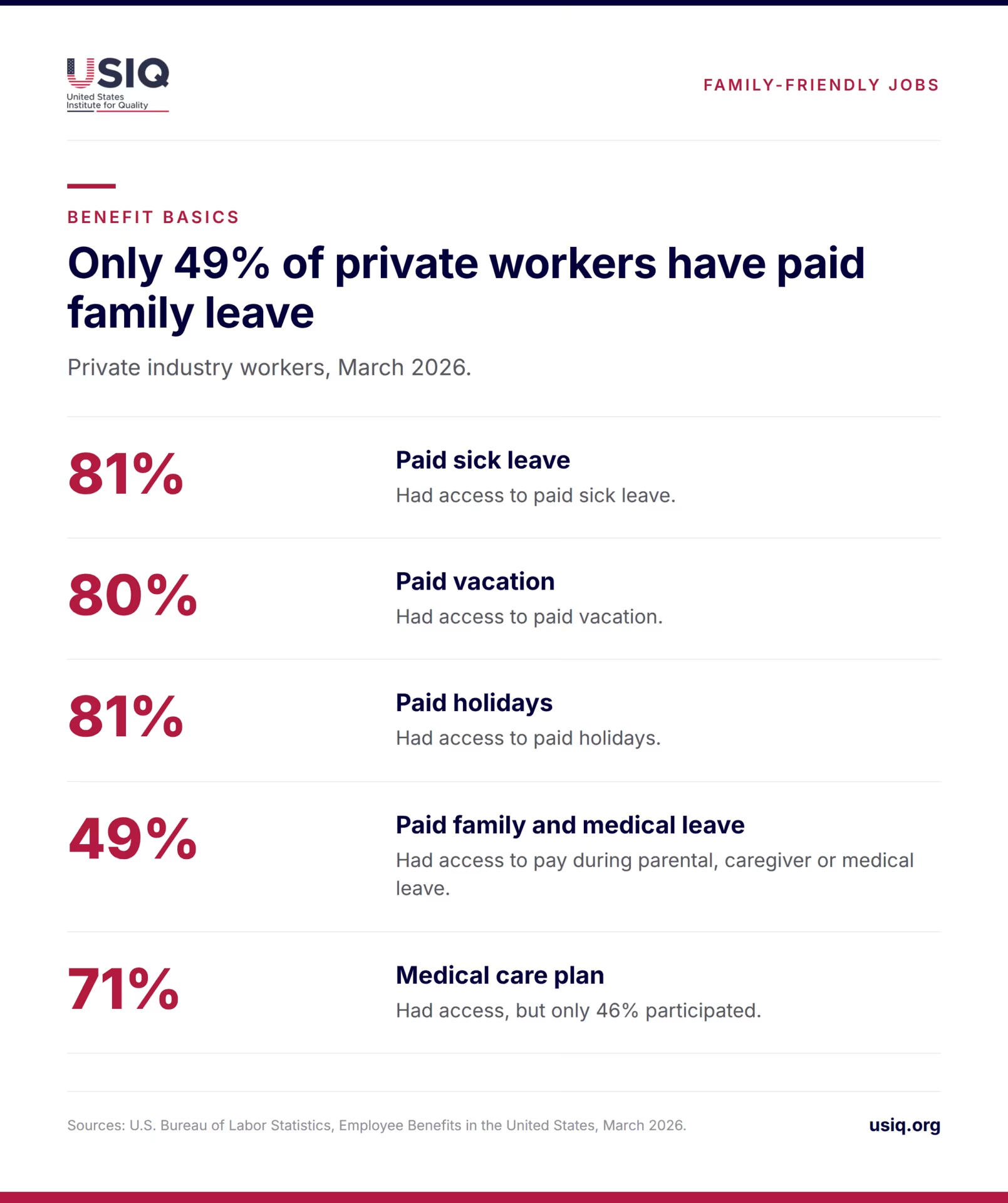
The BLS figures from March 2026 show how uneven the basics are. Among private industry workers, 81% had access to paid sick leave, 80% to paid vacation and 81% to paid holidays. Access to a medical care plan stood at 71%, but only 46% of private industry workers participated, which suggests that cost or eligibility keeps many people out even when a plan exists. Retirement benefits were available to 72%.
| Criterion | What to look for | BLS benchmark, private industry, March 2026 |
|---|---|---|
| Paid sick leave | Days that can be used for a sick child or relative, not only for the employee | 81% had access |
| Paid vacation | Paid days off during school breaks and emergencies | 80% had access |
| Paid holidays | Paid days off on public holidays | 81% had access |
| Paid family and medical leave | Pay during parental, caregiver or medical leave | 49% had access |
| Medical care plan | Coverage the employee can afford, including family coverage | 71% had access, 46% participated |
Does the U.S. guarantee paid family leave?
No. The federal FMLA provides job protection but not pay. According to the DOL, eligible employees can take up to 12 workweeks of job-protected leave in 12 months, and up to 26 workweeks of military caregiver leave. The leave may be unpaid, or the employee may use it together with paid leave from the employer.
Two tests limit who qualifies. The employer must be covered: private employers count only if they have 50 or more employees in 20 or more workweeks, while public agencies and schools are covered at any size. The employee must also be eligible, meaning 12 months with the employer, 1,250 hours worked in the prior 12 months, and a work site with at least 50 employees within 75 miles.
For a private company with 10 to 49 employees, this means the federal FMLA does not apply. Where it does apply, group health benefits must continue during leave, and the employee must be restored to the same or a virtually identical job. State laws can add requirements, so employers and employees should check the rules of their own state.
For parents, the practical result is that whether a new mother, a father or a caregiver gets paid time away depends largely on the employer’s own policy. In March 2026, 49% of private industry workers had access to paid family and medical leave, compared with 57% of state and local government workers.
Which jobs are most family-friendly in the United States?
Older lists name professions such as teacher, registered nurse, librarian, accountant, paralegal, occupational therapist, speech-language pathologist, pharmacist, dental hygienist, human resources manager, financial analyst and graphic designer. Many of these offer weekday schedules, part-time options or school-based employment, which is why they appear so often. But the benefit data shows that the label alone says little.
Two occupations in the BLS tables make the point. Both are often called family-friendly, and their benefit profiles are very different.
| Occupation (civilian workers) | Paid sick leave | Paid vacation | Medical plan access | Watch out |
|---|---|---|---|---|
| Registered nurses | 91% | 86% | 87% | Schedules vary and shifts may run 12 hours. Flexibility depends on the employer and the unit, and the nurse does not always choose the shift. |
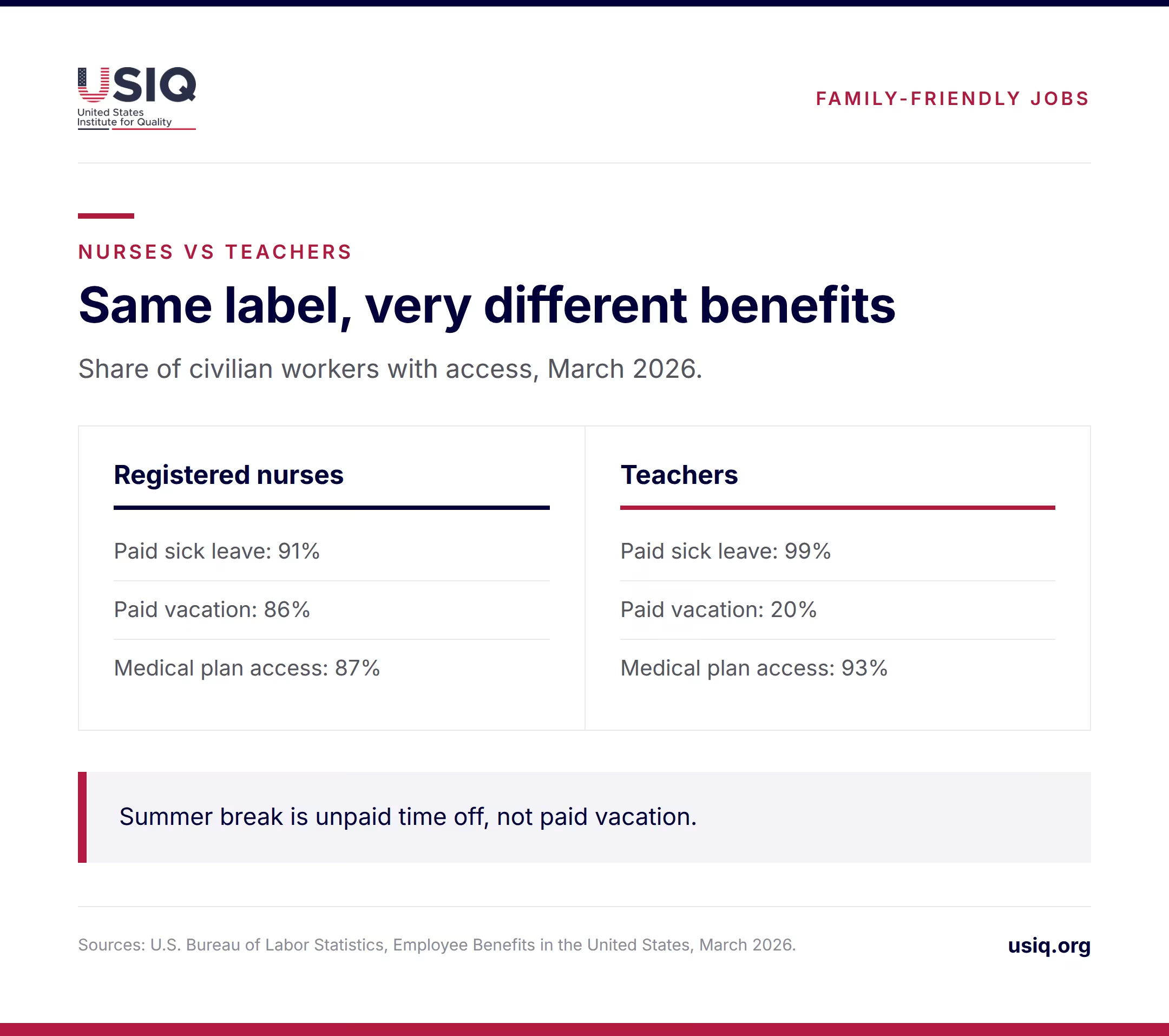
| Primary, secondary and special education teachers | 99% | 20% | 93% | Summer break is unpaid time off, not paid vacation. Grading and evening events add hours outside the school day. |
Why the old claim about teachers needs correction
Teaching is often described as a job with weekends and summers free. The summers are real, but they are unpaid. Only 20% of primary and secondary teachers had access to paid vacation, while 99% had paid sick leave. A parent who counts on summers at home should plan the household budget for those months. Pension coverage varies and needs to be checked with the individual school district.
Nursing: strong benefits, uneven schedules
Registered nurses rank high on benefits: 91% had paid sick leave, 86% paid vacation and 87% access to a medical plan. The schedule is the weak point for many families. Shifts can be long, and the ability to choose them depends on the hospital, the unit and the staffing situation. A nurse who wants a family-compatible schedule should ask about shift length, scheduling notice and swap rules before accepting a position.
Other professions: ask about the contract, not the title
The same logic applies elsewhere. An accountant may have a regular weekday schedule for most of the year, but busy seasons can change that. A pharmacist in a hospital may have a different schedule from one in retail. Occupational therapists, speech-language pathologists, virtual assistants and graphic designers can often work part time, on contract, or independently. That gives control over hours, but part-time and self-employed workers often have to buy their own coverage or go without. The next section shows how large that gap can be.
How do employer size and work status change family benefits?
Size and hours change access more than most job lists admit. BLS data for all civilian workers in March 2026 shows a clear gap between establishments with 1 to 99 workers and those with 100 or more.
| Benefit (all civilian workers) | 1 to 99 workers | 100 or more workers |
|---|---|---|
| Paid sick leave access | 75% | 90% |
| Paid vacation access | 71% | 83% |
| Medical plan access | 60% (56% at 1 to 49; 75% at 50 to 99) | 87% |
| Employer share of family medical premium | 64% | 73% |
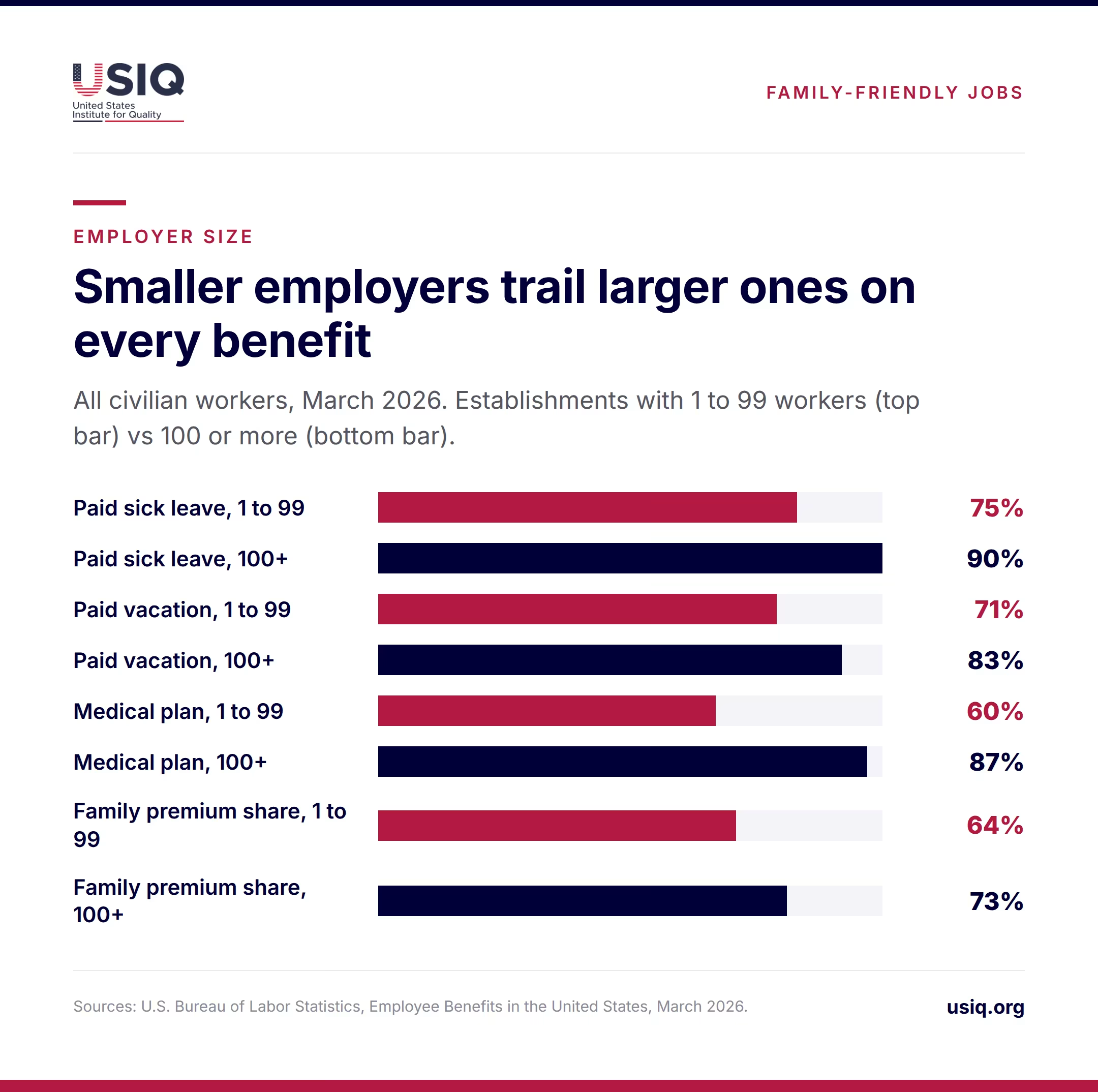
Across all employers, workers paid on average 31% of the premium for family medical coverage, and employers paid 69%. Smaller establishments sit below that average, with an employer share of 64%.
Part-time and service workers
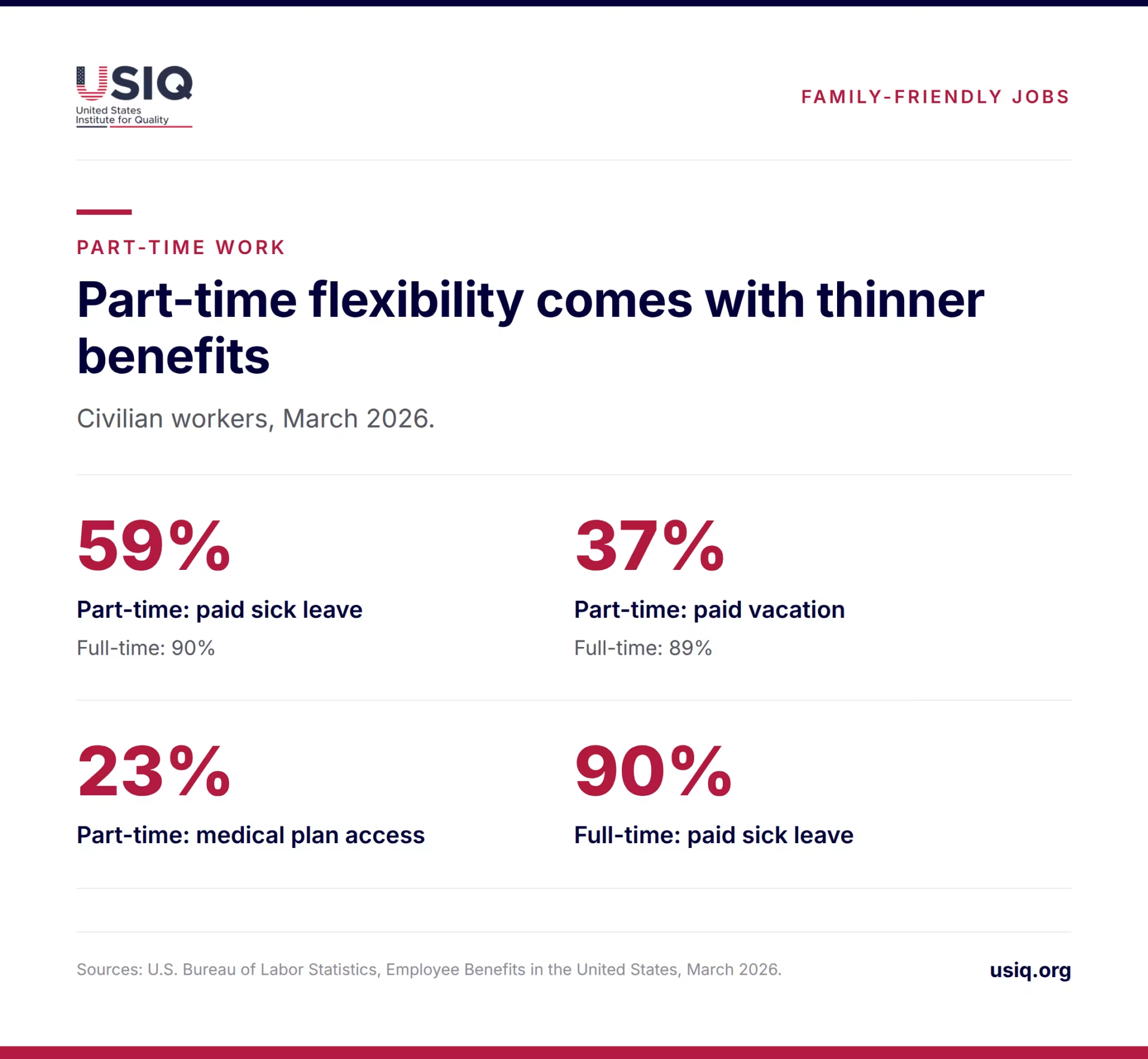
Many parents choose part-time work to manage child care. The benefit cost is steep. Among civilian workers in March 2026, 59% of part-time workers had paid sick leave and 37% had paid vacation, compared with 90% and 89% of full-time workers. Only 23% of part-time workers had access to a medical plan.
Service occupations also lag. Their paid sick leave access was 70% and their medical plan access 51%. These jobs often combine irregular schedules with limited benefits, which is the opposite of what a parent needs.
What can a company with 10 to 250 employees do to become a family-friendly employer?
The BLS gaps are an opportunity. A company with 40 or 120 employees will not match every benefit of a large corporation, but it can close the gaps that matter most to parents. The difference between 75% and 90% sick leave access shows that a clear offer is not yet universal among smaller employers.
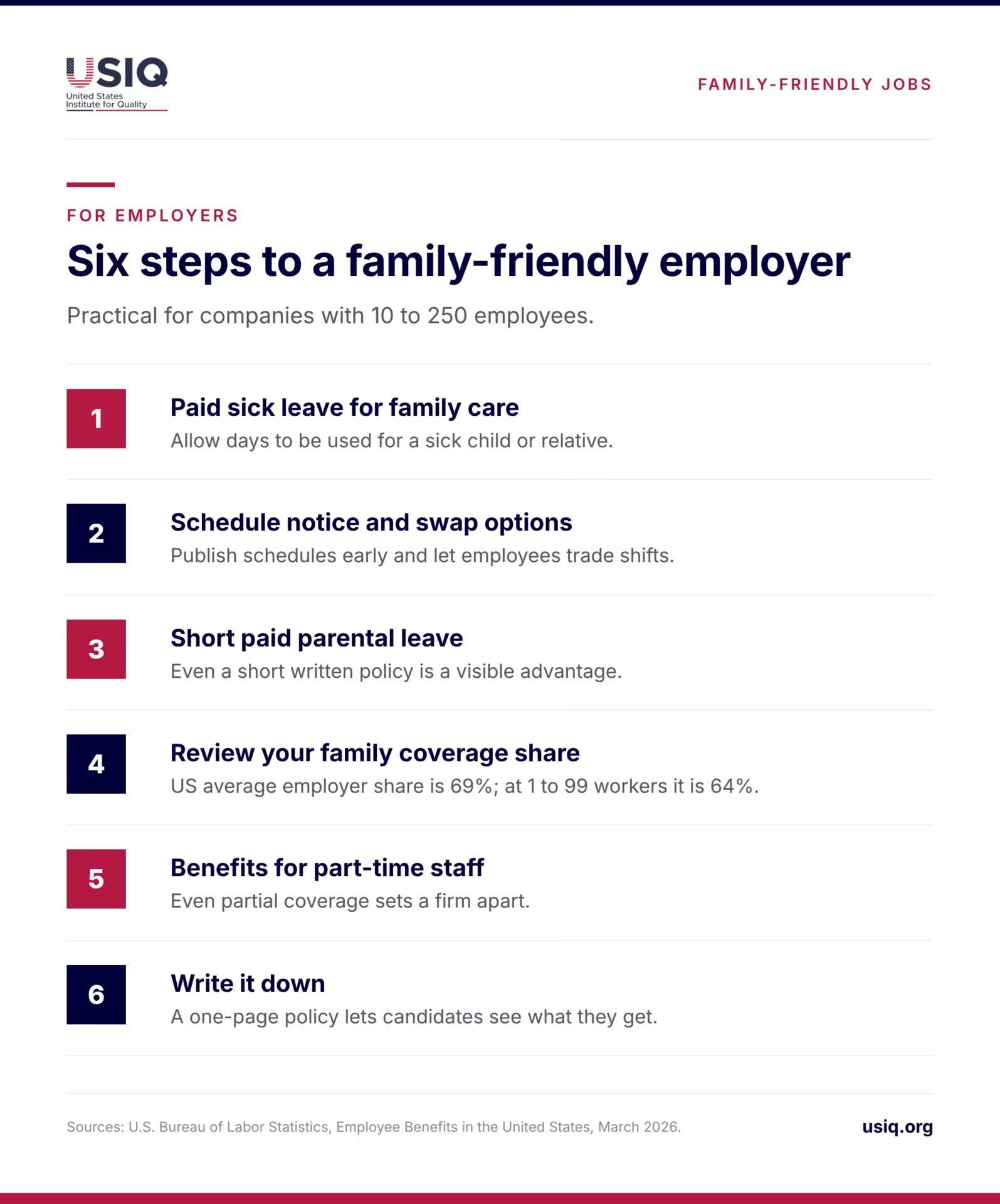
These steps are practical for most firms in this size range:
- Offer paid sick leave that covers family care. Allow days to be used for a sick child or relative.
- Give schedule notice and swap options. Publish schedules well ahead and let employees trade shifts. Predictability costs little and is often the first thing parents ask about.
- Add paid parental leave, even a short one. Private employers below 50 employees have no FMLA duty, so any written leave policy is a visible advantage. Companies covered by the FMLA can combine paid leave with the unpaid federal entitlement.
- Review the share of family coverage you pay. The national average employer share of the family medical premium is 69%. Firms with 1 to 99 workers average 64%, so closing that gap is a tangible signal.
- Extend some benefits to part-time staff. With 59% of part-time workers having paid sick leave and 23% medical plan access, even partial coverage sets a firm apart.
- Write it down. A one-page policy that states leave, scheduling and flexibility rules prevents favoritism and lets candidates see what they would get.
Costs depend on the size of the workforce, the plan chosen and the state, and no single figure fits every firm. A sensible approach is to price each measure against the cost of replacing an employee who leaves for lack of flexibility. For more ideas, see USIQ’s overview of family-friendly employer policies that matter to employees and the list of employee benefit types. Employers working with a limited budget can also read about building an employer brand on a small budget.
Do family-friendly employers attract more applicants?
A visible signal can help candidates tell a real offer from a slogan. In a randomized experiment with 1,093 participants, Oliver Scharfenberg found that an employer seal raised the stated likelihood of applying for a job by about 16 percentage points. It is described on USIQ’s research page.
Employers who want an external check of their family-related practices can look at the criteria of the Family Friendly Employer program, which USIQ runs. A seal does not replace the policies themselves: the benefits above are what employees experience day to day.
What do job lists and benefit data leave out?
Access to a benefit is not the same as use. The BLS reports that 71% of private industry workers had access to a medical plan, but only 46% participated. Cost, waiting periods and coverage through a spouse may explain part of the gap. Access figures also do not say how many days of leave a worker gets or whether a manager approves them without friction.
Occupation averages hide wide differences between employers. A nurse at one hospital may rarely work nights, while another has rotating 12-hour shifts. A parent should therefore ask each employer the same five questions: how much schedule notice, how to swap shifts, which leave is paid, what share of family coverage the employer pays, and what applies to part-time staff.
What are common misconceptions about family-friendly jobs?
- “Remote work means family-friendly.” Remote work helps with logistics but does not provide leave or coverage.
- “Teachers have summers off with pay.” Only 20% of primary and secondary teachers had access to paid vacation.
- “The law guarantees parental leave.” The FMLA is unpaid, covers private employers with 50 or more employees, plus public agencies and schools, and applies only to eligible employees.
- “Part-time is the safe compromise.” It gives control over hours, but access to paid sick leave drops from 90% to 59%.
- “Every employer in a profession offers the same terms.” Size, work status and occupation group all change benefit access.
What should parents and employers do next?
For job seekers: compare employers, not only professions. Ask about paid sick leave, schedule notice, the employer’s share of family coverage, and leave beyond the FMLA. If you consider part-time work, ask in writing which benefits apply.
For employers: start with paid sick leave that covers family care and with predictable schedules, then add parental leave and a larger premium share as the budget allows. Document the policy and make it easy to find in job postings.
FAQ
What is a family-friendly job?
A family-friendly job has a predictable or controllable schedule, paid sick and family leave, affordable health coverage, and some flexibility in hours or location. The profession matters less than the employer’s actual policies. Two people in the same occupation can have very different access to benefits.
Is remote work the same as a family-friendly job?
No. Remote work can reduce commuting and make child care logistics easier, but it does not guarantee paid leave, a predictable workload or health coverage. A job is family-friendly when the benefits and scheduling rules support family needs, whether the work happens at home or on site.
Does the FMLA apply to my small business?
Private employers are covered by the federal FMLA only if they have 50 or more employees in 20 or more workweeks. A private business with 10 to 49 employees is not covered federally, while public agencies and schools are covered at any size. Employees must also meet eligibility tests, and state law may add requirements.
Do teachers get paid summers off?
Generally not. BLS data for March 2026 shows that 20% of primary, secondary and special education teachers had access to paid vacation, while 99% had paid sick leave. Summer break is time off from work, but it is not a paid benefit in most cases, so households should budget for it.
Are part-time jobs family-friendly?
Part-time work gives more control over hours, but benefits are thinner. In March 2026, 59% of part-time civilian workers had paid sick leave and 23% had medical plan access, compared with 90% of full-time workers for paid sick leave. Ask an employer exactly which benefits apply to part-time staff.
Is registered nursing a good career for parents?
Benefits are strong: 91% of registered nurses had paid sick leave, 86% paid vacation and 87% medical plan access in March 2026. The schedule depends on the employer. Shifts can run 12 hours, and nurses do not always choose them, so ask about shift length and swap rules.
Do small employers offer fewer family benefits?
On average, yes. BLS data shows paid sick leave access of 75% at establishments with 1 to 99 workers versus 90% at those with 100 or more, and medical plan access of 60% versus 87%. Individual small employers can still match or beat larger ones with deliberate policies.
How much of the family health premium do employers pay?
Across all employers, the average employer share of the premium for family medical coverage was 69% in March 2026, with employees paying 31%. The employer share was 64% at establishments with 1 to 99 workers and 73% at those with 100 or more.
Sources
- U.S. Bureau of Labor Statistics: Employee Benefits in the United States, March 2026 (news release), published September 25, 2026.
- U.S. Department of Labor, Wage and Hour Division: Fact Sheet #28: The Family and Medical Leave Act, revised March 2025.
- USIQ: Research on employer seals (randomized experiment, 1,093 participants).

Related Articles

What research says about the effects of employer seals on current employees, potential applicants and employer image, from independent experiments and field data to the limits of the evidence.
Employee experience and customer experience are linked, but the link is weaker and more conditional than popular slogans suggest. This article reviews the evidence on staffing, training and workplace conditions and shows how employers can test the connection in their own business.
Most HR dashboards show too many metrics and trigger too few decisions. This guide defines ten employee experience metrics, shows a one-page layout and explains how to read your numbers against U.S. data.
A practical guide to calculating marketing ROI for small and mid-sized U.S. companies, including long B2B sales cycles, offline leads, a spreadsheet walkthrough and common errors.


