

Search for work-life balance examples and you will find long lists of personal habits: take a lunch break, mute your phone, guard your weekends. Those habits help, but they leave out the party that sets the hours, the meeting times and the expectations about replying after dinner: the employer.
This article starts from the employer’s side. It sorts work-life balance examples into policies a company with 10 to 250 employees can adopt, shows what U.S. government data say about who has flexibility today, and explains how to check whether a change works. A short section near the end covers what employees can do on their own.
Quick answer: Work-life balance examples that employers can act on include flexible start and end times, hybrid days where the job allows them, shift schedules published weeks ahead, paid leave that managers use themselves, and limits on after-hours messages. Track overtime, leave use and staff feedback to see whether they work.
Key takeaways
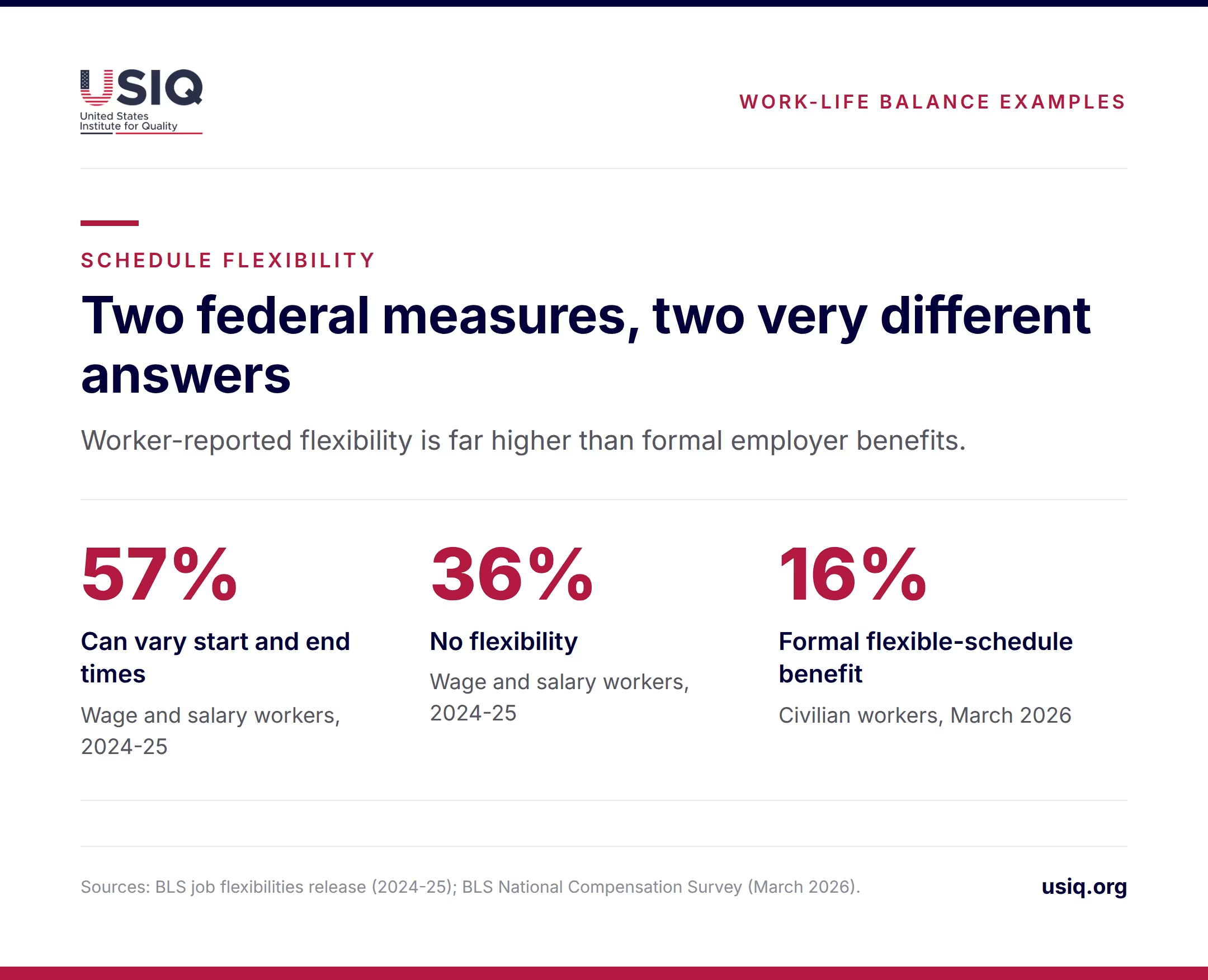
- Flexibility is unevenly spread. In 2024-25, 57% of U.S. wage and salary workers said they could vary their start and end times, but only 16% of civilian workers had a formal employer flexible-schedule benefit in March 2026.
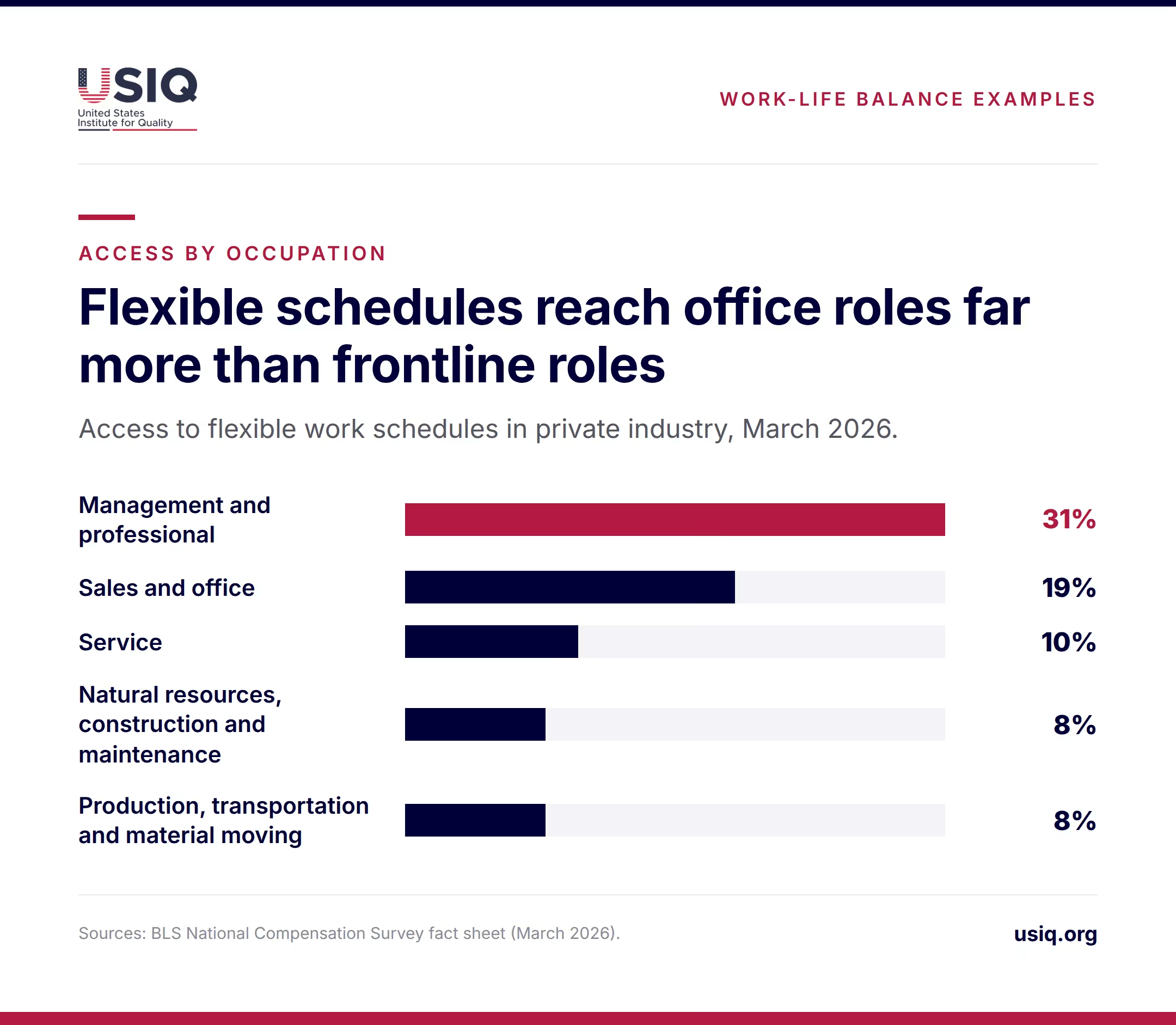
- Access differs sharply by occupation. Management and professional workers in private industry had 31% access to flexible schedules; production, transportation and material moving workers had 8%.
- For frontline staff, predictable schedules and paid leave usually count more than remote work.
- The U.S. Surgeon General’s framework names flexible, predictable schedules, more paid leave and leaders who model boundaries as core practices.
- A randomized trial found that hybrid work did not reduce productivity or promotions and cut resignations by 33%, but it studied one company with white-collar staff.
- Small employers can start with a short survey, one pilot team and written rules, then review the results every quarter.
What is work-life balance, and how does it differ from work-life integration?
Work-life balance describes how well a person can meet the demands of paid work alongside family, health, rest and personal interests. Work-life integration is a related idea: work and personal life blend over the day instead of staying in separate blocks, for example when a parent leaves at 3 p.m. for school pickup and finishes a report in the evening.
The U.S. Surgeon General’s workplace well-being framework uses a third term, “work-life harmony.” It rests on worker autonomy over when, where and how work is done, and on flexibility. The distinction matters in practice. Balance suggests fixed limits, integration suggests freedom to shift hours, and both only work when the employer sets clear expectations. Employees who can choose their hours but feel they must answer every message at night have integration without balance.
How much flexibility do U.S. employees actually have?
Two federal measures give different answers, and mixing them leads to wrong conclusions. The Bureau of Labor Statistics (BLS) asks workers whether they can vary their start and end times. A separate BLS survey of employers asks whether a formal flexible-schedule benefit exists. The first number is much higher than the second.
| Measure | Result | What it counts |
|---|---|---|
| Workers who can vary start and end times (2024-25) | 57% of wage and salary workers | Worker-reported flexibility, including informal arrangements |
| Of those, how often they can change the schedule | 36% frequently, 45% occasionally, 19% rarely | Share of flexible workers |
| Workers with no flexibility (2024-25) | 36% | Employer sets hours without worker input |
| Civilian workers with a formal employer flexible-schedule benefit (March 2026) | 16% | Formal benefit; workers set their own schedules within general limits, including compressed weeks such as four 10-hour days |
Sources: BLS job flexibilities release and the BLS flexible-schedule fact sheet. The gap suggests that much flexibility rests on informal manager discretion rather than written policy. That is good for those who have it, but it is hard to apply fairly across a team.
Flexibility differs sharply by occupation and work location
In private industry, formal access to flexible schedules in March 2026 ranged from 31% for management and professional workers to 8% for production, transportation and material moving workers. Access was also higher for full-time workers (19%) than for part-time workers (13%), although both figures rose from March 2022 (17% and 11%).
| Private industry occupation group | Access to flexible work schedules, March 2026 |
|---|---|
| Management and professional | 31% |
| Sales and office | 19% |
| Service | 10% |
| Natural resources, construction and maintenance | 8% |
| Production, transportation and material moving | 8% |
Source: BLS National Compensation Survey fact sheet.
Work location is linked to schedule control. In 2024-25, 34% of wage and salary workers (51 million) worked at home at least occasionally. Workers who could work at home were more likely to have a flexible schedule than those who could not (78% vs 44%), and more likely to say that taking an hour or two off during work hours would not be difficult (86% vs 59%).
Why do people work at home? Among those who did in 2024-25, 33% said the job required it, 31% cited personal preference and 12% wanted to coordinate work with personal or family needs. Time-use data point the same way: in 2025, 35% of employed people did some or all of their work at home on days worked, and 51% of workers with a bachelor’s degree or higher did, against 19% of those with a high school diploma and no college (BLS American Time Use Survey). Remote options mostly reach office-based, degree-holding staff, so employers with field, plant or customer-facing crews need other tools.
Which work-life balance examples work best for employers?
The examples below fall into six policy types. They draw on the practices the Surgeon General’s framework recommends: flexible and predictable schedules, more paid leave, and leaders who set and model boundaries, including limits on digital communication outside work hours. Which ones fit depends on the roles in your company.
| Policy example | Best fit | First step |
|---|---|---|
| Flexible start and end times, or compressed weeks | Office, administrative and many service roles | Define core hours when everyone is reachable |
| Hybrid or remote days | Roles that can be done away from a site | Pilot with one team and agree on which days are fixed |
| Predictable shift schedules with advance notice | Shift, retail, production and field crews | Publish schedules on a fixed date, several weeks ahead |
| Paid leave that managers actually take | All roles | Have leaders schedule and take their own time off visibly |
| Quiet hours and meeting-hour norms | All roles, especially mixed remote and on-site teams | Write a short rule on when messages and meetings are expected |
| Overtime tracking and limits | Hourly and project-driven teams | Report overtime hours per team every month |
Flexible hours and compressed weeks
Letting people shift their day by an hour or two covers school drop-offs, medical visits and long commutes without changing the total hours worked. A compressed week, such as four 10-hour days, is the other form the BLS counts as a flexible schedule. A small accounting firm, for instance, might set core hours from 10 a.m. to 3 p.m. and leave the rest to the employee. Companies weighing a shorter week can read the USIQ article on the four-day work week.
Hybrid and remote days
Remote work is the best-known example, but it applies to a minority of jobs. Where it does apply, a fixed hybrid pattern, such as two days at home, is easier to manage than case-by-case approvals. The evidence on productivity and retention is covered further below. The USIQ overview of remote workers adds employer-side detail.
Predictable schedules for shift and frontline staff
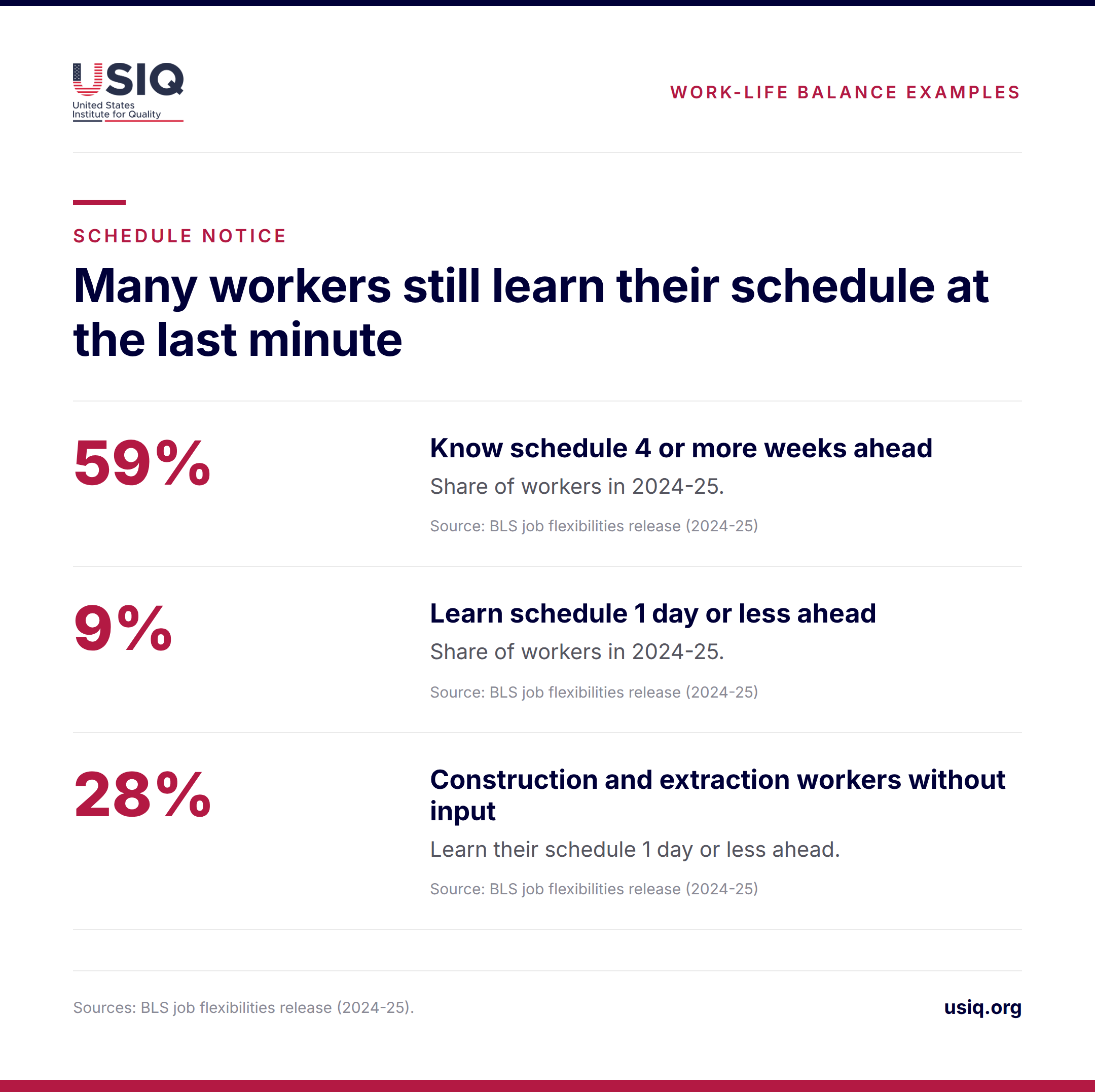
For many hourly workers, control over time means knowing the schedule early. In 2024-25, 59% of workers knew their schedule four or more weeks ahead, while 9% learned it one day or less ahead. Among construction and extraction workers without schedule input, 28% learned their schedule one day or less ahead. A little over half of workers in construction and extraction, production, and installation, maintenance and repair had no access to flexible hours.
Employers in these fields can still act. They can publish schedules on a fixed date, allow shift swaps between qualified colleagues and cross-train staff so that one absence does not force a last-minute call. Non-daytime work is not always a burden: among the 15% of workers on non-daytime schedules, 13% chose it because it allowed better family arrangements (18% of women, 9% of men). Source: BLS.
Paid leave that people actually use
According to the Surgeon General’s page, paid sick leave is available to 79% of U.S. civilian workers but to only 35% of those in the lowest 10% of average hourly wages. Paid family leave is available to 23% of civilian workers. The same page says that increasing access to paid leave can reduce the likelihood of lost wages by 30% and improve retention.
A leave policy on paper does little if staff fear being judged for using it. The practical example is simple: owners and managers book their own time off early and say so, and nobody is asked to answer messages while on leave. Many employers also offer mental health days as part of their sick or personal leave, which removes the need to invent a reason. The USIQ article on burnout and well-being covers the wider picture.
Quiet hours and meeting norms
The Surgeon General’s framework asks leaders to set and model boundaries, including limits on digital communication outside work hours. A workable rule can fit in three sentences: messages sent after 6 p.m. do not need a reply before the next morning, urgent matters go by phone, and meetings are not scheduled before 9 a.m. or after 4 p.m. without agreement. The rule only works if managers follow it themselves.
Overtime tracking and limits
Full-time employed people worked 8.1 hours on average on the days they worked in 2025 (8.5 on weekdays, 5.5 on weekend days). Also, 30% of employed people worked on an average weekend day (BLS American Time Use Survey). A monthly report of overtime hours per team shows where workloads are too heavy. Occasional extra hours are normal; a team that logs overtime every month needs more staff, fewer tasks or different deadlines.
Family-related support
Caregiving shapes how much room employees have. In 2025, employed adults living with children under 18 spent 1.7 hours a day on household activities. On days they did household activities, women spent 2.8 hours and men 2.1 hours. Policies such as flexible start times, leave for school or care needs and advance notice of schedules address this directly. The USIQ guide to family-friendly policies goes through the options in more detail.
How can a company with 10 to 250 employees start without an HR team?
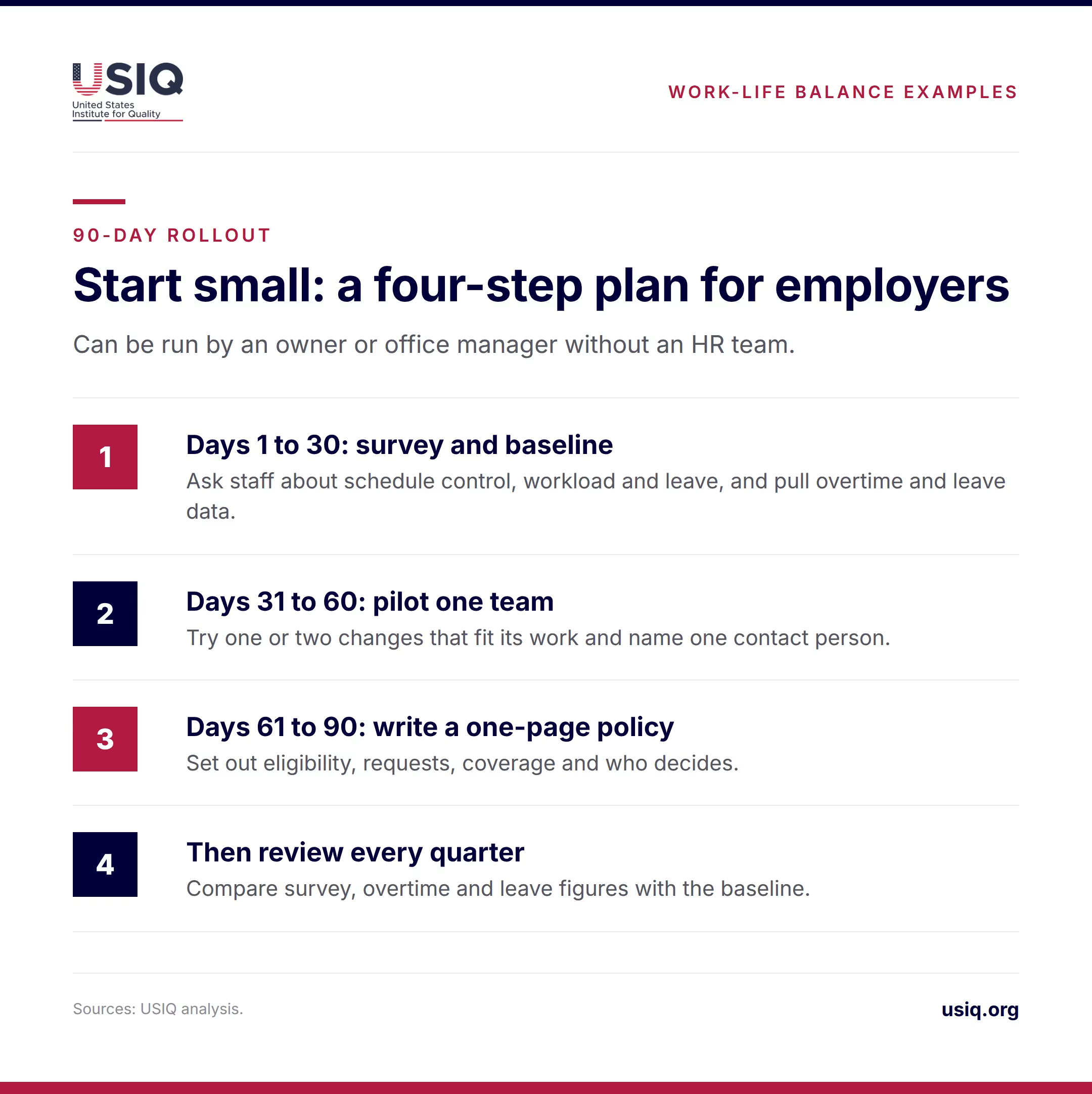
A small employer does not need a program. It needs a few clear rules, a trial and a review date. The sequence below fits roughly 90 days and can be run by an owner or office manager.
- Days 1 to 30: ask. Run a short anonymous survey on schedule control, workload, after-hours contact and leave use. An existing guide to employee survey questions can supply wording. Also pull last quarter’s overtime hours and leave taken.
- Days 31 to 60: pilot. Pick one team and one or two changes that fit its work, such as core hours, a hybrid pattern, schedules published earlier or quiet hours. Name one person to handle questions and exceptions.
- Days 61 to 90: write it down. Put the rules on one page: who is eligible, how requests work, how coverage is arranged and who decides. Cross-train staff so that coverage does not rest on one person.
- Then review quarterly. Repeat a few survey items, compare overtime and leave figures with the baseline, and adjust.
Low-cost tools do much of the work: a shared calendar with core hours marked, a scheduling tool or even a shared spreadsheet for shifts, and a written rule on message timing. Fairness is the main risk. If only some roles can work remotely, say so openly and offer the roles that cannot a comparable benefit, such as earlier schedule notice or more predictable shifts.
Does flexibility hurt productivity or retention?
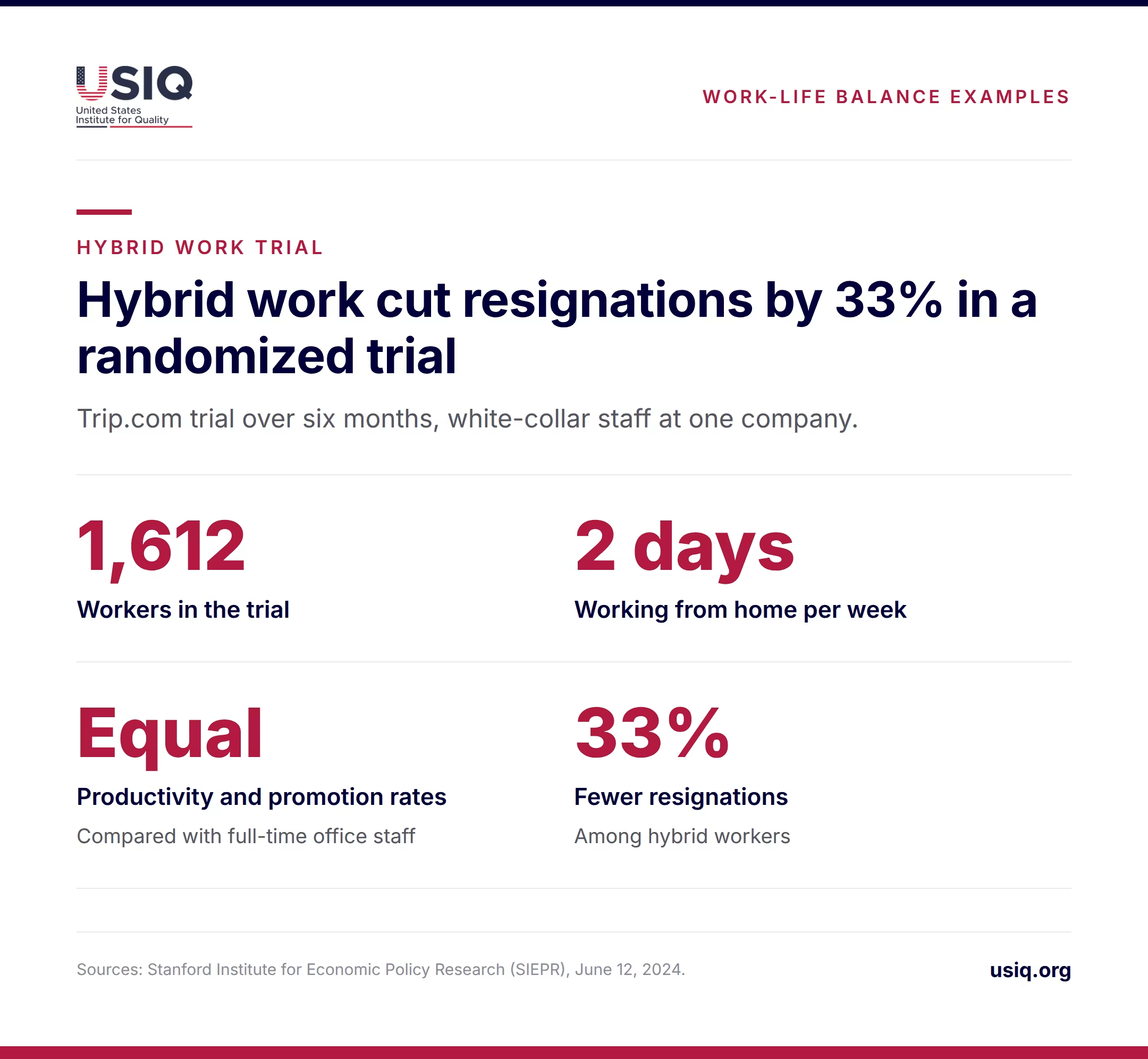
The strongest evidence comes from a randomized trial of 1,612 workers at Trip.com, run over six months from 2021 and reported by the Stanford Institute for Economic Policy Research. Employees who worked from home two days a week showed productivity and promotion rates equal to full-time office staff. Resignations fell 33% among hybrid workers. The researchers described hybrid work as a win for companies, workers and, through lower attrition, the firm’s costs.
What the trial does not cover
The trial covered one Chinese company and university-educated engineering, marketing, finance and accounting staff. It tested a hybrid pattern, not fully remote work, and the authors say the results do not apply to fully remote work that is managed poorly. U.S. employers with production lines, retail floors or field crews cannot copy the design. For them, the comparable question is whether predictable schedules and reliable leave improve retention. The Surgeon General’s page says more paid leave can improve retention.
Some managers also worry about collaboration, onboarding and oversight. Those concerns deserve a test rather than a dismissal. A pilot with defined measures, as described in the rollout above, answers them for your own business better than general studies can.
What legal points should employers keep in mind?
The U.S. Surgeon General’s page states that the United States is the only advanced OECD economy that does not guarantee paid medical and family leave. Paid leave rules therefore depend largely on state and local law, and on what the employer chooses to offer. Overtime, scheduling and leave obligations can also differ by employee type, location and company size.
Employers should check current requirements with the U.S. Department of Labor, their state labor agency and a qualified advisor before publishing a policy. A flexibility program does not by itself create or remove a legal duty, and nothing in the data above implies that an employer must offer remote work or flexible hours.
What can employees do on their own?
Personal habits cannot replace employer policy, but they matter where an employee has some control. These are practical tips, not proven interventions:
- Step away from the desk for lunch instead of eating at it.
- Write down the top three tasks each morning, so the day has a natural end point.
- Group routine tasks such as email into set times rather than answering continuously.
- Turn off work notifications on personal devices outside agreed hours, or ask the manager what is expected.
- Mark a clear end to the workday, for example by closing the laptop, and keep a dedicated work area if working from home.
- Put personal commitments such as exercise, family time or friends in the calendar like any other appointment.
- Review the week on Sunday or Friday: what drained time, what to change next week.
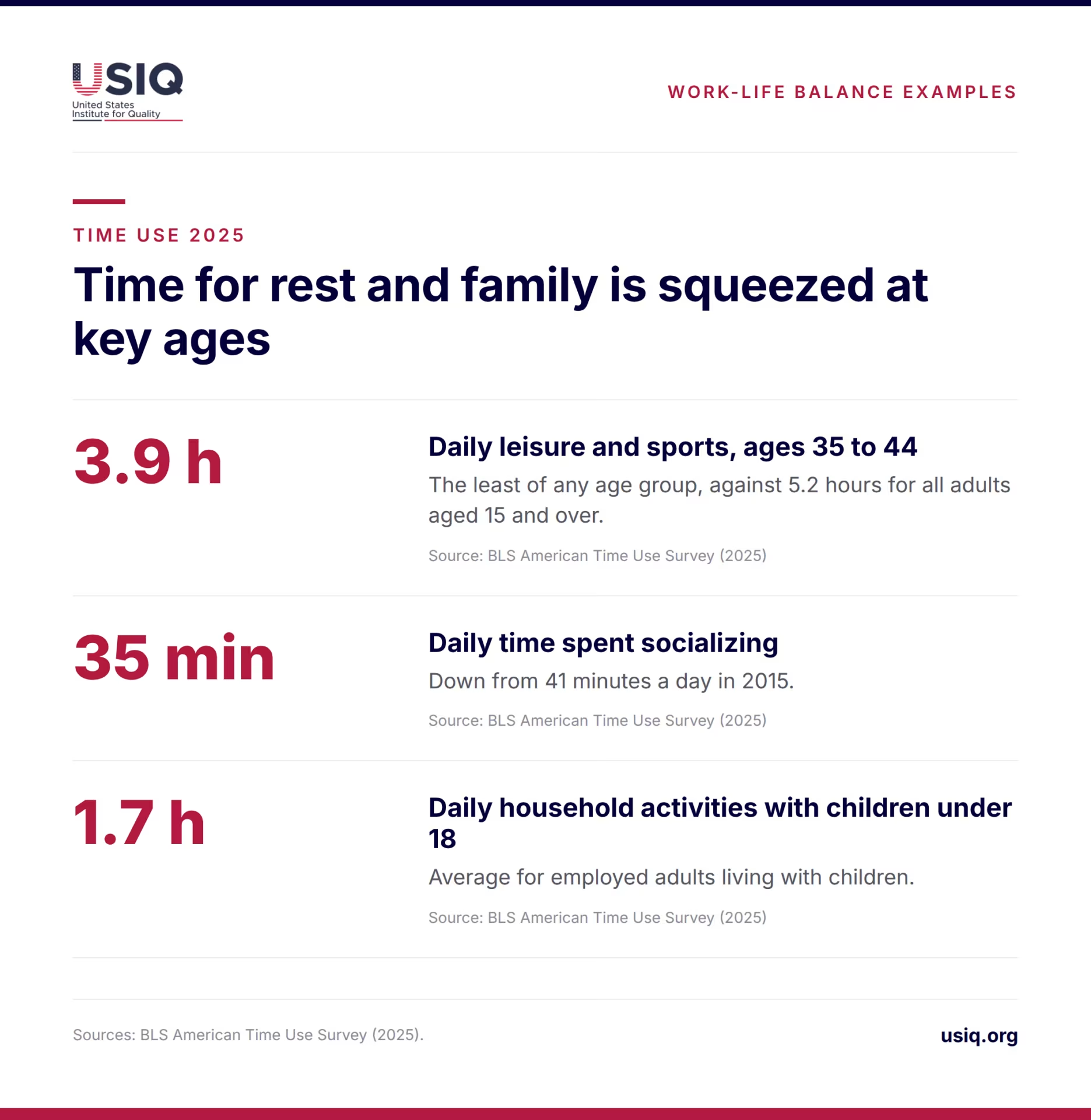
Time-use data show why this is not trivial. In 2025, adults aged 35 to 44 spent 3.9 hours a day on leisure and sports, the least of any age group, against 5.2 hours for all adults aged 15 and over. Time spent socializing fell from 41 minutes a day in 2015 to 35 in 2025 (BLS American Time Use Survey).
How do you measure whether work-life balance efforts are working?
Pick a handful of measures and track them at the same time each quarter. A basic set mixes survey items with records you already hold:
- Schedule input: the share of staff who can vary start or end times, mirroring the BLS measure.
- Schedule notice: the share of shift workers who get their schedule four or more weeks ahead, and the share who get it one day ahead or less.
- Overtime hours per team per month.
- Leave taken against leave offered, including by managers.
- Voluntary turnover, compared across teams with and without the new policy.
- Pulse survey items, such as “I can switch off after work” and “my manager respects my time off,” on a five-point scale.
Keep surveys anonymous and short, and report back what changed as a result. Guidance on employee surveys and HR dashboards can help present the numbers. The quarterly review is what keeps the policy matched to the workload.
What are common misconceptions about work-life balance?
“It is only a remote work issue.” Remote work reaches a minority of jobs. BLS data show that flexibility is lowest in production, construction and transportation roles, where schedule notice and leave are the practical levers.
“Flexible means fewer hours.” Under the federal definition, a flexible schedule means employee-set hours within limits, including compressed weeks, not reduced hours.
“Employees can fix it with better habits.” Personal routines help, but start times, workload, meeting hours and leave culture are set by the employer.
What should employers do first?
- Find out where staff stand today with a short survey and last quarter’s overtime and leave data.
- Match the policy to the job: core hours or hybrid days for office roles, early schedule notice and shift swaps for frontline roles.
- Have leaders book and take their own leave and respect quiet hours.
- Pilot with one team, write a one-page rule and review it every quarter.
- Confirm leave and overtime obligations with the Department of Labor, your state agency or an advisor.
Conclusion
The most useful work-life balance examples are employer decisions about schedules, leave, communication and workload, matched to how each role actually works. Start with one team and one measurable change, and expand once the numbers show it helps.
Frequently asked questions
What is work-life balance?
Work-life balance is the ability to meet the demands of paid work while keeping time and energy for family, health, rest and personal interests. For employers, it shows up in concrete conditions such as schedule control, predictable hours, usable leave and limits on after-hours contact, not just in personal habits.
What are work-life balance examples for small businesses?
Small businesses can set core hours with flexible start and end times, run a hybrid pattern where roles allow, publish shift schedules weeks ahead, let managers model leave use, write a short quiet-hours rule and track overtime monthly. Each can be tested with one team before it is rolled out company-wide.
Does remote work improve work-life balance?
It can help where the job allows it. BLS data show that workers who can work at home are more likely to have a flexible schedule (78% vs 44%). A randomized trial of hybrid work also found lower resignations. That trial covered one company and white-collar staff, though, and many jobs cannot be done remotely.
How many U.S. workers have flexible schedules?
It depends on the measure. In 2024-25, 57% of wage and salary workers said they could vary start and end times. In March 2026, only 16% of civilian workers had a formal employer flexible-schedule benefit. The first counts informal arrangements; the second counts formal benefits only.
How can employers support frontline and shift workers?
Remote work rarely applies, so the focus shifts to predictability. Publish schedules on a fixed date several weeks ahead, allow shift swaps, cross-train staff so coverage holds, and make leave easy to use. BLS data show that 9% of workers learn their schedule one day or less ahead.
Does U.S. federal law guarantee paid family leave?
According to the U.S. Surgeon General’s office, the United States is the only advanced OECD economy that does not guarantee paid medical and family leave. Paid family leave is available to 23% of civilian workers. State and local rules vary, so employers should check with their state labor agency or an advisor.
How do you measure work-life balance in a company?
Combine a short anonymous pulse survey with records: overtime hours per team, leave taken against leave offered, voluntary turnover, the share of staff with schedule input and the share who get schedules four or more weeks ahead. Track the same figures each quarter and compare them with your baseline.
Sources
- U.S. Bureau of Labor Statistics, “Job Flexibilities and Work Schedules News Release, 2025 A01 Results”: https://www.bls.gov/news.release/archives/flex2_09242026.htm
- U.S. Bureau of Labor Statistics, National Compensation Survey, “Flexible work schedule and student loan repayment benefits” (fact sheet, March 2026 data): https://www.bls.gov/ebs/factsheets/flexible-work-schedule-and-student-loan-repayment.htm
- U.S. Bureau of Labor Statistics, “American Time Use Survey News Release, 2025 A01 Results”: https://www.bls.gov/news.release/atus.htm
- Stanford Institute for Economic Policy Research (SIEPR), “Hybrid work is a ‘win-win-win’ for companies, workers, study finds,” June 12, 2024: https://siepr.stanford.edu/news/hybrid-work-win-win-win-companies-workers-study-finds
- U.S. Department of Health and Human Services, Office of the Surgeon General, “Workplace Mental Health & Well-Being”: https://www.hhs.gov/surgeongeneral/reports-and-publications/workplace-well-being/index.html

Related Articles
What research says about the effects of employer seals on current employees, potential applicants and employer image, from independent experiments and field data to the limits of the evidence.
Employee experience and customer experience are linked, but the link is weaker and more conditional than popular slogans suggest. This article reviews the evidence on staffing, training and workplace conditions and shows how employers can test the connection in their own business.
Most HR dashboards show too many metrics and trigger too few decisions. This guide defines ten employee experience metrics, shows a one-page layout and explains how to read your numbers against U.S. data.
A practical guide to calculating marketing ROI for small and mid-sized U.S. companies, including long B2B sales cycles, offline leads, a spreadsheet walkthrough and common errors.