
Search for employer certification and you will find a visa form, a tax status, a safety exemption and a workplace seal, all under the same name. Owners and HR leads at companies with 10 to 250 employees often start with one meaning in mind and land on a page about another.
This guide sorts the meanings first. It then explains what voluntary third-party seals check, how the process runs, what it costs and how to judge whether a seal pays off.
Quick answer
Employer certification is an umbrella term. It covers mandatory steps such as PERM labor certification, government programs such as OSHA SHARP and the IRS CPEO status, and voluntary seals in which an outside body reviews how a company treats its people. Only the voluntary seals are about workplace quality, and no public evidence yet proves their return.
Key takeaways
- The term covers four different things: immigration, tax, safety and voluntary workplace seals. Check which one a page or vendor means.
- A voluntary seal does not replace compliance with wage, safety or anti-discrimination law, and it is not a legal safe harbor.
- Government options exist for small employers, including OSHA’s no-cost On-Site Consultation and the SHARP program for sites with 250 or fewer on-site employees.
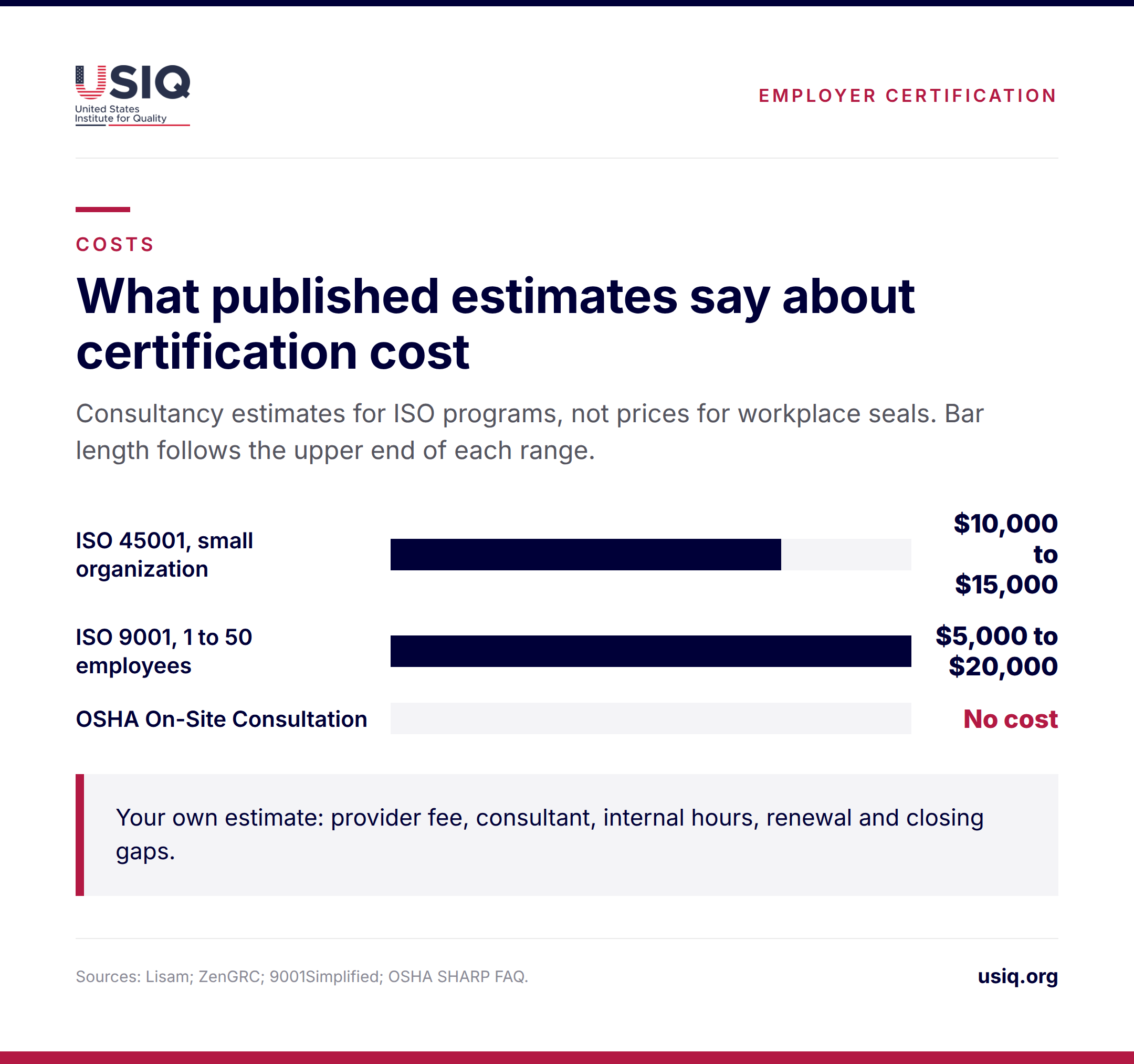
- Published price guidance exists mainly for ISO-type management-system certification. One consultancy puts ISO 9001 at about $5,000 to $20,000 in total for businesses with 1 to 50 employees, and another puts ISO 45001 for small organizations at $10,000 to $15,000. Internal staff time comes on top.
- Hard evidence on the return of workplace seals is scarce. Estimate it from your own turnover and hiring costs rather than from vendor claims.
- A seal shown in recruiting materials is an advertising claim and needs a reasonable basis. Have counsel review the wording.
- Credible programs publish their criteria, score independently, set response thresholds and state renewal terms.
What does employer certification mean in the U.S.?
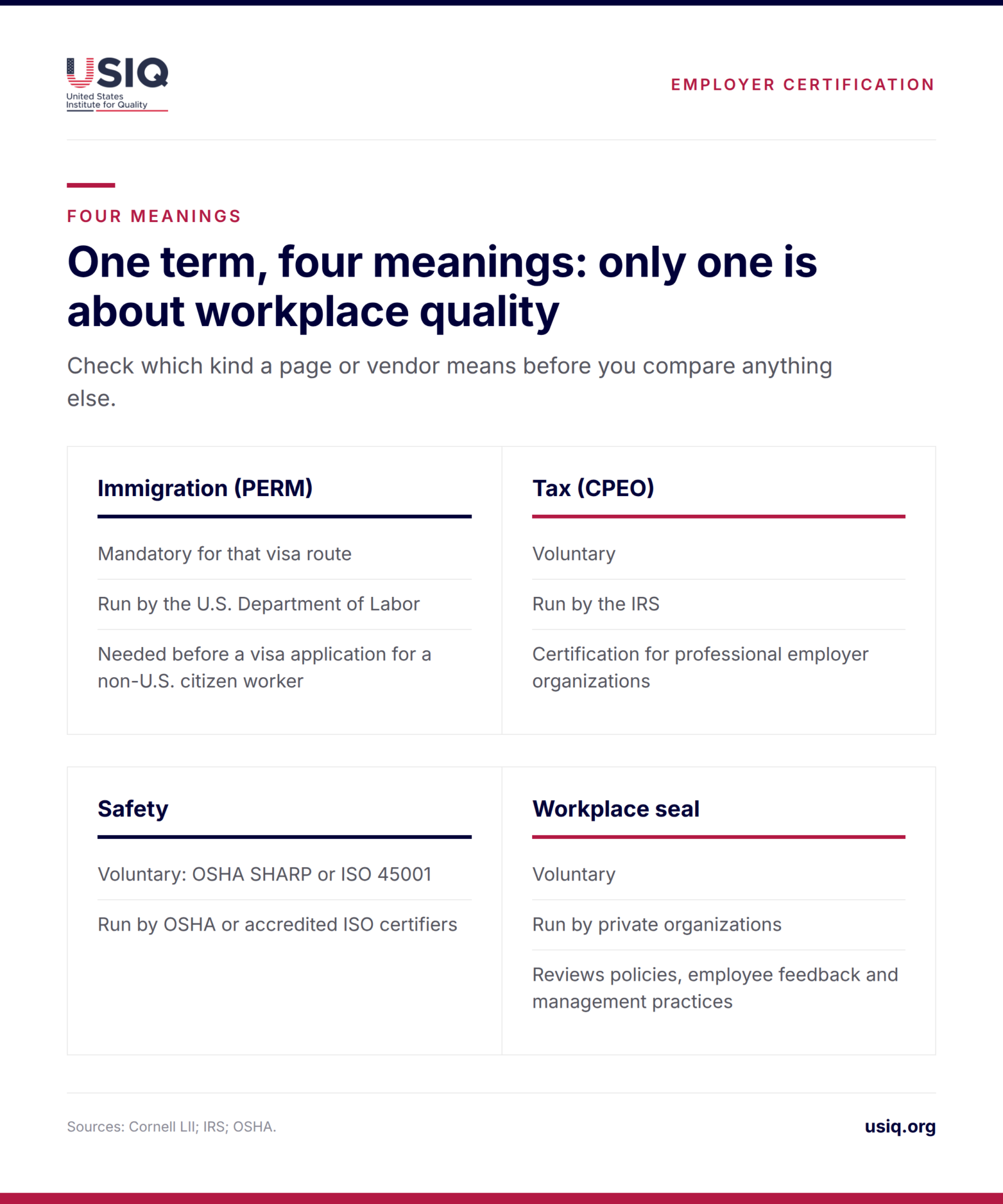
No single definition exists. In practice, four meanings overlap in search results, and only the last one concerns how employees experience their workplace.
| Meaning | What it is | Mandatory? | Run by |
|---|---|---|---|
| Immigration | PERM labor certification, which an employer must obtain before applying for a visa for a non-U.S. citizen worker | Yes, for that visa route | U.S. Department of Labor |
| Tax | Certified Professional Employer Organization (CPEO), a voluntary certification for PEOs created under the Tax Increase Prevention Act of 2014 | No | IRS |
| Safety | OSHA SHARP for small employers, or management-system standards such as ISO 45001 | No | OSHA, or accredited ISO certifiers |
| Workplace seal | A third party reviews policies, employee feedback and management practices | No | Private organizations |
Cornell Law School’s legal encyclopedia defines labor certification as the PERM step and notes that the Department of Labor may reject or audit an application if it suspects dishonesty (Cornell LII). The IRS describes the CPEO program as a voluntary tax-compliance certification for PEOs. A company that uses a PEO can ask whether its provider is certified (IRS).
The rest of this article focuses on voluntary programs: third-party reviews of workplace practice, plus the safety programs that smaller employers can realistically use. A voluntary seal differs from an award, which often rests on votes or a one-time result. It also differs from accreditation, which usually applies to institutions such as schools.
One disclosure applies throughout: USIQ, the publisher of this article, runs certification programs of this kind. Weigh the comparisons below with that in mind.
Which types of employer certification exist, and what does each check?
Voluntary programs differ mainly in the evidence they examine. Before comparing prices, find out what the program actually looks at.
| Type | What it typically checks | Typical evidence |
|---|---|---|
| Compliance and safety | Whether safety and labor practices meet defined requirements | Site visits, records, documented procedures |
| Workplace experience | How employees rate leadership, fairness, communication and growth | Employee survey, HR interview, policy review |
| Employer brand | Whether hiring communication matches what employees experience | Candidate experience review, careers content, employee feedback |
| Diversity, equity and inclusion | Policies and practices on equal opportunity | Varies widely by program |
| Industry-specific | Standards tailored to one sector | Sector rules and working conditions |
Diversity-related seals deserve extra care. Federal and state rules on diversity programs have changed since 2024, so check current guidance from the relevant agencies and your counsel before you apply for one or advertise it.
Workplace-experience seals usually combine an employee survey with an HR interview. They assess culture, which describes how work actually gets done, rather than the employer brand, which is the story told to the market. When the two diverge, employees tend to notice first, and a seal that only reviews the brand story adds little. For the culture side, see USIQ’s piece on company culture versus business culture.
How does the certification process work?
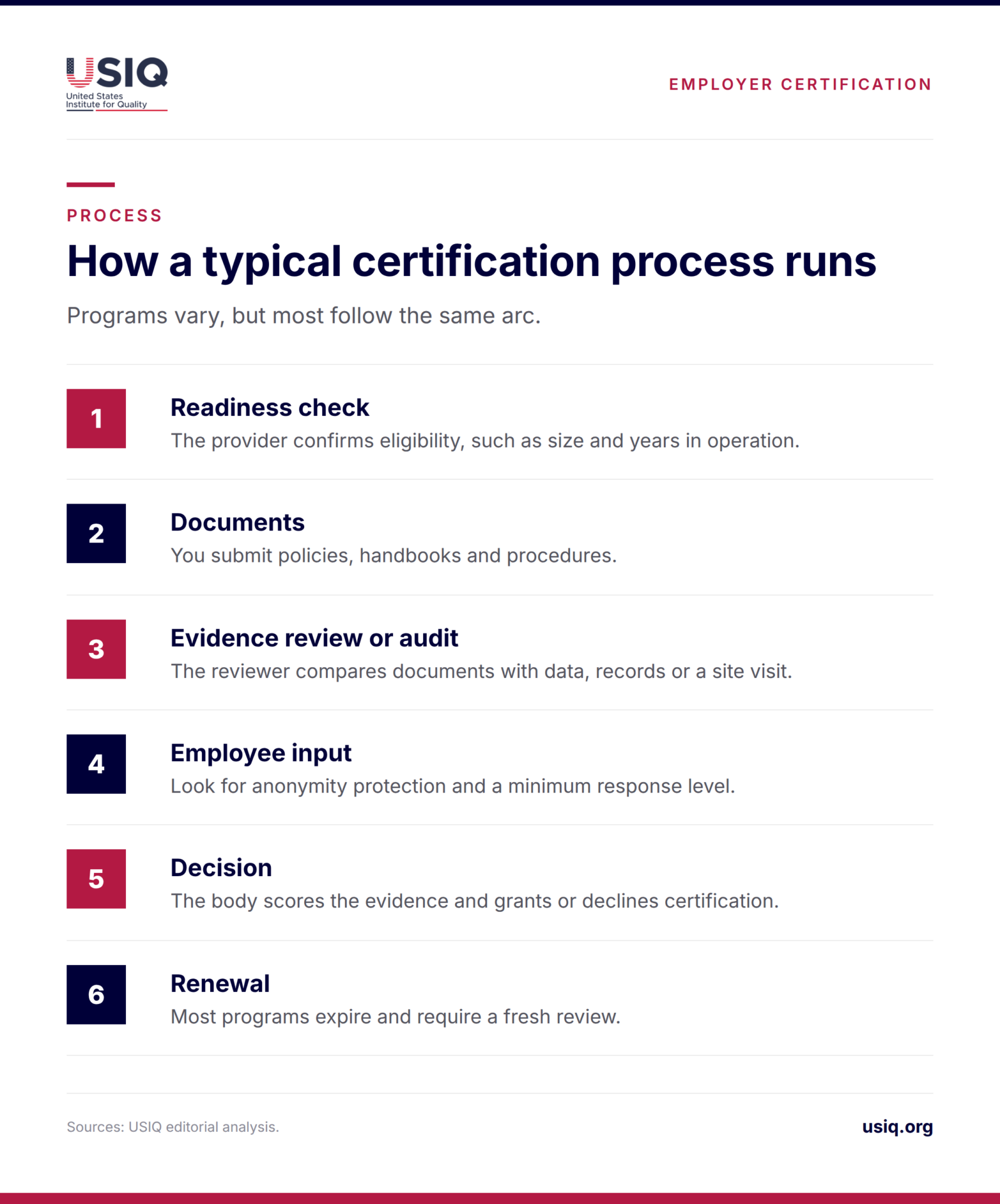
Programs vary, but most follow the same arc.
- Readiness check. The provider confirms the employer is eligible, for example by size, years in operation and workforce structure.
- Documents. The employer submits policies, handbooks and procedures.
- Evidence review or audit. The reviewer compares documents with data, records or a site visit.
- Employee input. Many workplace programs run a survey. Look for anonymity protection and a minimum response level so that results reflect the whole workforce.
- Decision. The body scores the evidence and grants or declines the certification.
- Renewal. Most programs expire and require a fresh review.
How long does a certification stay valid?
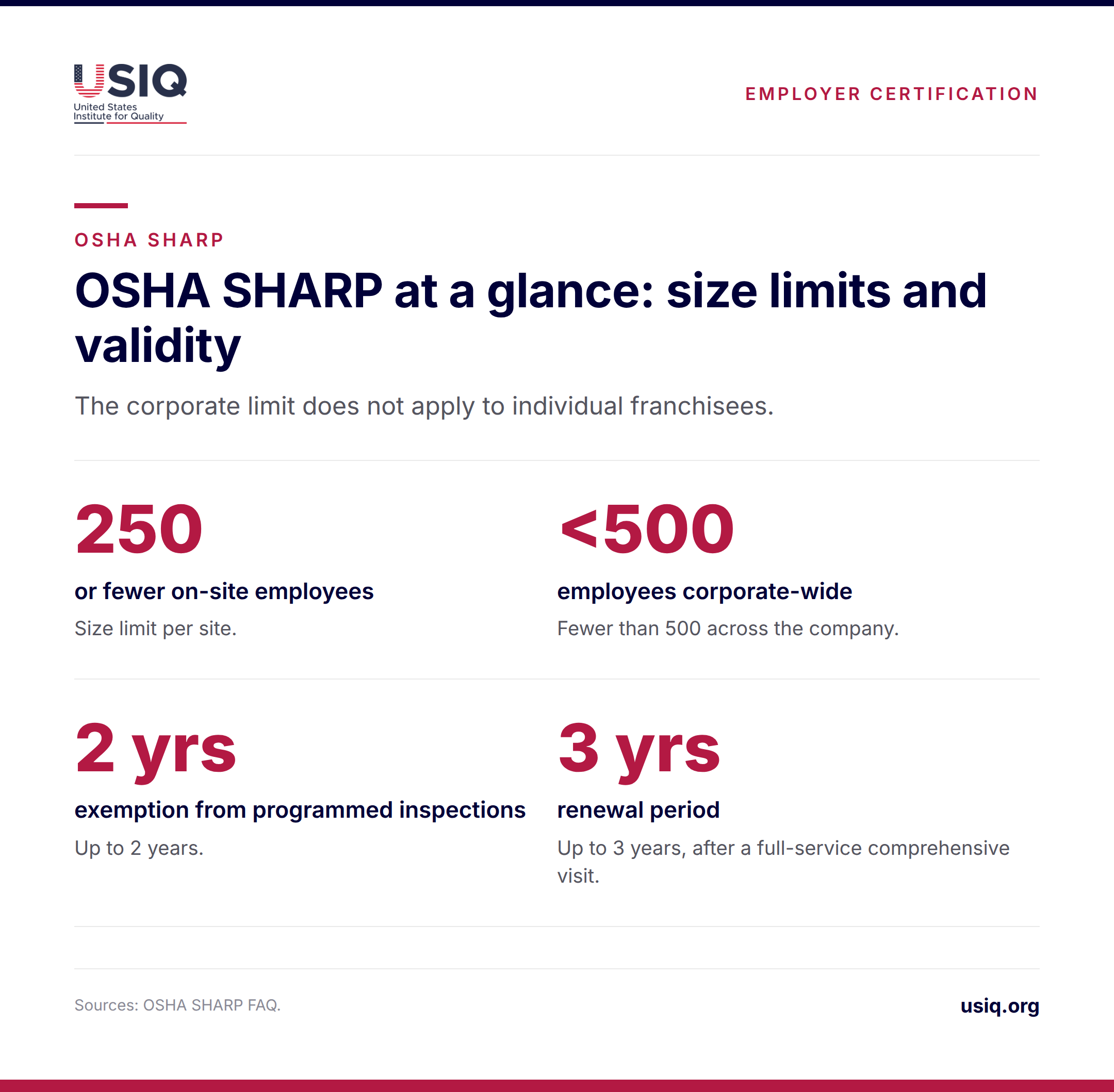
It depends on the program, and published terms should settle the question before you apply. The one period verified here comes from OSHA. SHARP certification gives an exemption from OSHA programmed inspections for up to 2 years. Renewal is available for up to 3 years, but the employer must apply in the last quarter of the exemption period and pass a full-service comprehensive visit (OSHA SHARP FAQ).
Size limits are part of the rules. SHARP is open to sites with 250 or fewer on-site employees and employers with fewer than 500 corporate-wide, and the corporate limit does not apply to individual franchisees.
Why do employers fail a review?
Three patterns recur: documents are missing or outdated, written policy does not match daily practice, and leadership is not involved. Employee survey results can expose the second problem quickly, for example when staff report that a policy exists on paper but managers do not apply it. A short internal check before applying catches most of these gaps.
How much does employer certification cost a small or mid-sized company?
Providers of workplace-culture seals rarely publish prices and usually charge by company size and program scope. The figures that do exist belong to ISO management-system certification. They are consultancy estimates, not prices for workplace seals, but they show the order of magnitude of a formal audit-based program.
| Program | Estimate | Source type |
|---|---|---|
| ISO 45001 (occupational health and safety), small organization | About $10,000 to $15,000 | Consultancy (Lisam) |
| ISO certification, small business | Typically $10,000 to $15,000 | Compliance software vendor (ZenGRC) |
| ISO 9001 (quality), businesses with 1 to 50 employees | About $5,000 to $20,000 total estimated range | Consultancy (9001Simplified) |
| OSHA On-Site Consultation | No cost, no citations or monetary penalties | OSHA |
Sources: Lisam, ZenGRC, 9001Simplified and the OSHA SHARP FAQ. For ISO 9001, internal staff time comes on top of the external costs.
OSHA’s On-Site Consultation Program is funded by OSHA and delivered by state grantees. It gives small business owners no-cost help with safety without citations or monetary penalties, which makes it a sensible first step for a safety-focused employer. For background on management-system standards, see USIQ’s explainer on quality management systems for employers.
What belongs in your own cost estimate?
- The provider’s fee, including any audit or survey charges
- Consultant support, if you use one
- Internal hours for documents, employee communication and interviews
- Renewal fees and the work of repeating the review
- Follow-up costs to close gaps the review uncovers
Internal time is usually the item small firms underestimate. A 15-person company has no HR department, so the owner or office manager carries the work. Ask providers for the expected hours before you sign.
Is employer certification worth it? What does the evidence show?
No study has yet published a reliable financial return figure for workplace seals. Many widely repeated percentages about turnover or cost per hire come without a traceable source and should not drive a budget decision.
The best-documented effect concerns applicants. In a randomized experiment with 1,093 participants, Oliver Scharfenberg, CEO of USIQ, found that an employer seal raised the stated likelihood of applying for a job by about 16 percentage points. A stated intention is not the same as an application in a real hiring process, so read the figure as a direction rather than a forecast for your company. The method and its limits are summarized on USIQ’s research page.
What does the labor market look like right now?
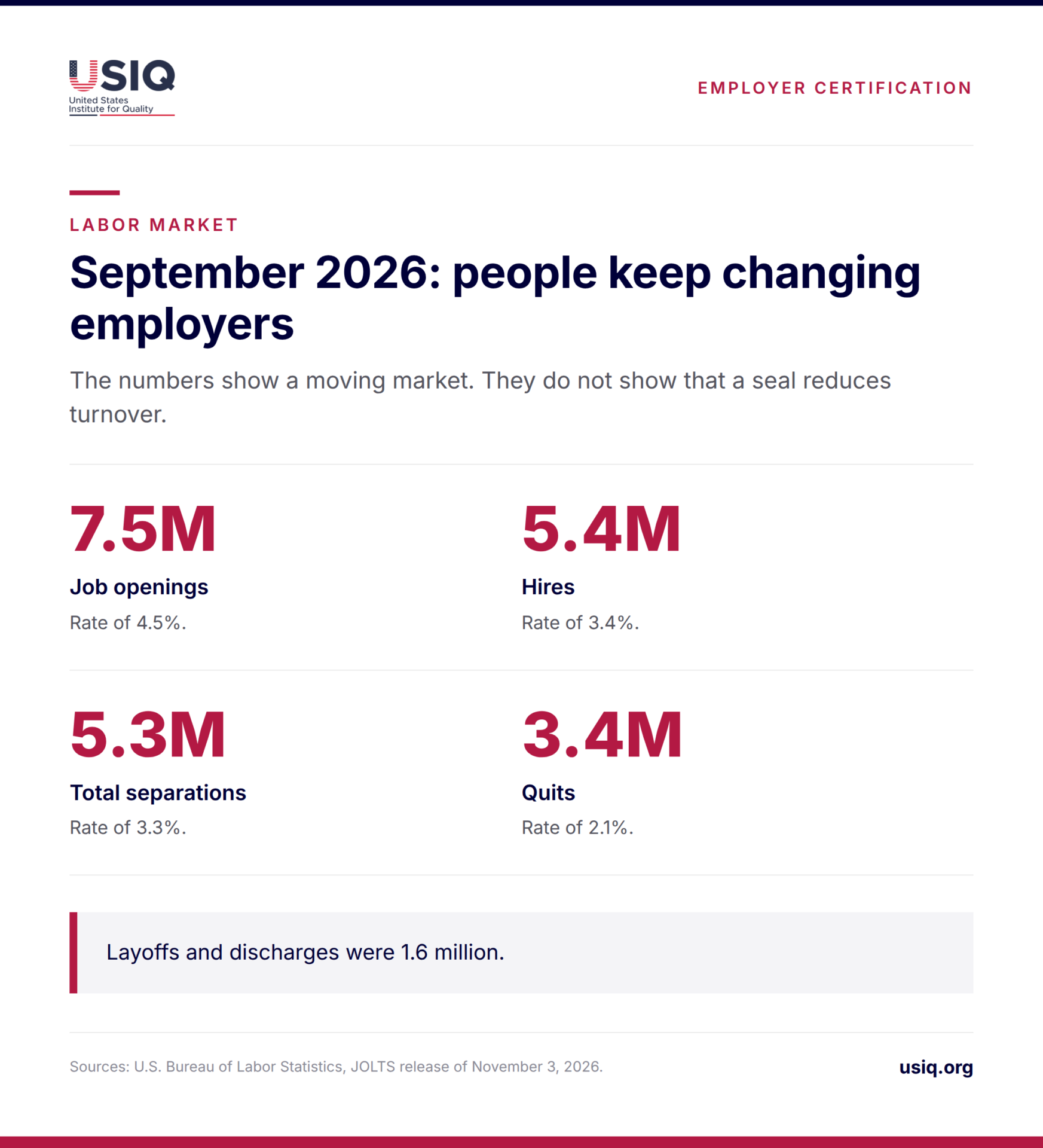
The Bureau of Labor Statistics reported 7.5 million job openings (a rate of 4.5%) and 5.4 million hires (3.4%) for September 2026. Total separations were 5.3 million (3.3%). Quits rose to 3.4 million, a rate of 2.1%, and layoffs and discharges were 1.6 million (BLS JOLTS).
BLS describes the quits rate as a measure of workers’ willingness or ability to leave jobs, and its release includes tables by establishment size class. The numbers show a market in which people keep changing employers. They do not show that a seal reduces turnover.
How can you estimate the return yourself?
Build the break-even from your own records. Add the full cost from the list above: fee, consultant, internal hours multiplied by their loaded hourly cost, and renewal. Then divide by what one avoided external hire costs you, counting advertising, agency fees, interviewing time and ramp-up.
The result is the number of hires or departures the seal must prevent over its validity period to pay for itself. Judge it conservatively. If the answer is “four hires” and your company makes six a year, the case is plausible. If it is “twenty,” it is not. USIQ’s guide on reducing recruiting costs lists the cost items worth tracking.
What are the counterarguments and limits?
- Self-selection. Employers that apply are often already well run, so a seal may confirm quality as much as create it.
- No common standard. Seals differ in criteria and rigor, so two seals can mean very different things.
- Point in time. A seal reflects the review period. Conditions can change before renewal.
- Cost. Fees plus internal time are real, and the return is uncertain.
- Weak legal value. A seal does not protect against a wage, safety or discrimination claim.
How do you choose a credible certification?
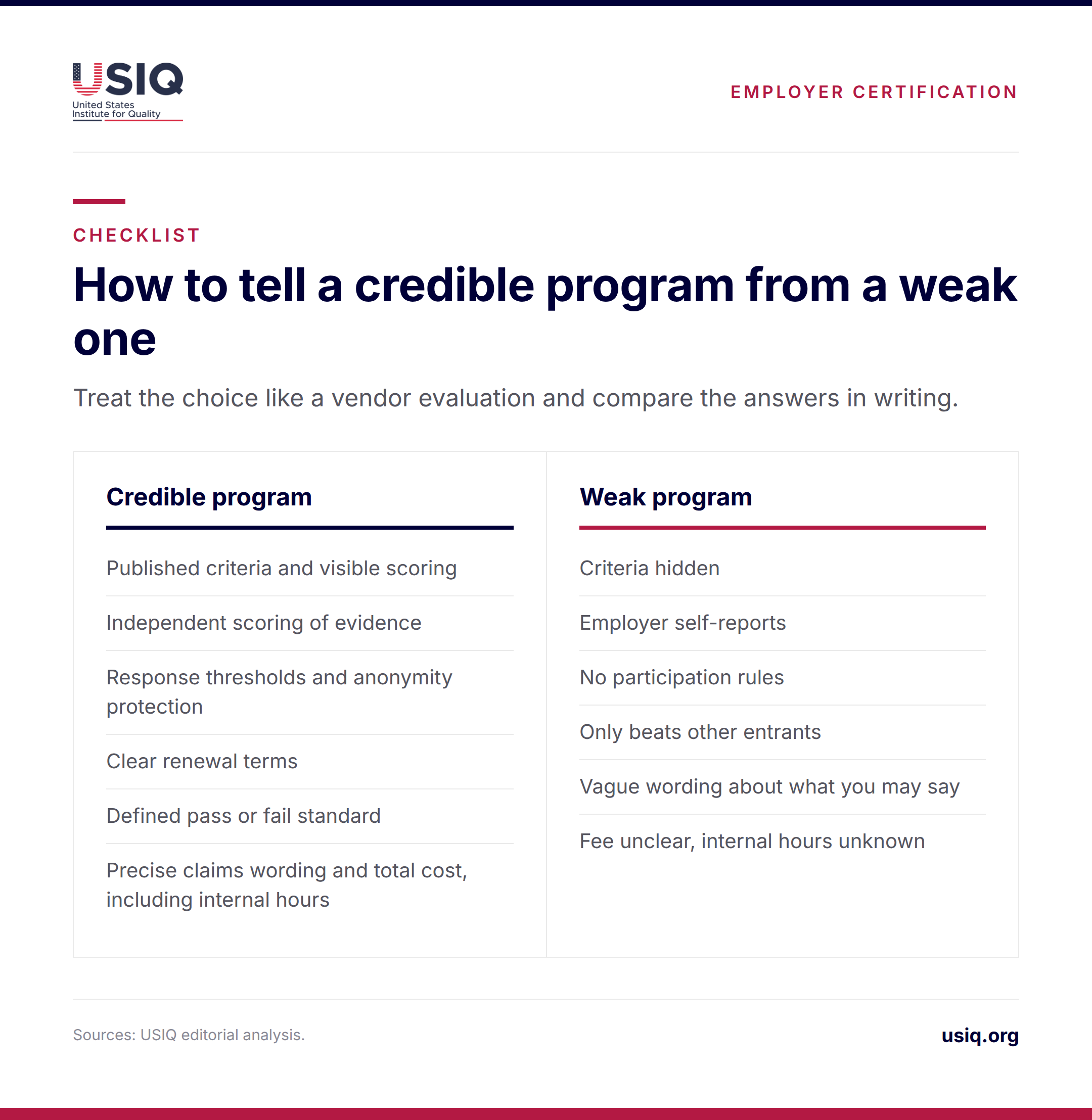
Treat the choice like a vendor evaluation. Ask each provider the following questions and compare the answers in writing.
- Criteria. Are the standards published, and can you see how results are scored?
- Independence. Does an outside party collect and score the evidence, or does the employer self-report?
- Participation rules. Is there a minimum survey response level, and is anonymity protected?
- Pass or fail logic. Does the employer meet a defined standard, or only beat other entrants?
- Renewal. How long is the seal valid, and what does renewal require?
- Recognition. Do candidates in your industry and region know the seal?
- Claims wording. Does the provider tell you exactly what you may say about the seal?
- Total cost. Is the fee all-inclusive, and how many internal hours should you expect?
Apply the same questions to rankings. A ranking can raise visibility, but check how it selects and scores entrants and what you must do to be listed. USIQ’s article on what workplace rankings really measure goes into this in detail, and its overview of employer seals covers the seal side.
Size matters too. A program that needs several hundred survey responses will not fit a 12-person company, and survey results from very small teams can reveal who said what. Companies between 10 and 49 employees should ask how a provider protects anonymity. Those between 50 and 249 should ask whether results can be broken out by team. Size rules are normal: SHARP’s cap of 250 on-site employees is one example.
What legal rules apply to displaying a seal?
A seal does not substitute for legal compliance. SHARP shows the difference: it rests on a comprehensive safety visit and is run through state-based consultation services, not on a logo (OSHA).
Using a seal in recruiting also creates an advertising claim. The Federal Trade Commission’s substantiation policy requires advertisers to have a reasonable basis for objective claims before they disseminate them, and the policy covers express and implied claims (FTC). A phrase such as “certified great employer” implies more than “reviewed by an independent body in 2026.”
FTC staff guidance on environmental seals offers a useful analogy, though it concerns products and not employers. It warns that a seal that does not explain its basis can convey broad claims that cannot be substantiated (FTC Business Blog). For employers, that means stating what the seal covers, who awarded it and when.
Whether additional federal or state rules on recruiting advertising, endorsements or pay transparency apply to your job ads depends on where you hire. Ask counsel to review the seal wording before it goes into job posts.
How should a 10 to 250-employee company prepare?
- Name a sponsor. One leader owns the effort and signs off on the budget. Programs expect management involvement, not only HR.
- Run an internal gap check. Compare written policies with what happens daily and update outdated documents.
- Gather the documents. Handbook, safety procedures, pay and conduct rules and feedback processes belong in one place.
- Tell employees first. Explain why the review happens, how answers stay anonymous and what will be done with the results. Trust in the process drives participation. USIQ’s guide to employee surveys covers question design and follow-up.
- Calculate the break-even. Use your own turnover and hiring costs before committing.
- Share the outcome. Show staff the results and the actions that follow, then put the seal on the careers page with precise wording.
One example of a survey-based model is USIQ’s Top Employer methodology, which combines a confidential survey of all employees with an HR assessment of 39 criteria and publishes its scoring rules.
What are the common myths about employer certification?
Myth 1: Only large companies can get certified. Several programs are built for small employers. OSHA SHARP is limited to sites with 250 or fewer on-site employees, and the On-Site Consultation Program targets small business owners. ISO cost guidance exists for businesses with 1 to 50 employees. Whether a given seal is worth the effort for a small firm is a separate question that the break-even answers.
Myth 2: A seal is only marketing. A seal can influence applicants, as the experiment cited above suggests, though evidence from real hiring data is still thin. Its credibility depends on criteria, independent scoring and renewal. A seal without those is marketing.
Myth 3: Certified means perfect. A review compares an employer with defined criteria at one time. SHARP, for example, demands a renewal visit before the exemption can continue. Issues can emerge afterward, and a seal does not shield the employer from legal obligations.
Myth 4: The process is too complicated. Complexity depends on the program. Audit-based programs demand more preparation than survey-based ones, and a documented handbook and an engaged owner shorten either path. Ask each provider for expected hours.
Myth 5: Certification has no long-term value. Renewal requirements are what keep a seal meaningful. Whether it produces lasting business value is something each employer should measure against its own hiring and turnover data.
What is the outlook for employer certification?
Job seekers have more ways to check employers, from review sites to AI assistants, so employers face more pressure to back their claims with something checkable. At the same time, regulators expect claims in recruiting materials to be substantiated. Both trends favor programs with transparent criteria and precise wording. For the AI side, start with USIQ’s piece on employer seals and AI search.
Conclusion
Employer certification is worth pursuing when you know which kind you need, can afford the full cost including staff time, and can show on paper that the break-even is realistic. Start with free or low-cost government options for safety, and choose a voluntary seal only if its criteria and claims wording hold up to the checklist above.
Frequently asked questions
Is employer certification the same as PERM labor certification?
No. PERM labor certification is a mandatory step an employer must complete before applying for a visa for a non-U.S. citizen worker, and the Department of Labor can audit or reject it. Voluntary employer certification is an optional review of workplace practices by a private body. They share a word but serve unrelated purposes.
Does a workplace seal protect against legal claims?
No. A voluntary seal is not a legal safe harbor. Employers still have to comply with wage, safety and anti-discrimination law. Government programs show the distinction: OSHA SHARP gives an inspection exemption only after a comprehensive safety visit, not because a logo exists. Treat any seal as a signal and compliance as a duty.
What does employer certification cost?
Workplace-seal pricing varies by provider and company size, and ranges are rarely published. For comparison, consultancies estimate ISO 45001 certification for small organizations at about $10,000 to $15,000, and ISO 9001 for businesses with 1 to 50 employees at about $5,000 to $20,000 in total. Add internal staff time and renewal.
Are there free options for small employers?
For safety, yes. OSHA’s On-Site Consultation Program gives small business owners no-cost help without citations or monetary penalties. It is funded by OSHA and run by state grantees. Employers that later qualify can pursue SHARP, which covers sites with 250 or fewer on-site employees and exempts them from programmed inspections for up to 2 years.
How long does a certification last?
It depends on the program, so check the provider’s published terms. One verified example is OSHA SHARP: the first exemption lasts up to 2 years, and renewal is available for up to 3 years after a full-service comprehensive visit. Workplace seals set their own validity periods and renewal rules.
Can I advertise the seal in job postings?
Usually yes, but the wording matters. The FTC requires advertisers to have a reasonable basis for objective claims, including implied ones. Name the seal, say who issued it and when, and avoid broad phrases the review did not cover. Ask counsel to check the text and any state rules that apply.
Does a seal raise applications?
The evidence points that way, but it is limited. In a randomized experiment with 1,093 participants, Oliver Scharfenberg, CEO of USIQ, found that an employer seal raised the stated likelihood of applying for a job by about 16 percentage points. No public study yet quantifies the effect on actual applications, turnover or cost per hire, so test it against your own hiring data.
How do rankings differ from certifications?
A certification tests an employer against defined criteria, so every applicant can pass. A ranking orders companies against each other. Whatever the format, check how entrants are selected, what is scored, who pays what and how long the result stays valid before you rely on it in recruiting.
Sources
- Job Openings and Labor Turnover – September 2026. U.S. Bureau of Labor Statistics, November 3, 2026. https://www.bls.gov/news.release/jolts.nr0.htm
- SHARP – Frequently Asked Questions. OSHA, U.S. Department of Labor. https://www.osha.gov/sharp/faq
- Certified Professional Employer Organization. Internal Revenue Service. https://www.irs.gov/tax-professionals/certified-professional-employer-organization
- Labor certification. Cornell Law School Legal Information Institute (Wex), last reviewed March 2022. https://www.law.cornell.edu/wex/labor_certification
- FTC Policy Statement Regarding Advertising Substantiation. Federal Trade Commission, 1984. https://www.ftc.gov/legal-library/browse/ftc-policy-statement-regarding-advertising-substantiation
- Performing seals. FTC Business Blog, September 14, 2015. https://www.ftc.gov/business-guidance/blog/2015/09/performing-seals
- ISO 45001 Certification: Costs, Benefits, and Steps. Lisam. https://www.lisam.com/news/iso-45001-certification/
- What Does ISO Certification Cost? ZenGRC. https://www.zengrc.com/blog/what-does-iso-certification-cost/
- How Much Does ISO 9001 Certification Cost? 9001Simplified, 2026. https://www.9001simplified.com/learn/iso-9001-certification-cost.php
- Oliver Scharfenberg, randomized experiment on employer seals and application intentions (n = 1,093). ResearchGate profile. https://www.researchgate.net/profile/Oliver-Scharfenberg/

Related Articles
Employee experience and customer experience are linked, but the link is weaker and more conditional than popular slogans suggest. This article reviews the evidence on staffing, training and workplace conditions and shows how employers can test the connection in their own business.
Most HR dashboards show too many metrics and trigger too few decisions. This guide defines ten employee experience metrics, shows a one-page layout and explains how to read your numbers against U.S. data.
A practical guide to calculating marketing ROI for small and mid-sized U.S. companies, including long B2B sales cycles, offline leads, a spreadsheet walkthrough and common errors.
If you glance at the U.S. jobs numbers this fall, "labor shortage" isn't the first phrase that comes to mind. [...]


