

In the modern business world, we often hear the two terms “company culture” and “business culture” used together, equating the two as if they are related, but in reality, they are not related in any way, as both terms refer to different aspects of how companies function and achieve. Clarifying such overlapping concepts is critical, as confusion often results in HR leaders and executives undertaking actions that are surface-level and not leading to measurable improvements in employee experience and/or the organization’s outcomes.
Culture in the workplace has a direct impact on hiring, retention, engagement, and reputation, so it is important to have a nuanced understanding so that leaders can implement an effective leadership and talent strategy.
Research shows that organizations that have good cultures create about four times the revenue growth as their opponents, which shows the real business benefit of culture design for good. This claim is supported by research done by Harvard Business School, which demonstrated the financial impact that cultural strength had on performance.
Moreover, using global engagement data, we can see that only 23% of employees are actively engaged in the workplace, which means there is a huge opportunity for leaders to help improve their cultural and organizational results. Such statistics show the importance of having exact definitions, not just for the sake of theory, but to engage in strategic execution and sustained success.
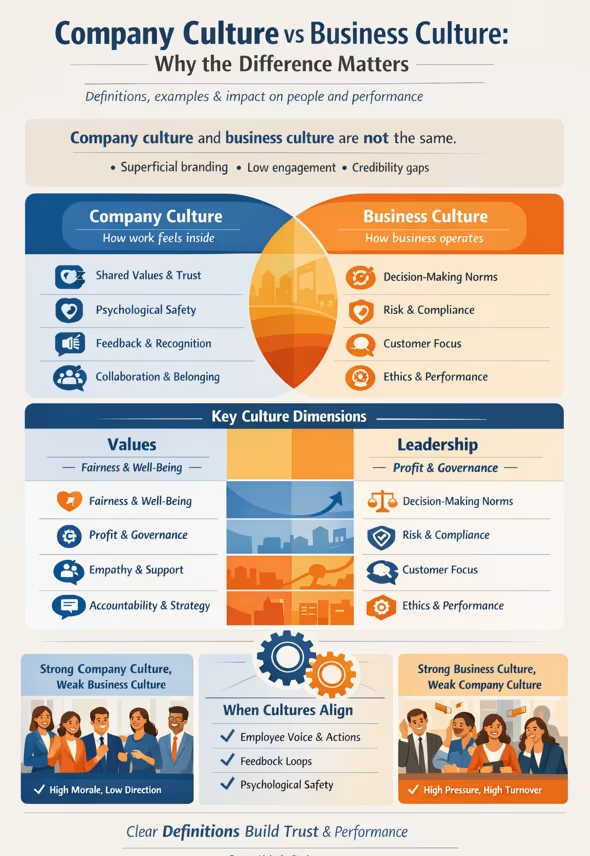
Defining the Terms: Company Culture Vs Business Culture
What Is Company Culture?
Company culture is the experience or experience of working inside an organization as lived and internal – the shared values, behaviors, norms, and day-to-day interactions that influence the way work actually feels in an organization. It is not defined by mission statements and employer branding campaigns, but by the way people are treated, the behavior of leaders, and teamwork on a day-to-day basis. In practice, the influence of the company culture on motivation, trust, involvement, and long-term retention.
Core aspects of company culture (e.g., how leadership behaves and how credible they are, how employees recognize and give each other feedback, psychological safety, the level of collaboration across teams, etc.). These things determine whether or not employees are able to feel supported, heard, and connected to the purpose of the organization. As a result, company culture is often spoken in the context of corporate culture, which is very much related to company culture and is often used in the HR and organizational development contexts to describe the norms and values found within the organization.
As highlighted by the recent data, this is an important one to get right. According to Gallup’s 2024 Workplace Engagement Report, only 23% of employees worldwide say they strongly agree they feel engaged at work, compared with 60% that say they feel emotionally detached. This stubborn engagement gap speaks volumes about how fragile company culture can be – and how easily it can deteriorate when leadership behaviors and employee experience are out of alignment. In the context of culture in the workplace as a larger whole, company culture is what the employees see on a direct level.
What Is Business Culture?
Business culture, by contrast, conveys the external-facing operational mind of the organization. It determines the way decisions are made, priorities are set, and performance is measured throughout an enterprise. Business culture impacts an organization’s risk response, competition, regulation, customer, and long-term growth pressures.
Key elements include: risk tolerance and compliance standards, customer-centricity, ethical decision-making, and market competitiveness. Which, in contrast to company culture, which is felt inwards,
Defining the Words: Company Culture vs. Business Culture
What Is Company Culture?
Company culture is the lived, internal experience of company employees – what values, behaviors, norms, and everyday interactions we all share about how work truly feels within an organization. It is less influenced by formal policies and more by informal behaviors such as day-to-day leadership in person, relationships among peers, and the pattern of daily practice of values across teams. In this sense, company culture is the human layer of the organization and an integral part of the culture in the workplace.
Key elements of company culture include leadership trust and credibility, meaningful employee recognition, open feedback mechanisms, psychological safety, and collaboration across functions. These elements have a direct impact on morale, discretionary effort level, and employees’ tendency to remain with an organization for a long period. The term corporate culture is often used interchangeably with company culture, especially in the field of HR and organizational development, as it is used to describe this internal environment.
Recent research shows how decisive this internal experience can be. According to Work human’s 2024 Global Human Workplace Report, four times as many employees report feeling a sense of belonging, and three times as many employees report staying with their employer for the next year when they feel their organization has a strong and positive culture. This reinforces the idea that company culture is not an intangible concept- it is a retention and stability driver that is grounded in day-to-day behavior.
What Is Business Culture?
Business culture is the business organization’s external-facing mode of operation – how the business does business; its approach to decision making, performance, risks, and competitiveness in the market. It is how strategy is carried out as opposed to how employees care about work emotionally. Business culture controls priorities, accountability, governance, and the way that success is measured at an organizational level.
Its fundamental components are risk tolerance and compliance, customer-centric decision-making, ethical standards, speed versus stability trade-offs, and the excessively aggressive approach an organization takes to growth. Business culture is seen in executive decisions, resource deployment, and the way the organization responds to the pressure in the market.
A 2024 global survey by EY found that 67% of leaders believe there is a reputational risk in misalignment between stated values and actual business decisions. This shows that the business culture is closely examined by your customers, partners, and regulators – even if you cannot see the sentiment of internal employees immediately.
Why the Distinction Matters
The difference between these two ideas is critical. Company culture determines the experience of employees, while business culture determines the behavior and strategy of an organization. When the two are confused and poorly aligned, organizations risk polished employer branding coupled with poor, substandard internal realities, great performance coupled with poor, unhealthy work environments, or effective certification claims with no credibility, given that the relevant cultures have not been clearly defined and likewise measured.
Culture Dimensions Matrix: Where the Differences Become Visible
To clearly differentiate company culture from business culture, it is helpful to use a simple culture dimensions matrix to achieve this. This framework emphasizes the points where the two concepts overlap and differ, and it also helps make culture more observable and measurable. By decomposing culture into foundational dimensions – values, leadership, and communication – organizations can more effectively understand what dimensions influence the employee experience and which to follow in organizational strategy.
Values
From the perspective of the company culture, values are experienced in daily activities. Inclusivity, fairness, employee well-being, and opportunities for growth are made real when employees see them being consistently practiced when making hiring decisions, conducting performance reviews, and interacting as a team. Values in company culture. The question in company culture is: How are people treated here?
In contrast, business culture makes meaning of values within an operational framework. Profitability, efficiency, compliance, and sustainability inform the exercise of the range of trade-offs that leadership is willing to undertake. These values affect strategic decisions such as the expansion of the market, cost control, and governance standards. In this regard, values address a different issue: How does the organization compete and function responsibly?
Research supports the importance of clear articulation in both of these dimensions of values. According to Deloitte’s Human Capital Trends, organizations with clear and well-embedded values report around 30% greater employee commitment, which shows that values must have a say and be performed to be successful.
Leadership
One of the most powerful indicators of culture is leadership. Within company culture, one can define management as manager accessibility, empathy, coaching styles, and day-to-day transparency. Employees assess culture, in large part, by their direct managers-how they give them feedback, how they handle mistakes, and whether or not they can trust you in return.
Within the business culture, leadership is manifested through the authority to make decisions, frameworks of accountability, and time-horizon thinking. This involves everything from who gets to make the decision to how performance is measured to whether or not leaders are more interested in short-term results or long-term resilience. These leadership behaviors organize consistency and credibility of the organization at a strategic level.
The quantifiable effects of leadership on company culture are well documented. Research from Gallup suggests that around 70% of engagement variance is due to managers, which is one more reason why leadership has to be assessed differently depending on whether the focus is employee experience or organizational performance.
Communication
In company culture, communication is all about feedback loops, psychological safety, and voice. Employees value a culture based on whether an employee can speak up, share concerns, and contribute ideas without fear of negative aftereffects.
In the business culture, communication involves information and crisis management, or alignment across the departments and regions. It determines how fast organizations adapt and the consistency with which they execute their strategy.
Evidence provided by McKinsey & Company shows that high-performing organizations are 4.5 times more likely to communicate well, which makes communication a defining divider between aspirational and operational culture.
Mapping What Gets Measured
Not all cultural elements are equally visible, however, or measurable. As a result, surveys, audits, and culture seals aim at specific dimensions, some of which measure internal employee sentiment, while others measure leadership behavior and organizational consistency. This distinction explains why it is vital to appreciate the culture matrix before one can try to measure or certify culture.
Real Life Examples of Corporate Culture
Strong Company Culture, Poor Business Culture
In this situation, employees express satisfaction, good relationships, and a positive day-to-day environment. Teams feel supported and energized, but poor decision-making and a lack of a clear long-term strategy prevail in the organization. Leadership may value harmony and flexibility but not make tough trade-offs around accountability, performance, or scaling.
The danger is that positivity is able to glaze over structural weaknesses. Burnout can arise if motivated teams have no direction, and financial instability often follows the absence of operational discipline. This pattern is common with early-stage startups that have a great people-first mindset with little governance, lack of consistent priorities, or weak execution frameworks.
Strong Business Culture and Weak Company Culture
Here, performance expectations are clear and results-driven, but low trust and high turnover. Employees work under constant pressure and have little psychological safety or voice. While this organization may appear, externally, to be a success, there is a high cost within.
A study conducted by the Massachusetts Institute of Technology Sloan Management Review found that toxic workplace cultures are ten times more predictive of employees’ attrition than compensation is, indicating how the negative effects of poor company culture can be even worse in a high-performing organization.
When Company Culture and Business Culture Work Hand in Hand
The ideal state is when there are clear, unambiguous values and these values are consistently reinforced through leadership behaviors, organizational systems, and strategic decision-making. In such alignment, what leaders persist in, what employees feel about them, and how the business operates, are all aligned toward the same things, so that there is coherence among the internal culture and the external performance. Employees know how their work relates to organizational objectives, leading to the creation of a strong employer brand, sustained performance, and credible culture certifications.
Measuring Culture: Surveys, Signals, and Certification Seals
What Culture Surveys Usually Measure
Most culture assessments target company culture, such as trust, inclusion, engagement, and leadership credibility. These indicators reflect the sentiment and lived experience of employees. In contrast, business culture indicators measure the alignment of governance, standard ethics, and consistency amongst teams, regions, and levels of leadership.
Role of USIQ
USIQ sits at the intersection of measuring the culture dimensions using structured and employee-validated surveys. Its approach is a definition that distinguishes internal experience from practices organized at the plant level in order to make certifications reflect reality and not marketing claims. The resulting seal is an indication of verified culture at work and strong employer branding.
This is important because trust is the driving force behind talent decisions. According to a LinkedIn Employer Branding Study, job seekers are three times as likely to trust employers with verified culture claims as job seekers who rely on self-promotion alone.
Why Certifications Are Useless Without Definitive Definitions
Certifications do not have credibility if they are marketing-driven or lack employee validation, or if they do not clearly distinguish between company culture and business culture.
Conclusion: Culture Clarity Is a Competitive Advantage
Company culture and business culture are closely related to each other, and they are not the same thing. One has employee experience; the other has organization behavior and strategy. When organizations don’t know the difference between them, employer branding is undermined, and credibility suffers.
Those who define, measure, and align both cultures intentionally build trust with employees, candidates, and the market. In an environment where transparency and verification are a matter of greater importance than ever before, being clear about our culture is not an option-but a strategic requirement.

Related Articles
What research says about the effects of employer seals on current employees, potential applicants and employer image, from independent experiments and field data to the limits of the evidence.
Employee experience and customer experience are linked, but the link is weaker and more conditional than popular slogans suggest. This article reviews the evidence on staffing, training and workplace conditions and shows how employers can test the connection in their own business.
Most HR dashboards show too many metrics and trigger too few decisions. This guide defines ten employee experience metrics, shows a one-page layout and explains how to read your numbers against U.S. data.
A practical guide to calculating marketing ROI for small and mid-sized U.S. companies, including long B2B sales cycles, offline leads, a spreadsheet walkthrough and common errors.