

A quality management system (QMS) is the set of written processes, clear roles and regular checks that lets an organization deliver the same result every time. Most descriptions come from manufacturing, medical devices or software vendors. For a company with 10 to 250 employees, the more practical question is how the idea applies to hiring, performance reviews, employee surveys and everyday operations.
The short version: a QMS is a management choice, not a legal duty, and ISO 9001 certification is an optional extra on top of it. Many employers get most of the value from a light, uncertified version that covers three or four processes that matter.
This article explains what a QMS contains, how the ISO 9001 standard fits in (including the new 2026 edition), what certification costs, and how to build a basic system step by step.
Quick answer: A quality management system is a documented way of working: defined processes, named owners, measurable goals and regular reviews that drive improvement. It applies to services and HR as well as products. U.S. law does not require one, and ISO 9001 certification is optional, so employers can start small without certifying.
Key takeaways
- A QMS means written processes, clear ownership, measurement and continuous improvement. It is not a stack of documents.
- ISO 9001 is the best-known requirements standard. The sixth edition, ISO 9001:2026, was published on September 16, 2026 and replaces the 2015 edition.
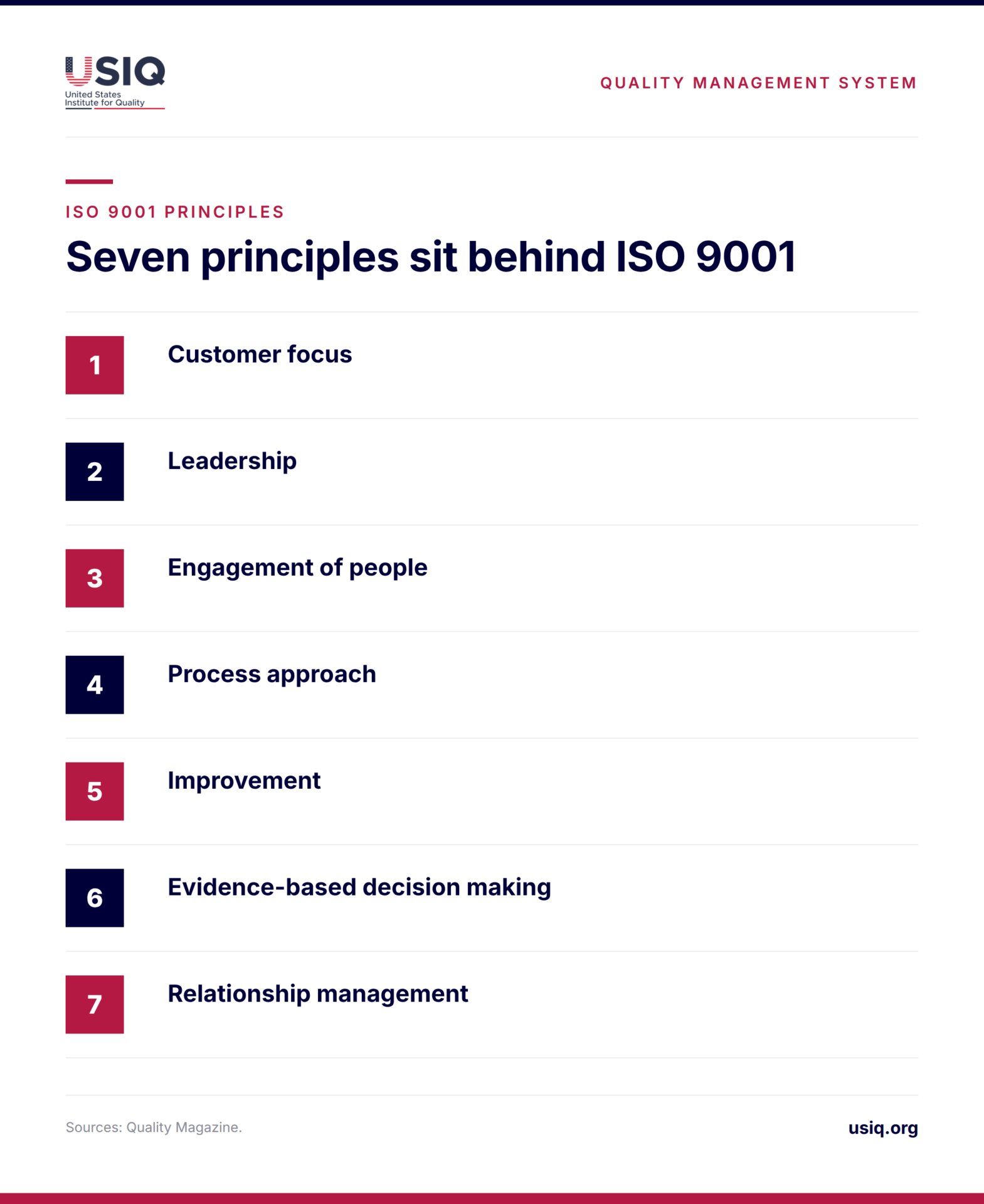
- ISO 9001 rests on seven quality management principles.
- Certification is voluntary. One published example puts initial certification for a business with fewer than 10 employees at $4,000 to $6,000.
- QMS thinking works well for HR: consistent hiring criteria, the same review process for everyone, and surveys with tracked follow-up.
- A QMS standardizes process. It does not by itself guarantee legal compliance or unbiased decisions.
- The most common failure is a system that is documented but not lived. Document only what you actually do.
What is a quality management system (QMS)?
A quality management system is a company’s agreed way of getting work done right. It defines how key tasks are performed, who owns them, how results are measured and how the company learns from problems. The goal is consistency: a customer or employee gets a comparable experience whichever manager, team or site they deal with.
Documents are only part of it. A procedure that sits in a shared folder while people work differently is not a QMS. The system exists when people follow the process, check it and change it when it stops working.
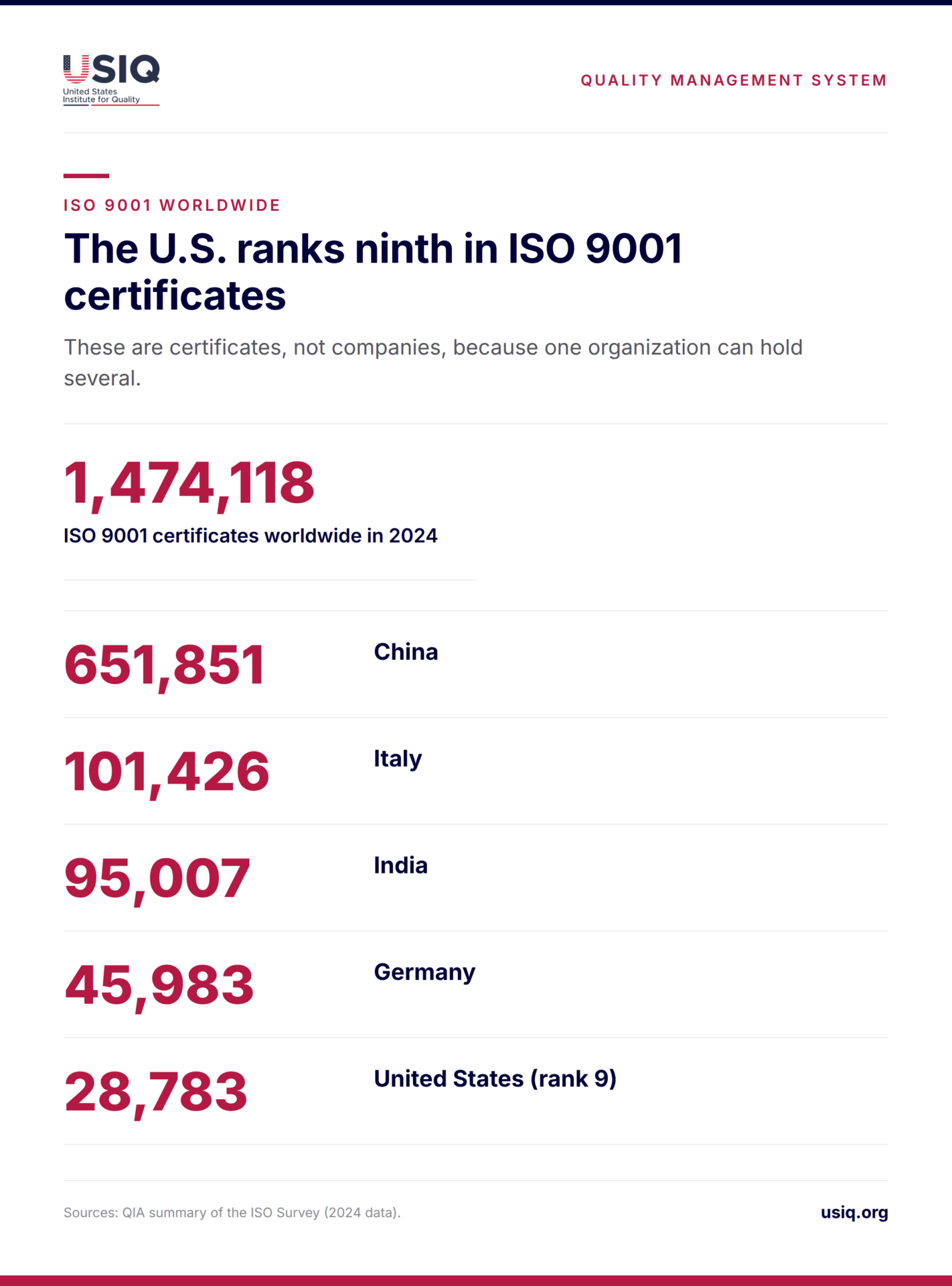
The best-known framework is ISO 9001. According to a summary of the ISO Survey by QIA, 1,474,118 ISO 9001 certificates were issued worldwide in 2024, up 75.9% on 2023. The United States ranked ninth with 28,783 certificates (47,463 sites), behind China (651,851), Italy (101,426), India (95,007) and Germany (45,983). These are certificates, not companies, because one organization can hold several.
The 2023 dip to 837,978 certificates (down 33.7%) followed 1,265,216 in 2022. The same source attributes the dip mainly to incomplete reporting by certification bodies rather than a real collapse in use, so year-to-year swings in these counts need careful reading.
Do small and mid-size U.S. employers need a quality management system?
No rule requires an employer to run a formal QMS or to hold ISO 9001 certification. The question is whether it pays off. It usually does when the same work is done by many people, when several managers make similar decisions, when you run more than one location, or when customers or partners ask for proof of structured processes.
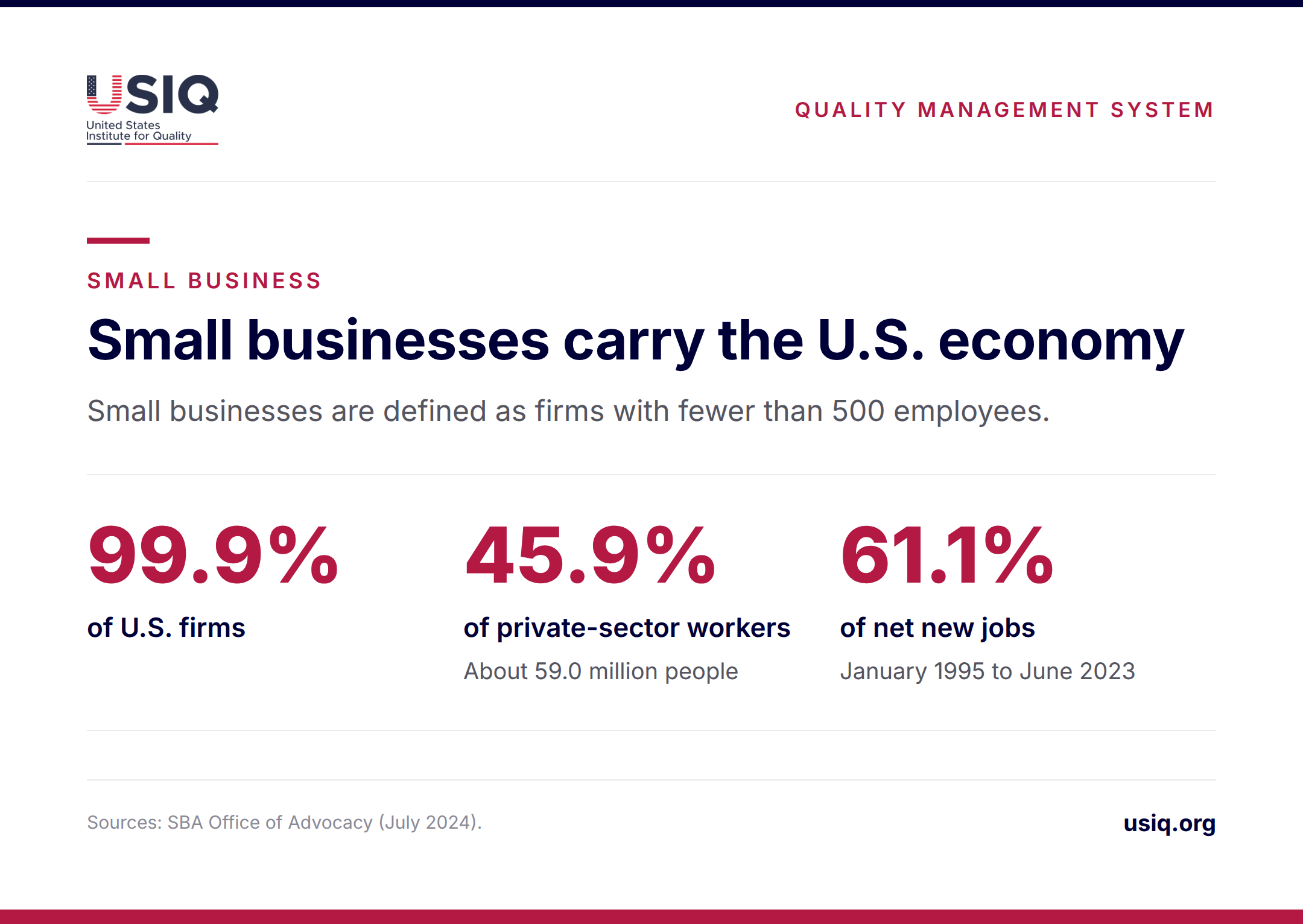
Small and mid-size firms are the norm in the U.S. economy. The SBA Office of Advocacy reports that small businesses, defined as fewer than 500 employees, make up 99.9% of U.S. firms and employ 45.9% of private-sector workers, about 59.0 million people. They also created 61.1% of net new jobs between January 1995 and June 2023.
Staying power is a real concern. Of new employer establishments founded from 1994 to 2021, 67.9% survived two years, 49.2% survived five and 33.8% survived ten. Those figures do not show that a QMS prevents closures. They do show why a small company cannot afford processes that depend on one person’s memory.
When a QMS is probably more than you need
A 15-person firm with one manager and a handful of repeated tasks may need little more than a short written checklist for hiring and reviews. Heavy documentation in a small team often produces binders nobody opens. Start with the processes where inconsistency hurts, and add structure only where it earns its keep.
What are the core elements of a QMS?
Every working QMS, large or small, combines the same building blocks. For an employer they translate into plain management routines.
- Policies and documentation. Short, written descriptions of how key tasks are done, such as how a job is posted, how interviews are scored or how survey results are shared. Keep each to a page or two.
- Standard processes. The same steps every time, across teams and locations. A new manager should be able to run the process from the description alone.
- Roles and ownership. One named person is responsible for each process, including follow-up. Employees know whom to ask.
- Quality objectives. Measurable goals, such as the share of reviews completed on schedule or the share of survey actions closed within 90 days.
- Risk thinking. A short look at what could go wrong, such as a key manager leaving, a regulatory change or a new IT tool, and a plan for it.
- Change control. When a process changes, the written version changes too, and people are told.
- Measurement, internal checks and review. Results are tracked over time, and someone periodically checks whether practice matches the written process.
The new edition of the standard puts more weight on some of these. Amtivo, a certification body, lists quality culture and leadership, risks and opportunities, and alignment with other ISO management system standards among the key change areas in ISO 9001:2026. A second summary adds that quality culture becomes an explicit leadership responsibility.
What are the seven quality management principles?
ISO 9001 is built on seven quality management principles defined in ISO 9000, as Quality Magazine explains. The table pairs each principle with an example from an employer’s daily work.
| Principle | What it means in an employer setting |
|---|---|
| Customer focus | Define who your “customers” are, including applicants and employees, and what they expect |
| Leadership | Managers set direction and model the standards they ask for |
| Engagement of people | Employees know the quality goals and can give input that leads to action |
| Process approach | Treat hiring, onboarding or reviews as connected processes, not one-off tasks |
| Improvement | Fix root causes and revisit processes on a schedule |
| Evidence-based decision making | Use survey scores, turnover or time-to-hire data rather than gut feeling |
| Relationship management | Manage suppliers and partners, such as staffing agencies or payroll providers, deliberately |
ISO 9004:2018 is a related document, but it works differently. The ANSI Blog describes it as guidance for achieving sustained success that applies to any organization regardless of size. It is the fourth edition and replaces the 2009 version. It offers advice rather than certifiable requirements.
How does a QMS apply to HR, hiring and employee experience?
ISO 9001 is not an HR standard, and no one can say an HR department is “ISO certified” because it uses these ideas. QMS principles still transfer well to people processes, because those processes suffer from exactly the problem a QMS solves: different managers doing the same thing differently.
Hiring
A documented hiring process defines the job criteria, the interview questions, the scoring method and who decides. Consistency also has a legal side. The EEOC states that discriminatory employment tests and selection procedures are prohibited by Title VII, the Americans with Disabilities Act (ADA) and the Age Discrimination in Employment Act (ADEA), all of which it enforces. A written, consistently applied process makes it easier to show that every candidate was assessed on the same job-related criteria. It does not, on its own, make a process lawful, and the EEOC fact sheet dates from 2007, so check for newer guidance.
The EEOC’s regulations page lists 29 CFR Part 1607 (Uniform Guidelines on Employee Selection Procedures) and 29 CFR Part 1602 (Recordkeeping and Reporting Requirements). Read these with counsel before setting retention rules for hiring records. Our guide to interview best practices for hiring managers covers the interview side in more detail.
Performance reviews
Set one review cycle, one set of criteria per role family and one documentation format. When two managers rate the same work by different yardsticks, employees notice quickly. A shared process makes ratings easier to compare and to explain. It reduces inconsistency, but managers still exercise judgment, so calibration meetings remain useful.
Employee surveys with follow-up
A survey that produces a report and no change teaches employees that feedback is pointless. A QMS approach fixes the schedule, keeps the questions comparable over time, assigns an owner to each finding and tracks the action until it closes. Employees then see that input leads somewhere. For the design side, see our explainer on employee surveys and employer trust.
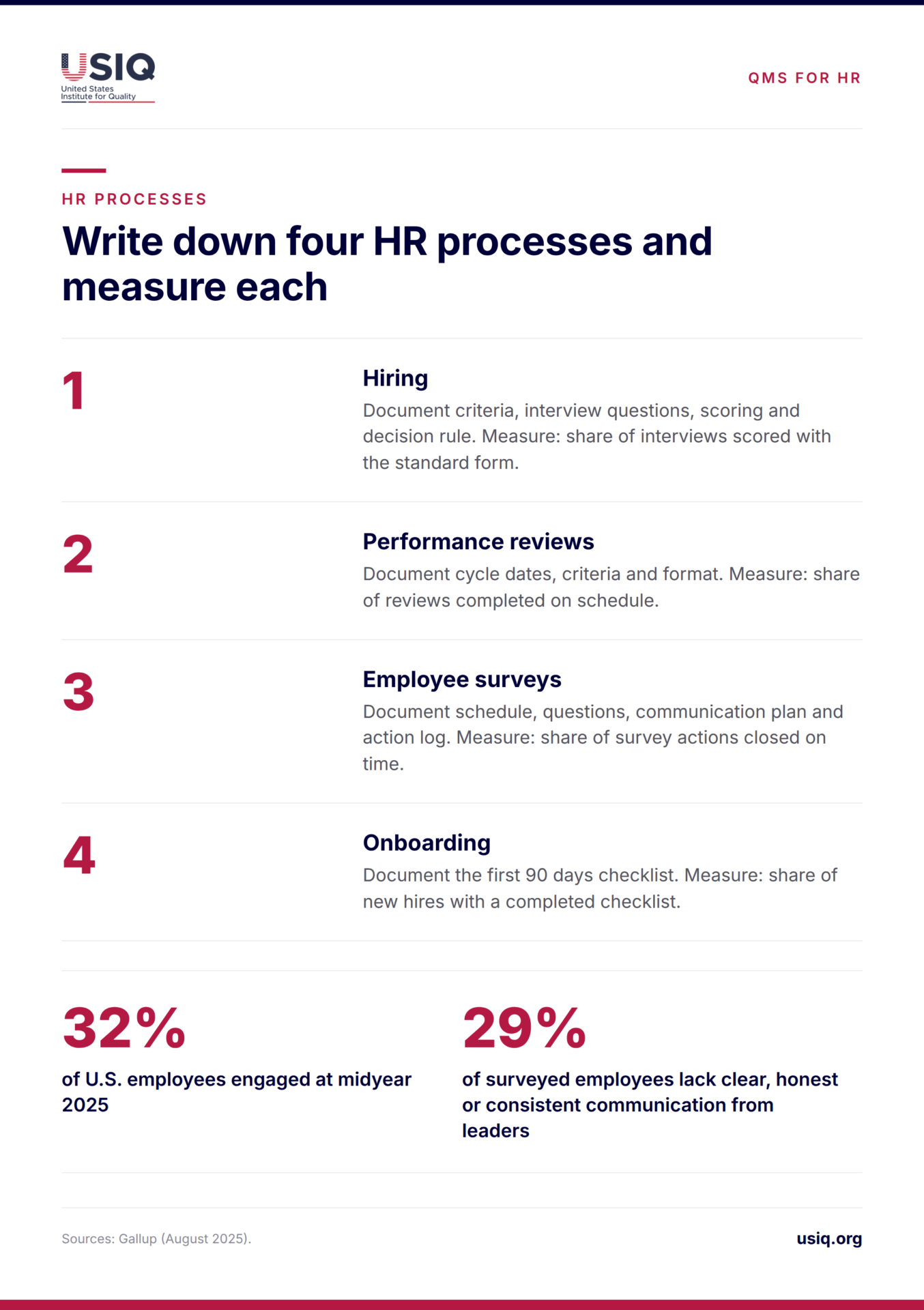
Gallup reports that 32% of U.S. employees were engaged as of midyear 2025, and that 29% of surveyed employees say they lack clear, honest or consistent communication from leaders. These numbers describe the problem, not the cure: they do not prove that a QMS raises engagement. They do show why predictable, communicated processes deserve attention.
| HR process | What to write down | Owner | Example measure |
|---|---|---|---|
| Hiring | Criteria, interview questions, scoring, decision rule | HR lead | Share of interviews scored with the standard form |
| Performance reviews | Cycle dates, criteria, documentation format | HR lead with department heads | Share of reviews completed on schedule |
| Employee surveys | Schedule, questions, communication plan, action log | HR lead or COO | Share of survey actions closed on time |
| Onboarding | Checklist for the first 90 days | Hiring manager | Share of new hires with a completed checklist |
Cultural initiatives can follow the same pattern. Define what the value means in behavior, decide how you will check it and review the result on a calendar. Our article on HR dashboard examples shows how such measures can be displayed.
What is the difference between a QMS, ISO 9001 and certification?
The three terms are often mixed up. A QMS is the system itself. ISO 9001 is a standard that sets requirements for such a system. Certification is an optional audit by an outside body that confirms the system meets the standard. A company can run a good QMS without ever certifying, and a certificate does not by itself prove the system works well in daily practice.
| Term | What it is | Optional? |
|---|---|---|
| Quality management system | Your own documented processes, roles, measures and reviews | Yes, a management choice |
| ISO 9001 | The requirements standard for a QMS; sixth edition (2026) replaces 2015 | Yes |
| ISO 9001 certification | Third-party audit against the standard; three-year cycle with annual audits | Yes |
| ISO 9004:2018 | Guidance for sustained success, not a certifiable standard | Yes |
What changed in ISO 9001:2026?
ISO 9001:2026 was published on September 16, 2026. According to ISO 9001 Checklist, the transition period runs three years, to about September 2029, and the revision is evolutionary: refinements around quality culture, ethical behavior and clearer risk management, plus the 2024 climate-change amendment folded in. Amtivo notes that certified organizations transition within their existing certification cycle. The timeline matters only to companies that choose to certify. For a deeper look, read our article on ISO 9001 certification for U.S. employers.
What does a QMS or ISO 9001 certification cost a small employer?
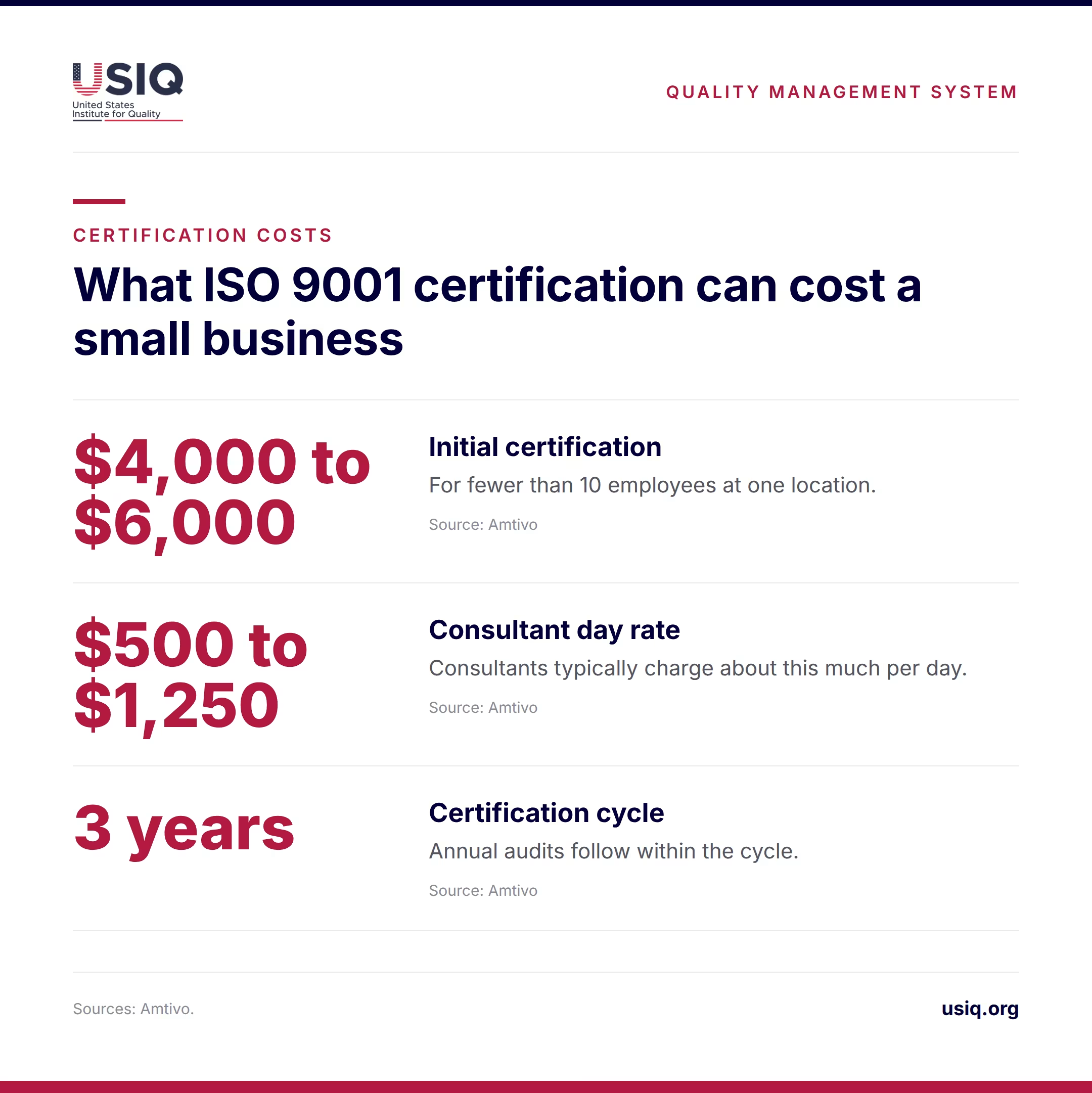
Building a light, uncertified QMS costs mainly management time: someone has to map processes, write them down and run the reviews. Certification adds outside costs. Amtivo gives one size-specific example: a business with fewer than 10 employees at a single location might expect to pay $4,000 to $6,000 for initial ISO 9001 certification. The same source says consultants typically charge about $500 to $1,250 per day.
Reliable price ranges for companies with 10 to 250 employees are scarce. Costs rise with headcount, number of sites, scope of the system, consultant days and the recurring audits that follow. Once certified, an organization follows a three-year cycle with annual audits, so the first-year price is not the final price. Request quotes from more than one certification body and define the scope before comparing them.
| Cost item | Published figure | Source |
|---|---|---|
| Initial ISO 9001 certification, fewer than 10 employees, one location | $4,000 to $6,000 | Amtivo |
| Consultant day rate | About $500 to $1,250 per day | Amtivo |
| Audit cycle after certification | Three years, with annual audits | Amtivo |
| Light, uncertified QMS | Mainly internal management time | No published figure |
How do you implement a basic quality management system step by step?
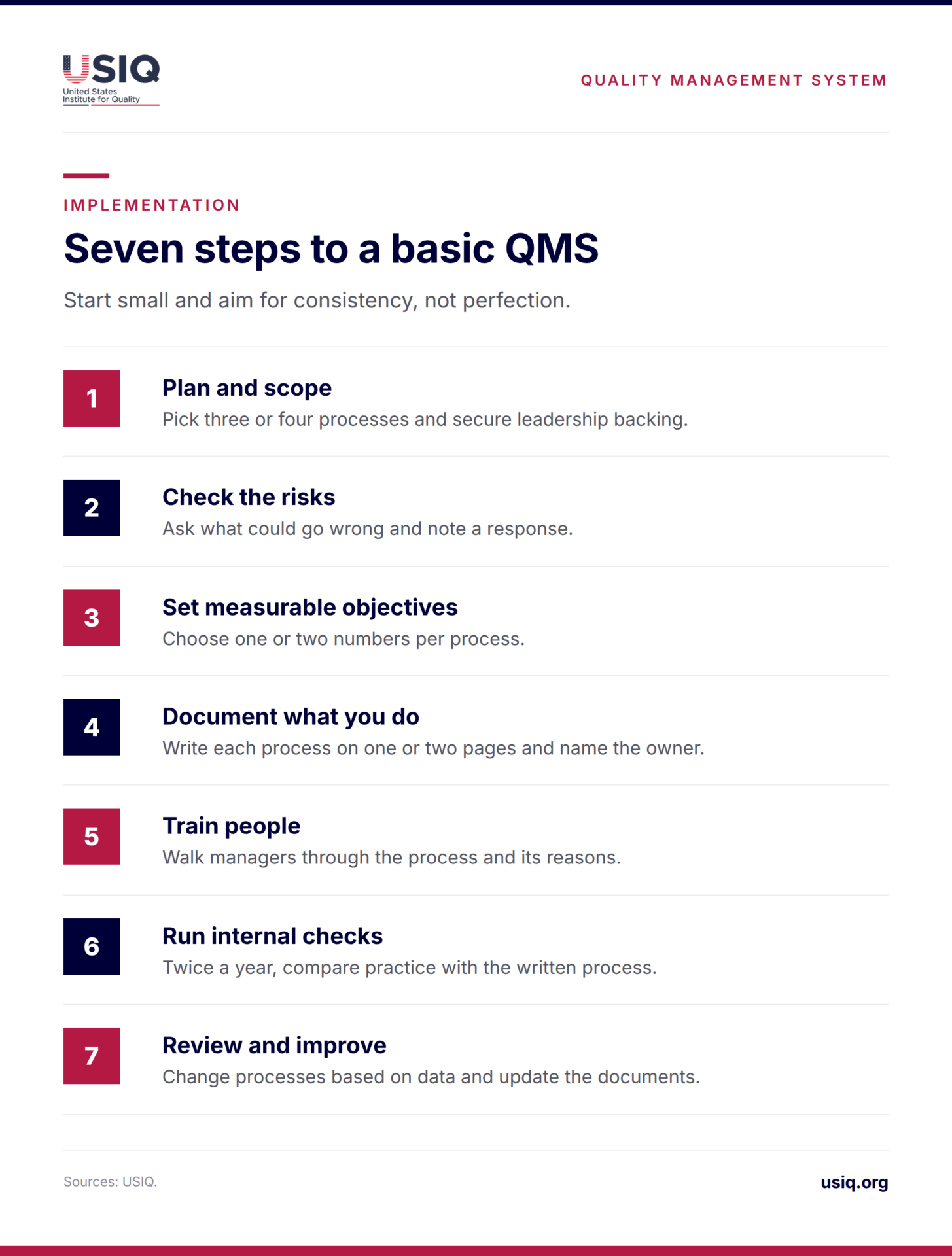
Start small and aim for consistency, not perfection. These steps work for a company of 50 people as well as for one of 200.
- Plan and scope. Pick three or four processes, such as hiring, reviews, surveys and onboarding. Get explicit backing from top leadership and set aside time.
- Check the risks. For each process, ask what could go wrong and who would notice. Note the two or three biggest risks and a response.
- Set measurable objectives. Choose one or two numbers per process, such as reviews completed on time.
- Document what you actually do. Write each process on one or two pages, name the owner and store it where managers can find it.
- Train the people involved. Walk managers through the process and the reasons behind it. A system people do not understand will not be followed.
- Run internal checks. Twice a year, compare practice with the written process. Record gaps and fix either the practice or the document.
- Review and improve. Put a review on the calendar. Change processes based on data and feedback, and update the documents when you do.
The value comes from returning to the system regularly and improving it in small steps. If you later decide to pursue an outside assessment, the records you built along the way are the starting point. Our overview of whether to get ISO 9001 certified helps with that decision.
What mistakes do employers make with a QMS?
Most failures come from the same few habits.
- Surveys without follow-up. Employees give feedback, see nothing change and stop answering honestly.
- Inconsistent reviews. Each manager uses their own method, so ratings cannot be compared and fairness is hard to defend.
- Unwritten rules. Knowledge lives in one person’s head and leaves with them.
- Over-documentation. Long procedures nobody reads. Cut anything that does not reflect real practice.
- A one-person system. If only one employee understands the QMS, it collapses when that person is absent or leaves.
Common misconceptions
A QMS does not guarantee legal compliance or remove bias; it makes a process visible so that gaps are easier to find. ISO 9001 certification is not a legal requirement for U.S. employers. A certificate does not make an HR process “ISO certified” either, since the standard is not an HR standard. And a QMS is not paperwork for its own sake.
Conclusion
A quality management system is worth building where inconsistency costs you trust, time or compliance. For most U.S. employers with 10 to 250 employees, the right first move is not certification but writing down three or four key HR processes, naming owners and reviewing them on a fixed schedule.
FAQ
Is a quality management system required by U.S. law?
No general U.S. law requires an employer to run a QMS or hold ISO 9001 certification. Some customers or contracts may ask for it. Employers still face legal duties in areas such as hiring, where Title VII, the ADA and the ADEA apply. A QMS can help you apply those rules consistently, but it does not replace legal advice.
How many quality management principles are there?
Seven. ISO 9001 is based on the seven principles defined in ISO 9000: customer focus, leadership, engagement of people, process approach, improvement, evidence-based decision making and relationship management. Each one can be applied to everyday employer processes such as hiring, reviews and surveys, as the table above shows.
Is ISO 9001 certification worth it for a company with 50 employees?
It depends on your customers and your goals. Certification pays off when clients or contracts ask for it. If the aim is simply better consistency, a light internal QMS achieves much of that without audit fees. Get quotes first, because published cost data for mid-size firms is limited.
What changed with ISO 9001:2026?
ISO 9001:2026, the sixth edition, was published on September 16, 2026 and replaces ISO 9001:2015. It is an evolutionary revision with more emphasis on quality culture, leadership, ethical behavior and risk. Certified organizations have about three years, to around September 2029, to transition within their certification cycle.
Can HR processes be ISO 9001 certified?
ISO 9001 is a general quality management standard, not an HR standard, so an HR department cannot claim to be “ISO certified” on that basis. What employers can do is apply QMS principles to hiring, reviews, surveys and onboarding, and, if they wish, include those processes in the scope of a wider system.
How much does ISO 9001 certification cost?
Amtivo gives $4,000 to $6,000 for initial certification of a business with fewer than 10 employees at one location, and about $500 to $1,250 per day for consultants. Larger firms, more sites and a broader scope cost more, and annual audits follow within a three-year cycle. Ask several certification bodies for quotes.
What is the difference between ISO 9001 and ISO 9004?
ISO 9001 sets requirements that an organization can be audited against. ISO 9004:2018 is guidance for achieving sustained success and applies to organizations of any size, but it is not a certification standard. Companies often use ISO 9004 ideas to improve a system that already follows ISO 9001.
Where should a small employer start?
Choose three or four HR processes, such as hiring, reviews and surveys. Write each on one or two pages, name an owner, set one measure and schedule a review. Do this before considering software or certification. Consistency matters more than perfection, and the first version can be improved later.
Sources
- QIA: ISO Certification Trends 2020 to 2024 (2026-04-13). https://www.qi-a.com/news/iso-certification-trends-2024/
- ISO 9001 Checklist: ISO 9001:2026 Revision (modified 2026-10-16). https://www.iso-9001-checklist.co.uk/iso-9001-2026-revision.htm
- Amtivo: ISO 9001:2026 Revision (modified 2026-10-16). https://amtivo.com/us/resources/technical/iso-9001-revision/
- Amtivo: How Much Does ISO 9001 Certification Cost? (modified 2026-10-16). https://amtivo.com/us/resources/insights/how-much-does-iso-9001-certification-cost/
- Quality Magazine: The Seven Quality Management Principles. https://www.qualitymag.com/articles/99031-the-seven-quality-management-principles
- ANSI Blog: ISO 9004:2018 – Guidance to Achieve Sustained Success. https://blog.ansi.org/ansi/iso-9004-2018-guidance-sustained-success/
- Gallup: Anemic Employee Engagement Points to Leadership Challenges (2025-08-05). https://www.gallup.com/workplace/692954/anemic-employee-engagement-points-leadership-challenges.aspx
- SBA Office of Advocacy: Frequently Asked Questions About Small Business (July 2024). https://advocacy.sba.gov/wp-content/uploads/2024/12/Frequently-Asked-Questions-About-Small-Business_2024-508.pdf
- U.S. EEOC: EEOC Issues Fact Sheet on Employment Tests and Selection Procedures (2007-12-03). https://www.eeoc.gov/newsroom/eeoc-issues-fact-sheet-employment-tests-and-selection-procedures-screen-applicants-0
- U.S. EEOC: Regulations and Guidelines. https://www.eeoc.gov/regulations-and-guidelines

Related Articles

What research says about the effects of employer seals on current employees, potential applicants and employer image, from independent experiments and field data to the limits of the evidence.
Employee experience and customer experience are linked, but the link is weaker and more conditional than popular slogans suggest. This article reviews the evidence on staffing, training and workplace conditions and shows how employers can test the connection in their own business.
Most HR dashboards show too many metrics and trigger too few decisions. This guide defines ten employee experience metrics, shows a one-page layout and explains how to read your numbers against U.S. data.
A practical guide to calculating marketing ROI for small and mid-sized U.S. companies, including long B2B sales cycles, offline leads, a spreadsheet walkthrough and common errors.


