
Ask three people what a “business certificate” is and you may get three answers. A town clerk will describe a registration filed under a trade name. A state agency will talk about licenses and permits. A customer’s procurement team will mean an audited standard such as ISO 9001. Each is real, and each does a different job.
For an owner or HR lead at a company with 10 to 250 employees, mixing them up has a cost. You can pay for a badge that no customer asks for, or skip a filing the law does require. This article sorts the main business certification types, explains what each one proves, and shows how to judge whether a certification deserves your time and money. It also covers what certificates cannot do, and how seals can mislead when they are used carelessly.
Quick answer: A business certificate is a document showing that a company is registered or has met a defined standard. In the U.S. it can mean a local “doing business as” registration, a government-issued license, or a voluntary third-party certification. Only the last one is audited against a published standard, and only some are legally required.
Key takeaways
- “Business certificate” has at least three meanings: a registration, a license or permit, and a voluntary third-party certification.
- A registration certificate is not a license. Other licenses or permits may still be required.
- A credible certification has an independent issuer, a published standard, verification of real practice and recurring renewal.
- Individual training certificates prove that a person learned something. They say little about how a company operates.
- Seals can mislead. The Federal Trade Commission (FTC) has warned certification-seal providers and businesses that use them.
- Choose a certification because a customer, contract, regulator or hiring goal calls for it, not because a badge looks good.
What is a business certificate, and is it the same as a license?
No. The phrase covers three separate things. A registration certificate records who owns a business and under what name. A license or permit is government permission to carry out a regulated activity. A voluntary certification is a third party’s confirmation that a company meets a defined standard.
Massachusetts shows how the first kind works. There, a “business certificate” is a “doing business as” (DBA) registration filed with the Town Clerk in every city or town where the business is situated. The Town of Sudbury explains that its purpose is consumer and creditor protection, because it identifies the names and addresses of a business’s owners.
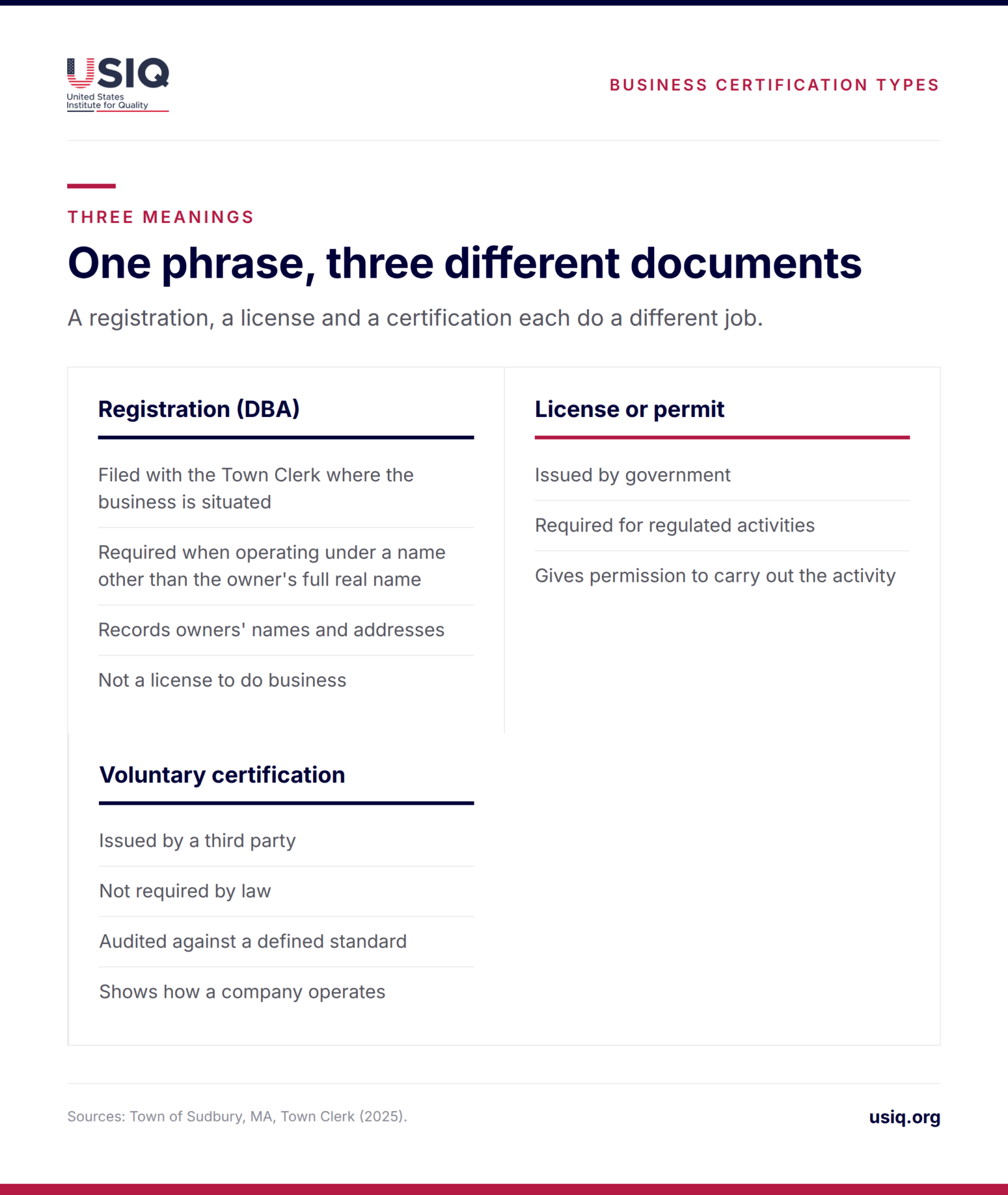
The same town page states that a business certificate is not a license to do business, and that other town or state licenses or permits may be required. Anyone operating under a name other than the full real name of the owner must file, while a corporation using its true corporate name is among the exemptions. The page cites Massachusetts General Laws, Chapter 110, Sections 5 and 6, as the legal basis.
Rules, forms and fees for assumed-name filings differ by state, county and town. Check the filing office where you operate before assuming that a rule from another state applies to you.
The rest of this article focuses on voluntary, program-based certification, because that is where owners face real choices about cost and credibility.
What business certification types exist in the U.S.?
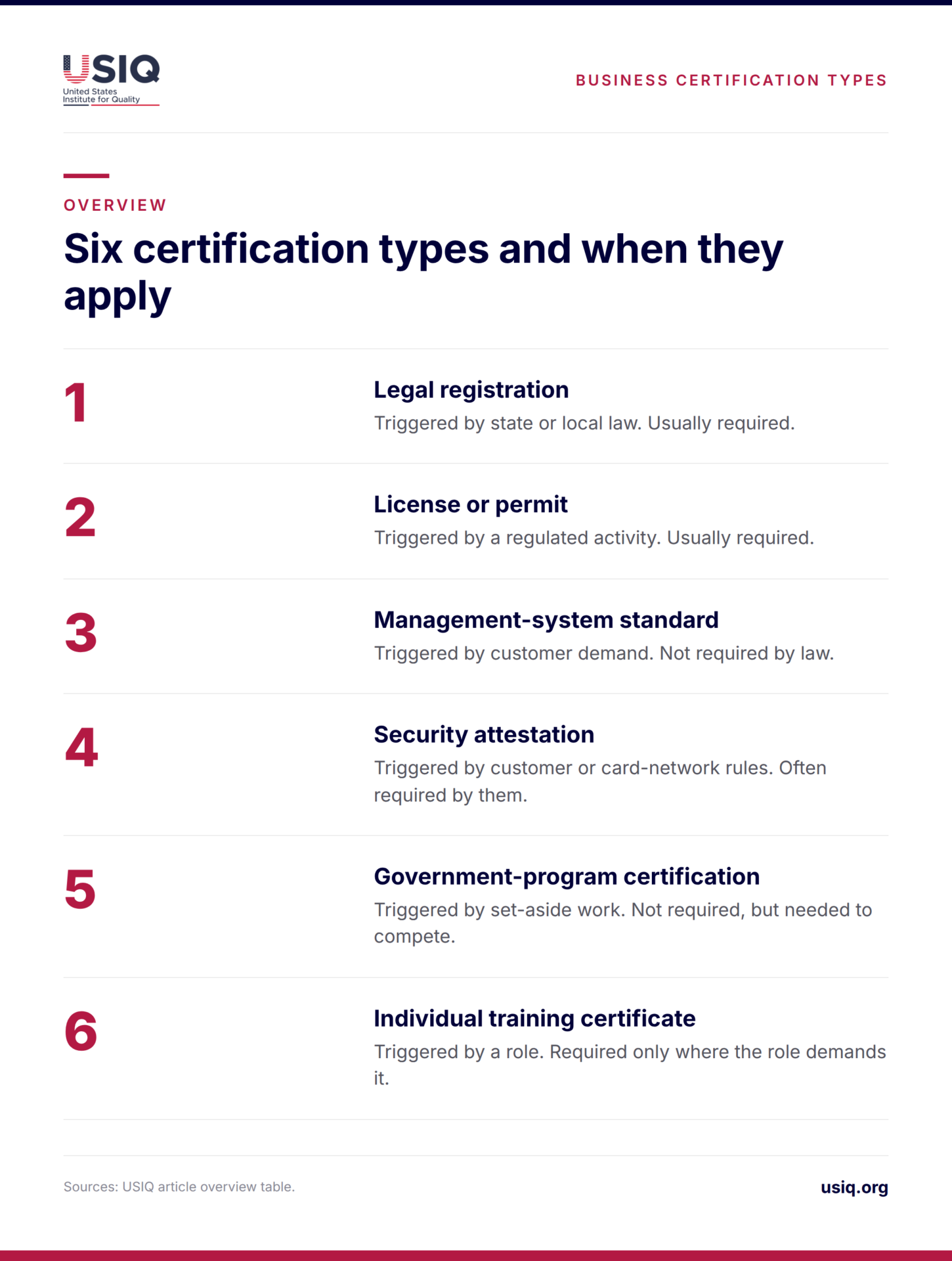
Business certification types fall into a handful of families. The table below groups them by what they prove and who usually asks for them. The examples are well-known names, not a complete list.
| Type | What it proves | Examples | Usually required? |
|---|---|---|---|
| Legal registration | Who owns the business and under which name | DBA or assumed-name certificate, certificate of formation | Yes, when the conditions in state or local law apply |
| License or permit | Government permission to perform a regulated activity | State trade or professional licenses, local permits | Yes, for regulated activities |
| Management-system standard | A documented, audited way of managing quality, security or safety | ISO 9001, ISO 27001, ISO 45001 | No, but customers may require it |
| Security attestation | Controls for protecting customer or payment data | SOC 2, PCI-DSS | Often a customer or card-network requirement |
| Government-program certification | Eligibility for a public contracting program | SBA 8(a), HUBZone, WOSB, SDVOSB, state MBE/WBE | No, but needed to compete for set-aside work |
| Individual training or professional certificate | A person completed a course or holds a skill | Course completions, professional credentials | Only where a role demands it |
Eligibility rules for government programs such as SBA 8(a) or HUBZone, including size standards, are set by the agencies that run them. Read the program’s own pages before you budget time for an application. Some of these programs are run by government rather than sold by private firms, so the application itself may not carry a certifier’s fee.
ISO standards come up often with suppliers. A company is certified against a standard, such as ISO 9001 for quality management, by an outside certification body. Our guides explain what ISO 9001 certification is and whether to get certified and what a quality management system means for employers.
How is a business certificate different from a training certificate or an award?
The key difference is scope. A training certificate belongs to a person. It shows that someone attended a course or passed an assessment. A business certification belongs to an organization and speaks to how that organization operates.
Professional certificates sit in between. They confirm that an individual has a defined skill or qualification, but they do not show that the employer’s systems, policies or leadership meet any standard. A company whose staff all hold course certificates has not thereby shown that it is well run.
| Feature | Training or professional certificate | Business certification | Award or ranking |
|---|---|---|---|
| Who holds it | An individual | An organization | An organization |
| What it shows | Learning or a skill | Conformity with a standard | Often popularity or a nomination result |
| Verification of practice | Rarely | Yes, in credible schemes | Varies, often none |
| Renewal | Sometimes | Recurring in credible schemes | Usually yearly or one-off |
Awards deserve caution for the same reason. A popularity vote or a nomination does not necessarily apply published criteria or check what a company really does, so it carries less weight than an audited standard.
Seal versus certificate
A seal is the emblem a company places on a website, a bid or a job post. The certificate is the document behind it. It names the issuer, the standard, the scope and the date. A seal without a verifiable certificate behind it is only a graphic.
What are business certificates not?
Four things are often mistaken for certification:
- A license. Licenses are issued by government and required for regulated activities. Many offers titled “certified plumber” or similar describe, in practice, a state license, so check which one is meant.
- A DBA registration. It records a name and owners. The Sudbury Town Clerk states that it is not a license to do business.
- A purchased or self-granted badge. A mark you can buy without any review proves nothing about your practices.
- A popularity award. Without published criteria and verification, it is recognition, not certification.
Do certificates really build trust with customers and employees?
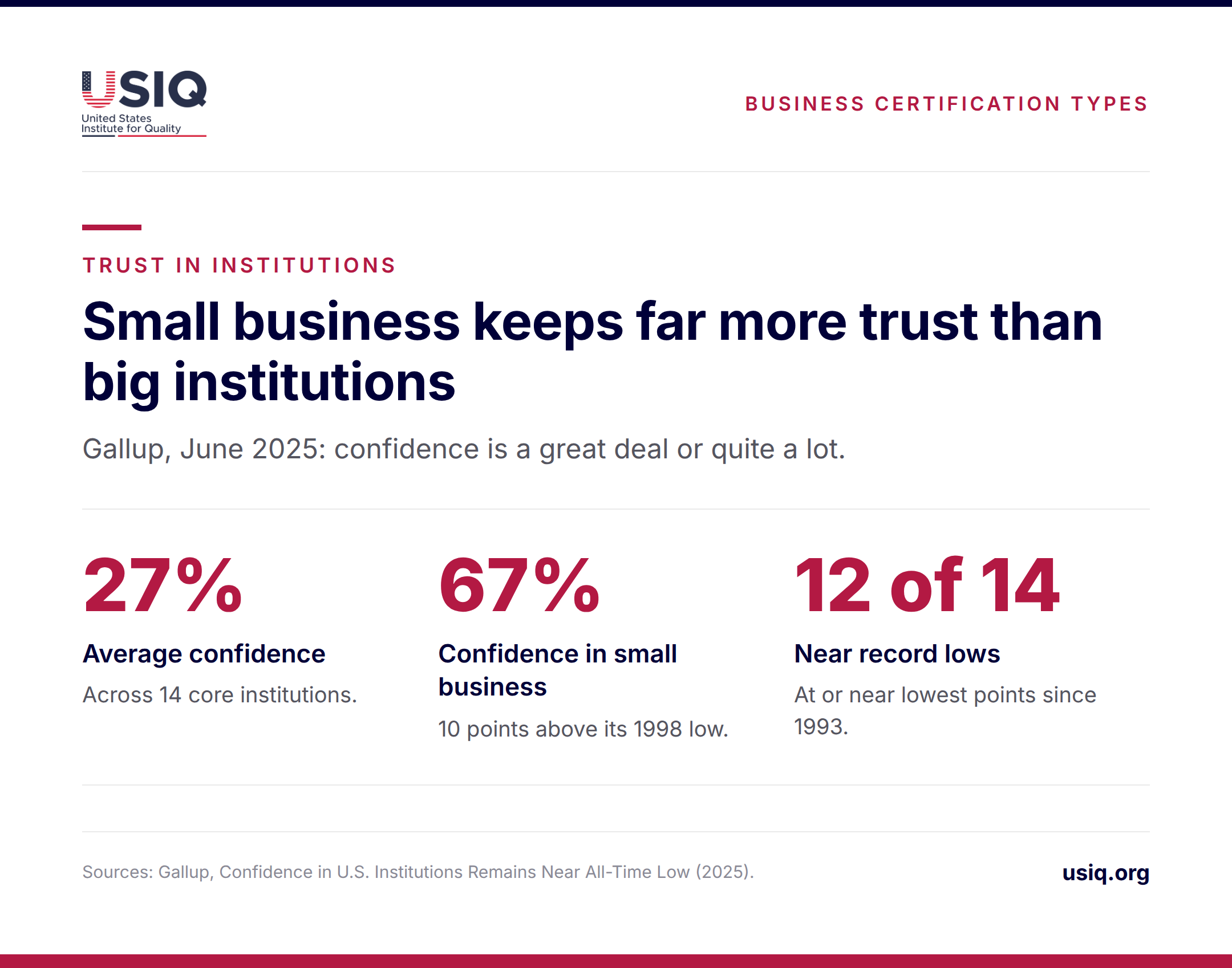
They can, but the context matters. Trust in institutions is low in the U.S. In Gallup’s June 2025 poll, confidence in 14 core institutions averaged 27% (“a great deal” or “quite a lot”), one point above the 2023 record low. Big business is among the 14, and 12 of them sit at or near their lowest points since 1993.
Small business does far better. Gallup found 67% confidence in small business, close to its average since 1997 and 10 points above its 1998 low. Small and mid-sized employers start from a stronger position than large corporations, so a certificate is not a rescue from distrust. It is a way to back up a claim that readers might otherwise take on faith.
Where certificates fall short
A certificate works only if the audience can recognize it and check it. If buyers have never heard of the issuer, the badge adds little. In many B2B settings, demand comes from a contract clause or a security questionnaire rather than from the badge itself, so the certification is a condition of doing business rather than a marketing asset.
Certification can also be costly paperwork when the standard does not fit the business. A weak scheme with no audit costs money and can damage credibility if someone notices.
Which certifications might your 10-to-250-employee company need?
Start from the trigger, not from the catalog. Most small and mid-sized employers need a certification because someone outside the company asks for one.
| Trigger | Typical certification to look at | First step |
|---|---|---|
| A customer contract or supplier questionnaire asks for a quality standard | ISO 9001 or a comparable management-system standard | Ask the customer which standard and which scope it accepts |
| A customer asks about data security or payment handling | ISO 27001, SOC 2 or PCI-DSS | Read the questionnaire and confirm which attestation satisfies it |
| You want public contracts or set-aside work | SBA programs such as 8(a), HUBZone, WOSB or SDVOSB, or state MBE/WBE | Check eligibility on the program’s own pages |
| Your activity is regulated (food, construction, healthcare) | State or local licenses and permits, plus industry rules | Contact the state licensing board and local authority |
| You want to show applicants how you treat employees | An independent employer certification based on an employee survey | Check the criteria, the issuer and how claims can be verified |
Industry changes the picture. Food businesses, construction firms and healthcare providers face regulation before they ever consider voluntary schemes, and customers in those sectors often ask for proof on top of the legal minimum. An IT firm is more likely to face security questionnaires. A professional services firm with 40 people may need none of these and benefit more from a clear, verifiable employer claim.
For employers, an independent certification can document workplace quality for applicants, and customer service certifications can do the same for service quality. USIQ runs programs of this kind, so weigh its descriptions accordingly. The Top Employer, Family Friendly Employer and Top Service pages describe how they work. Our article on employer certification standards, process and return goes deeper.
What does certification cost, and how long does it take?
The cost depends on the scheme, the number of employees and sites, and how much work your documentation needs. Plan for several parts rather than a single fee:
- Audit or assessment fees paid to the certification body or program.
- Consultant support, if you do not have in-house experience.
- Internal time for writing procedures, collecting evidence and preparing staff.
- Annual surveillance or renewal, which recurring schemes require.
- Corrections after a first review that finds gaps.
Internal time is the cost owners underestimate most. A 15-person company usually lacks a dedicated quality manager, so the work falls on the owner or an operations lead. A company with 200 employees has more people to involve but also more processes to document. Ask every certifier for a written quote that covers the first audit and the recurring years, and ask which government options exist before paying a private provider for the same outcome.
How do you spot a credible certification and avoid pay-to-get-a-badge schemes?
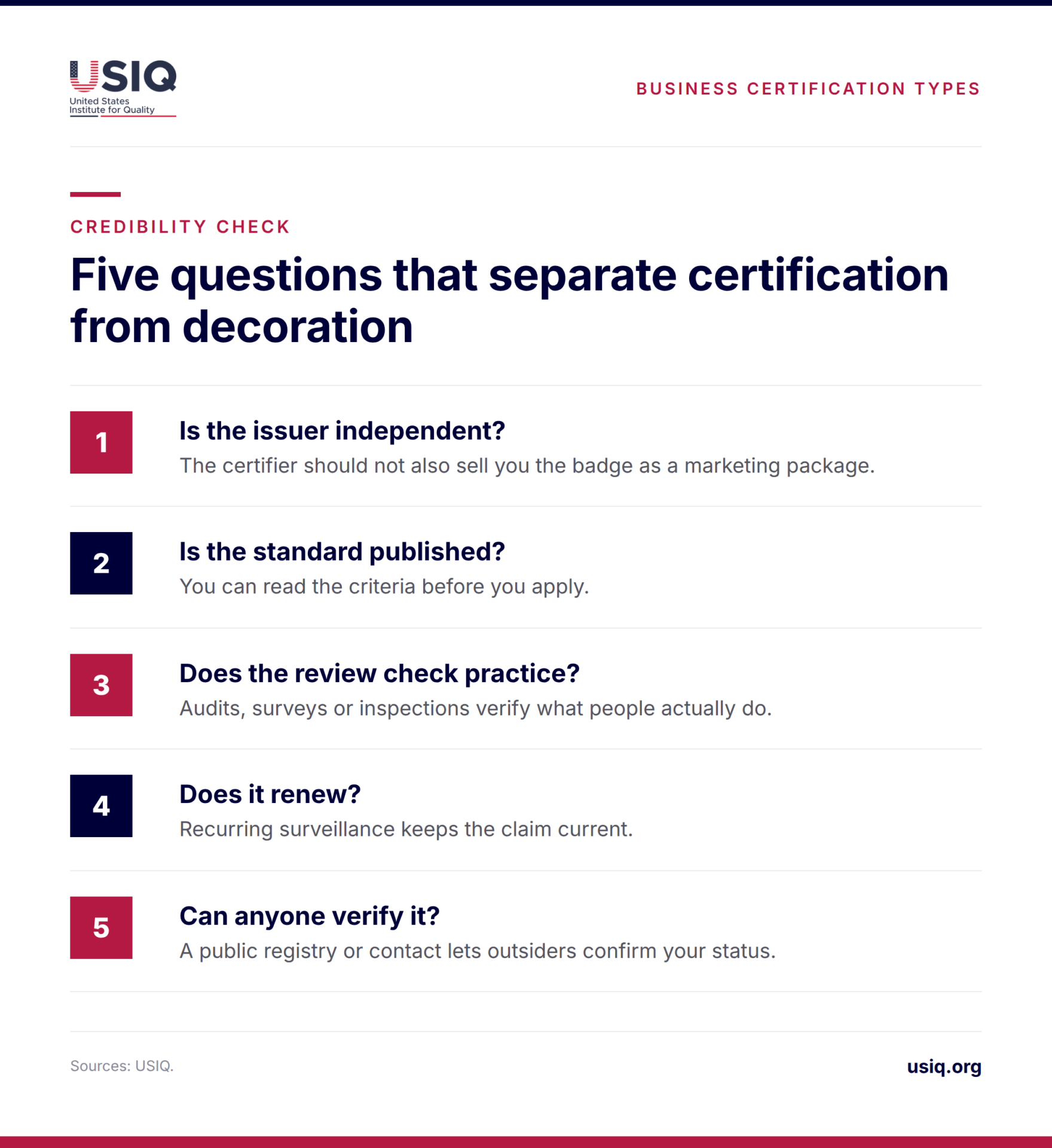
Five questions separate audited certification from decoration:
- Is the issuer independent? The body that certifies you should not also sell you the badge as a marketing package.
- Is the standard published? You should be able to read the criteria before you apply.
- Does the review check practice? Policies on paper are not enough. Look for verification of what people actually do, such as audits, surveys or inspections.
- Does it renew? A one-time award ages quickly. Recurring surveillance or renewal keeps the claim current.
- Can anyone verify it? A public registry or a verification contact lets customers and applicants confirm your status.
- Name the standard, the issuer, the scope and the date.
- Link to the verification page where one exists.
- Do not describe the whole company as certified if only one site, product or service is covered.
- Remove the seal when the certification lapses.
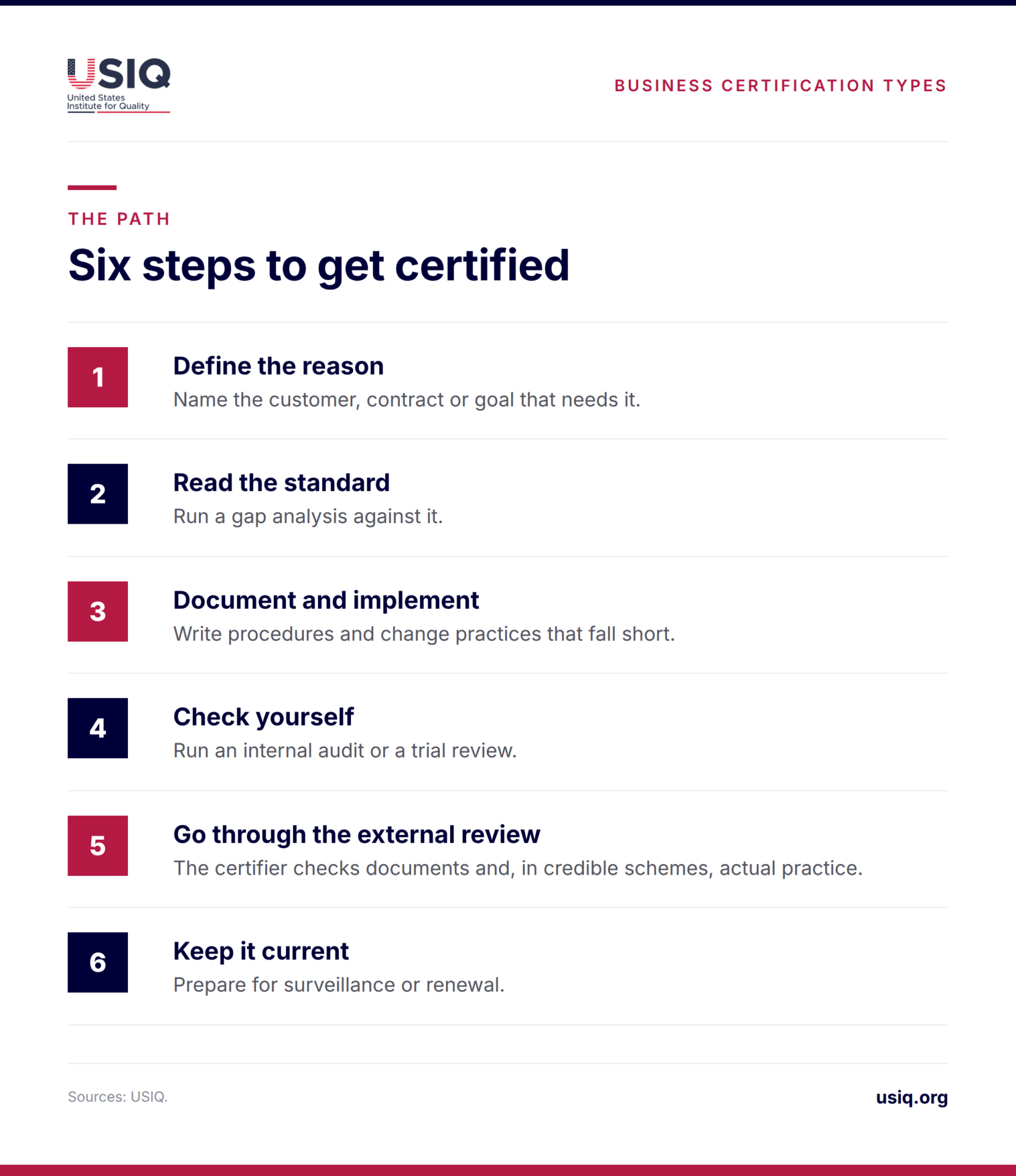
- Define the reason. Name the customer, contract or goal that needs the certification.
- Read the standard. Run a gap analysis against it.
- Document and implement. Write procedures and change practices where they fall short.
- Check yourself. Run an internal audit or a trial review.
- Go through the external review. The certifier checks documents and, in credible schemes, actual practice.
- Keep it current. Prepare for surveillance or renewal.
- “A DBA certificate lets me operate.” It does not. The Sudbury Town Clerk states that it is not a license to do business.
- “Every employer needs an employer certification.” No law requires one. It is a voluntary choice.
- “A seal proves quality.” A seal proves only what the underlying certification checked.
- “Training certificates show a well-run company.” They show that individuals completed courses.
- “More badges mean more trust.” A page crowded with unfamiliar logos can lower clarity. Show the few that your audience understands or can verify.
- Confirm your legal basics first: registration under your state and local rules, plus any license or permit your activity requires.
- List the certifications that customers, contracts or regulators have already requested.
- Check any candidate scheme against the five credibility questions before paying for it.
- Request a written quote covering the first audit and every recurring year.
- Publish a short explanation next to any seal: standard, issuer, scope, date and a verification link.
- Town of Sudbury, MA, Town Clerk: “What is a Business Certificate (DBA) and Who Must File?” Updated July 30, 2025. https://sudbury.ma.us/clerk/faq/what-is-a-business-certificate-and-who-must-file/
- Gallup: “Confidence in U.S. Institutions Remains Near All-Time Low.” 2025. https://news.gallup.com/poll/712436/confidence-institutions-remains-near-time-low.aspx
- Federal Trade Commission: “FTC Sends Warning Letters about Green Certification Seals.” https://www.ftc.gov/node/44708
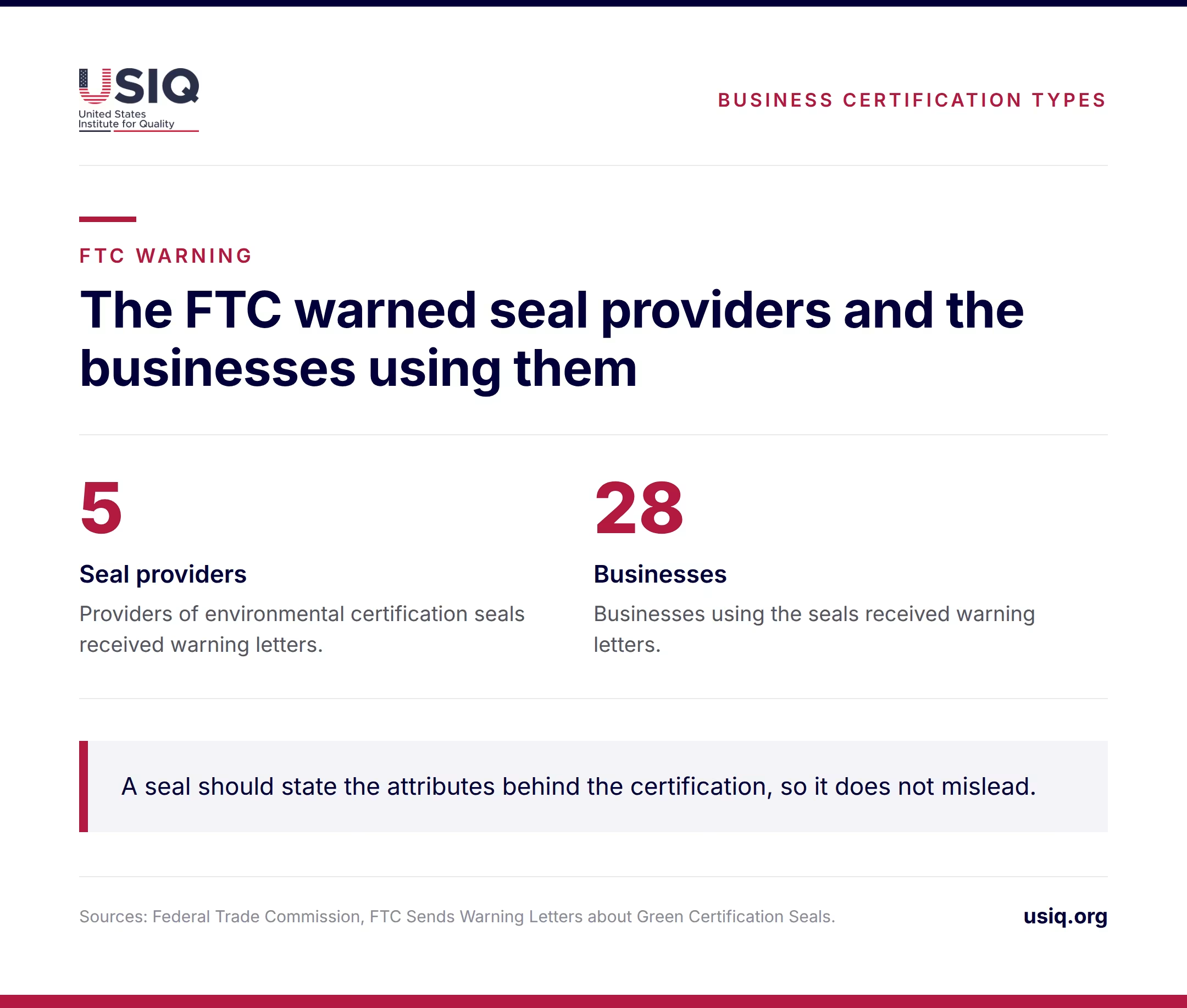
The FTC has treated this problem seriously. Its staff sent warning letters to five providers of environmental certification seals and to 28 businesses using them, because seals can convey more than the marketer intends and mislead consumers. The FTC says a seal avoids deception when it states the attributes behind the certification, in line with its Green Guides. It took no law-enforcement action at that time.
The example is environmental, but the lesson applies to any seal. A badge should say what was certified, and by whom. Our overview of seals of approval and how they work covers the mechanics.
How should you display and use your certificate?
Put it where the decision happens: the careers page, the proposal template, the email signature, the reception area. Many viewers do not know what a standard means, so add one sentence that explains it.
Accuracy rules apply as much as design rules:
These rules follow from the FTC’s concern that a seal should state the attributes behind it. For design and placement ideas, see how to display your business certificates for maximum impact.
What are the steps to get certified?
The exact sequence depends on the scheme, but most audited certifications follow the same path:
A failed first review is not a dead end. The findings show where processes are unclear or too slow, and a company can fix those points and apply again. The feedback often has more lasting value than the certificate itself.
What are common misconceptions about business certificates?
Where is the use of business certificates heading?
Low trust in large institutions, as Gallup’s data shows, pushes buyers and applicants toward claims they can check. Expect more verification pages, more questions about scope and more scrutiny of seals that cannot be traced to an audit. Companies that treat certification as a documented, renewable practice will fit that pattern better than companies that collect logos.
What should small and mid-sized employers do next?
Conclusion
The term “business certificate” hides several different documents, and only one family, audited third-party certification, offers independent proof of how a company works. Pick a certification because someone you want to win over asks for it, make sure it can be verified, and describe it exactly as far as it reaches.
FAQ
Is a business certificate the same as a business license?
No. A business certificate in the DBA sense is a registration of a business name and its owners. A license is government permission to perform a regulated activity. The Town of Sudbury, Massachusetts, states that a business certificate is not a license to do business and that other licenses or permits may be required.
Who has to file a business certificate in Massachusetts?
A person or business operating under a name other than the complete real name of the owner must file with the Town Clerk in each city or town where the business is situated. A corporation using its true corporate name is among the exemptions. The legal basis is Massachusetts General Laws, Chapter 110, Sections 5 and 6.
Are business certifications legally required?
Registrations, licenses and permits are required where state or local law says so. Voluntary certifications, such as management-system standards or employer certifications, are not required by law. They become a requirement only through a customer contract, a supplier questionnaire or a program you want to join.
What is the difference between a seal and a certificate?
A seal is the emblem a company displays on its website, bids or job posts. The certificate is the document behind it, naming the issuer, the standard, the scope and the date. A seal is only as reliable as the certification it points to, so it should state what was certified.
How can I tell whether a certification is credible?
Check for an independent issuer, a published standard, verification of actual practice, recurring renewal and a way for outsiders to confirm your status. If a mark can be bought without any review, it proves nothing about your practices. The FTC has warned seal providers and businesses about seals that mislead.
Can I say my whole company is certified?
Only if the certification covers the whole company. If one site, product or service was assessed, say so and name the scope. The FTC’s guidance on certification seals points the same way: a seal should state the attributes behind the certification so that it does not suggest more than was checked.
Is a training certificate a business certification?
No. A training certificate shows that an individual completed a course or passed an assessment. A business certification applies to an organization and checks how it operates against a standard. Staff training can support a certification, but individual certificates alone do not show that a company’s systems meet one.
Sources

Related Articles
What research says about the effects of employer seals on current employees, potential applicants and employer image, from independent experiments and field data to the limits of the evidence.
Employee experience and customer experience are linked, but the link is weaker and more conditional than popular slogans suggest. This article reviews the evidence on staffing, training and workplace conditions and shows how employers can test the connection in their own business.
Most HR dashboards show too many metrics and trigger too few decisions. This guide defines ten employee experience metrics, shows a one-page layout and explains how to read your numbers against U.S. data.
A practical guide to calculating marketing ROI for small and mid-sized U.S. companies, including long B2B sales cycles, offline leads, a spreadsheet walkthrough and common errors.