
A seal of approval is a small mark with a big job. It tells a customer, a job seeker or a business partner that someone other than the company itself has looked at a claim and found it acceptable. For owners and HR leaders of companies with 10 to 250 employees, the practical question is whether to earn or display one, and how to tell a meaningful seal from a decorative badge.
Dictionaries mostly treat the phrase figuratively. Merriam-Webster defines a seal of approval as an action or statement showing approval or official acceptance. In business, the phrase has a narrower and more useful meaning: a mark awarded by a third party after an organization, product or service met stated criteria.
This article explains how a seal works, what the evidence shows, how to vet an issuer, and what U.S. advertising rules say about displaying one. It is written for decision makers who have to judge a seal as a buyer.
Quick answer: A seal of approval is a mark from an outside party stating that a product, company or employer met defined criteria. It works by reducing uncertainty for buyers and applicants who cannot check quality themselves. It helps only if the issuer is independent, the criteria are public and the claim matches daily reality.
Key takeaways
- “Seal of approval,” “quality seal” and “quality label” are used almost interchangeably for a third-party mark of verified criteria.
- Seals work by reducing information asymmetry, the gap between what a seller knows and what a buyer can check.
- The strongest causal evidence comes from online retail, where a randomized field experiment found that a third-party seal raised purchase conversion. It is not evidence about employer seals.
- Credibility depends on independence, public criteria, real audits or data, renewal and a way to verify the seal.
- Under the FTC Endorsement Guides, a seal counts as an endorsement, and the advertiser can be liable for what it implies. Paying a reasonable fee is not automatically deceptive.
- A seal does not replace good practice. If daily work does not match the claim, the seal becomes a liability.
What is a seal of approval and which types exist?
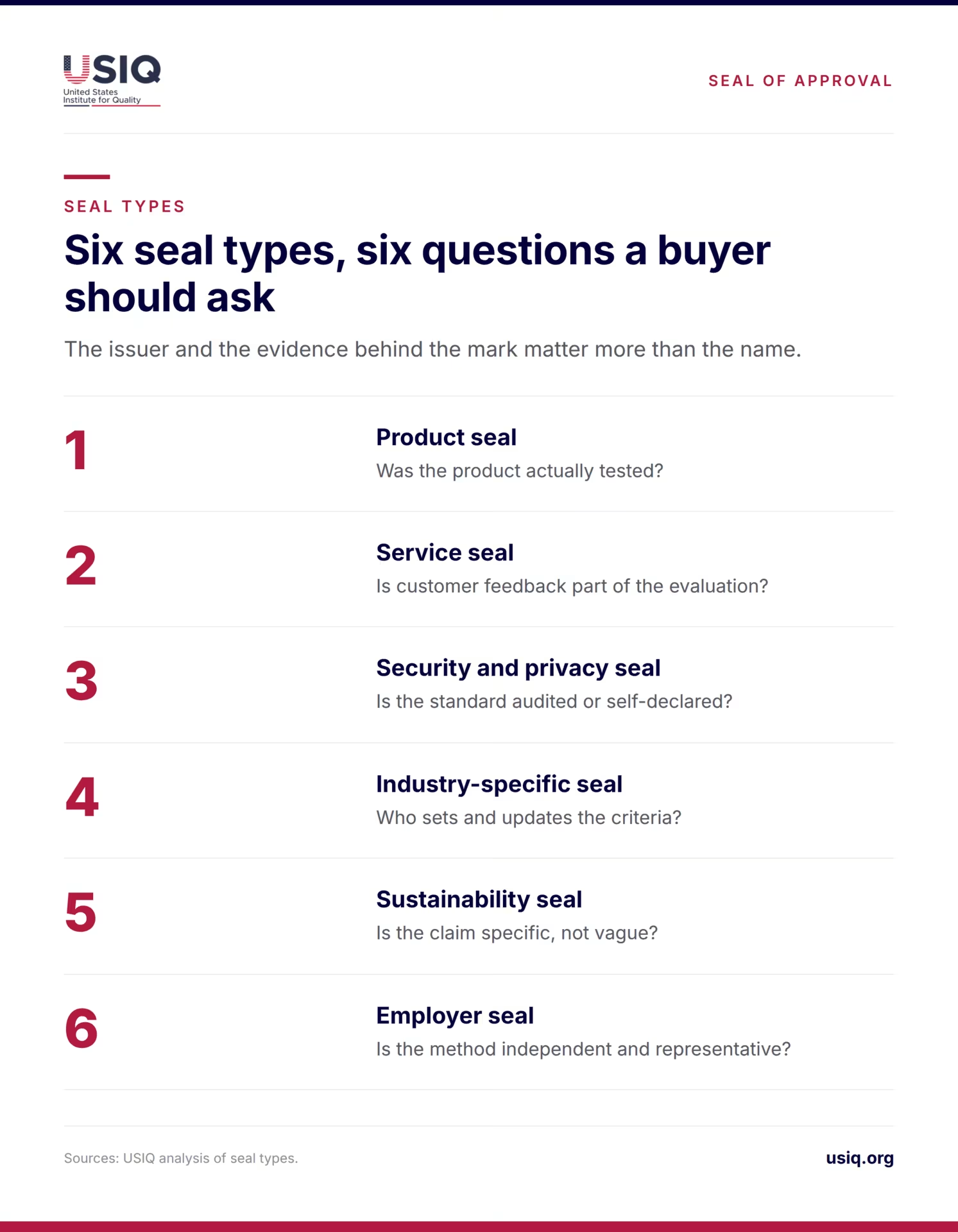
A seal of approval is a word or picture mark, awarded by a third party, that attests a product, service, company or employer met stated criteria. It is an extrinsic quality signal: information that sits outside the offer itself and helps someone judge qualities they cannot easily observe. The issuer may be an industry body, a certifier, a publisher or a testing organization.
The terms overlap. Quality seal, quality label, certification mark and seal of approval all describe the same basic idea. The differences that matter are who issues the mark and what was checked before it was awarded.
| Seal type | What it signals | Typical audience | Key question for a buyer |
|---|---|---|---|
| Product seal | An item meets quality, safety or performance criteria | Customers, retailers | Was the product actually tested? |
| Service seal | Service quality is consistent and measured | Customers, B2B buyers | Is customer feedback part of the evaluation? |
| Security and privacy seal | Data handling and transactions meet a standard | Online shoppers | Is the standard audited or self-declared? |
| Industry-specific seal | Compliance with sector expectations | Regulated or technical sectors | Who sets and updates the criteria? |
| Sustainability seal | Environmental or social practices | Customers, investors | Is the claim specific, not vague? |
| Employer seal | Workplace quality, usually from employee feedback and HR information | Job seekers, employees | Is the method independent and representative? |
USIQ, the publisher of this article, runs certification programs of this kind, including employer and customer service programs. The vetting questions below apply to USIQ as much as to any other issuer.
How does a seal of approval work?
The mechanism is old and well understood in economics. George Akerlof’s 1970 article “The Market for ‘Lemons'” showed that when buyers cannot judge quality before they buy, trust erodes and good sellers struggle to be recognized. Michael Spence’s signaling theory (1973) described the remedy: a credible signal lets a seller with real quality separate itself from the rest.
A seal is such a signal. A job seeker cannot inspect a company’s culture before applying, just as a shopper cannot inspect a retailer’s reliability before clicking “buy.” An independent mark gives both a quick, outside reference point.
What does the evidence show?
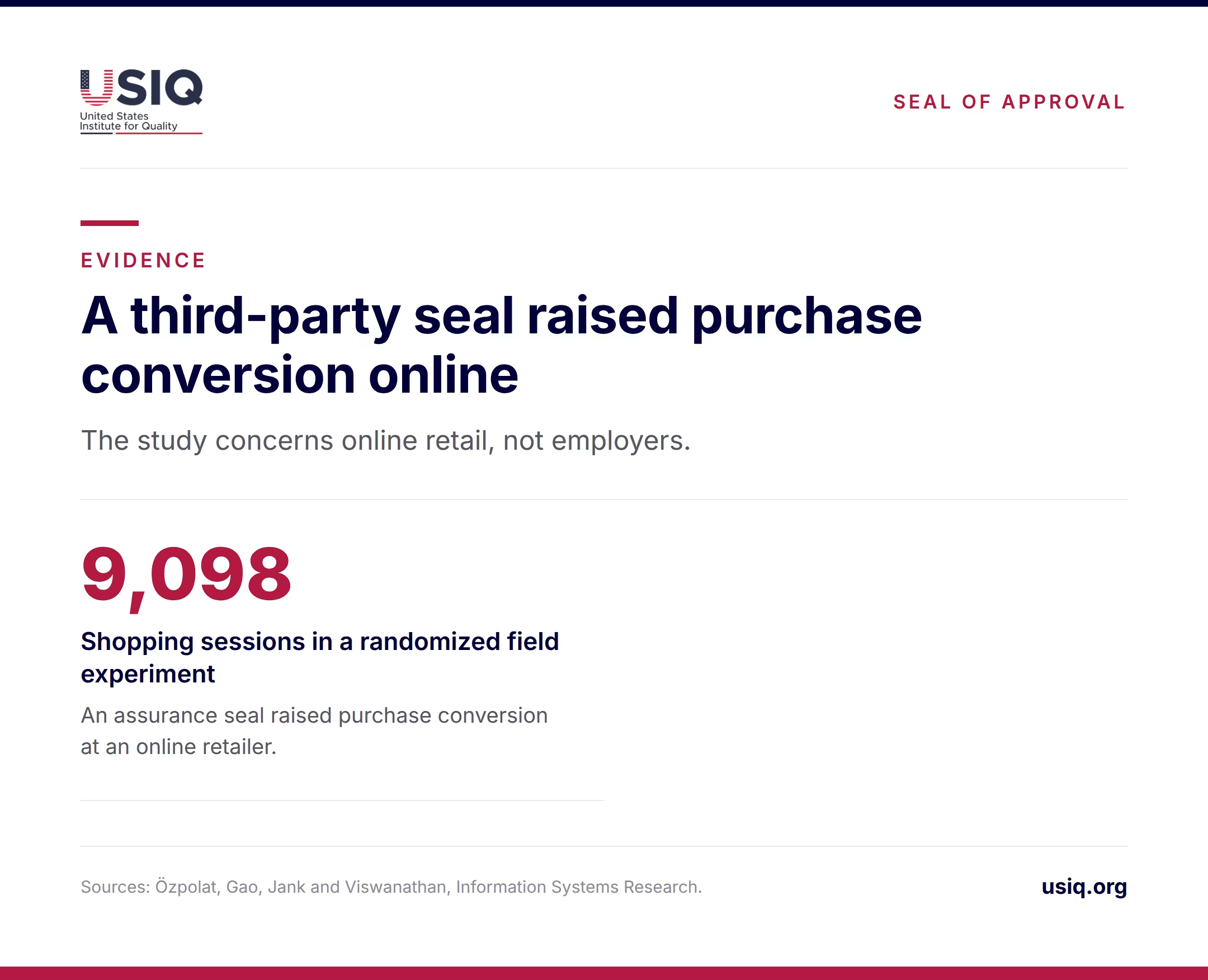
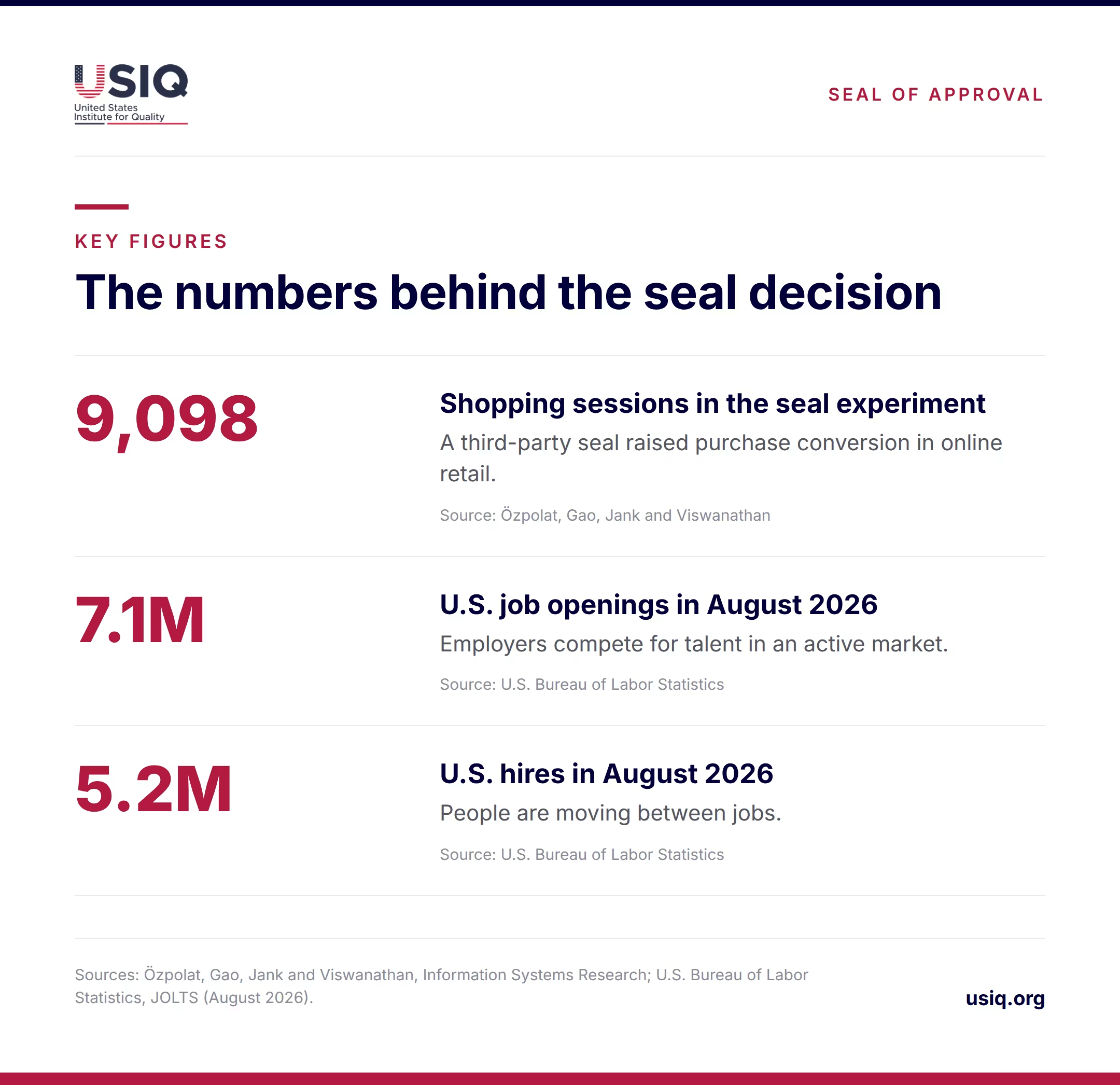
The cleanest evidence comes from online shopping. In a randomized field experiment covering 9,098 shopping sessions at an online retailer, Özpolat, Gao, Jank and Viswanathan found strong evidence that the presence of a third-party assurance seal raises purchase conversion, and that seals reduce the uncertainty shoppers feel. The study concerns online retail, not employers, so it does not prove that every seal works everywhere.
What makes one seal work better than another?
Researchers on quality labels commonly point to three factors. Each is a reasonable working assumption for a buyer to test.
- Awareness: a seal the audience already recognizes carries more weight than an unknown one.
- Credibility of the issuer: independence and expertise matter more than design or branding.
- Prior attitude: people who have had good experiences with seals tend to trust them more, and skeptics trust them less.
A smaller company cannot buy awareness overnight, but it can pick an issuer whose criteria stand up to scrutiny. Credibility is the factor an employer controls.
Do employer seals attract applicants?
Employer seals are younger and less studied than product seals, so firm effect sizes are scarce. A seal is one input into recruiting, not a guarantee, and stated interest in a job is not the same as an application or a hire.
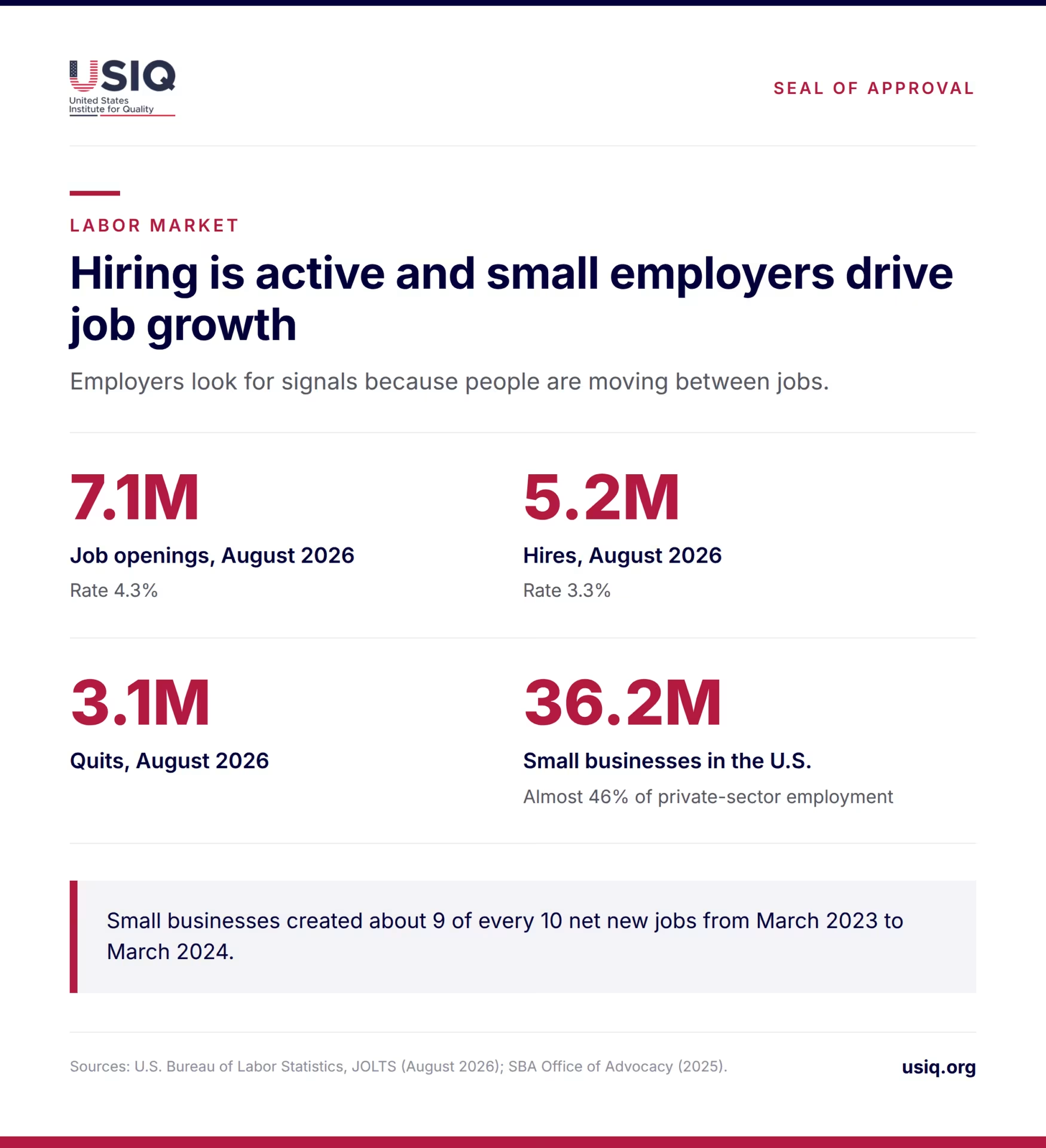
The labor market context explains why employers look for signals at all. The U.S. Bureau of Labor Statistics reported 7.1 million job openings (rate 4.3%) and 5.2 million hires (rate 3.3%) for August 2026, along with 5.1 million total separations and 3.1 million quits. Hiring is active, and people are moving between jobs.
Small employers are central to that picture. The SBA Office of Advocacy counts 36.2 million small businesses in the U.S., almost 46% of private-sector employment, and reports that from March 2023 to March 2024 small businesses created about 9 of every 10 net new jobs. Its focus group is businesses with fewer than 500 employees, so a company with 10 to 250 employees competes for talent with many peers of similar size.
When might a seal matter most?
Research on applicant decisions suggests that early in the process, people lean on general impressions and quick signals. If that holds, a seal may matter most at the first look at a job ad, and most for employers whose names applicants do not yet know. This is a hypothesis, and an employer can test it in its own data.
What are the limits?
Many employer seals rest on surveys and subjective ratings that may not reflect actual conditions. A seal can lift an employer’s image for a while, but new hires judge the company by what they experience in the first weeks. If pay, scheduling or management practice contradicts the claim, the seal becomes a façade and can invite backlash. Evidence on employer seals is also thinner than for online shopping seals, and results across studies are not uniform.
For more on this topic, see the guide to employer seals and the explainer on employer certification standards, process and ROI.
How can you tell a credible seal from a pay-to-play badge?
A fee alone does not make a seal worthless. Evaluations cost money to run, and the FTC’s own guidance recognizes that consumers expect certifications to be paid for. What matters is whether the fee buys an honest evaluation or simply buys the badge.
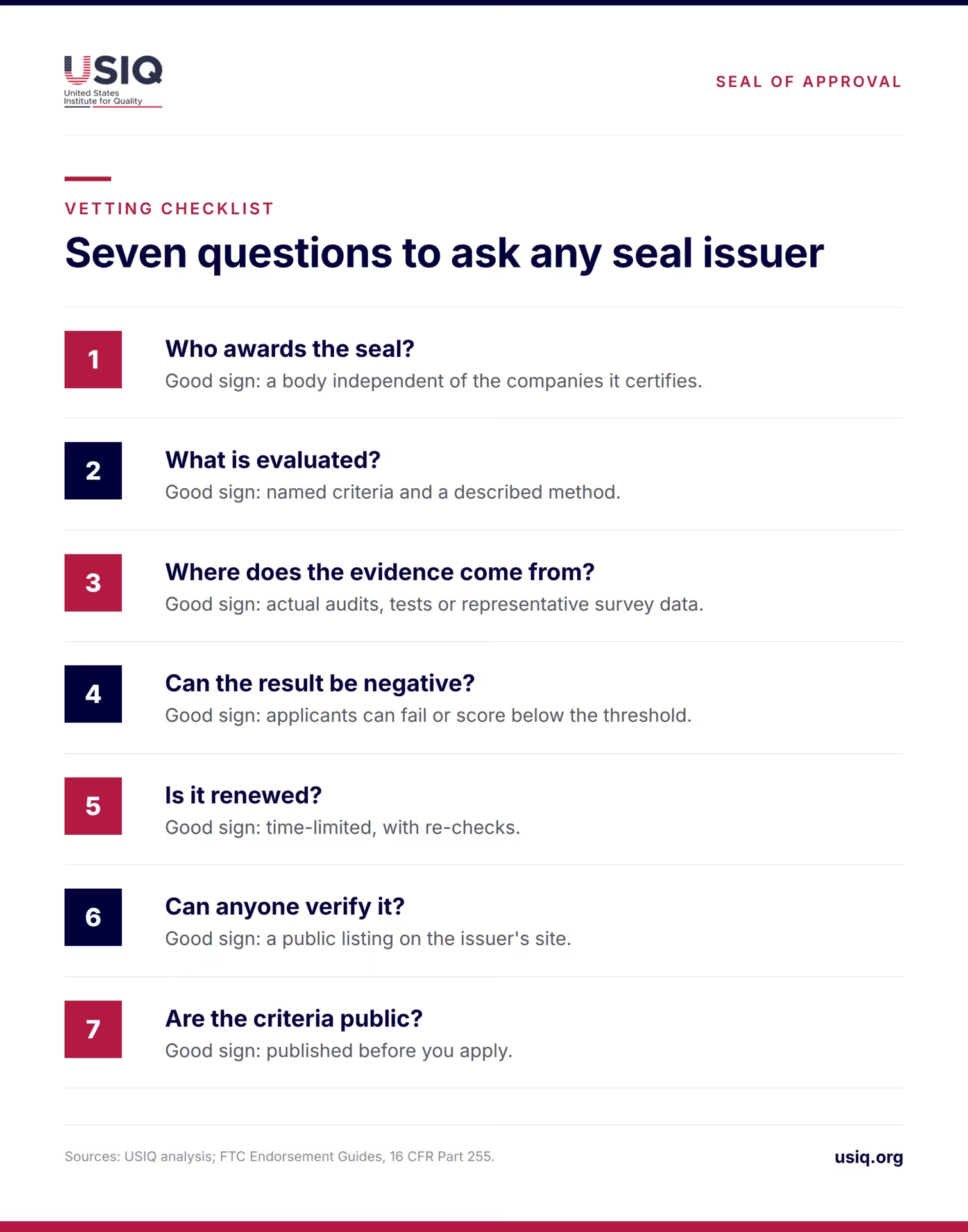
| Question to ask the issuer | Good sign | Warning sign |
|---|---|---|
| Who awards the seal? | A body independent of the companies it certifies | The issuer is owned or run by a participant, or is not identifiable |
| What is evaluated? | Named criteria and a described method | Vague “excellence” language |
| Where does the evidence come from? | Actual audits, tests or representative survey data | Self-assessment only |
| Can the result be negative? | Applicants can fail or score below the threshold | Payment practically guarantees the badge |
| Is it renewed? | Time-limited, with re-checks | One-time purchase, no expiry |
| Can anyone verify it? | A public listing on the issuer’s site | No way to confirm a holder |
| Are the criteria public? | Published before you apply | Shared only after payment |
The FTC Endorsement Guides supply a useful benchmark. In one example, an “American Institute of Science” approval would be deceptive if the institute is not a bona fide independent testing organization, for instance because the manufacturer set it up and runs it. Even a genuinely independent body must have actually tested the product, and the results must support the claim.
What does a seal cost and what does it return?
Costs fall into four groups: the issuer’s fee, internal staff time, any survey or audit effort, and the ongoing work of keeping the seal through annual re-checks. Fees and effort vary widely by issuer and company size, so ask for the full cost in writing before applying.
A reliable return figure for employer seals does not exist, and employers should be wary of anyone who quotes one. Measure your own results instead. Record applications per opening, offer acceptance rate and time to fill for a few months before the seal and for a comparable period after, and note any other changes in the same window, such as pay adjustments or new job-ad channels. The guide on employer certification and ROI covers measurement in more depth.
If a company is not ready, preparation is still productive. List the gaps against the issuer’s criteria, get outside help where in-house knowledge is thin, and give the work enough time. Applying too early risks delays or rejection and wastes staff time.
What do U.S. rules say about displaying a seal?
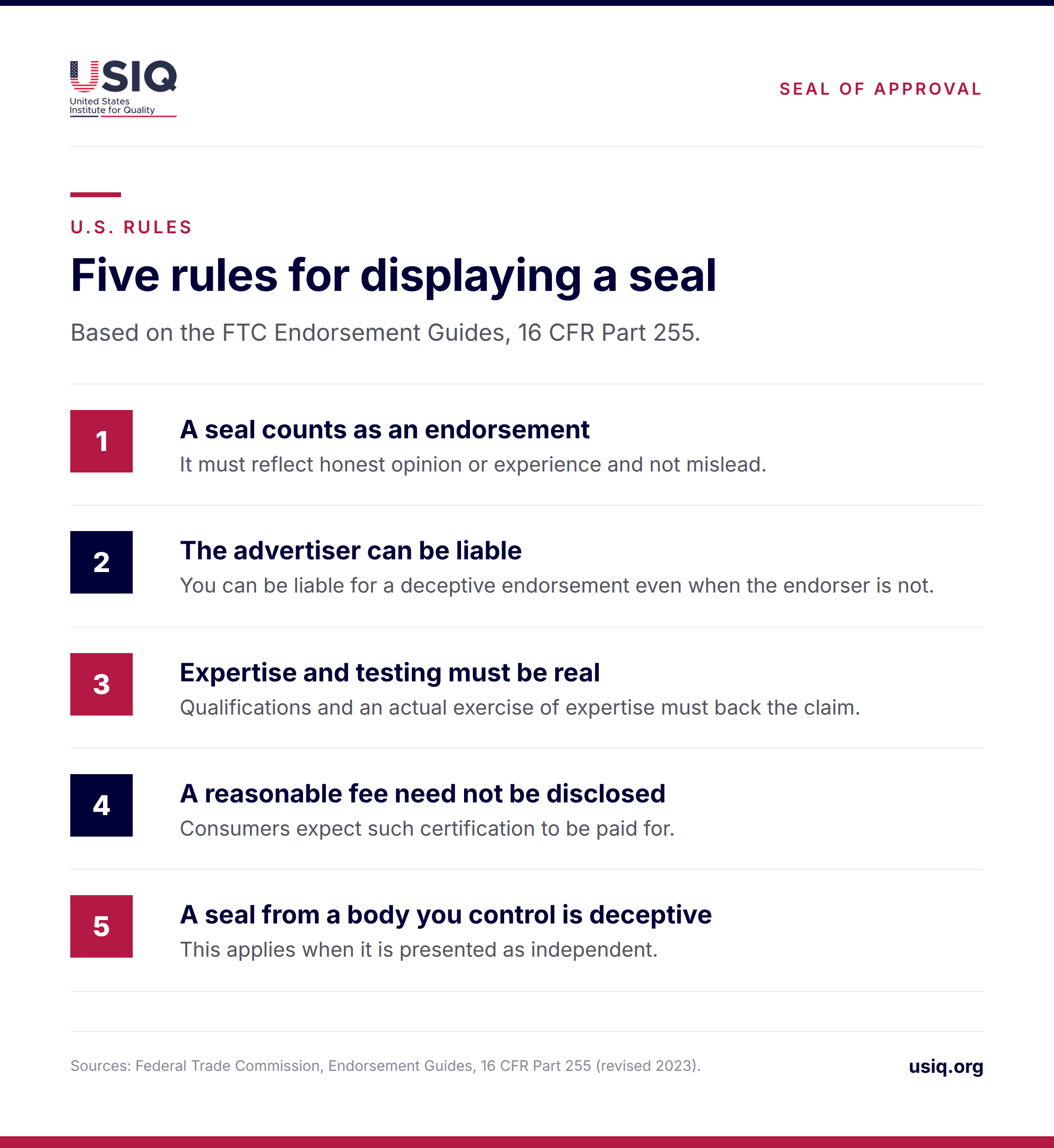
The FTC’s Endorsement Guides (16 CFR Part 255, revised in 2023) treat “the name or seal of an organization” as a possible endorsement. Several consequences follow for an employer that displays one.
- An endorsement must reflect the honest opinion or experience of the endorser and may not convey a representation that would be deceptive if the advertiser made it directly (§255.1).
- When an endorser is presented as an expert, its qualifications must give it the expertise it claims, and the endorsement must rest on an actual exercise of that expertise (§255.3).
- An advertiser can be liable for a deceptive endorsement even when the endorser is not. Advertisers should guide endorsers, monitor compliance and act to remedy non-compliance.
- In the FTC’s example, a paper company paid a non-profit association a reasonable fee for a product-and-process evaluation. Consumers would reasonably expect such certification to be paid for, so the fee does not have to be disclosed.
- A seal from a body the advertiser created or controls, presented as independent, is deceptive.
Separately, on August 14, 2024, the FTC announced a final rule banning fake reviews and testimonials, with civil penalties available against knowing violators. Among other things, it bars a business from misrepresenting that a website or entity it controls gives independent reviews or opinions about a category that includes its own products or services. The rule targets reviews and testimonials, and employers should not assume it settles questions about employer seals either way.
A seal is not a legal defense and does not prove compliance with any law. Describe it accurately, state what it covers and when it was awarded, and ask counsel to review marketing claims that go beyond the seal’s actual scope.
How do you earn and use a seal well?
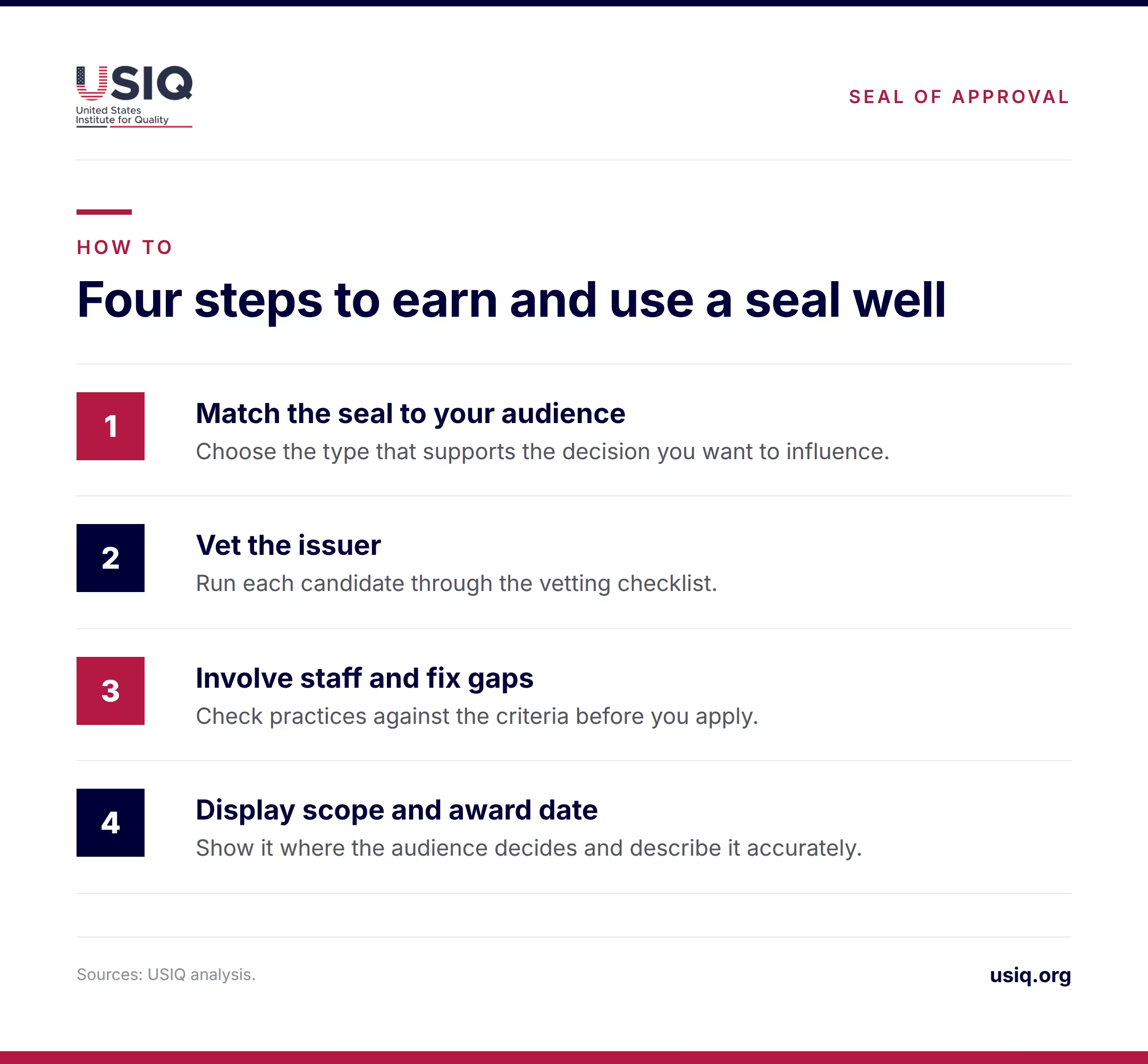
Start with the audience. A company hiring technicians needs a different signal than one selling services to other businesses. Match the seal type to the decision you want to influence, then run the issuer through the vetting table above.
Four common mistakes are worth avoiding.
- Skipping the research: criteria differ, and a seal you barely qualify for or that your audience ignores wastes money.
- Underestimating the commitment: keeping a seal usually means ongoing maintenance and regular re-checks.
- Rushing the application: check your practices against the criteria first.
- Leaving staff out: employees should know the standards, especially when their feedback feeds the evaluation. See the explainer on employee surveys and employer trust.
Once earned, display the seal where the audience decides: job ads, career pages and proposals. Name the scope and award date, and link to the issuer’s verification page if one exists. For placement ideas, read how to display business certificates. Employers weighing an employer certification can also look at the USIQ Top Employer program and judge it with the same vetting table as any other issuer.
What do people get wrong about seals?
“Any seal builds trust.” Trust attaches to the issuer, not the artwork. An unknown or unverifiable badge can raise doubts instead.
“Paying means it is fake.” Not necessarily. A reasonable fee for a real evaluation is normal. The problem is a fee that substitutes for the evaluation.
“A seal protects us legally.” It does not. Advertisers remain responsible for what a seal implies in their marketing.
“Online conversion studies prove employer seals work.” They show that a third-party seal can reduce uncertainty in online shopping. Employer decisions differ, which is why employer-specific evidence matters.
What should a small or mid-sized employer do next?
- Define the decision the seal should support, such as more applications or easier vendor approval.
- Shortlist two or three issuers and run each through the vetting table.
- Request the total cost, the criteria and the renewal terms in writing.
- Close obvious gaps between your claims and daily practice before applying.
- Set baseline recruiting metrics so the effect can be measured.
- Have counsel review how the seal is used in advertising and job ads.
FAQ
What is the difference between a seal of approval, a certification and an award?
The terms overlap. A seal is the visible mark, a certification is the process and result behind it, and an award usually ranks or selects winners. What matters is the method: published criteria, real evaluation and independence from the company being assessed. Check that behind the name, whatever it is called.
Is a seal of approval legally required?
Generally no. Seals are voluntary marks. Some industries have legal requirements of their own, but a voluntary seal does not replace them. If you display one, FTC endorsement rules apply to how you describe it, so claims must be accurate and supported.
Can a seal of approval be a deceptive claim?
Yes. Under the FTC Endorsement Guides, an approval from a body that is not truly independent, such as one set up and run by the manufacturer, is deceptive. Even an independent body must actually have tested the product, and the results must support the claim. Advertisers can be liable for what a seal implies.
Does paying for a seal make it a deceptive endorsement?
Not automatically. In its example of a paper company that paid a non-profit association a reasonable fee for an evaluation, the FTC said consumers would expect such certification to be paid for, so the fee need not be disclosed. A relationship consumers would not expect, such as controlling the issuer, is a different matter.
Do employer seals actually increase applications?
No reliable figure exists yet. The controlled evidence comes mostly from online retail, where a randomized experiment found that a third-party seal raised purchase conversion. Employer seals are less studied, and stated interest in a job is not an application. Track applications, offer acceptance and time to fill in your own company before and after a seal.
Does a seal improve search engine rankings?
There is no reliable evidence that a seal on its own raises rankings, so it should not be bought for that reason. Its realistic value lies with people: customers, applicants and partners who see it and judge your organization more confidently or more skeptically.
How do I check whether a seal is genuine?
Look the issuer up independently, read its published criteria, and confirm the holder appears in the issuer’s own public listing. Ask what was audited, whether the seal expires, and whether companies can fail. If none of these answers are available, treat the seal as marketing, not verification.
Which seal fits a company with 10 to 250 employees?
Pick the seal that matches the audience you need to convince. Hiring pressure points to an employer seal, customer retention to a customer service seal. Then compare issuers on independence, criteria, cost and renewal. The two types answer different questions, so one does not substitute for the other.
Sources
- SEAL OF APPROVAL Definition & Meaning, Merriam-Webster: https://www.merriam-webster.com/dictionary/seal%20of%20approval
- 16 CFR Part 255, Guides Concerning the Use of Endorsements and Testimonials in Advertising (revised 2023, 88 FR 48102, July 26, 2023), eCFR, U.S. Government, current as of 6/09/2026: https://www.ecfr.gov/current/title-16/chapter-I/subchapter-B/part-255
- FTC Announces Final Rule Banning Fake Reviews and Testimonials, Federal Trade Commission, August 14, 2024: https://www.ftc.gov/news-events/news/press-releases/2024/08/federal-trade-commission-announces-final-rule-banning-fake-reviews-testimonials
- The value of third-party assurance seals in online retailing: An empirical investigation (Özpolat, Gao, Jank, Viswanathan), Information Systems Research, vol. 24, pp. 1100-1111, University of Rhode Island Digital Commons / INFORMS: https://digitalcommons.uri.edu/cba_facpubs/326/
- Job Openings and Labor Turnover, August 2026, U.S. Bureau of Labor Statistics: https://www.bls.gov/news.release/jolts.nr0.htm
- New Advocacy Report Shows the Number of Small Businesses in the U.S. Exceeds 36 Million, SBA Office of Advocacy, June 30, 2025: https://advocacy.sba.gov/2025/06/30/new-advocacy-report-shows-the-number-of-small-businesses-in-the-u-s-exceeds-36-million/
- Akerlof, G. A., “The Market for ‘Lemons’: Quality Uncertainty and the Market Mechanism,” Quarterly Journal of Economics 84(3), 1970.

Related Articles
What research says about the effects of employer seals on current employees, potential applicants and employer image, from independent experiments and field data to the limits of the evidence.
Employee experience and customer experience are linked, but the link is weaker and more conditional than popular slogans suggest. This article reviews the evidence on staffing, training and workplace conditions and shows how employers can test the connection in their own business.
Most HR dashboards show too many metrics and trigger too few decisions. This guide defines ten employee experience metrics, shows a one-page layout and explains how to read your numbers against U.S. data.
A practical guide to calculating marketing ROI for small and mid-sized U.S. companies, including long B2B sales cycles, offline leads, a spreadsheet walkthrough and common errors.