

Inflation, energy costs, tariffs and recession worries have made planning harder for owners of small and mid-sized companies. Most of them have no large HR department, so the way managers talk to staff and make decisions carries a lot of weight.
Leading through uncertainty is less about heroic strategy and more about habits: telling people what you know, protecting the people who hold the business together, and cutting costs in a deliberate order. This article collects current U.S. figures and turns them into decision rules and a 90-day plan.
Quick answer: Leading through uncertainty means keeping communication, decisions and people practices steady while the outlook is unclear. Equip managers first, share updates on a fixed rhythm, watch retention and survey signals, and cut costs in steps before considering layoffs. Check federal and state notice rules before any restructuring.
Key takeaways
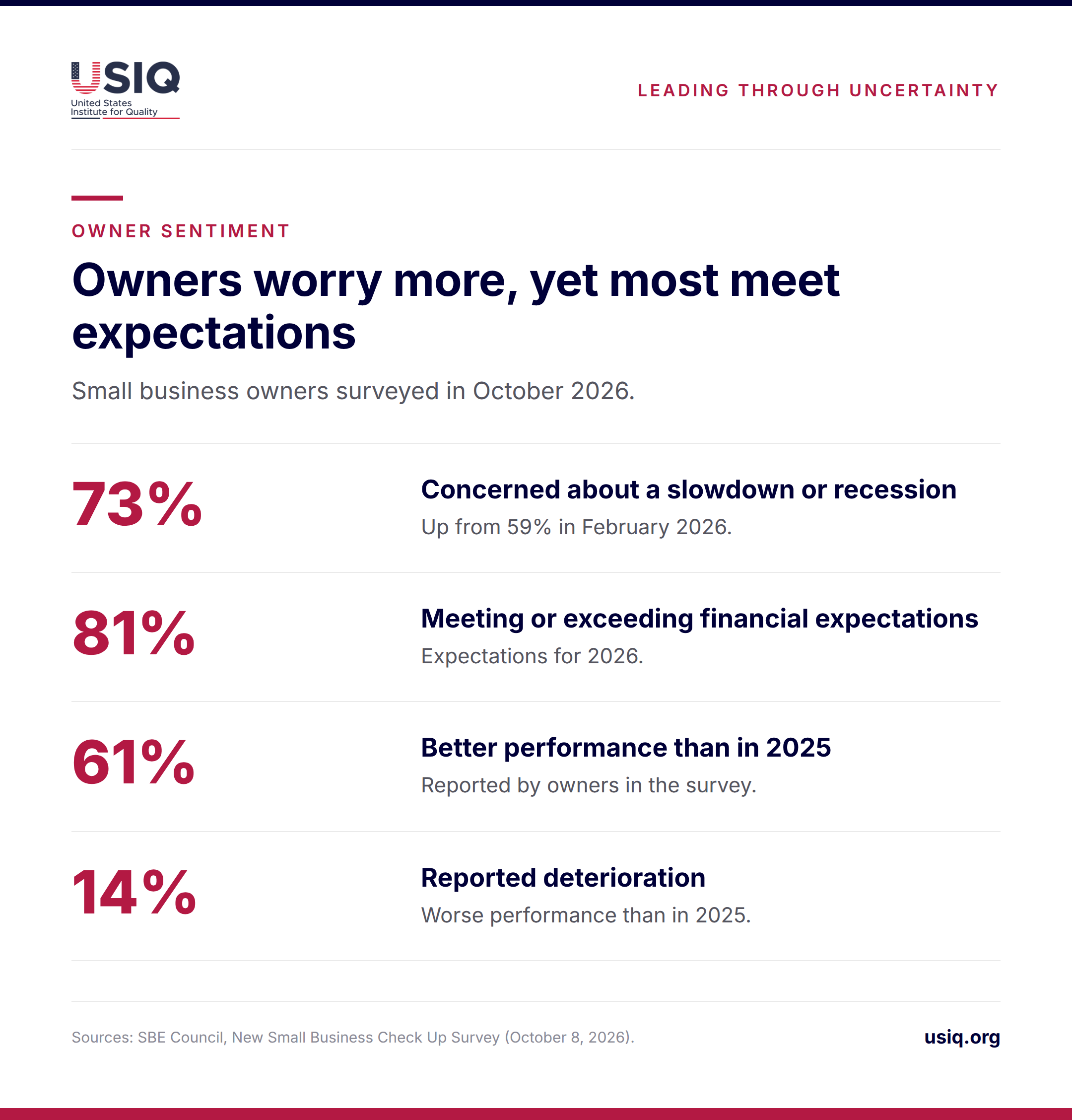
- Worry and performance can diverge: 73% of small business owners worry about a slowdown, yet 81% say they meet or exceed financial expectations.
- Layoffs are still low (1.0% rate in September 2026), so retention is the more common problem than mass job loss.
- Only 29% of U.S. employees are engaged, and managers account for at least 70% of the variance in team engagement.
- Replacing an employee can cost one-half to two times annual salary, so a hiring freeze or hours cut is often cheaper than losing people.
- Survivors of layoffs need training and clear roles; in one vendor survey, only 27% received structured training.
- Federal WARN notice applies to employers with 100 or more employees; smaller firms should check state law and consult employment counsel.
What does leading through uncertainty mean for a small or mid-sized company?
It means keeping decisions, communication and people practices steady when the outlook is unclear. The aim is not to predict the economy. It is to make sure employees know what to expect and that cost decisions do not destroy the capabilities the company needs when conditions improve.
The mood among owners is mixed. In an October 2026 survey by the SBE Council, an advocacy group whose sample is not described on the page, 73% of small business owners were concerned about a slowdown or recession, up from 59% in February. At the same time, 81% said they were meeting or exceeding financial expectations for 2026, 61% reported better performance than in 2025 and 14% reported deterioration.
| Indicator (small business owners, October 2026) | Result |
|---|---|
| Concerned about a slowdown or recession | 73% (59% in February 2026) |
| Meeting or exceeding financial expectations | 81% |
| Top concern: inflation | 39% |
| Gasoline and energy costs | 29% |
| Economic uncertainty | 28% |
| Tariffs | 19% |
| Customer spending fell over six months | 36% (29% rose, 31% unchanged) |
The gap between worry and results is useful to a leader. It argues for preparation without panic: scenarios and early signals rather than sudden cuts.
What do the labor-market numbers say right now?
The U.S. Bureau of Labor Statistics reports preliminary JOLTS figures for September 2026: a quits rate of 2.1%, a layoffs and discharges rate of 1.0%, a hires rate of 3.4%, a total separations rate of 3.3%, and 7,523,000 job openings (a rate of 4.5%). Preliminary numbers are revised later.
Layoffs remain low by these measures, so for most small employers the live question is whether good people stay, not whether large job cuts are coming. That is a reading of the data, not a forecast.
| JOLTS measure, September 2026 (preliminary) | Value |
|---|---|
| Quits rate | 2.1% |
| Layoffs and discharges rate | 1.0% |
| Hires rate | 3.4% |
| Total separations rate | 3.3% |
| Job openings | 7,523,000 (4.5%) |
Why does manager behavior matter most when times are uncertain?
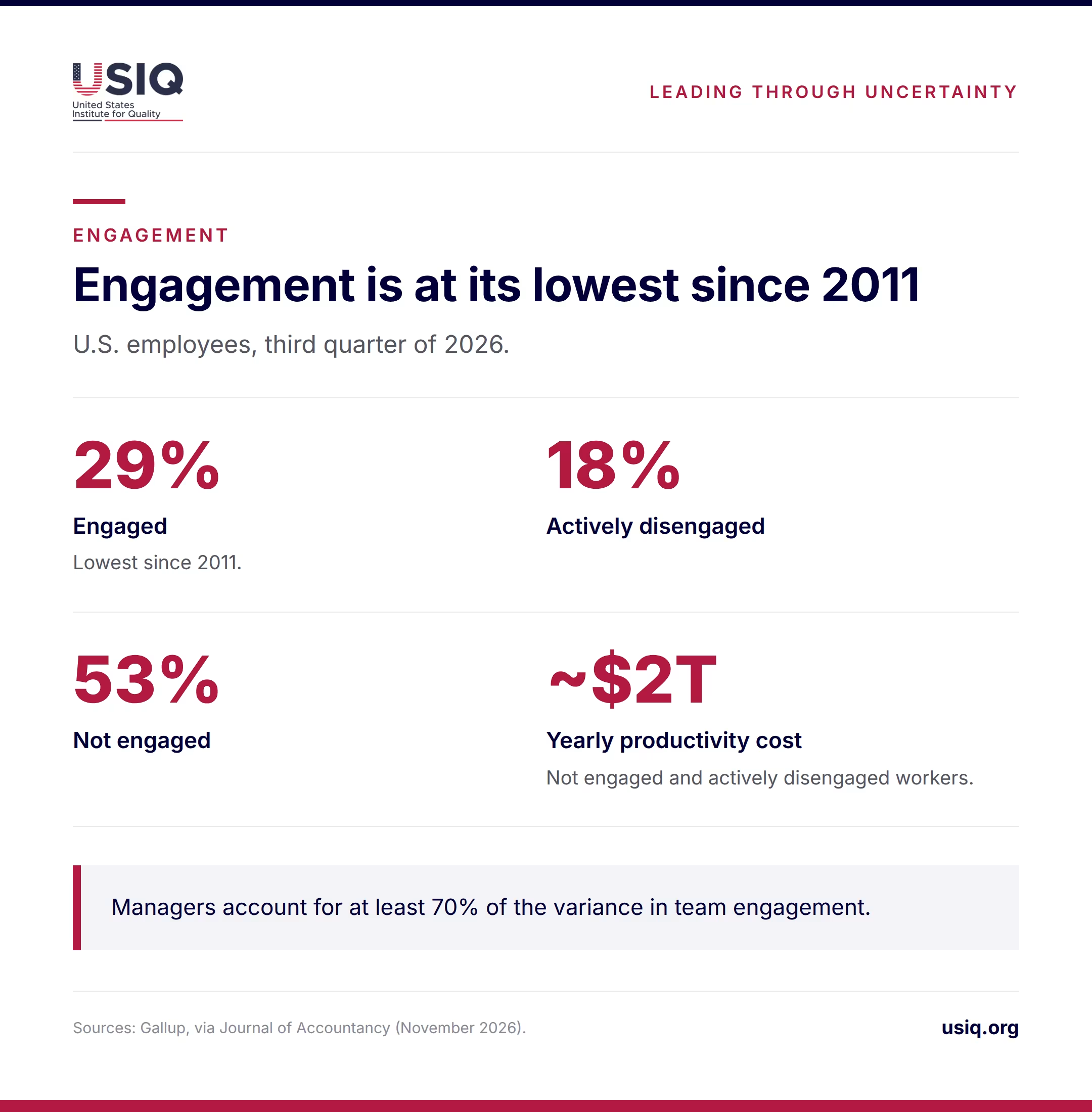
Gallup reports that 29% of U.S. employees were engaged in the third quarter of 2026, down from 31% the previous quarter and the lowest since 2011. Active disengagement rose to 18%, and 53% of employees were not engaged. Gallup estimates that not-engaged and actively disengaged workers cost the U.S. economy about $2 trillion a year in lost productivity.
Manager support is the factor most strongly associated with engagement. Gallup finds that managers account for at least 70% of the variance in team engagement, yet manager engagement fell nine points between 2022 and 2025. Organizations that combined frequent AI use, a clear AI strategy and active manager support reached 53% engagement.
Brief and support your managers before you announce anything. They will field the questions, and an unprepared supervisor can undo a well-written announcement. Related reading on employee engagement covers the day-to-day habits.
How should leaders communicate during uncertainty?
Regularly and in both directions. Gallup found that 51% of exiting employees said neither their manager nor another leader talked with them about job satisfaction or their future in the three months before they left, and 52% of voluntary leavers said their manager or organization could have prevented their departure.
A simple update routine
- Set a fixed rhythm, for example a short all-hands every two weeks, and keep it even when there is little news.
- Structure each update as: what we know, what we do not know, and when we will update again.
- Hold stay interviews with key people: why do you stay, what would make you leave, what would you change?
- Give employees a channel for questions and ideas, and answer visibly.
Use short pulse surveys as an early warning
A pulse survey of four or five questions, repeated every month or quarter, shows trends before resignations do. Useful items: “I know what is expected of me in the coming months,” “My manager talks with me about my future here,” “I trust the information leadership shares,” and “I intend to be working here a year from now.” Watch the direction over time rather than any single score. See also guidance on employee surveys and questions to ask.
How much does losing people cost, and how do you protect retention?
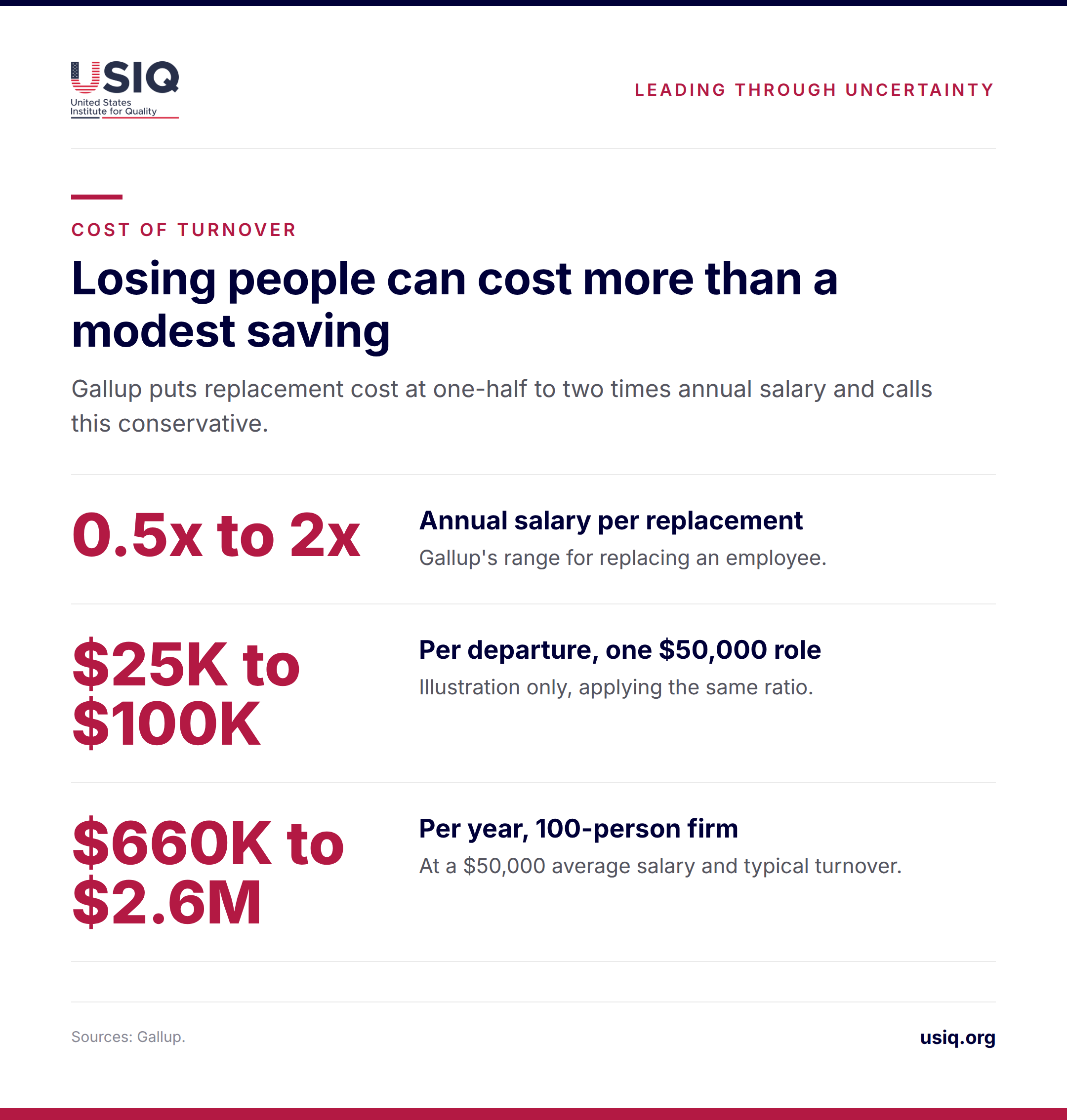
Gallup puts the cost of replacing an employee at one-half to two times annual salary and calls that estimate conservative. For a 100-person firm with a $50,000 average salary, Gallup’s ratio implies roughly $660,000 to $2.6 million a year, which assumes typical turnover across the workforce.
As an illustration only: applying the same ratio to a single $50,000 position gives $25,000 to $100,000 per departure. For a 50-person company, losing even three experienced people in a year can cost more than a modest across-the-board saving.
Retention steps that cost little include regular manager conversations about the future, visible development paths (see upskilling and reskilling), and recognition. Flexible schedules and recognition are options to consider, not proven fixes. Targeted retention pay for critical roles is another tool. SHRM reports HR experts weighing it after layoffs, with a Korn Ferry total rewards leader saying a company “would reasonably” raise pay for remaining employees it sees as part of its future. One expert described extreme salary-band claims as an upper-end ceiling, not a typical range.
How do you cut costs without damaging trust?
Cut in steps, from the least to the most harmful to people, and explain each step. The ladder below is practical advice, not a researched finding; adjust it to your cash position and contracts.
| Step | Action | Main risk |
|---|---|---|
| 1 | Reduce discretionary spending (travel, events, subscriptions) | Low; watch for cuts that hit customers |
| 2 | Freeze hiring and backfills for non-critical roles | Workload creeps up on remaining staff |
| 3 | Reduce hours or pause raises and bonuses, with leaders going first | Pay-related morale and fairness; check wage and contract rules |
| 4 | Layoffs, after legal review | Survivor effects, legal notice duties, brand damage |
Targeted cuts beat across-the-board ones. Protect development, retention and customer-facing work where you can, and avoid panic moves that damage the core of the business. Customer spending fell for 36% of owners in the SBE survey, so keep sales and service roles intact. Owners named social media (28%) and word of mouth (22%) as the most effective ways to find new customers, ahead of paid online ads (8%) and email (5%).
What if layoffs are unavoidable? What does the law require?
The federal WARN Act covers employers with 100 or more employees, not counting those with under six months of service or under 20 hours a week. Covered employers must give at least 60 calendar days’ written notice of a plant closing or mass layoff affecting 50 or more employees at a single site. Exceptions exist for unforeseeable business circumstances, faltering companies and natural disasters, according to the U.S. Department of Labor.
A company with 10 to 99 employees falls below the federal employer threshold, and many larger firms will not reach 50 affected workers at one site. That does not settle the question: state laws may differ, so check your state labor department. Severance terms, selection criteria and final-pay rules also carry legal risk, and employment counsel should review them before any announcement.
How do you protect the people who stay?
A 2016 laboratory experiment published in Frontiers in Psychology found that downsizing lowered survivors’ identification with the employer, which related to lower performance. It was a lab study, not a field study of companies, but it describes the “survivor syndrome” many managers recognize.
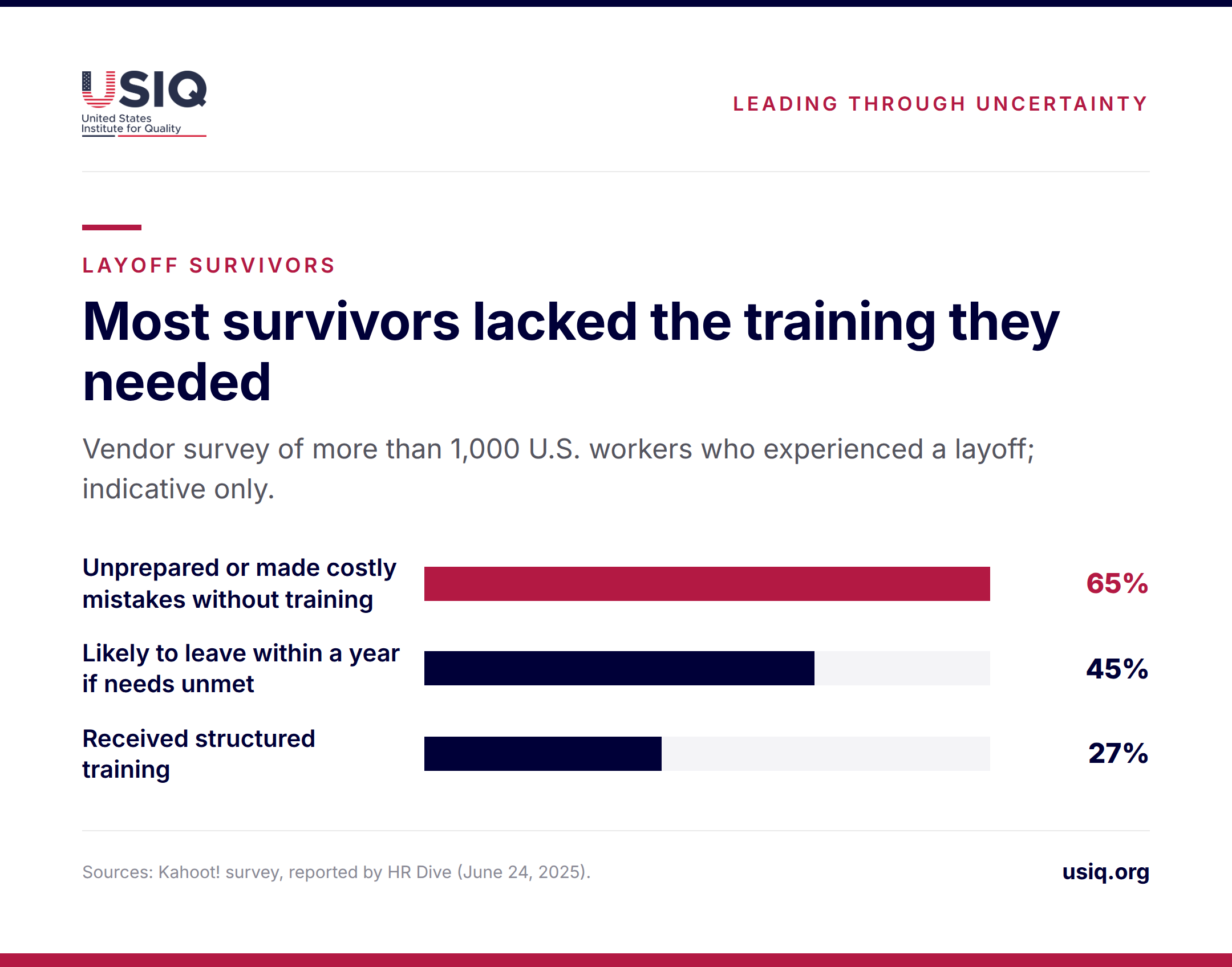
A Kahoot! survey reported by HR Dive in June 2025 covered more than 1,000 full-time U.S. workers who had experienced a layoff in the past three years. It is a vendor survey, so treat it as indicative only. Of those respondents, 65% said a lack of training left them unprepared or led to costly mistakes, only 27% received structured training or orientation, nearly half reported lower morale and engagement, and 45% said they would likely leave within a year if training needs went unmet.
- Explain the reasons for the decision plainly, and have managers briefed before the announcement.
- Redefine roles and priorities for remaining staff, and stop work that no longer matters.
- Provide structured training for new tasks.
- Be visible, and hold stay conversations with key people in the weeks that follow.
- Consider retention pay for critical roles.
What should a 30/60/90-day action plan look like?
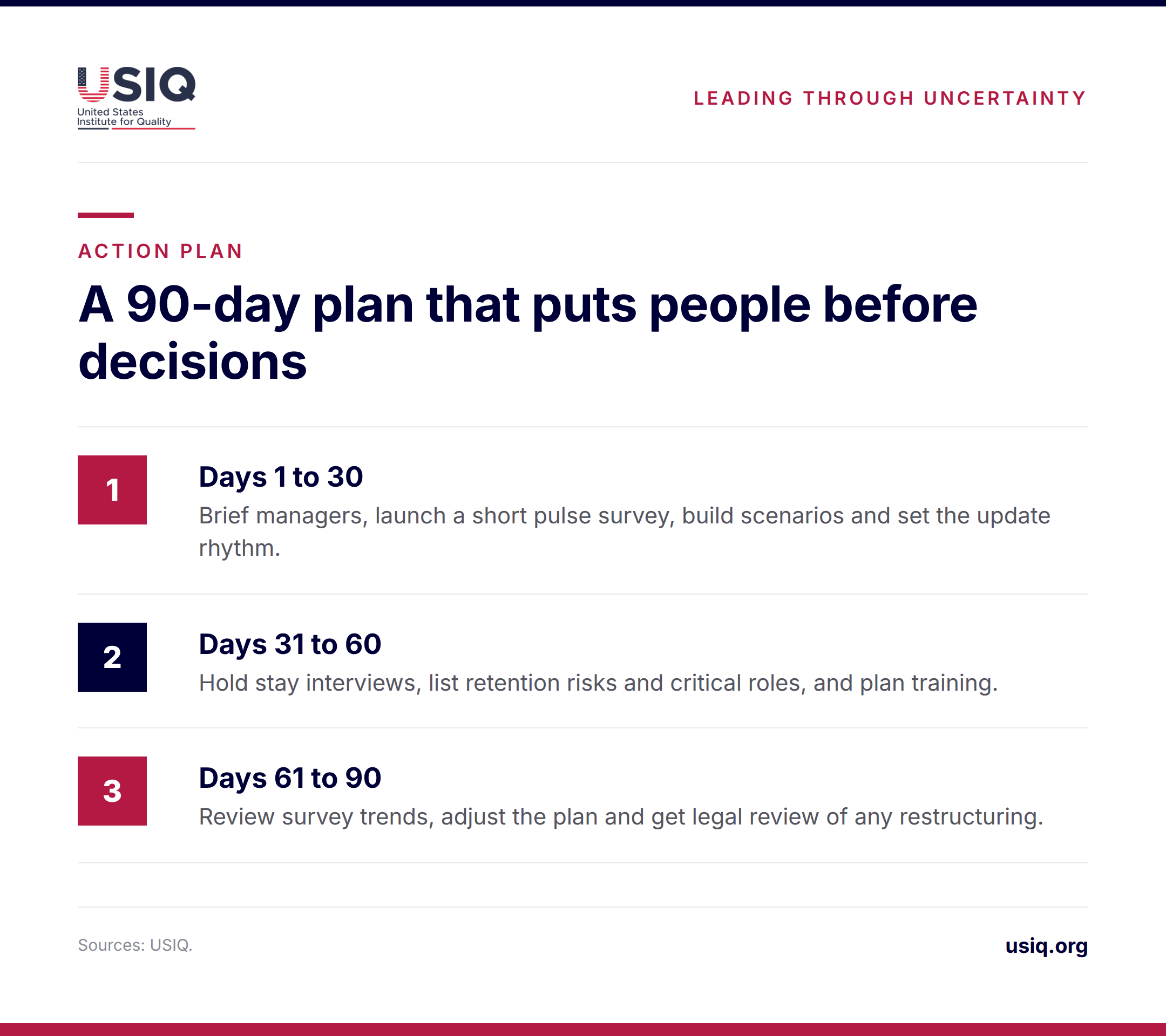
Sequence the work so that people come before decisions. The plan below suits a company without a dedicated HR team.
| Phase | Actions | Owner |
|---|---|---|
| Days 1 to 30 | Brief managers; launch a short pulse survey; build cash and headcount scenarios; set the update rhythm | Owner or CEO, with HR lead |
| Days 31 to 60 | Hold stay interviews; list retention risks and critical roles; plan training; apply steps 1 and 2 of the cost ladder if needed | Managers, HR lead |
| Days 61 to 90 | Review survey trends; adjust the plan; get legal review of any restructuring; communicate results | Owner, HR lead, counsel |
Is the situation as bad as it sounds?
Not necessarily. In the SBE survey, 81% of owners met or exceeded expectations and 61% did better than in 2025, while the JOLTS layoff rate stands at 1.0%. Uncertainty is not the same as decline, and overreacting can cause the damage a leader is trying to avoid.
The counterweights are real, though: customer spending fell for 36% of owners, and engagement is at its lowest since 2011. The SBE results also come from an advocacy group, and the Kahoot! figures from a vendor, so use them as signals and test them against your own numbers.
Does handling uncertainty well affect your reputation as an employer?
Employees and candidates notice how a company treats people in a downturn. USIQ, the publisher of this article, runs employer certification programs of this kind. USIQ research found that an employer seal raised the stated likelihood of applying for a job by about 16 percentage points in a randomized experiment with 1,093 participants; it measured stated intentions in a hypothetical recruitment scenario rather than actual applications (research summary). Background on certification appears in employer certification explained, and the Top Employer (USIQ) page describes the program.
Practical recommendations
- Train and brief managers first; they shape most of team engagement.
- Set a fixed update rhythm and use the “know, don’t know, next update” format.
- Run a short pulse survey and track quits and exits as early signals.
- Use the cost ladder and compare each cut with the replacement cost of the people affected.
- Check federal and state notice rules and talk to employment counsel before any layoff.
- Plan training and retention steps for the people who stay.
FAQ
What is crisis leadership?
Crisis leadership means keeping decisions, communication and people practices steady while the outlook is unclear. In practice it combines honest, regular updates, supported managers and cost decisions made in a deliberate order. It does not require predicting the economy, only preparing for several outcomes and acting on early signals.
Is it better to cut costs or keep investing in people?
Usually both, in a targeted way. Replacing an employee can cost one-half to two times annual salary, according to Gallup, so broad cuts to staff can be expensive. Reduce discretionary spending and freeze non-critical hiring first, and protect development and retention for critical roles.
Do small companies have to give layoff notice?
Federal WARN applies to employers with 100 or more employees and requires 60 calendar days’ written notice of a plant closing or mass layoff affecting 50 or more employees at a single site. A company with fewer than 100 employees is below the federal threshold, but state rules may differ. Check with your state labor department and counsel.
How often should leaders communicate during uncertainty?
On a fixed rhythm, such as every two weeks, even when there is little news. Each update should say what is known, what is not, and when the next one comes. Gallup found 51% of exiting employees had no conversation about their future with a leader in their last three months.
How can I spot disengagement early?
Combine a short recurring pulse survey with stay interviews and a look at quits and absences by team. Watch trends rather than single scores. Gallup reports that 53% of employees are not engaged, so quiet withdrawal is more common than open complaints.
How do I support employees who remain after layoffs?
Explain the reasons, define new roles clearly, provide structured training and stay visible. In a vendor survey reported by HR Dive, only 27% of layoff survivors received structured training, and 45% said they would likely leave within a year if needs went unmet. Treat that as indicative.
Should I give retention pay to remaining staff?
It can make sense for critical roles. SHRM reports HR experts discussing pay for remaining staff after layoffs, with a Korn Ferry leader saying a company would reasonably raise pay for employees it sees as part of its future. Extreme salary claims are an upper-end ceiling, not a norm.

Sources
- U.S. Bureau of Labor Statistics, “JOLTS Latest Numbers”: https://www.bls.gov/jlt/latest-numbers.htm
- Journal of Accountancy (reporting Gallup), “U.S. employee engagement falls below 30% for first time in 15 years,” November 2026: https://www.journalofaccountancy.com/news/2026/nov/u-s-employee-engagement-falls-below-30-for-first-time-in-15-years/
- Gallup, “This Fixable Problem Costs U.S. Businesses $1 Trillion,” published March 13, 2019, modified May 13, 2025: https://www.gallup.com/workplace/247391/fixable-problem-costs-businesses-trillion.aspx
- SBE Council, “New Small Business Check Up Survey,” October 8, 2026: https://sbecouncil.org/2026/10/08/new-small-business-check-up-survey-main-street-businesses-are-powering-through-2026/
- HR Dive, “Layoff survivors say a lack of retraining has led to pricey mistakes,” June 24, 2025: https://www.hrdive.com/news/layoff-survivors-lack-of-retraining-has-led-to-pricey-mistakes/751491/
- Frontiers in Psychology (PMC), “Goodbye or Identify: Detrimental Effects of Downsizing on Identification and Survivor Performance,” May 25, 2016: https://www.ncbi.nlm.nih.gov/pmc/articles/PMC4879335/
- SHRM, “After Layoffs, Is Higher Pay for Remaining Staff the Right Retention Tool?,” June 9, 2026: https://www.shrm.org/topics-tools/news/benefits-compensation/after-layoffs-is-higher-pay-remaining-staff-right-retention
- U.S. Department of Labor, “Plant Closings and Layoffs”: https://www.dol.gov/general/topic/termination/plantclosings
- USIQ, employer seal research: https://www.usiq.org/top-employer/research/
Related Articles
Our quality management system passed an independent ISO 9001:2015 audit by QRO Certification LLP. What the audit covered and what it means for companies we certify.

What research says about the effects of employer seals on current employees, potential applicants and employer image, from independent experiments and field data to the limits of the evidence.
Employee experience and customer experience are linked, but the link is weaker and more conditional than popular slogans suggest. This article reviews the evidence on staffing, training and workplace conditions and shows how employers can test the connection in their own business.
Most HR dashboards show too many metrics and trigger too few decisions. This guide defines ten employee experience metrics, shows a one-page layout and explains how to read your numbers against U.S. data.
