

Most lists of workplace trends 2026 read the same way: more AI, more flexibility, more skills, more wellbeing. The data tell a more mixed story. Telework has stopped growing, skills-based hiring has changed less than the announcements suggest, and employee engagement in the United States is low.
For an owner or HR lead at a company with 10 to 250 employees, the useful question is not what is fashionable. It is which shifts show up in the numbers, which ones carry legal consequences, and which ones are visible inside your own company. This article sorts the trends by evidence. Data are current as of November 2026.
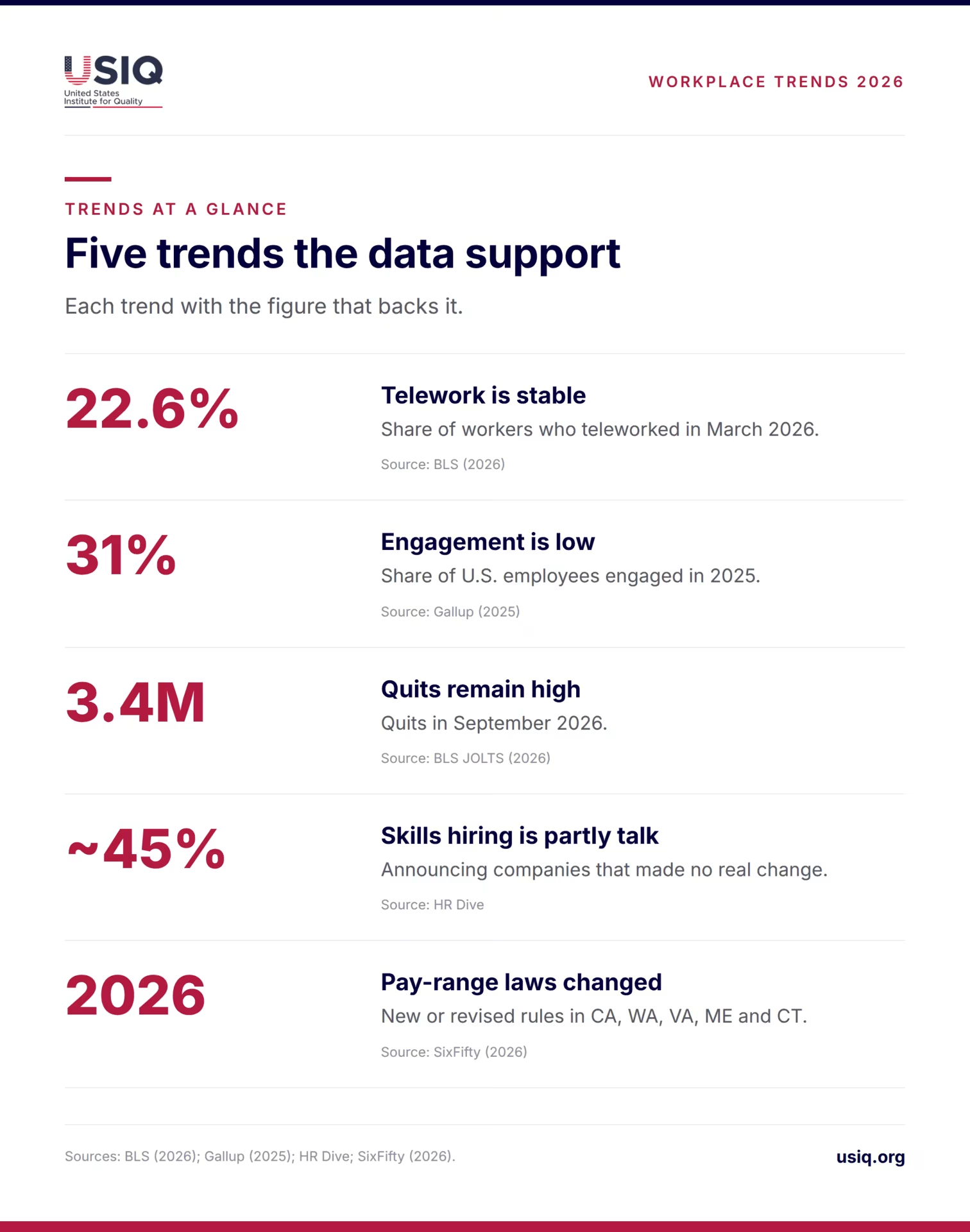
Quick answer: The workplace trends 2026 that the data support are stable telework at about 22.6% of workers, low U.S. engagement at 31%, a labor market with 7.5 million openings and 3.4 million quits, hiring changes that are more talk than practice, and a growing patchwork of state pay-range laws. Employers should act on postings, manager skills and employee feedback first.
Key takeaways
- Telework is flat, not rising: 22.6% of U.S. workers teleworked in March 2026, within a 21.5% to 23.0% range over the prior year.
- Only 31% of U.S. employees were engaged at work in 2025, and managers account for at least 70% of the variance in team engagement.
- The labor market is neither frozen nor frantic: 7.5 million openings, 5.4 million hires and 3.4 million quits in September 2026.
- Skills-based hiring is often announced but rarely practiced: about 45% of announcing companies made no real change.
- Pay-range posting rules differ by state and employer size, and several changed in 2026. Remote roles can trigger them.
- A short list of actions beats a long trend list: audit postings, write a clear flexibility policy, train managers, and ask employees what is landing.
Which workplace trends 2026 should small employers act on?
Five areas stand out once claims are checked against primary data: flexibility, the labor market, engagement and burnout, skills-based hiring, and pay transparency. AI belongs on the list too, but as a management question rather than a statistic. The table summarizes each trend, the evidence and the practical response.
| Trend | Evidence | What to do |
|---|---|---|
| Flexibility is stable | 22.6% of workers teleworked in March 2026 (BLS) | Write explicit rules for office and remote days |
| Balanced labor market | 7.5 million openings, 3.4 million quits in Sept. 2026 (BLS) | Budget for retention, not only hiring |
| Low engagement | 31% of U.S. employees engaged in 2025 (Gallup) | Train managers, measure with a survey |
| Skills-first hiring, partly real | About 45% of announcing firms changed nothing (HR Dive) | Use structured skills assessments |
| Pay transparency | New or revised laws in CA, WA, VA, ME, CT in 2026 (SixFifty) | Audit postings by state |
Each section below gives the evidence first and the practical consequence second.
Is hybrid work really the default in 2026?
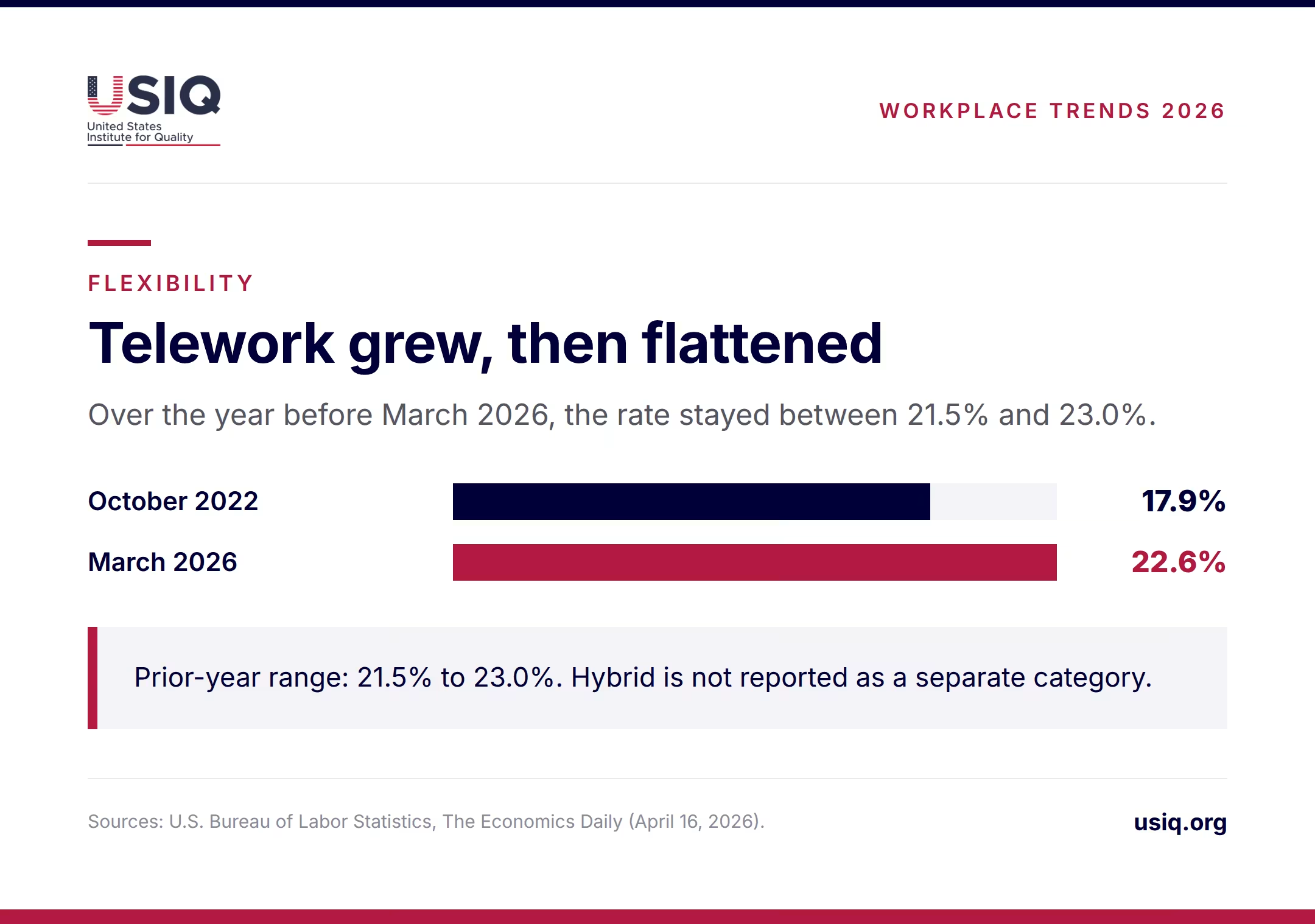
Not by the numbers. The Bureau of Labor Statistics reports that 22.6% of workers teleworked or worked at home for pay in March 2026. Over the prior year, the rate ranged from 21.5% to 23.0%. October 2025 is missing from that series because of the 2025 federal funding lapse.
The rate was 17.9% in October 2022, so telework grew from that level and then flattened. BLS does not report hybrid arrangements as a separate category, so claims that hybrid has become the standard are not backed by this series. Flexibility has stabilized, while the rules around it are getting more specific.
For a small employer, a stable rate means the question is no longer whether to allow remote work. It is how to run it fairly. A few habits help:
- State which days or tasks need presence in person, and why.
- Give remote staff the same tools, meeting access and information as colleagues in the office, so no one is left out of a hallway decision.
- Plan onboarding for hybrid hires deliberately, with a named buddy and scheduled in-person time.
- Review the policy twice a year using employee feedback, not only manager impressions.
Employers weighing stricter attendance rules can read our analysis of the back-to-office debate.
Is the labor market still a job seeker’s market?
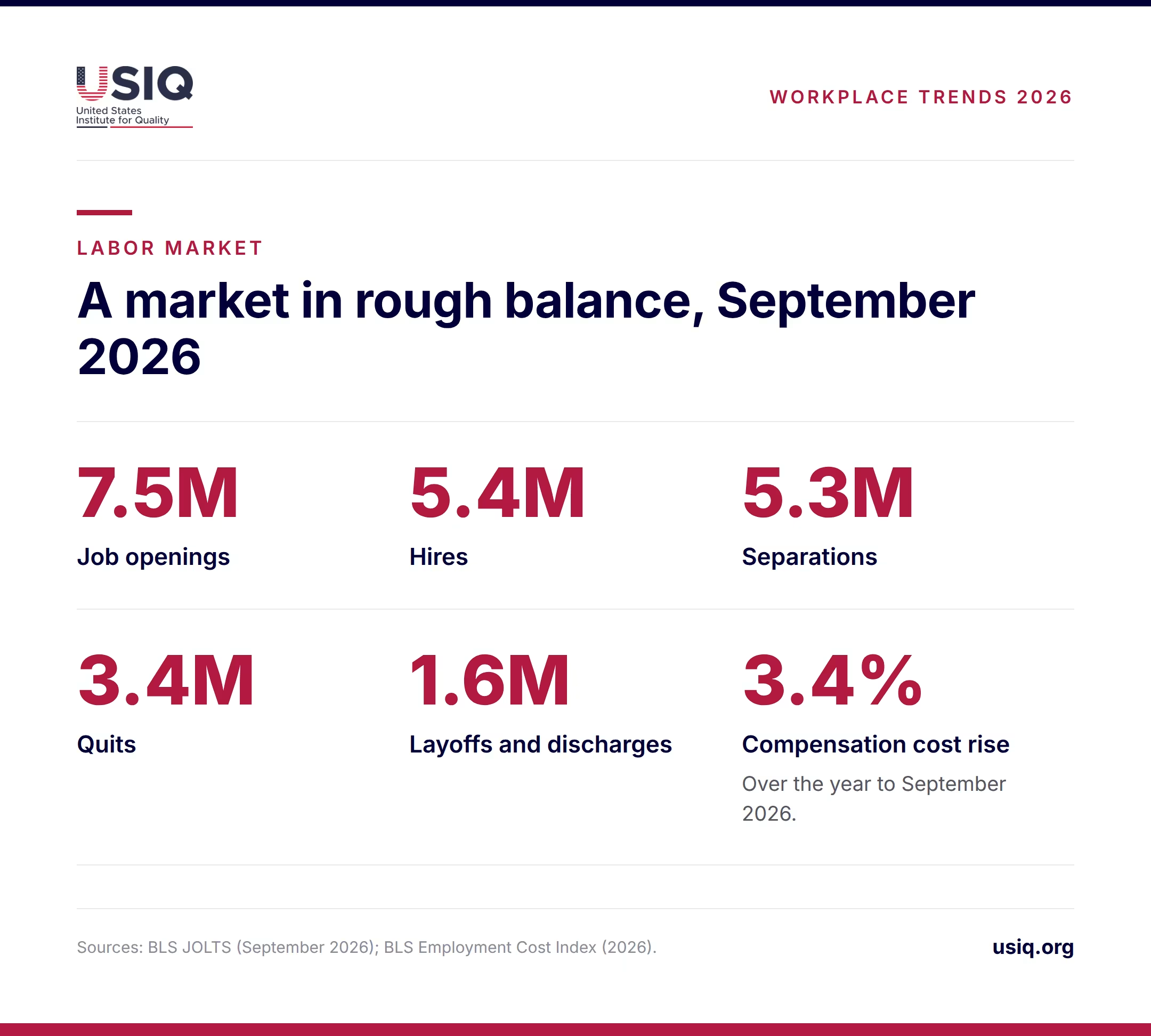
The September 2026 Job Openings and Labor Turnover Survey (JOLTS) shows a market in rough balance. Job openings were 7.5 million, little changed. Hires were 5.4 million and total separations were 5.3 million. Quits rose to 3.4 million, while layoffs and discharges were 1.6 million.
Employees are still leaving voluntarily in large numbers, but they are less confident about what comes next. Gallup’s 2026 regional data put U.S. and Canadian job-market confidence at 47%, against 52% globally. Cost pressure continues too: the Employment Cost Index shows compensation costs up 3.4% over the year ending September 2026.
For a 10 to 250 person company, replacing a person who quits is a recurring cost, and wage budgets are rising at a similar pace for everyone. Retention work (clear expectations, fair pay, good managers) is cheaper than constant recruiting. Our overview of talent acquisition trends in 2026 covers the hiring side.
How engaged and stressed are U.S. employees?
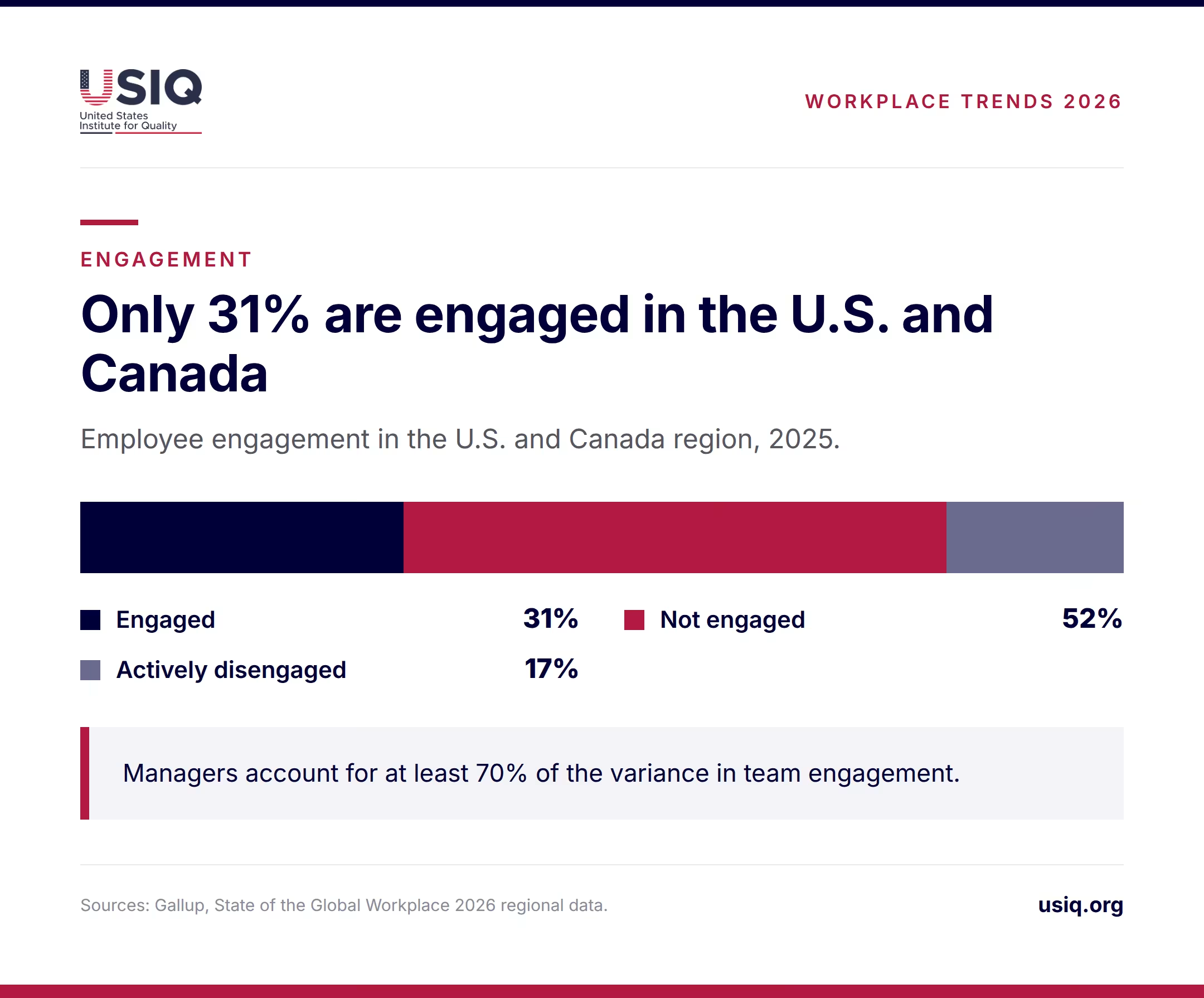
Gallup reports that only 31% of U.S. employees were engaged at work in 2025, compared with 20% globally. The same 31% appears on Gallup’s indicator page for U.S. employees and in its regional table for the U.S. and Canada region, so the two figures are not strictly the same group. In the U.S. and Canada region, 52% were not engaged and 17% were actively disengaged. Half of employees reported significant daily stress, the highest share of any world region, and 19% reported loneliness.
SHRM’s 2026 State of the Workplace, based on more than 1,800 HR professionals and more than 2,000 workers, names burnout as a shared concern of workers, HR professionals and HR executives. It also finds that 72% of HR professionals believe workers have higher expectations of employers than before.
Why managers matter most
Gallup finds that managers account for at least 70% of the variance in team engagement. That is the strongest lever a small company has, because every employee has a direct manager. SHRM adds that job satisfaction was 91% where workplace needs are met effectively, versus 44% where effectiveness is low, and it links the low group to high turnover risk.
In practice, this means coaching-first management: asking questions, setting clear boundaries on after-hours messages, redistributing work before someone is overloaded, and training managers to spot burnout early. For definitions and tactics, see our guide to what high-performing employers do differently on engagement.
Is skills-based hiring real or just a headline?
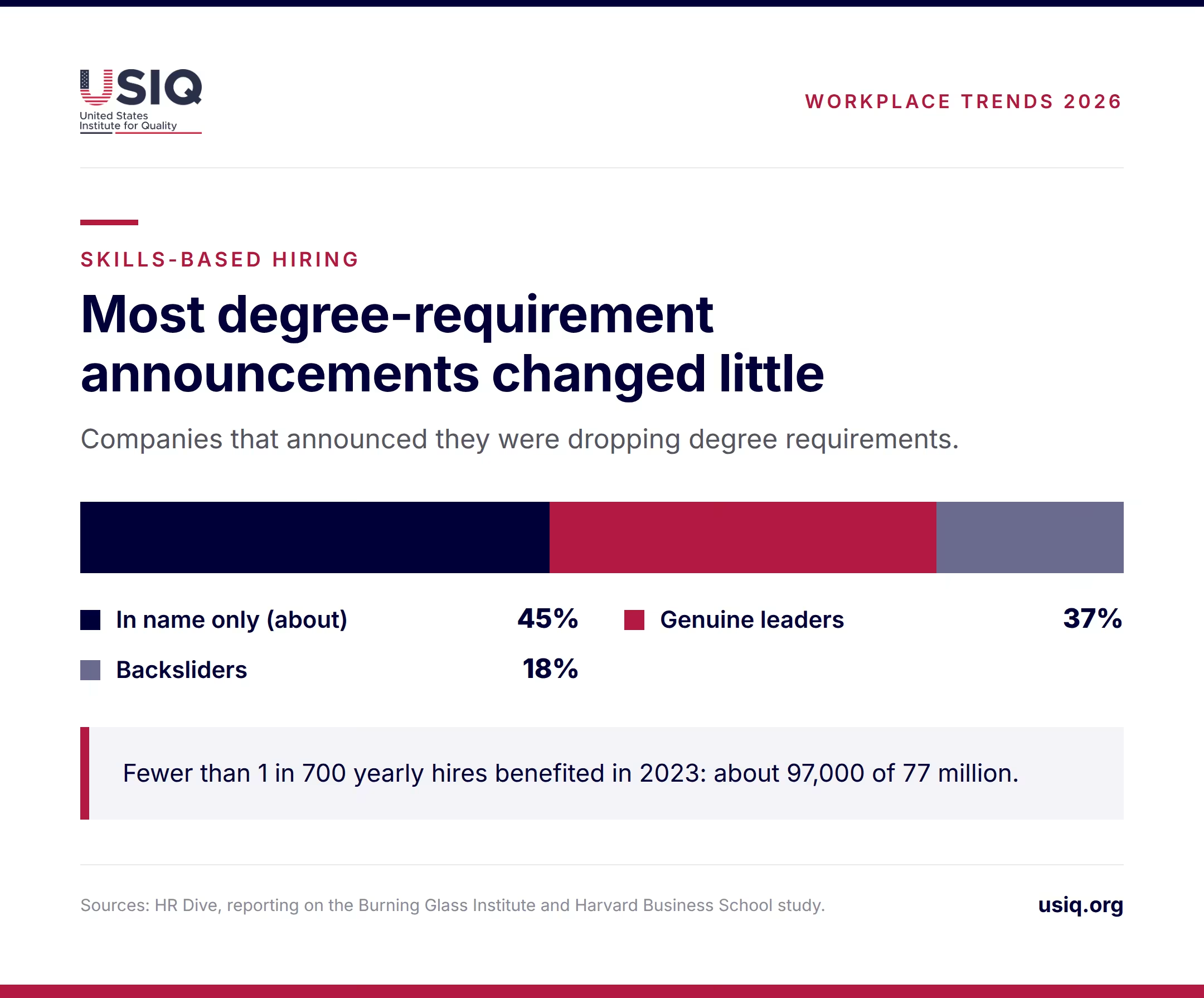
The evidence is mixed. A Burning Glass Institute and Harvard Business School study, reported by HR Dive, found that among companies that announced they were dropping degree requirements, about 45% were “in name only”, 37% were genuine leaders and 18% were backsliders.
The direction is real. From 2014 to 2023, the number of roles dropping degree requirements each year rose nearly fourfold. But the effect on hiring is small. Only 3.6% of roles at large firms dropped a requirement, a net gain of 0.14 percentage points in non-degree hiring. About 97,000 workers benefited out of 77 million yearly hires, fewer than 1 in 700 in 2023.
A posting change alone does not change who gets hired. Small employers have an advantage here, because owners and hiring managers can change practice directly:
- Define the three to five skills a role really needs, and test them with a work sample or structured interview.
- Train interviewers to weigh portfolios, certifications and demonstrated work, not only a diploma.
- Track how many hires come without a degree, so the policy is measured.
- Build skills from within through training and cross-functional moves, as covered in our guide to upskilling and reskilling.
How should small employers handle AI at work?
AI use is the trend most often quoted with unreliable numbers, so this article quotes none. The practical pattern is clearer than the statistics: AI works best as an assistant. A marketing specialist uses it for first drafts and spends the saved time on strategy. An analyst uses it to find patterns and spends the time interpreting them.
Three management steps follow. First, train people on the tools they are expected to use. Second, require a human quality check before AI output reaches a customer or a candidate. Third, review any AI used in screening or evaluating applicants with legal counsel, because hiring decisions carry legal responsibility whatever tool produced the ranking. Our overview of AI tools for HR in 2026 lists the common categories.
Which pay transparency laws apply to my company?
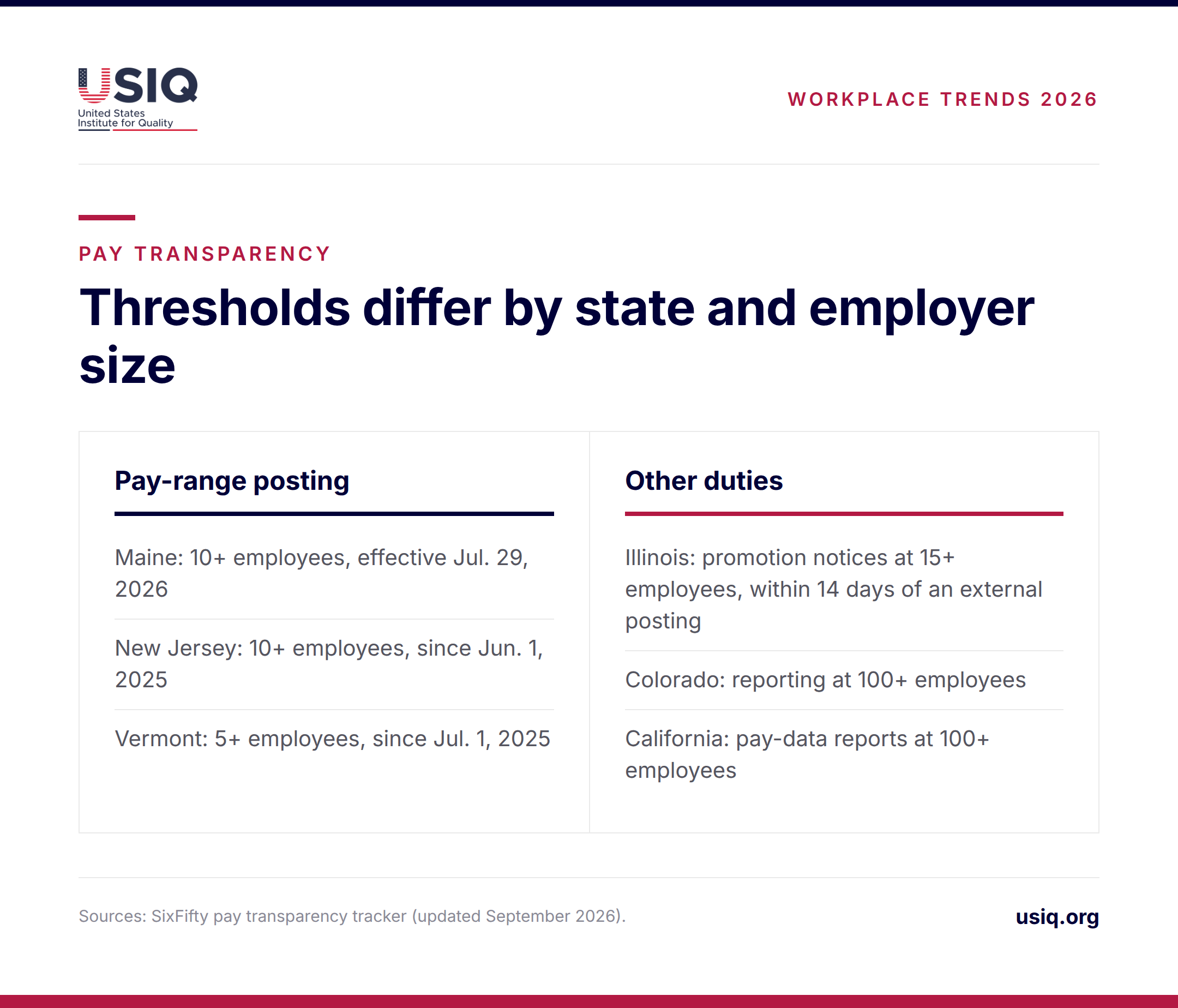
There is no single rule. Posting requirements are set state by state and depend on employer size, and several changed in 2026. The table is based on SixFifty’s state compliance tracker, updated September 2026. It is a secondary source, so confirm details on your state labor department’s site and with counsel.
| Jurisdiction | Who is covered | Requirement | Effective |
|---|---|---|---|
| California (SB 642) | Employers covered by its posting rules | Posted pay scale must be a good-faith estimate | Jan. 1, 2026 |
| Washington | Employers covered by its posting rules | Fixed wage amount must be disclosed when only a fixed wage is offered | Jan. 1, 2026 |
| Virginia (HB 636/SB 215) | Postings internal and external | Good-faith ranges; ban on wage-history requests | Jul. 1, 2026 |
| Maine (HB 18) | 10+ employees | Pay ranges in postings, unless pay is solely commission | Jul. 29, 2026 |
| Connecticut (HB 5003) | Employers covered by its posting rules | Revised posting rules, now including benefits descriptions | Oct. 1, 2026 |
| New Jersey | 10+ employees | Wage ranges and a general benefits description | Since Jun. 1, 2025 |
| Vermont | 5+ employees, including remote roles tied to a Vermont office | Pay range in postings | Since Jul. 1, 2025 |
| Maryland | Employers covered by its posting rules | Wage range and benefits description | Since Oct. 1, 2024 |
| District of Columbia | All postings | Wage ranges | Since mid-2024 |
Three other points matter for companies in the upper half of the 10 to 250 range. Illinois requires employers with 15 or more employees to announce promotion opportunities to current staff within 14 days of an external posting. Colorado’s HB 1207, effective August 12, 2026, requires private employers with 100 or more employees to file EEO-1-style demographic data, starting July 1, 2027. California employers with 100 or more employees had pay-data reports due May 13, 2026.
Vermont shows why remote hiring complicates compliance: a remote role tied to an office in a covered state can trigger that state’s rules. Employers who hire across state lines should check each location where a candidate might live or report. The business case is separate from the legal one. Visible salary ranges reduce guesswork, but they build trust only when current employees see pay that is consistent with them.
What should a company with 10 to 250 employees do now?
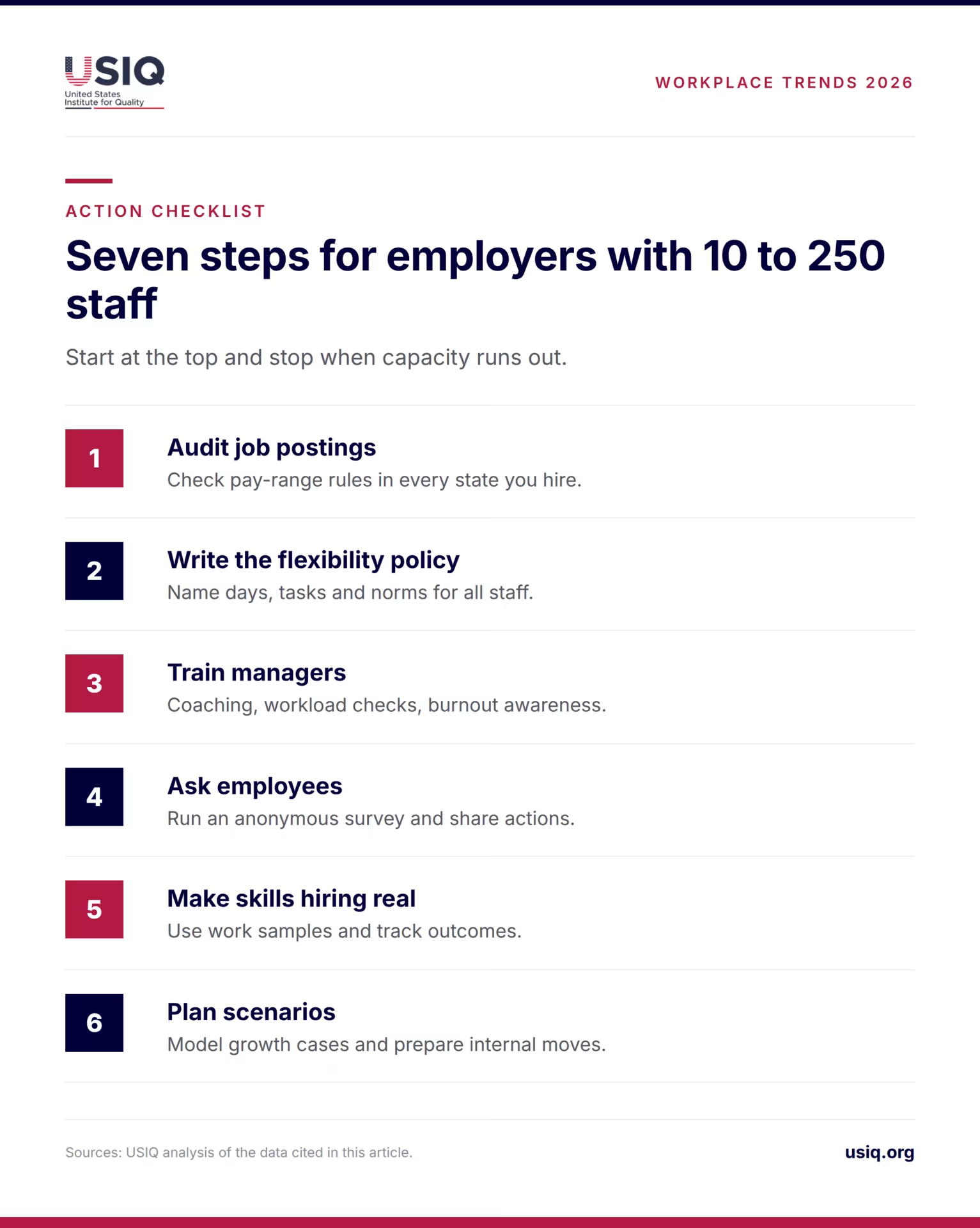
The trends above reduce to a short list. Start at the top and stop when capacity runs out, because the first items carry the most risk or the most return.
- Audit job postings. List every state where you hire or have remote staff, check its posting rules, and make each posted range a good-faith estimate.
- Write the flexibility policy. Name the days, tasks and communication norms, and apply them equally to remote and office staff.
- Train managers. Focus on coaching, workload checks, after-hours boundaries and recognizing burnout early.
- Ask employees. Run an anonymous survey at least once a year and share results and actions. National averages show a trend. Your own survey shows whether it is landing in your company. See how employee surveys drive engagement and trust.
- Make skills hiring real. Use work samples, track outcomes and train interviewers.
- Plan for scenarios. Model strong, slow and weak growth, and prepare cross-functional moves so existing staff can fill gaps instead of hiring every time.
- Set AI rules. Define approved tools, a human review step and legal review of any screening use.
Costs are modest compared with turnover: most of these steps need manager time and a survey tool, not new software. Legal review of postings and AI screening is the one item where outside advice is worth budgeting.
What are the limits of these trends and common misconceptions?
Several popular claims do not survive a check against the data. “Hybrid is the new default” overstates a telework rate that has hovered between 21.5% and 23.0%. “Companies have dropped degrees” overstates a shift that touched fewer than 1 in 700 hires in 2023. “Everyone is burning out” is a headline, not a measurement. The sourced picture is that burnout is a shared concern and that half of U.S. and Canadian employees report significant daily stress.
National averages also say little about a single company. A 40-person firm may have engagement far above or below 31%. The legal table is a snapshot too: dates and thresholds change, and state agencies, not trackers, have the final word.
What is the outlook beyond 2026?
Expect continuity rather than a new wave. Telework looks settled at roughly one in five workers. Pay-range laws are spreading, with effective dates still arriving in the second half of 2026 and reporting duties for larger employers starting in 2027. The employers who do best will most likely treat engagement as a management routine instead of an annual event.
Conclusion
The workplace trends 2026 worth acting on are the ones with evidence behind them: stable flexibility, low engagement, a balanced labor market, partial skills-based hiring and changing pay-range laws. For a 10 to 250 person employer, the first move is to fix what you control: compliant postings, a written flexibility policy and managers who can keep people engaged.
FAQ
What percentage of U.S. workers work from home in 2026?
The Bureau of Labor Statistics reports that 22.6% of workers teleworked or worked at home for pay in March 2026. Over the prior year the rate ranged from 21.5% to 23.0%. BLS does not report hybrid arrangements separately, so no official hybrid share is available from this series.
How many U.S. employees are engaged at work?
Gallup reports that 31% of U.S. employees were engaged in 2025, against 20% globally. For the U.S. and Canada region, 52% were not engaged and 17% were actively disengaged. Gallup also finds that managers account for at least 70% of the variance in team engagement.
Is skills-based hiring replacing degree requirements?
Only partly. Among companies that announced dropping degree requirements, about 45% made no real change, 37% were genuine leaders and 18% backslid. At large firms, only 3.6% of roles dropped a requirement, a net gain of 0.14 percentage points in non-degree hiring, according to HR Dive’s report on the Burning Glass Institute and Harvard study.
Do I have to post salary ranges in job ads?
It depends on the state. Maine and New Jersey cover employers with 10 or more employees, Vermont covers 5 or more, and the District of Columbia covers all postings. Remote roles can trigger a state’s rules. Confirm current requirements with your state labor department and legal counsel.
What changed in pay transparency law in 2026?
California SB 642 and a Washington fixed-wage rule took effect January 1, 2026. Virginia’s good-faith range rule took effect July 1, Maine’s law July 29, and Connecticut’s revised posting rules take effect October 1, 2026. Colorado’s demographic reporting duty for employers with 100 or more employees starts July 1, 2027, according to SixFifty.
How does the labor market look for employers right now?
BLS JOLTS data for September 2026 show 7.5 million job openings, 5.4 million hires and 5.3 million separations. Quits rose to 3.4 million, and layoffs and discharges were 1.6 million. Compensation costs rose 3.4% over the year to September 2026, so retention remains a budget issue.
How can a small company tell whether a trend affects its own staff?
Ask employees directly. An anonymous survey on workload, manager support, flexibility and pay fairness shows which national trends are present in your team. SHRM found job satisfaction of 91% where workplace needs are met effectively and 44% where effectiveness is low, so the gap inside a company can be large.


Sources
- U.S. Bureau of Labor Statistics: “22.6 percent of workers teleworked in March 2026,” The Economics Daily, April 16, 2026. https://www.bls.gov/opub/ted/2026/22-6-percent-of-workers-teleworked-in-march-2026.htm
- U.S. Bureau of Labor Statistics: Job Openings and Labor Turnover Summary, September 2026 (also lists the Employment Cost Index headline, October 30, 2026). https://www.bls.gov/news.release/jolts.nr0.htm
- Gallup: “Global Indicator: Employee Engagement,” 2025 data. https://www.gallup.com/394373/indicator-employee-engagement.aspx
- Gallup: “State of the Global Workplace 2026, regional data.” https://www.gallup.com/workplace/697850/state-of-the-global-workplace-regional-data.aspx
- SHRM: “2026 State of the Workplace,” January 8, 2026. https://www.shrm.org/topics-tools/research/state-of-the-workplace-summary-and-report
- HR Dive: “Report: Employers don’t practice what they preach on skills-based hiring” (on the Burning Glass Institute and Harvard Business School report). https://www.hrdive.com/news/employers-failing-at-skills-based-hiring/707897/
- SixFifty: “Pay transparency laws by state for 2026,” updated September 2026. https://www.sixfifty.com/resource-library/pay-transparency-laws-by-state/
Related Articles
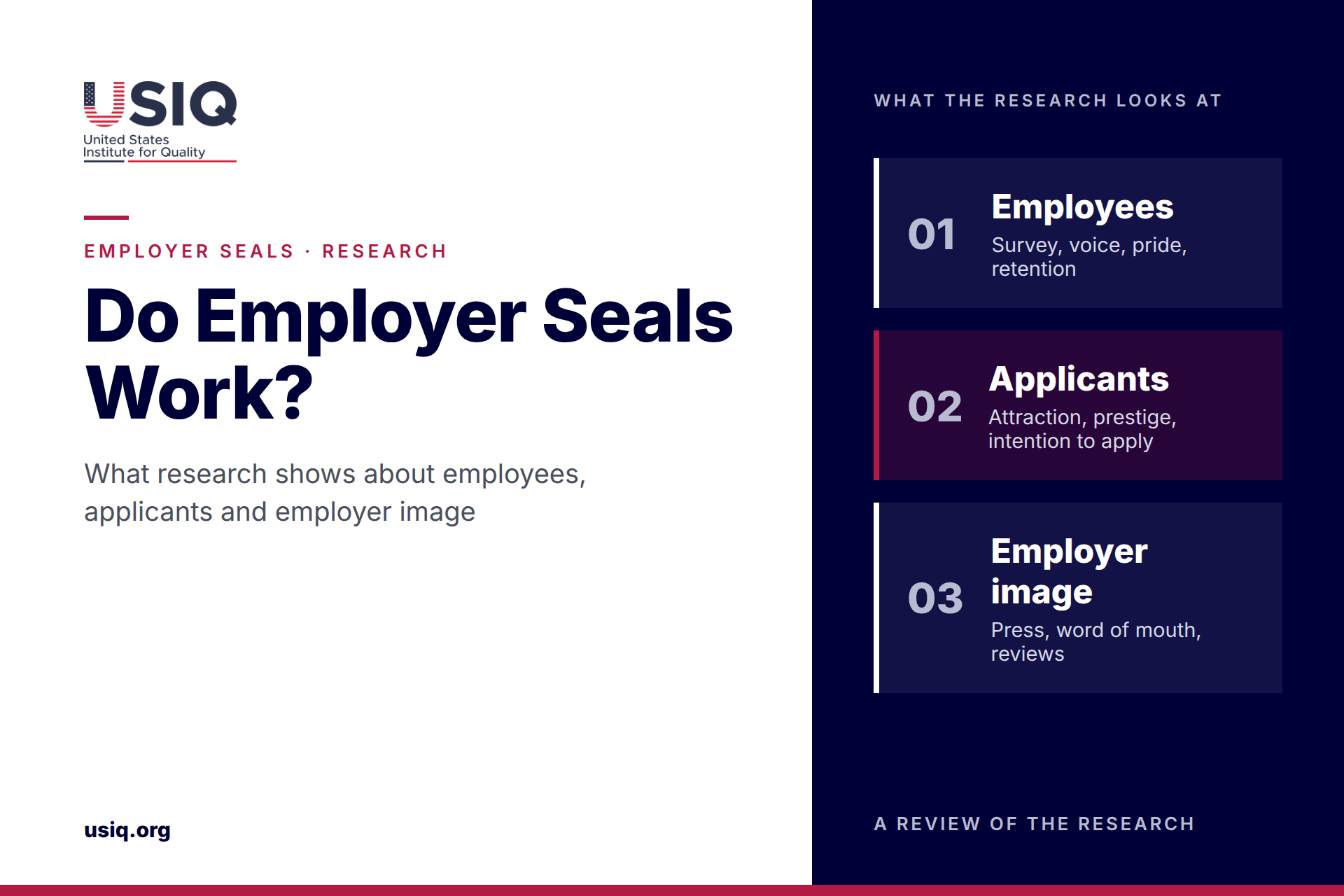
What research says about the effects of employer seals on current employees, potential applicants and employer image, from independent experiments and field data to the limits of the evidence.
Employee experience and customer experience are linked, but the link is weaker and more conditional than popular slogans suggest. This article reviews the evidence on staffing, training and workplace conditions and shows how employers can test the connection in their own business.
Most HR dashboards show too many metrics and trigger too few decisions. This guide defines ten employee experience metrics, shows a one-page layout and explains how to read your numbers against U.S. data.
A practical guide to calculating marketing ROI for small and mid-sized U.S. companies, including long B2B sales cycles, offline leads, a spreadsheet walkthrough and common errors.