

Most employer branding tools help a company show what it says about itself. Candidates look for what employees say, and the gap between the two decides whether a polished career page earns trust or loses it. For a company with 10 to 250 employees, the question is rarely which tool is the best on the market. It is which few tools to set up first, who will run them, and how to tell whether they work.
This guide starts from what a smaller employer usually already owns: an applicant tracking system (ATS), a LinkedIn page, an Indeed account and a Glassdoor profile. It then adds tools in a sensible order, with the legal cautions and the metrics that show whether the effort pays off.
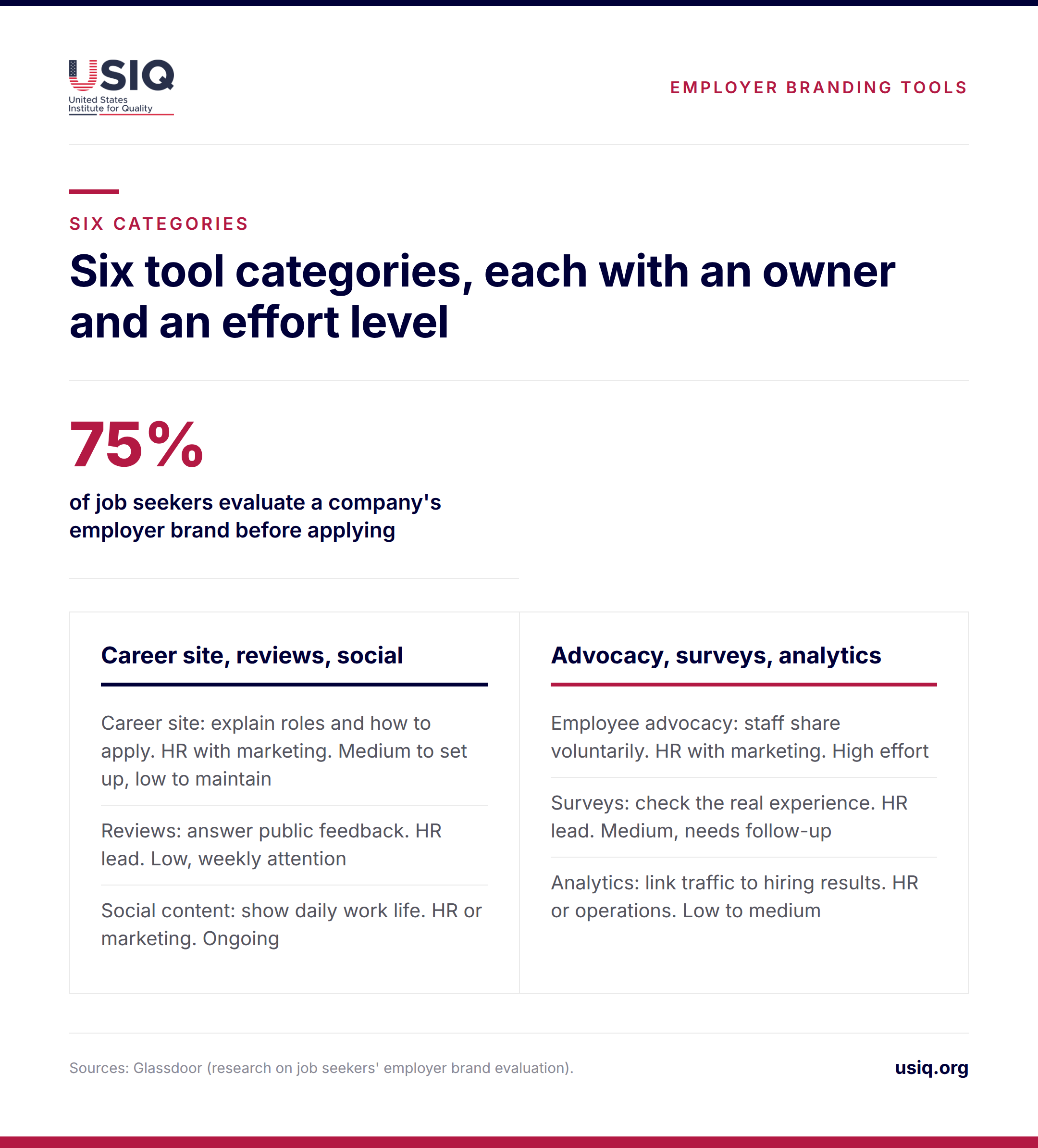
Quick answer: Employer branding tools fall into six categories: career site, reviews, social content, employee advocacy, surveys and analytics. A company with 10 to 250 employees should start with its career page and review profiles, add surveys, then social and measurement, and bring in advocacy software last. Fewer, connected tools beat a large stack.
Key takeaways
- Employer branding tools fall into six categories. Most small and mid-sized employers need only two or three of them at the start.
- Per Glassdoor research, 75% of job seekers evaluate a company’s employer brand before applying.
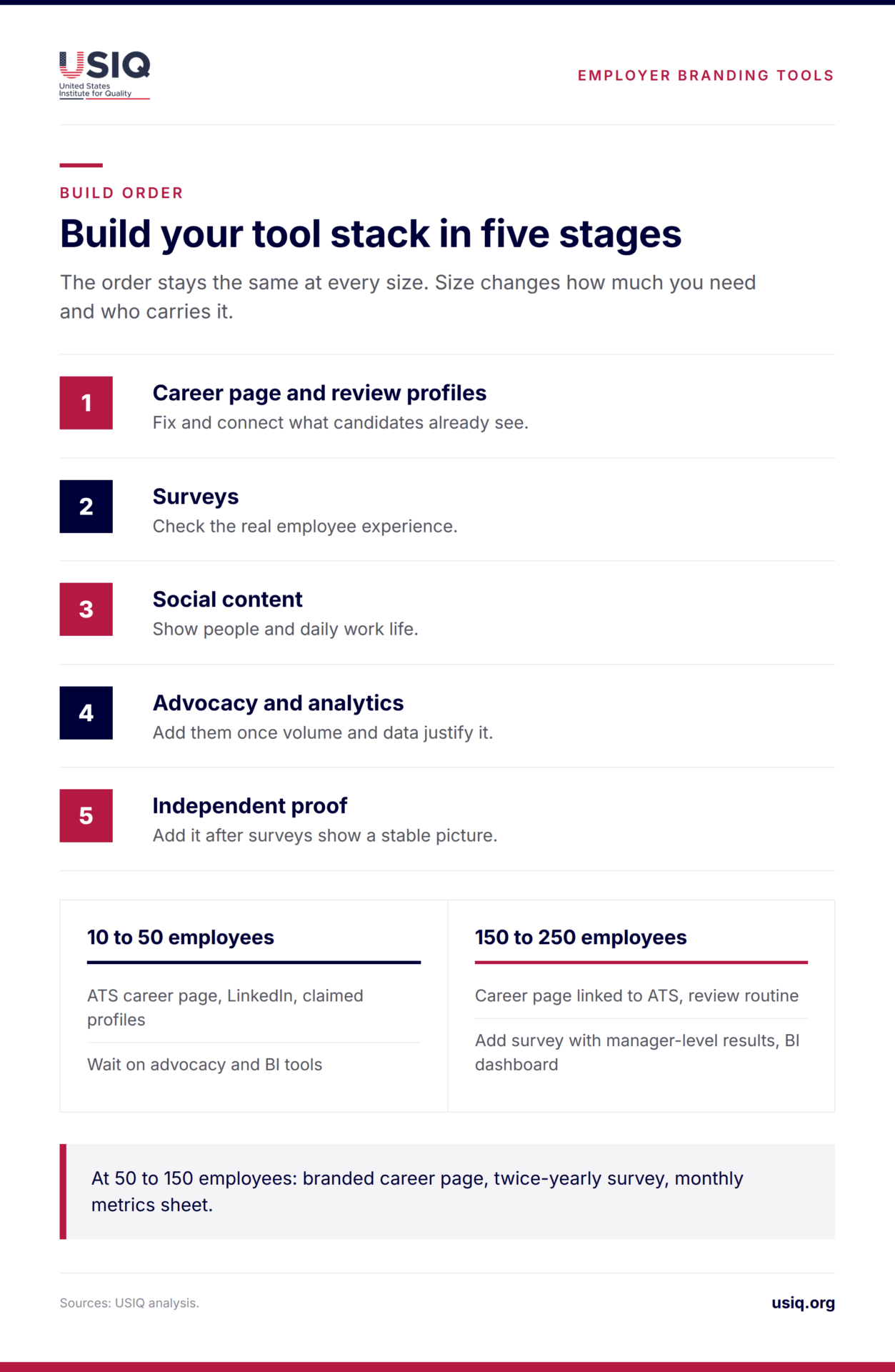
- Build in order: career page and review profiles, then surveys, then social content, then advocacy and analytics, then independent proof.
- Treat reviews as feedback, not as marketing content. Never buy, write or pressure staff into fake reviews.
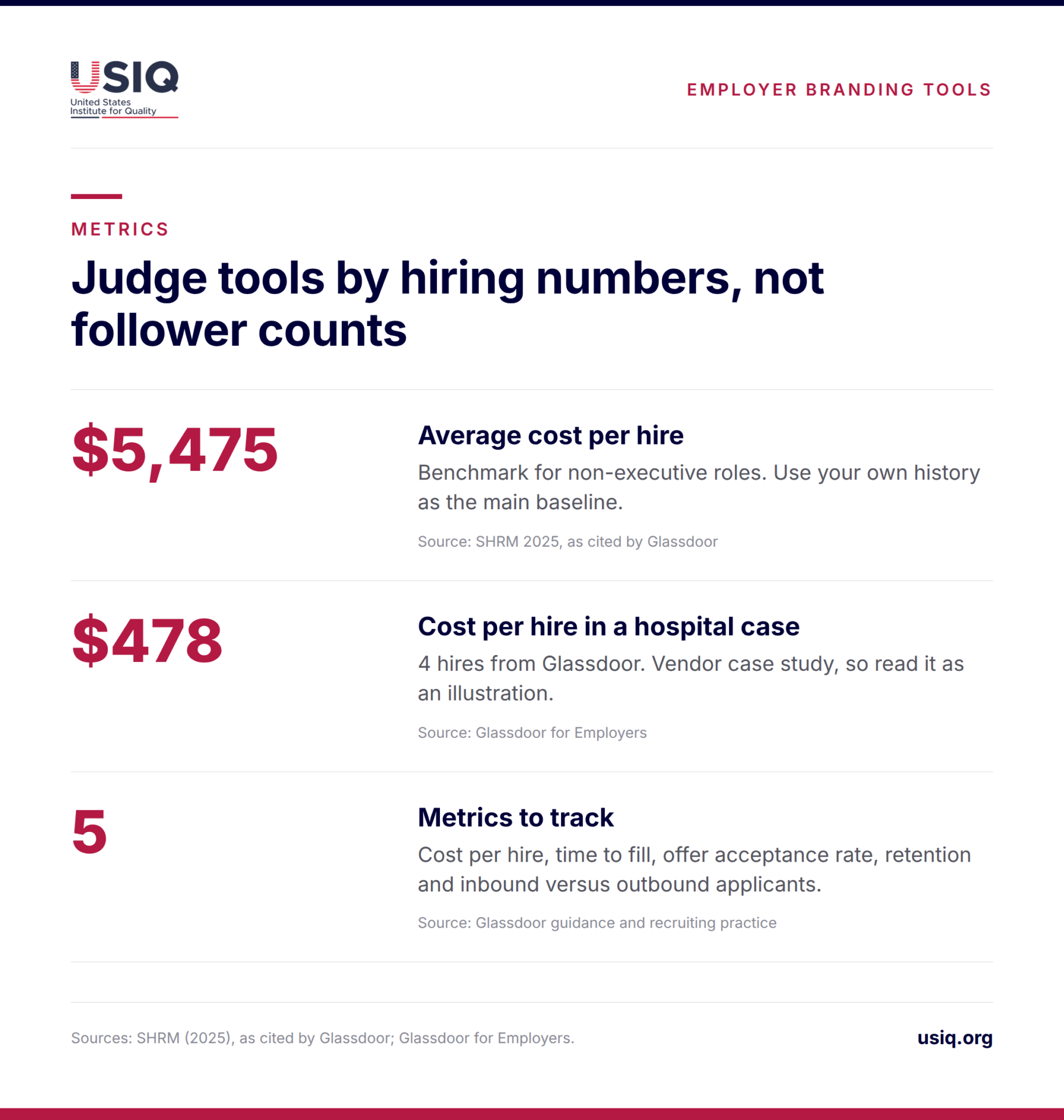
- Measure with cost per hire, time to fill, offer acceptance, retention and the ratio of inbound to outbound applicants, not with follower counts.
- No tool fixes a weak employee experience. Tools show the message; surveys and independent data show whether it is true.
What are employer branding tools, and which ones does a small or mid-sized company need?
Employer branding tools are the software and platforms a company uses to publish, monitor, test and measure how it appears to candidates and employees. The employer brand itself is how people describe working at the company. The tools only carry it. Glassdoor research reports that 75% of job seekers evaluate a company’s employer brand before applying, so what the tools show matters before a candidate ever submits a résumé.
Smaller employers do not have to buy enterprise software to take part. Many get the same result from the ATS they already pay for plus a few free profiles.
| Category | Purpose | Examples | Typical owner | Effort |
|---|---|---|---|---|
| Career site and page | Explain roles, culture and how to apply | ATS career page, website CMS | HR with marketing support | Medium to set up, low to maintain |
| Reviews and reputation | Monitor and answer public employee feedback | Glassdoor, Indeed company pages | HR lead | Low, but needs weekly attention |
| Social and content | Show daily work life and people | LinkedIn, Canva, Buffer, Hootsuite | HR or marketing | Ongoing, grows with volume |
| Employee advocacy | Help staff share approved content voluntarily | Dedicated advocacy platforms | HR with marketing | High, needs an engaged culture |
| Surveys and feedback | Check the real employee experience | Pulse and engagement survey tools | HR lead | Medium, results need follow-up |
| Analytics and reporting | Connect traffic, applications and hiring results | Web analytics, spreadsheet, BI tool | HR or operations | Low to medium |
Feature sets and pricing change often, so check any vendor’s official page before you decide.
Why does employer branding matter in the current U.S. labor market?
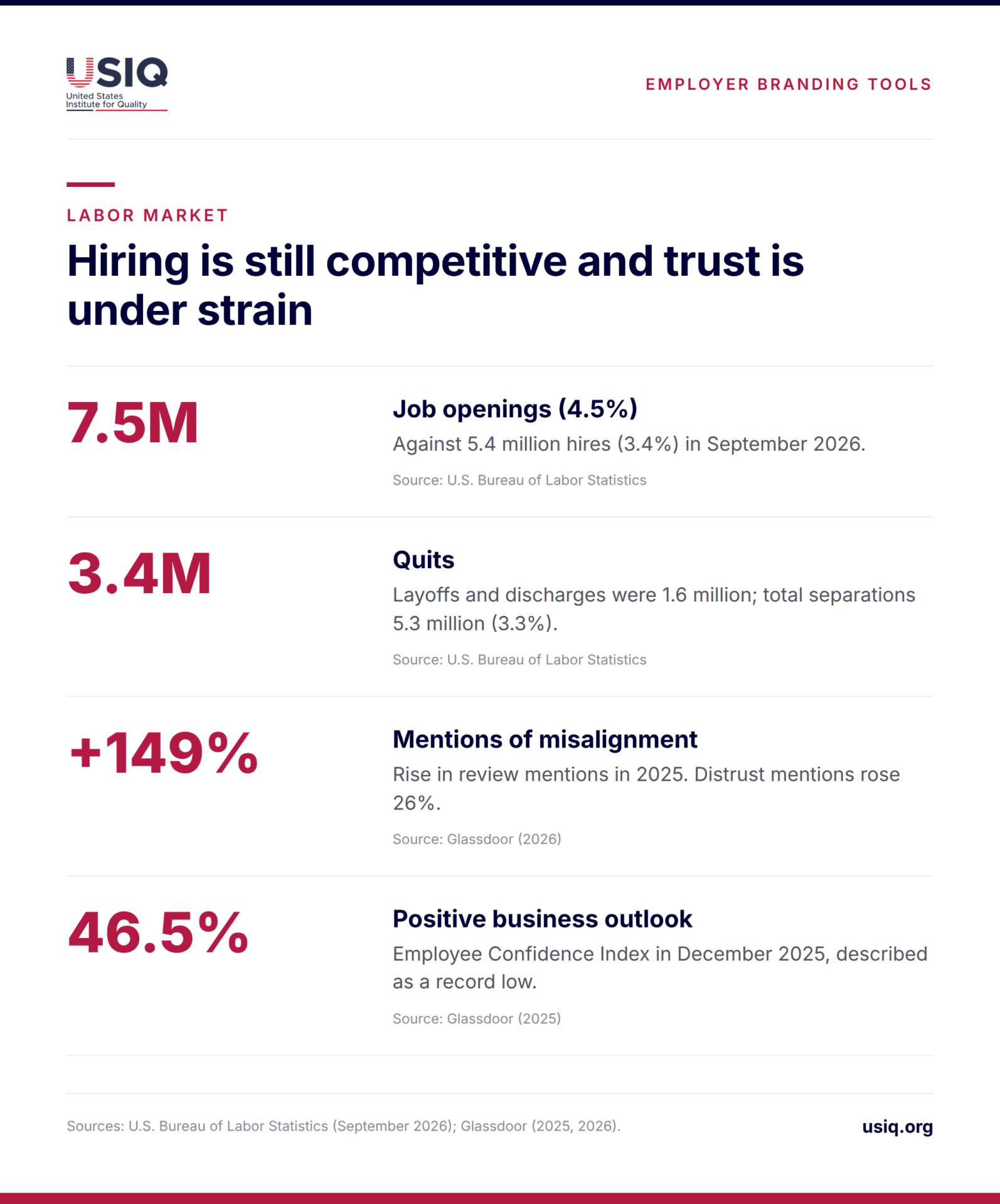
Hiring remains competitive even though the market has cooled from its peak. The U.S. Bureau of Labor Statistics reported 7.5 million job openings (a 4.5% rate) in September 2026, against 5.4 million hires (3.4%). Quits totaled 3.4 million, layoffs and discharges 1.6 million, and total separations 5.3 million (3.3%).
Employers still compete for candidates while workers still change jobs in large numbers. BLS also publishes these rates by industry and establishment size class, so a company can compare its own turnover with similar employers.
Candidates read before they apply. A 2021 Glassdoor resource reported that 86% of employees and job seekers research company reviews and ratings when deciding where to apply, and Pin’s 2026 study repeats that figure. It is dated. Pin also cites 2017 CareerArc data, reported by HR Dive, that only 1 in 5 candidates would still apply to a company with a one-star rating. The exact shares have likely moved, but the direction is clear.
Trust is under strain as well. Glassdoor’s 2026 guide reports that mentions of “misalignment” in reviews rose 149% and mentions of “distrust” rose 26% in 2025. Glassdoor’s Employee Confidence Index showed 46.5% of employees with a positive outlook on their company’s business prospects in December 2025, described as a record low. When employees doubt their employer, a career page that promises a great culture invites a harder look.
How do you choose the right employer branding tools?
Start with an inventory, not a shopping list. Most companies in this size range already have an ATS with a career page, a LinkedIn company page, an Indeed employer account and a Glassdoor profile that candidates can see whether or not the company manages it. Fix and connect these before adding anything.
Selection criteria that hold up
- Mobile speed: many candidates first see a job on a phone, so a slow page costs applications.
- Search visibility: job and company pages need clean titles, readable text and fast loading.
- ATS integration: applications and source data should flow into one system, not into inboxes.
- Total cost: count the license, set-up time and the hours the person running it will spend each month.
- Ownership and data: know who owns the content and survey data, and whether you can export it if you switch.
- Space for proof: the career page should have room for reviews, survey results and seals.
A tool stack by company size
The order stays the same at every size: career site and review profiles first, then surveys, then social and advocacy, then analytics, then independent proof. Size changes how much of it you need and who carries it.
| Company size | Start with | Add next | Wait on |
|---|---|---|---|
| 10 to 50 employees | ATS career page, LinkedIn page, claimed Indeed and Glassdoor profiles | Short pulse survey, simple scheduling and design tools | Advocacy software, BI tools |
| 50 to 150 employees | Branded career page with employee stories, review monitoring | Engagement survey twice a year, a monthly metrics sheet | Advocacy platform until staff already share posts on their own |
| 150 to 250 employees | Career page linked to the ATS, review response routine | Survey with manager-level results, social scheduling, a BI dashboard | Large multi-tool suites without a dedicated owner |
Tool sprawl is the most common mistake. Every added tool needs an owner, a login, an integration and a monthly review of its results. A company with one HR generalist cannot run eight platforms well, so it should run three.
For budget-conscious teams, our guide on building a strong employer brand on a small budget covers the low-cost end of this list.
Do career site and review platform tools come first?
Yes, for nearly every employer in this size range. These two sit where candidates look first, and both are cheap to improve compared with their effect.
The career page
A good career page answers three questions: what the work is like, what the company offers, and how to apply. Use real photos, named team members and specific details such as shift patterns, remote rules or typical day-to-day tasks. Make sure the page loads quickly on a phone and sends applications straight into the ATS.
Pay-transparency rules differ by state and can affect what a job post must include. Check your state’s requirements with counsel, and keep the career page and individual job ads consistent. Our article on SEO tips for a recruiting website covers the search side.
Review and reputation profiles
Claim your profiles on the main review sites and read them every week. Glassdoor advises responding to reviews with accountability, tracking sentiment over time and using reviews alongside internal engagement surveys to catch blind spots. Track themes, not single comments, and use reviews as feedback rather than as marketing content.
Review sites reflect the people who choose to post, so a handful of angry or enthusiastic reviews can skew the picture at a company with 40 employees. Read them for repeated topics such as scheduling, pay clarity or manager behavior, and do not react to every outlier.
What does the law say about asking for reviews?
The Federal Trade Commission announced a final rule in August 2024 that bans fake reviews and testimonials. It prohibits selling or buying fake reviews and lets the FTC seek civil penalties against knowing violators. The rule addresses consumer reviews of products and services, so ask counsel whether and how it applies to employer reviews. Either way, do not buy, write or pressure staff into positive reviews, and keep any request for feedback neutral and voluntary.
Glassdoor for Employers publishes a hospital case reporting 4 hires at a cost per hire of $478 from Glassdoor, with close to $40,000 in saved recruiting fees. It is a vendor case study, so read it as an illustration of what an active profile can do, not as an expected result.
Are social media and employee advocacy tools worth it for a small company?
Up to a point. LinkedIn comes first, because most employers can post culture content, jobs and team stories there at no license cost. Add a design tool such as Canva for consistent visuals, and a scheduler such as Buffer or Hootsuite only once posting volume makes manual work a burden. Early on, good photos and honest captions matter more than automation.
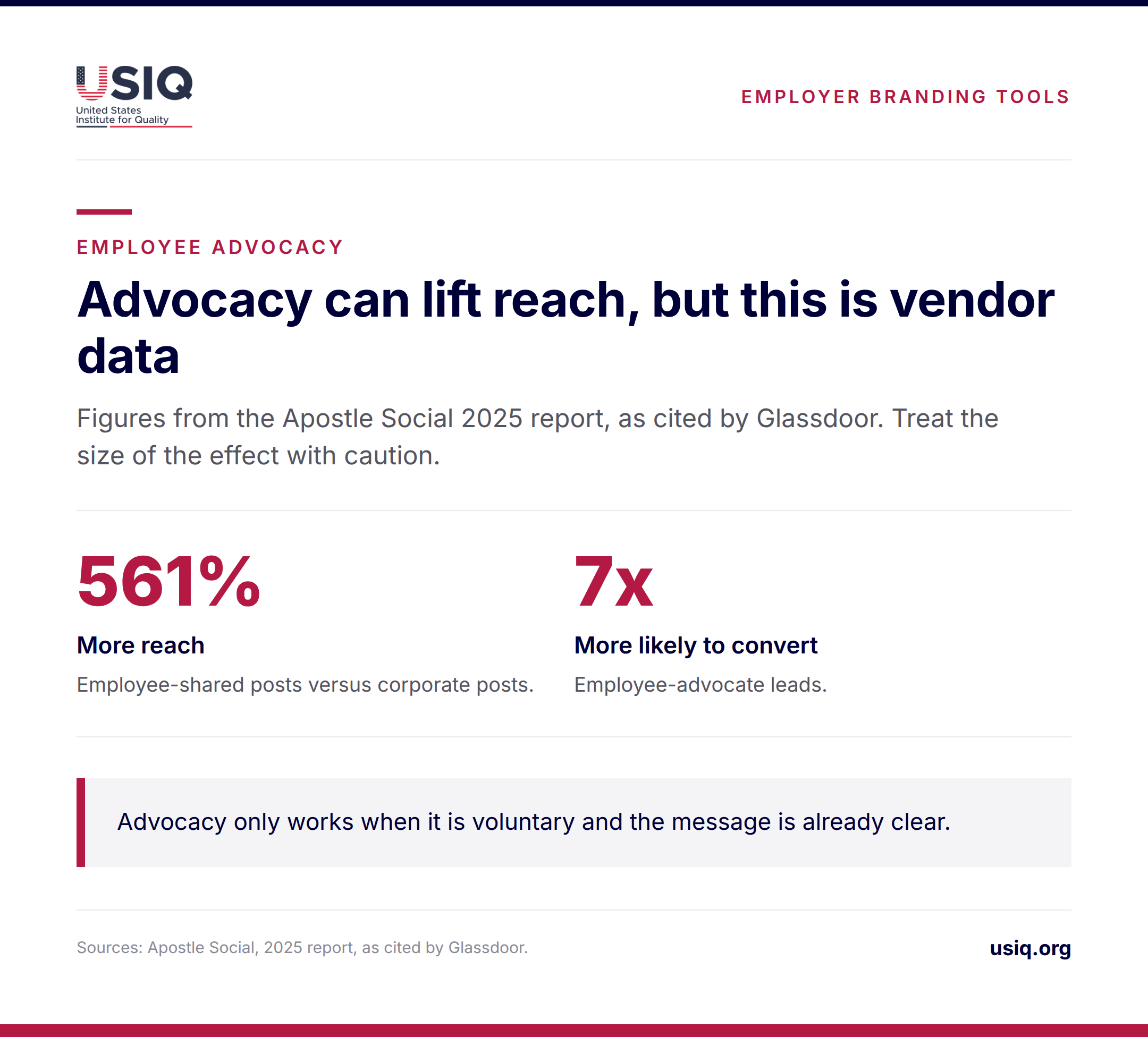
Employee advocacy is the next step, and the one most often started too early. Glassdoor cites a vendor benchmark, the Apostle Social 2025 report, which says employee-shared posts generate 561% more reach than corporate posts and that employee-advocate leads are seven times more likely to convert. Because this is vendor data, treat the size of the effect with caution. The direction fits common sense: people trust colleagues more than a company account.
Advocacy only works when it is voluntary and when the message is already clear. If staff feel pushed to post, the content reads as forced and can create problems of its own. Social media policies and employee speech rules vary, so have counsel review any advocacy program before launch. For ideas on content that employees actually want to share, see our guide to content marketing for employers.
How can surveys and analytics prove your employer brand is real?
Surveys are the proof, not the claim. A pulse or engagement survey shows what staff think before it appears in public reviews, and it gives you facts you can act on. Glassdoor recommends combining internal engagement surveys with review monitoring to catch blind spots. Our explainer on employee surveys and employer trust covers design and follow-up.
Keep surveys confidential and tell staff how results will be used. Employees who see no action after a survey stop answering honestly. Check how any survey tool stores and shares data, and confirm requirements for survey data in your state with counsel.
Which metrics show whether the tools work?
Employer brand work is usually judged on cost per hire, time to fill, offer acceptance rate, retention and the ratio of inbound to outbound applicants. These measures come from Glassdoor guidance and general recruiting practice. Add career page conversion, application sources, review score trends and changes in survey results.
| Metric | What it tells you | Where the data lives |
|---|---|---|
| Inbound vs. outbound applicants | Whether candidates come to you or you chase them | ATS source reports |
| Career page conversion | How many visitors start an application | Web analytics, ATS |
| Cost per hire | What each hire costs in fees, ads and time | Finance and HR records |
| Time to fill | How long roles stay open | ATS |
| Offer acceptance rate | Whether the pitch matches the offer | ATS |
| Retention | Whether hires stay | HRIS or payroll |
| Review score trend and themes | How public perception moves | Review platforms |
| Survey result changes | Whether fixes improve the experience | Survey tool |
For a benchmark, Glassdoor cites SHRM’s 2025 benchmarking, which gives an average cost per hire of $5,475 for non-executive roles. Compare your own figure with it, but use your own history as the main baseline. Our guide to the most important KPIs in recruiting explains how to calculate them. A spreadsheet is enough for companies under 100 employees. A BI tool pays off only when data sits in several systems.
Why do employer branding tools need independent proof?
Every tool above shows what a company says or what some people chose to post. None of them shows a verified picture of what employees across the company experience. Candidates know this. With “misalignment” and “distrust” rising in public reviews, as Glassdoor reports, a claim on a career page carries more weight when someone outside the company has checked it.
USIQ, the publisher of this article, runs certification programs of this kind. Its Top Employer program combines a confidential online survey of all eligible employees at the covered U.S. locations with an online HR assessment of 39 criteria in eight areas. Each part is worth up to 100 points. People score the results, a second reviewer checks every award, and every seal links to a public verification page. Payment does not influence the result, and the full rules are in the methodology.
USIQ’s research offers some evidence on the effect of such a seal. In a randomized experiment with 1,093 participants, Oliver Scharfenberg found that an employer seal raised the stated likelihood of applying for a job by about 16 percentage points (USIQ research).
Independent proof is the last layer, not the first. It works best after surveys have shown a stable picture, because a seal cannot compensate for a weak employee experience. Once earned, it belongs where candidates decide: the career page, job posts, company profiles and social posts. Our guide on displaying business certificates covers placement.
What mistakes should you avoid when building your employer branding tool stack?
- Buying too many tools too early. A large stack without an owner produces stale pages and unread dashboards.
- Skipping integration. If applications, sources and survey data sit in separate systems, nobody can see what works.
- Not tracking results. Without a baseline for cost per hire, time to fill and offer acceptance, any tool looks useful.
- Treating reviews as marketing. Reviews are feedback. Answer them with accountability and fix recurring problems.
- Fake or pressured reviews. Do not buy, write or demand them; the FTC treats fake consumer reviews as an enforcement priority.
- Using tools to cover a weak experience. Polished content over a poor workplace widens the gap that candidates and reviews expose.
What does a 90-day plan look like?
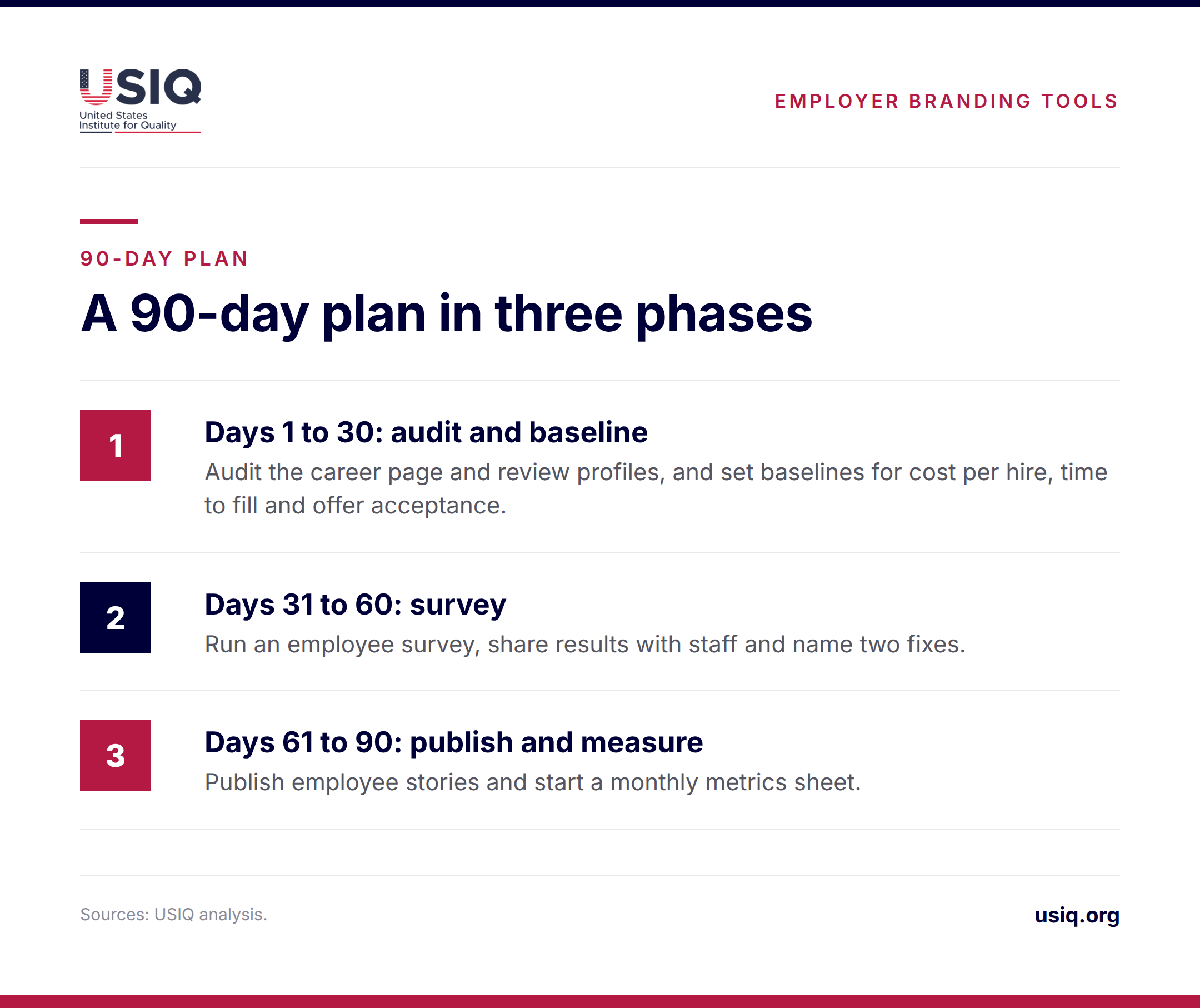
Days 1 to 30: audit the career page, claim and read all review profiles, set a response routine, and pull baseline numbers for cost per hire, time to fill and offer acceptance. Days 31 to 60: run a short employee survey, share the results with staff and name two fixes. Days 61 to 90: publish employee stories on the career page and LinkedIn, set up a monthly metrics sheet, and decide whether scheduling or advocacy tools are justified by actual volume.
Where to start
Employer branding tools make an employer visible, but visibility only helps when the experience behind it is real. Begin with the career page and review profiles, add a survey that tells the truth, and bring in proof later. Judge every tool by what it changes in your hiring numbers.
Frequently asked questions
What are the most important employer branding tools for a small business?
Most small businesses need a career page connected to their applicant tracking system, a LinkedIn company page and claimed review profiles on sites such as Glassdoor and Indeed. Add a short employee survey next. Scheduling, advocacy and analytics software can wait until volume or data complexity justifies the added cost and effort.
How many employer branding tools should a company use?
There is no fixed number, but fewer is usually better. Each tool needs an owner, an integration and a regular review of results. A company with 10 to 50 employees can often work well with three or four, mostly free or already owned. Add a tool only when a specific gap appears.
Do employer review sites really influence candidates?
Evidence suggests they do. A 2021 Glassdoor resource reported that 86% of employees and job seekers research company reviews and ratings when deciding where to apply, and Pin’s 2026 study repeats the figure. The figure is dated, so treat it as directional and keep your profiles current and answered.
Can I ask employees to leave reviews?
You can invite feedback, but keep it neutral and voluntary. Do not offer rewards for positive reviews, write reviews yourself or pressure staff. The FTC has banned fake consumer reviews and treats them as an enforcement priority. Ask counsel how rules apply to employer reviews before running any review campaign.
Is employee advocacy software worth it for a company with 50 employees?
Usually not at first. Advocacy works when staff already want to share and the employer message is clear. A vendor benchmark cited by Glassdoor reports 561% more reach for employee-shared posts, but it is vendor data. Start with a shared folder of approved content, keep participation voluntary, and consider software later.
Which metrics show whether employer branding works?
Employer brand work is usually judged on cost per hire, time to fill, offer acceptance rate, retention and the ratio of inbound to outbound applicants. Add career page conversion, application sources, review score trends and survey changes. Set a baseline before adding tools so you can see whether any change comes from your work.
Do employer seals help an employer brand?
They can add independent proof. In a randomized experiment with 1,093 participants, Oliver Scharfenberg found that an employer seal raised the stated likelihood of applying for a job by about 16 percentage points. Seals work best after surveys show a stable picture, since they cannot offset a weak employee experience. USIQ publishes this article and runs such programs.
Where should I display employer proof?
Place it where candidates decide: the career page, individual job posts, company profiles on job and review sites, and employer posts on social media. Link any seal to its public verification page so candidates can check it, and keep survey results and claims consistent across channels.
Sources
- U.S. Bureau of Labor Statistics, “Job Openings and Labor Turnover Summary,” September 2026 data, released Nov 3, 2026: https://www.bls.gov/news.release/jolts.nr0.htm
- Glassdoor, “Employer branding strategy: A complete guide for 2026”: https://www.glassdoor.com/blog/eight-employer-branding-strategies/
- Glassdoor, “Employee Confidence Index, December 2025”: https://www.glassdoor.com/blog/glassdoor-employee-confidence-index-december-2025/
- Glassdoor, “How to leverage Glassdoor reviews for employer branding”: https://www.glassdoor.com/blog/how-to-leverage-glassdoor-to-help-employer-brand/
- Glassdoor, “40+ Stats For Companies to Keep In Mind for 2021”: https://www.glassdoor.com/employers/resources/hr-and-recruiting-stats/
- Glassdoor for Employers, “What is Employer Branding”: https://www.glassdoor.com/employers/what-is-employer-branding/
- Pin, “The Glassdoor Effect 2026,” published Jul 7, 2026, updated Sep 24, 2026: https://www.pin.com/blog/candidate-glassdoor-effect-study/
- Federal Trade Commission, “Federal Trade Commission Announces Final Rule Banning Fake Reviews and Testimonials,” Aug 14, 2024: https://www.ftc.gov/news-events/news/press-releases/2024/08/federal-trade-commission-announces-final-rule-banning-fake-reviews-testimonials
- USIQ, research on employer seals: https://www.usiq.org/top-employer/research/

Related Articles

What research says about the effects of employer seals on current employees, potential applicants and employer image, from independent experiments and field data to the limits of the evidence.
Employee experience and customer experience are linked, but the link is weaker and more conditional than popular slogans suggest. This article reviews the evidence on staffing, training and workplace conditions and shows how employers can test the connection in their own business.
Most HR dashboards show too many metrics and trigger too few decisions. This guide defines ten employee experience metrics, shows a one-page layout and explains how to read your numbers against U.S. data.
A practical guide to calculating marketing ROI for small and mid-sized U.S. companies, including long B2B sales cycles, offline leads, a spreadsheet walkthrough and common errors.


