
In today’s labor market of the US, the term best organization to work for has come to mean those employers that deliver a consistent and strong employee experience, work for a leader they trust, and reward their employees fairly, as well as provide long-term career growth through data, not only reputation.
Over the last decade, “best companies to work for” lists and employer rankings have proliferated with the impetus of media publishers, research firms, and platforms such as Glassdoor and LinkedIn. These rankings are important because they are used as shortcuts of trust by job seekers who are looking at where to apply and who have little or no experience in a particular industry or a competitive industry.
Research indicates that most candidates do research on employer ratings and rankings before going through the application process. However, rankings tend to be misunderstood. Methodologies range far and wide, participation rules are not always necessarily visible, and high visibility does not necessarily translate to high workplace quality. This article discusses what these rankings really measure and the metrics behind them clearly today.
What Does “Best Organization to Work For” Actually Mean?
What we consider to be the best organization to work for is often influenced by reputation, media visibility, or word of mouth, but used to be, true quality in the workplace is measurable. Reputation reflects the perception, and measurable quality is based on things like the employees engagement, the trust of leadership, the opportunities for growth, and the fairness of the work. The phrase is, however, used widely in ordering, employer awards, and certifications, although in each case, different inputs are assessed and different standards are applied.
Across the majority of lists, what great companies to work for have in common is clear communication from leadership, meaningful career development, competitive rewards, an inclusive culture, and consistent processes for employees to provide feedback. However, no single indicator can be used to define the best employer. High pay alone does not guarantee engagement, and in the same way, a strong culture can lack growth, limiting retention.
For this reason, credible evaluations are based on multi-level models that use a combination of surveys, benchmarks, and validation. Understanding this distinction is necessary before interpreting rankings or going after recognition filled with confidence today.
How “Best Companies to Work For” Rankings Are Built
Most “best companies to work for” rankings are created by a combination of media publishers, research companies, and employer branding platforms. Some lists are designed by independent research organizations, others are assembled by business magazines or online platforms looking for audience engagement. The process by which these rankings are constructed varies considerably, and this has a direct bearing on the credibility of the rankings.
Common data inputs range from employee surveys, engagement scores, employer reviews, HR policies questionnaires, or nomination or application materials submitted from companies. Research-based rankings are usually based heavily on anonymous employee feedback and statistical benchmarks. Editorial lists, by contrast, might have combined limited data with subjective assessments, storytelling, or sponsor relationships.
A major difference is in transparency. Many public rankings are not entirely transparent about sample sizes, weighting techniques, response rate thresholds, or validation procedures. This makes it difficult for readers to know what is actually being measured or to enable comparisons of rankings accurately. In some cases, participation fees or promotional packages make the issue of objectivity even trickier.
Methodology is important since rankings affect career decisions, employer reputation, and internal HR priorities. Without clearer and consistent frameworks to measure these factors, rankings can lead to prioritization of visibility over quality of work, creating confusion for job seekers and employers.
Employee Surveys: The Foundation of Rankings
Employee surveys are the backbone of most “best organization to work for” rankings because they provide direct insight into employee experience at scale. Unlike branding claims or leadership messaging, surveys provide a way to rank using consistent criteria on how employees really feel. Most systems are used to assess engagement, leadership trust, culture and values, career growth opportunities, wellbeing, and inclusion. Together, these dimensions capture both life on the job in the here and now as well as workplace health across the long term.
To ensure reliability, good rankings have minimum participation requirements, for example, requiring responses from 60-70% of employees or being statistically representative. Without a sufficient amount of participation, results can be skewed by vocal minorities. Anonymity plays a vital role in this, as the employees give more honest feedback if confidentiality is ensured.
Strong data integrity controls also ensure that survey findings are a reflection of organizational reality, rather than a reflection of selectiveness or manipulation of input. This combination of scale, honesty, and validation is why surveys continue to be at the core of the ranking of credible employers across industries and markets across the world.
Engagement Score, Culture Metrics
Engagement scores are the measurement of an emotional and professional bond that employees have with their job and company. They usually evaluate motivation, commitment, discretionary effort, and intent to stay. Workplace culture is measured by indicators such as values alignment, psychological safety, inclusion, collaboration, and leadership behavior. While satisfaction is about the short-term comfort of the situation, engagement is about the deeper levels of investment and long-term performance.
An employee may be content with compensation but not interested in his or her purpose or growth. Rankings thus give more weight to engagement and culture metrics than do surface-level satisfaction scores. Strong culture metrics contribute to overall ranking outcomes every time because they are the correlation of retention, productivity, and advocacy. Culture data also has long-term weight because it is harder and slower to manipulate.
Organizations that have healthy cultures tend to perform somewhat the same throughout survey cycles, so culture metrics are a good indicator of sustained quality as an employer and not a short-term condition or incentive that may motivate many employees.
Employer Branding vs. Employee Realities
Employer branding has a visible role in rankings in the form of impacting the public image through career pages, social media, and awards promotion. Strong branding can be used to attract attention and shape initial impressions, but it doesn’t ensure good employee experience. In many cases, there can be a gap between the shine of messaging on the outside and reality on the inside that leads to disappointment and attrition once employees join.
Rankings using a substantial amount of branding signals are at risk of overstating workplace quality. Over time, it is not possible to maintain high rankings through branding alone when employee feedback does not match public claims. This is the reason why evidence-backed validation is important. Independent surveys and verifiable data are useful to separate authentic employer good news from marketing stories so that recognition is based on life experience, not image management.
Drawbacks of “Best Employer” Rankings
For all their influence, “best employer” rankings do have some notable limitations. Some programs involve pay-to-participate programs that can blur the line between recognition and promotion. Ranking inflation is also a problem, with categories that grow and expanding regional lists swimming in combination with it. Industry and company size can also influence things, since big organizations always have more means to take part and market the results.
Additionally, rankings may not entirely consider workforce diversity, remote structures, or sector-specific challenges. Because methodologies differ and because there is no uniformity in terms of transparency, rankings should not be analyzed in isolation. They provide useful signals but need context, supporting data, and validation in order to achieve an accurate reflection of the quality of employers.
How USIQ Measures Best Organizations to Work For
USIQ measures the best organizations to work for using a structured and research-driven certification model instead of competitive ranking lists. Its approach is centered on a survey-based evaluation that captures real employee feedback related to the dimensions of engagement, leadership, culture, growth, and well-being. All data collected is collected anonymously to protect the respondents and for better accuracy.
Independent validation processes are used to ensure results meet predefined standards for reliability and participation. Unlike opaque ranking systems, USIQ utilizes transparent scoring and benchmarking systems that measure outcomes compared to thresholds rather than compared to other companies. This removes zero-sum competition and is focused on objective performance.
Certification seals are only given when criteria are met, strengthening credibility. The difference between rankings and certification is critical: rankings compare employers with one another, while certification is how to verify whether an organization is performing a given standard of quality in the workplace.
Aligning Ranking Criteria with USIQ Certification Standards
The vast majority of ranking criteria are very similar to the USIQ certification standards if one looks carefully. Employee surveys are directly correlated with USIQ’s structured feedback instruments. Engagement and culture scores are validated by benchmarked evaluation and not relative placement. Leadership trust and growth metrics are measured based on non-editing judgment.
Certification, therefore, provides validation of the same core elements that rankings claim to measure, but with greater clarity of methodology. Through the use of independent verification and transparent scoring, certification enhances the credibility of ranking results. Seals are peer evidence that performance is not just real but repeatable and substantiated from other data other than list placement.
Framework: Setting the Stage for Becoming a Best Organization to Work For
Organizations that are preparing to become the best organization to work for must follow a structured framework.
- The first step is an internal readiness assessment to assess leadership alignment, policies, and workforce stability.
- Second, companies need to gather real employee feedback – using anonymous, well-designed surveys.
- Third, identified gaps in leadership behavior, communication, inclusion, or development must be addressed through actionable, measurable plans. Fourth, independent certification gives validation that improvements measure up to recognized standards.
- Finally, recognition should be used responsibly with a focus on transparency and not on promotion. This framework focuses on constant improvement, as opposed to one-time achievement.
Organizations that take these steps develop a sustainable quality of their workplaces, build more trust among employees, and position themselves credibly for rankings, certifications, and long-term employer brand strength.
Why Certification Is More Important Than Rankings Only
Certification is more important than just rankings, as it is proof rather than popularity. While rankings provide relative visibility, certification helps to verify the extent to which an organization measures up against defined standards. This helps to build trust with candidates, employees, and partners who are increasingly suspicious of marketing-driven claims.
Certified employers do well with long-term brand value because validation is based on data and repeatable assessment. Verification also helps to decrease skepticism as a result of demonstrating transparency and accountability. In an environment where rankings are constantly changing, certification provides stability, credibility, and confidence that is based on quantifiable workplace performance.
Redefining What It Means to Be the Best Employer
Being the best organization to work for is not about visibility or list placement anymore. True employer excellence is quantifiable, verifiable, and long-lasting. Rankings can be used to inform decisions, but obviously should be interpreted carefully. Organizations and job seekers alike stand to gain from looking beyond the headlines to using validated data. Independent certification offers a credible standard for defining what the best employer really means today.

Related Articles
Employee experience and customer experience are linked, but the link is weaker and more conditional than popular slogans suggest. This article reviews the evidence on staffing, training and workplace conditions and shows how employers can test the connection in their own business.
Most HR dashboards show too many metrics and trigger too few decisions. This guide defines ten employee experience metrics, shows a one-page layout and explains how to read your numbers against U.S. data.
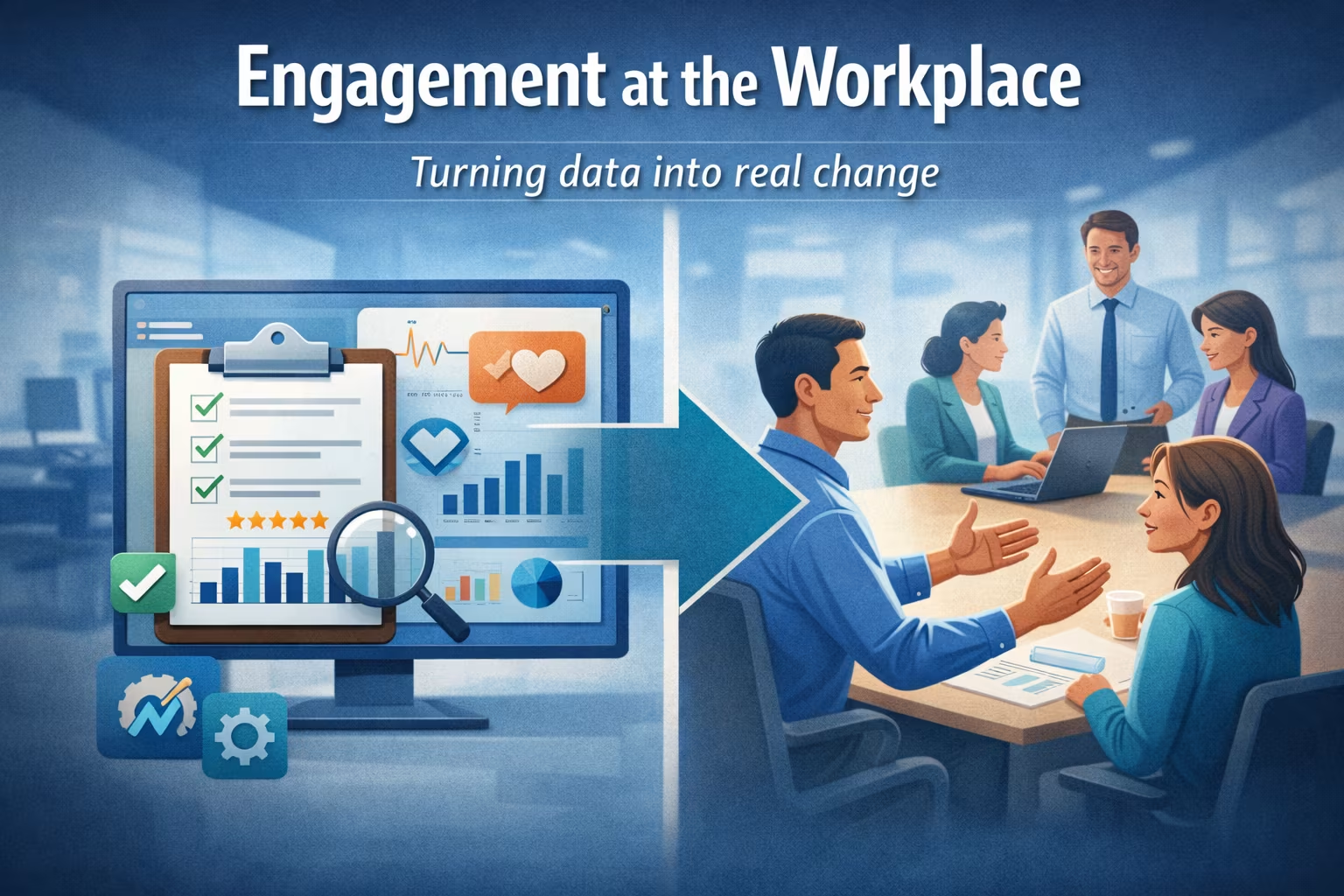
Engagement at the workplace means how connected people feel to their jobs and the company they work for. It is [...]
In today's labor market of the US, the term best organization to work for has come to mean those employers [...]


