

A company with 40 employees competes for the same candidates as a regional chain with a recognizable name. Candidates cannot see how a workplace really operates before they apply, so they look for outside signals. Employer awards are one of those signals.
Employer awards recognize how a company treats its people: culture, benefits, flexibility and employee experience. They do not recognize products or services, and they are not the same as internal employee recognition. Their value depends heavily on who issues them, how the assessment works and how the company describes the result.
This article defines the main types, summarizes what the research shows and where it falls short, and explains how owners and HR leaders at companies with 10 to 250 employees can choose, win and use an award without overclaiming.
Quick answer: Employer awards are third-party recognitions of workplace practices such as culture, benefits and flexibility. Experiments show they can raise a company’s attractiveness to applicants, especially lesser-known employers, but no verified evidence shows they cut turnover or costs. Choose programs with published criteria and clear fees, and describe the award accurately.
Key takeaways
- An employer award recognizes workplace practices. A product or service award is a different category.
- Four types exist: government or association recognitions, survey-based seals, published rankings and paid badges. Credibility differs sharply between them.
- Experimental research finds that awards raise a company’s attractiveness to applicants. Unknown employers benefited, while well-known ones saw a side effect on applicant self-selection.
- No verified evidence shows that awards reduce turnover, cut recruiting costs or improve financial results.
- The Bureau of Labor Statistics publishes quits, separations and hires rates, but no “retention rate.”
- Name the program and year, link to the criteria and disclose any paid relationship when you advertise an award.
- Measure the effect with before-and-after metrics such as applications per posting, offer-acceptance rate and quits.
What are employer awards?
An employer award is a formal recognition that an outside organization gives to an employer for its workplace practices. The assessment looks at culture, pay and benefits, flexibility, development opportunities and how employees rate their experience.
Two distinctions help. First, an award recognizes an achievement, while a seal is a certification assessed against defined standards. In practice the terms overlap, and this article uses “employer awards” for both. Second, employer awards come from outside. A program that lets a company honor its own staff, such as “employee of the month,” is internal recognition, a separate topic covered in the guide to designing employee recognition programs.
Which types of employer awards exist?
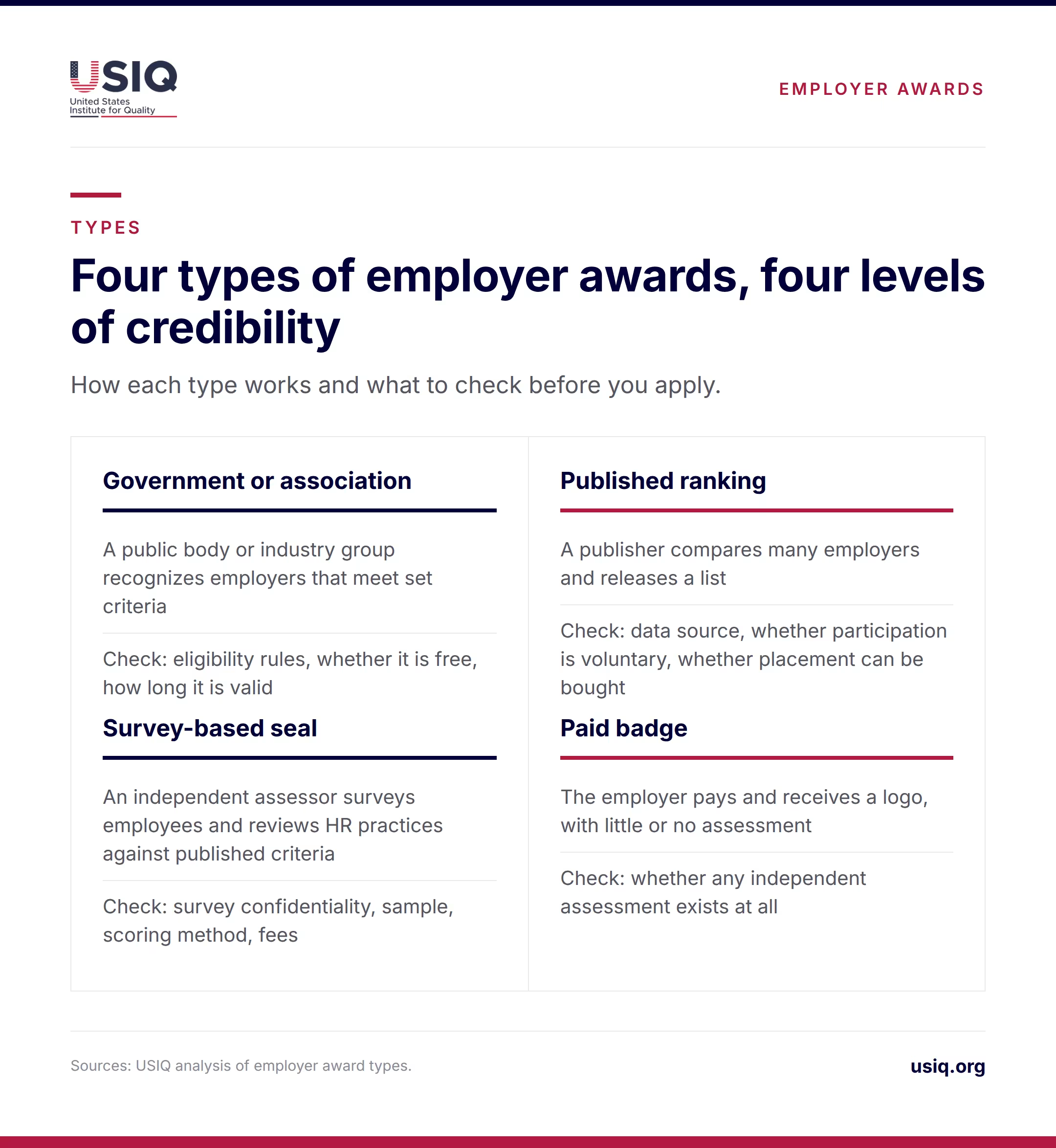
The market is mixed, and the four categories below behave differently. The differences matter most when you decide what to pursue and how to describe the result.
| Type | How it works | What to check |
|---|---|---|
| Government or association recognition | A public body or industry group recognizes employers that meet set criteria. | Eligibility rules, whether it is free, how long it is valid |
| Survey-based seal | An independent assessor surveys employees and reviews HR practices against published criteria. | Survey confidentiality, sample, scoring method, fees |
| Published ranking | A publisher compares many employers and releases a list. | Data source, whether participation is voluntary, whether placement can be bought |
| Paid badge | The employer pays and receives a logo, with little or no assessment. | Whether any independent assessment exists at all |
Disclosure: USIQ, the publisher of this article, runs certification programs of this kind. Its Top Employer and Family Friendly Employer programs are survey-based seals. They rest on a confidential employee survey and an HR interview, scored against published criteria. For a broader overview of the format, see everything you need to know about employer seals.
Do employer awards help hiring and retention?
For hiring, there is experimental evidence. A study by Baum and colleagues in the European Management Journal, “Top employer awards: A double-edged sword?”, found that awards raise an organization’s attractiveness to applicants. The same awards reduced the role of person-organization fit for well-known employers. That disturbs applicant self-selection and can lower the quality of the applicant pool. Unknown organizations did not suffer this downside and benefited from awards.
For retention and cost, the picture is thinner. The experimental evidence covers attractiveness. It does not show that awards reduce turnover, lower recruiting costs or improve financial performance. Such claims are plausible, but treat them as hypotheses to test in your own data.
What does the turnover baseline look like?
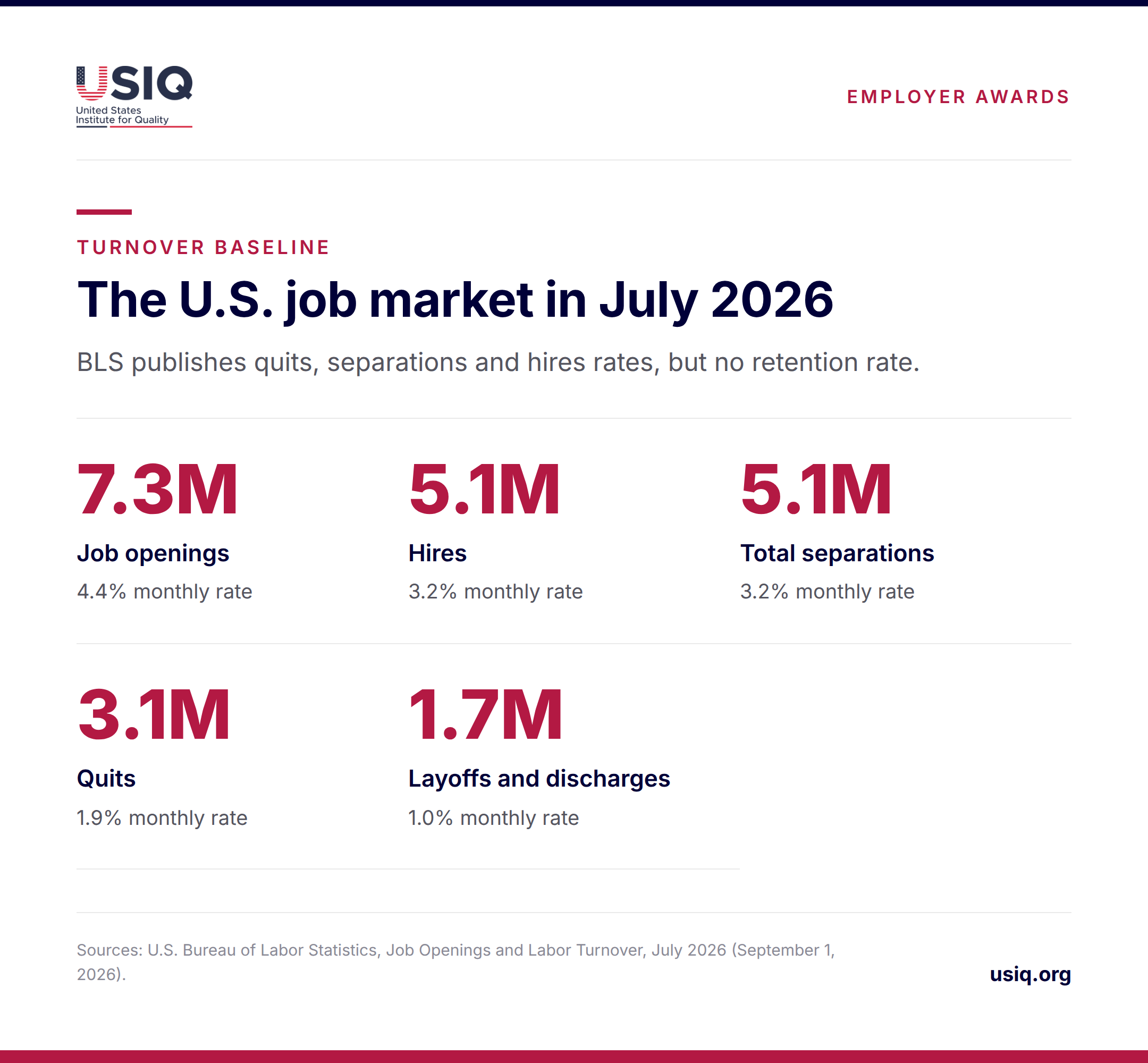
Retention claims are often built on shaky numbers. The Bureau of Labor Statistics does not publish a “retention rate.” Its Job Openings and Labor Turnover Survey (JOLTS) reports monthly rates for openings, hires, separations, quits and layoffs. BLS describes quits as generally voluntary separations initiated by the employee, and says the quits rate can serve as a measure of workers’ willingness or ability to leave jobs.
| Measure (July 2026, U.S. total) | Level | Monthly rate |
|---|---|---|
| Job openings | 7.3 million | 4.4% |
| Hires | 5.1 million | 3.2% |
| Total separations | 5.1 million | 3.2% |
| Quits | 3.1 million | 1.9% |
| Layoffs and discharges | 1.7 million | 1.0% |
Source: Job Openings and Labor Turnover, July 2026, U.S. Bureau of Labor Statistics, September 1, 2026. As an approximation, a monthly separations rate of 3.2% adds up to roughly 32% over a year when compounded (about 38% if simply multiplied by 12). Those are separations across the whole economy, not a measure of how many employees stay.
Are employer awards worth it for small and mid-sized companies?
They can be, with caveats. The Baum study found that lesser-known employers benefited from awards, while well-known employers saw the self-selection side effect. That is encouraging for a company with 10 to 250 employees that few candidates have heard of. It is one experiment, so it supports a cautious expectation, not a guarantee.
Small firms also face their own turnover patterns. JOLTS publishes rates by establishment size class (table 7 of the release). In July 2026, the 1 to 9 employee class showed a lower layoffs rate, and its quits and hires rates showed little or no change. For the 10 to 249 classes, pull the exact rates from that table and use them as your benchmark.
What are the limits?
An award does not repair a weak workplace. If employees leave because of poor management, unclear pay or burnout, a logo on the careers page will not change that, and candidates who join on the strength of the seal may leave quickly. The Baum finding adds a second limit: an award can shift who applies, and not always toward better fit.
Cost and effort vary by program. Before applying, ask for the fee in writing, the time employees will spend on a survey and the hours HR will need for the assessment. Compare those with the number of hires you plan over the next year.
How do you choose a credible employer award?
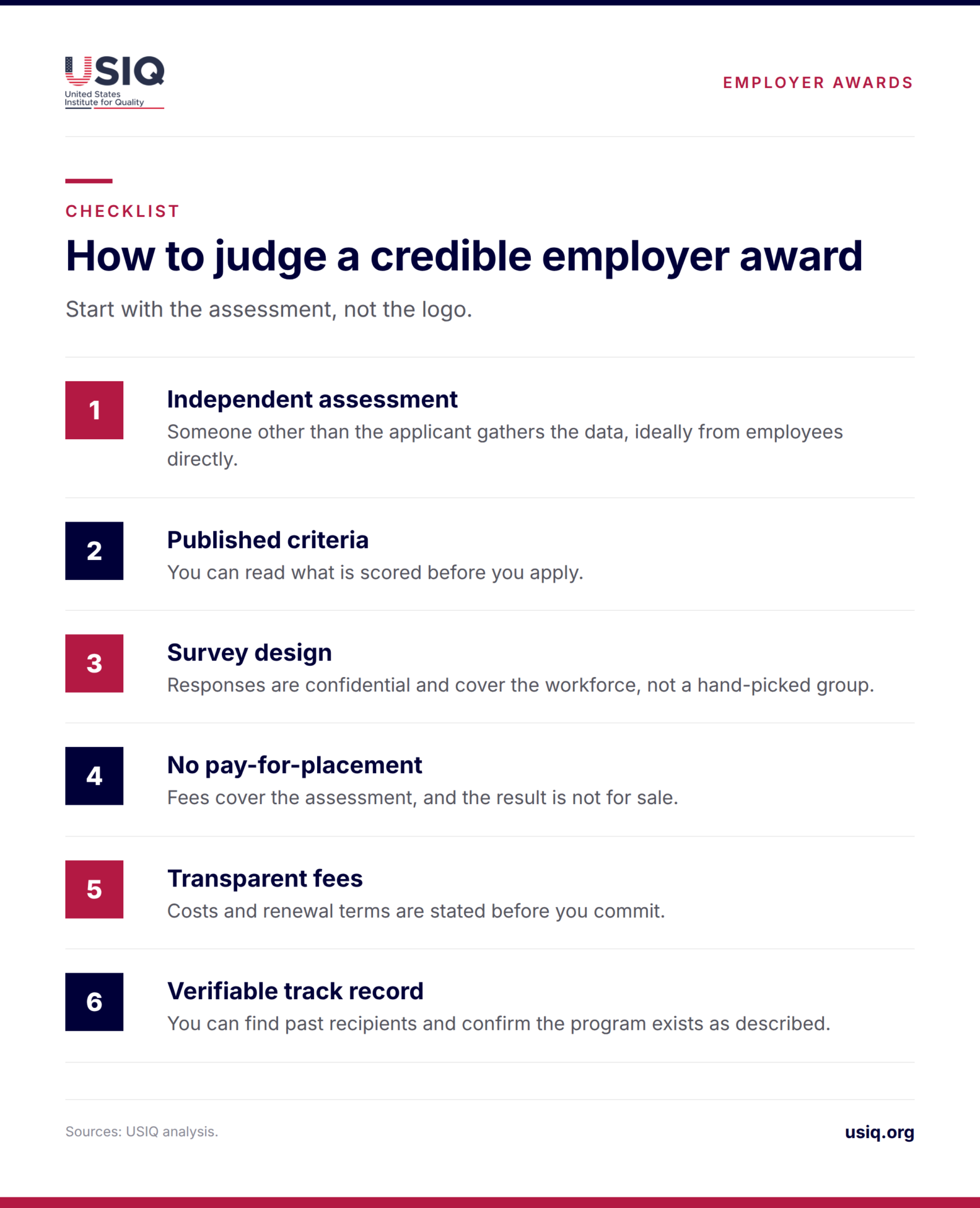
Start with the assessment, not the logo. A credible program can explain who was asked, what was measured and how the result was scored. A paid badge cannot.
- Independent assessment. Someone other than the applicant gathers the data, ideally from employees directly.
- Published criteria. You can read what is scored before you apply.
- Survey design. Employee responses are confidential and cover the workforce, not a hand-picked group. See how employee surveys build trust.
- No pay-for-placement. Fees cover the assessment, and the result is not for sale.
- Transparent fees. Costs and renewal terms are stated before you commit.
- Verifiable track record. You can find past recipients and confirm that the program exists as described.
Disclosure is the legal side of this question. The Federal Trade Commission’s guidance on endorsements, influencers and reviews covers disclosing material connections between advertisers and endorsers. A paid award or pay-to-play badge may raise exactly that question, so when in doubt, state the relationship plainly and ask counsel.
How do you win employer awards?
Winning begins before the application. Match the program to your actual strengths, read the criteria in full and back claims with specific data and examples.
- Audit your practices. Review pay, benefits, scheduling, development and management habits honestly. Employee surveys are one way to find gaps.
- Pick a program that fits. A company with strong flexible work and parental leave practices may fit a family-friendly program better than a general one.
- Read the criteria. Note what the program counts as evidence and what it ignores.
- Gather data. Collect policies, benefit descriptions and any internal metrics the HR assessment will ask about.
- Prepare employees. Explain what the survey is, that it is confidential and why participation matters.
- Complete the HR assessment. Answer from documented practice, not from intentions.
The process itself can be useful. A confidential employee survey combined with an HR assessment can surface weaknesses a company would otherwise miss, whether or not it earns the seal. That is an opinion drawn from how such programs work, not a measured result.
How does the USIQ process work?
The USIQ Top Employer and Family Friendly Employer seals use a confidential survey of employees and an HR assessment, scored against published criteria. The Family Friendly Employer assessment has a family-focused HR component. USIQ’s Top Service program is a separate certification for customer service quality and does not assess employers as workplaces.
How should you use an employer award in marketing and recruiting?
Once you hold an award, put it where candidates look, and keep each use accurate.
- Press release. Send it to local news and industry outlets, and name the program and year.
- Website and careers page. Place the seal near job listings and link to the program’s criteria.
- Job postings. Mention the award in one factual line instead of repeating superlatives.
- Email signatures and printed material. Use the official logo only, unaltered.
- Internal announcement. Credit employees, since their survey responses informed the result.
- Community events. Speak or sponsor with the award as background, not as the headline.
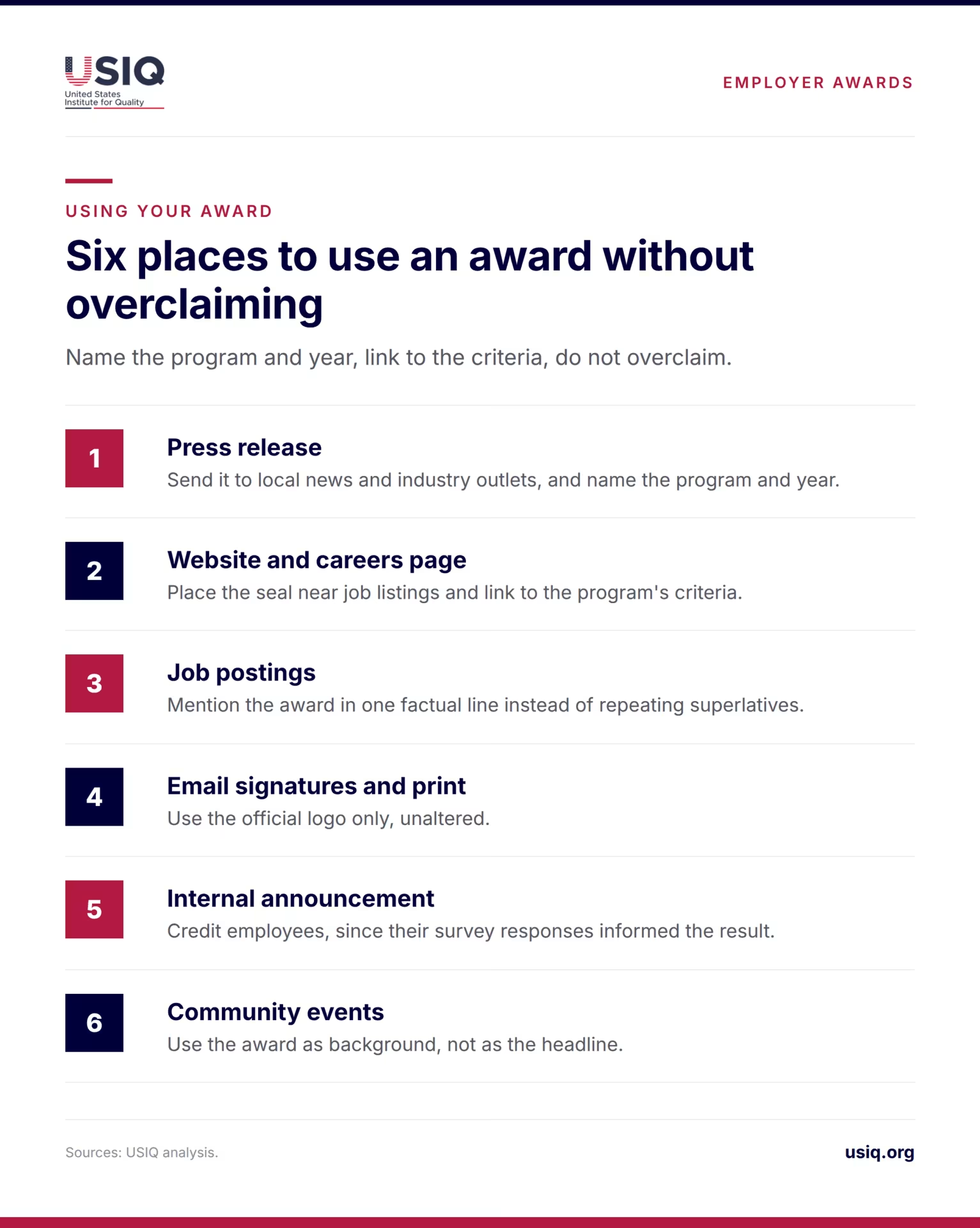
The guardrails are simple. Name the program and the year. Link to the criteria. Disclose any fee or relationship that a reader would want to know about. Do not imply that a private program is a government honor, and do not stretch the award into claims it did not assess, such as “best employer in the industry” when the program covered only participants.
The FTC’s Consumer Reviews and Testimonials Rule took effect on October 21, 2024, and authorizes courts to impose civil penalties for knowing violations. The rule concerns reviews and testimonials, but it signals that regulators now look closely at how businesses present third-party praise. For specific advertising language, ask a lawyer.
For help with display, see how to display business certificates.
How do you measure the return on an employer award?
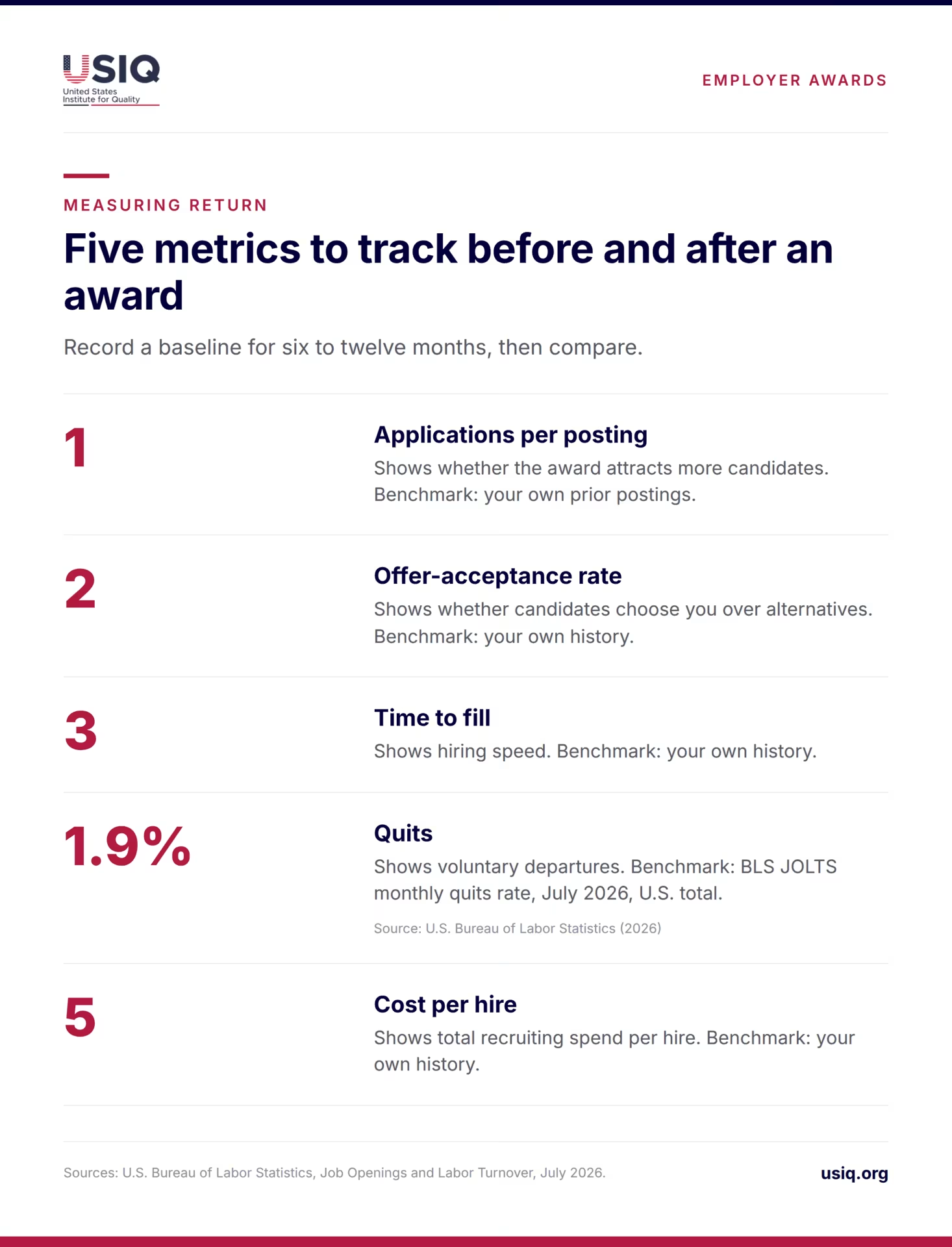
Treat the award as an experiment. Record a baseline for six to twelve months, then compare the same metrics after you publicize it. These are the most useful ones.
| Metric | What it shows | Benchmark |
|---|---|---|
| Applications per posting | Whether the award attracts more candidates | Your own prior postings |
| Offer-acceptance rate | Whether candidates choose you over alternatives | Your own history |
| Time to fill | Hiring speed | Your own history |
| Quits | Voluntary departures | BLS JOLTS quits rate (1.9% monthly, July 2026, U.S. total) |
| Cost per hire | Total recruiting spend per hire | Your own history |
For definitions and tracking tips, see the most important KPIs in recruiting.
Hiring results move with the labor market, seasonality and your own pay changes, so a clear causal effect is hard to isolate. If applications rise and offers convert better after the award, that is a reasonable sign, but not proof.
What are common misconceptions about employer awards?
“An award lowers turnover.” No verified evidence supports this. Awards may affect who applies, and retention depends on what happens after hiring.
“A high retention rate is the benchmark.” BLS does not publish a retention rate. It publishes quits, separations, hires and layoffs rates. Any single “industry retention figure” needs a clear source and definition.
“Only large companies win.” The Baum experiment points the other way: lesser-known employers benefited from awards.
“All badges are equal.” A seal based on an independent employee survey differs from a logo that can be bought.
What should employers do next?
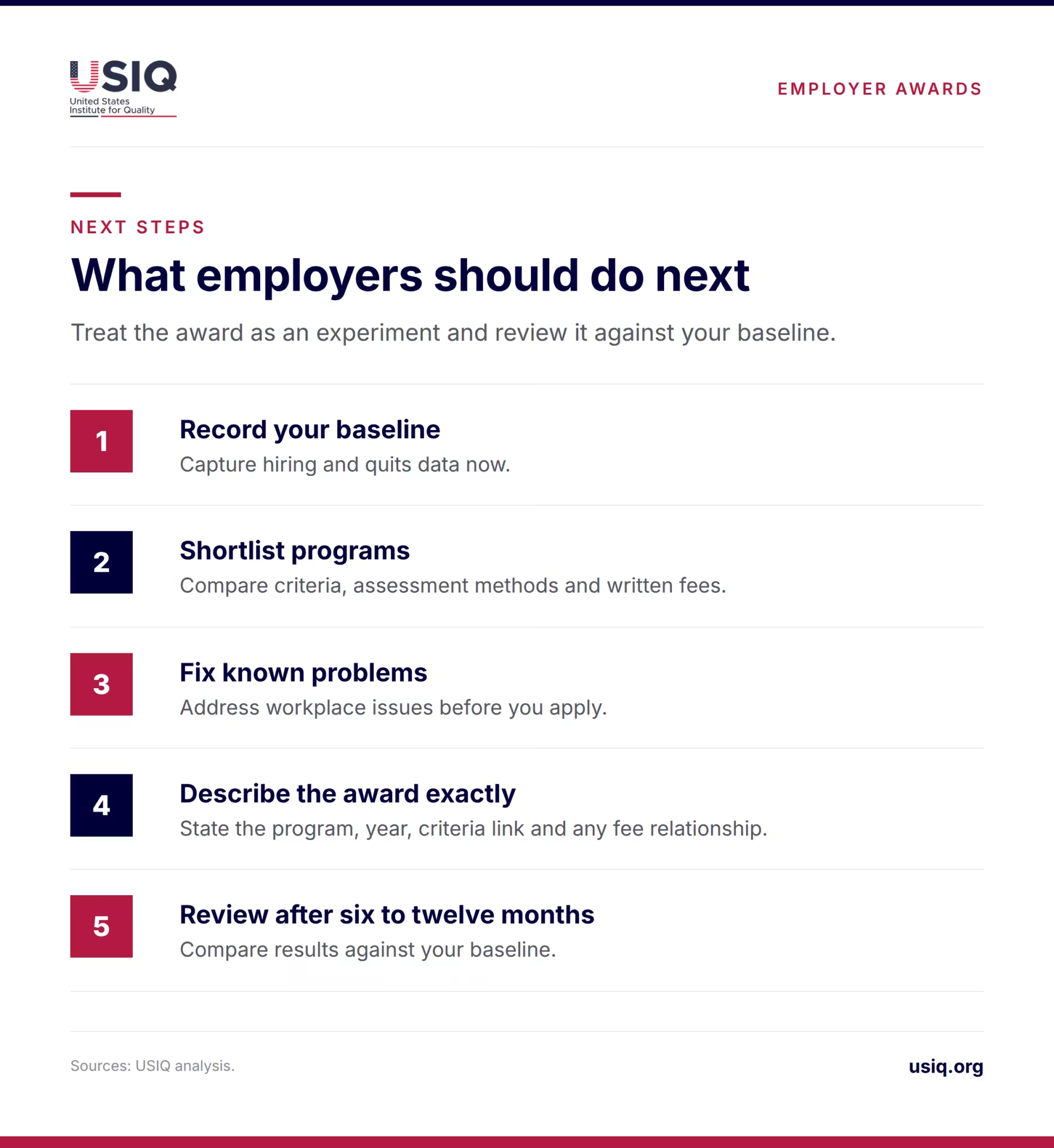
- Record your baseline hiring and quits data now.
- Shortlist programs, and compare their criteria, assessment methods and written fees.
- Fix known workplace problems before you apply.
- Describe any award exactly: program, year, criteria link, any fee relationship.
- Review the results after six to twelve months against your baseline.
An employer award is worth pursuing when it rests on an independent assessment of real practices and when you describe it accurately. The evidence supports an effect on how attractive you look to applicants, particularly if you are less well known, but not a promise of lower turnover or costs.
FAQ
What is the difference between an employer award and a seal?
An award recognizes an achievement, often chosen from a field of entries. A seal certifies that an employer was assessed against defined standards. The terms overlap in everyday use, and both recognize workplace practices. What matters is how the assessment works and whether the criteria are published.
Do employer awards reduce turnover?
No verified evidence shows that they do. Experiments show that awards can raise attractiveness to applicants. Turnover depends on management, pay, workload and fit. Track your own quits rate before and after an award, and compare it with the BLS quits rate.
Does BLS publish a retention rate?
No. The BLS JOLTS release reports monthly rates for job openings, hires, total separations, quits and layoffs and discharges. In July 2026, the total separations rate was 3.2% and the quits rate was 1.9%. Any retention figure attributed to BLS should be checked against the release.
Can a small company win an employer award?
Yes. Survey-based programs assess practices and employee feedback, not company size. Research also suggests that lesser-known employers benefit more from awards than well-known ones, though that rests on one experiment. A company with 10 to 250 employees should check each program’s eligibility rules and fees before applying.
Are paid employer awards legal, and what must be disclosed?
Paying a fee for an assessment is common. The FTC’s endorsement guidance covers disclosing material connections between advertisers and endorsers, so a paid relationship can matter when you advertise an award. State any fee or sponsorship plainly, never present a private badge as a government honor, and ask counsel about specific wording.
How should we advertise an award we won?
Name the program and year, use the official logo unaltered and link to the criteria. Keep the claim within what the program assessed. Disclose any paid relationship. The FTC’s reviews and testimonials rule took effect on October 21, 2024, and courts can impose civil penalties for knowing violations.
How do we know if an award paid off?
Compare applications per posting, offer-acceptance rate, time to fill, quits and cost per hire before and after. Use six to twelve months of baseline data. Seasonality and pay changes also affect these numbers, so treat the comparison as an indicator, not proof of cause.
What does an employee survey add to the process?
It gives the assessor, and you, a view of the workplace from the employees’ side. A confidential survey tends to produce more candid answers than an interview alone. Whatever the award outcome, the results can show where practices and employee experience diverge.
Sources
- U.S. Bureau of Labor Statistics. “Job Openings and Labor Turnover – July 2026.” September 1, 2026. https://www.bls.gov/news.release/archives/jolts_09012026.htm
- Matthias Baum et al. “Top employer awards: A double-edged sword?” European Management Journal (ScienceDirect), February 1, 2020. https://www.sciencedirect.com/science/article/abs/pii/S026323731930074X
- Federal Trade Commission. “The Consumer Reviews and Testimonials Rule: Questions and Answers.” https://www.ftc.gov/business-guidance/resources/consumer-reviews-testimonials-rule-questions-answers
- Federal Trade Commission. “Endorsements, Influencers, and Reviews.” https://www.ftc.gov/business-guidance/advertising-marketing/endorsements-influencers-reviews

Related Articles

What research says about the effects of employer seals on current employees, potential applicants and employer image, from independent experiments and field data to the limits of the evidence.
Employee experience and customer experience are linked, but the link is weaker and more conditional than popular slogans suggest. This article reviews the evidence on staffing, training and workplace conditions and shows how employers can test the connection in their own business.
Most HR dashboards show too many metrics and trigger too few decisions. This guide defines ten employee experience metrics, shows a one-page layout and explains how to read your numbers against U.S. data.
A practical guide to calculating marketing ROI for small and mid-sized U.S. companies, including long B2B sales cycles, offline leads, a spreadsheet walkthrough and common errors.


