
At a company with 40 or 80 employees, one manager is often the recruiter, the interviewer and the decision-maker. There is no HR team to design a process, so many interviews turn into friendly conversations that end with a gut feeling. Interview best practices replace that gut feeling with a method you can repeat for every candidate.
This guide builds that method step by step. It follows the structured-interview approach of the U.S. Office of Personnel Management (OPM), adds templates you can copy, and explains the federal rules on what you may and may not ask. OPM writes for federal hiring, so treat its guide as a model rather than a legal requirement for private employers.
Quick answer: The most reliable interview practice is structure. Ask every candidate the same job-related questions, rate each answer on a defined scale, score independently before any discussion, and keep notes. Sackett et al. (2022) put structured-interview validity at .42, and OPM describes the format as legally defensible.
Key takeaways
- Structure beats improvisation: the same questions for all candidates, rated on the same scale, with detailed notes.
- Unstructured interviews show low reliability and low-to-moderate validity, and the lack of standardization makes them easier to challenge legally.
- Behavioral and situational questions are both valid formats, and you can combine them.
- Federal law bars questions likely to reveal a disability before a job offer, and hiring decisions based on protected traits.
- Rating errors such as similarity bias, halo effect and leniency can be countered with training and independent scoring.
- “Culture fit” can hide bias. Replace it with values and behaviors tied to job criteria.
- Even a single manager can apply the method with a scorecard and a written debrief.
What are the interview best practices for small employers?
The core practice is a structured interview. OPM’s practical guide lists the essentials: the same questions for all candidates, detailed notes, and all responses rated on the same scale. Its training material adds that questions should follow the STAR model, which asks for the situation or task, the action taken and the result.
According to OPM, interviews used for employment decisions face the same legal and psychometric requirements as written tests. That is why standardization, job-relatedness and documentation matter. OPM states that structured interviews have shown high reliability, validity and legal defensibility, while unstructured interviews show low reliability and low-to-moderate validity.
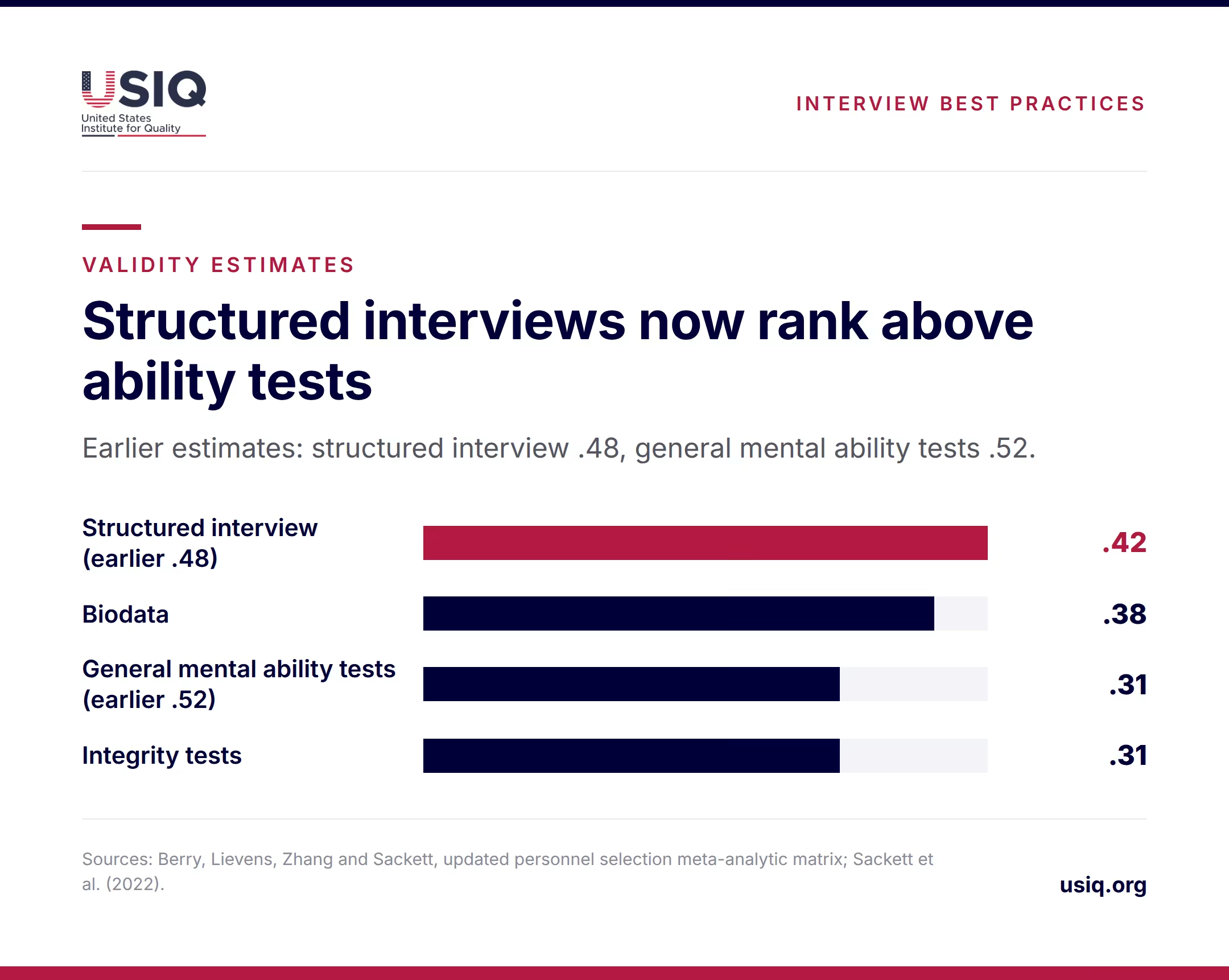
The .42 validity figure for structured interviews comes from Sackett et al. (2022) and is used in the updated personnel-selection research matrix by Berry, Lievens, Zhang and Sackett. The earlier estimate, from Roth and colleagues in 2011, was .48. In the same update, general mental ability tests fell from .52 to .31, so structured interviews now rank above them. Integrity tests came in at .31 and biodata at .38.
The eight-step overview
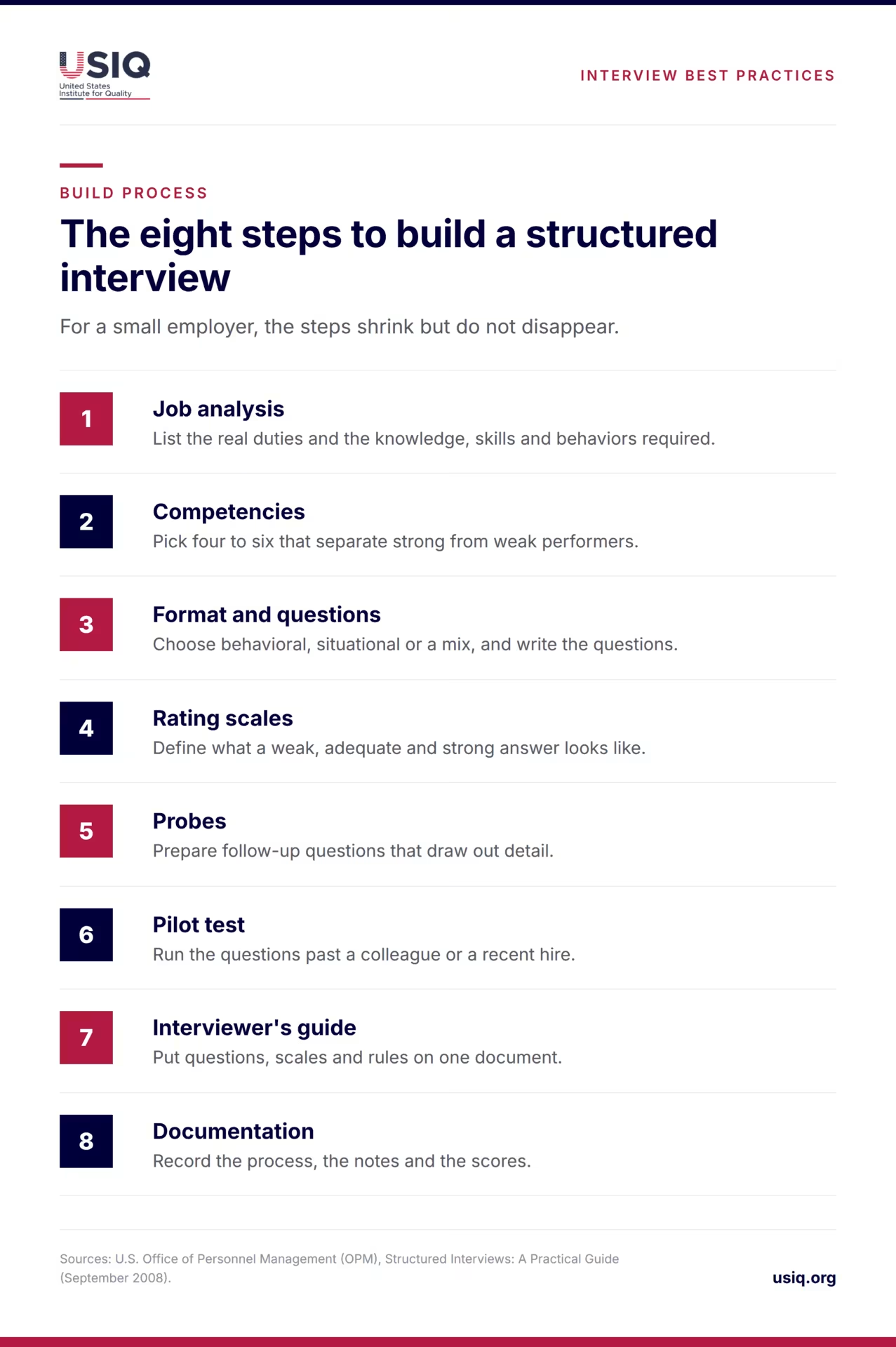
OPM’s build process has eight steps. For a small employer, the steps shrink but do not disappear.
- Job analysis: list the real duties and the knowledge, skills and behaviors the job requires.
- Competencies: pick four to six that separate strong from weak performers.
- Format and questions: choose behavioral, situational or a mix, and write the questions.
- Rating scales: define what a weak, adequate and strong answer looks like.
- Probes: prepare follow-up questions that draw out detail.
- Pilot test: run the questions past a colleague or a recent hire.
- Interviewer’s guide: put questions, scales and rules on one document.
- Documentation: record the process, the notes and the scores.
What structure does not do
A validity of .42 is strong for a selection method, but it is far from certainty. A well-run interview will still miss some good candidates and pass some weak ones. Treat the interview as one input alongside résumé review, references and any job-relevant exercise, and do not let a single impressive hour override the rest of the file.
How do you build a structured interview with a scorecard?
Start from the job, not from a list of generic questions. Write down the main duties, then derive four to six competencies. For a customer support lead at a 60-person company, these might be handling difficult customers, prioritizing under pressure, written communication, coaching others and process improvement.
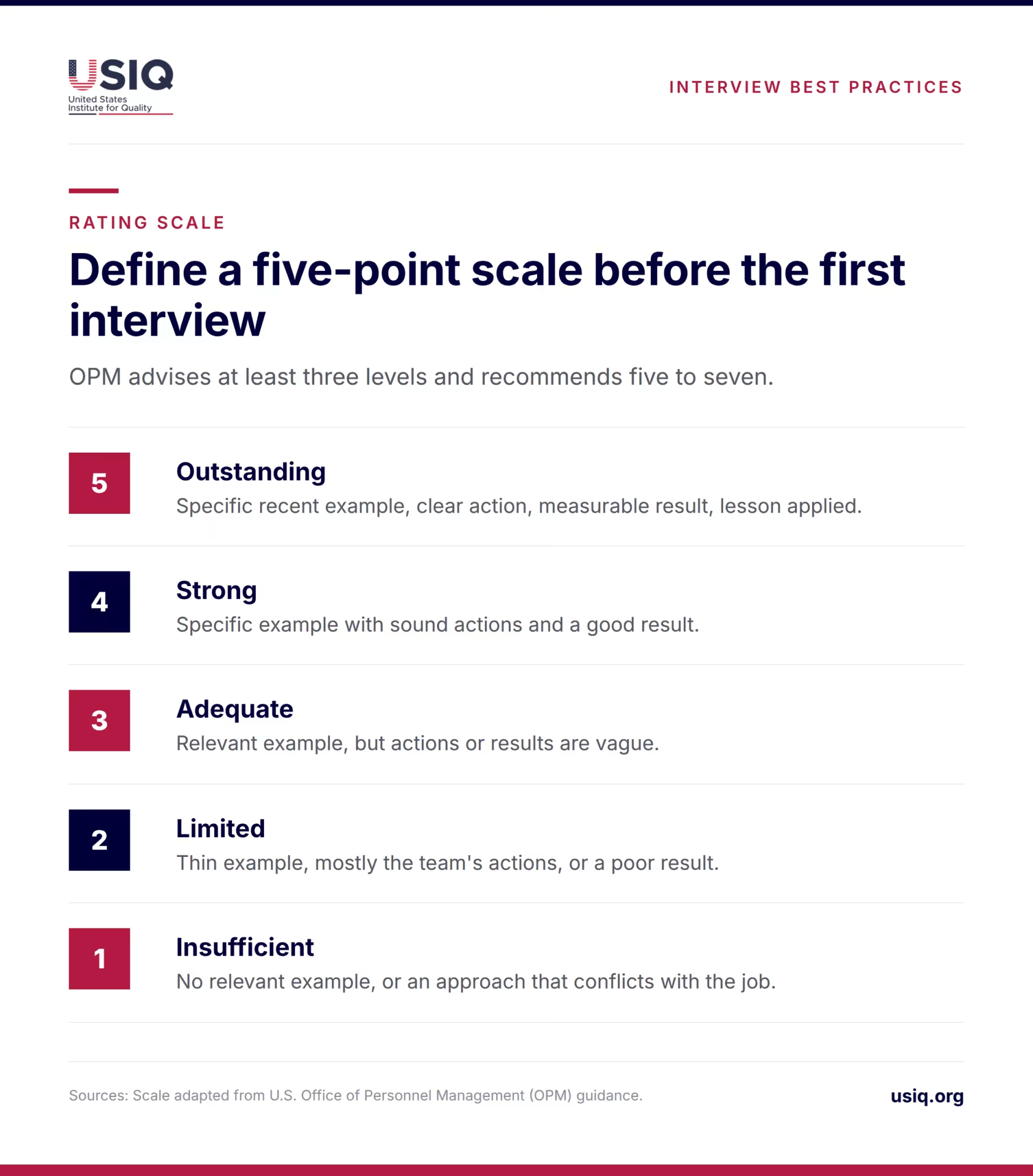
Write one or two questions per competency, plus probes such as “What did you do next?” or “What was the outcome?” Then define the rating scale before the first interview. OPM advises at least three proficiency levels, recommends five to seven, and says at least three levels should carry a label. It provides a five-level example. The table below shows a five-point scale you can adapt.
| Score | Label | What the answer shows (example: handling a difficult customer) |
|---|---|---|
| 5 | Outstanding | Specific recent example, clear personal action, measurable result, and a lesson applied later |
| 4 | Strong | Specific example with sound actions and a good result |
| 3 | Adequate | Relevant example, but actions or results are vague |
| 2 | Limited | Example is thin, mostly describes what the team did, or the result was poor |
| 1 | Insufficient | No relevant example, or the answer shows an approach that conflicts with the job |
Score each answer right after the candidate gives it, on the same scale for every candidate. Add a short notes column for what the candidate said and did, not how confident or likable they seemed.
Should you ask behavioral or situational questions?
Both. OPM defines a behavioral interview as one that asks about past behavior and a situational interview as one that presents future-oriented, hypothetical scenarios. The formats can be combined. OPM treats both as valid, so neither is automatically better.
Take the customer example. The behavioral version is: “Tell me about a time you handled a difficult customer.” The situational version is: “A long-standing customer calls angry about a late shipment and demands a refund you cannot approve. What do you do?” The behavioral version suits experienced candidates. The situational version helps when a candidate is new to the field and has little history to draw on.
Common interview questions, reframed for the interviewer
Candidates prepare for the classics, so polished answers tell you little. The table shows what each classic question is meant to reveal and a job-related alternative. Whether questions such as “Where do you see yourself in five years?” predict performance is not established, so the alternatives tie to competencies instead.
| Classic question | What it is meant to reveal | Stronger job-related version | Warning sign in an answer |
|---|---|---|---|
| Tell me about yourself | Relevant background and focus | “Walk me through the experience that best prepares you for this role’s top two duties.” | No link to the job |
| Why do you want this job? | Understanding of the role | “What part of this role would you want to do most, and what would you want to learn?” | Generic praise that fits any company |
| What are your strengths? | Self-awareness, job match | “Describe a task where you performed at your best and what made it work.” | Claims without an example |
| What are your weaknesses? | Self-awareness, development | “Tell me about a time you got critical feedback on your work. What did you change?” | No change made, or blame on others |
| Where do you see yourself in five years? | Fit of goals with the role | “Which skills do you want to build in the next two years, and how would this role help?” | Goals unrelated to anything the job offers |
| Why should we hire you? | Self-assessment against requirements | “Which of our requirements is your strongest match, and which would you need support on?” | Cannot name any requirement |
| Describe a challenge and how you handled it | Problem solving, judgment (STAR) | Same question, scored on situation, action and result | Missing action or result |
| How do you handle pressure? | Prioritization, coping | “Tell me about a week when deadlines collided. What did you do first, and what happened?” | Only abstract statements |
Rewrite leading questions too. “Are you skilled at multitasking?” invites a yes. Ask instead: “Describe a day when you had several urgent tasks at once. How did you decide what to do first?” The answer gives you something to score.
What questions can’t you ask in an interview?
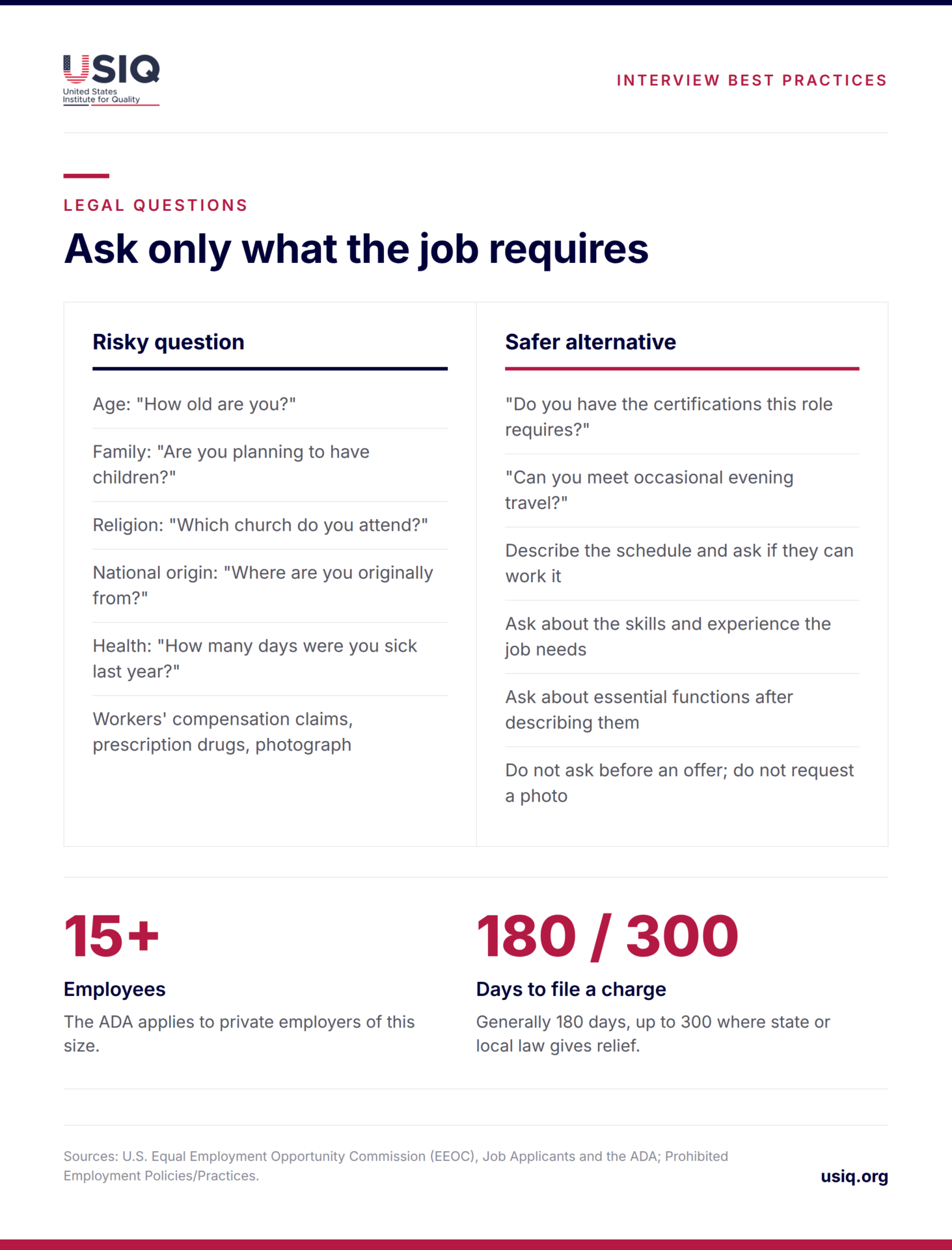
Federal law bars hiring decisions based on race, color, religion, sex (including transgender status, sexual orientation and pregnancy), national origin, age (40 or older), disability or genetic information. The Equal Employment Opportunity Commission (EEOC) says pre-employment information should be limited to what is essential to judge whether someone is qualified, and employers should not ask for a photograph.
The Americans with Disabilities Act (ADA) adds a specific rule. It applies to private employers with 15 or more employees and is enforced by the EEOC. Before a job offer, employers may not ask questions likely to reveal a disability, whether in interviews, questionnaires or medical exams. After an offer, such questions are allowed only if all applicants offered the same job are asked. State and local laws may add protections or cover smaller employers, so check them for your location.
| Topic | Risky question | Safer, job-related alternative |
|---|---|---|
| Age | “How old are you?” or “When did you graduate?” as a proxy for age | “Do you have the certifications this role requires?” |
| Family and pregnancy | “Are you planning to have children?” | “This role requires occasional evening travel. Can you meet that requirement?” |
| Religion | “Which church do you attend?” | Describe the work schedule and ask whether the candidate can work it |
| National origin | “Where are you originally from?” | Ask about the skills and experience the job needs |
| Disability and health (before an offer) | “How many days were you sick last year?” | “Can you perform the essential functions of this job, with or without accommodation?” only after you describe those functions |
| Workers’ compensation | “Have you ever filed a workers’ compensation claim?” | Do not ask before an offer |
| Medication | “Do you take any prescription drugs?” | Do not ask before an offer |
| Appearance | Asking for a photograph | Do not request one |
The sick-days, workers’ compensation and prescription-drug examples come directly from EEOC’s ADA guidance. The rest of the table applies the same principle: ask only what the job requires.
Accommodations during the hiring process
Employers may describe the hiring process to all applicants and ask whether anyone needs a reasonable accommodation for it. They generally may not ask all applicants whether they need accommodation to perform the job. EEOC lists an accessible interview location and a reader or interpreter as examples. Medical information gathered in hiring must be kept confidential, with narrow exceptions.
Discrimination charges generally must be filed within 180 days, or up to 300 days where state or local law gives relief. Notes and scorecards that show the same job-related questions were asked of everyone help an employer explain its decisions during that window.
How do you reduce bias when interviewing?
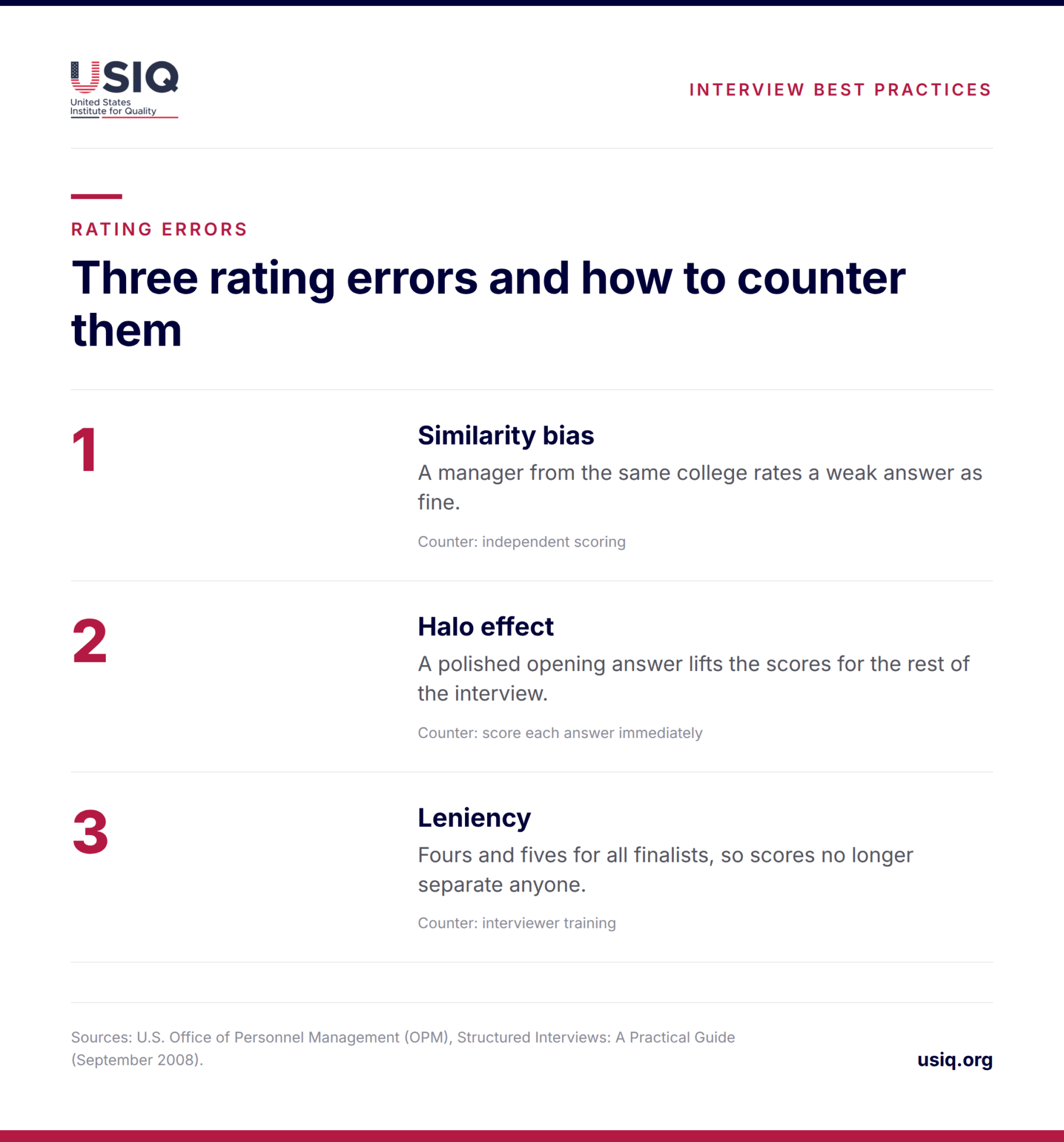
OPM lists several common rating errors, including similarity to the interviewer, halo effect and leniency. Each has a typical small-company version.
- Similarity bias: rating candidates higher because they resemble the interviewer. A manager who attended the same college rates a candidate’s weak answer as “fine.”
- Halo effect: letting one strong impression color every rating. A polished opening answer lifts the scores for the rest of the interview.
- Leniency: rating everyone high. A friendly manager gives fours and fives to all finalists, so the scores no longer separate anyone.
OPM calls interviewer training essential. It should cover note-taking, the effects of non-verbal behavior and rating errors. In practice, that means a one-hour session before a hiring round, in which interviewers practice scoring a sample answer and compare results.
Useful countermeasures:
- Score each answer right after it is given, against the written anchors.
- Rate the same competencies for every candidate.
- Score independently before any group discussion.
- Score what candidates say about job-related behavior, not their speaking pace or eye contact, which can introduce bias and have no established value as hiring signals.
Why “culture fit” needs care
“Culture fit” often means “someone like us,” which is similarity bias under a friendlier name. It becomes a channel for excluding people on traits the law protects. Define instead the values and behaviors the job requires, such as “gives direct feedback” or “shares credit with the team,” and score them with the same anchors as any other competency. For ideas on defining values in a usable way, see this overview of company values that attract top talent, and for the broader picture, diversity and inclusion as a measurable culture.
Are panel interviews better?
Not automatically. OPM’s guidance describes a panel of two or more interviewers in which each member records and rates individually and then discusses. A large panel that talks over the candidate adds pressure without adding information.
Small companies can scale this. If two managers share a team, use a two-person panel and give each a different set of competencies to probe. If one person makes the hire, rely on the scorecard and a written debrief, and consider asking a colleague to review the notes before the decision.
How do you run the interview itself?
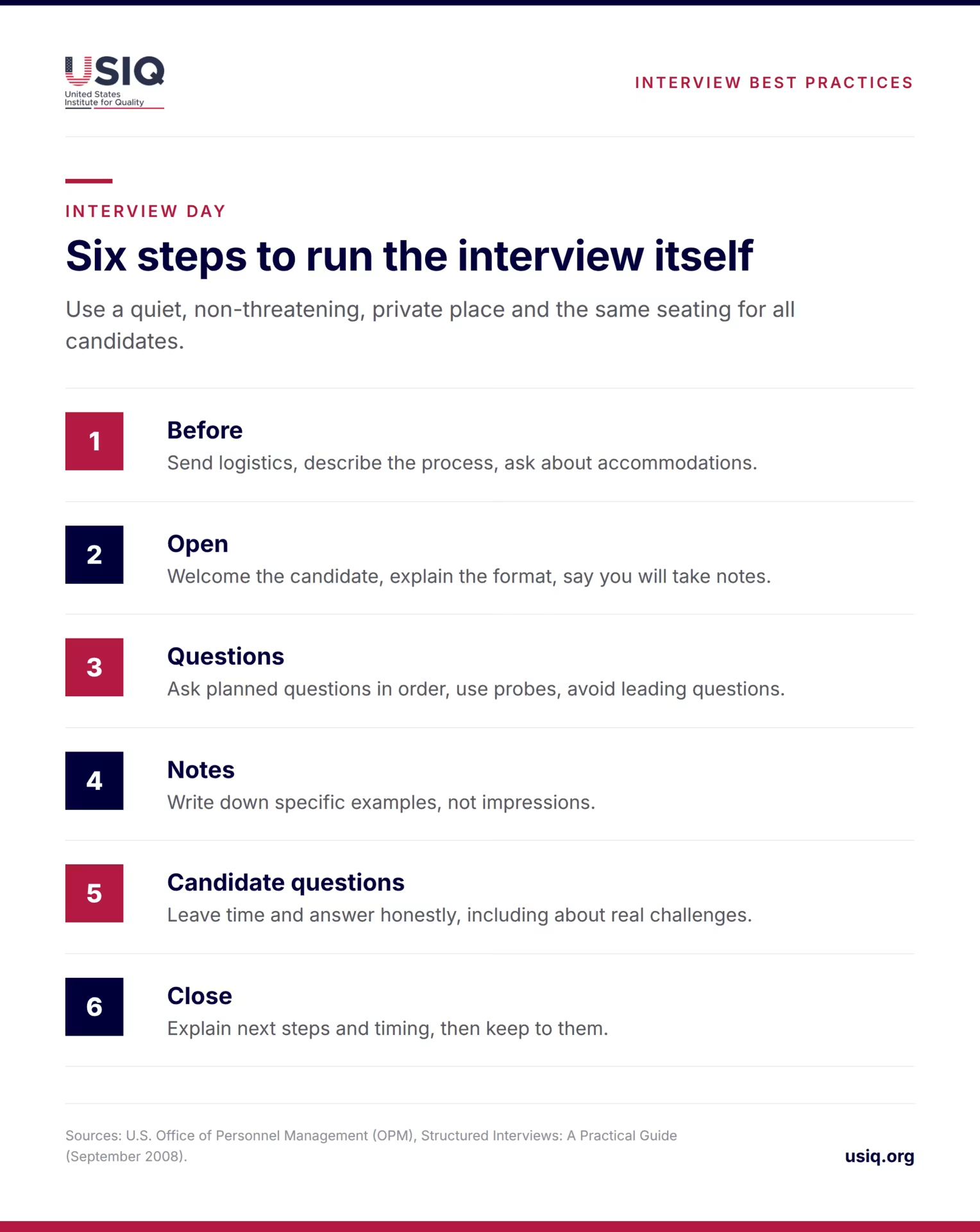
OPM recommends a quiet, non-threatening, private place and the same seating arrangement for all candidates. A video call needs the same discipline: a quiet space, the same agenda and the same questions. The structure does not change with the medium.
- Before: send logistics and describe the process. Ask whether anyone needs an accommodation for the interview itself, such as an accessible location or an interpreter.
- Open (about five minutes): welcome the candidate, explain the format, and say that you will take notes.
- Questions: ask the planned questions in the planned order, use the prepared probes, and avoid leading questions.
- Notes: write down the specific examples given and what the candidate said and did, not impressions.
- Candidate questions: leave time for them and answer honestly, including about real challenges in the role.
- Close: explain the next steps and timing, and then keep to them. Start and end on schedule.
How do you decide after the interviews?
Hold a short debrief. Each interviewer shares scores, written separately, before anyone argues for a candidate. Then discuss the competencies where scores differ, point to the notes, and decide against the criteria set before the interviews. This mirrors OPM’s panel rule: individual rating first, then consensus.
Keep the scorecards and notes. They are your record if a decision is questioned, and they show whether the process worked. Over time you can compare scores with later performance and refine the questions. Recruiting metrics such as those in the most important KPIs in recruiting can help you track the process as a whole.
Tell every interviewed candidate the outcome promptly and politely, including those you reject. It costs little and affects how people talk about your company. For the wider hiring process, see best practices in talent acquisition and how to reduce recruiting costs.
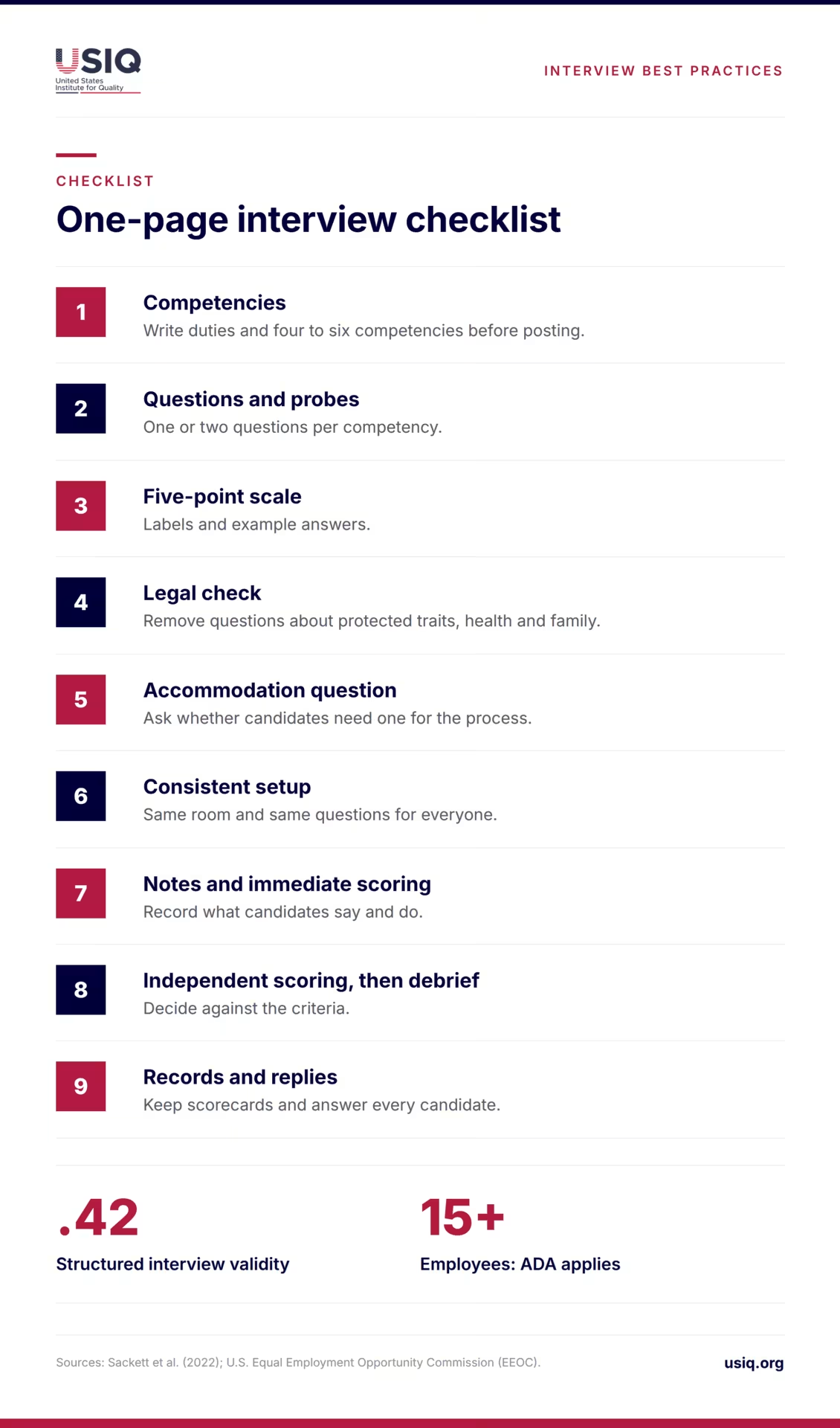
Practical recommendations: a one-page checklist
- Write down the duties and four to six competencies before posting the job.
- Prepare one or two questions per competency, with probes, in behavioral, situational or mixed format.
- Build a five-point scale with labels and example answers.
- Remove questions about protected traits, health and family. If you have 15 or more employees, remember the ADA pre-offer rule.
- Describe the process to candidates and ask whether they need an accommodation for it.
- Use the same room setup and the same questions for every candidate.
- Take notes on what candidates say and do, and score each answer immediately.
- Score independently, then debrief, then decide against the criteria.
- Keep scorecards and notes, and answer every candidate.
Conclusion
Good interviewing is a process, not a talent. Decide in advance what the job requires, ask everyone the same questions, score against written anchors and discuss only after scoring.
FAQ
Can small companies use structured interviews?
Yes. The method scales down. A manager hiring alone needs four to six competencies, a handful of prepared questions, a five-point scale and a notes sheet. A colleague can review the notes before the decision. Skipping the formal pilot test and long guide is acceptable if the questions and scoring anchors are written down.
What is the difference between a behavioral and a situational question?
A behavioral question asks about past behavior, such as “Tell me about a time you handled a difficult customer.” A situational question presents a hypothetical scenario and asks what the candidate would do. OPM treats both as valid and notes that you can combine them in one interview.
Do the ADA interview rules apply to my company?
The ADA applies to private employers with 15 or more employees. Below that size, federal ADA rules may not apply, but state or local laws can cover smaller employers. Asking only job-related questions is sensible at any size, and you should check your state’s rules.
Can I ask candidates whether they need an accommodation?
You may describe the hiring process to all applicants and ask whether they need a reasonable accommodation for it, such as an accessible interview location or an interpreter. You generally may not ask all applicants whether they need accommodation to perform the job before an offer, according to EEOC guidance.
Is an unstructured conversation ever fine?
As a first, informal conversation, yes, if you ask nothing that touches protected traits or health. It should not drive the decision. OPM describes unstructured interviews as having low reliability and low-to-moderate validity, so base the decision on a structured round with scored answers.
How many interviewers should be in the room?
OPM’s guidance describes a panel of two or more. Each interviewer records and rates individually, then the group discusses. A larger panel is not automatically more reliable, and a single trained interviewer with a scorecard is workable at a small company, ideally with a colleague reviewing the notes.
What should I write in my interview notes?
Write down what the candidate said and did that bears on each competency: the situation, the action and the result. Leave out guesses about personality, appearance or confidence. OPM’s note-taking guidance covers body language and other non-verbal factors, so interviewers should be trained on how they affect ratings.
Can structured interviews be challenged legally?
Any hiring decision can be challenged. OPM states that interviews used for employment decisions face the same legal and psychometric requirements as written tests, and that structured interviews have shown legal defensibility. Job-related questions, consistent scoring and kept records give an employer a clear account of how it decided.


Sources
- U.S. Office of Personnel Management (OPM), “Structured Interviews: A Practical Guide,” September 2008. https://www.opm.gov/policy-data-oversight/assessment-and-selection/structured-interviews/guide.pdf
- U.S. Office of Personnel Management (OPM), “Structured Interviews” (training presentation). https://www.opm.gov/policy-data-oversight/assessment-and-selection/structured-interviews/structured-interviews.pdf
- Berry, Lievens, Zhang and Sackett, “Insights from an Updated Personnel Selection Meta-analytic Matrix” (manuscript APL-2022-4078 R3). https://filiplievens.squarespace.com/s/APL-2022-4078_R3.pdf
- U.S. Equal Employment Opportunity Commission (EEOC), “Job Applicants and the ADA,” issued October 7, 2003. https://www.eeoc.gov/laws/guidance/job-applicants-and-ada
- U.S. Equal Employment Opportunity Commission (EEOC), “Prohibited Employment Policies/Practices.” https://www.eeoc.gov/prohibited-employment-policiespractices
Related Articles
Our quality management system passed an independent ISO 9001:2015 audit by QRO Certification LLP. What the audit covered and what it means for companies we certify.
What research says about the effects of employer seals on current employees, potential applicants and employer image, from independent experiments and field data to the limits of the evidence.
Employee experience and customer experience are linked, but the link is weaker and more conditional than popular slogans suggest. This article reviews the evidence on staffing, training and workplace conditions and shows how employers can test the connection in their own business.
Most HR dashboards show too many metrics and trigger too few decisions. This guide defines ten employee experience metrics, shows a one-page layout and explains how to read your numbers against U.S. data.