

Employer attractiveness is how appealing a company is to job candidates and to the people who already work there. It shows up in who applies, who accepts an offer and who is still around two years later. The question behind the term is practical: why would a good person choose your company and stay?
Small and mid-sized U.S. employers face this question with few recruiters, no brand department and larger competitors that can outbid them on pay. This article sets out what current U.S. data says about what draws people in and what pushes them out. It also covers what benefits cost, which state rules on pay ranges apply, and how a company with 10 to 250 employees can improve and measure its position.
Awards and perks are not part of the definition. A seal or a snack bar can support a good employer reputation, but neither replaces clear expectations, fair pay and managers who care.
Quick answer: Employer attractiveness rests on fair pay, visible chances to advance, respectful and clear management, and workable flexibility. Pay and advancement top the reasons U.S. workers give for quitting, while Gallup finds that feeling cared about and knowing what is expected are eroding. Small firms can improve all of these at modest cost.
Key takeaways
- Attractiveness has an external side (applicants and offer acceptance) and an internal side (engagement and retention). Each feeds the other.
- Gallup reports that 31% of U.S. employees were actively engaged in 2025, down from a 2020 high of 36%.
- In a Pew Research Center survey, 63% of workers who quit in 2021 cited low pay, 63% cited no opportunities for advancement and 57% cited feeling disrespected.
- Benefits make up 30.0% of private-industry compensation cost, or $14.07 of $46.89 per hour worked (BLS, June 2026), so targeted benefits beat blanket perks.
- Pay-range disclosure laws now reach employers with as few as 4 employees in some places. They are both a compliance duty and an attraction lever.
- Manager quality and role clarity matter more than most perks, and they cost little to improve.
- Measure with a few simple indicators, such as offer acceptance, first-year turnover and an anonymous pulse survey, and read the results with caution in very small teams.
What is employer attractiveness and why does it matter for a small company?
Employer attractiveness describes the pull a company exerts on two groups. External attractiveness is the appeal to people who might apply. Internal attractiveness is the appeal to people who already work there, and it shows in their engagement and their decision to stay.
The two sides feed each other. Current employees describe the company to friends, answer reference calls and write reviews, so a workforce that is losing interest weakens the external picture. In the other direction, an employer that attracts applicants who understand the job in advance tends to start new hires on firmer footing. Most small companies neglect one of the two sides.
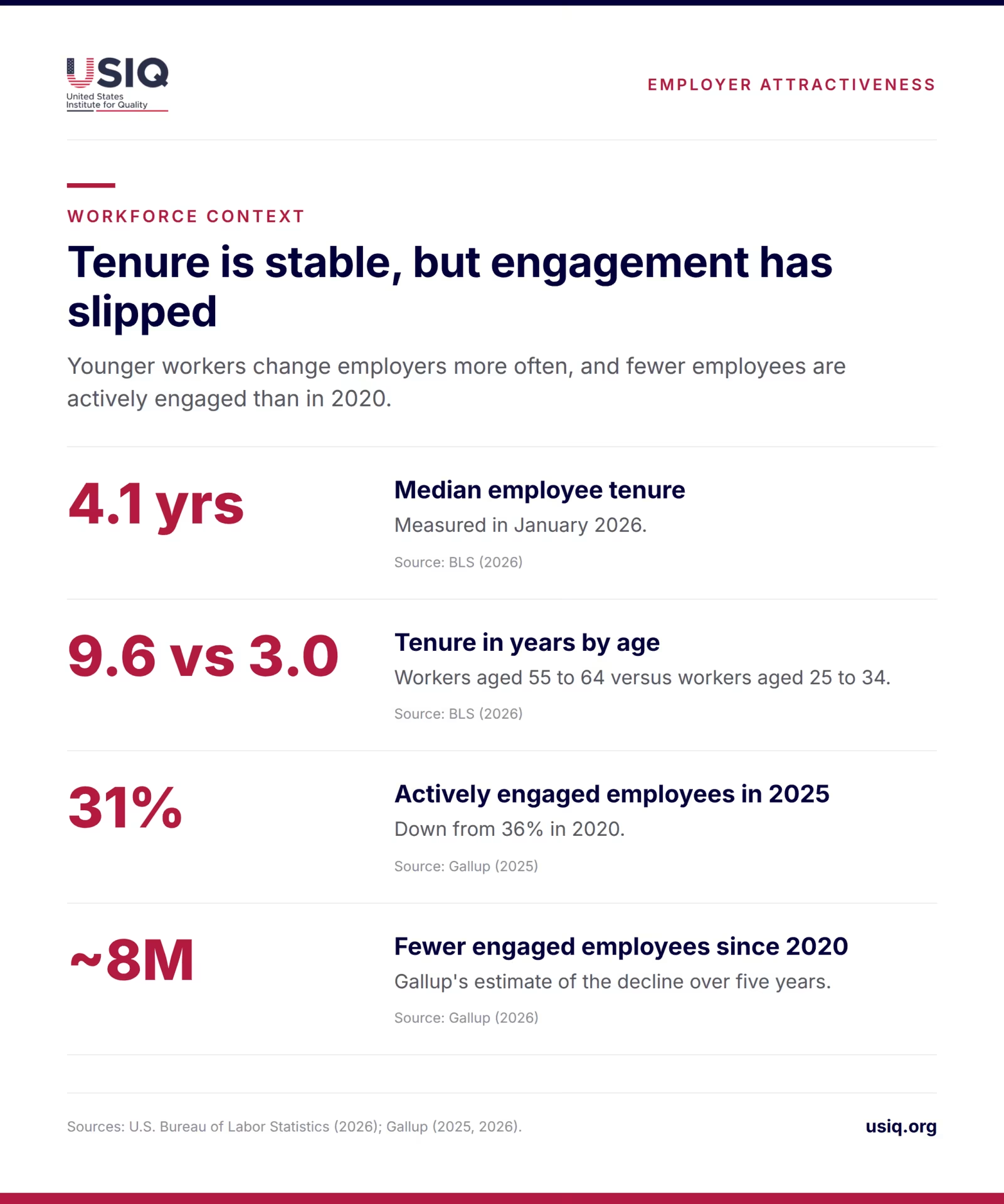
Two national data points show what is at stake. The Bureau of Labor Statistics reports that median employee tenure was 4.1 years in January 2026, up from 3.9 years in January 2024. The gap between age groups is wide: workers aged 55 to 64 had a median tenure of 9.6 years, while workers aged 25 to 34 had 3.0 years. Younger workers change employers more often, so firms that rely on them have to earn their loyalty repeatedly. The BLS tenure release also shows men at 4.3 years and women at 4.0 years.
Gallup’s 2025 employee engagement survey found that 31% of U.S. employees were actively engaged, unchanged from 2024 and down from a 2020 high of 36%. Gallup puts that decline at about 8 million fewer engaged employees over five years. In its report on the decline from the 2020 peak, Gallup notes that engagement among Gen Z and younger millennials fell 8 points over the period.
These figures describe the climate, not a guaranteed return. Attention to the workplace is thin in many companies, which leaves room for a smaller employer to stand out.
What actually makes an employer attractive to workers?
The clearest evidence comes from people who left. A Pew Research Center survey conducted February 7 to 13, 2022, asked U.S. workers who quit a job in 2021 why they did. The results, published by Pew on March 9, 2022, are dated, but they still show the order of priorities.
| Reason for quitting a job in 2021 | Share of quitters citing it |
|---|---|
| Low pay | 63% |
| No opportunities for advancement | 63% |
| Feeling disrespected at work | 57% |
| Lack of flexibility to choose hours | 45% |
| No good benefits, such as health insurance and paid time off | 43% |
| Child care issues (among those with a child under 18) | 48% |
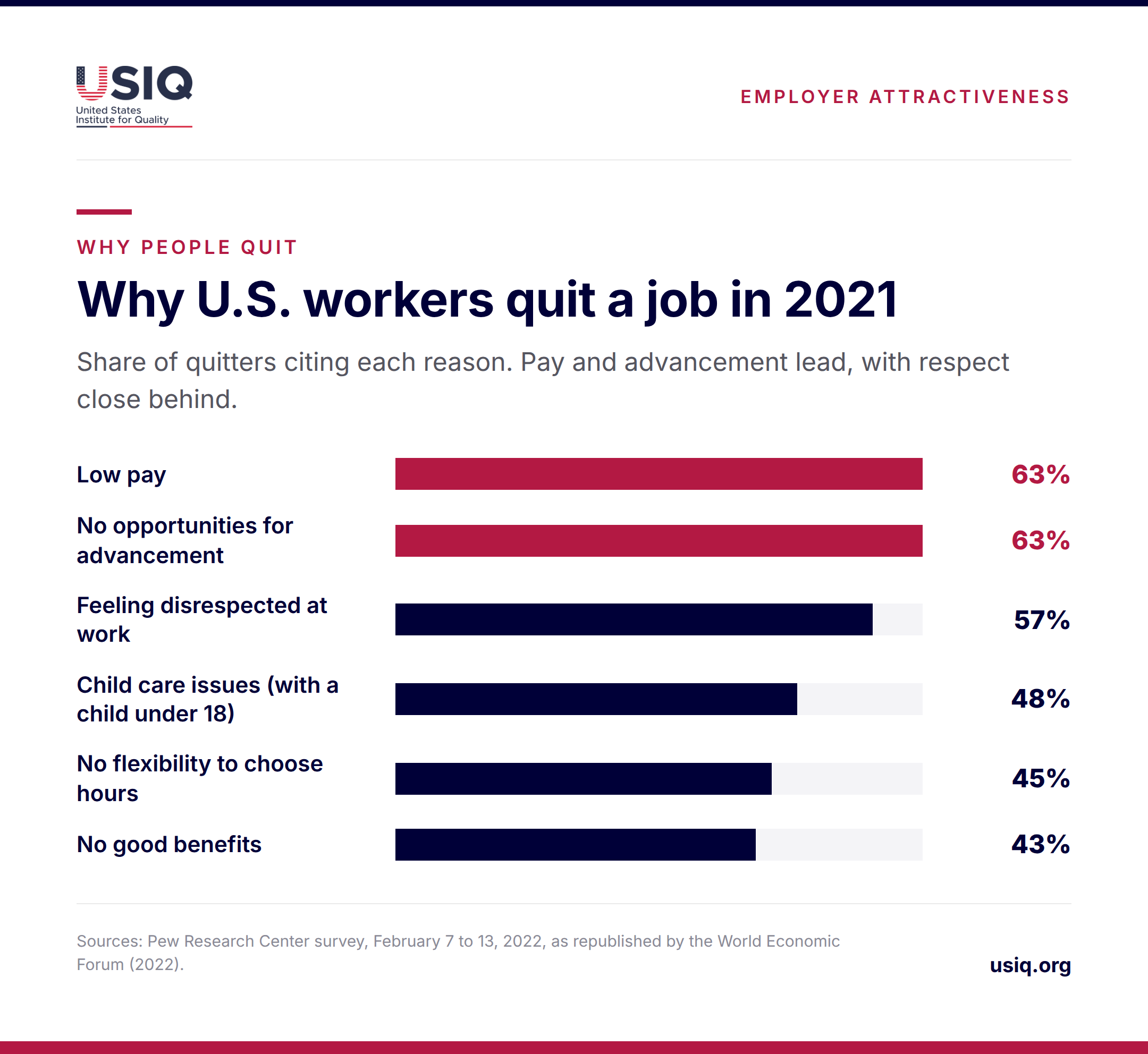
Pay and advancement lead, with respect close behind. The survey covers people who quit during a tight labor market, so it does not describe today’s workforce. It does show that no single factor carries a job on its own.
Manager quality and clarity
“Good management” and “trust in management” are often listed as separate building blocks. They describe one thing: whether the person a worker reports to is clear, fair and interested in them. Gallup’s data points to exactly this area. Among all U.S. employees, role clarity (knowing what is expected) and feeling cared about show the largest declines of any engagement item since 2020.
The pattern is sharper for younger workers. Among Gen Z and younger millennials, the share who strongly agree that their supervisor or someone at work seems to care about them as a person fell from 54% in 2020 to 41% in 2025. The share who strongly agree they have opportunities at work to learn and grow fell from 48% to 37%.
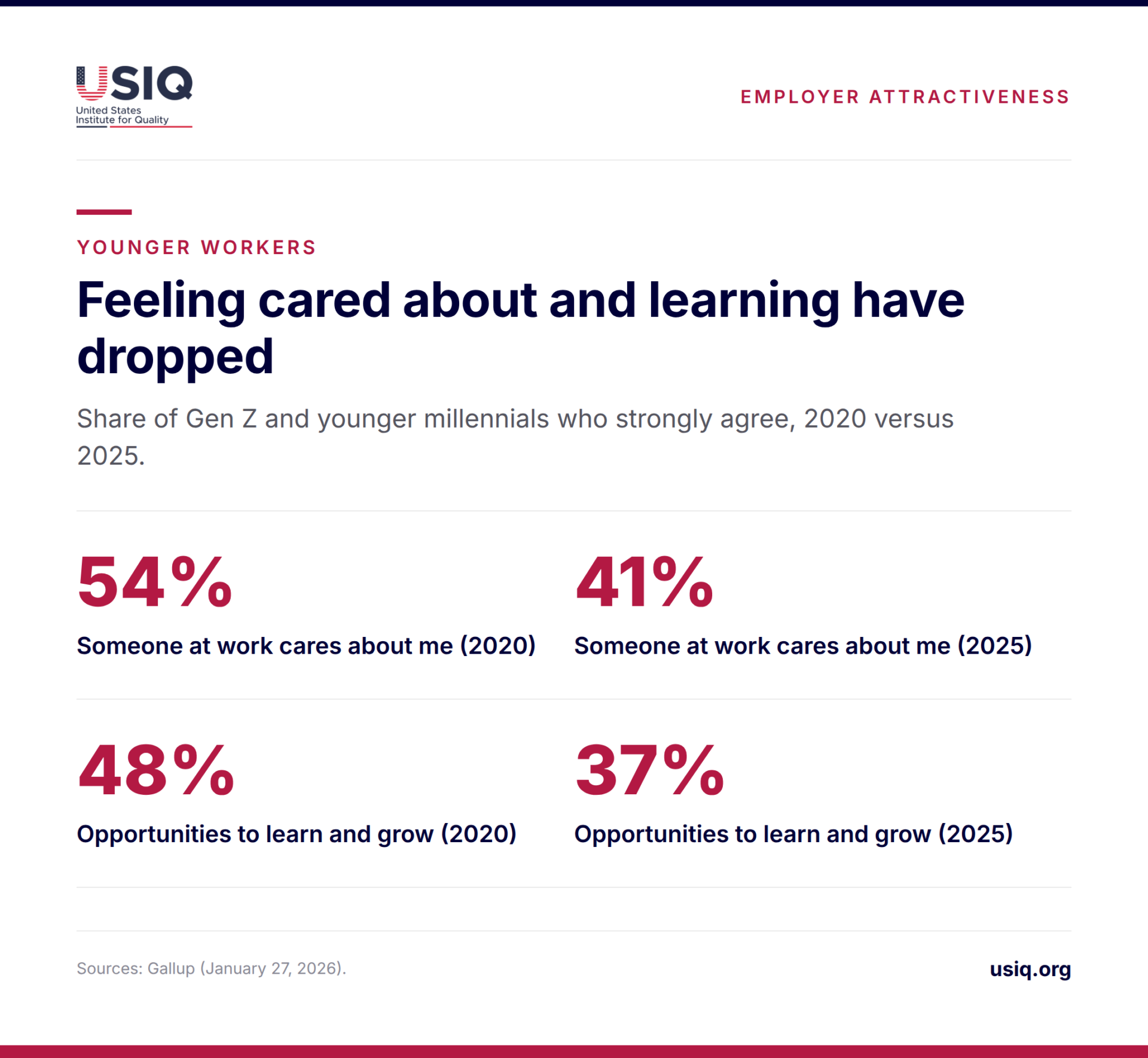
Pay may get people in the door, but these items shape whether they stay, and they cost far less than a raise. A weekly one-on-one conversation, a written statement of what each role is expected to deliver, and a visible path to the next role are management habits, not budget lines.
How much do pay and benefits matter, and what do they cost?
Pay and benefits are necessary but not sufficient. Candidates who find the pay clearly below market will usually not apply, and the exit data above shows that low pay still drives departures. What a small employer can control is how it spends its compensation budget.
The BLS reports that private-industry employer compensation costs averaged $46.89 per hour worked in June 2026. Wages and salaries accounted for $32.82 (70.0%) and benefits for $14.07 (30.0%). For full-time workers, total compensation averaged $54.00 per hour, of which benefits were $17.03. For part-time workers the figures were $25.20 and $5.05. The details are in the BLS Economics Daily item of September 17, 2026.
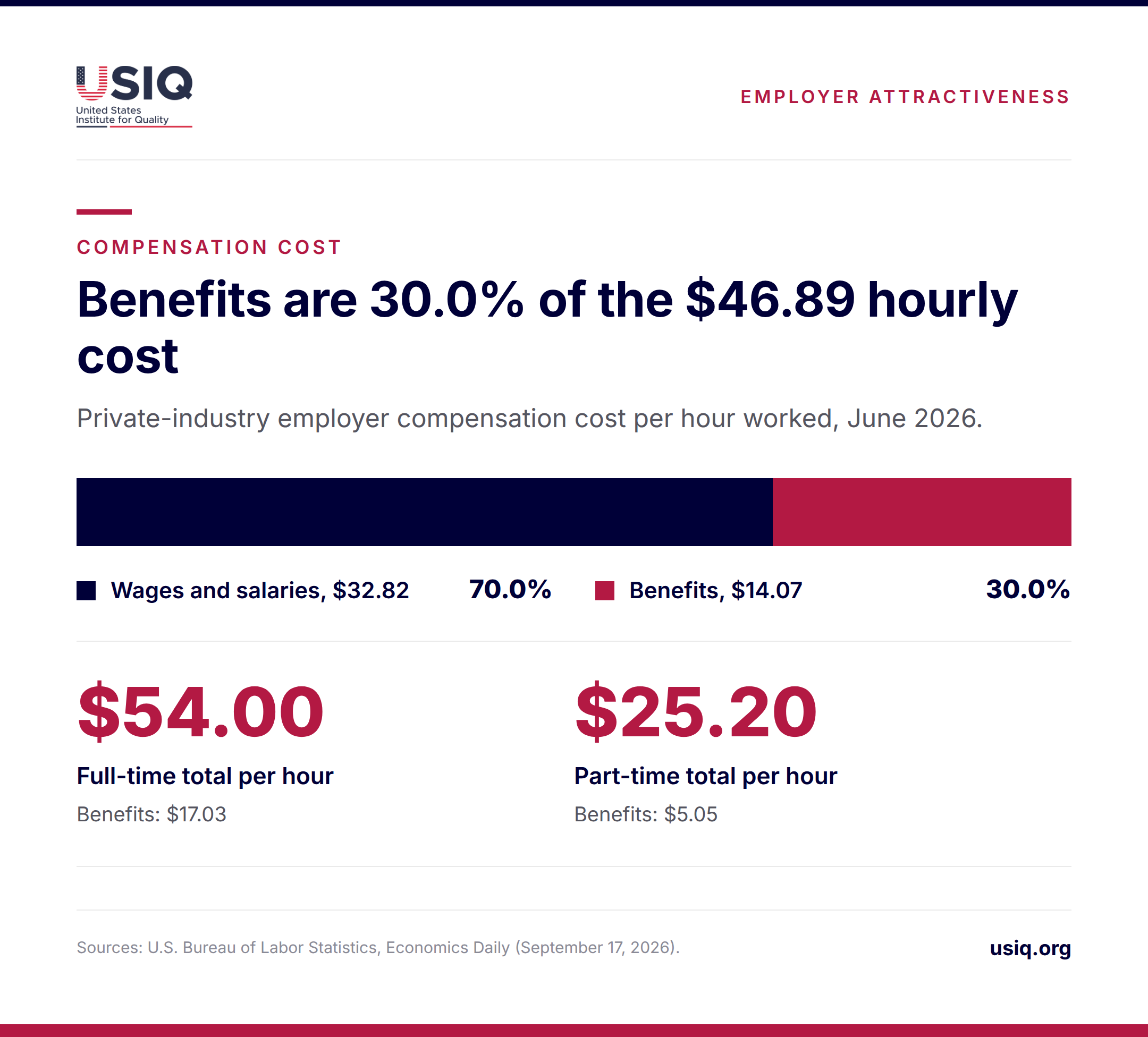
Benefits are close to a third of what employers already spend on each hour of work, so the question is less “should we add perks?” than “does this spending reach what our people value?” A 40-person trades firm may get more from predictable scheduling and a clear training path than from a gym stipend. A professional services firm with many parents on staff may find that child care help matters more than snacks. Asking employees which benefits they use and value before adding new ones avoids spending on things nobody asked for.
Do flexibility and remote work still matter?
Yes, but the meaning depends on the job. The BLS found that 22.6% of workers teleworked or worked at home for pay in March 2026, and the rate stayed between 21.5% and 23.0% over the preceding year (October 2025 data were unavailable). The BLS item of April 16, 2026 describes a stable pattern. Telework is common, but most workers do not do it.
That split matters for small employers. If most of your staff work on site, such as in a clinic, a shop or on job sites, remote options will not set you apart. Flexibility has to take other forms: shift swaps between colleagues, schedules published well in advance, a say in start times, or compressed weeks where the work allows. Pew’s data fits this reading, since 45% of 2021 quitters said they lacked the flexibility to choose their hours, which is a broader point than working from home.
For roles that can be done remotely, the trade-offs are real: coordination costs, weaker mentoring and uneven access to managers. USIQ has covered the benefits of remote workers and the pull in the other direction in its piece on the return to the office. Whatever the policy, the clearest signal to candidates is a rule that is written down and applied consistently.
How do small employers become more attractive without a big budget?
What fits depends on company size. A 12-person firm has no HR department but can hire fast and speak to every employee. A 220-person firm has more structure but also more distance between leaders and staff. The table below suggests where to start at each size. These are practical suggestions, not benchmarks.
| Company size | Start here | Add next |
|---|---|---|
| 10 to 25 employees | Job ads with a clear role description and pay range; fast, courteous hiring; regular one-on-ones between owner or manager and each employee | A written statement of expectations for each role; a simple thank-you routine |
| 26 to 100 employees | A visible development path for key roles; a referral program with a monetary or non-monetary reward; a recognition routine | Mentoring pairs; a short anonymous pulse survey twice a year |
| 101 to 250 employees | Structured onboarding; basic training for new managers; a small dashboard of people metrics | Formal career frameworks; stay interviews for key staff; a review of benefits against what staff use |
The U.S. Chamber of Commerce’s small business guide to attracting employees (January 23, 2026) recommends referral programs with monetary or non-monetary rewards. It also notes that candidates are wary of “bait-and-switch” job listings: 72%, according to a 2025 Greenhouse report cited by the Chamber. A listing that matches the real job, pay and schedule is cheap to produce and removes a common reason for distrust.
Low-cost habits that tend to work
- Keep communication open. Make clear that employees can raise concerns, and respond when they do. Give feedback regularly and specifically, framed so that people can act on it.
- State expectations. Write down what each role is expected to deliver. Role clarity is one of the items Gallup finds declining fastest.
- Invest in learning. Pair newer employees with experienced mentors and fund training that connects to a next role. Younger workers’ views on learning opportunities have dropped.
- Involve staff in decisions. Hold regular team meetings in which employees present ideas, and delegate real responsibility to capable people.
- Recognize good work. A specific, timely note of thanks costs nothing. For larger programs, see USIQ’s guide to employee recognition programs.
- Support health and safety. Mental health resources, sensible workloads and ergonomic workstations signal that the employer pays attention to wellbeing. Choose measures that fit your workforce rather than copying a large company’s menu.
- Lead by example. Owners and managers who behave ethically, work to the standard they expect and stay professional under pressure set the tone more reliably than any policy.
- Hire and assign on merit. Use clear, job-related criteria for hiring and promotion, applied the same way to every candidate, and document the reasons. Check current legal guidance with an employment lawyer or the relevant agency.
For more on building a reputation with limited funds, see USIQ’s articles on building a strong employer brand on a small budget and on how employer branding works.
Do I have to post salary ranges in job ads?
It depends on where you hire and how many people you employ. A growing number of states and cities require pay ranges in job postings, and some thresholds are very low. Pay ranges also work as an attraction tool, since candidates can judge a job’s fit before applying. The table below summarizes the thresholds that Brightmine’s state-by-state overview lists as of October 27, 2026.
| Jurisdiction | Employer size at which the law applies |
|---|---|
| New York | 4 or more employees |
| Vermont | 5 or more employees |
| Maine, New Jersey | 10 or more employees |
| California, Washington, Illinois (postings) | 15 or more employees |
| Massachusetts | 25 or more employees |
| Minnesota | 30 or more employees |
| Hawaii | 50 or more employees |
| Colorado, Connecticut, Maryland, Nevada, Rhode Island, Virginia, District of Columbia | All employers, or employers with at least one employee |
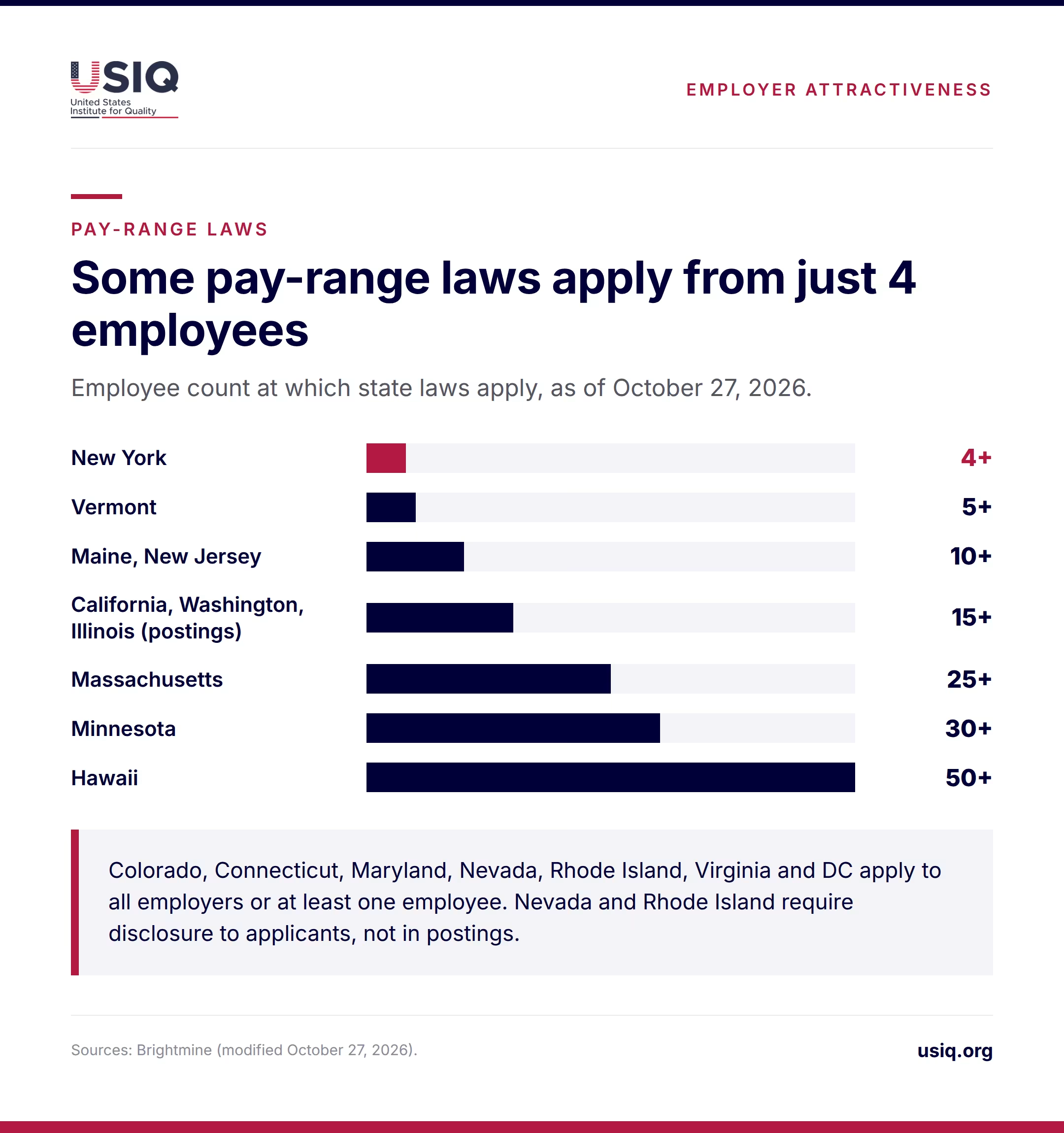
Nevada and Rhode Island differ from the rest of the last row: they require pay ranges to be given to applicants, not published in job postings. Local laws add more. According to Brightmine, New York City, Albany County and Ithaca apply at 4 or more employees, Jersey City at 5 or more, and Cincinnati, Cleveland and Toledo at 15 or more. More are on the way. Connecticut has a wage-range posting provision effective October 1, 2026. Columbus, Ohio takes effect January 1, 2027 for employers with 15 or more employees, and Delaware has enacted a law effective September 26, 2027 for employers with more than 25 employees.
Remote roles can trigger these rules. Brightmine notes, for example, that Connecticut’s rule covers roles reporting to a Connecticut worksite, so employers hiring across state lines should check every state involved. The table is a secondary summary, not legal advice, and statutes change. Confirm the current rules with the relevant state labor department or an employment attorney before relying on it.
There is one counterargument. Published ranges can raise questions among current employees about their own pay, so a company that starts posting ranges should first check how its existing pay compares. Handling that conversation before the first ad goes live is easier than doing it afterward.
How do you measure employer attractiveness?
No single number captures it, so track a few indicators on each side and review them together. Start with what you already have in payroll and applicant records.
| Side | Indicator | What it tells you |
|---|---|---|
| External | Applicants per opening | Whether your ads and reputation draw interest |
| External | Offer acceptance rate | Whether pay, terms and the hiring experience hold up against competitors |
| External | Time to fill | How quickly roles are staffed |
| External | Referral share of hires | Whether employees recommend you |
| Internal | 90-day and first-year turnover | Whether the job matches what was promised |
| Internal | Anonymous pulse survey, including a recommend-as-employer question (eNPS) | How employees currently feel |
| Internal | Stay interviews | Why key people stay and what could make them leave |
Anonymous surveys and personal conversations complement each other. A survey gives breadth and candor from many people at once, and a stay interview gives depth from a few. In a stay interview, a manager asks a valued employee what keeps them at the company, what they would change and what might make them look elsewhere.
Surveys have limits in small teams. If only eight people work in a department, results are not really anonymous, and a single answer can move an average. Report results for the whole company rather than for small groups, and treat trends over several rounds as more reliable than one score. USIQ’s guides to employee surveys and recruiting KPIs go into method and definitions.
Do employer seals and certifications help?
They can add an independent signal to what a company says about itself, but they work only when the underlying employment experience holds up. A seal supports a good employment experience; it does not replace one.
USIQ, the publisher of this article, runs certification programs of this kind. For a neutral overview of standards and process, see the article on employer certification.
What are the limits and common misconceptions?
- “Perks fix a bad manager.” They do not. Respect, clarity and care for the person are the areas where Gallup sees declines, and no benefit makes up for their absence.
- “Pay no longer matters.” The opposite is closer to the truth. Low pay was the joint top reason for quitting in the Pew survey, tied with lack of advancement.
- “Every young employee wants the same thing.” Generational labels flatten large differences. Gallup’s data supports narrower statements, such as the drop in feeling cared about and in learning opportunities among Gen Z and younger millennials.
- “Remote work is the default.” About one in five workers teleworked in March 2026 according to the BLS, and many jobs cannot be done remotely.
- “Attractiveness is marketing.” Marketing communicates reality. It cannot create it, and misleading listings backfire, as the 72% wariness figure suggests.
What should a small employer do first?
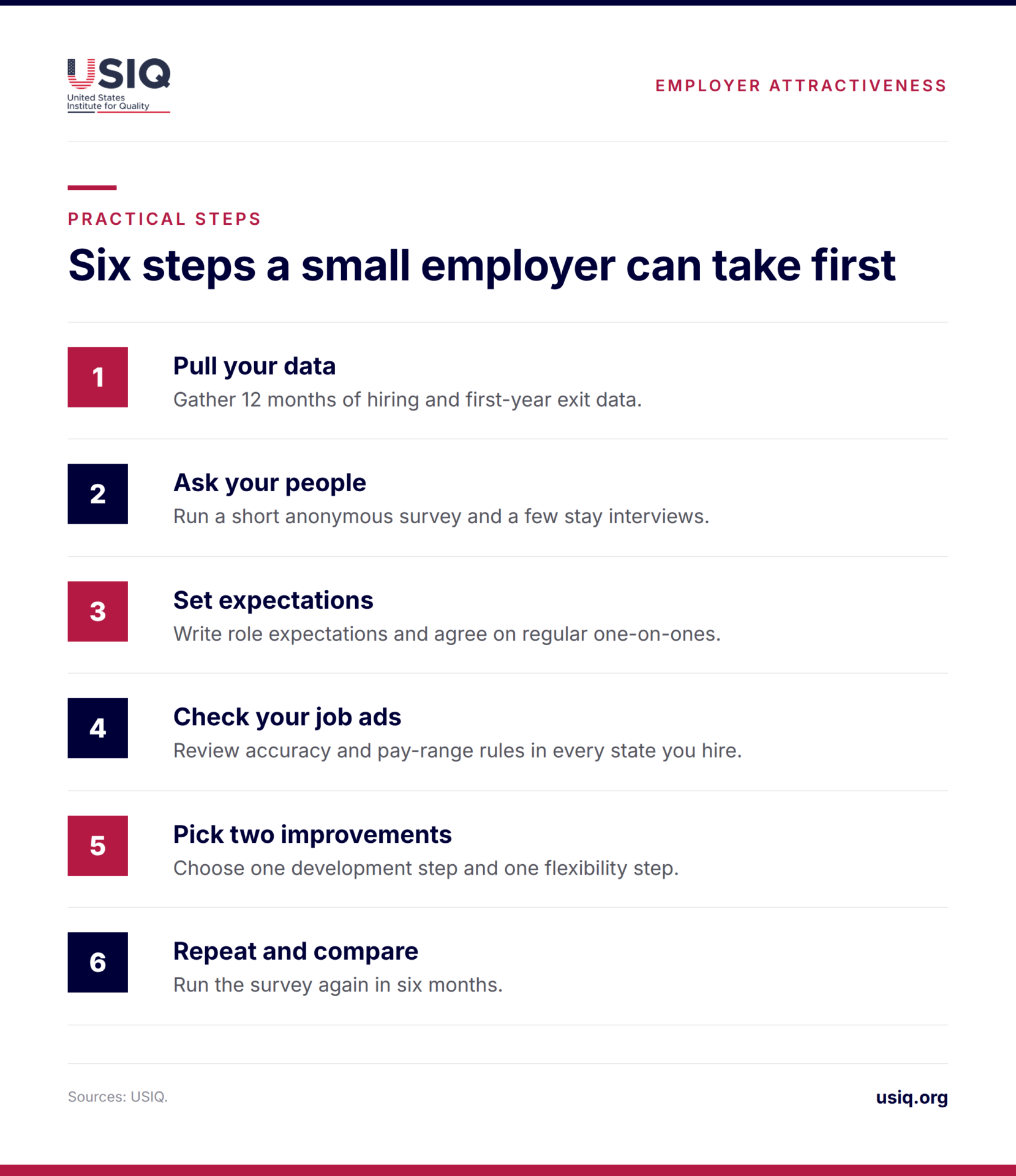
- Pull your last 12 months of data: applicants, offers accepted, and departures within the first year.
- Ask employees through a short anonymous survey and a few stay interviews what keeps them and what frustrates them.
- Write down expectations for each role and agree on a regular one-on-one rhythm with every manager.
- Review job ads for accuracy and for pay-range rules in every state where you hire.
- Choose one development step and one flexibility step that fit your workforce, and announce them.
- Repeat the survey in six months and compare.
What is the outlook?
Pay transparency is spreading, with Connecticut effective October 1, 2026, Columbus on January 1, 2027 and Delaware in September 2027, so candidates will increasingly compare ranges before they apply. Engagement has not recovered from its 2020 high, which leaves an opening for employers that get the basics right. The Pew data on quitters is from 2021 and the “Great Resignation” is over, but the same priorities of pay, advancement and respect remain visible in more recent Gallup results.
Conclusion
Employer attractiveness comes down to a fair deal that is honestly described and delivered by managers who are clear and who care. A small company that fixes its job ads, clarifies roles, opens a path to growth and listens regularly to its people can compete with larger employers on the factors that cost least and matter most.
Frequently asked questions
What is employer attractiveness in simple terms?
It is how appealing a company is as a place to work, both to people considering a job there and to those already employed. It shows in the number and quality of applicants, how often offers are accepted, and how long people stay. Pay is one part. Management, growth opportunities, flexibility and respect are the others.
What is the difference between attracting and retaining employees?
Attracting concerns external appeal: whether qualified people apply and accept offers. Retaining concerns internal appeal: whether current employees stay engaged and choose to remain. The two are linked, because satisfied employees recommend the company and an honest recruiting process brings in people who fit the job as it really is.
Why do U.S. workers quit their jobs?
In a Pew Research Center survey of workers who quit in 2021, 63% cited low pay, 63% cited no opportunities for advancement and 57% cited feeling disrespected. Lack of flexibility with hours (45%) and poor benefits (43%) followed. The data are from 2021, so they show priorities rather than current rates.
Do small businesses have to post pay ranges in job ads?
It depends on the location. According to Brightmine, thresholds range from 4 or more employees in New York to 50 or more in Hawaii, and some states cover all employers. Remote roles can also trigger a state’s rule. Check the current law in each state where you hire, and consult an employment attorney if unsure.
How much do benefits cost employers?
The BLS reports that private-industry employers paid $46.89 per hour worked in June 2026, of which $14.07 (30.0%) was benefits and $32.82 (70.0%) was wages. For full-time workers, benefits averaged $17.03 per hour and for part-time workers $5.05. Costs vary widely by industry and company, so treat these as national averages.
Is remote work still important to employees?
Flexibility still matters, but remote work applies to only part of the workforce. The BLS found 22.6% of workers teleworked in March 2026, within a range of 21.5% to 23.0% over the prior year. Employers whose staff must be on site can offer shift swaps, predictable schedules and input into start times instead.
How can a small company measure whether it is an attractive employer?
Track a few indicators: applicants per opening, offer acceptance rate, time to fill, referral share, and turnover in the first 90 days and first year. Add an anonymous pulse survey and stay interviews with key staff. In very small teams, report company-wide results so that individual answers cannot be identified.
Does an employer seal make a company more attractive?
A seal can add an independent signal to what a company says about itself, but only if the employment experience behind it is sound. It does not replace fair pay, clear expectations or good managers. USIQ runs certification programs of this kind, and its article on employer certification explains the standards and process.
Sources
- Employee Tenure News Release. U.S. Bureau of Labor Statistics. January 2026 survey results. https://www.bls.gov/news.release/tenure.htm
- U.S. Employee Engagement Declines From 2020 Peak. Gallup. January 27, 2026. https://www.gallup.com/workplace/701486/employee-engagement-declines-2020-peak.aspx
- Majority of workers who quit a job in 2021 cite low pay, no opportunities for advancement, feeling disrespected (Kim Parker and Juliana Menasce Horowitz). Pew Research Center. March 9, 2022. https://www.pewresearch.org/short-reads/2022/03/09/majority-of-workers-who-quit-a-job-in-2021-cite-low-pay-no-opportunities-for-advancement-feeling-disrespected/
- Compensation costs for private industry workers averaged $46.89 per hour worked in June 2026. U.S. Bureau of Labor Statistics, Economics Daily. September 17, 2026. https://www.bls.gov/opub/ted/2026/compensation-costs-for-private-industry-workers-averaged-46-89-per-hour-worked-in-june-2026.htm
- 22.6 percent of workers teleworked in March 2026. U.S. Bureau of Labor Statistics, Economics Daily. April 16, 2026. https://www.bls.gov/opub/ted/2026/22-6-percent-of-workers-teleworked-in-march-2026.htm
- U.S. pay transparency laws by state and locality. Brightmine. Modified October 27, 2026. https://www.brightmine.com/us/resources/hr-compliance/pay-transparency/u-s-pay-transparency-laws-by-state-and-locality/
- How to Attract Employees to Your Small Business. U.S. Chamber of Commerce. January 23, 2026. https://www.uschamber.com/co/run/human-resources/attracting-employees-to-your-business

Related Articles

What research says about the effects of employer seals on current employees, potential applicants and employer image, from independent experiments and field data to the limits of the evidence.
Employee experience and customer experience are linked, but the link is weaker and more conditional than popular slogans suggest. This article reviews the evidence on staffing, training and workplace conditions and shows how employers can test the connection in their own business.
Most HR dashboards show too many metrics and trigger too few decisions. This guide defines ten employee experience metrics, shows a one-page layout and explains how to read your numbers against U.S. data.
A practical guide to calculating marketing ROI for small and mid-sized U.S. companies, including long B2B sales cycles, offline leads, a spreadsheet walkthrough and common errors.


