

The 4-day work week is one of the most debated ideas in workplace policy. Supporters describe sharper focus, lower burnout and an edge in hiring. Skeptics point to coverage gaps, customer expectations and the risk of squeezing five days of work into four.
For an owner or HR leader at a company with 10 to 250 employees, the useful question is narrower than “does it work?” It is whether a specific model fits your work, your customers and your payroll rules, and how you would find out before committing.
This article explains the main models, what a pilot should measure, where the model breaks down, what to check on the legal side and how to run a trial in a small organization.
Quick answer: A 4-day work week gives employees one more day off, usually at full pay and often with fewer hours. It tends to suit work that can be measured by output and scheduled flexibly. It fits poorly where coverage is fixed. Test it in a time-limited pilot with clear metrics before making it permanent.
Key takeaways
- “4-day work week” describes several different models. Reduced hours at full pay and compressed hours are not the same policy.
- Most published results come from voluntary pilots, so they reflect employers that wanted the model to work.
- Fit depends on how work is organized: output-based, project-based roles adapt more easily than roles with fixed coverage.
- Hourly staff, overtime rules and benefits eligibility need review before any schedule change.
- A pilot needs a baseline, a defined end date, a few business and employee metrics, and a decision rule set in advance.
- A schedule is one lever among several. Pay, benefits, culture and management quality also drive hiring and retention.
What is a 4-day work week?
A 4-day work week replaces the traditional five working days with four. What changes beyond that depends on the employer. Some companies cut weekly hours to about 32 and keep pay unchanged. Others keep 40 hours and stretch them over four longer days.
That difference matters more than the label. A reduced-hours model asks the organization to produce the same results in less time. A compressed model gives employees a day off but changes nothing about workload, and it can make the remaining days longer and more tiring.
Which 4-day work week models exist?
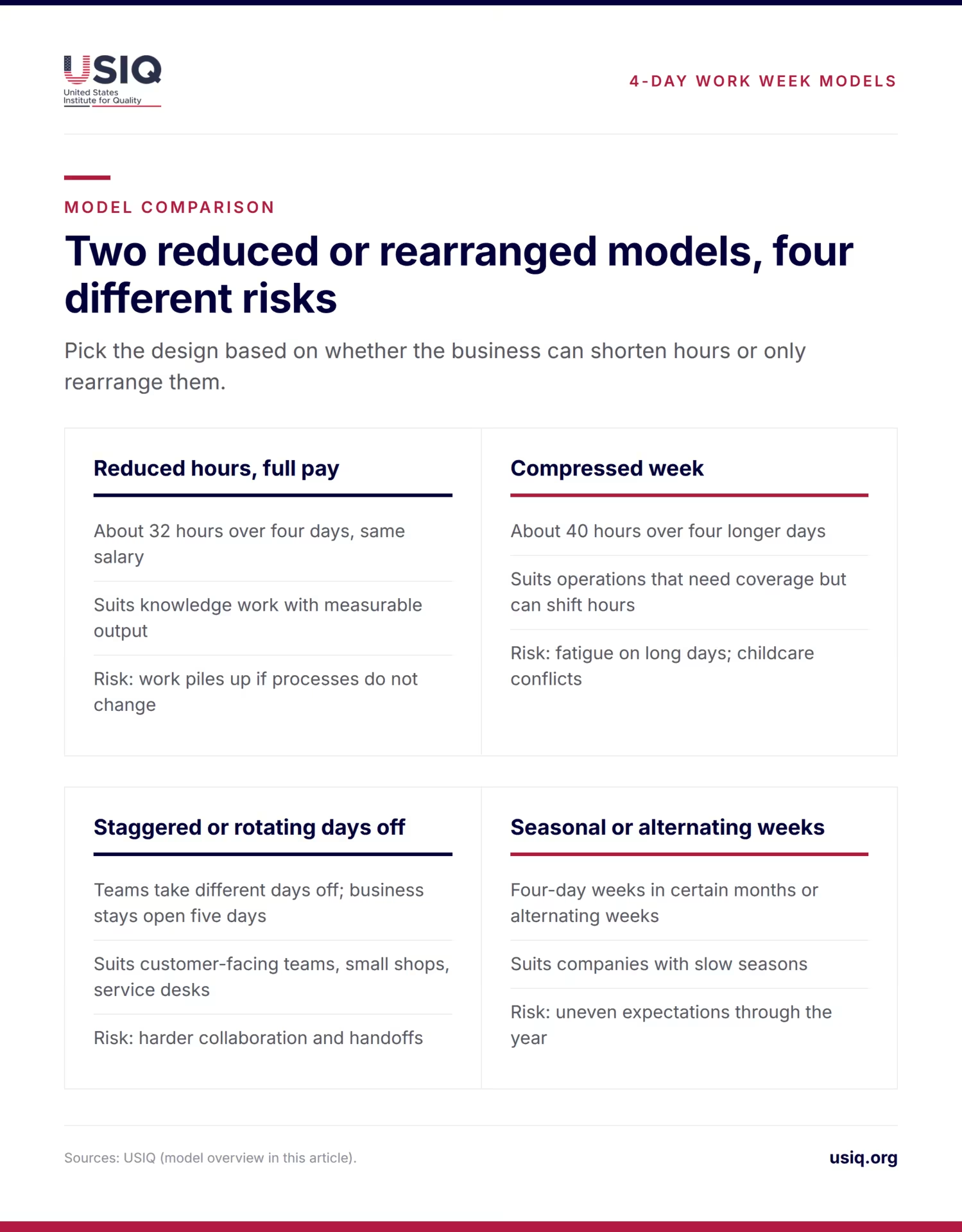
Companies tend to pick from a handful of designs. The right one depends on whether the business can shorten hours or only rearrange them.
| Model | How it works | Best suited to | Main risk |
|---|---|---|---|
| Reduced hours, full pay | About 32 hours over four days, same salary | Knowledge work with measurable output | Work piles up if processes do not change |
| Compressed week | About 40 hours over four longer days | Operations that need coverage but can shift hours | Fatigue on long days; childcare conflicts |
| Staggered or rotating days off | Teams take different days off so the business stays open five days | Customer-facing teams, small shops, service desks | Harder collaboration and handoffs |
| Seasonal or alternating weeks | Four-day weeks in certain months or in alternating weeks | Companies with slow seasons | Uneven expectations through the year |
Some employers combine models, for example a 32-hour week for office roles and a staggered schedule for the service team. Mixing is workable, but it raises fairness questions that need an answer before launch.
What do 4-day work week pilots report?
Reports from pilots in several countries describe a similar pattern. Participating employers often say output held steady or improved on their own measures. Employees often report less stress, less burnout and a better balance between work and private life. Many employers say they want to keep the new schedule.
These results come with caveats. Pilots are usually voluntary, and companies that sign up tend to be motivated and well organized. Many are small, and many are in office-based or technology work. Results from a self-selected group do not predict what happens in a warehouse, a clinic or a restaurant. A company-level result also says little about whether any single manager or team found the change harder.
Single-company stories need the same scrutiny. Claims such as “productivity rose by a given percentage” often rest on one metric, such as revenue per employee, in one period. A rise in revenue per head says little about workload, quality or customer experience. When you read a case study, look for what was measured, over what period and whether the company kept the schedule afterward.
Why would a 4-day work week help a company?
The plausible mechanisms are straightforward, and each can be tested in a pilot.
- Focus. A shorter week forces teams to cut low-value meetings, status updates and interruptions.
- Recovery. An extra day off can lower fatigue and the risk of burnout. See the overview of burnout and employee mental health in HR.
- Recruiting appeal. A shorter week stands out in job postings, which matters for small employers that cannot always match large-company pay. The guide on how to reduce recruiting costs covers the cost side of turnover.
- Retention. Schedule flexibility is one reason employees stay. It rarely compensates for weak management or below-market pay.
What are the risks and limits of a 4-day work week?
A shorter week does not remove work. It moves it. If the underlying processes stay the same, employees absorb the gap with longer days, skipped breaks or work on the day off. That defeats the purpose and shows up as higher stress, not lower.
Coverage and customer expectations
Customers rarely adjust to your schedule. A business that answers phones, serves walk-ins or supports clients on a deadline needs a plan for the fifth day. Staggered schedules solve part of that, but they require clear handoffs and a shared view of who is reachable when.
Uneven fit across roles
Roles tied to production lines, shift schedules, patient care or fixed store hours are harder to shorten. If only office staff get the new schedule, employees in other roles may read it as unequal treatment. Decide early how you will explain that and whether other benefits can offset it.
What if it does not work?
Some companies end or change a trial because of client demands, growth, leadership changes or a poor fit with certain teams. Reversing a permanent benefit is hard on morale, which is why a defined pilot with an agreed exit rule is safer than an open-ended announcement.
What legal and payroll points should U.S. employers check?
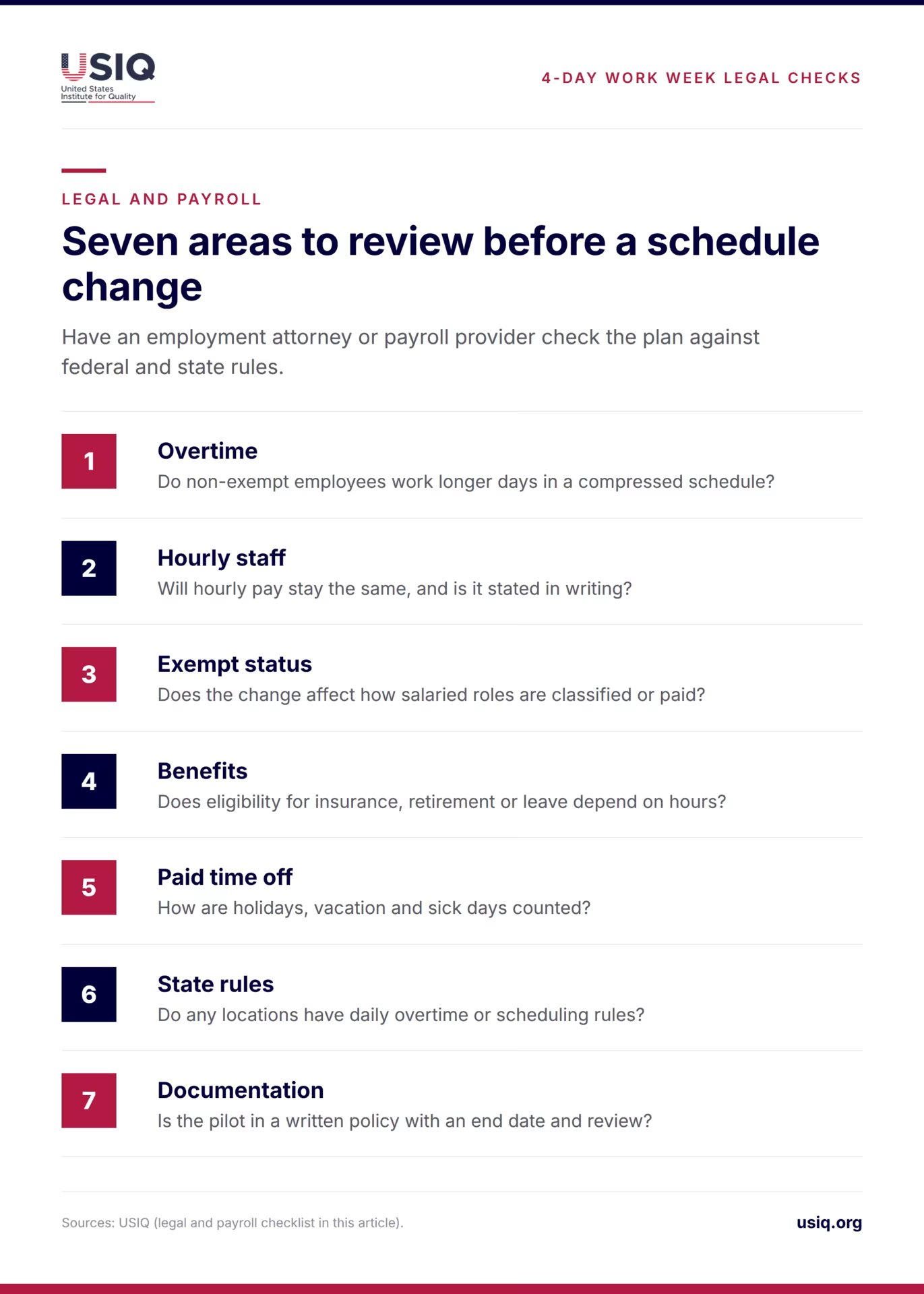
Pay and hours rules decide a lot in the U.S. This article gives no legal advice. Before changing schedules, have an employment attorney or payroll provider review the plan against the federal and state requirements that apply to your locations.
| Area | Question to settle |
|---|---|
| Overtime | Do any non-exempt employees work longer days in a compressed schedule, and how do federal and state overtime rules apply to them? |
| Hourly staff | Will hourly pay stay the same with fewer hours, or will earnings fall? Is that stated in writing? |
| Exempt status | Does the change affect how salaried roles are classified or paid? |
| Benefits | Do health insurance, retirement and leave eligibility depend on hours worked, and does the new schedule change eligibility? |
| Paid time off | How are holidays, vacation and sick days counted when a workday is 10 hours or the week is 32? |
| State rules | Do any locations have daily overtime or scheduling rules that differ from federal rules? |
| Documentation | Is the pilot described in a written policy or agreement, including its end date and review? |
Compressed weeks deserve particular attention because longer days can trigger overtime obligations for some employees. A full-pay, reduced-hours model avoids that issue for most staff but raises questions about how hourly employees are paid.
Which companies and roles suit a 4-day work week?
Company size matters less than how the work is organized. A 12-person agency and a 200-person software firm may both manage it, while a 40-person manufacturer may find it much harder.
| Work type | Typical fit | Practical note |
|---|---|---|
| Software, design, marketing, consulting | Often workable | Output is measurable; client deadlines still need coverage rules |
| Professional services (accounting, legal support, insurance) | Mixed | Seasonal peaks may require exceptions or alternating weeks |
| Customer support and sales | Possible with staggering | Stagger days off to keep response times steady |
| Retail, restaurants, hospitality | Hard for full closure | Fixed opening hours favor rotating schedules or compressed shifts |
| Manufacturing, logistics, healthcare | Hard | Shift coverage and safety rules limit options |
Individual employees also differ. Some prefer longer days to get a full extra day off. Others, such as caregivers, find ten-hour days difficult. A survey before launch shows which version your own staff would actually use.
How can a small company pilot a 4-day work week?
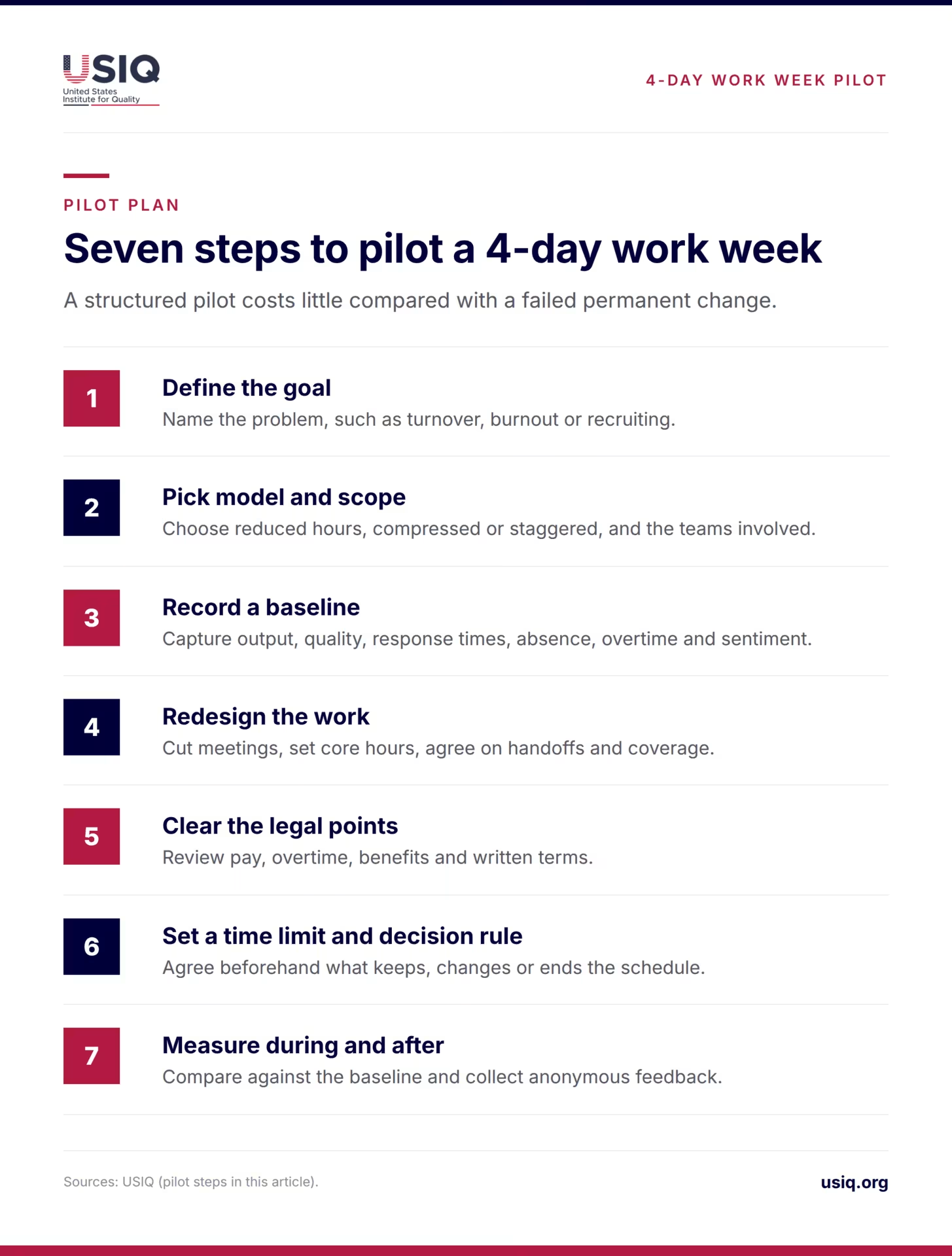
A structured pilot costs little compared with a failed permanent change. These steps suit a company without a large HR team.
- Define the goal. Name the problem the schedule should help with, such as turnover, burnout or recruiting. A goal makes the results interpretable.
- Pick the model and the scope. Choose reduced hours, compressed or staggered, and decide which teams take part.
- Record a baseline. Capture output, quality, customer response times, absence, overtime and employee sentiment before the change.
- Redesign the work. Cut or shorten meetings, set core hours, agree on handoffs and decide who covers customers on days off.
- Clear the legal points. Review pay, overtime, benefits and written terms with an attorney or payroll provider.
- Set a time limit and a decision rule. A trial of a few months with a stated review date works better than an open-ended start. Agree beforehand what result keeps, changes or ends the schedule.
- Measure during and after. Compare against the baseline, talk to managers and collect anonymous employee feedback.
How should you measure the results?
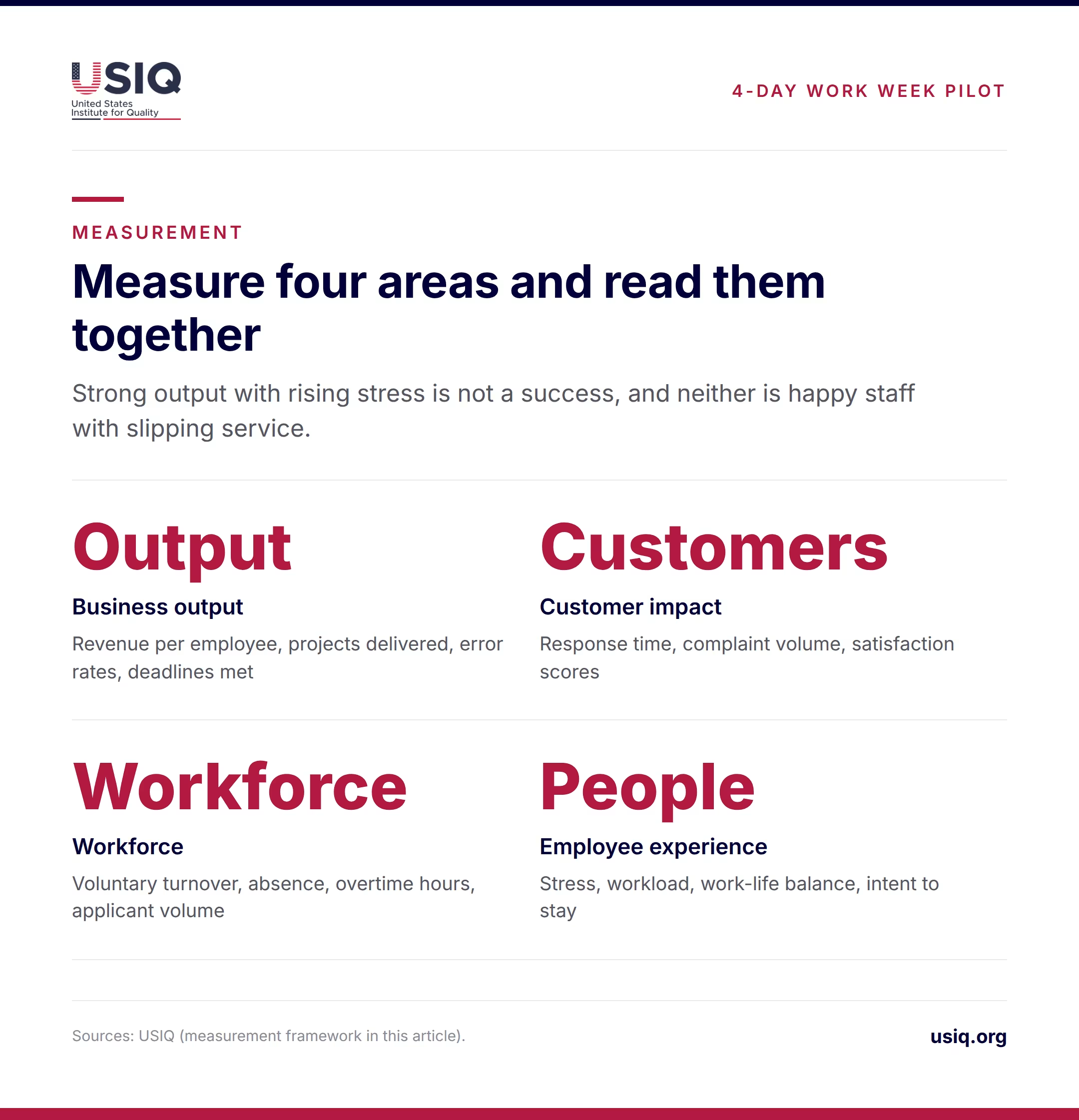
Use a short list of business and people measures, and read them together. Strong output with rising stress is not a success, and happy employees with slipping customer service is not one either.
| Measure type | Examples |
|---|---|
| Business output | Revenue per employee, projects delivered, error rates, deadlines met |
| Customers | Response time, complaint volume, satisfaction scores |
| Workforce | Voluntary turnover, absence, overtime hours, applicant volume |
| Employee experience | Stress, workload, work-life balance, intent to stay |
An anonymous employee survey is the most direct way to capture the people side. The guides on employee surveys and work-life balance examples offer starting points for questions and benchmarks inside your own company.
Some employers also use third-party measurement for the employee side. USIQ, the publisher of this article, runs certification programs of this kind. Its Top Employer program, for example, combines a confidential online survey of eligible employees with an HR assessment; the rules are described in the published methodology. A schedule change is not a requirement for any tier.
What are common misconceptions about the 4-day work week?
- “It means 100 percent of the work in 80 percent of the time.” That is the principle of some pilots, not a guaranteed outcome. Whether it holds depends on the work and on how the company changes its processes.
- “It is only for tech startups.” Many examples come from technology and office work, but the real test is whether work can be scheduled and measured flexibly.
- “Every version cuts hours.” A compressed week keeps total hours and may lengthen days.
- “It replaces other benefits.” Employees weigh pay, health coverage, growth and management as well. A shorter week works best on top of fair basics. The quiet quitting trend, covered in the article on what businesses can learn from it, shows how disengagement often has several causes.
Is the 4-day work week here to stay?
It is likely to remain a niche but growing option rather than a new standard. Interest tends to rise when labor markets are tight and employers look for ways to stand out, and cool when business pressure rises. For most small U.S. employers, a flexible form (staggered days, seasonal weeks or a pilot in one team) will be more realistic than a company-wide switch.
Employers that want to compete on flexibility can also look at related options such as hybrid work or family-friendly policies. The article on the return to the office covers the other side of the flexibility debate.
What should employers do next?
- Name the problem first. If turnover or burnout is the issue, find the causes before choosing a schedule.
- Ask employees which model they would use and what concerns them.
- Pilot with one team for a limited period, with a baseline and a decision rule.
- Have counsel or your payroll provider review overtime, hourly pay and benefits.
- Tell candidates exactly what the schedule is and how long the trial lasts.
Conclusion
A 4-day work week is a design choice, not a verdict. It can improve focus and appeal when the work is reorganized to support it, and it can add stress when it is not. A short, measured pilot in the part of the company where the model is most plausible gives the data to decide what comes next.
FAQ
Does a 4-day work week mean 32 hours?
Not always. The reduced-hours model uses about 32 hours over four days, usually at full pay. A compressed week keeps about 40 hours but spreads them over four longer days. Check which version a company means before comparing results, because the two change workload and fatigue very differently.
Is a 4-day work week legal in the U.S.?
Employers generally set schedules themselves, but wage, hour and overtime rules still apply, and they vary by state. Compressed weeks can raise overtime questions for non-exempt staff, and benefits eligibility can depend on hours. Have an attorney or payroll provider review any plan before it starts.
Can small businesses with 10 to 50 employees use it?
Often yes, because small teams can change schedules quickly and make decisions without layers of approval. The limit is coverage: with few people, one absence can leave a gap. Staggered days off or a pilot in a single team help manage that risk while the company learns what works.
What happens to hourly employees?
It depends on the policy. If hours drop and the hourly rate stays the same, take-home pay falls unless the employer adjusts the rate or guarantees the old earnings. Put that choice in writing, and check overtime rules if days get longer. Hourly roles are where unclear terms create the most friction.
How long should a pilot run?
Long enough to see past the novelty and cover a normal business cycle, typically a few months. Set the end date and review criteria before the start, record a baseline and decide in advance what result continues, changes or stops the schedule. An open-ended trial makes an honest assessment harder.
Do pilot results prove a 4-day work week works everywhere?
No. Most pilots are voluntary, and participating employers tend to be motivated, smaller and concentrated in office-based work. Their results are useful signals, but they do not show how the model performs in roles with fixed coverage. Your own pilot, with your own baseline, gives the most relevant evidence.
Will a 4-day work week fix turnover?
Only if schedule strain is a main reason people leave. Turnover usually has several causes, including pay, management, growth and workload. Find out why employees leave before choosing a remedy, for example through exit interviews and an anonymous survey, and treat the schedule as one possible part of the answer.
Sources
- USIQ, “Top Employer methodology”: https://www.usiq.org/top-employer/methodology/

Related Articles
What research says about the effects of employer seals on current employees, potential applicants and employer image, from independent experiments and field data to the limits of the evidence.
Employee experience and customer experience are linked, but the link is weaker and more conditional than popular slogans suggest. This article reviews the evidence on staffing, training and workplace conditions and shows how employers can test the connection in their own business.

Most HR dashboards show too many metrics and trigger too few decisions. This guide defines ten employee experience metrics, shows a one-page layout and explains how to read your numbers against U.S. data.

A practical guide to calculating marketing ROI for small and mid-sized U.S. companies, including long B2B sales cycles, offline leads, a spreadsheet walkthrough and common errors.