

AI Visibility in Brief
AI visibility describes whether and how a business, person or source appears in AI-generated answers. It includes brand mentions, links to source pages, recommendations and the accuracy of the information presented. To measure it, you need a defined set of questions and a record of the answers each platform returns.
Imagine a buyer asking an AI assistant which service providers deserve a closer look. Your company might appear on the shortlist. An article from your website might be cited without the company being recommended. Or a competitor might be named alongside an outdated description of your business. Each result calls for a different response.
That distinction matters more than a single visibility score. In The AI Visibility SEO & GEO Playbook, I examine how businesses become easier to find, understand and verify. This guide turns that approach into a practical routine: establish what buyers see today, improve the evidence behind the answers and check whether those answers change.
What counts as AI visibility
A brand mention, a source citation and a recommendation are different observations. A mention tells you that the name appeared. A citation tells you that a page was linked as a source. A recommendation tells you that the answer presented the business as a possible choice. None, by itself, proves that a customer trusted the answer or acted on it.
Accuracy belongs in the same review. An answer that names your company but misstates its services is visible and wrong. A link can also sit beside a claim that the linked page does not support. Read the passage around the mention and open the cited source before counting the result as a success.
The setting matters, too. ChatGPT with web search, a Google AI Overview and an answer produced without live search are different experiences. Record which one you tested. Treating them as interchangeable makes the resulting numbers difficult to interpret.
AI visibility and SEO
Search engine optimization helps people discover relevant pages through search. That includes work on accessibility, content, internal links and search presentation. AI visibility measures a particular outcome within AI answers. The two overlap, especially when an answer draws on a search index.
Generative Engine Optimization, usually shortened to GEO, is a term for work intended to improve that outcome. It does not describe a separate set of rules shared by every AI provider.
| Term | What it describes | A useful measure |
| SEO | Improving a website’s visibility and usefulness in search | Relevant impressions, clicks and business outcomes |
| GEO | Work intended to improve representation in generative answers | Changes in mentions, citations and accuracy after specific improvements |
| AI visibility | The presence and treatment of a brand or source in those answers | Mention and citation rates within a documented sample |
How AI answers find and use sources
Some AI answers draw on information retrieved from the web. Others rely on information already learned by the model. Retrieval-augmented generation is one approach to combining retrieved material with answer generation; the original RAG paper by Lewis and colleagues describes the underlying research, rather than the complete workings of today’s commercial search products.
Google explains that its AI search features can issue related searches to explore different aspects of a question. A page may therefore be relevant to one part of an answer even when it does not directly match the original query. Google’s documentation on AI features also makes clear that eligibility does not guarantee inclusion.
For a business, the useful question is what a source enables someone to establish. Does the page explain exactly what the service includes? Can a reader verify the result being claimed? Is the information attached to the right company? Those are things you can inspect and improve. The final choice of sources remains with the platform.
How to measure AI visibility
Start with questions your customers actually ask. Sales enquiries, support conversations and search data are better starting points than a list of prompts designed to produce flattering answers.
For a service business, a first sample might include questions such as:
- “What should a small business check before choosing a customer service provider?”
- “Which providers support multilingual customer service in the United States?”
- “How can I verify a provider’s service quality claims?”
- “What services does [company name] offer?”
- “Compare [company name] and [competitor] for a small business.”
Keep questions containing your brand separate from questions that do not name it. Asking directly about a company tests how it is represented. Asking about a category tests whether it appears without that prompt. Mixing the two can make a brand look much more discoverable than it is.
Build a repeatable sample
For a manageable discovery baseline, choose 30 questions that do not name your brand and run each three times per platform in fresh conversations. Keep a separate set of branded questions for checking accuracy. This is a suggested workload, not a statistically representative survey. Keep the wording, language, location and search settings as consistent as the product allows. Record the date and the visible model or product version.
Save the complete answers and their source links. For each answer, mark whether the brand appears, whether your website is cited, whether the business is recommended and whether any material fact is wrong. Use the same definitions when comparing competitors.
Record failed requests separately. For Google, also record occasions when no AI answer appears; report that frequency alongside the results from the AI answers you could assess. Do not quietly discard inconvenient outcomes or add replacement prompts halfway through a comparison.
Calculate mentions and citations separately
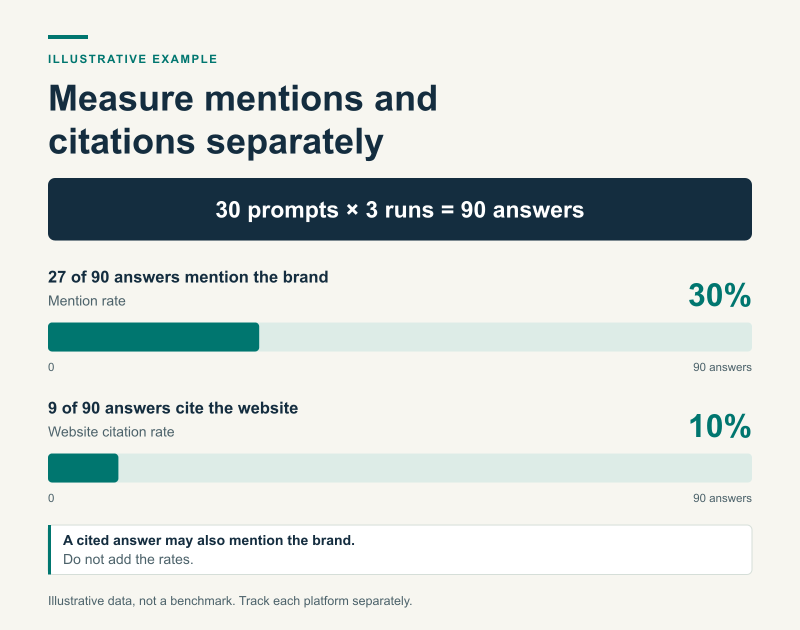
Suppose all 90 runs on one platform return assessable answers. In this illustrative example, 27 answers mention the brand and nine cite its website:
- Mention rate: 27 ÷ 90 × 100 = 30%.
- Website citation rate: 9 ÷ 90 × 100 = 10%.
An answer can do both. The rates overlap and must not be added. Count an answer once for each metric, even if it contains several mentions or links. These figures describe the sample; they are not estimates of your share of all AI conversations.
Illustrative data, not a benchmark. Mention rate and website citation rate use the same denominator and can overlap.
Repeat the sample on a schedule you can maintain. Keep results separate by platform and by branded or unbranded question. Review the actual answers when a rate moves: a small change may come from variable responses, while a repeated factual error may require immediate attention.
AI Visibility – Measure mentions and citations separately
Connect the findings to search and business results
Google’s Generative AI performance report in Search Console reports impressions from AI Overviews and AI Mode. It can help identify which pages are appearing and how impressions vary by country, device and date. It does not measure every unlinked brand mention, and it does not cover other companies’ AI products.
Use that information alongside website referrals, enquiries and conversions where attribution is available. A cited technical article may attract few visits but useful enquiries. A widely mentioned brand may receive no measurable benefit. Keep visibility and commercial results as separate measures until you have evidence connecting them.
How to improve AI visibility
The most useful improvements usually begin with a specific weakness: an inaccessible page, an unanswered question, an unsupported claim or conflicting company information. Choose the change that addresses the weakness you found, then record it so you can assess what happened afterward.
Make important pages accessible
Check whether your key pages can be reached without a login, whether search engines can index them and whether the main content is available as readable text. Inspect indexing instructions, canonical URLs, internal links and security rules that may block legitimate crawlers.
For Google’s AI search features, check that pages are indexed and eligible for snippets. Also check that the site is included in Search generative AI features in Search Console. Google’s technical guidance and Search generative AI settings documentation explain these requirements.
Make crawler decisions by purpose. OpenAI distinguishes OAI-SearchBot, used for search, from GPTBot, used for potential model training. Its crawler documentation explains those controls. Allowing search access and allowing training use are separate decisions. Neither creates an entitlement to a citation.
Answer the question with enough detail to be useful
Give the main answer early, then explain its conditions. A reader asking how a certification works needs to know what is assessed, who carries out the assessment, how long the result remains valid and where it can be checked. “We help outstanding companies stand out” answers none of those questions.
Keep a limitation beside the claim it qualifies. If a survey covers existing customers in one country, say so in the passage reporting the result. A short sentence stripped of its scope may be easy to quote and still be misleading.
Clear headings help readers find their place. There is no need to force every section into a fixed word count. Google explicitly rejects the idea that pages need tiny text fragments, special AI wording or an llms.txt file to succeed in its generative search features. See its guide to optimizing for generative AI search.
Publish evidence someone can check
Replace broad claims with the information needed to assess them. “Excellent service” tells a buyer very little. A documented assessment can explain the criteria, sample, collection period, result and limitations. A case study can show the starting point, the intervention and how the outcome was measured.
If you have original research, make its method available. If you rely on someone else’s research, link to it and describe what it actually tested. A useful source does not need to support every claim you would like to make.
The GEO study by Aggarwal and colleagues tested content interventions and found improvements in visibility measures within its experimental setting. It offers evidence worth investigating. It does not establish a universal percentage increase that a business should expect from adding quotations or statistics to a page.
Make company and author information consistent
Review your company name, services, locations, contact details and author biographies across the pages you control. Explain trading names and relationships between entities where a reader could otherwise confuse them. Correct an old profile when the facts change.
Use structured data to describe visible information accurately. An article’s author should be the person responsible for it, with a link to a relevant profile. Organization details should match the business described on the page. Markup is supporting information; it cannot substantiate a claim that the page itself leaves unexplained.
Earn relevant external coverage
A useful interview, an independent review or a trade publication’s discussion of your research can give readers another way to assess your work. Seek coverage because the information deserves attention. Repeated copies of the same press release should not be presented as separate independent endorsements.
My book uses the term Evidence Calendar for planning this work. Put the missing evidence on the calendar: a method that needs documenting, a case study awaiting customer permission or a comparison whose sources need updating. Give each item an owner and a reason to exist. The number of posts is a poor substitute for that judgment.
Keep the public record current
Review pages when a material fact changes. Correct the fact, check related pages and record the change in your monitoring notes. Updating a date while leaving an obsolete claim in place does not help the reader.
When an AI answer gets your business wrong, save the prompt, answer, date and source links. Correct any inaccurate pages you control and use the relevant site’s or platform’s correction process for other errors. If a false statement is causing serious harm, seek appropriate advice promptly. Publishing more content is not a substitute for addressing the statement itself.
The 5C check for a page worth citing
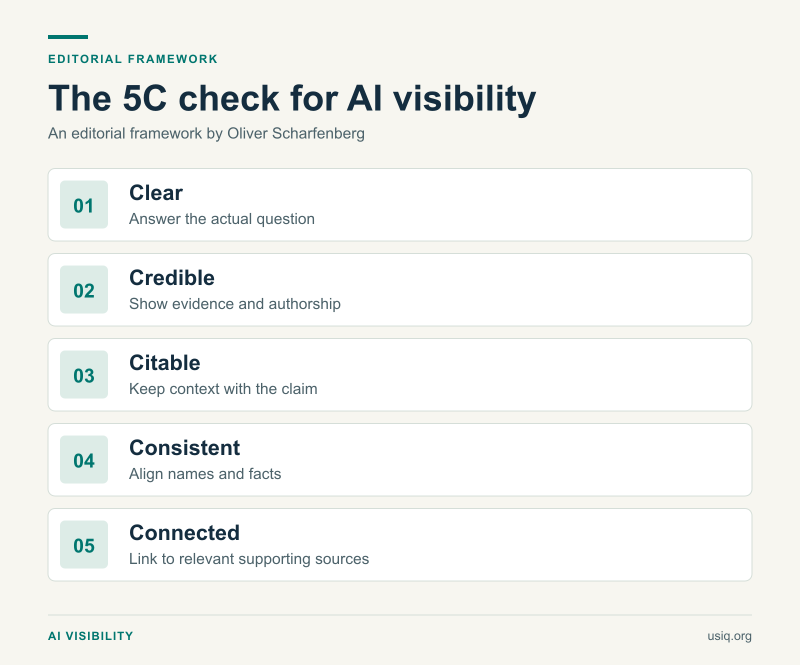
The 5C check in my book asks whether a page is clear, credible, citable, consistent and connected. I use the five checks to review a page before publication.
Adapted from the 5C checklist in The AI Visibility SEO & GEO Playbook by Oliver Scharfenberg. This is an editorial framework, not a ranking formula.
In practical terms: answer the actual question; show evidence and authorship; keep context with the claim; align names and facts; and connect readers to relevant supporting sources. A page that fails one of those checks gives you a concrete editing task.
ai-visibility-5c-check
Where quality signals fit
Quality signals deserve particular care because they can mean very different things. A certification may confirm that specified criteria were assessed. An award may recognize a result under a different process. Neither automatically proves that a company is the best choice for every buyer.
For any seal or award you reference, make the issuer, criteria, scope, assessment date and validity easy to find. Where a public verification record exists, link to it. Describe exactly what the recognition covers and avoid extending it to services or locations that were not assessed.
USIQ’s explanation of quality seals and how they work provides further background. USIQ also provides certifications and awards, which is the commercial context of this discussion.
There is no basis here for claiming that buying a certification improves an AI citation rate. The defensible role of a quality signal is to make a defined claim easier to verify. Whether a particular AI answer uses that evidence must be measured.
A practical plan for the first 90 days
Use the first quarter to establish a baseline and improve a small number of important pages. The timetable below organizes the work; it does not predict when rankings or citations will rise.
| Period | Work to complete | What to keep as evidence |
| Days 1 to 30 | Choose the question set, save baseline answers and check access to priority pages | Prompt list, answer archive and access findings |
| Days 31 to 60 | Repair the weakest pages, document claims and align company information | Change log, source links and revised pages |
| Days 61 to 90 | Repeat the checks, inspect changes in answers and review enquiries | Platform comparisons, error list and next priorities |
At the end of the quarter, ask which questions you now answer better and which errors still recur. Those findings are more useful for the next round of work than declaring victory because one answer happened to include your name.
For an application to recruitment and employer reputation, see USIQ’s 90-day plan for employers to build AI search visibility.
Frequently asked questions
The difference between AI visibility and GEO
AI visibility is the outcome you observe in generated answers. GEO describes work intended to improve that outcome. Define your measures before comparing services or tools that use either term.
Measuring AI visibility without a paid tool
A small, documented sample can be reviewed manually. Paid tools become useful when you need to manage many questions, retain answer histories or compare results across markets. Check their prompt selection, refresh schedule and counting rules before treating a score as meaningful.
Brand mentions without website citations
A system may name a company using information from another source, or produce an answer without linking sources. Inspect the answer and its available references. Track the mention separately from citations to your own website.
The difference between a citation and a recommendation
A page can be cited for a definition, a statistic or even criticism of the business. Read the surrounding passage to establish what the citation supports before treating it as a recommendation.
How long improvements take
There is no reliable timetable that applies to every business. Access changes, content revisions and new external coverage may be reflected at different times. Run comparable checks over time and avoid attributing a change to one edit without supporting evidence.
Smaller businesses in AI answers
A smaller business can appear alongside larger competitors when it offers information relevant to the question. Choose questions you can answer with real detail and evidence. Company size alone does not tell you whether a particular answer will include the business.
Start with one answer that matters
Choose a question a prospective customer would ask before contacting you. Read the answers on the platforms that matter to that customer. Open the sources. Then improve the most important gap you can actually address and keep a record of what you changed.
That is the approach behind a line in my book: “GEO should be treated as a measurement discipline, not as a one-time content trick.” The work becomes useful when you can explain what you observed, what you changed and what happened next.
Sources and further reading
- Oliver Scharfenberg. The AI Visibility SEO & GEO Playbook, first edition, 2026. The 5C checklist (p. 34) and Evidence Calendar inform this guide. The quotation above appears in the unnumbered Methodology and Evidence Note.
- Google Search Central — AI features and your website.
- Google Search Central — Optimizing for generative AI features on Google Search.
- Google Search Console Help — Generative AI performance report.
- OpenAI — Overview of OpenAI crawlers.
- Aggarwal et al. — GEO: Generative Engine Optimization, published at KDD 2024.
- Lewis et al. — Retrieval-Augmented Generation for Knowledge-Intensive NLP Tasks, 2020.


Related Articles

What research says about the effects of employer seals on current employees, potential applicants and employer image, from independent experiments and field data to the limits of the evidence.
Employee experience and customer experience are linked, but the link is weaker and more conditional than popular slogans suggest. This article reviews the evidence on staffing, training and workplace conditions and shows how employers can test the connection in their own business.
Most HR dashboards show too many metrics and trigger too few decisions. This guide defines ten employee experience metrics, shows a one-page layout and explains how to read your numbers against U.S. data.
A practical guide to calculating marketing ROI for small and mid-sized U.S. companies, including long B2B sales cycles, offline leads, a spreadsheet walkthrough and common errors.
