

The first two conversations focused on why AI visibility matters. This time, I wanted to get practical with Oliver Scharfenberg and focus on how employers can improve it. Because the insight that candidates ask the AI does not help much if you do not know where to begin. Scharfenberg, a marketing expert with an MBA in Marketing and a doctorate and the author of The AI Visibility SEO & GEO Playbook, has built a roadmap for exactly this situation.
The encouraging part is that most employers do not need a full website relaunch or a massive budget. They need a clear sequence of priorities, disciplined execution, and consistent follow-through. We went through his plan step by step.
Let’s start practically. Where does a company that wants to be visible in AI search begin?
Start with an audit, not a rebuild. The first step is always taking stock: ask the systems what they say about you today, and check whether your basic details are even technically readable and findable. If crawlers can’t access important career content, if it’s buried in scripts, or if it’s available only in images, search and AI systems may struggle to discover or use it. It sounds basic, but technical accessibility is still one of the first things worth checking. Only once the technical side is sound does the rest pay off.
You often talk about the entity. What does that mean for an employer?
An entity is simply a uniquely identifiable thing, in this case your company. Search and AI systems need enough consistent information to distinguish your company from organizations with similar names and connect the right facts to the right entity. For that you define the core facts cleanly, once: official name, locations, industry, founding year, a sentence or two on what you stand for, and the people in charge. Then keep those core facts consistent everywhere, on the website, on LinkedIn, in the Google business profile, on Kununu. Technically, structured markup helps, schema markup that can help machines understand the organization and its relationships more clearly. Google started moving from plain keywords to real things back in 2012, the so-called Knowledge Graph. That entity-based approach also matters in AI-driven discovery. Consistency does not guarantee visibility, but unnecessary contradictions make accurate interpretation harder.
What content does a careers page need for the AI to actually use it?
Answers to real questions, in plain language. Candidates ask about pay and development, about culture, about flexibility, about how the application works. So those exact questions should be answered on the page, concretely and verifiably. A well-designed FAQ can be particularly useful, because it separates question and answer cleanly, in a format that is easy for both people and machines to parse. Tone matters. Do not write in ad-speak, write plainly and with evidence. According to the foundational GEO research by Aggarwal and colleagues from 2024, real numbers, sources and credible quotes noticeably raise your chance of being cited, while advertising phrases and repeated slogans do practically nothing. A specific, attributable employee perspective can communicate more than a paragraph of generic employer-brand language.
Is there a simple quality check for such a page?
Yes, I call it the 5C test, five questions to ask before publishing. Is the answer clear, meaning immediately recognizable? Is the source credible, with an author and evidence? Is the key statement citable, can it stand on its own without losing its meaning? Is the account consistent, the same everywhere? And is the page connected, embedded in other credible sources? If a page fails on one of these points, you know at once where to start. One useful editing technique: put the actual answer to the main question right at the top, in a concise answer block, often around 40 to 70 words when that length fits the question. That short block should be able to stand on its own. The rest of the page then backs it up.
Suppose I still do not get cited. How do I find the reason?
By diagnosing rather than guessing. I think of citation readiness as a chain. The page has to be reachable, then retrievable, then be relevant to the query, supported by credible evidence, and structured so the answer is easy to extract, and finally be more useful than the competition. Break one link and you get passed over. You work the chain from the bottom and fix the first broken link first, because nothing above it can hold. If you are not being discovered at all, start by checking technical accessibility and indexing before assuming the problem is editorial. If you are found but not named, the next questions are whether the content is sufficiently relevant, well-supported, current, and easy to interpret. This method saves a lot of blind rewriting.
How do you measure success when hardly anyone clicks anymore?
Clicks and rankings only tell half the story now, so you ask the systems directly. Take a fixed set of prompts, always the same ones, for example: Is my company a good employer? What is the culture like with us? Name good employers for a particular job in a particular region. Note down regularly: Are you mentioned? How are you described? Next to which competitors? Which sources does the AI draw on? What matters is not a target value on one day, but the movement over time, measured against the same questions. Over time, that gives you a more useful visibility benchmark than an occasional spot check.
What does a realistic 90-day plan look like?
In three phases. In the first month you lay the foundation: check the technical side, set up the entity cleanly, rewrite the most important pages so they give clear answers. In the second month you build evidence: real employee voices, numbers, a credible seal, well-maintained profiles on LinkedIn and Kununu, maybe a press article or an interview. In the third month you measure and distribute: you track your prompts, refresh thin content and make sure your story is told consistently in several places. After ninety days you do not have a perfect picture, but a solid base that keeps growing. Because authority tends to build cumulatively as consistent evidence accumulates across credible sources.
A look ahead. What comes next?
The next stage is agents, AI acting on people’s behalf. AI agents are already beginning to compare options and complete parts of digital workflows. In recruiting it is easy to imagine an assistant pre-sorting suitable employers for a candidate, clearing up first questions, maybe even kicking off the application. For these systems, machine-readable structure, accessible text, and understandable forms become increasingly important, through the structure and the text, not through pretty pictures. That makes the inconspicuous basics important: clean, clearly structured web, understandable forms, information a machine can grasp without guessing. There is no need to rush today. But you should grasp that some future interactions with your careers content may be mediated by software acting on a candidate’s behalf.
What is your most important message to HR leaders?
That it is not about tricking the systems, but about becoming the kind of employer an AI system could represent accurately and confidently. Clear in how you present yourself, credible in your evidence, consistent across all channels, and honest about what you promise. Work that way and you get found, you get trusted, and you get named when a candidate puts her question to the AI. That is exactly what my books are about, and exactly what will decide, in the coming years, which employers make it onto the shortlist of strong candidates.
Who inside the company should actually own this?
Ideally HR and marketing together, because this is where the two meet. The HR team knows which questions candidates really ask and where the truth about daily work lies. Marketing knows how to turn that into clear, findable content. In practice a single responsible person who owns the process and coordinates the others often does the job. More important than the org chart is that someone exists who regularly looks at what the AI is saying and sets changes in motion. Without a fixed responsibility the work tends to lose momentum, because it belongs to no one in particular.
What role do the employees themselves play in this?
A bigger one than many assume. The most credible content does not come from the marketing department, it comes from the people who actually do the job. A real voice, a concrete example from the working day, an honest sentence about what is going well and what is not, all of that carries more weight with candidates and provides more concrete material for AI systems than generic promotional messaging than any glossy message. I encourage companies to give their people room to become visible, in interviews, on LinkedIn, in short field reports. There is a nice side effect: a company that takes its people seriously and lets them speak usually becomes an employer worth reporting good things about.
Many fear they will never be done with this. Rightly so?
You are never done, but that is no cause for worry, it is the nature of the thing. Visibility is not a project with a closing report, it is a routine, like bookkeeping or maintenance. The effort is greatest at the start, when you create order. After that a regular rhythm is enough: check the prompts once a quarter, keep content current, add fresh evidence. Internalise that and you hold a lasting lead, precisely because most competitors misread it as a one-off action and stop maintaining it.
Conclusion
What starts as a technical topic ends at a very human insight. A company that takes its visibility in AI search seriously is pushed toward greater transparency, because it forces itself to deliver evidence instead of claims. In the end, the 90-day plan is also a plan for more substance.
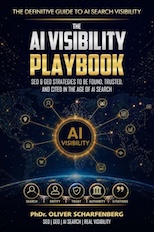 About Oliver Scharfenberg
PhDr. Oliver Scharfenberg, MBA is CEO of the Syntharis Group and an expert in recruiting and AI Visibility. The marketing specialist, who holds an MBA in Marketing and a doctorate (PhDr.), advises hundreds of companies and is the author of several books on digital visibility and employer attractiveness, among them The AI Visibility SEO & GEO Playbook, available on Amazon.


Related Articles

What research says about the effects of employer seals on current employees, potential applicants and employer image, from independent experiments and field data to the limits of the evidence.
Employee experience and customer experience are linked, but the link is weaker and more conditional than popular slogans suggest. This article reviews the evidence on staffing, training and workplace conditions and shows how employers can test the connection in their own business.
Most HR dashboards show too many metrics and trigger too few decisions. This guide defines ten employee experience metrics, shows a one-page layout and explains how to read your numbers against U.S. data.
A practical guide to calculating marketing ROI for small and mid-sized U.S. companies, including long B2B sales cycles, offline leads, a spreadsheet walkthrough and common errors.
