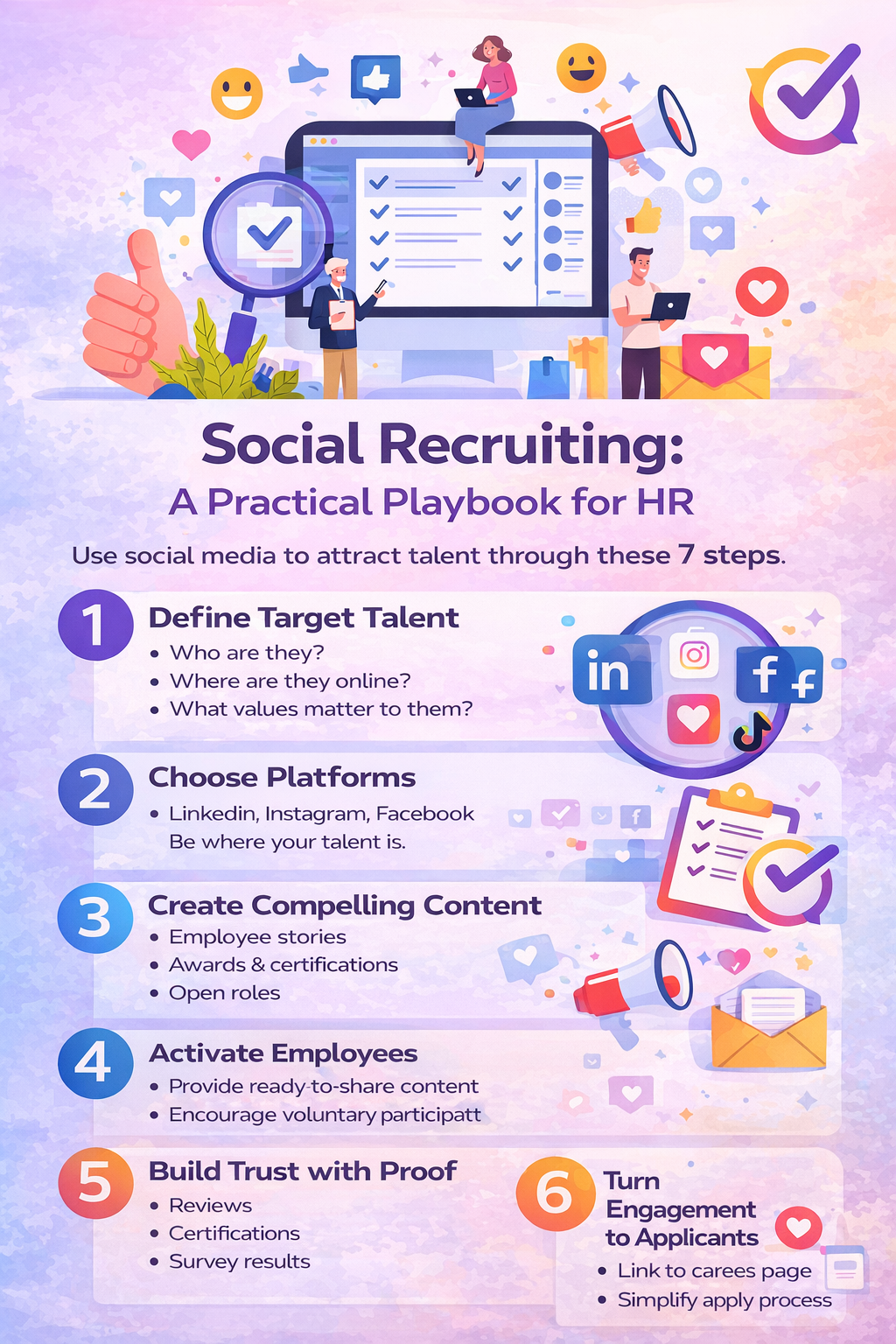
Social recruiting can be defined as using social media to attract, engage, and hire talent. Instead of waiting for candidates to find job postings, employers are instead meeting people where they are – on social platforms. This change is significant because traditional job boards are no longer sufficient to reach the modern working class.
Candidates now find employers through social feeds, employee postings, reviews, and content shared by their colleagues long before they even choose to apply. They monitor how companies communicate with and how employees talk about work, and how trustworthy, how human, the employer seems.
The latest data confirms this change. According to research shared by LinkedIn, 79% of job seekers use social media as a part of their job search, which is clear proof and indication that social platforms play a central role in the way people evaluate employers nowadays. This makes social recruiting a fundamental activity of HR – not a side task.
This practical playbook is for you, explaining how to define target talent, select the right platforms, create content to attract candidates, use trust signals, such as certifications and employer seals, and measure what actually works – step by step.
What Social Recruiting Really Means for HR Teams
Social recruiting goes beyond posting job openings on social media. Posting jobs is a way of communication. Actively prospecting social media involves using social media to create conversations, post real-life stories, and help to spur interest long before anybody applies. It’s a combination of employer branding, content sharing, and relationship building to help candidates understand what it’s really like to work at a company.
This is the very reason why HR, and not just marketing, must be involved. HR knows what is needed to hire, culture, and the experience of the employees, and marketing helps with reach and presentation. When both come into play, social recruiting becomes more real and better.
Social recruiting isn’t limited to current openings, but to long-term talent pipelines. By continually being visible and consistent, employers create familiarity over time. That familiarity matters. According to research from Glassdoor, 75% of job seekers research an employer’s brand even before applying for a job. When candidates already know who the employer is and have already built trust with the employer, they are much more likely to apply when the right role is posted.
Step One: Be Specific About Your Target Talent
Social recruiting often misses the mark when employers attempt to speak to all their employees simultaneously. Without a defined audience, messages become generic and are simple to ignore. HR teams first need to determine who they would like to hire, where those individuals are spending their time online, and what is important to them when they are at work. Early-career candidates may be more concerned with growth and culture, while experienced professionals may be more concerned with stability and leadership. Technical roles may react to the learning content, while customer-facing roles may value the team stories.
Internal data is used to further refine this focus. Looking at current top performers and high-retention employees reveals what type of communication talent succeeds and stays. This understanding should meet the employer value proposition image shared via the social channels.
This approach has the backing of data. According to HubSpot’s 2024 marketing research, personalized content is significantly more effective than generic messaging in terms of engagement and response rates. Targeted social recruiting is just more effective.
Step Two: Select the Appropriate Social Platforms
The most important channel for professional recruiting is LinkedIn. Research from LinkedIn shows that 75% of job seekers consider an employer’s brand before even applying for a job. Company pages, Life tabs, job posts, and employee sharing can all facilitate visibility and trust.
Instagram is good for showcasing culture, people, and day-to-day work life. According to Pew Research (2024), younger adults are very active on Instagram and often look to Instagram as a means of judging brands, including employers, through visuals and short videos.
Facebook is still useful in local hiring and community-based roles. Pew Research affirms that a significant proportion of working-age adults continue to use Facebook regularly, particularly for groups and to find local jobs.
TikTok, when applicable, is part of employer branding through authentic, short-form content. Recent recruiting studies demonstrate an increasing phenomenon of using TikTok to discover a career, especially among younger generations.
The takeaway is really simple: you just need to be where your target talent already is.
Step Three: Build Content Themes to Attract Candidates
Content is the core of social recruiting, and the human response to content is maximum when the content is real.
Employee stories have a high performance rate. Day-in-the-life posts and spotlights on the team allow candidates to envision themselves at the company. According to LinkedIn, the content shared by employees receives much higher engagement than the content shared by company accounts only.
Workplace Culture Content depicts values in practice. The familiarity and trust that come from sharing team moments, learning opportunities, and growth stories.
When putting open roles on the table, simple and human language does better than long lists of tasks. Visual-first posts also do better on most platforms.
Awards, certifications, and seals provide social proof. Glassdoor research finds employers perceived as trustworthy attract more interest from job seekers – and certifications help to offset skepticism by providing independent validation.
Step Four: Use Social Proof to Create Trust
Social proof is a large part of the decision regarding recruitment. In hiring, social proof consists of employee reviews, employee voices, certifications, and awards. These signals are used by candidates to determine if an employer’s claims are genuine or not.
Third-party validation is important as it is more honest than self-promotion. Certification announcements, high-level survey results, and recognition badges are effective ways to show proof without sharing too much.
This trust gap is well-documented. According to the 2024 Edelman Trust Barometer, trust revolves around people being much more likely to trust peer voices and independent organizations than direct brand messaging. Glassdoor data also reveals that whether candidates apply or not has a strong bearing on their views on employer reputation.
Employer seals and certifications are a credibility booster across platforms by being something for candidates to believe in objectively.
Step Five: Make Employees Your Recruiting Partners
Employees are one of the most powerful recruiting channels that exist. Their posts seem personal and authentic, which makes them more trusted by job seekers. Encouraging employees to share content – but without the pressure – can go a long way in increasing reach.
HR teams should release ready-to-share content, for example, role highlights, culture posts, or certification announcements, along with some guidelines. Participation should also always be optional.
The impact is measurable. LinkedIn’s new data shows that employee-shared content reaches many more people than content shared from company pages, which means advocacy is a cost-effective recruiting strategy.
Done correctly, employee advocacy transforms everyday employees into trusted recruiting partners.
Step Six: Make Engagement Turn into Applicants
Being merely engaged is not enough to make a hire unless there is a clear next step. Every social recruiting post should have a simple call-to-action, such as follow, learn more, join a talent community, or apply.
Posts should link directly to career pages or profiles of the employer, where candidates can take action. The reduction of friction is critical. Long forms, multiple logins, or unclear steps lead to candidate drop-off.
This is backed by research from SHRM and LinkedIn, which supports that the more complex the application process, the higher the rate of abandonment, especially on mobile devices. Making it easy to get from interest to application makes them achieve better results without having to spend more on advertising.
Step Seven: Measuring What Is Important in Social Recruiting
Why we should measure social recruiting success on more than just likes! HR teams should track reach, engagement rates, click-throughs to career pages, applications from social channels, and, where possible, quality of hire.
These metrics should be in line with hiring goals and not vanity numbers. Data helps teams to understand what platforms and content types attract the right candidates.
The value of measurement is easy to understand. According to Deloitte and LinkedIn research, organizations that hire data-driven are the ones who are better at hiring quickly and better at hiring quality. Tracking results enables HR teams to make tweaks to content, refine targeting, and invest where social recruiting actually works.
Common Social Recruiting Mistakes to Avoid
Many social recruiting efforts fail, as they are focused on activity versus impact. One common error is to post only job ads. Candidates rarely get into constant vacancies without context or a story. Another problem is not replying to comments and messages, which sends the message that one must not be present and that trust is negatively affected.
Over-polished or too corporate material is another problem. Of course, candidates themselves prefer honest and simple communication over perfect branding. A lack of follow-up measurement is also common. When teams do not measure clicks, applications, and the quality of engagement, it is impossible to make improvements.
Finally, social recruiting that is treated as a one-time campaign rather than an ongoing effort limits success. Research from LinkedIn shows that application likelihood rises when employers are familiar with employees over time. Social recruiting is most effective when it is constant, responsive, and human.
How Social Recruiting Supports Employer Branding – Long Term
Social recruiting, therefore, is not a mere hiring tool, but is a long-term employer branding channel. Having a regular presence in a social network helps candidates to know a company even before they need a job. This familiarity helps reduce hesitation and build trust when roles are open.
According to LinkedIn Talent Solutions, the cost per hire and the time frame to fill the position are smaller for brands that are good employers since the employer is already known and trusted by the candidate. Social recruiting is also great for referrals, keeping, as well as internal pride when employees see their workplace represented properly on the web.
Combined with employee voices, reviews, and certifications, social recruiting strengthens credibility and consistency within and across platforms. Over time, this creates a name and identity about being an employer, which builds trust and is recognizable, and helps both with hiring and retention.
Conclusion: A Workable, Reproducible Method of Social Recruiting
Social recruiting is effective when it is simple, focused, and consistent. It begins with understanding who it is that you want to hire, selecting the correct platforms, and sharing content that shows the real employee experience. Trust is increased by what candidates feel when they see employee voices, reviews, and independent proof, such as certifications and the employer seals.
The most successful teams approach social recruiting with the mindset of an ongoing HR process and not a fad in marketing. By measuring what matters and making adjustments based on data, employers are able to attract better talent and build better pipelines. The message is clear; social recruiting is only successful when it is structured, human, and built on a basis of trust.

Related Articles
What research says about the effects of employer seals on current employees, potential applicants and employer image, from independent experiments and field data to the limits of the evidence.
Employee experience and customer experience are linked, but the link is weaker and more conditional than popular slogans suggest. This article reviews the evidence on staffing, training and workplace conditions and shows how employers can test the connection in their own business.
Most HR dashboards show too many metrics and trigger too few decisions. This guide defines ten employee experience metrics, shows a one-page layout and explains how to read your numbers against U.S. data.
A practical guide to calculating marketing ROI for small and mid-sized U.S. companies, including long B2B sales cycles, offline leads, a spreadsheet walkthrough and common errors.


