

Social recruiting means using social media to find, attract and engage candidates, not only to publish job ads. For a company with 10 to 250 employees, it is one of the few recruiting channels that costs more time than money. That makes it attractive, and it also makes it easy to do badly.
This playbook uses figures from public agencies and Pew Research Center where they exist, and makes its points without a number where no reliable one is available. It also covers a gap most guides skip: the legal rules for looking at candidates’ profiles and for asking employees to share posts.
The sections follow the order of a real project: definition, fit for your company size, platform choice, seven steps, content, employee advocacy, legal limits, conversion, measurement and common mistakes.
Quick answer: Social recruiting is a steady routine of sharing real workplace content, answering candidates and linking every post to a simple application. Pick one main and one supporting platform, involve employees voluntarily, track source of hire, and never ask candidates for account access.
Key takeaways
- Social recruiting combines active sourcing with long-term employer-brand building. Posting vacancies is only a small part of it.
- Smaller establishments hire at a higher rate relative to their size than large ones: 3.9% at 10–49 employees and 4.2% at 50–249, versus 1.8% at 5,000 or more (BLS, September 2026).
- Match the platform to the audience. YouTube (84% of U.S. adults) and Facebook (71%) reach the widest groups, while Instagram reaches 80% of adults aged 18–29 (Pew, 2025).
- A weekly routine of two to three hours beats occasional campaigns. HR should supply the substance, and marketing supports reach and format.
- Looking at profiles can expose protected characteristics. Use consistent, documented criteria, and never ask for passwords or private-account access.
- Measure source of hire, applications and 90-day retention by channel, not likes.
What is social recruiting, and how is it different from posting job ads?
Social recruiting is the use of social platforms to build visibility with future candidates, start conversations and move interested people toward an application. A job ad asks for an immediate decision. Social recruiting also reaches people who are not looking yet, but may be in a year.
The U.S. Chamber of Commerce’s guide on the topic splits it into an active approach (searching for people and reaching out) and a passive approach (building a brand that candidates find on their own) (U.S. Chamber of Commerce). A company with 10 to 250 employees needs both, in small doses. A few outreach messages a week and a steady flow of real content will do more than a large one-off campaign.
Who owns it: HR or marketing?
Both, with a clear split. HR knows which roles are hard to fill, what the job is really like and what keeps people. Marketing, or whoever handles your website and social accounts, knows format, timing and reach. Without a marketer, an HR lead with a phone camera and a content calendar can cover most of it.
The practice is not new. In a late-2015 survey of 410 HR professionals, 84% of organizations used social media for recruiting and 9% more planned to, up from 56% in 2011. For 81%, it was one of several tools, and only 5% called it their primary one (SHRM). The data is a decade old, but the pattern still holds: social media supports other channels and rarely replaces them.
Does social recruiting work for a small or midsize employer?
It can, particularly because smaller employers hire frequently relative to their headcount. In September 2026, U.S. employers reported 7.5 million job openings, 5.4 million hires, 3.4 million quits and 1.6 million layoffs and discharges (U.S. Bureau of Labor Statistics). Every quit is a vacancy someone has to fill, and at a 40-person company one departure is felt immediately.
| Establishment size | Hires rate, Sept 2026 | Details |
|---|---|---|
| 10–49 employees | 3.9% | 2.191 million openings (rate 4.8%), 1.683 million hires |
| 50–249 employees | 4.2% | 1.555 million openings (rate 3.7%), 1.680 million hires |
| 1,000–4,999 employees | 3.1% | Larger establishments hire at a lower rate |
| 5,000+ employees | 1.8% | Lowest rate of the size classes cited here |
| All private sector | 3.7% | 6.644 million openings (rate 4.7%), 5.078 million hires |
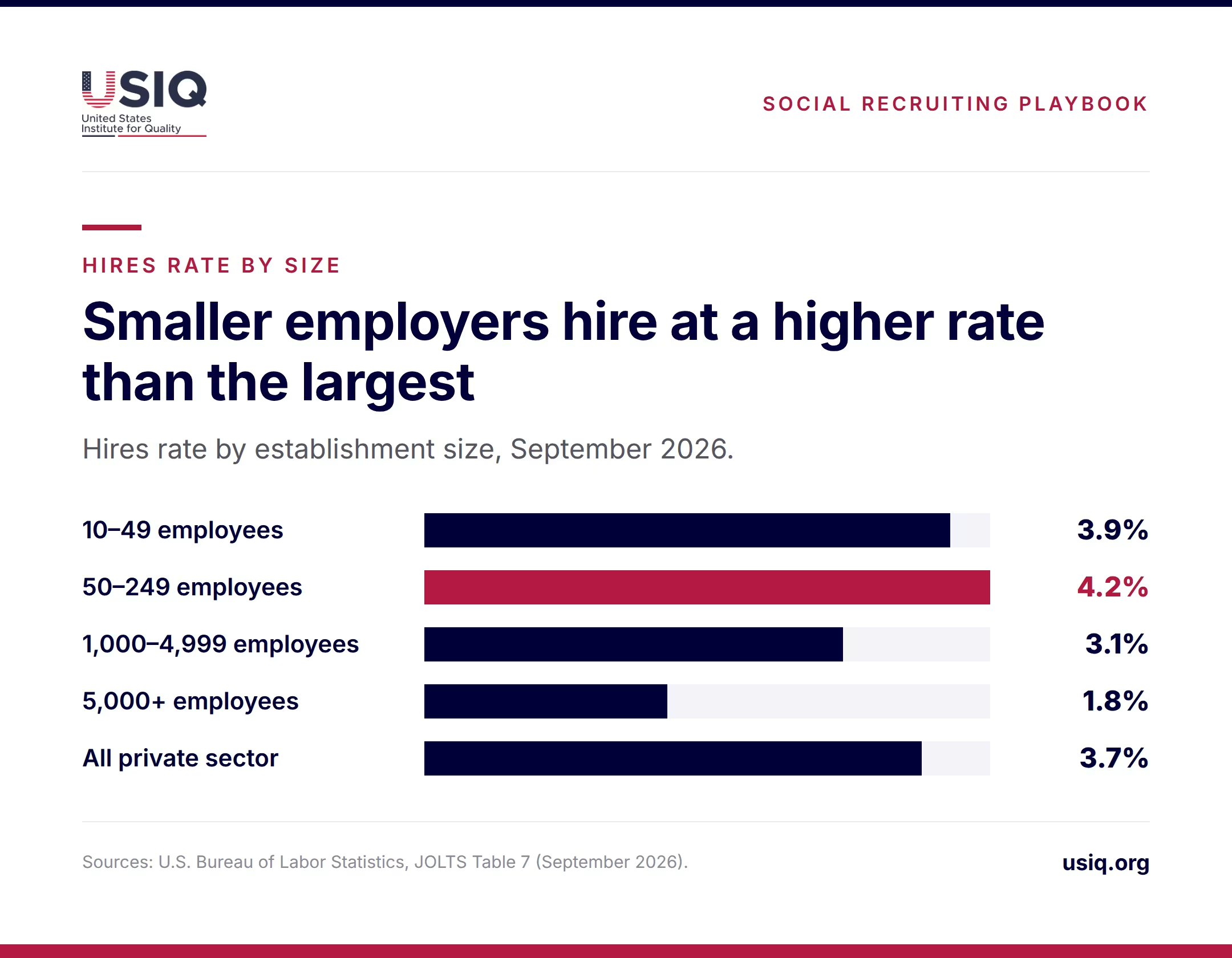
Because small and midsize firms hire at higher rates than the largest ones, they have more chances to benefit from a recruiting channel they control. A steady social presence means that when a role opens, you are not starting from zero.
Where social recruiting has limits
Social recruiting does not replace job boards or referrals. It suits local, hourly, customer-facing and early-career roles well, because those candidates are active on consumer platforms. For specialized or senior roles it is a slow build, and direct outreach, referrals and professional networks usually carry more of the load.
Employee advocacy has a limit too: it cannot be forced, and posts that feel scripted can hurt more than silence. Treat social as one channel in a mix, and compare its results with your other sources (see the measurement section below).
Which social platforms should you use to recruit?
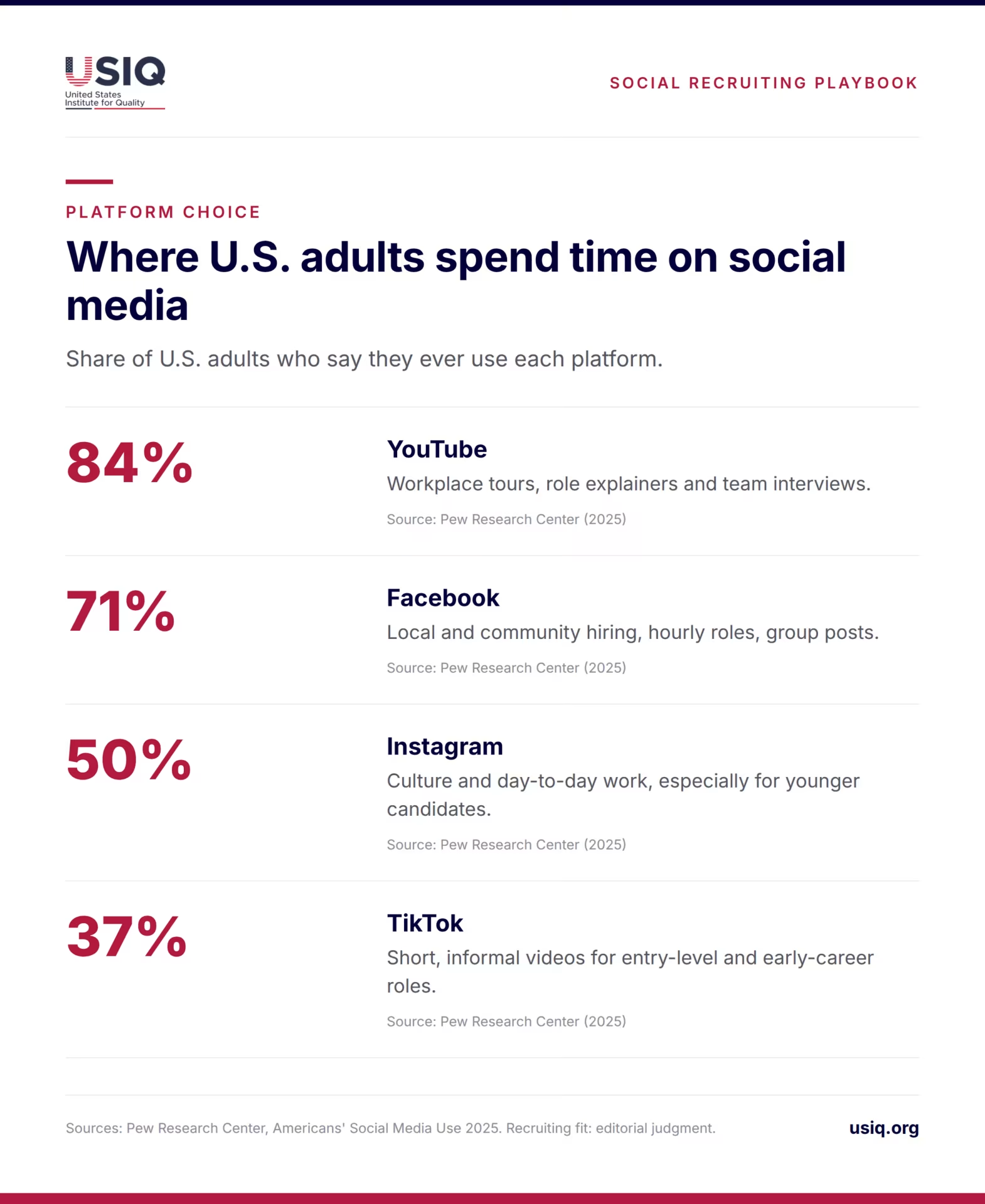
Choose platforms by where your target candidates already spend time. Pew Research Center’s 2025 survey of 5,022 U.S. adults gives a neutral basis: 84% say they ever use YouTube, 71% Facebook, 50% Instagram and 37% TikTok. Instagram use rose from 40% in 2021, and TikTok from 21% (Pew Research Center).
| Platform | Share of U.S. adults who use it | Typical recruiting fit |
|---|---|---|
| YouTube | 84% | Workplace tours, role explainers, interviews with team members |
| 71% | Local and community hiring, hourly roles, group posts | |
| 50% | Culture, people and day-to-day work, especially for younger candidates | |
| TikTok | 37% | Short, informal videos for entry-level and early-career roles |
Age matters more than the headline numbers. Instagram is used by 80% of adults aged 18–29 but only 19% of those 65 and older. Facebook use peaks among 30–49-year-olds at 80%. YouTube and Facebook are the only sites used by a majority in every age group (Pew Research Center).
Pew’s figures also show habit: about half of U.S. adults visit Facebook and YouTube daily, 37% visit Facebook several times a day, and 24% visit TikTok daily. LinkedIn does not appear in the data cited here. It remains the usual first choice for professional, office-based and managerial roles, but that is a practical convention rather than a measured fact.
A simple rule: one main channel, one support channel
A small team cannot run five accounts well. Pick one main platform where your core candidates are, and one support platform for repurposed content. A restaurant group hiring cooks and servers might choose Facebook and Instagram. A 60-person engineering firm might choose LinkedIn and YouTube. For more on the Facebook route, see this guide to using Facebook for job postings and recruitment.
How do you start social recruiting in seven steps?
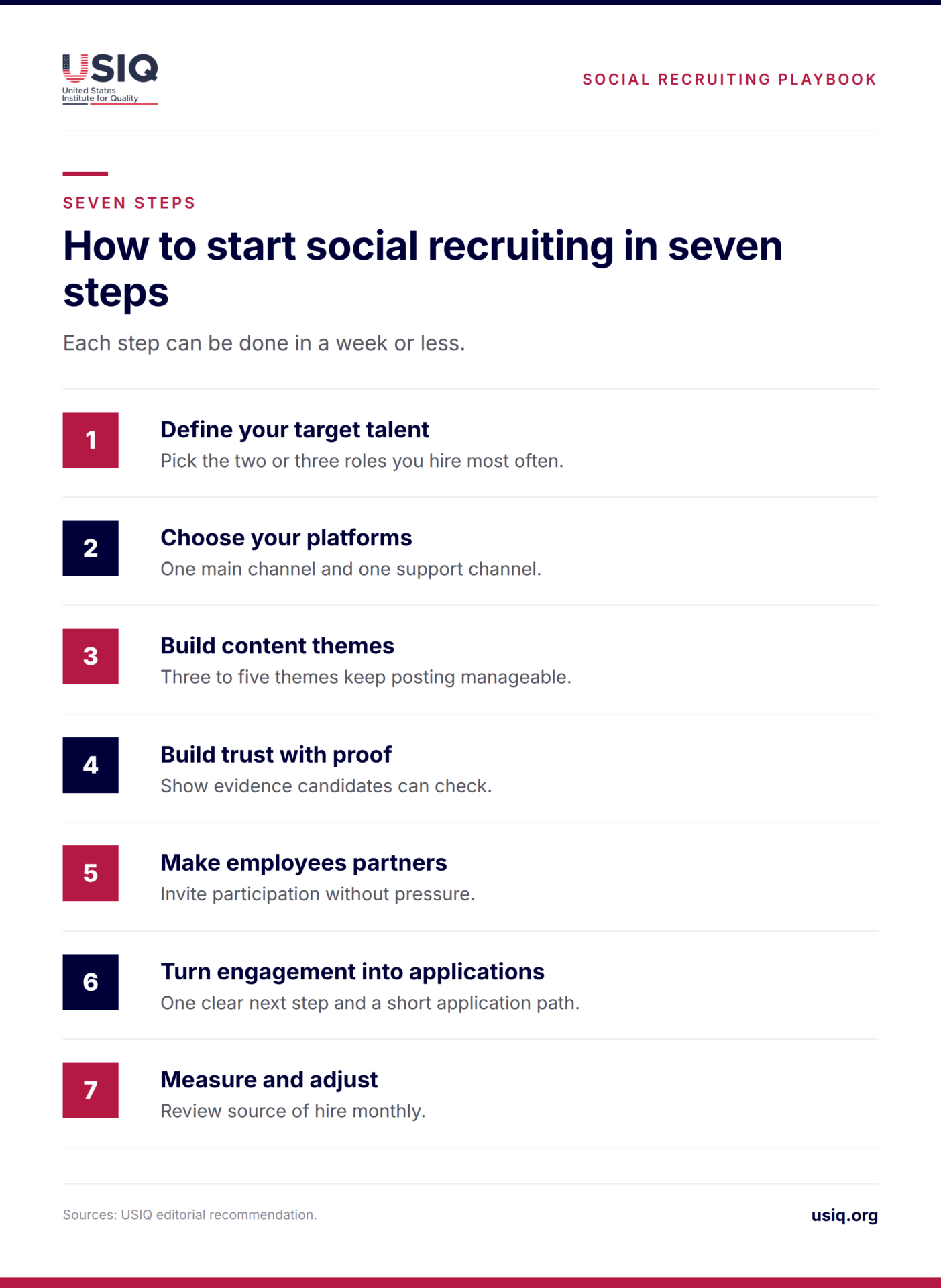
The sequence below works for teams without a dedicated marketer. Each step can be done in a week or less.
Step 1: Define your target talent
Messages aimed at everyone get ignored. Decide which two or three roles you hire most often, who fills them and what those people care about. Early-career candidates often ask about learning and team culture, experienced professionals about stability and leadership, and hourly candidates about schedules and pay.
Use your own data. Look at your top performers and your longest-staying employees in those roles, and ask what attracted them. Their answers shape what you say and where you say it.
Step 2: Choose your platforms
Apply the one-main, one-support rule from the previous section. Make sure each profile has a complete description, a link to your careers page and current contact details.
Step 3: Build three to five content themes
Themes keep posting manageable. Typical examples are a day in the life of a role, team moments, learning and promotions, customer stories and open roles in plain language. The next section covers what works in each.
Step 4: Build trust with proof candidates can check
Candidates look for evidence that your claims are real. The strongest proof you control is specific: employees speaking in their own words, concrete outcomes such as promotions from within, transparent pay ranges and benefits, and honest answers to hard questions. Respond to public reviews calmly and factually, including the critical ones. Leave out claims you cannot back up with something concrete.
Step 5: Make employees recruiting partners
Employees’ posts feel personal, and candidates often ask them questions directly. The employee-sharing section below explains how to invite participation without pressure and what to disclose.
Step 6: Turn engagement into applications
Every post needs one clear next step and a short path to an application. Details follow in the conversion section.
Step 7: Measure and adjust
Track where applicants and hires come from, and review monthly. Cut what does not produce candidates and do more of what does.
A realistic time budget and a 90-day plan
Plan for roughly two to three hours a week. That covers one or two posts, replies to comments and messages, and a short review of the numbers. Treat it as a planning guide and adjust it to your team.
- Days 1–30: define the target roles, choose channels, tidy profiles, set up tracking links and write a short social media policy.
- Days 31–60: publish weekly, collect three or four employee stories, and reply to every comment and message within a working day.
- Days 61–90: review source of hire and applications by channel, drop what does not work and set a content calendar for the next quarter.
What content attracts candidates?
Content that shows the work as it is. Candidates want to picture themselves in the job, so the best material answers the questions they would ask in an interview: What does a normal day look like? Who would I work with? What happens if I do well?
- Employee stories and day-in-the-life posts: a short video or photo series of one role, told by the person who does it.
- Team moments and learning: training sessions, project wrap-ups, internal promotions.
- Plain-language job posts: what the person will do, the schedule, the pay range and the first steps to apply, instead of a long task list.
- Visual-first formats: a clear photo or a 30-second video usually fits feed-based platforms better than a text block.
Phone footage with good sound is usually enough. Over-polished content can feel like advertising, and candidates tend to trust honest, simple material more. For short-video ideas, see these tips for creating TikTok videos for employer branding, and for a wider view, this piece on content marketing for employers.
Reply to comments and direct messages quickly. An unanswered question about pay or schedule tells a candidate how the company handles people.
How do you get employees to share job posts without pressure?
Make it easy, optional and transparent. Give employees ready-to-share posts, such as a role highlight or a team photo, plus a short guide on what they may and may not say. Thank those who take part, and never tie performance reviews to posting.
A written social media policy should cover confidentiality, respectful conduct and the ground rules for speaking about the company. Have counsel review it, since what an employer may restrict is a legal question with its own rules.
Does the FTC require disclosure on employee posts?
For posts that promote the company’s products or services, yes. The Federal Trade Commission says employees who mention their employer’s products on social media should disclose the relationship, and that listing the employer on a profile is not enough. The company can be liable for endorsements that omit material connections, and it should have reasonable programs to train and monitor endorsers it pays or directs (Federal Trade Commission).
That guidance addresses products, and it does not clearly cover posts about open jobs. A light-touch line such as “I work at [Company]” in recruiting posts is a sensible habit and costs nothing. Employees who also promote your products or services need a firmer disclosure rule.
Is it legal to look at candidates’ social media profiles?
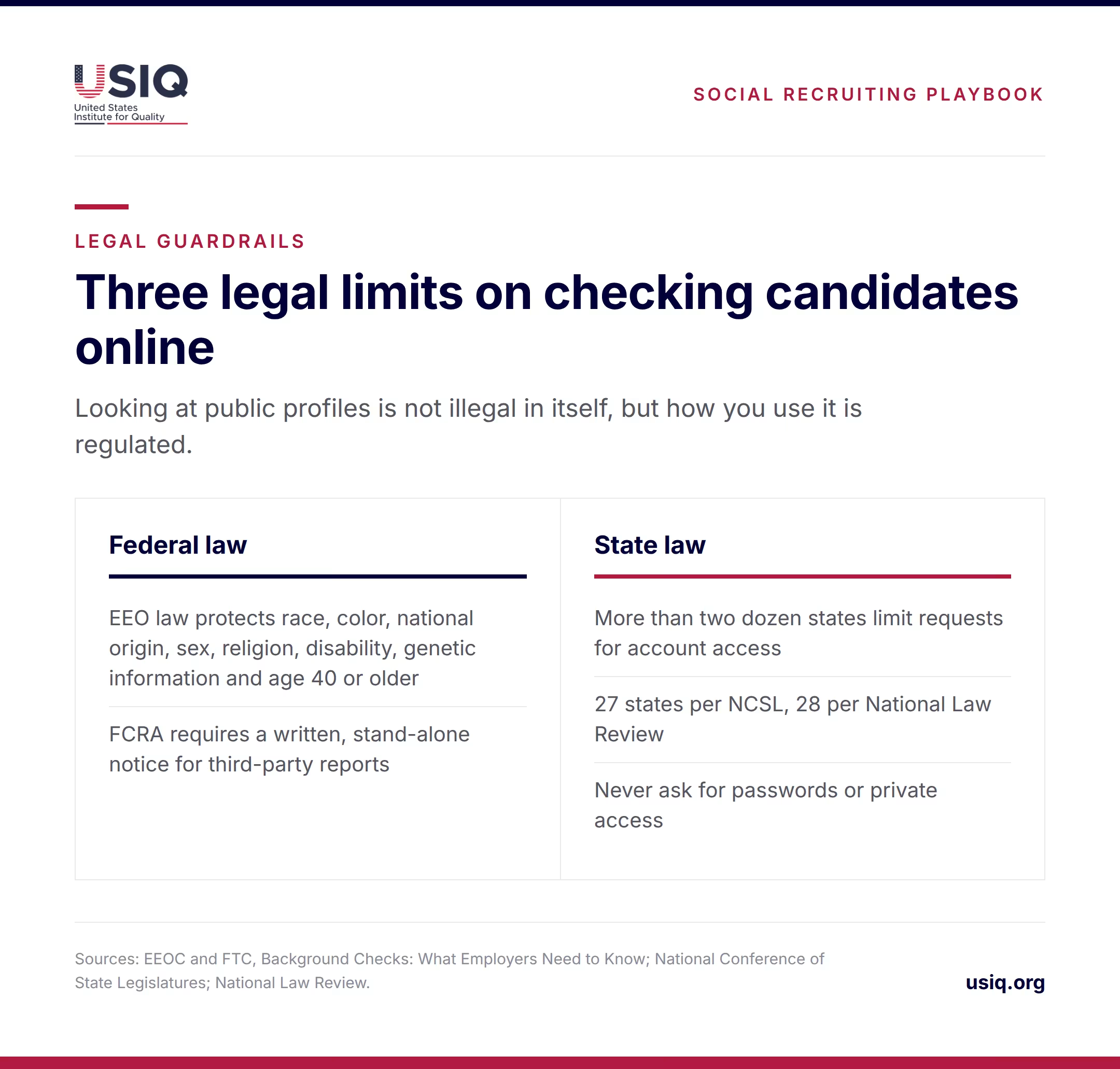
Looking at what a candidate has made public is not illegal in itself, but how you use it is regulated. The joint EEOC and FTC guide says background checks must comply with the equal employment opportunity laws, which protect against discrimination based on race, color, national origin, sex, religion, disability, genetic information and age (40 or older), and with the Fair Credit Reporting Act (FCRA) (EEOC and FTC, Background Checks: What Employers Need to Know).
Profiles often show exactly those characteristics. The EEOC states that social media information may not be used for employment decisions on prohibited bases, and that the EEO laws do not expressly permit or prohibit specified technologies (EEOC, March 12, 2014).
| Issue | What the sources say | Practical rule |
|---|---|---|
| Protected characteristics | Federal EEO laws apply to information used in hiring, however obtained | Use consistent, documented criteria for every candidate, and keep screening separate from the decision-makers where possible |
| Third-party screening firms | The FCRA requires a written, stand-alone notice and applicant authorization before a company that compiles background reports is used. The notice cannot sit inside the job application | Use a separate disclosure form and follow the adverse-action process |
| Passwords and private accounts | Many states bar employers from requesting access to personal accounts | Never ask for usernames, passwords or “friend” requests to see private content |
| State and local rules | The EEOC and FTC guide advises checking state and local requirements | Have counsel confirm the rules in each state where you hire |
State laws add another layer. The National Conference of State Legislatures reports that 27 states have enacted laws limiting employer requests for access to personal social media accounts, with legislation beginning in 2012 (NCSL). A law-firm count puts the number at 28 and lists the typical bans: no requests for usernames or passwords, no friend requests to get access, no lowering of privacy settings and no retaliation. Arkansas, Colorado and Nevada bar even suggesting it (National Law Review). The counts differ, so the safe summary is more than two dozen states. Check yours.
Recruiting is not background checking
Sourcing candidates on social platforms and screening them are different activities. Sourcing means finding people and inviting them to apply. Screening means evaluating a named applicant’s profile, and it is the step where bias and compliance problems arise. If you screen at all, do it late, in the same way for every finalist, and let a person not involved in the hiring decision filter out protected information where possible.
Rules on job-ad targeting options and on automated screening tools vary and change, so ask counsel before you use either.
How do you turn social engagement into applications?
Remove steps between interest and application. Each post should carry one call to action: apply, learn more, follow or join a talent community. Link directly to the specific job or to a careers page that loads quickly on a phone.
- Ask for the minimum at first: name, contact details and a resume or a few short questions.
- Avoid forced account creation and multiple logins.
- Test the application on a phone before you promote it.
- Offer a talent community or email list for people who like the company but see no fitting role.
- Confirm receipt quickly and tell applicants what happens next.
Your own data will show where applicants drop off. Compare how many people click through with how many finish the form, and shorten the form if the gap is large.
How do you measure social recruiting results?
Measure outcomes from the first view to the hire, not likes. Tag every link you post with a tracking parameter (UTM link), and add a required “How did you hear about us?” field to the application or to your applicant tracking system. Together they show which channel and which post produced candidates.
| Funnel stage | What to track | What it tells you |
|---|---|---|
| Reach | Views and followers per platform | Whether the right audience sees you |
| Clicks | Click-throughs to the careers page | Whether content and call to action work |
| Applications | Applications by source | Which channel brings candidates |
| Interviews and hires | Interviews and hires by source, time to fill by source | Whether those candidates fit the role |
| Quality proxy | 90-day retention of hires by source | Whether hires from social stay |
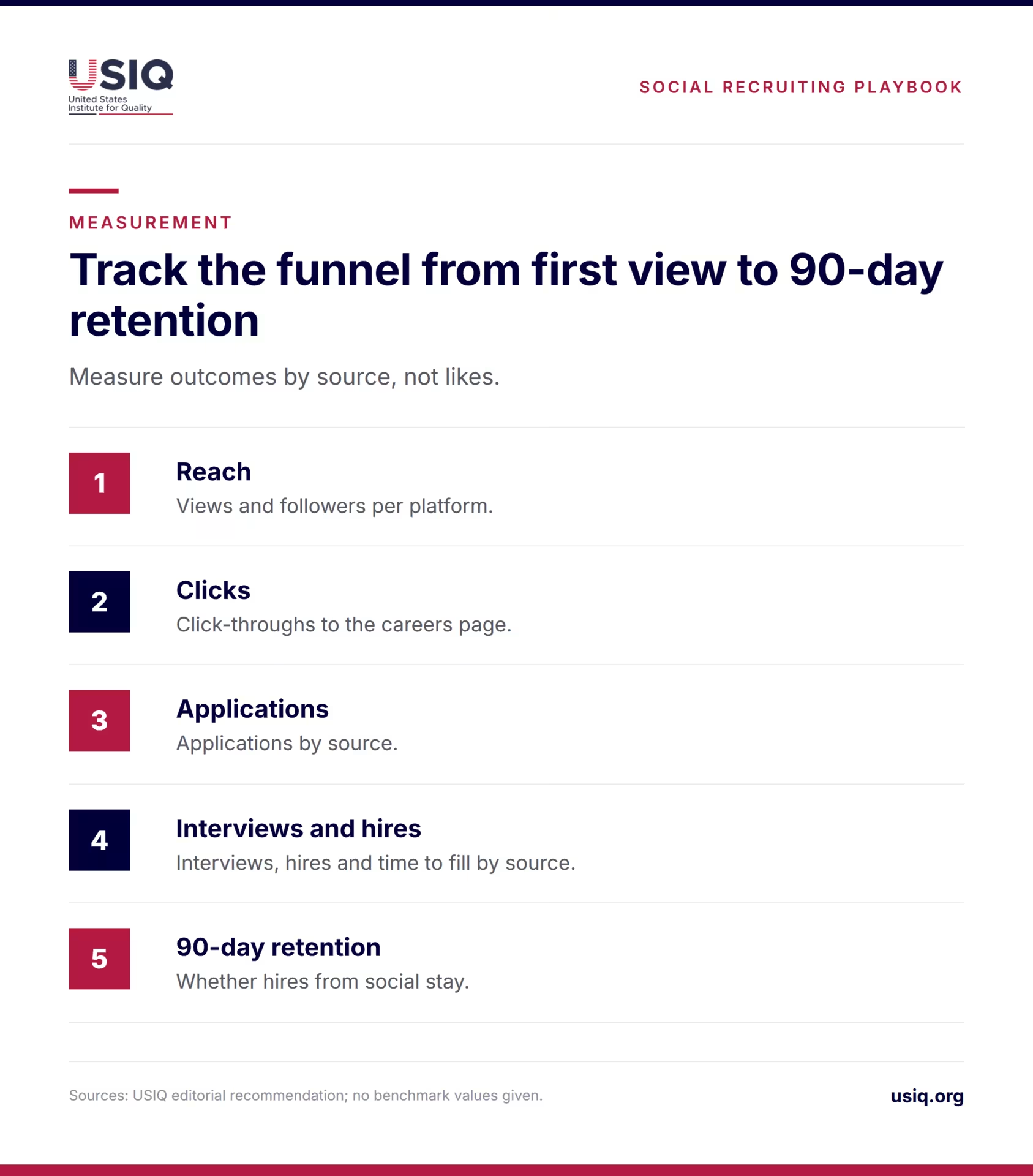
With only a few hires per year, percentages swing widely. Look at trends over six to twelve months and treat a single quarter with caution. For more on recruiting metrics, see this overview of the most important KPIs in recruiting.
What are the most common social recruiting mistakes?
- Job ads only: a feed of vacancies without context or people gives candidates little reason to follow.
- No replies: unanswered comments and messages signal that nobody is listening.
- Over-polished content: corporate gloss reads as advertising.
- No measurement: without source-of-hire data, you cannot tell what works.
- One-off campaigns: familiarity builds over months, not in a week.
- Biased targeting or screening: using profile information, or ad options, in ways that exclude protected groups creates legal and reputational risk.
- Forced advocacy: pressuring employees to post weakens trust inside and outside the company.
What is the outlook for social recruiting?
Platform use keeps shifting. Pew’s data shows Instagram rising from 40% to 50% of U.S. adults between 2021 and 2025, TikTok from 21% to 37%, and Reddit from 18% to 26%. Candidates are spread across more places than before, and the platform mix that works today may not fit in two years.
That favors a flexible, content-first approach over investment in one tool. Reusable stories, clear job posts and a fast application stay useful regardless of platform. Candidates also increasingly research employers through other tools, a topic covered in this article on how candidates ask AI about employers.
What should you do first?
- Choose two or three priority roles and write down who you want to reach.
- Pick one main and one support platform based on that audience.
- Block two to three hours a week and name one owner.
- Collect three employee stories in the first month, with permission.
- Write a short social media policy and a screening rule, and have counsel review both.
- Add tracking links and a “how did you hear about us” field before you post.
- Review source of hire and 90-day retention every quarter.
For smaller budgets, this guide on building a strong employer brand on a small budget offers more ideas, and this article on sourcing passive candidates goes deeper into active outreach.
Frequently asked questions
What is the difference between social recruiting and social media marketing?
Social media marketing aims at customers, while social recruiting aims at candidates and future applicants. The tools and platforms overlap, but the content differs. Recruiting posts focus on the work, the people, pay and growth, and they end in an application, not a purchase. Many small companies run both from the same accounts.
How much time does social recruiting take for a small HR team?
A workable starting point is two to three hours a week: one or two posts, replies to comments and messages, and a quick review of results. Setup in the first month takes longer. Treat the figure as a planning guide and adjust it after your first 90 days.
Which platform is best for hiring hourly or local workers?
Facebook is a common starting point, as 71% of U.S. adults use it and use peaks at 80% among 30–49-year-olds (Pew, 2025). Instagram suits younger applicants, as 80% of adults aged 18–29 use it. Test one main platform for a quarter and compare applications by source.
Can I ask a candidate for access to a private social media account?
No. More than two dozen states limit employer requests for access to personal social media accounts. Typical bans cover asking for usernames or passwords, sending friend requests to get access, and asking applicants to lower privacy settings. Even without a state law, asking creates avoidable risk. Check the rules in your state.
Is it legal to reject a candidate based on what I find on their profile?
It depends on the reason. Federal law bars employment decisions based on race, color, national origin, sex, religion, disability, genetic information or age 40 and older, however you learned the information. Use job-related criteria, apply them to everyone, document them and have a person not making the decision do the first screen where possible.
Do employees have to disclose that they work for us when they share job posts?
The FTC requires disclosure when employees promote the company’s products or services. Its guidance does not clearly address recruiting posts. A short “I work at [Company]” line is a sensible habit, and a written policy with brief training helps employees follow it.
How do I know whether social recruiting is working?
Track applications, interviews and hires by source, using tracking links and a “how did you hear about us” field. Add 90-day retention and time to fill by source as quality checks. Review the numbers over several months, because a small company’s few hires can distort short periods.
Should social recruiting replace job boards?
Usually not. In a late-2015 SHRM survey, 81% of organizations using social media for recruiting said it was one of several tools, and only 5% called it their primary one. The data is old, but the logic holds: social suits some roles well, and it works best alongside referrals and job postings.
Sources
- Pew Research Center, “Americans’ Social Media Use 2025,” November 20, 2025. https://www.pewresearch.org/internet/2025/11/20/americans-social-media-use-2025/
- U.S. Bureau of Labor Statistics, “Job Openings and Labor Turnover – September 2026.” https://www.bls.gov/news.release/jolts.nr0.htm
- U.S. Bureau of Labor Statistics, “JOLTS Table 7: Job openings, hires and separations by establishment size class.” https://www.bls.gov/news.release/jolts.t07.htm
- EEOC and FTC, “Background Checks: What Employers Need to Know.” https://www.ftc.gov/system/files/documents/plain-language/pdf-0142-background-checks-what-employers-need-know.pdf
- U.S. Equal Employment Opportunity Commission, “Social Media Is Part of Today’s Workplace but its Use May Raise Employment Discrimination Concerns,” March 12, 2014. https://www.eeoc.gov/newsroom/social-media-part-todays-workplace-its-use-may-raise-employment-discrimination-concerns
- National Conference of State Legislatures, “Privacy of Employee and Student Social Media Accounts.” https://www.ncsl.org/technology-and-communication/privacy-of-employee-and-student-social-media-accounts
- National Law Review (Barnes & Thornburg), “State Employment Law – 28 States Limit Employer Access to Private Social Media Accounts.” https://natlawreview.com/article/state-employment-law-28-states-limit-employer-access-private-social-media-accounts
- Federal Trade Commission, “FTC’s Endorsement Guides: What People Are Asking.” https://www.ftc.gov/business-guidance/resources/ftcs-endorsement-guides-what-people-are-asking
- SHRM, “Survey: Employers Using Social Media to Find Passive Candidates” (survey conducted late 2015). https://www.shrm.org/topics-tools/news/talent-acquisition/survey-employers-using-social-media-to-find-passive-candidates
- U.S. Chamber of Commerce (CO), “Top Social Media Recruiting Tips and Strategies.” https://www.uschamber.com/co/grow/marketing/social-media-recruiting-strategies

Related Articles

What research says about the effects of employer seals on current employees, potential applicants and employer image, from independent experiments and field data to the limits of the evidence.
Employee experience and customer experience are linked, but the link is weaker and more conditional than popular slogans suggest. This article reviews the evidence on staffing, training and workplace conditions and shows how employers can test the connection in their own business.
Most HR dashboards show too many metrics and trigger too few decisions. This guide defines ten employee experience metrics, shows a one-page layout and explains how to read your numbers against U.S. data.
A practical guide to calculating marketing ROI for small and mid-sized U.S. companies, including long B2B sales cycles, offline leads, a spreadsheet walkthrough and common errors.


