

The labor shortage 2026 debate looks different from the one in 2022. Job openings have come down from their peak, and the market is cooler. Still, owners of small and midsize companies keep telling surveyors that they cannot find the people they need.
Both statements are true at once. The pool of workers is growing more slowly than it used to, and many employers are looking for skills that applicants do not have. This article sorts the current U.S. data, explains why the problem persists and lays out what a company with 10 to 250 employees can do about it.
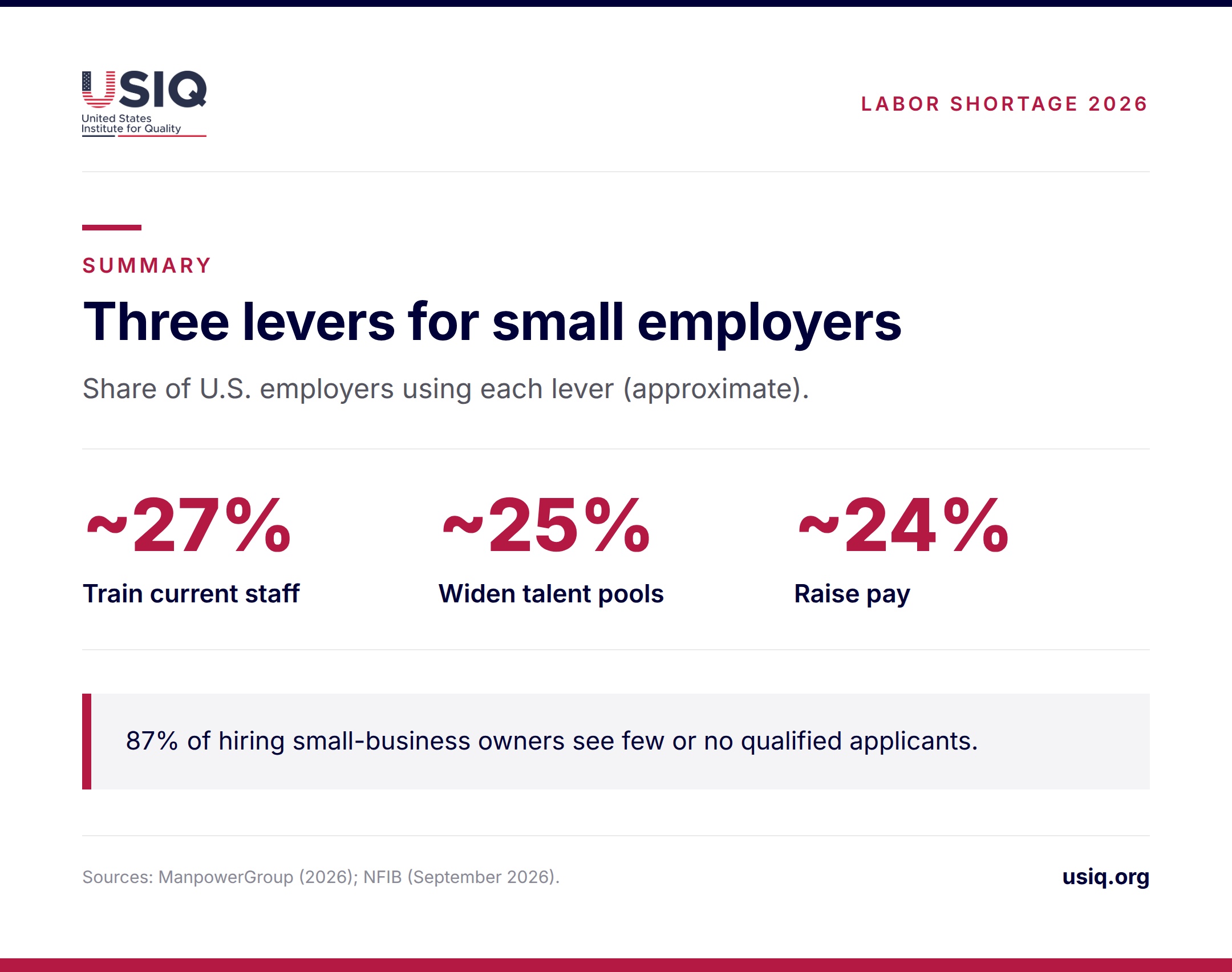
Quick answer: In 2026 the U.S. does not face a classic, across-the-board worker shortage. Openings stand at 7.1 million, but 69% of employers report trouble finding skilled talent, and 87% of hiring small-business owners see few or no qualified applicants. Slower labor force growth and skills mismatches drive the problem.
Key takeaways
- U.S. job openings were 7.1 million in August 2026, a cooler market than in recent years, yet employer surveys still show widespread hiring difficulty.
- For small firms the main issue is quality of applicants, not pay: 26% of NFIB owners call labor quality or availability their top problem, while only 6% name labor costs.
- The Bureau of Labor Statistics (BLS) projects a falling labor force participation rate, from 62.6% in 2024 to 61.1% in 2034.
- Healthcare and social assistance is projected to grow fastest (8.4%), while retail trade is projected to shrink (1.2%).
- The most common employer responses are upskilling (about 27%), wider talent pools (about 25%), higher wages (about 24%) and flexible schedules (about 22%).
- Retention is part of the answer: about 3.1 million Americans quit their jobs in August 2026 alone.
- Automation helps with routine tasks but does not replace care, judgment or the people needed to run the technology.
What does the labor shortage 2026 data actually show?
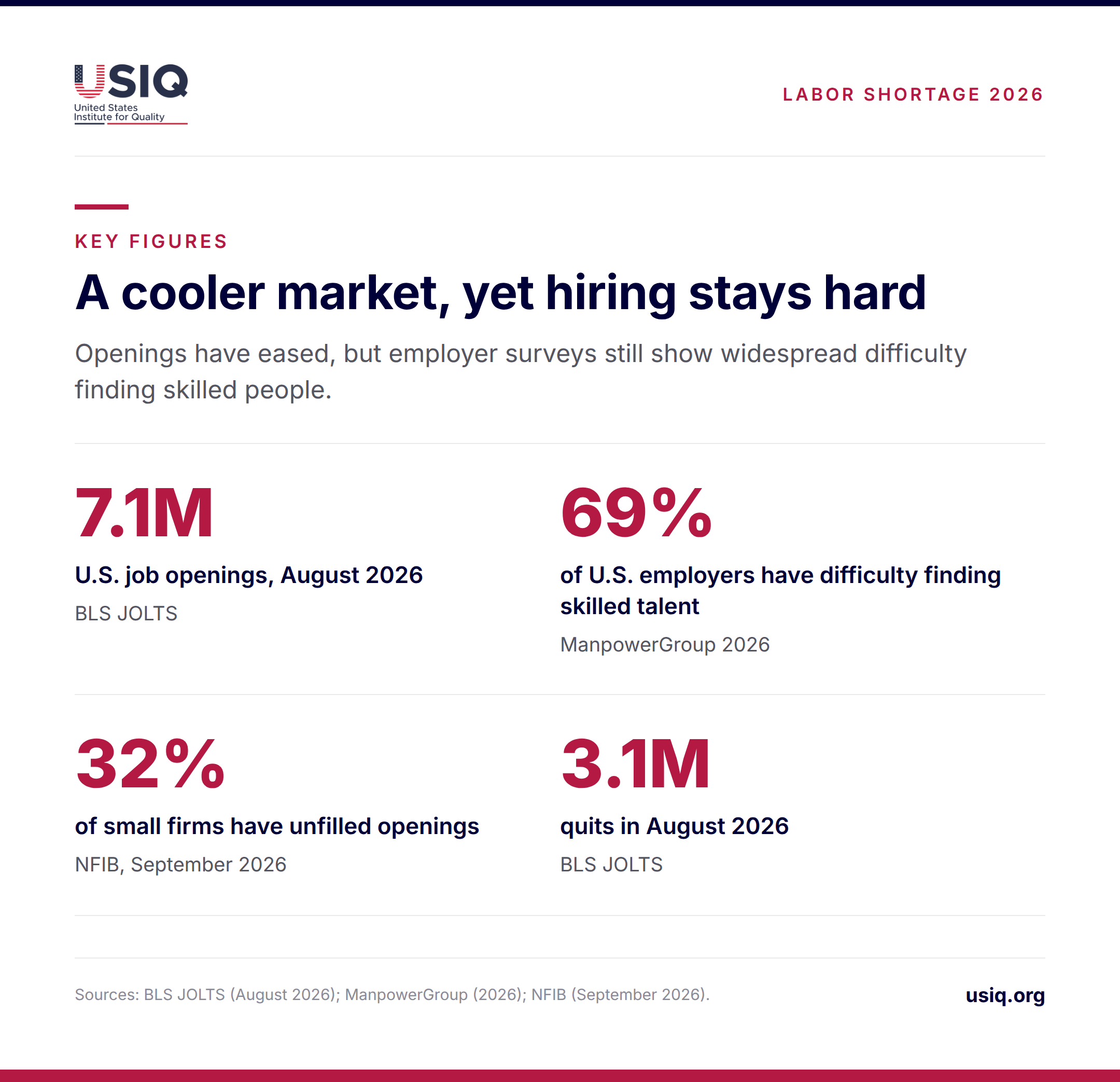
The latest Job Openings and Labor Turnover Survey (JOLTS) from the BLS counted 7.1 million U.S. job openings in August 2026, little changed from the month before, for an openings rate of 4.3%. July was revised up by 64,000 to 7.3 million. Employers hired 5.2 million people (a hires rate of 3.3%), and total separations came to 5.1 million.
Employer surveys paint a tighter picture than the openings count alone. ManpowerGroup’s 2026 survey, with fieldwork in October 2025, found that 69% of U.S. employers have difficulty finding skilled talent, down from 71% a year earlier. The U.S. sample covered more than 6,000 employers; the global average was 72%.
Small businesses report the same strain. In the NFIB’s September 2026 jobs report, 32% of small business owners had unfilled openings, 8 points above the historical average. Some 27% had openings for skilled workers and 16% for unskilled workers. The report draws on 411 member firms, so it indicates direction rather than a precise count.
| Indicator | Latest figure | Source |
|---|---|---|
| U.S. job openings (August 2026) | 7.1 million, rate 4.3% | BLS JOLTS |
| Hires (August 2026) | 5.2 million, rate 3.3% | BLS JOLTS |
| Quits (August 2026) | 3.1 million, rate 1.9% | BLS JOLTS |
| Layoffs and discharges (August 2026) | 1.6 million, rate 1.0% | BLS JOLTS |
| U.S. employers with difficulty finding skilled talent | 69% (prior year: 71%) | ManpowerGroup 2026 |
| Small firms with unfilled openings (September 2026) | 32%, 8 points above average | NFIB |
BLS also publishes JOLTS tables by establishment size. In August 2026 the openings rate fell for establishments with 1 to 9 employees, while hires, quits and separations in the other size classes changed little.
Is it a worker shortage or a skills and fit shortage?
A labor shortage means employers cannot fill openings at the wages they offer because too few suitable people are available. That can mean too few people overall, or too few with the right skills, schedules or location. For small firms, the 2026 data points more toward the second reading.
The NFIB found that 51% of owners were hiring or trying to hire. Of all owners, 45% reported few or no qualified applicants, which equals 87% of those hiring: 25% saw few qualified applicants and 20% saw none. Some 26% named “labor quality or availability” their single most important problem, 14 points above the 12% historical average. Only 6% named labor costs, the lowest share since December 2020.
The ManpowerGroup survey adds detail on what is missing. Among hard skills, engineering and AI literacy are hardest for U.S. employers to find. The soft skills they rate most important are adaptability, critical thinking and communication.
Why economists disagree about “shortage”
BLS builds its employment projections on an assumption of full employment in the target year. It states that it “does not project an overall labor shortage or surplus,” because labor supply and demand are linked in its model. The projections are a scenario under stated assumptions, not a forecast.
That is one reason sources reach different conclusions. A headline openings count, an employer sentiment survey and a government projection measure different things. A single owner can still lose a contract because the one qualified technician in the county took another job.
Why does the labor shortage persist?
The main structural cause is demographics. BLS projects the labor force participation rate to fall from 62.6% in 2024 to 61.1% in 2034, which Indeed Hiring Lab’s analysis translates into roughly 4.3 million fewer workers than if participation held steady.
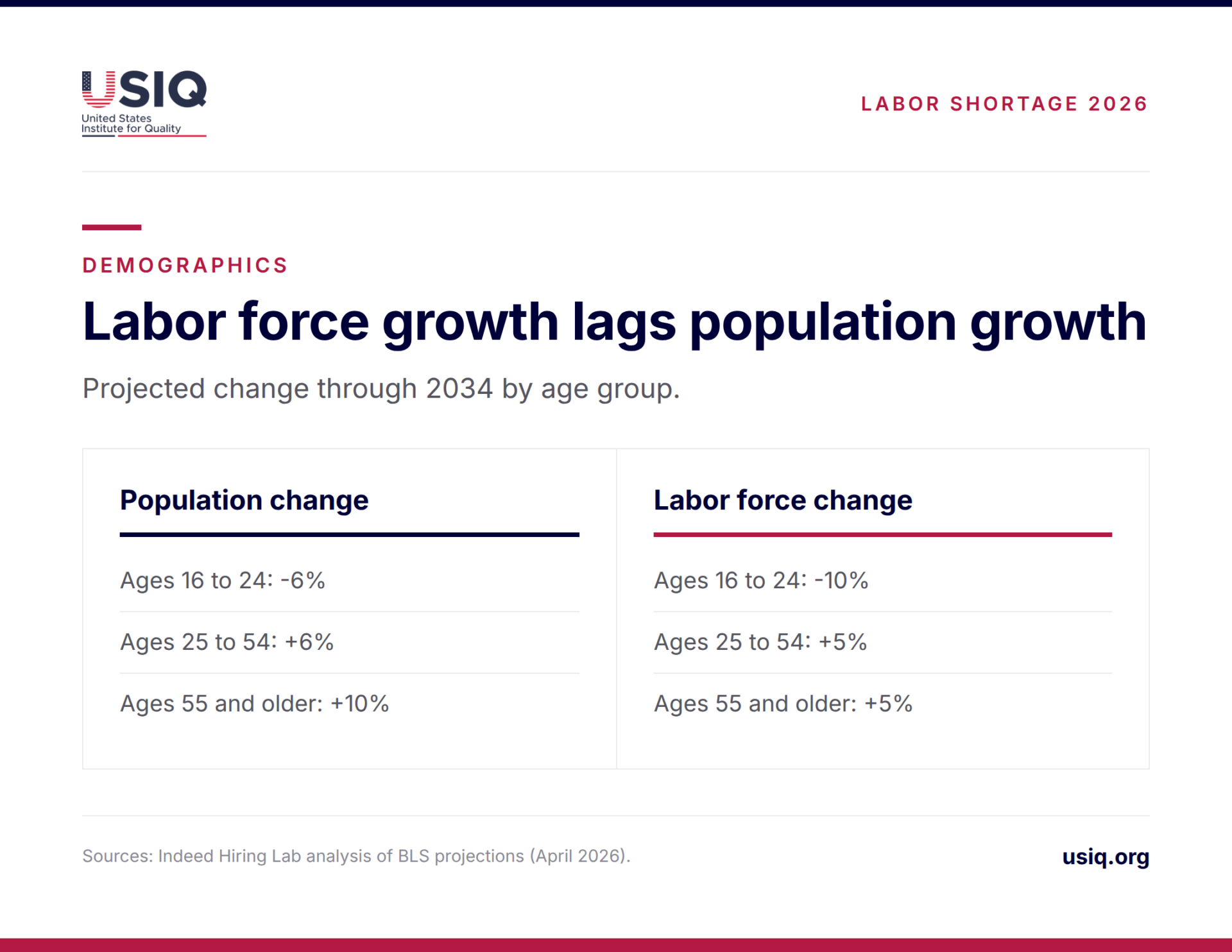
The age mix matters. The population aged 55 and older is projected to grow about 10%, but its labor force only about 5%. The population aged 16 to 24 is projected to fall 6%, and its labor force 10%, with the participation rate for that group dropping from 55.9% to 53.6%. Prime-age workers (25 to 54) are projected to grow 6% in population and 5% in labor force through 2034.
| Group (through 2034) | Population change | Labor force change |
|---|---|---|
| Ages 16 to 24 | about -6% | about -10% |
| Ages 25 to 54 (prime age) | about +6% | about +5% |
| Ages 55 and older | about +10% | about +5% |
Two further causes show up in employer data. The first is a skills mismatch: employers want engineering, AI literacy and adaptability, and applicants do not always bring them. A JPMorganChase report, as summarized by Inc., says three in four U.S. companies struggle to find qualified workers and four in ten adults lack basic digital skills. That is secondary reporting, so read it as a signal, not a measurement.
The second cause is worker expectations. People weigh schedule flexibility, development and pay together, and they leave when an employer falls short. The 3.1 million quits in August 2026 show that movement between jobs remains high, which keeps replacement hiring constant for many employers.
Which industries will be hit hardest, and which will shrink?
BLS projects the economy will add 5.2 million jobs from 2024 to 2034, reaching 175.2 million, a growth of 3.1%. That compares with 13.0% over 2014 to 2024. Growth is uneven, and the sectors adding the most jobs will compete hardest for workers.
| Sector or occupation group | Projected change, 2024 to 2034 |
|---|---|
| Healthcare and social assistance | +8.4% (fastest of any sector) |
| Healthcare support occupations | +12.4% |
| Healthcare practitioners | +7.2% |
| Services for the elderly and persons with disabilities | +21.0%, adding 528,500 jobs |
| Professional, scientific and technical services | +7.5% |
| Information | +6.5% |
| Transportation and warehousing | +3.0% |
| Retail trade | -1.2% (largest job loss of any sector) |
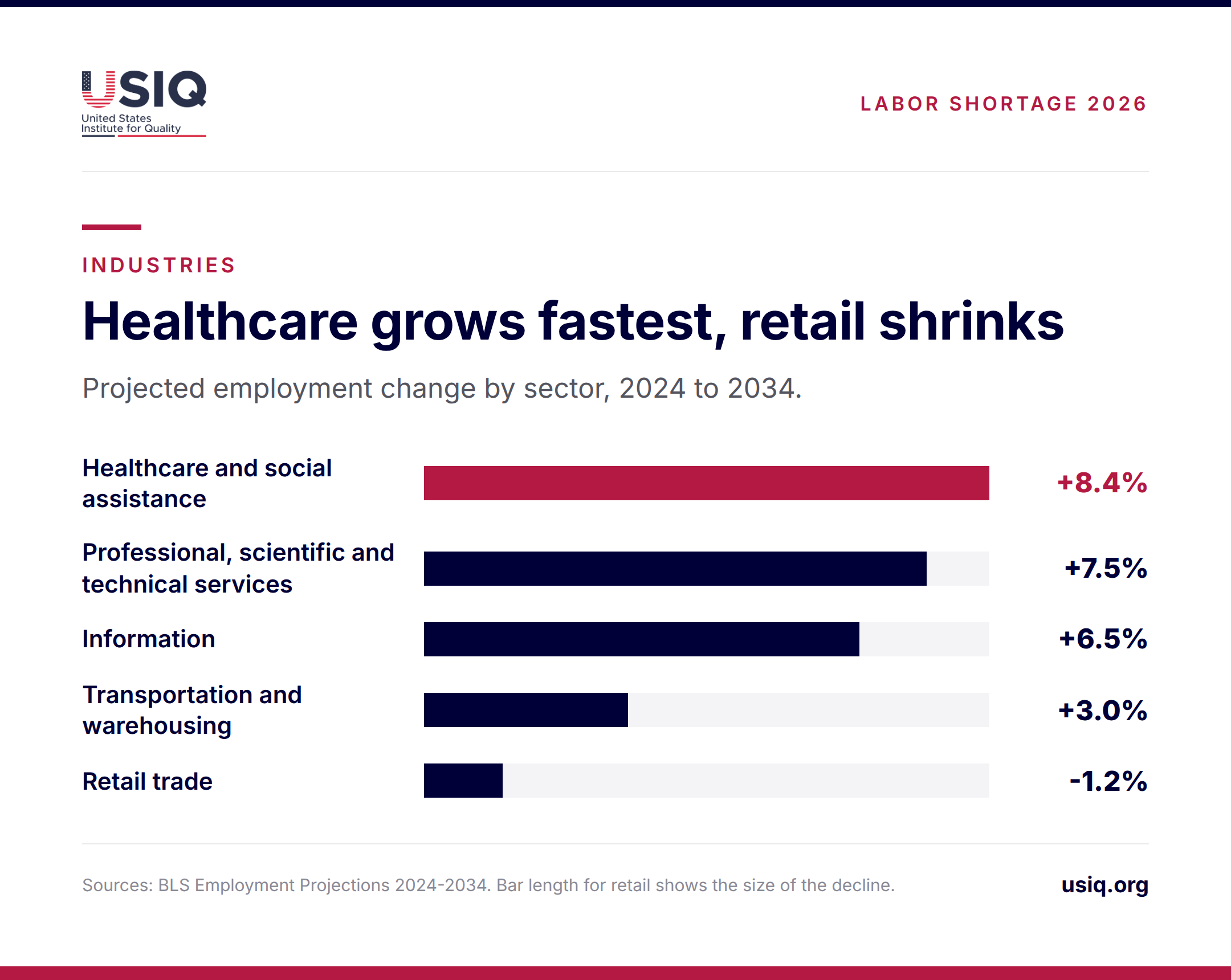
For a 40-person home health agency, these numbers mean that competition for aides and nurses will intensify as the field expands. For a regional retailer, the projected decline means more workers will be looking for jobs elsewhere. BLS links that decline to automation and e-commerce, so a shrinking sector can still be a source of trainable staff for growing ones.
Technology roles grow within professional services and information. Skilled trades and manufacturing remain important for many local employers; check BLS industry tables and your state labor department for your own area.
What does the shortage cost a company with 10 to 250 employees?
The costs show up in three places: work that does not get done, pay that has to rise and time that managers spend hiring instead of managing. An unfilled position means delayed projects, overtime for existing staff and, in service businesses, slower response to customers. Every employer’s cost differs, and no single figure applies to all.
Pay pressure is visible in the NFIB data: a net 28% of owners raised compensation, and a net 20% plan to raise it in the next three months. A net 17% plan to add jobs, and the NFIB Employment Index stood at 100.6 against a historical average of 100.0. Yet labor costs rank last among owner worries, which suggests owners accept higher pay as the price of getting qualified people at all.
Small firms have a structural disadvantage: no recruiting department, thinner benefits budgets and less brand recognition. They also have advantages that larger competitors struggle to match, such as faster decisions, direct access to owners and broader job content.
What can small and midsize employers do now?
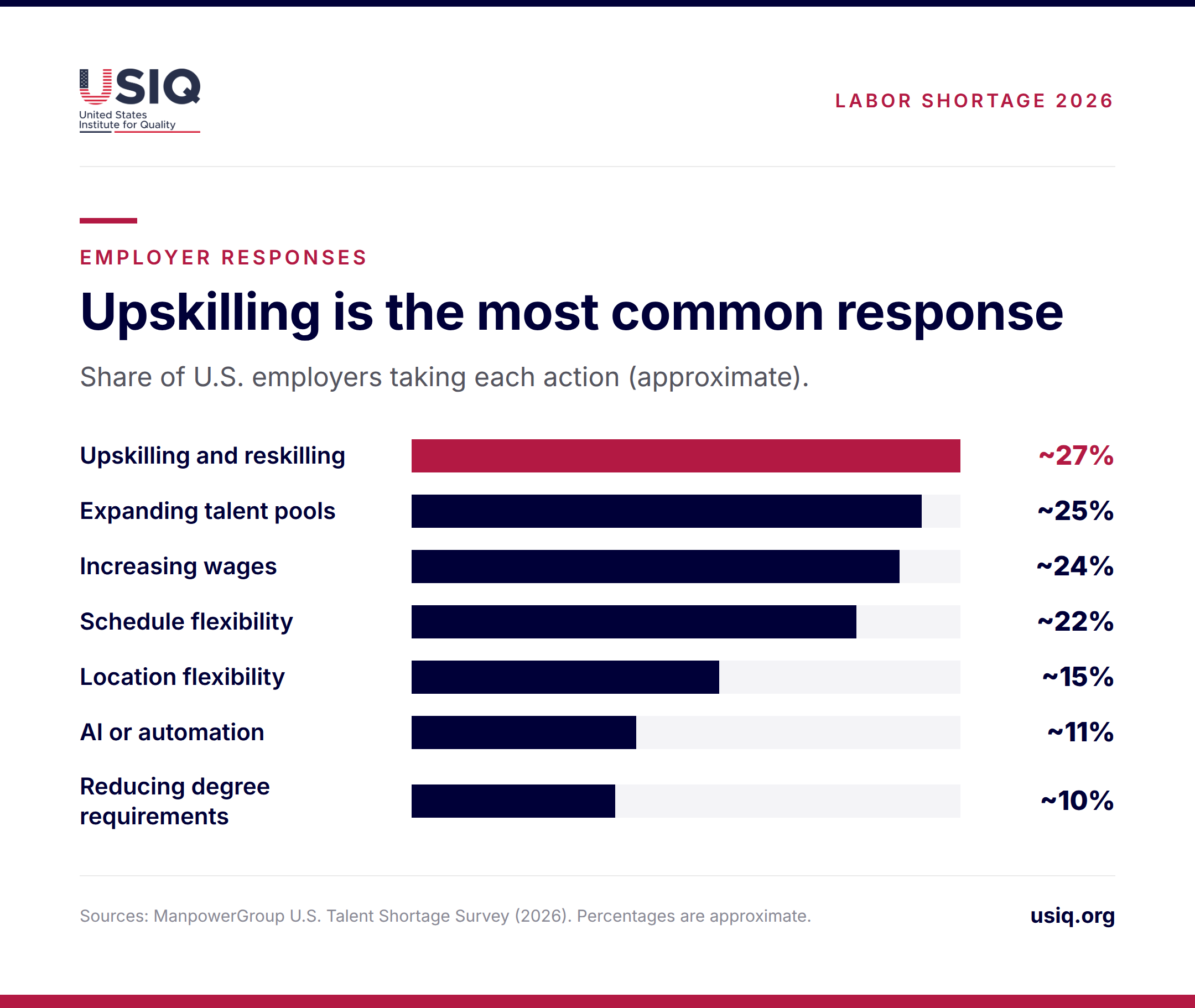
ManpowerGroup asked U.S. employers what they are doing. The percentages below are approximate and were read from the survey’s report text.
| Employer action | Share of U.S. employers (approx.) |
|---|---|
| Upskilling and reskilling | 27% |
| Expanding talent pools | 25% |
| Increasing wages | 24% |
| Schedule flexibility | 22% |
| Location flexibility | 15% |
| AI or automation | 11% |
| Reducing degree requirements | 10% |
Train the people you already have
Upskilling tops the list because it solves the fit problem directly. Pick the two or three roles that are hardest to hire, define the skills they need and train current staff toward them. The guide on upskilling and reskilling covers the formats.
Widen the talent pool
Skills-first hiring drops degree requirements where the job does not need them. Veterans, people with disabilities, older workers and caregivers are often overlooked groups, and flexible hours make roles reachable for them. Apprenticeships and internships, built with local community colleges and trade schools, create a pipeline that does not depend on the open market. Employee referrals cost little, and employee spotlights that show real career paths help candidates picture a future with you.
Benchmark pay and be clear about it
Compare your pay and benefits with local and industry norms before the next opening, not after the third failed search. Signing and retention bonuses can work for specific hard roles, but they should match budget and goals. Transparent hiring communication, with clear expectations, timelines and feedback, leaves a good impression even on candidates who do not get the job.
Keep the people who are already there
With a monthly quits rate of 1.9%, every departure that can be avoided saves a search. Structured onboarding in the first 90 days, with a mentor and a checklist, is the cheapest retention measure. Internal mobility and stretch assignments show people where they can go next. An employee survey is a useful diagnostic: it shows why people stay or consider leaving, and it is worth running whether or not a company seeks outside recognition. See how to prevent fluctuation and low-cost ways to retain employees for specific practices, and employee surveys explained for how to run one.
Some employers also use independent employer certification to make their workplace visible to applicants. USIQ, the publisher of this article, runs certification programs of this kind; employer certification explained describes the standards, process and return.
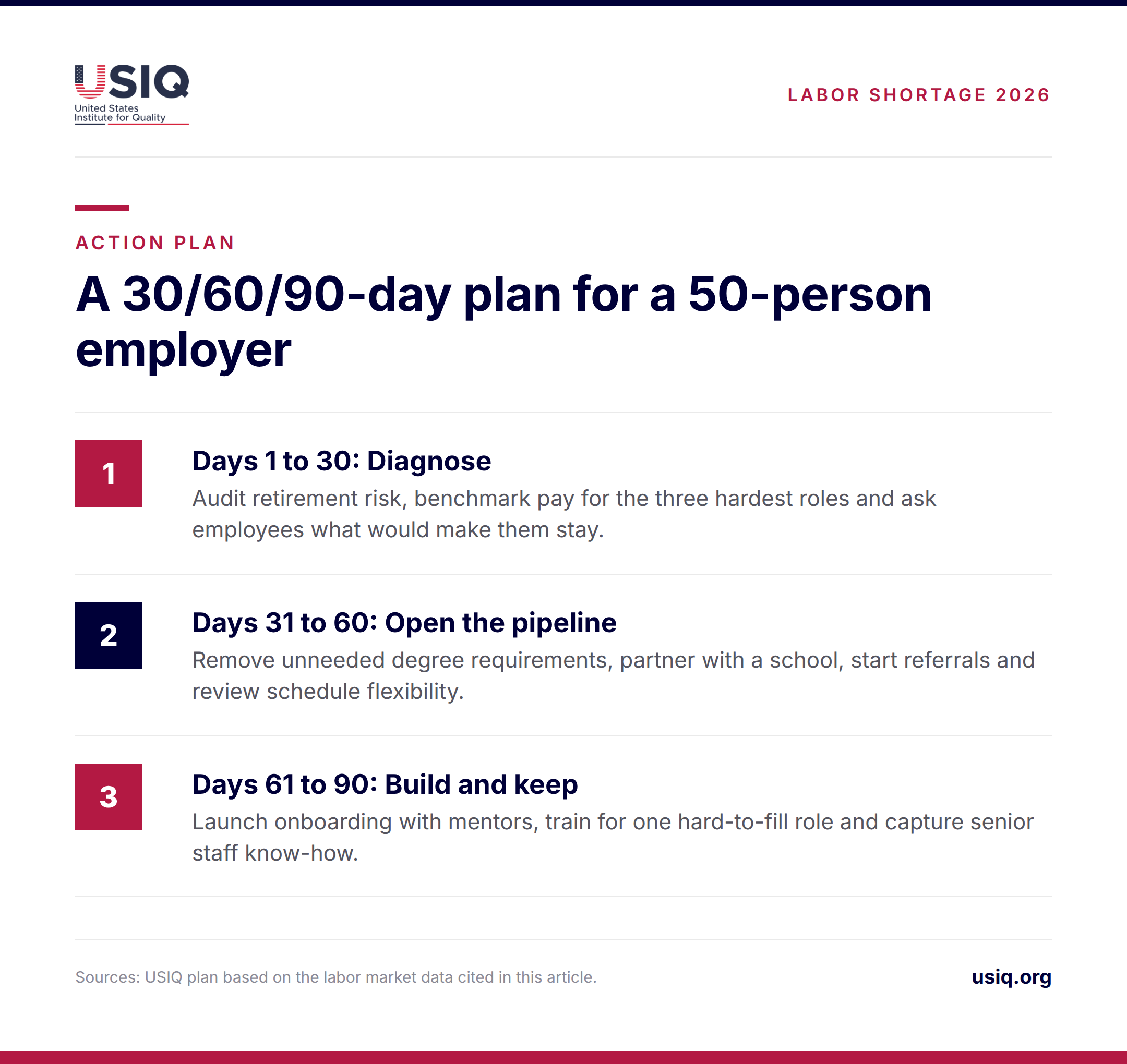
A 30/60/90-day plan for a 50-person employer
| Period | Focus | Concrete steps |
|---|---|---|
| Days 1 to 30 | Diagnose | List roles at risk of retirement in the next 5 to 10 years and the knowledge tied to them; benchmark pay for the three hardest roles; ask employees what would make them stay. |
| Days 31 to 60 | Open the pipeline | Remove unneeded degree requirements; contact a community college or trade school; start a referral process; review schedules for flexibility. |
| Days 61 to 90 | Build and keep | Launch a 90-day onboarding checklist with mentors; start training for one hard-to-fill role; document critical know-how from senior staff. |
Can automation and AI close the gap?
Automation covers part of the gap, not all of it. About 11% of U.S. employers in the ManpowerGroup survey use AI or automation to reduce staffing needs. Data entry, inventory tracking and first-line customer questions are typical candidates, and freeing staff from them lets existing employees focus on work that needs people.
The limits are real. Technology needs people who can set it up, supervise it and fix it, and AI literacy is among the hardest skills for employers to find. Care, teaching, leadership and other judgment-heavy work stay with humans, which is also where BLS projects the most growth. BLS ties the projected decline in retail to automation and e-commerce, so the effect on jobs depends on the industry. For HR-specific uses, see the impact of automation and AI on HR.
What should employers expect in 2027?
The BLS projections point to slow job growth of 3.1% over ten years and a shrinking participation rate. That combination suggests hiring will stay selective even if openings stay near current levels. The ratio of qualified people to openings matters more than the openings count alone.
Three indicators are worth tracking: the JOLTS openings rate and quits rate, the NFIB share of owners with unfilled openings, and the next ManpowerGroup annual survey. The BLS caveat applies throughout: its projections are a scenario, not a forecast. The U.S. labor shortage in 2027 follows these indicators further.
What are common misconceptions about the labor shortage?
- “Nobody wants to work.” The NFIB data shows the complaint is about qualified applicants (87% of hiring owners report few or none), not about pay costs, which only 6% rank first.
- “Raising wages solves it.” A net 28% of owners raised pay, yet 26% still call labor quality or availability their biggest problem. Pay helps, but it does not create skills.
- “A big openings number means a deep shortage.” Openings and hires count different things, and BLS itself does not project an overall shortage.
- “Automation will make hiring unnecessary.” Only about 11% of employers use AI or automation to reduce staffing needs, and the technology depends on skilled people.
Conclusion
The 2026 problem is less about too few people overall than about too few qualified and available people for the roles small employers need to fill, and slower labor force growth will keep it that way. The practical response is to train current staff, widen the pool of candidates and keep the people already on the team.
FAQ
What is a labor shortage?
A labor shortage exists when employers cannot fill openings at the wages and conditions they offer because too few suitable workers are available. It can be a shortage of people, of specific skills, or of workers in a particular place. Surveys of employers measure perceived difficulty, while government data counts openings and hires.
Is there a labor shortage in 2026?
Many employers say yes, though the market is cooler than in recent years. BLS counted 7.1 million openings in August 2026, and 69% of U.S. employers report difficulty finding skilled talent. BLS itself does not project an overall shortage, so the picture depends on the measure and the occupation.
Which industries have the biggest shortage?
Pressure is greatest where BLS projects the fastest growth: healthcare and social assistance (8.4%), especially elder and disability services (21.0%), plus professional and technical services (7.5%) and information (6.5%). Retail trade is projected to shrink 1.2%. Local conditions vary, so check your state’s labor data.
How does company size matter?
Small firms report strain: 32% of NFIB members had unfilled openings in September 2026, and 87% of those hiring saw few or no qualified applicants. BLS publishes JOLTS tables by establishment size. In August 2026 the openings rate fell for establishments with 1 to 9 employees, while other size classes changed little.
Why is hiring hard when openings are falling?
Fewer openings do not mean more qualified applicants. BLS projects participation falling from 62.6% to 61.1% by 2034, and employers still look for skills such as engineering, AI literacy and adaptability that many applicants lack. A cooler market eases pressure without solving the mismatch.
What is the most effective first step for a small employer?
Start with the roles that are hardest to fill and the employees most likely to leave. Benchmark pay for those roles, review degree requirements, and ask current staff what keeps them. Upskilling, the most common employer action at about 27%, usually delivers faster than a longer search.
Will automation and AI solve the labor shortage?
Not on its own. About 11% of U.S. employers use AI or automation to reduce staffing needs. It suits routine tasks, but it needs skilled people to run it, and care, teaching and judgment-based roles stay human. It reduces some workloads and creates demand for new skills.
Why do older workers matter for the labor supply?
The population aged 55 and older is projected to grow about 10% through 2034, but its labor force only about 5%. Employers who keep experienced staff longer, through flexible hours or phased schedules, retain skills that younger groups cannot replace in numbers, because the 16 to 24 labor force is projected to fall 10%.
Sources
- U.S. Bureau of Labor Statistics. “Job Openings and Labor Turnover Summary, 2026 M08 Results.” https://www.bls.gov/news.release/jolts.nr0.htm
- U.S. Bureau of Labor Statistics. “Employment Projections 2024-2034” news release, August 28, 2025. https://www.bls.gov/news.release/archives/ecopro_08282025.htm
- ManpowerGroup. “U.S. Talent Shortage Survey 2026.” https://www.manpowergroupusa.com/hubfs/2026%20Talent%20Shortage/ManpowerGroup%202026%20U.S.%20Talent%20Shortage%20Survey.pdf
- NFIB. “NFIB Jobs Report, September 2026.” https://www.nfib.com/wp-content/uploads/2026/09/NFIB-September-2026-Jobs-Report.pdf
- Indeed Hiring Lab. “Why labor force participation is projected to fall through 2034,” April 7, 2026. https://hiringlab.indeed.com/2026/04/07/why-labor-force-participation-is-projected-to-fall-through-2034/
- Inc. “The Skilled Worker Shortage May Hit Hard in 2026,” December 24, 2025. https://www.inc.com/kit-eaton/the-skilled-worker-shortage-may-hit-hard-in-2026/91279187

Related Articles
Employee experience and customer experience are linked, but the link is weaker and more conditional than popular slogans suggest. This article reviews the evidence on staffing, training and workplace conditions and shows how employers can test the connection in their own business.
Most HR dashboards show too many metrics and trigger too few decisions. This guide defines ten employee experience metrics, shows a one-page layout and explains how to read your numbers against U.S. data.
A practical guide to calculating marketing ROI for small and mid-sized U.S. companies, including long B2B sales cycles, offline leads, a spreadsheet walkthrough and common errors.
If you glance at the U.S. jobs numbers this fall, "labor shortage" isn't the first phrase that comes to mind. [...]


