

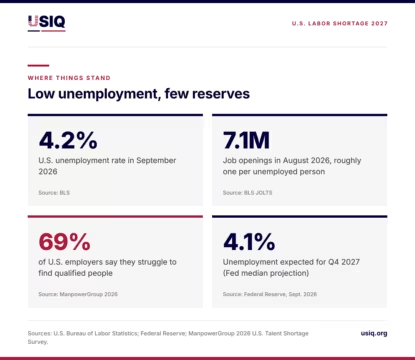
If you glance at the U.S. jobs numbers this fall, “labor shortage” isn’t the first phrase that comes to mind. Employers added just 29,000 nonfarm jobs in September, according to the Bureau of Labor Statistics (BLS), and the unemployment rate ticked up to 4.2%. Companies are hiring cautiously. Workers are staying put. That sounds more like a cooling economy than an overheated one.
And yet, in ManpowerGroup’s 2026 U.S. Talent Shortage Survey, 69% of more than 6,000 U.S. employers said they have trouble finding qualified people. Hospitals need nurses. Contractors need electricians who can wire data centers. Factories need technicians. So which is it?
The short answer: the U.S. labor shortage is shifting from a cyclical problem to a structural one. It depends less on how fast the economy grows and more on how many people are actually available to work, and what skills they bring. Three forces are driving that shift, and all three hit especially hard in 2027: the last big wave of baby boomers reaching retirement age, a historic drop in immigration, and AI reshaping entire job categories.
This article pulls together the data as of late October 2026. It draws on official statistics from the BLS, population projections from the Congressional Budget Office (CBO), the Federal Reserve’s economic projections, and research from the Brookings Institution, Stanford University, the Association of American Medical Colleges, and several industry groups. Every figure is linked to its source. Where the sources disagree, we say so.
Key Takeaways
- The shortage is targeted, not across the board. U.S. unemployment stood at 4.2% in September 2026, and the Fed expects 4.1% by the end of 2027. Even so, 69% of U.S. employers say they struggle to find the people they need.
- Demographics: 2027 is the last year of “Peak 65,” when more than 4.1 million Americans turn 65 every year.
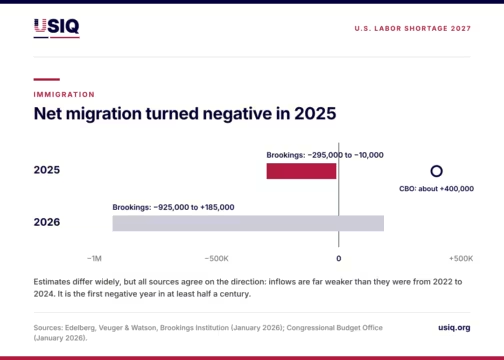
- Immigration: Net migration turned negative in 2025 for the first time in at least 50 years, according to Brookings. Its range for 2026 runs from minus 925,000 to plus 185,000.
- Hardest-hit sectors: construction (456,000 additional workers needed in 2027), nursing (roughly a 10% shortfall in 2027, 24% in rural areas), manufacturing, semiconductors, and energy and data centers.
- AI is moving the shortage around. Office jobs and entry-level roles are shrinking, while skilled trades, technical jobs, and care work stay hard to fill.
What Is a Labor Shortage?
A labor shortage exists when employers can’t fill open jobs at current wages and conditions because there aren’t enough available workers with the right skills in the right place. It’s not the same as low unemployment, although the two often go together.
Economists usually separate three things. A general labor shortage means the whole economy has more open jobs than people looking for work, as in 2022. A skills gap means there are job seekers, but not with the qualifications employers need. A geographic mismatch means the workers live in one place and the jobs are somewhere else. The U.S. in 2027 is mostly a story of the second and third kind, sharpened by a labor force that has almost stopped growing.
Is There a Labor Shortage Right Now?
The U.S. heads into 2027 with unemployment around 4% and roughly one job opening for every unemployed person. That’s not a crisis. But it isn’t a market with a big pool of idle workers waiting to be hired, either.
Here’s what the BLS September report shows. The unemployment rate has stayed in a narrow band of 4.1% to 4.3% since March, with about 7.1 million people out of work. Labor force participation sits at 61.8% and has barely budged since January. Over the 12 months before September, the economy added only 45,000 jobs a month on average, and July and August were revised down by a combined 60,000. Private-sector hourly pay rose 3.0% over the year.
On the demand side, the JOLTS report for August 2026 counted 7.1 million job openings, an openings rate of 4.3%. The hires rate was 3.3%, the quits rate just 1.9%, and layoffs 1.0%. Economists call this a “low-hire, low-fire” market. People who have jobs hang on to them, and people looking for work take longer to land something. Nearly 1.9 million Americans have been unemployed for 27 weeks or more, which is 27.1% of everyone who’s unemployed.
It’s tempting to read all this as proof that there’s no labor shortage. That would be a mistake. The real question is how much job growth the economy needs just to keep unemployment steady. Economists at the Brookings Institution put that “breakeven” pace at only 20,000 to 50,000 jobs a month in late 2025, and they think it could turn negative in 2026. In other words, weak payroll gains aren’t mainly a sign of weak demand. They’re a sign that the supply of workers has nearly stopped growing.
The industry numbers fit that picture. Health care added 17,000 jobs in September, about half its 12-month average of 33,000. Nursing and residential care facilities actually lost 9,000 jobs, even though demand for that care keeps climbing. Manufacturing has added back 72,000 jobs since its low point in December 2025. Taken together, the data suggest that in some fields, it’s a lack of people, not a lack of demand, that’s holding growth back.
Why Is There a Labor Shortage?
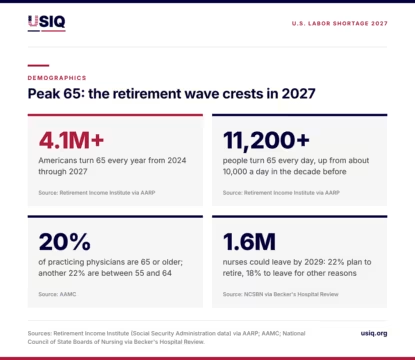
2027 marks the final year of what’s been called “Peak 65.” Since 2024, more than 4.1 million Americans have turned 65 every year, or over 11,200 a day, according to the Retirement Income Institute’s analysis of Social Security Administration data, as reported by AARP. In the decade before, it was closer to 10,000 a day. Not everyone stops working at 65, of course. But for a lot of people it’s the point where they retire or cut back.
The impact shows up most among experienced professionals. According to the Association of American Medical Colleges (AAMC), 20% of practicing physicians are 65 or older, and another 22% are between 55 and 64. In nursing, a National Council of State Boards of Nursing survey found that about 22% of nurses plan to retire within five years, and another 18% expect to leave for other reasons, mostly stress and burnout (Becker’s Hospital Review). That adds up to roughly 1.6 million nurses who could leave by 2029. Even in construction, Associated Builders and Contractors (ABC) attributes most of the industry’s 2026 hiring need to retirements rather than new projects (ABC).
The longer view isn’t any easier. In its January 2026 Demographic Outlook, the Congressional Budget Office projects population growth of just 0.3% a year on average over the next decade. Starting in 2030, deaths are projected to outnumber births. Without immigration, the population would begin shrinking that same year. Meanwhile, the 65-and-older group keeps growing faster than any younger age group.
The BLS projections reflect the same shift. From 2025 to 2035, the agency expects total employment to grow just 3.5%, compared with 10.9% over the previous decade (BLS Employment Projections 2025-2035). One methodological point matters here. The BLS model ties labor supply and demand together and assumes full employment, so it explicitly doesn’t project an overall shortage or surplus. Slower job growth in those numbers mostly mirrors a slower-growing labor force. It isn’t a direct measure of missing workers. To put a number on the U.S. labor shortage, you have to look at occupation and industry models that estimate supply and demand separately.
What that means for 2027: a large share of the jobs employers need to fill won’t come from growth. They’ll come from replacing people who leave. That replacement demand is predictable, which is exactly why it gets expensive for companies that don’t plan for it.
Immigration: The Biggest Unknown for 2027
For decades, immigration has accounted for a large share of U.S. labor force growth. In 2025, that engine stalled for the first time in at least half a century. Writing for the Brookings Institution, economists Wendy Edelberg, Tara Watson, and Stan Veuger estimate that net migration in 2025 landed somewhere between minus 295,000 and minus 10,000 people. For 2026, their range runs from minus 925,000 to plus 185,000. They point mainly to a sharp drop in arrivals, not deportations. Most humanitarian programs were suspended, fewer temporary visas were issued, and the border was more tightly controlled. By their count, removals rose only modestly, to between 310,000 and 315,000.
Those figures are contested. The CBO’s January 2026 estimates still showed positive net migration of about 400,000 for 2025. Analyses based on the Current Population Survey, including work by the Pew Research Center and the Center for Immigration Studies, point the other way, to a drop of roughly 2 million in the foreign-born population. Brookings itself notes that reduced data transparency, such as paused visa statistics, makes every estimate shakier. What the sources do agree on is the direction. Inflows are far weaker than they were from 2022 to 2024, and the CBO has lowered its projections for 2025 through 2029 accordingly.
How people judge this depends a lot on where they sit politically. Supporters of tighter immigration argue that fewer newcomers strengthen the bargaining position of American workers and push employers to invest more in training and wages. The Brookings team and other economists counter that a shrinking labor supply drags down employment, spending, and growth; they estimate consumer spending will be $60 billion to $110 billion lower across 2025 and 2026. Both things can be true at once. For employers, the practical point is that shortages in immigrant-heavy fields such as construction, agriculture, hospitality, and long-term care are hard to fill quickly with domestic workers. ABC flatly calls immigration policy a “wildcard” for the construction workforce.
The picture has changed for high-skilled workers, too. In September 2025, a presidential proclamation imposed a $100,000 payment on new H-1B petitions for workers abroad. A federal court in Massachusetts struck the fee down in June 2026, and in July the First Circuit declined to put that ruling on hold (Fragomen). On September 18, 2026, the administration extended the proclamation through September 2027. Twelve days later, a second court, in California, blocked the fee again (Ellis Immigration Law). As of October 2026 the fee isn’t being collected, but the appeals are still pending. A separate proposed rule for a $103,265 fee on certain H-1B petitions hasn’t taken effect either. For companies hoping to bring in international specialists in 2027, planning remains a guessing game.
Which Industries Face the Biggest Labor Shortage in 2027?
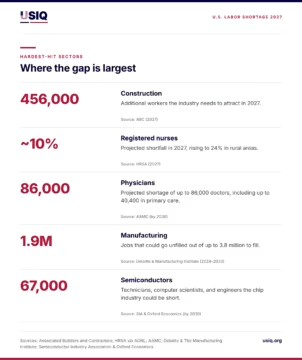
The shortage is very uneven. It’s sharpest in construction, health care, manufacturing (including chipmaking), and technical jobs tied to AI and energy. The table below pulls together the key studies. Keep in mind that the numbers come from different models and time frames, so they can’t simply be added up.
| Sector | Shortage according to the study | Time frame | Source |
|---|---|---|---|
| Construction | 456,000 additional workers needed (349,000 in 2026) | 2027 | ABC |
| Registered nurses | About a 10% shortfall in full-time equivalents; 24% in rural areas | 2027 | HRSA via AONL |
| LPNs/LVNs | Supply covers only 80% of demand | 2027 | HRSA via AONL |
| Physicians | Shortfall of 13,500 to 86,000 | 2036 | AAMC |
| Manufacturing | Up to 3.8 million jobs to fill; 1.9 million could go unfilled | 2024–2033 | Deloitte and the Manufacturing Institute |
| Semiconductors | 67,000 technicians, computer scientists, and engineers short | 2030 | SIA and Oxford Economics |
| Technical jobs overall | 1.4 million workers short | 2030 | SIA and Oxford Economics |
Construction Labor Shortage 2027: 456,000 Workers Needed
Construction is where the 2027 numbers are most concrete. Under the model used by Associated Builders and Contractors, the industry needs about 349,000 additional workers in 2026 and 456,000 in 2027, when construction spending is expected to pick up again. ABC translates spending into jobs at a rate of roughly 3,450 workers per $1 billion. Most of the 2026 need comes from retirements, not new projects.
Data centers are the wild card. Electricians with precision wiring skills are in especially high demand because of facilities being built for AI. Bisnow did the math: the roughly $86 billion in projected 2026 data center spending alone would support about 296,700 jobs, around 85% of ABC’s estimated need for the year. It also reports that nearly one in five electricians is over 55. ABC chief economist Anirban Basu considers the underlying spending forecasts conservative. In his words, the industry “will need even more workers than the model predicts” if spending runs hotter.
Health Care and Nursing
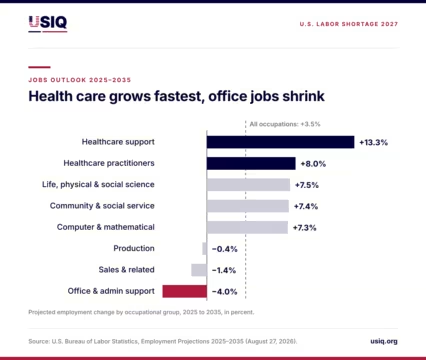
No sector is growing faster, and none depends more on having people available. The BLS expects the two health care occupational groups to account for almost a third of all new jobs through 2035. The reasons are familiar: an aging population and more chronic illness. The Health Resources and Services Administration (HRSA) puts the gap for registered nurses at about 10% in 2027. It’s projected to shrink to 6% by 2037, but it doesn’t close. For licensed practical and vocational nurses, things are tighter still. On the physician side, the AAMC projects a shortage of up to 86,000 doctors by 2036, including up to 40,400 in primary care.
The chart also shows the flip side. Office and administrative support jobs are projected to shrink 4.0% by 2035, a loss of 752,100 positions, and the BLS explicitly points to automation and AI as part of the reason. The labor market isn’t just getting tighter. It’s shifting.
Manufacturing and Semiconductors
Deloitte and the Manufacturing Institute estimate that U.S. manufacturers may need to fill as many as 3.8 million jobs between 2024 and 2033. Without deliberate action, about half of those could go unfilled. In chipmaking, the Semiconductor Industry Association expects the industry to add roughly 115,000 jobs by 2030. At current graduation rates, about 67,000 of them could stay empty, including 26,400 technician roles and 27,300 engineering roles.
Energy, Data Centers, and AI
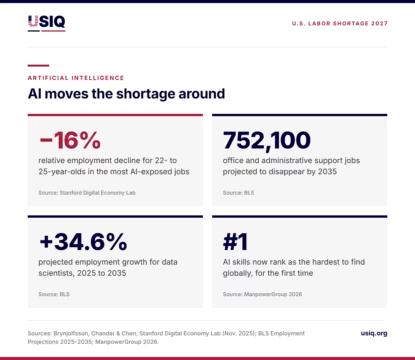
The electricity needs of AI are reshaping the job market faster than many people expected. According to the BLS, utilities will be the fastest-growing sector through 2035, at 9.8%. Computing infrastructure, data processing, and hosting are projected to grow 25.1%, and data scientists 34.6%. Among individual occupations, solar installers (up 36.5%) and wind turbine technicians (up 29.5%) are near the top of the list, though from a small base. One detail from the ManpowerGroup survey stands out. Globally, AI skills now rank as the hardest to find for the first time. U.S. employers, by contrast, put operations and logistics at the top of their list. The American shortage isn’t only digital. A lot of it is very hands-on.
Where the Shortage Is Worst: States, Rural Areas, and Company Size
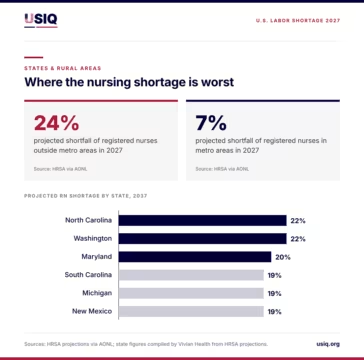
National averages hide a lot. In health care, location matters more than almost anything else. HRSA projects a 24% shortfall of registered nurses outside metro areas in 2027, compared with 7% in metro areas (AONL). A state-by-state analysis of the same HRSA projections by Vivian Health finds 34 states short of nurses in 2025 and 29 still short in 2037.
Company size matters too, and maybe not the way you’d expect. In ManpowerGroup’s 2026 survey, 76% of companies with 1,000 to 4,999 employees reported shortages, compared with 66% of firms with 10 to 49 employees and 61% of those with fewer than 10 (Staffing Industry Analysts). Smaller firms report fewer problems overall, partly because they hire less often. But when a 30-person company can’t replace its one licensed electrician or its only payroll specialist, the impact is immediate.
What the Labor Shortage Costs Businesses
Unfilled jobs don’t just mean extra work for the people who stay. They show up as delayed projects, lost revenue, and rising labor costs. A few numbers give a sense of scale:
- Manufacturing: An earlier Deloitte and Manufacturing Institute study estimated that unfilled manufacturing jobs could cost the U.S. economy $1 trillion by 2030 through delayed or canceled investments and longer order times (ASME).
- Construction: ABC warns that failing to attract enough workers will deepen shortages in certain trades and regions and keep pushing labor costs up (ABC).
- Health care: Fewer clinicians mean longer waits and less access to care, especially in rural areas. The AAMC notes that people across the country already struggle to find a new doctor (AAMC).
- Wages: In ManpowerGroup’s 2025 survey, raising pay was the most common employer response to talent scarcity (28%), ahead of upskilling (25%) and tapping new talent pools (24%) (Staffing Industry Analysts).
There’s also a hidden risk. With a quits rate of just 1.9%, many companies haven’t felt turnover pressure for a while. That can change quickly once the market turns, and the people who leave first are usually the ones who are hardest to replace.
Will AI Solve the Labor Shortage?
AI won’t end the U.S. labor shortage in 2027. It’ll move it around. Where work happens on a screen and can be standardized, companies need fewer people. In hands-on work, skilled trades, and caregiving, demand stays high or even rises, because AI replaces little of that work while creating new demand for things like data centers and power grids.
One of the most closely watched studies on this comes from the Stanford Digital Economy Lab. For their working paper “Canaries in the Coal Mine?”, Erik Brynjolfsson, Bharat Chandar, and Ruyu Chen analyzed payroll records from ADP, one of the largest data sources on the U.S. job market. In the November 2025 version, they find a 16% relative decline in employment for 22- to 25-year-olds in the most AI-exposed occupations, even after controlling for company-wide effects. Older workers in the same jobs, and young workers in less exposed fields, held steady or grew. Two findings matter a lot for employers. The adjustment is happening through head count, not pay. And it’s concentrated in jobs where AI automates the work, much less in jobs where it helps people do the work.
The BLS is more cautious. In its 2025-2035 projections, it introduces AI exposure categories for occupations for the first time. But it also stresses that, historically, technology has changed jobs gradually rather than overnight, and that uncertainty right now is very high. Even so, the agency expects office and administrative support occupations to lose about 752,000 jobs by 2035, while data scientists, researchers, and workers who build and run energy and computing infrastructure stay in strong demand.
On the skills side, the scarcity has already shifted. In ManpowerGroup’s global findings, AI skills topped the list of hardest-to-find capabilities in 2026 for the first time, ahead of traditional IT and engineering (Staffing Industry Analysts). In the U.S., AI literacy, meaning the ability to use AI tools well, also ranks among the five scarcest skills.
That creates a paradox likely to define 2027. New college graduates have a harder time breaking into some office jobs, while hospitals, job sites, and factories can’t find enough people. For companies, there’s a long-term risk hiding here. If you replace entry-level roles with AI today, you’ll have fewer experienced people in five or ten years who would have grown out of those roles. Tomorrow’s shortage of senior talent can be created by today’s cost-cutting.
Labor Shortage 2027 Forecast: Three Scenarios
The Federal Reserve expects unemployment of 4.1% in the fourth quarter of 2027, with the economy growing 2.4%. That’s the median of the projections released in September 2026. For 2027, Fed officials’ estimates range from 4.0% to 4.5%, with a central tendency of 4.0% to 4.2%. Back in June, the median for 2027 was still 4.3%. What’s notable is the combination: solid growth, unemployment that barely moves, and slow job creation. That only works if productivity rises while the labor force grows slowly. And that’s exactly the setting in which skilled workers get scarce even though the unemployment numbers look unremarkable.
Some context helps. The Fed itself puts the average historical error for its unemployment forecast two years out at plus or minus 1.3 percentage points. PCE inflation is projected to fall from 3.7% in 2026 to 2.3% in 2027, and the median path for the federal funds rate stays at 4.1%. Higher borrowing costs can slow investment, but they do nothing to slow retirements.
Based on the studies cited here, three plausible scenarios emerge for 2027. This is our own synthesis of the sources, not an official forecast.
| Scenario | Assumptions | What it means for the labor shortage |
|---|---|---|
| Baseline | Unemployment around 4.1%, net migration near zero, construction spending picks up | Structural gaps in nursing, construction, electrical trades, and manufacturing; weak job growth despite a growing economy; entry-level office jobs stay hard to get |
| Tighter | Clearly negative net migration (Brookings’ low end for 2026: minus 925,000), continued boom in AI data centers | Noticeable wage gains in the trades and health care, project delays, rural areas lose care capacity |
| Looser | An economic slowdown, faster AI productivity gains in services, courts strike down immigration barriers | Fewer openings, more applicants per job; the gap in health care and nursing remains anyway |
All three scenarios share the same core. Replacement demand from retirements peaks in 2027, and health care stays understaffed, according to HRSA projections. Construction needs more workers than in 2026, per ABC. What really changes from one scenario to the next is the outlook for office work and entry-level roles.
It’s just as important to note what the data don’t show. None of the institutions cited here expects an economy-wide worker shortage like the one in 2022, when there were at times about two job openings for every unemployed person. The labor shortage in 2027 will be selective: severe in certain occupations, regions, and skill levels, and barely noticeable in others. For an individual company, though, it can still be make-or-break.
How Employers Can Prepare for the 2027 Labor Shortage
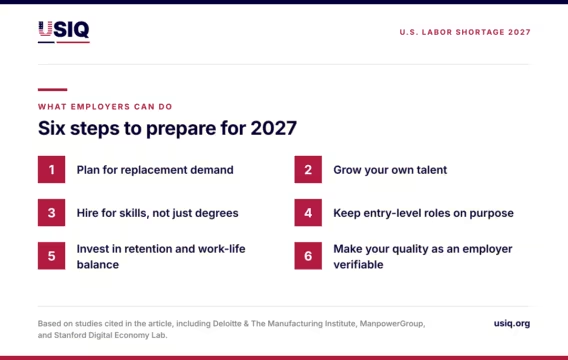
Companies that need to hire in the U.S. in 2027 shouldn’t treat the labor shortage as a business-cycle issue. In their core roles, it’s the new normal. The studies cited above point to six areas where employers can act.
- Plan for replacement demand. A simple age-structure analysis shows which key positions are likely to open up in the next two to three years. Phased retirement, part-time options for older employees, and documented knowledge transfer lower the risk of losing years of experience all at once.
- Grow your own talent. When the outside market is empty, the only real fix is your own pipeline. In the Deloitte and Manufacturing Institute study, manufacturers named technical colleges (73%), industry associations (58%), and universities (48%) as their most important partners (Technical Education Post). Registered apprenticeships remain a proven model in the trades and manufacturing.
- Hire for skills, not just degrees. Upskilling and reskilling current employees is now the most common way employers worldwide respond to talent scarcity, according to ManpowerGroup. Writing job requirements around the skills a role actually needs opens the door to candidates who would otherwise be screened out.
- Keep entry-level roles on purpose. The Stanford findings show AI is hitting early-career workers hardest. Companies that redesign entry-level jobs instead of cutting them are securing their experienced workforce of the future.
- Invest in retention and work-life balance. Today’s low 1.9% quits rate is a snapshot. Once the market turns, in-demand workers are the first to leave. In health care and the trades, family-friendly schedules, predictable shift planning, and help with child care often do more than a pay bump alone.
- Make your quality as an employer verifiable. Job seekers trust independent, checkable information more than a company’s own claims. In a randomized study by the author of this article, with 1,093 participants, stated likelihood of applying rose by about 16 percentage points when an employer displayed a quality seal (ResearchGate). What matters is that the seal is based on transparent criteria and real employee surveys. USIQ, the publisher of this article, offers such certifications; you can see how the methodology works on the pages for Top Employer and Family Friendly Employer, and in this overview of how quality seals work. For the Federal Trade Commission’s expectations around seals and awards, see FTC & EmpCo Ready.
None of these steps works overnight. But companies that don’t start looking until 2027 will be competing for the same small pool of skilled workers as everyone else.
Conclusion: 2027 Will Be a Year of Targeted Scarcity
The U.S. labor shortage looks different in 2027 than it did during the post-pandemic boom. Back then, workers were missing almost everywhere because demand exploded. Today, demand is growing at a moderate pace, but supply has stalled. The last large boomer cohorts are reaching retirement age, immigration has dropped sharply, and where it goes next depends on court rulings and political decisions.
The result is a labor market with two faces. Construction, health care, the electrical trades, manufacturing, and energy will likely feel the lack of workers clearly in 2027. In office work and in entry-level roles in AI-exposed fields, there may well be more applicants than jobs.
For employers, the takeaway is simple. Companies that plan hiring around their workforce’s age structure, invest in training, and show credible proof of being a good place to work will have a real edge in 2027. Those waiting for the business cycle to bring relief will probably be waiting a long time in the hardest-to-fill roles.
FAQ: The U.S. Labor Shortage in 2027
Will there be a labor shortage in the U.S. in 2027?
Yes, but not everywhere. Unemployment is around 4%, and the Federal Reserve expects 4.1% at the end of 2027. At the same time, nursing, medicine, construction, the electrical trades, and manufacturing face structural shortages. 69% of U.S. employers report trouble finding qualified workers.
What is a labor shortage?
A labor shortage exists when employers can’t fill open jobs at current wages and conditions because not enough workers with the right skills are available in the right place. It can affect the whole economy or, as in the U.S. in 2027, mainly specific occupations and regions.
Which industries are hit hardest?
Construction, health care, and manufacturing, including semiconductors. For 2027, ABC estimates the construction industry needs 456,000 additional workers, and HRSA projects about a 10% shortfall of registered nurses.
How many construction workers will be needed in 2027?
About 456,000 net new workers, according to Associated Builders and Contractors, up from 349,000 in 2026. Retirements and data center construction are the main drivers.
Why is there a labor shortage if the job market is cooling?
Because the supply of workers has nearly stopped growing. More than 4.1 million Americans turn 65 each year through 2027, and Brookings estimates that net migration turned negative in 2025 for the first time in at least 50 years. Even modest growth in demand leads to shortages in specific occupations.
Which states have the worst nursing shortages?
Based on HRSA projections, North Carolina and Washington face the largest registered nurse shortfalls by 2037, at 22% each, followed by Maryland at 20%. Rural areas are hit hardest, with a projected 24% shortfall in 2027.
What role does AI play?
AI mainly reduces demand for office work and entry-level tasks. A Stanford study found a 16% relative employment decline for 22- to 25-year-olds in highly AI-exposed jobs. At the same time, demand is rising for workers who build and run data centers and power grids and who develop AI.
How does the $100,000 H-1B fee affect the labor shortage?
It makes hiring high-skilled workers from abroad far more expensive. The fee was introduced in September 2025 and extended through September 2027, but as of October 2026 it is blocked by two federal court rulings. The appeals are still pending.
What can companies do about the labor shortage?
The most effective steps are forward-looking succession planning, in-house training and apprenticeships, skills-based hiring, keeping the people you already have, and credible proof of being a good employer, for example through certifications based on independent employee surveys.
Sources
- American Organization for Nursing Leadership (2024). HRSA predicts nursing shortage through 2037.
- ASME (2024). Manufacturing Faces Critical Gaps.
- Associated Builders and Contractors (2026). Construction Workforce Shortage Analysis 2026.
- Association of American Medical Colleges (2024). The Complexities of Physician Supply and Demand: Projections From 2021 to 2036.
- Becker’s Hospital Review (2025). National RN shortage to shrink, LPN demand to swell.
- Bisnow (2026). Data Centers, Immigration Action Add To Construction Labor Shortage.
- Brynjolfsson, E., Chandar, B., & Chen, R. (2025). Canaries in the Coal Mine? Six Facts about the Recent Employment Effects of Artificial Intelligence. Stanford Digital Economy Lab.
- Congressional Budget Office (2026). The Demographic Outlook: 2026 to 2056.
- Edelberg, W., Veuger, S., & Watson, T. (2026). Macroeconomic implications of immigration flows in 2025 and 2026: January 2026 update. Brookings Institution.
- Ellis Immigration Law (2026). $100K H-1B fee blocked in California.
- Federal Open Market Committee (2026). Summary of Economic Projections, September 16, 2026.
- Fragomen (2026). Federal Appeals Court Declines to Stay Lower Court Order Vacating $100,000 H-1B Fee.
- HR Tech Edge (2026). AI talent shortage hits tipping point: ManpowerGroup data.
- ManpowerGroup (2026). 2026 U.S. Talent Shortage Survey
- Manufacturing Institute & Deloitte (2024). Taking charge: Manufacturers support growth with active workforce strategies.
- Retirement Income Institute, via AARP (2023). Silver tsunami: late boomers turn 65.
- Semiconductor Industry Association & Oxford Economics (2023). Chipping Away: Assessing and Addressing the Labor Market Gap Facing the U.S. Semiconductor Industry.
- Staffing Industry Analysts (2025). Talent shortages still challenge US employers.
- Staffing Industry Analysts (2026). 69% of US employers report difficulty finding talent.
- Staffing Industry Analysts (2026). AI displaces IT as hardest skill to find: ManpowerGroup.
- Technical Education Post (2024). Manufacturers Need 3.8M by 2033.
- U.S. Bureau of Labor Statistics (2026a). The Employment Situation – September 2026
- U.S. Bureau of Labor Statistics (2026b). Job Openings and Labor Turnover – August 2026.
- U.S. Bureau of Labor Statistics (2026c). Employment Projections 2025–2035.
- Vivian Health (2025). A Crisis by the Numbers: Nursing Shortages in 2025 by State.


Related Articles
Employee experience and customer experience are linked, but the link is weaker and more conditional than popular slogans suggest. This article reviews the evidence on staffing, training and workplace conditions and shows how employers can test the connection in their own business.
Most HR dashboards show too many metrics and trigger too few decisions. This guide defines ten employee experience metrics, shows a one-page layout and explains how to read your numbers against U.S. data.
Engagement at the workplace means how connected people feel to their jobs and the company they work for. It is [...]
In today's labor market of the US, the term best organization to work for has come to mean those employers [...]