

Most owners and managers know they should ask customers what they think. The harder part is choosing customer survey questions that produce answers you can act on, without building a form so long that nobody finishes it.
A company with 10 to 250 employees rarely has a research team. It needs five to eight well-worded questions, a short survey, a sensible way to send it and a plan for what happens to the results. This guide covers all four, with exact question wording, metric definitions, completion-time data and the basic legal rules for sending surveys in the United States.
Quick answer: Pick one relationship question (likelihood to recommend, scored 0 to 10), one or two questions about the specific interaction (satisfaction or effort), one question on what could be better and one open comment. Keep the survey under five minutes, put demographics last and optional, and follow up quickly on unhappy answers.
Key takeaways
- Choose questions by goal: relationship health, a specific interaction, product feedback or pricing. Five to eight questions are enough for most small firms.
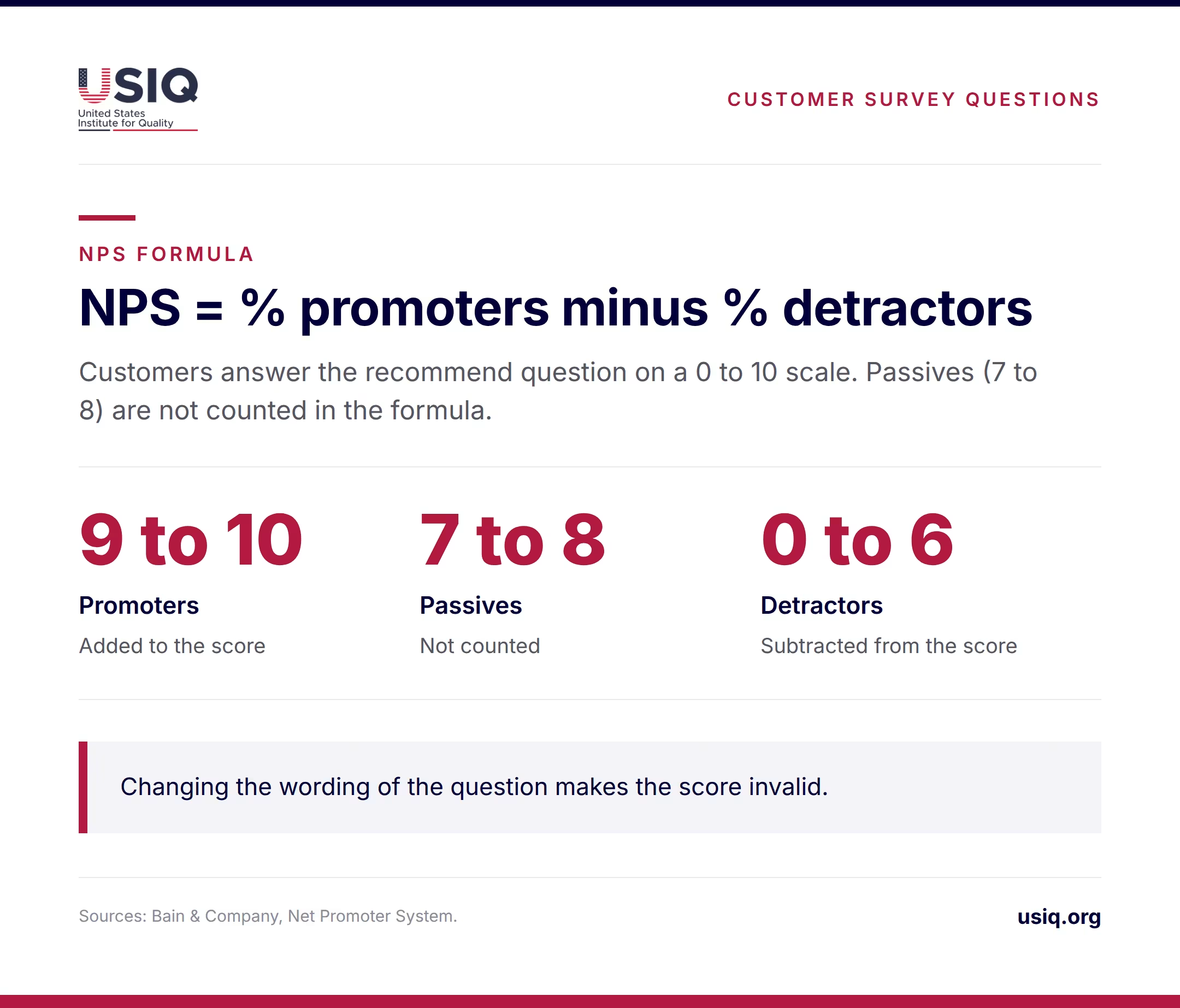
- NPS is the percentage of promoters (9 to 10) minus the percentage of detractors (0 to 6) on the “friend or colleague” question. Changing the wording makes the score invalid.
- Real-world surveys are short: the median response time across 7,677 surveys was 1.8 minutes. Aim for under five minutes and treat ten as a ceiling.
- Leading, double-barreled and loaded questions distort results. Rewrite them in neutral language and pretest with a handful of customers.
- Published response rates mostly come from opted-in audiences. A cold list will usually do worse.
- Email surveys can fall under CAN-SPAM, and the CCPA applies only above specific thresholds. Check both before you send.
- A survey only pays off if someone reads the results, contacts unhappy customers and changes something.

What are the best customer survey questions to ask?
The best questions are tied to a decision you are willing to make. Start from the goal, then choose the metric and the wording. The table maps common goals to a question format.
| Goal | Metric or format | Example question | Scale |
|---|---|---|---|
| Measure the overall relationship | Net Promoter Score (NPS) | How likely are you to recommend us to a friend or colleague? | 0 to 10 |
| Rate a specific interaction | Customer satisfaction (CSAT) | How satisfied were you with your experience today? | Five-point, very dissatisfied to very satisfied |
| Find friction in a process | Customer Effort Score (CES) | The company made it easy for me to resolve my issue. | Five-point, strongly disagree to strongly agree |
| Understand the “why” | Open-ended follow-up | What is the main reason for your score? | Free text |
| Test price perception | Value for money | How would you rate the value you receive for the price you pay? | Five-point, poor to excellent |
The NPS wording is fixed. Bain & Company, the firm behind the method, defines it as the share of promoters minus the share of detractors, based on the question “How likely is it that you would recommend us to a friend or colleague?” on a 0 to 10 scale (Bain & Company, Net Promoter System). Asking whether customers would recommend “your support team” is a different question and does not produce a comparable NPS.
Question banks by category
Use three to six questions from the categories that match your goal. Do not use all of them in one survey.
Overall satisfaction and loyalty
- How satisfied are you with [company name] overall?
- How likely are you to recommend us to a friend or colleague? (0 to 10)
- What is the main reason for your score?
- How likely are you to buy from us again? (very unlikely to very likely)
Product or service feedback
- How easy was it to use ? (very difficult to very easy)
- Did you run into any problem while using it? If yes, please describe it.
- How often do you use it? (daily, weekly, monthly, rarely)
- How well does it meet your needs? (not at all to completely)

Customer service and support
- Was your issue resolved? (yes, partly, no)
- The company made it easy for me to handle my request. (strongly disagree to strongly agree)
- How would you rate the clarity of the information you received?
- Which channel would you prefer for future contact? (phone, email, chat, text, in person)
Price, value and competitors
- How would you rate the value for money of ?
- What was the main reason you chose us? (price, quality, location, recommendation, other)
- Did you consider other providers? If yes, which features or services did they offer that you would like from us?
Open-ended
- What do you like most about working with us?
- What is the one thing we should improve first?
- Is there anything else you would like to tell us?
How should the question set differ for B2B and B2C?
A B2C business, such as a restaurant, clinic or retailer, usually surveys right after a purchase or visit. Short, transactional questions about the experience fit best. A B2B firm, such as an IT services provider or a staffing agency, has fewer customers and longer relationships, so a quarterly relationship survey works better. Add questions about responsiveness, account management and whether the service helped the customer’s own goals.
For B2B, ask about company size and the respondent’s role instead of personal demographics. Those details help you segment results and raise fewer privacy concerns. Small Business Trends offers a free set of examples that includes an “Overall Experience Questions” group (Small Business Trends). Grouping questions this way is a useful starting point, provided you cut the list down to what you will use.
How do CSAT, CES and NPS differ, and which should a small business use?
The three metrics answer different questions. CSAT asks how satisfied a customer was with something specific. CES asks how much work the customer had to do. NPS asks how likely the customer is to recommend the company, which makes it a relationship measure.
| CSAT | CES | NPS | |
|---|---|---|---|
| What it measures | Satisfaction with one interaction or product | Effort needed to get something done | Loyalty and willingness to recommend |
| Typical scale | Five-point satisfaction scale | Five- or seven-point agreement scale | 0 to 10 |
| Calculation | Share of respondents choosing the top answers | Average score or share who agree | % promoters (9 to 10) minus % detractors (0 to 6) |
| Best used | Right after a purchase, visit or service call | After support requests or onboarding | Quarterly or twice a year for the whole relationship |
| Main limit | Says little about future behavior on its own | Evidence for its predictive power comes largely from one study | A single number hides the reasons behind it |
Bain classifies scores of 7 and 8 as passives. Its NPS survey needs only three items: the recommend score, “Why?” and “What could we do better?”. Scores can be tracked weekly and split by segment. The same Bain page says an industry’s loyalty leader grows more than twice as fast as its competitors (Bain & Company, 2011). That is Bain’s own analysis of its own metric, so read it as a correlation, not proof that raising NPS raises growth.
What are the counterarguments?
A Harvard Business Review study of more than 75,000 people using contact-center or self-service channels found that over-the-top service efforts make little difference. Customers mainly want a simple, quick solution. The authors introduced the Customer Effort Score and argued that it predicts loyalty better than satisfaction measures or NPS (Harvard Business Review, July 2010). That claim rests on one study, and NPS has its critics, so neither metric should be treated as the single truth.
A practical rule for smaller firms: use NPS for the overall relationship, and CSAT or CES after a specific interaction. Keep the scales consistent over time so trends mean something.
Do not compare your score with the wrong yardstick. National satisfaction indexes use different scales and methods from NPS, so they give context at best, not a benchmark for your own score. The most useful comparison is your own previous survey round.
How long should a customer survey be?
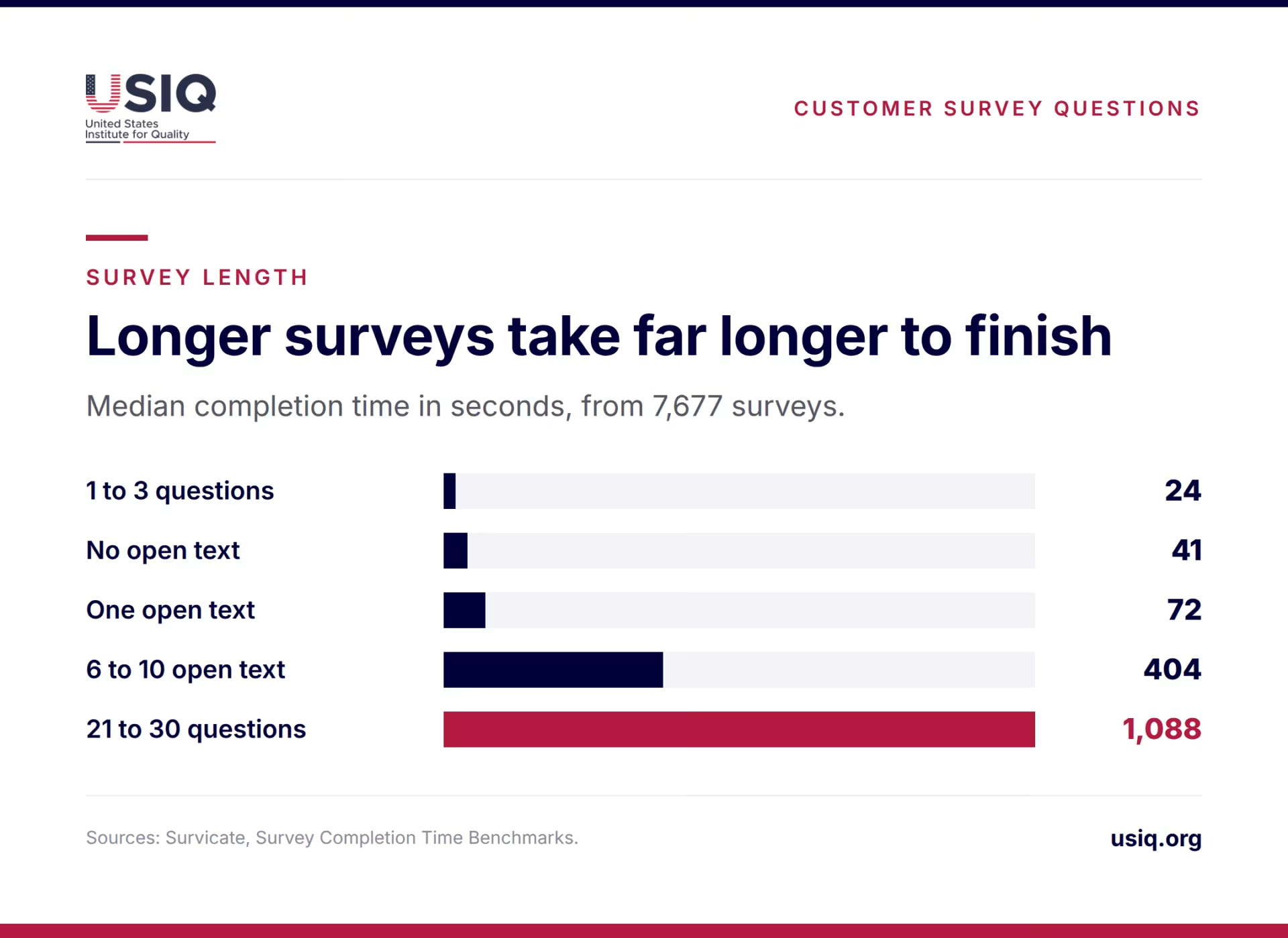
Shorter than most firms assume. Survicate analyzed 7,677 surveys from 1,044 companies and found a median response time of 108 seconds, or 1.8 minutes. Nearly 75% of the surveys had 10 questions or fewer (Survicate, Survey Completion Time Benchmarks).
| Survey feature | Median completion time |
|---|---|
| Micro survey, 1 to 3 questions | 24 seconds |
| No open-text question | 41 seconds |
| One open-text question | 72 seconds |
| 6 to 10 open-text questions | 404 seconds |
| 21 to 30 questions | 1,088 seconds (18.1 minutes) |
Question type matters as much as count. The median time is 107 seconds for rating and single-selection questions, 400 for matrix questions, 530 for dropdowns and 633 for ranking questions (same Survicate report). If you need to cut time, drop matrix grids and ranking tasks first.
Is five minutes the limit, or ten?
The evidence is mixed. Zoho, a survey vendor, cites Kantar research that a survey over 25 minutes loses more than three times as many respondents as one under 5 minutes. It also cites another firm’s analysis of more than 100,000 surveys, which found abandonment rising by up to 20% beyond 7 to 8 minutes. The page gives the ideal length as 5 to 10 minutes in one place and 5 to 12 minutes in another, with about 10 to 20 well-crafted questions (Zoho Survey). These figures are second-hand and come from a vendor.
A workable approach: aim for under five minutes, treat ten minutes as the upper limit, and use one to three questions for a pulse right after a transaction. Longer relationship surveys can run closer to the limit if respondents know the length in advance.
How do you write survey questions that avoid bias?
Most bias comes from wording. A question that signals the “right” answer, asks two things at once or uses emotional language produces numbers that look useful but are not. Plain words and one idea per question fix most of it.
| Problem | Weak question | Better question |
|---|---|---|
| Leading | How great was our friendly staff? | How would you rate the helpfulness of our staff? |
| Double-barreled | Was our service fast and friendly? | Ask two questions: How would you rate the speed of our service? How would you rate the friendliness of our staff? |
| Loaded | Do you agree our prices are fair, unlike the overpriced competition? | How would you rate the value for money of our prices? |
| Vague time frame | Do you often contact support? | How many times did you contact support in the last three months? |
| Unbalanced scale | Excellent, very good, good, fair | Excellent, good, neutral, poor, very poor |
| Forced answer | Required: Rate our pricing. | Offer “not applicable” or “no opinion” |
Avoid industry jargon. Mix closed questions, which are easy to compare, with one or two open ones that let customers say what you did not think to ask. Our guide to quality criteria for market research covers sampling and objectivity in more depth.
Should you ask about income, age or gender?
Only if you will use the answer. Make any demographic question optional, place it at the end and give a “prefer not to say” choice. B2B firms can ask for company size and role instead, which usually answers the segmentation question without asking anything personal. This is a practice recommendation, not a legal requirement.
Why pretest and survey a cross-section?
Send the draft to five to ten customers or colleagues first and ask them to explain each question in their own words. Confusing items show up fast. Then think about who you invite. Surveying only loud or happy customers skews results, so draw from a cross-section: new and long-term customers, large and small accounts, people who bought and people who complained.
When and how should you send a survey to get more responses?
Send it close to the interaction, from a sender customers recognize, with a single line stating how long it takes. A short survey after a service call, delivery or appointment beats a long annual questionnaire because the experience is still fresh.
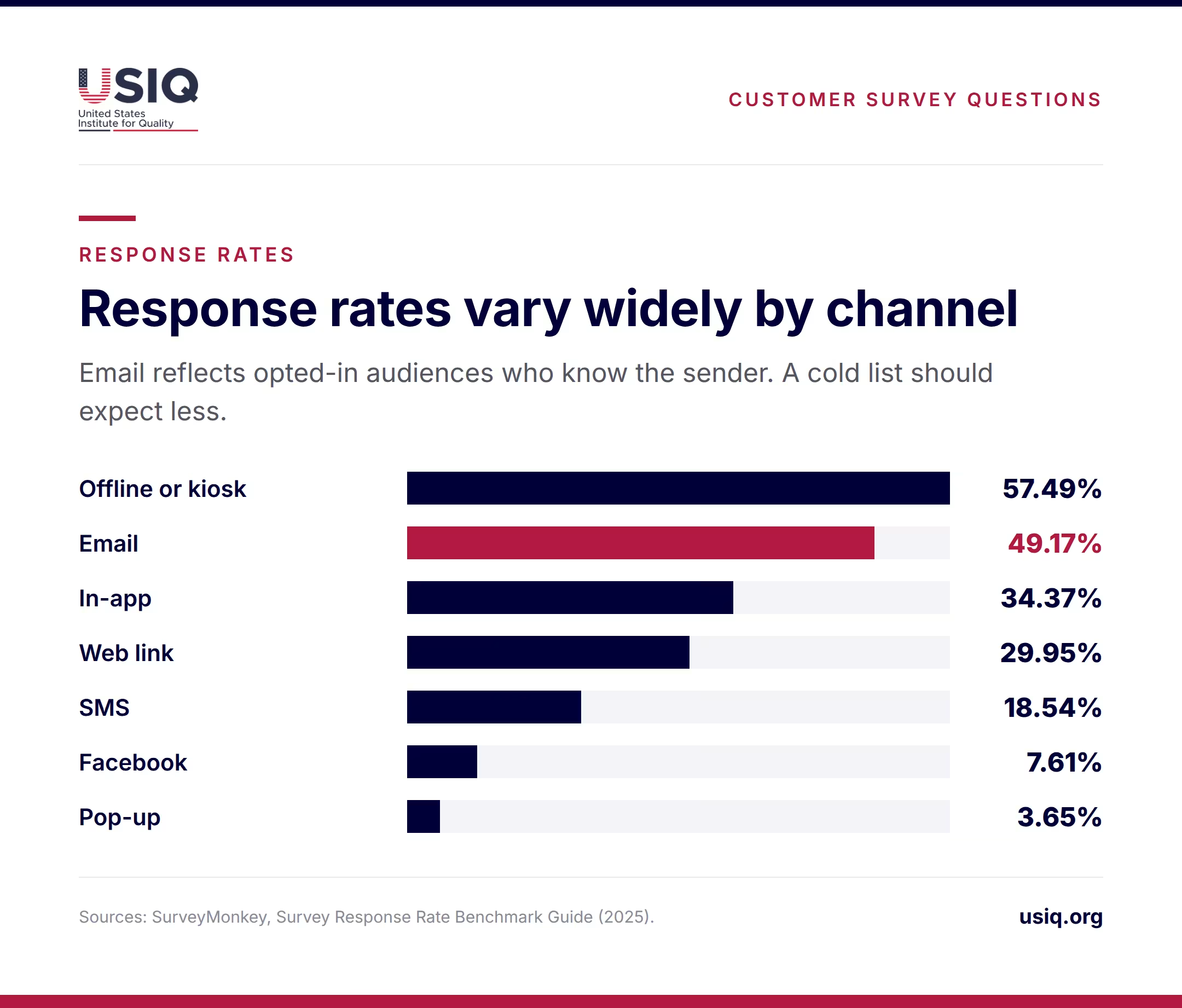
SurveyMonkey publishes 2025 platform averages by channel. The email figure reflects opted-in audiences who know the sender, so a cold list should expect less (SurveyMonkey, Survey Response Rate Benchmark Guide).
| Channel | Average response rate, 2025 |
|---|---|
| Offline or kiosk | 57.49% |
| 49.17% | |
| In-app | 34.37% |
| Web link | 29.95% |
| SMS | 18.54% |
| 7.61% | |
| Pop-up | 3.65% |
Tools matter less than process. Any basic survey platform, form builder or the survey function in your customer-management software can run the questions above. Choose one that lets you segment results, export data and send automatically after a trigger such as a closed ticket. Ask the team who will read the results before you buy anything.
What legal rules apply to customer surveys in the U.S.?
Two sets of rules come up most often: email law and state privacy law. The following is general information, not legal advice. Ask counsel if your survey collects sensitive data or you operate in several states.
How does CAN-SPAM affect survey emails?
The FTC says CAN-SPAM covers commercial email, including messages to existing or former customers. Marketing email must include a clear opt-out, honored within 10 business days, with the mechanism working for at least 30 days after sending. Each separate violating email can bring penalties of up to $53,088 (FTC, CAN-SPAM Act: A Compliance Guide for Business).
Whether a pure feedback request counts as commercial depends on its content. A survey invitation that also promotes a product or offer is safer treated as commercial. Read the message-type section of the FTC guide, and include honest sender information, a physical postal address and an opt-out in every survey email. Text-message surveys have their own consent rules; check FCC and FTC guidance before sending any.
Does the CCPA apply to small firms?
Usually not. According to a law-firm summary, the California Consumer Privacy Act applies to a for-profit business that does business in California only if it exceeds a revenue threshold (stated as $25 million), buys, sells or shares the data of 100,000 or more consumers or households, or earns 50% or more of its revenue from selling or sharing personal information. Merely collecting data is not a threshold. The same source notes that the dollar figures are indexed every odd-numbered year, so the current number may differ (Bay Legal). Confirm the current threshold with the California Privacy Protection Agency before relying on it.
Staying below the thresholds does not mean ignoring privacy. Other state laws may apply, and customers expect care. Collect only what you need, tell people how you will use their answers and offer anonymous responses where you do not need to identify them. If you want to follow up with an unhappy customer, ask for contact details only in that case.
What do you do with the results?
Collecting answers is the easy part. Value comes from a routine that turns them into action, and the routine matters more than the dashboard.
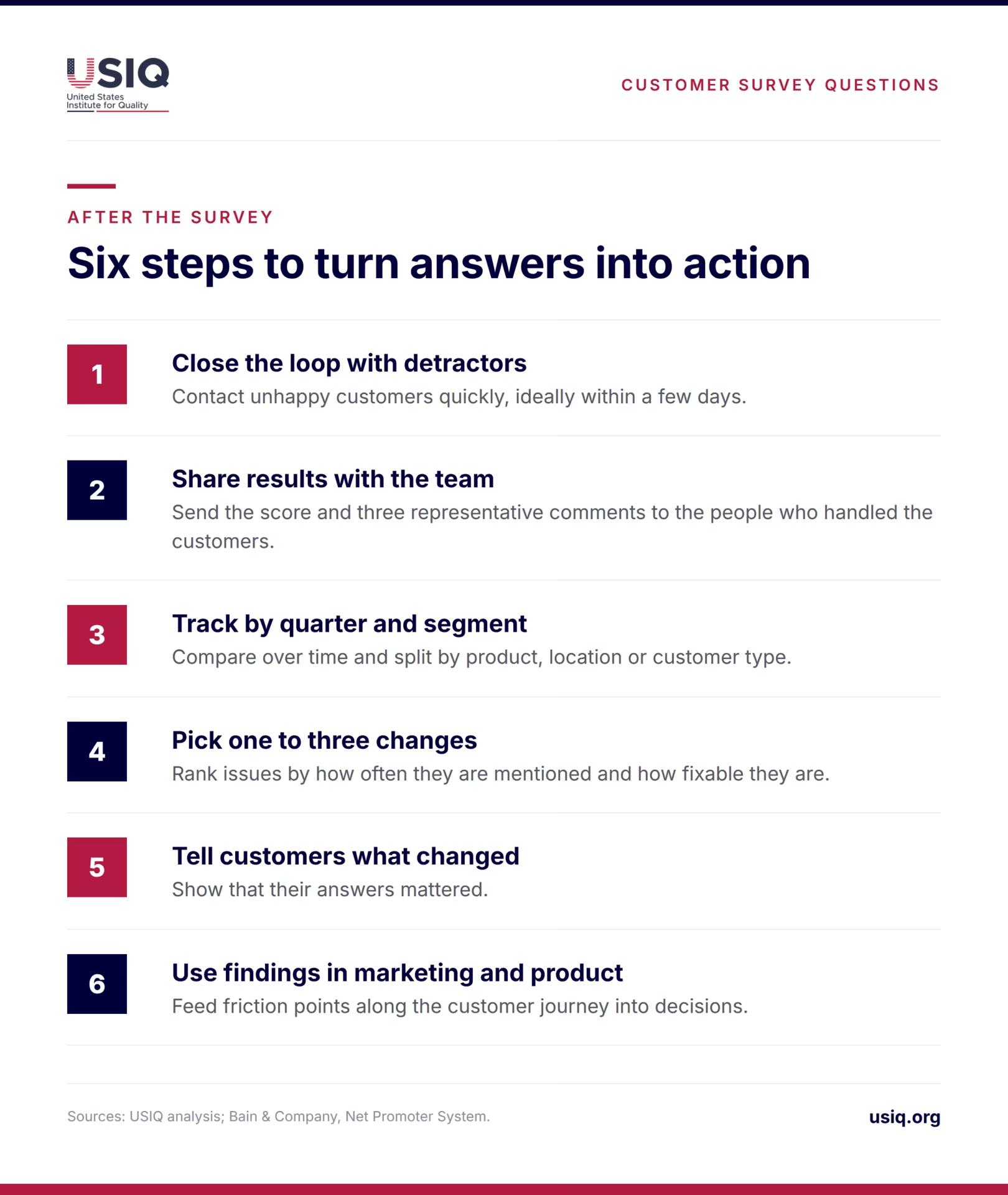
- Close the loop with unhappy customers. Contact detractors quickly, ideally within a few days, by phone or personal email. Ask what went wrong and what would fix it.
- Share results with the team. Send the score and three representative comments to the people who handled the customers, not only to management.
- Track over time and by segment. Compare quarter to quarter and split by product, location, customer type or channel, as Bain describes for NPS.
- Pick one to three changes. Rank issues by how often customers mention them and how fixable they are. Do not try to fix everything at once.
- Tell customers what changed. A short note such as “You told us checkout was slow, so we simplified it” shows that answers matter and tends to support future participation.
- Use findings beyond service. Feed friction points along the customer journey into marketing and product decisions.
How do employees affect customer survey results?
Low scores on speed, clarity or friendliness often trace back to staffing levels, training, tools or unclear processes, not to individual effort. If comments repeatedly mention long waits or inconsistent answers, look at the workload and handoffs behind them. Our articles on employee experience and customer experience and on employee survey questions show how to collect that internal view.
Some companies also have their service quality assessed by an outside party. USIQ, the publisher of this article, runs certification programs of this kind; one example is the Top Service seal for customer service quality. A certificate does not replace your own survey routine.
What are common misconceptions about customer surveys?
- “More questions mean more insight.” Long surveys cost completion time, and the median real-world survey takes under two minutes.
- “A high score means we are done.” A score shows a level, not a reason. The open follow-up question explains it.
- “Delighting customers is the goal.” The HBR study suggests that simple, quick problem resolution matters more than extra effort.
- “Benchmarks tell us if we are good.” Vendor averages come from opted-in audiences, and national indices use different methods. Your own trend is the most reliable comparison.
Conclusion
Strong customer survey questions are specific, neutral and few. Start with one recommend question, one interaction question and one or two open comments, keep the survey under five minutes and send it close to the experience. Then read every answer and follow up on the unhappy ones.
Customer survey FAQ
How many questions should a customer survey have?
For most small and mid-sized firms, five to eight questions are enough. Use one to three for a pulse right after a transaction. Survicate found that nearly 75% of surveys have 10 questions or fewer, and that micro surveys take a median of 24 seconds. Add more only if each answer will drive a decision.
What is a good survey response rate?
It depends on channel and audience. SurveyMonkey’s 2025 platform averages range from 3.65% for pop-ups to 49.17% for email, but email figures reflect opted-in audiences who know the sender. A cold list will likely do worse. Track your own rate over time and improve it with shorter surveys and better timing.
What is the difference between NPS, CSAT and CES?
NPS measures loyalty with the “friend or colleague” question on a 0 to 10 scale: percent promoters (9 to 10) minus percent detractors (0 to 6). CSAT measures satisfaction with a specific interaction. CES measures how much effort a customer needed. Use NPS for the relationship and CSAT or CES after interactions.
Do small businesses need to comply with the CCPA?
Often not. A law-firm summary says the CCPA applies to for-profit businesses in California only above certain thresholds: a revenue level, data on 100,000 or more consumers or households, or half of revenue from selling or sharing personal data. The dollar figures are indexed, so check the current amount with the California Privacy Protection Agency.
Should customer surveys be anonymous?
Offer anonymity when you do not need to know who answered, since people tend to be more candid. If you want to follow up on a complaint, add an optional field for contact details. Collect only the data you will use and explain how answers are handled.
How often should we survey customers?
Send a short transactional survey after key interactions and a relationship survey, such as NPS, once or twice a year or quarterly in B2B. Bain notes that NPS can be tracked as often as weekly. Avoid asking the same person repeatedly in a short period.
Should a customer survey ask about income or gender?
Only if you will analyze the answer. Make such questions optional, place them last and offer “prefer not to say.” B2B companies can ask about company size and role instead, which usually gives enough context for segmentation without collecting personal details.
Sources
- Measuring Your Net Promoter Score. Bain & Company (Net Promoter System). https://www.netpromotersystem.com/about/measuring-your-net-promoter-score/
- Introducing: The Net Promoter System. Bain & Company, December 8, 2011 (modified October 31, 2023). https://www.bain.com/insights/introducing-the-net-promoter-system-loyalty-insights/
- Stop Trying to Delight Your Customers. Harvard Business Review, July 2010. https://hbr.org/2010/07/stop-trying-to-delight-your-customers
- 2025 Benchmark Report: Survey Completion Time. Survicate. https://survicate.com/reports/survey-completion-time-benchmarks/
- Survey Response Rate Benchmark Guide. SurveyMonkey. https://www.surveymonkey.com/learn/survey-best-practices/survey-response-rate-benchmarks/
- Optimal Survey Length for Higher Responses. Zoho Survey. https://www.zoho.com/survey/insight/how-long-should-a-survey-be.html
- CAN-SPAM Act: A Compliance Guide for Business. Federal Trade Commission. https://www.ftc.gov/business-guidance/resources/can-spam-act-compliance-guide-business
- CCPA Small Business Requirements. Bay Legal. https://baylegal.com/ccpa-small-business-requirements/
- 7 Free Examples of Customer Satisfaction Survey Questions. Small Business Trends. https://smallbiztrends.com/customer-satisfaction-survey-questions-examples-free/

Related Articles
What research says about the effects of employer seals on current employees, potential applicants and employer image, from independent experiments and field data to the limits of the evidence.
Employee experience and customer experience are linked, but the link is weaker and more conditional than popular slogans suggest. This article reviews the evidence on staffing, training and workplace conditions and shows how employers can test the connection in their own business.
Most HR dashboards show too many metrics and trigger too few decisions. This guide defines ten employee experience metrics, shows a one-page layout and explains how to read your numbers against U.S. data.
A practical guide to calculating marketing ROI for small and mid-sized U.S. companies, including long B2B sales cycles, offline leads, a spreadsheet walkthrough and common errors.