

Employer branding is how a company shapes, and then earns, its reputation among the people it wants to hire and keep. A company with 10 to 250 employees rarely has a brand team or a media budget. It does have something larger employers lack: owners and managers who know their people and can fix problems quickly.
This guide builds that reputation step by step. It covers the employee value proposition, job ads and careers pages, employee stories, online reviews, listening to staff, cost, time and the numbers that show whether the effort works. It also covers the limits, because no campaign can cover for weak pay or poor management.
Quick answer: Employer branding is the work of shaping how candidates and employees see you as an employer. For a company with 10 to 250 employees, it starts with an honest employee value proposition, shows up in truthful job ads, a simple careers page and real employee stories, and is judged by hiring and retention numbers such as quit rate.
Key takeaways
- Employer brand is your reputation as an employer, the employee value proposition (EVP) is the promise behind it, and employer branding is the ongoing work of making both true and visible.
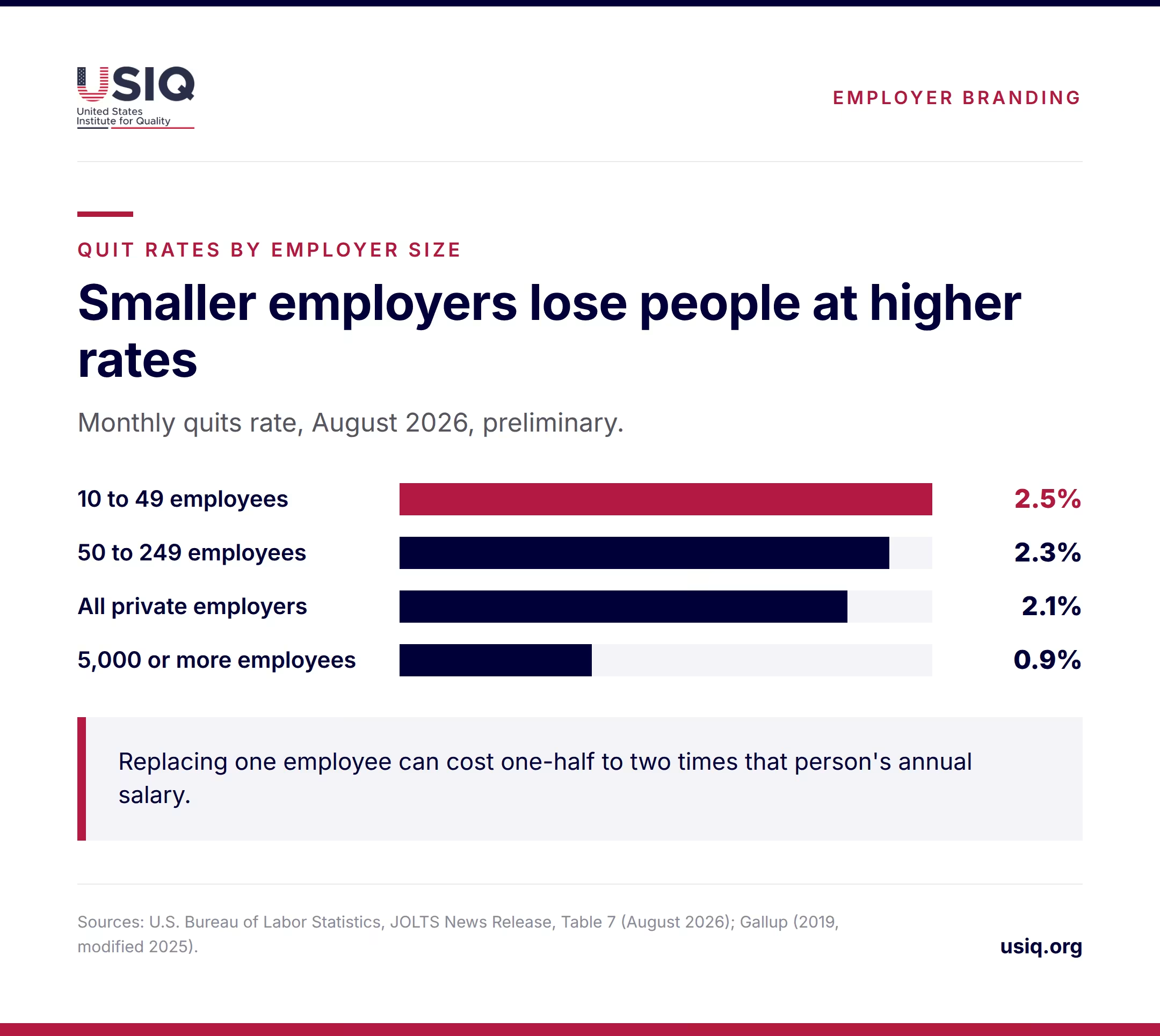
- In August 2026, BLS data show higher monthly quit rates at establishments with 10 to 49 employees (2.5%) and 50 to 249 employees (2.3%) than at all private employers (2.1%).
- Gallup puts the cost of replacing one employee at one-half to two times annual salary, which makes retention the strongest business case for the work.
- Build the EVP from what employees tell you, and keep only the points you can prove.
- Pay ranges in job postings are now a legal question in several places, including California and Columbus, Ohio.
- Never write, buy or steer reviews. The FTC’s fake-review rule is a clear warning against it.
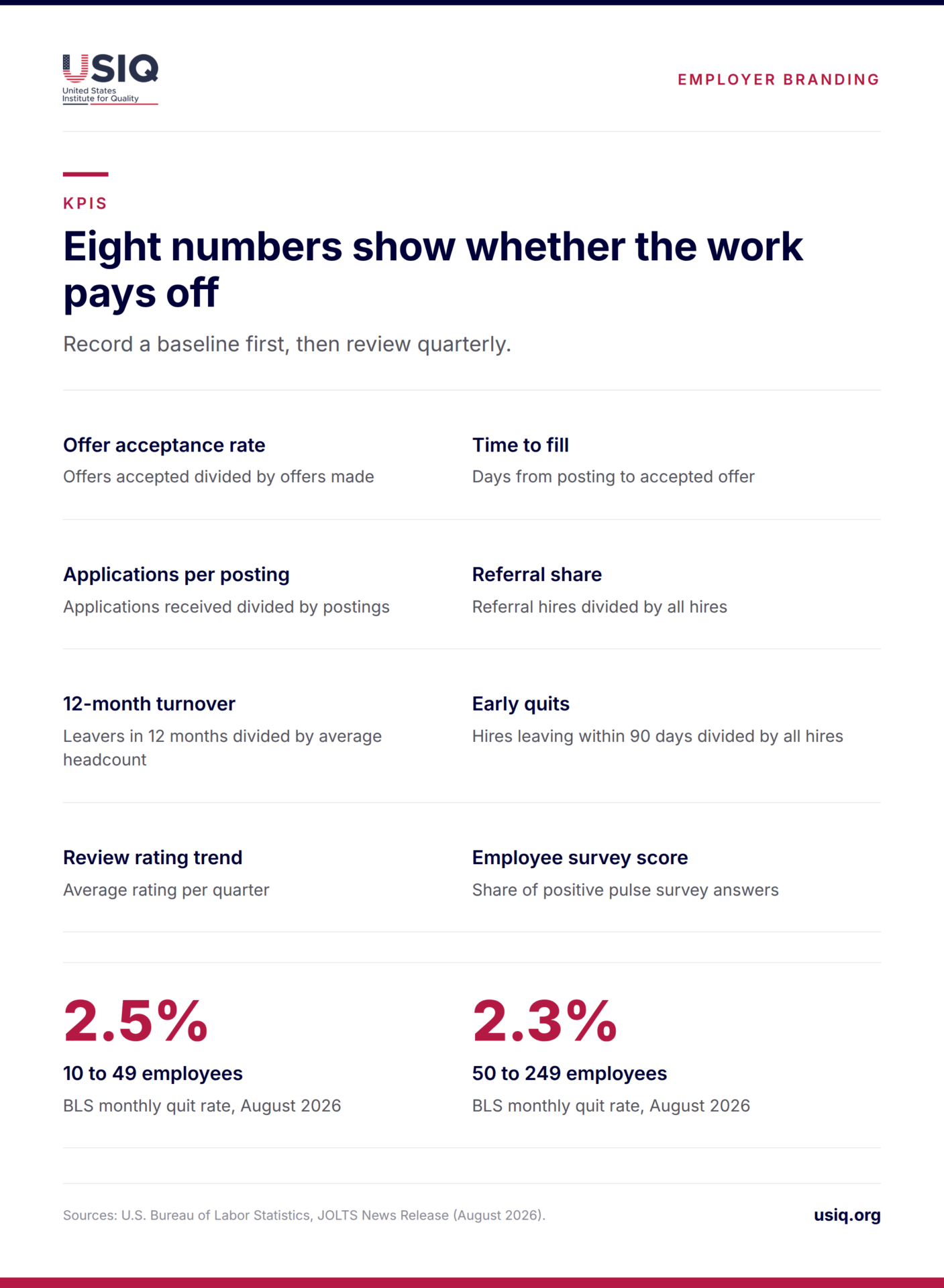
- Track a few numbers against a baseline: offer acceptance, time to fill, quit rate, applications per posting and referral share.
What is employer branding, and why does it matter for a company with 10 to 250 employees?
Three terms get mixed up. The employer brand is the reputation: what current staff, former staff and candidates say about working for you. The employee value proposition is the promise: what you offer in return for people’s work, such as pay, growth, flexibility and respect. Employer branding is the activity of defining that promise, delivering it and communicating it truthfully. For a deeper definition, see what employer branding means.
Size matters because smaller firms feel turnover more. BLS data from the August 2026 JOLTS release show that establishments with 10 to 249 employees lose and hire people at higher monthly rates than the private sector as a whole. These are monthly rates, seasonally adjusted and preliminary.
| Establishment size | Quits rate | Hires rate | Job openings rate |
|---|---|---|---|
| 10 to 49 employees | 2.5% | 3.9% | 4.4% |
| 50 to 249 employees | 2.3% | 4.0% | 4.3% |
| All private employers | 2.1% | 3.6% | 4.5% |
| 5,000 or more employees | 0.9% | 1.9% | not listed here |
BLS describes quits as generally voluntary separations initiated by the employee, so the quits rate reflects workers’ willingness or ability to leave. A small employer that loses people at a higher rate than the national figure pays for it in recruiting time and lost know-how. The latest headline figures on the JOLTS home page (September 2026, preliminary) are a job openings rate of 4.5%, a hires rate of 3.4% and a quits rate of 2.1%.
Gallup calls its estimate conservative: replacing an individual employee can cost one-half to two times that person’s annual salary. Keeping a good employee is almost always cheaper than finding a new one.
How do you define your employee value proposition in 30 days?
Start with identity, not with posts. Write down your mission, your values and how work actually happens: how decisions get made, how schedules are set, what people learn, how mistakes are handled. Then test that description against what employees say. The gap between the two is your first work list.
A practical 30-day sequence:
- Week 1: Run a short anonymous survey of all staff. Ask what they value most, what would make them leave and what they would tell a friend about working here.
- Weeks 2 and 3: Hold five to eight conversations with people from different roles and tenures, including someone who joined in the last year.
- Week 4: Write a one-page EVP with three to five points, each backed by a concrete example. Cut anything you cannot deliver today.
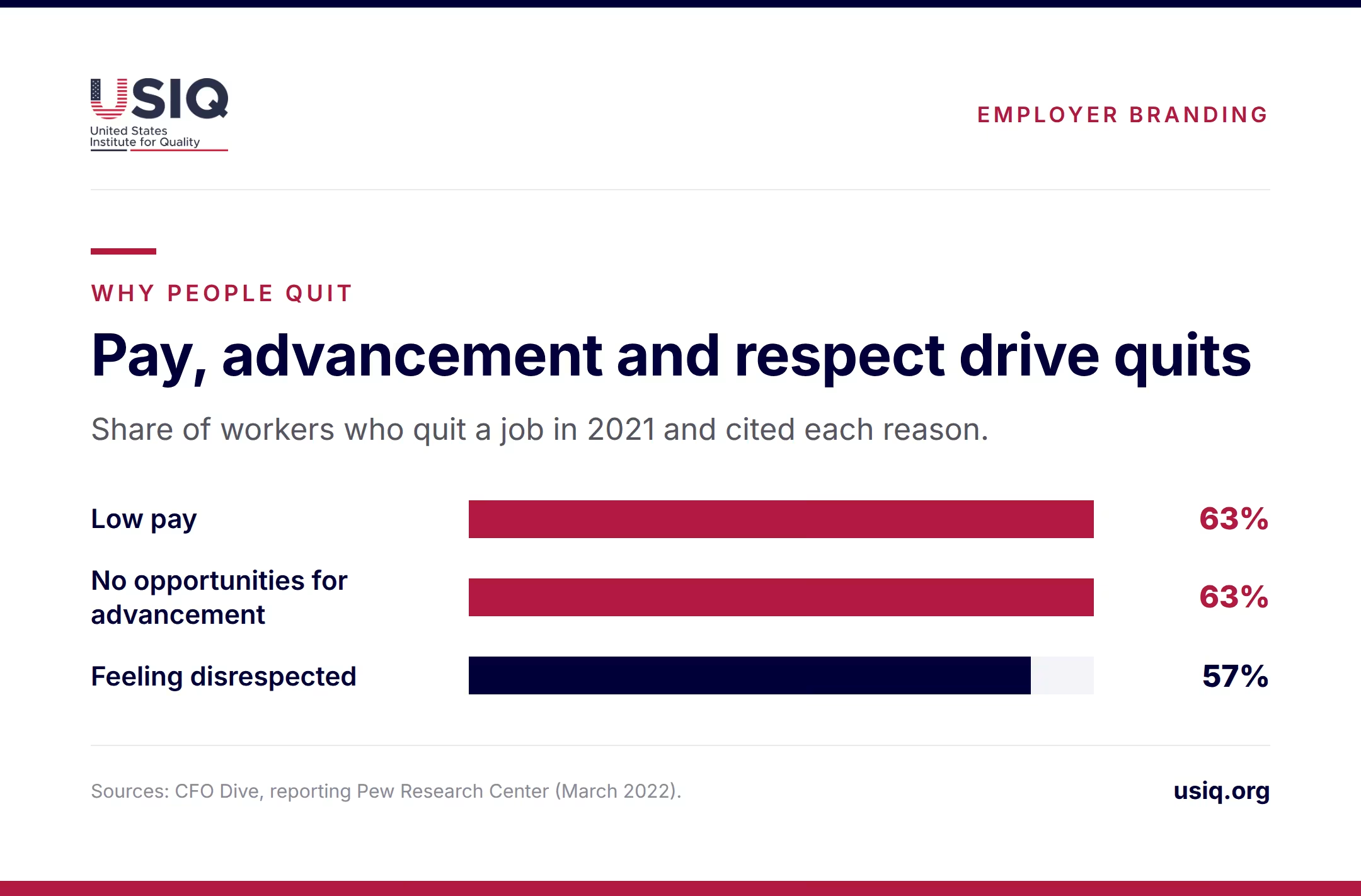
Check the draft against what makes people leave. A Pew Research Center survey, reported by CFO Dive, found that among workers who quit a job in 2021, 63% cited low pay, 63% cited no opportunities for advancement and 57% cited feeling disrespected. An EVP built only on free lunches and a casual dress code will not hold up against those reasons.
Differentiate on what your own team values. If staff light up when they learn, put training first. If flexibility matters to parents, say how schedules really work. A 40-person firm cannot match a large employer’s perks, so do not copy its campaign. It can offer faster growth, direct access to leadership and more flexibility. Related thinking is in company values that attract talent.
What does an honest employer brand look like in job ads and on your careers page?
Job ads are the most-read piece of employer branding you publish. Write them as a realistic job preview. Describe the role, the people the hire will work with and a normal week. If the work is fast, seasonal or deadline-driven, say so. If support and training are strong, give an example. A candidate who knows the hard parts before accepting is less likely to quit in the first months.
Say who the role suits. “Someone who likes solving customer problems on the phone” saves time for both sides. Use plain language and avoid internal jargon.
A careers page that answers candidates’ questions
Keep it short and human. Open with two or three sentences from a named manager or the owner about the team and the work. Use real photos of your own people and workplace, not stock images. List open roles in order, explain the application steps and add a small FAQ with the questions candidates actually ask, such as “Can I work remotely?” and “Can I advance here?” Give honest answers even when the answer is no. More practical advice is in building an employer brand on a small budget.
Pay ranges and posting rules
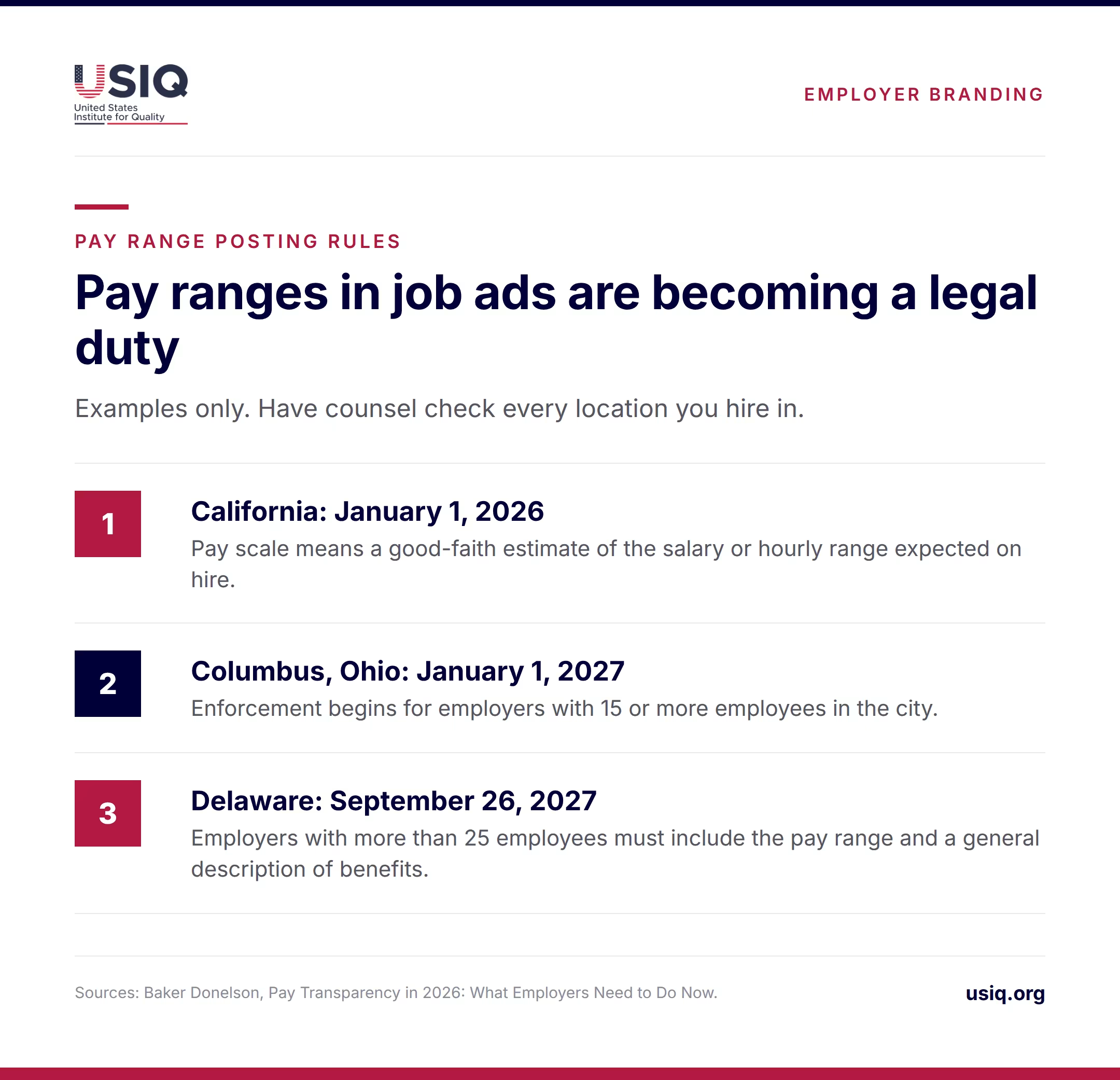
Publishing pay builds trust and, increasingly, is a legal duty. A growing set of state and local laws requires pay information in postings. The examples below come from a law-firm summary. The list is not complete and details change, so have counsel review your templates, especially if you hire in several states.
| Jurisdiction | Rule as summarized | Timing |
|---|---|---|
| California | “Pay scale” means a good-faith estimate of the salary or hourly range the employer reasonably expects to pay on hire. | Effective January 1, 2026 |
| Columbus, Ohio | Employers with 15 or more employees in the city must include a reasonable salary range. | Enforcement begins January 1, 2027 |
| Delaware | Employers with more than 25 employees must include the pay range and a general description of benefits in internal and external postings. | From September 26, 2027 |
Even where no law applies, a stated range tells candidates you have nothing to hide. Posting your jobs where search engines can find them also helps; see how Google for Jobs works.
How can employee stories and social media work without looking fake?
Candidates tend to give more weight to what employees say than to corporate copy, because employees have nothing to sell. The content still has to hold up. A photo of a team lunch tells a candidate little, while a short “day in the life” post from a dispatcher or nurse aide shows what the shift is like.
Practical rules for small teams:
- Ask for consent before using anyone’s name, photo or quote, and let people withdraw it.
- Keep participation voluntary and do not reward positive sentiment.
- Ask employees who post about the company to state their connection to it.
- Plan a modest rhythm, such as one or two posts a week, rather than bursts followed by silence.
- Mark milestones such as work anniversaries, finished projects and first days, because recognition shows how you treat people. See designing a recognition program.
Keep the tone the same across ads, website, social posts and interviews. If a post says “we move fast and have fun” while the job ad reads like a legal notice and interviews run stiff, candidates notice the mismatch. Have legal counsel review written guidelines for staff before rollout, particularly any rule about what employees may say online.
How should you handle online employer reviews?
Candidates read reviews, so treat them as free, unfiltered feedback. Claim your company profiles on the main review sites and Google, make sure the basic facts are correct and answer reviews politely, including critical ones. A calm reply that names a fix reads better than silence or a defensive rebuttal. Look for themes: three reviews that mention scheduling are a signal, one angry post is not.
Do not write reviews yourself, pay for them or pressure staff to post them. In August 2024 the Federal Trade Commission announced a final rule banning fake reviews and testimonials. It covers buying reviews and reviews written by company insiders without a clear disclosure of their material connection to the business. The rule is written for consumer reviews of products and services, so it does not necessarily govern employer-review sites. It is still a clear warning that incentivized or staged reviews carry risk, and counsel should advise before you design any review request.
A neutral way to ask is to tell all recent hires and leavers that feedback sites exist and that honest comments are welcome, without steering sentiment or rewarding it. Fix recurring problems before promoting your workplace more heavily.
How do you listen to employees and close the loop?
The best evidence for an employer brand is what current employees say and do. Listening has to be routine. Run a short pulse survey each quarter, hold stay interviews with people you want to keep and talk to leavers. Then tell staff what changed, in a plain “you said, we did” note. Guidance on question design is in employee surveys explained.
Many employers skip the conversation. Gallup found that 51% of exiting employees said neither their manager nor any other leader spoke with them about job satisfaction or their future in the three months before they left. A small employer can close that gap with a monthly one-on-one that covers growth and satisfaction.
Once you act on feedback, say so publicly. A post or careers-page note about what you changed after employee input shows candidates that the company listens.
Can an employee survey or a seal back up your employer brand?
Claims on your own website are easy to make, so outside evidence helps. An independent employee survey is one form. A seal based on such a survey is another. USIQ, the publisher of this article, runs certification programs of this kind.
The USIQ Top Employer program combines a confidential online survey of all eligible employees at the covered U.S. locations (32 scored items in seven dimensions) with an online HR assessment of 39 criteria in eight areas. Each part is worth up to 100 points, and tiers run from Certified to Platinum. People score the results, and a separate reviewer who did not do the original research checks the award. USIQ keeps the final decision. Certificates are valid for 24 months, and every seal links to a public verification page. The full rules are in the methodology, and an overview is on the Top Employer page.
On the effect on candidates, USIQ’s research reports that in a randomized experiment with 1,093 participants, Oliver Scharfenberg found that an employer seal raised the stated likelihood of applying for a job by about 16 percentage points. The experiment measured stated intentions in a hypothetical recruitment scenario rather than actual applications. It tested a different seal, a German one, on an IT job ad, not the USIQ seal. See also whether employer seals work.
How much does employer branding cost, and how long does it take?
No reliable benchmark exists for what a company of 10 to 250 employees spends on employer branding, and vendor figures are often circular. The one hard number in this guide is the replacement-cost range from Gallup: one-half to two times annual salary per employee. Weigh any spending against that.
Think in tiers. The first costs mostly owner and manager time: the EVP work, honest job ads, a better careers page, listening routines and review replies. The second adds modest outlays, such as a half day of photography at your own site or short employee videos. The third is paid promotion, such as sponsored job-board listings. Most small employers can get most of the value from the first tier.
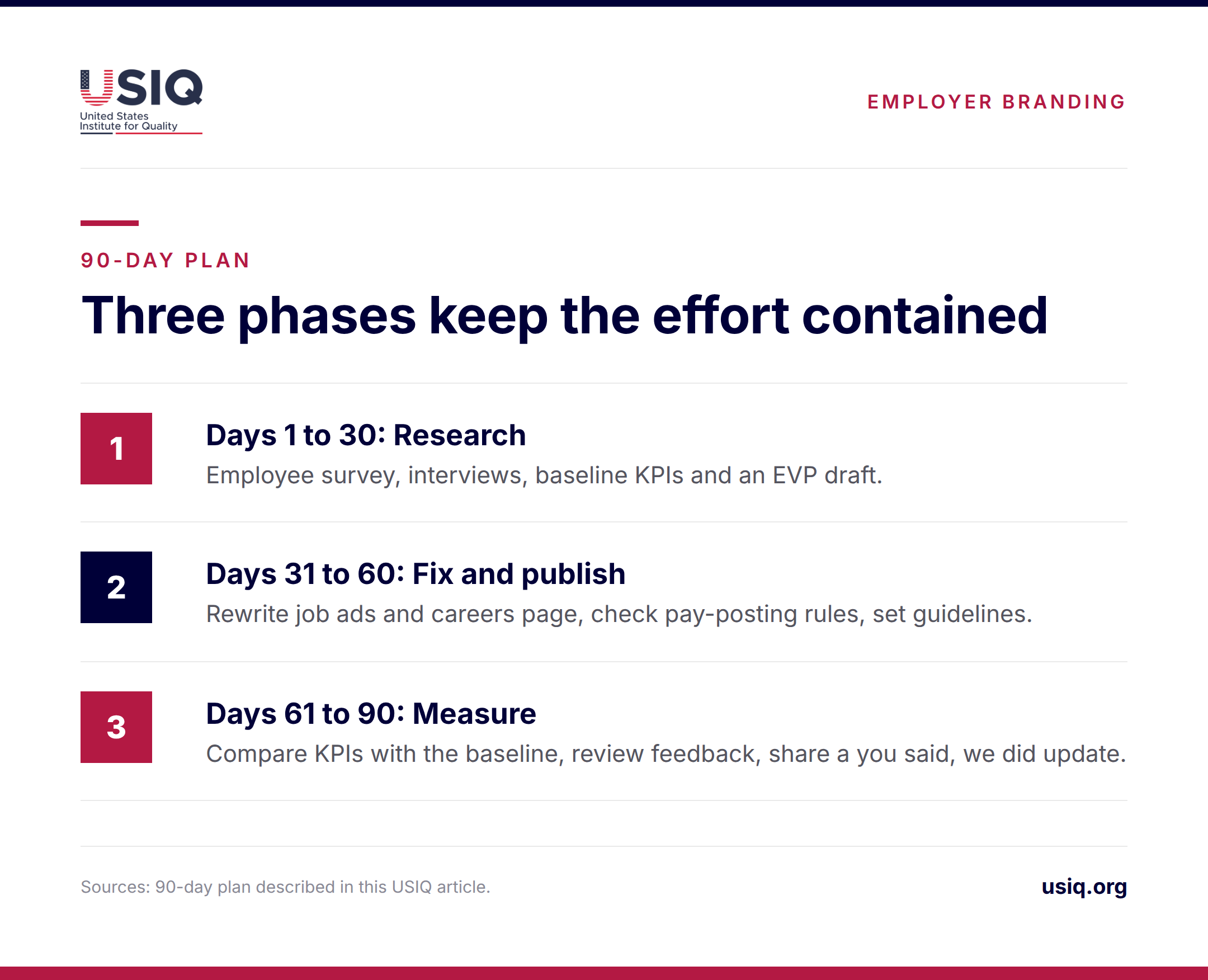
A 90-day plan keeps the effort contained:
| Phase | Days | Main tasks |
|---|---|---|
| Research | 1 to 30 | Employee survey, interviews, baseline KPIs, EVP draft |
| Fix and publish | 31 to 60 | Rewrite job ads and careers page, check pay-posting rules with counsel, set posting rhythm and guidelines |
| Measure | 61 to 90 | Compare KPIs with the baseline, review reviews and survey comments, share a “you said, we did” update |
Expect results over months, not weeks. Hiring metrics can improve within a quarter, but retention shows up over a year or more.
Which KPIs show that employer branding is working?
Measure before you start, so you have a baseline, and review each number quarterly. Six or seven figures are enough. More detail is in the most important recruiting KPIs.
| KPI | How to calculate it | What it tells you |
|---|---|---|
| Offer acceptance rate | Offers accepted divided by offers made | Whether your promise holds up against competing offers |
| Time to fill | Days from posting to accepted offer | How quickly the brand attracts qualified people |
| Applications per posting | Applications received divided by postings | Reach and appeal of ads and careers page |
| Referral share | Hires from employee referrals divided by all hires | Whether staff would recommend you |
| 12-month turnover | Leavers in 12 months divided by average headcount | Retention, the strongest sign of a true brand |
| Early quits | Hires who leave within 90 days divided by all hires | Whether ads match reality |
| Review rating trend | Average rating per quarter on your main profiles | Direction of public perception |
| Employee survey score | Share of positive answers in your pulse survey | Internal sentiment, an early warning |
To compare your quit rate with BLS data, note that the BLS figures are monthly rates: quits during the month as a share of employment. They are not annual turnover. Convert your own number the same way, dividing the month’s voluntary quits by average headcount, and compare it with the 2.5% (10 to 49 employees) or 2.3% (50 to 249 employees) from the August 2026 release. Small headcounts make the monthly figure jumpy, so look at a trailing average over several months.
What if the problem is pay or management, not branding?
Then fix that first. Branding cannot cover for low pay, unpredictable schedules or a manager people avoid. The Pew findings above point at exactly those areas: pay, advancement and respect. If your survey shows the same pattern, a campaign will bring candidates in the door and see them out of it again.
A rosy brand that does not match reality is worse than a modest one that does. New hires who discover the gap leave early, and they say why in reviews.
What mistakes should small employers avoid?
- Copying a big company’s campaign instead of building on what your own team values.
- Saying one thing in social posts and another in job ads or interviews.
- Writing, buying or steering reviews.
- Ignoring state and local pay-posting rules.
- Featuring employees without clear consent.
- Promoting before fixing known problems.
- Measuring nothing, so no one knows whether the work paid off.
What should you do first?
- Record your baseline: quit rate, time to fill, offer acceptance and current review ratings.
- Survey employees and hold a handful of interviews.
- Write a one-page EVP with only provable points.
- Rewrite your two most-used job ads as realistic previews, with pay ranges where required or possible.
- Simplify the careers page with real photos, steps and an honest FAQ.
- Set up quarterly pulse surveys and monthly stay conversations.
- Have counsel review posting templates, review requests and any employee social media guidelines.
FAQ
What is employer branding in simple terms?
Employer branding is the work of shaping and communicating what it is like to work for your company. It includes defining what you offer employees, writing honest job ads, sharing real employee stories and listening to feedback. The result is your employer brand, which is your reputation among candidates and staff.
What is the difference between employer brand and EVP?
The employer brand is how people perceive you as an employer. The employee value proposition is the specific promise you make: pay, growth, flexibility, respect and similar points. You write and control the EVP. You earn the brand through whether that promise holds up in daily work.
How much should a small business spend on employer branding?
No reliable benchmark exists for firms of 10 to 250 employees. Start with owner and manager time, which covers the EVP, job ads, careers page and listening routines. Add small outlays only if needed. Compare spending with Gallup’s estimate that replacing one employee costs one-half to two times annual salary.
How long does it take to see results?
Plan on 90 days for the groundwork: research, fixing ads and the careers page, and setting up measurement. Hiring indicators such as applications per posting can move within a quarter. Retention changes show up more slowly, often over a year, so compare quarterly against your own baseline.
Do I have to post salary ranges in job ads?
It depends on where you hire. California defines “pay scale” in its rules from January 1, 2026. Columbus, Ohio, covers employers with 15 or more employees, with enforcement from January 1, 2027. Delaware covers employers with more than 25 employees from September 26, 2027. Ask counsel to check every location you recruit in.
Can I ask employees to post reviews about us?
You can tell staff that review sites exist and that honest feedback is welcome. Do not write reviews for them, reward positive ones or require posting. The FTC’s fake-review rule targets bought reviews and undisclosed insider reviews for consumer products and services. Treat it as a warning and get legal advice.
Which numbers should I track first?
Start with offer acceptance rate, time to fill, applications per posting, 12-month turnover and your monthly quit rate. Record a baseline now. Compare the quit rate with the BLS size-class figures, but remember BLS reports monthly rates, not annual turnover.
Sources
- U.S. Bureau of Labor Statistics, “JOLTS News Release 2026 M08,” September 29, 2026, Table 7 and definitions: https://www.bls.gov/news.release/archives/jolts_09292026.htm
- U.S. Bureau of Labor Statistics, “Job Openings and Labor Turnover Survey (JOLTS) Home”: https://www.bls.gov/jlt/
- Gallup, “This Fixable Problem Costs U.S. Businesses $1 Trillion,” March 13, 2019 (modified May 13, 2025): https://www.gallup.com/workplace/247391/fixable-problem-costs-businesses-trillion.aspx
- CFO Dive, “Quitting workers seek higher pay, advancement: Pew” (reporting Pew Research Center), March 10, 2022: https://www.cfodive.com/news/quitting-workers-seek-higher-pay-advancement-pew/620213/
- Federal Trade Commission, “FTC Announces Final Rule Banning Fake Reviews and Testimonials,” August 14, 2024: https://www.ftc.gov/news-events/news/press-releases/2024/08/federal-trade-commission-announces-final-rule-banning-fake-reviews-testimonials
- Baker Donelson, “Pay Transparency in 2026: What Employers Need to Do Now”: https://www.bakerdonelson.com/pay-transparency-in-2026-what-employers-need-to-do-now
- USIQ, “Top Employer research” (randomized experiment, 1,093 participants): https://www.usiq.org/top-employer/research/

Related Articles
What research says about the effects of employer seals on current employees, potential applicants and employer image, from independent experiments and field data to the limits of the evidence.
Employee experience and customer experience are linked, but the link is weaker and more conditional than popular slogans suggest. This article reviews the evidence on staffing, training and workplace conditions and shows how employers can test the connection in their own business.
Most HR dashboards show too many metrics and trigger too few decisions. This guide defines ten employee experience metrics, shows a one-page layout and explains how to read your numbers against U.S. data.
A practical guide to calculating marketing ROI for small and mid-sized U.S. companies, including long B2B sales cycles, offline leads, a spreadsheet walkthrough and common errors.