

Most U.S. companies now have people in their twenties, forties and sixties on the same team. Managing generations in the workplace means leading Gen X, Millennials, Gen Z and often Baby Boomers together, and a good deal of advice on the subject rests on stereotypes rather than evidence.
For an owner or HR lead at a company with 10 to 250 employees, the practical question is narrower than the headlines suggest. Which differences are real, which come from career stage, and what can a manager do without an HR department?
This guide gives the accepted birth years, separates tendencies from rules, and lists low-cost steps for feedback, flexibility, mentoring and measurement. It also covers the legal side, because decisions based on assumptions about age can create risk.
Quick answer: Pew Research defines Gen X as born 1965 to 1980, Millennials as 1981 to 1996 and Gen Z as 1997 onward. Generations share most workplace needs: fair pay, a good manager, trust and room to grow. Differences are tendencies, so ask individuals what they want instead of assuming it from their age.
Key takeaways
- Use consistent definitions: Gen X 1965 to 1980, Millennials 1981 to 1996, Gen Z 1997 onward (Pew Research Center).
- Generation labels are conventions, and cut-off years differ between sources.
- Age, career stage and role often explain behavior better than birth year does.
- Employees of every age want fair pay, trust, a capable manager, flexibility and development. They differ mostly in degree.
- Short, frequent feedback and clear communication norms solve more friction than any generation-specific program.
- Federal age-discrimination law protects workers 40 and older, which includes all of Gen X and the oldest Millennials.
- Track engagement, turnover and internal moves by age band, but only where groups are large enough to protect anonymity.
Which generations work together today, and when were they born?
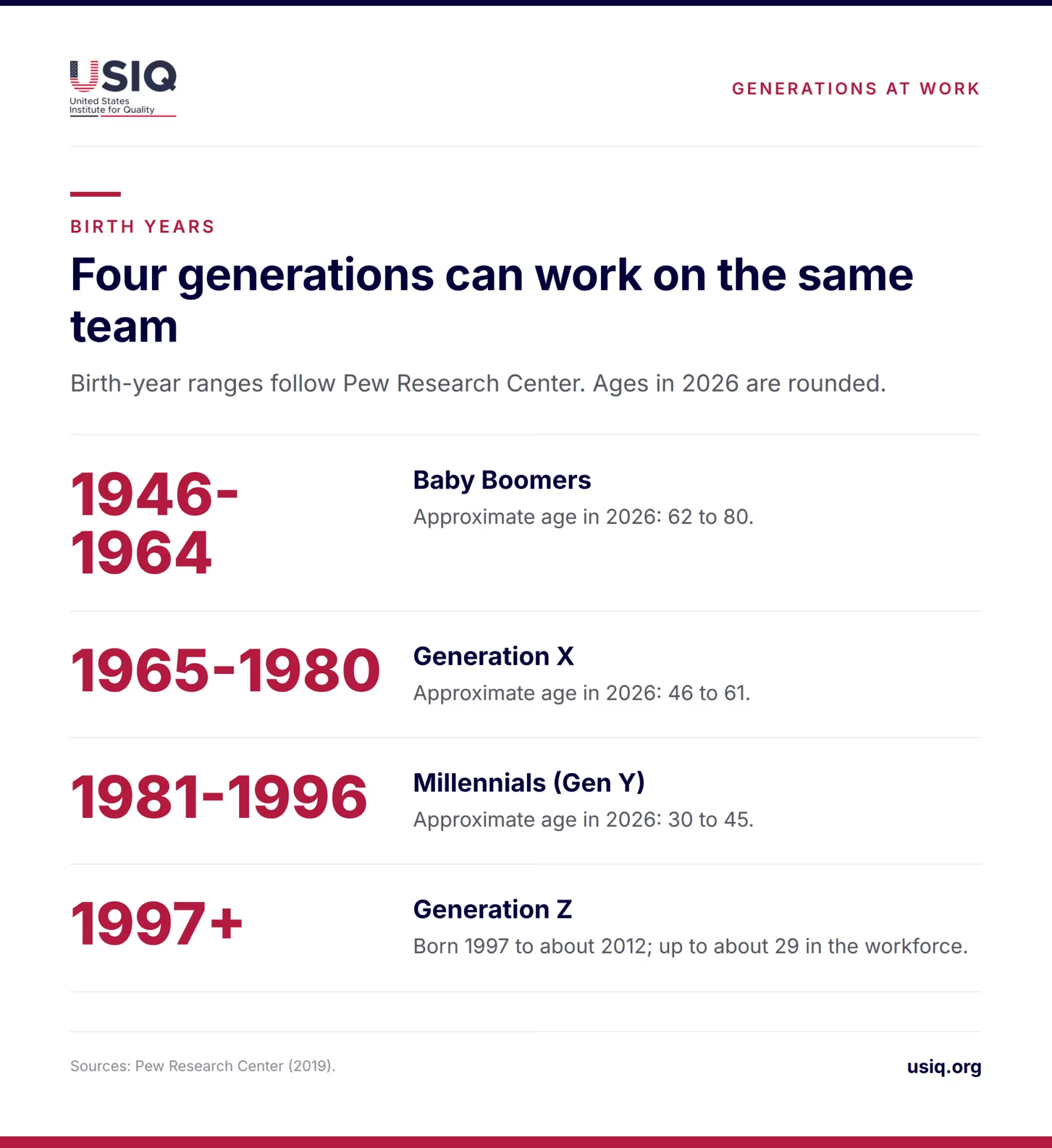
Pew Research Center adopted its current generation definitions in 2018 and restated them in a 2019 analysis. Millennials were born from 1981 to 1996, and Generation Z from 1997 onward. Generation X covers 1965 to 1980, a 16-year span like the Millennials. Baby Boomers span 19 years, and they are the only generation officially designated by the U.S. Census Bureau.
| Generation | Birth years | Approximate age in 2026 |
|---|---|---|
| Baby Boomers | 1946 to 1964 | 62 to 80 |
| Generation X | 1965 to 1980 | 46 to 61 |
| Millennials (Gen Y) | 1981 to 1996 | 30 to 45 |
| Generation Z | 1997 to about 2012 | up to about 29 in the workforce |
| Generation Alpha | after Gen Z | mostly still in school |
Many sources give looser ranges such as “Gen X from the 1960s to the 1980s.” Those ranges overlap with the Millennials and blur any comparison, so a company that surveys or reports by generation should fix one definition and keep it.
Gen Z is also not the newest generation. Gen Alpha follows it, but Alpha members are mostly children and teenagers, so they matter for workplace planning only in the long run.
How do generations in the workplace really differ?
Less than popular articles claim. A 30-year-old and a 55-year-old differ in many ways, but much of that gap comes from career stage, family situation and seniority. A 25-year-old Millennial a decade ago probably wanted rapid promotion and frequent feedback for the same reasons a 25-year-old Gen Z employee does today.
Labels such as “latchkey kids,” “multitaskers” or “needs instant rewards” describe averages at best and caricatures at worst. A manager who treats a 28-year-old as a stereotype will often misread that person. Variation inside any generation is wider than the gap between generations.
Some differences are real and measurable. Tenure is the clearest example: the Bureau of Labor Statistics publishes median years with the current employer by age group, and tenure rises with age because older workers have had more years to build it. Technology habits also differ, since younger employees grew up with mobile and cloud tools, though plenty of 55-year-olds use them with ease.
Why a Gen X manager and a Gen Z employee can misread each other
Consider an illustrative example. A new hire starts strong and then seems to lose interest after a few months. Her manager, who rarely gives feedback because he values autonomy himself, reads her drop in energy as a lack of commitment. She reads his silence as a sign that her work does not matter.
Neither is acting on a generational trait. Each is missing information the other assumed was obvious. A shared agreement on how and when feedback happens fixes this faster than any training on “how Gen Z thinks.”
What do employees of every age want from an employer?
The shared list is longer than the differences. Employees of every age want fair pay, respectful treatment, a manager they trust, reasonable flexibility, a chance to learn and recognition for good work. Generations tend to weight these differently, usually because of life stage.
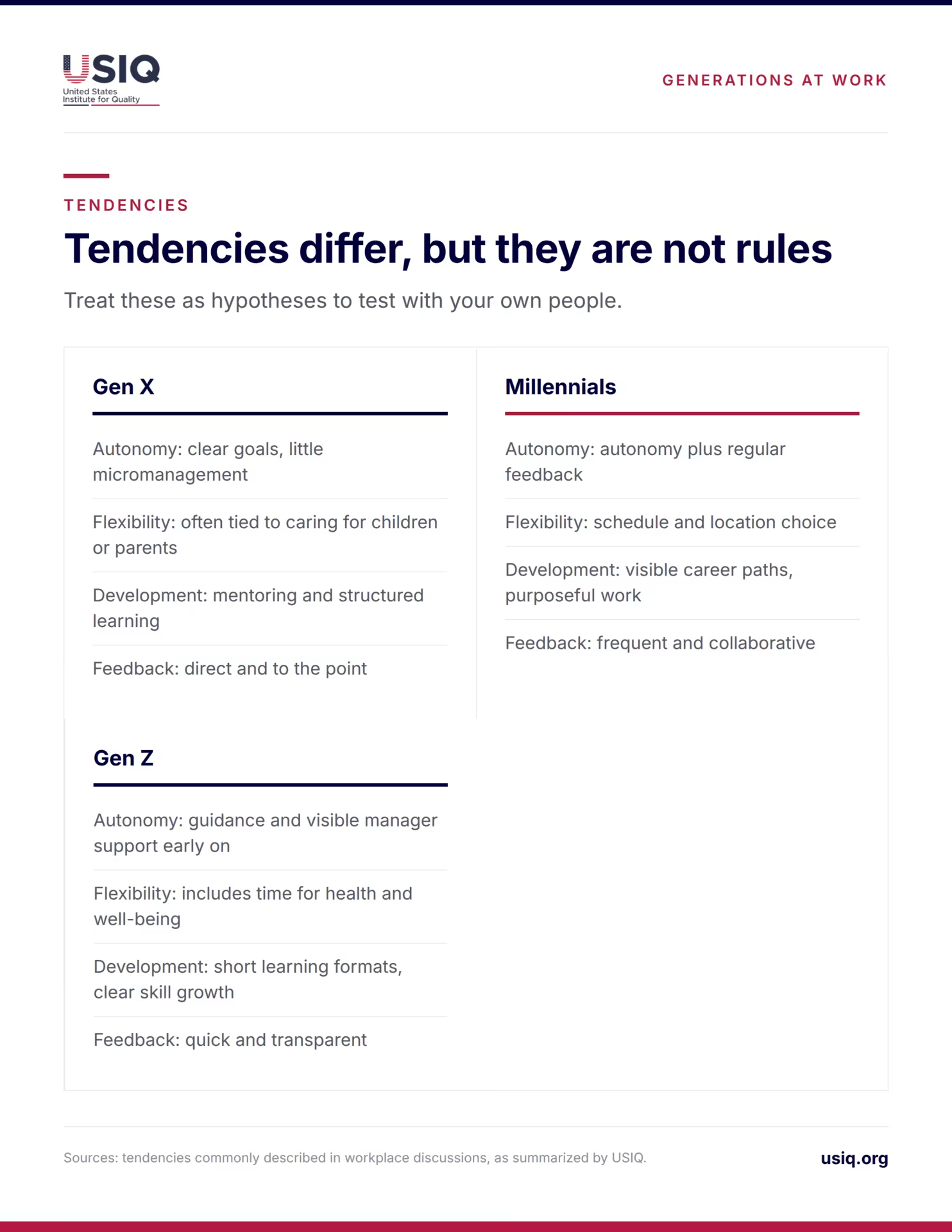
The table below collects tendencies commonly described in workplace discussions. Treat it as a set of hypotheses to test with your own people, not as a rulebook.
| Topic | Gen X (tends to) | Millennials (tend to) | Gen Z (tends to) |
|---|---|---|---|
| Autonomy | Prefer clear goals and little micromanagement | Want autonomy plus regular feedback | Want guidance and visible manager support early on |
| Flexibility | Value it, often tied to caring for children or parents | Value schedule and location choice | Value it, including time for health and well-being |
| Development | Mentoring and structured learning | Visible career paths, purposeful work | Short learning formats, clear skill growth |
| Feedback | Direct and to the point | Frequent and collaborative | Quick and transparent |
The Gen X caregiving point shows life stage outweighing generation. Many people in their forties and fifties look after both children and aging parents. A 38-year-old Millennial in the same situation has the same need for flexibility.
What problems do mixed-age teams run into, and what fixes them?
Most friction falls into five areas. Each has a low-cost fix that does not depend on knowing anyone’s birth year.
| Friction point | Typical symptom | Low-cost fix |
|---|---|---|
| Communication norms | Unanswered messages, meetings that could have been emails | Agree on one tool for quick questions and written summaries for decisions |
| Feedback cadence | Strong annual review, then a resignation | Short monthly check-ins with a forward-looking “what next” conversation |
| Technology | Some staff feel left behind by new tools | Short walkthroughs, and let staff who are comfortable with the tool teach it |
| Recognition | Praise that embarrasses or misses the person | Ask each employee how they like to be recognized |
| Hierarchy and autonomy | Conflict over who decides and how closely work is checked | Define outcomes and decision rights, then agree how often to check in |
Silence is a good test case. One manager means silence as trust, while one employee hears it as no feedback. Say the rule out loud: “If you do not hear from me, it means the work is on track, and you can always ask.” That sentence costs nothing.
Annual-only reviews are a second weak spot for employees of every age. A short monthly check-in plus a conversation about the next goal gives people the information the yearly review delivers too late.
How can a small or mid-sized company manage a multigenerational team?
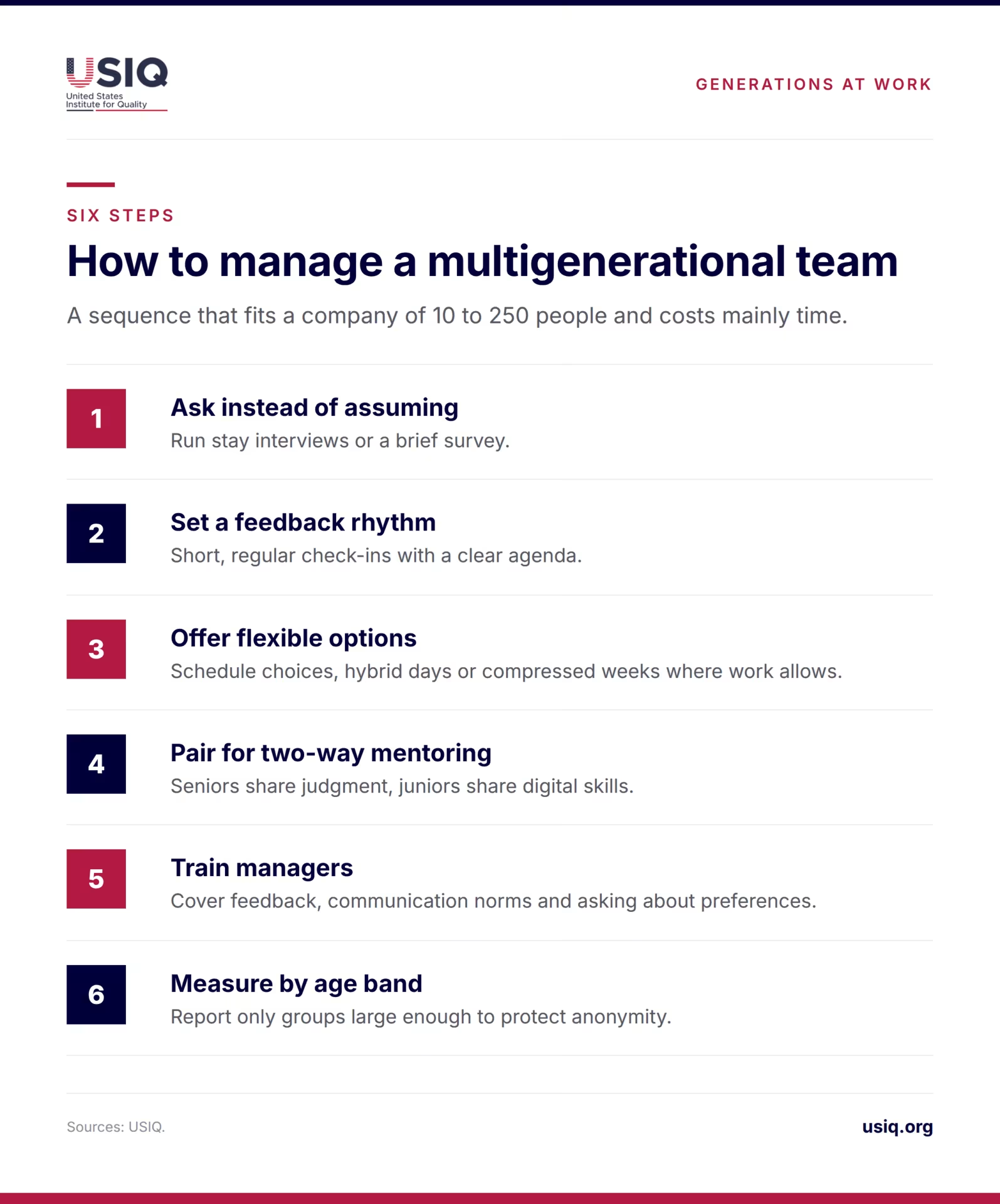
A company of 10 to 250 people usually has no dedicated HR analytics team and a handful of managers. The sequence below fits that reality and costs mainly time.
- Ask instead of assuming. Run short stay interviews or a brief survey. Ask what keeps people here, what would make them leave and what support they lack. Our guide to employee surveys covers question design.
- Set a feedback rhythm. Short, regular check-ins with a clear agenda: what went well, what is blocking you, what is next.
- Offer flexible options. Schedule choices, hybrid days or compressed weeks, where the work allows. Our overview of work-life balance examples offers practical ideas.
- Pair people for two-way mentoring. A senior employee shares judgment and company knowledge, and a junior colleague shares digital skills or fresh views.
- Train managers. Cover feedback, communication norms and how to ask about preferences. The manager shapes daily experience more than any program does.
- Measure by age band. Track engagement, turnover and internal moves, and compare them across age groups. Report a group only when it has enough people that no individual can be identified.
If turnover is the concern, the checklist in low-cost ways to retain employees fits the same budget constraints. For recognition, see employee recognition programs.
Benefits and learning by choice
Uniform benefit packages tend to suit some employees better than others. Cafeteria-style plans or flex credits let each person spend a set budget on what matters to them, such as retirement contributions, caregiver support, mental health services or financial planning. Learning works the same way: offer short modules for some, mentoring or structured courses for others, and hold everyone to the same standard of results. Ideas for benefits beyond salary and for upskilling can help here.
Is it legal to treat employees differently by age or generation?
Not when the difference rests on age itself. The federal Age Discrimination in Employment Act (ADEA), enforced by the U.S. Equal Employment Opportunity Commission (EEOC), protects applicants and employees who are 40 and older. In 2026 that covers all of Gen X and Baby Boomers and the oldest Millennials.
The federal law applies only to employers above a minimum size, but some state laws reach smaller employers or protect younger workers as well. A company with 15 employees should check its state’s rules instead of assuming it is exempt.
Several everyday practices carry risk. Job ads that ask for a “digital native” or a “recent graduate” can read as age-related language. Decisions on training, promotion and layoffs based on guesses about who will “adapt” or “retire soon” invite the same problem. Safer practice is to use skills, performance and documented, age-neutral criteria, and to have someone review ads before they are posted.
This section is general information, not legal advice. For specific cases, consult an employment attorney or the EEOC.
What about older workers and Gen Alpha?
Older workers deserve attention in workforce planning. The BLS Employment Projections tables report labor force participation by age group, and they are a reasonable starting point for estimating how many people in your sector may stay past traditional retirement ages. When experienced employees do retire, they take process knowledge and customer relationships with them.
Two steps help. Document key procedures and customer history early, and pair soon-to-retire staff with colleagues who will inherit their work. Phased retirement, where it fits the business, keeps knowledge in the company longer. Our article on the U.S. labor shortage looks at the wider hiring pressure.
Gen Alpha follows Gen Z and is mostly still in school, so it needs no policy yet. Avoid hard-coding any generation’s traits into HR processes, because the next group will arrive with its own mix of tendencies.
Where do generational explanations fall short?
Three misconceptions come up repeatedly. The first is that each generation wants something fundamentally different. In practice the overlap is large, and the differences are in emphasis.
The second is that younger workers are less loyal. Job changes are strongly tied to age and career stage, and people early in their careers have always moved more often. The third is that older workers resist technology. Skill with tools varies by training, role and exposure far more than by birth year.
Generation labels still have a use, mainly as a prompt to ask better questions and notice when different life stages need different support. They fail as a shortcut for deciding what an individual wants.
What should employers do first?
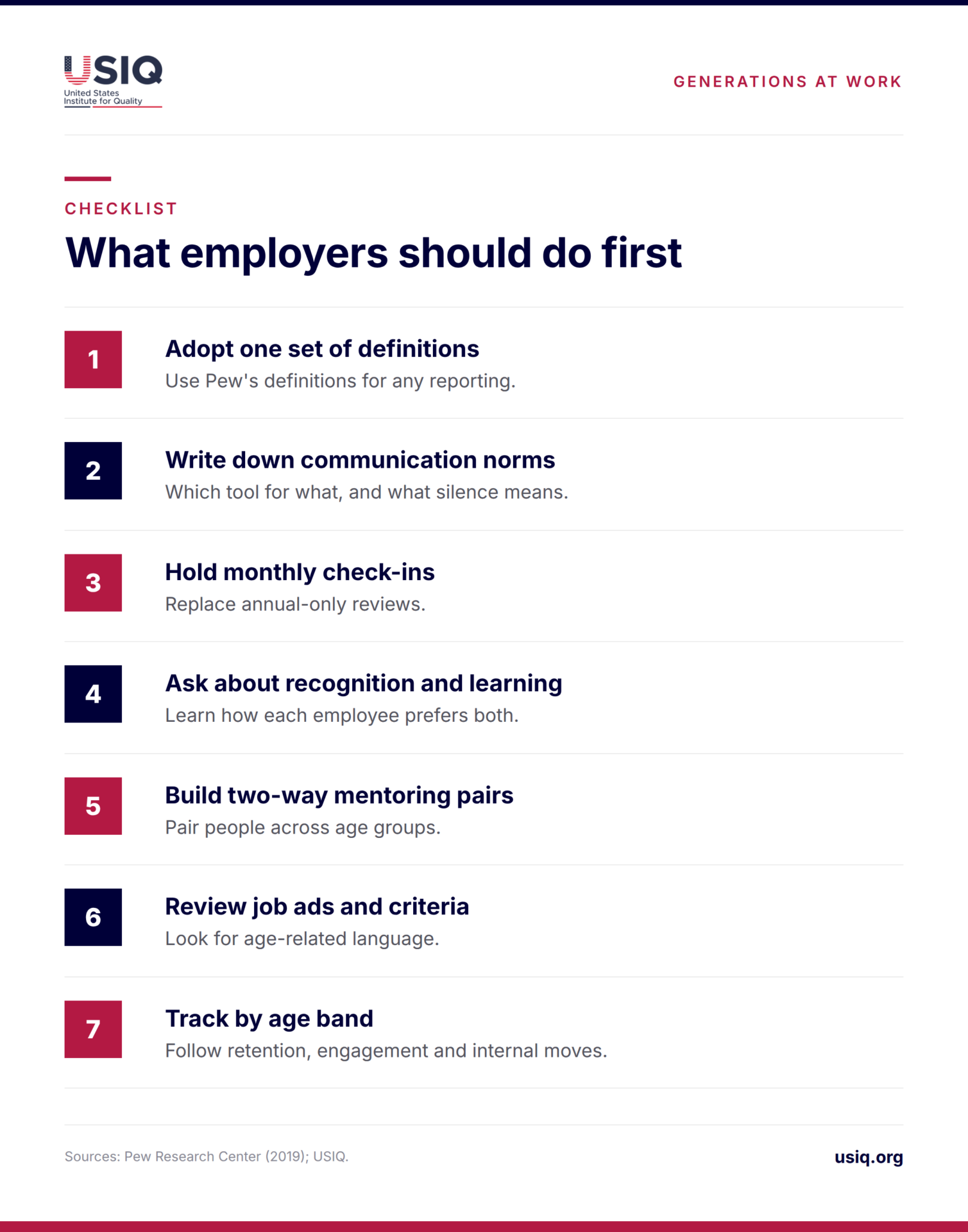
- Adopt one set of generation definitions, such as Pew’s, for any reporting.
- Write down communication norms: which tool for what, and what silence means.
- Replace annual-only reviews with monthly check-ins.
- Ask each employee how they prefer to be recognized and how they want to learn.
- Build two-way mentoring pairs across age groups.
- Review job ads and promotion criteria for age-related language.
- Track retention, engagement and internal moves by age band, and read the results alongside retention data you already have.
Summary
Generations in the workplace are best treated as a starting question, not an answer. Use accurate birth years, expect more overlap than difference, and ask each employee what they need. Managers who give regular feedback and state their norms openly will serve every age group better than those who manage by label.
Frequently asked questions
What years define Gen X, Millennials and Gen Z?
Pew Research Center defines Generation X as born 1965 to 1980, Millennials as 1981 to 1996 and Generation Z as 1997 onward. Many sources end Gen Z around 2012, but that cut-off varies. Pick one definition, ideally Pew’s, and use it consistently in surveys and reports.
Do generational stereotypes hold up at work?
Only loosely. Traits such as “latchkey independence” or “needs constant praise” describe averages at best. Career stage, role and personality often explain behavior better than birth year. Treat generation as a prompt to ask questions, not as a prediction of what one person wants.
Do all generations want different things from an employer?
Mostly no. Employees of every age want fair pay, a trustworthy manager, flexibility, a chance to learn and recognition. Groups differ in emphasis, often because of life stage, such as caregiving for parents or building a first career. Ask people directly instead of assuming.
How often should managers give feedback to a mixed-age team?
A short monthly check-in works for most teams, with more frequent contact for new hires. Annual reviews alone arrive too late to change behavior. Agree on the rhythm with each employee, and say clearly what silence means so nobody has to guess.
Can I use “digital native” or “recent graduate” in a job ad?
These phrases can be read as age-related language, and the EEOC enforces the federal law that protects applicants 40 and older. Describe the skills the job requires instead, such as “proficient in our scheduling software.” Have someone review ads before they go live, and check your state’s rules.
What is reverse mentoring, and does it work for small companies?
Reverse mentoring means a junior employee shares skills, often digital ones, with a senior colleague, usually alongside traditional mentoring in the other direction. It costs only time. Judge it by results you already track, such as retention and engagement for the people involved.
Is Gen Z the youngest generation in the workforce?
Gen Z is the youngest generation now working in any numbers. Gen Alpha comes after it, but its members are mostly children and teenagers. Employers do not need an Alpha strategy yet, only a habit of questioning labels before building policies around them.
Can I track engagement by generation without breaching privacy?
Yes, if each age band has enough respondents that no one can be identified. In a small company, combine groups, for example under 35 and 35 and older, or report only company-wide results. Never share results that point to a specific person.
Sources
- Where Millennials end and Generation Z begins, Pew Research Center, January 17, 2019: https://www.pewresearch.org/short-reads/2019/01/17/where-millennials-end-and-generation-z-begins/
- Fact Sheet: Age Discrimination, U.S. Equal Employment Opportunity Commission: https://www.eeoc.gov/laws/guidance/fact-sheet-age-discrimination
- Employee Tenure release, U.S. Bureau of Labor Statistics: https://www.bls.gov/news.release/tenure.htm
- Civilian labor force participation rate by age, Employment Projections, U.S. Bureau of Labor Statistics: https://www.bls.gov/emp/tables/civilian-labor-force-participation-rate.htm

Related Articles

What research says about the effects of employer seals on current employees, potential applicants and employer image, from independent experiments and field data to the limits of the evidence.
Employee experience and customer experience are linked, but the link is weaker and more conditional than popular slogans suggest. This article reviews the evidence on staffing, training and workplace conditions and shows how employers can test the connection in their own business.
Most HR dashboards show too many metrics and trigger too few decisions. This guide defines ten employee experience metrics, shows a one-page layout and explains how to read your numbers against U.S. data.
A practical guide to calculating marketing ROI for small and mid-sized U.S. companies, including long B2B sales cycles, offline leads, a spreadsheet walkthrough and common errors.


