
Employer branding describes how current and potential employees see you as an employer. It is shaped less by your careers page than by what people actually experience at work and what they say about it. The employer branding trends of 2026 follow that logic: candidates look for evidence, and employees are the main source of it.
A company with 10 to 250 employees rarely has a marketing team or a large budget behind this work. The useful question is therefore not which trend is new, but which one changes a hiring or retention result at your size. This article sorts the available data by that test.
Data points are dated and attributed to the publisher that reported them. Several come from vendors with a commercial interest, and the text says so where it applies. The article was last updated on November 7, 2026.
Quick answer: Employer branding trends in 2026 point to proof over polish. Candidates check reviews and judge the hiring process, quits are low but edging up, and gaps between promise and daily experience show up in public reviews. Small employers should fix the experience first, track a few metrics, then tell the story through real employees.
Key takeaways
- Credibility beats creativity: an employer value proposition (EVP) is judged by daily experience, not by slogans.
- Glassdoor reports that 75% of job seekers evaluate an employer’s brand before applying.
- The U.S. quits rate was 2.1% in September 2026, so the brand matters as much for keeping your own people as for attracting new ones.
- The hiring process itself shapes the brand: iCIMS reports that 96% of candidates say it influences how they see an employer.
- Employee advocacy works only when it is not scripted, and faking or pressuring reviews creates legal and reputational risk.
- Measure a handful of numbers (application rate, offer acceptance, turnover, cost-per-hire) instead of buying a dashboard.
- Independent proof helps only when the criteria are public, the survey date is recent and the issuer is named.
What does the 2026 labor market mean for employer branding?
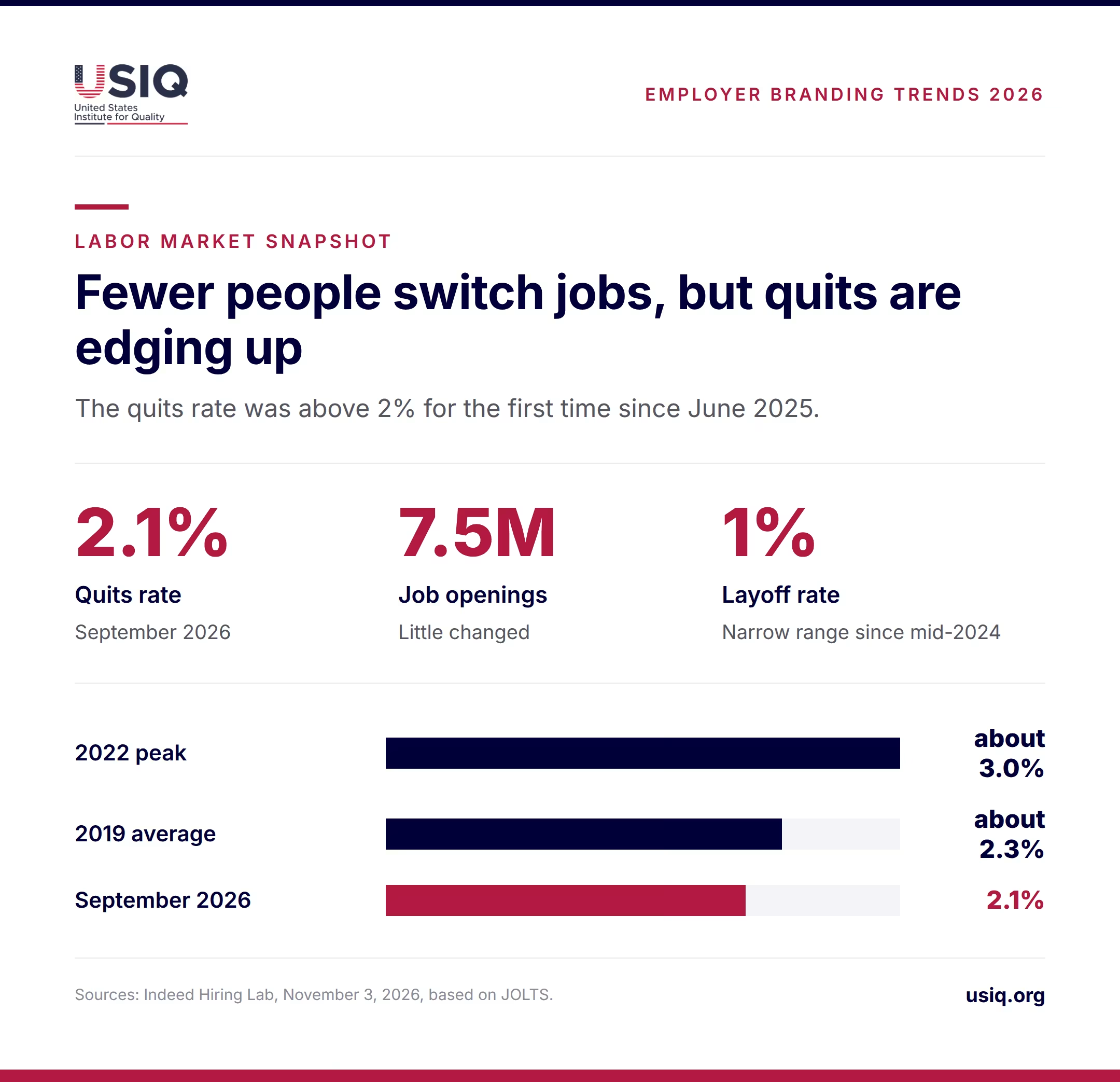
The “war for talent” framing is weaker than it was in 2022. According to Indeed Hiring Lab’s reading of the September 2026 JOLTS report, job openings were little changed at 7.5 million and the layoff rate was 1%, within the narrow range it has held since mid-2024. The quits rate was 2.1%, above 2% for the first time since June 2025.
For context, Indeed’s chart shows the 2019 average quits rate at about 2.3% and the 2022 peak near 3.0%. Workers are moving less than at the peak, and the share separating from jobs each month has barely changed in two and a half years.
What this means for a small employer is interpretation, not a finding of the data: when fewer people switch jobs, each resignation and each hard-to-fill role costs more attention. The brand then does two jobs. It supports hiring in specific roles, and it gives your current employees fewer reasons to look elsewhere as quits tick up.
Do candidates really check employer reviews before applying?
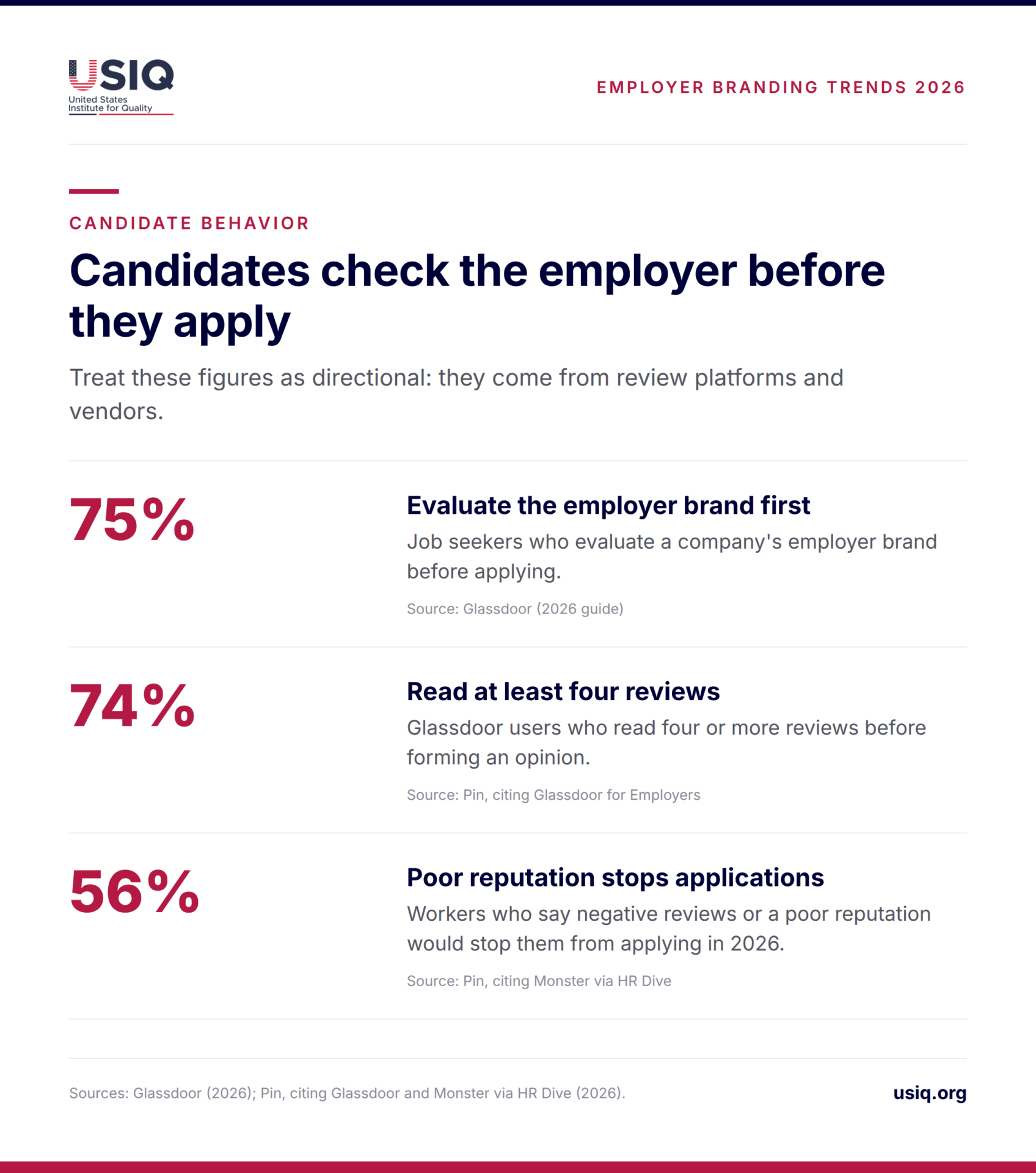
Most evidence says yes, though much of it comes from review platforms and recruiting vendors. Glassdoor reports that 75% of job seekers evaluate a company’s employer brand before applying. Pin, a recruiting-software vendor, cites Glassdoor for the finding that 74% of Glassdoor users read at least four reviews before forming an opinion.
Reputation also affects whether people apply at all. Pin, citing Monster via HR Dive, reports that 56% of workers say negative reviews or a poor reputation would stop them from applying in 2026. Pin also cites Glassdoor for an association between a 0.5-star rating increase and about 20% more job clicks and 16% more application starts.
Treat these as directional. They describe association, not proof that a better rating causes more applicants, and each source has an interest in the topic. The table shows how to weigh them.
| Statistic | Reported by | Source quality |
|---|---|---|
| 75% of job seekers evaluate the employer brand before applying | Glassdoor (2026 guide) | Review platform, original publisher of the claim |
| 74% of Glassdoor users read at least four reviews | Pin, citing Glassdoor for Employers | Secondary, vendor |
| 56% say a poor reputation would stop an application in 2026 | Pin, citing Monster via HR Dive | Secondary, original not checked |
| 0.5-star gain linked to about 20% more job clicks and 16% more application starts | Pin, citing Glassdoor | Secondary, association only |
| Only 1 in 5 candidates would apply to a 1-star company | Pin, citing CareerArc via HR Dive | Dated 2017, use as background only |
What is the real cost of a weak employer brand?
Solid cost data is limited. Glassdoor, attributing the figure to SHRM benchmarking, puts the average U.S. cost-per-hire at $5,475 for non-executive roles. A Harvard Business Review piece from 2016 by Wade Burgess of LinkedIn Talent Solutions carried the headline “A Bad Reputation Costs a Company at Least 10% More Per Hire.” It is an older estimate from a LinkedIn author, so read it as an indication of scale.
An illustrative calculation shows why even a modest effect matters. If a 10% premium applied to the $5,475 average, each hire would cost about $548 more. A 60-person company that fills eight roles a year would then pay roughly $4,400 extra. These are example numbers built from the sources above, not a measured result for any company.
The larger cost for a small team is usually harder to put in dollars. A role that stays open, or a good employee who leaves, shifts work onto colleagues. Your own cost-per-hire and turnover figures tell you more than any benchmark.
Why does the gap between promise and experience matter most?
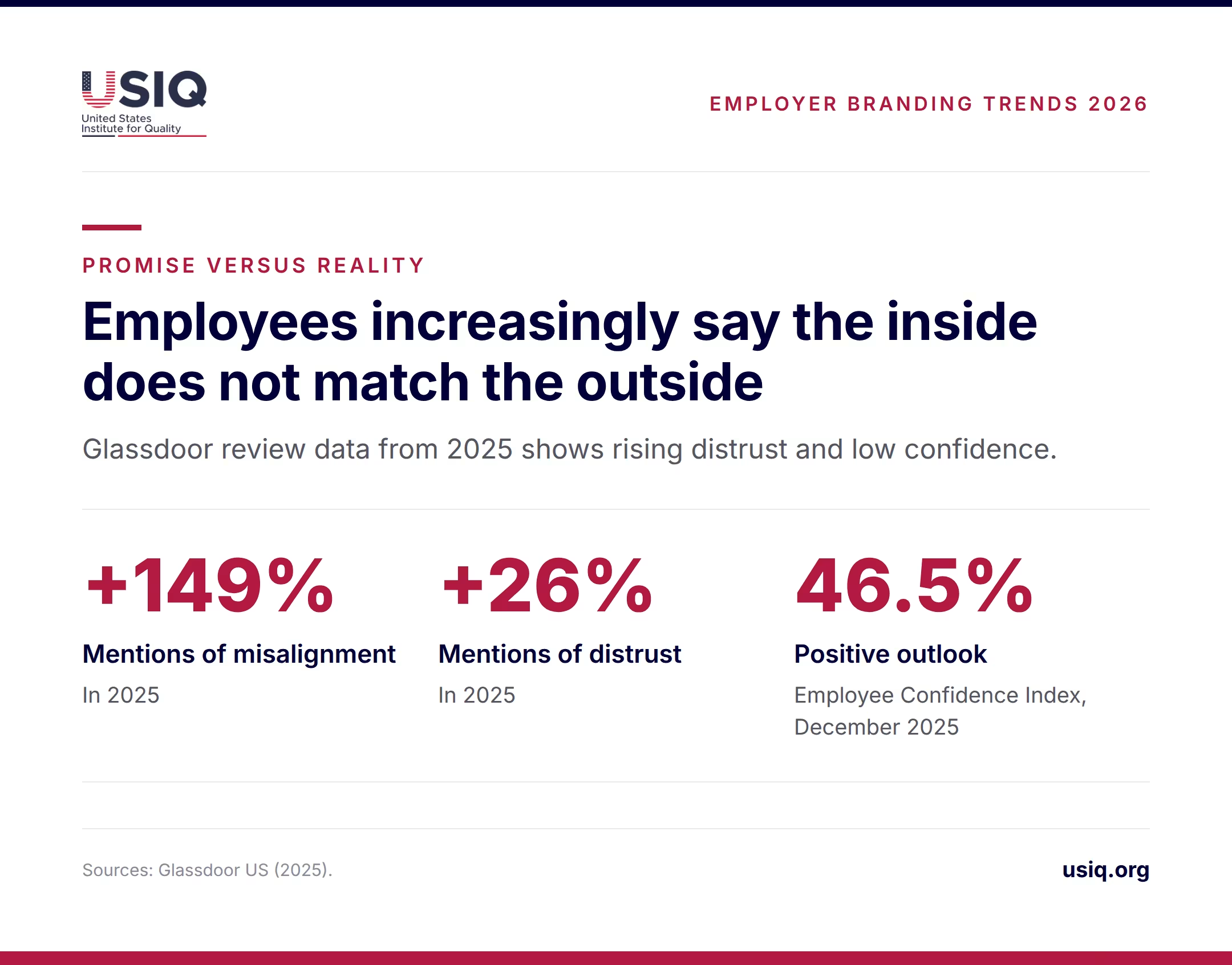
The strongest trend in 2026 is the pressure on employers to make the inside match the outside. Glassdoor reports, from its own review data, that mentions of “misalignment” rose 149% and mentions of “distrust” rose 26% in 2025. Its Employee Confidence Index showed that 46.5% of employees had a positive outlook on their company’s business prospects in December 2025, a record-low trend that began in mid-2025.
An EVP is judged by execution. If you promise growth, people expect a mentor and a visible path. If you promise collaboration, they expect access to leaders. Slogans that the daily routine contradicts end up in reviews.
A simple check: promise, proof, owner
List every claim you make in job ads and on your careers page. For each, write down the proof an employee would point to and the person who owns it. Fill the table with your own practices; the rows show the format.
| Promise in your job ad | Proof an employee would cite | Owner |
|---|---|---|
| “We invest in your growth” | Written development plan per employee, reviewed twice a year | Department manager |
| “Open door culture” | Regular leadership Q&A, questions answered in writing | Owner or CEO |
| “Flexible work” | A written policy that managers apply consistently | HR lead |
| “Fair pay and recognition” | Clear pay ranges, a defined recognition routine | HR lead and finance |
The most direct way to see where promise and experience diverge is to ask employees. A confidential survey shows the gaps before they appear in public reviews; the guide on employee surveys and employer trust explains how to run one.
How does candidate experience shape your brand?
Every applicant, hired or not, forms an opinion and may share it. iCIMS, an applicant tracking vendor, reports that 96% of candidates say the hiring process influences how they perceive an employer. The underlying study is not named on the page, so the figure should be read as an iCIMS claim.
The fixes are inexpensive and mostly about discipline:
- Acknowledge every application within a set number of days, and tell candidates what happens next.
- Write job descriptions that describe the real work, the real team and the real next step in growth.
- Give every interviewed candidate a decision, even a rejection, and short feedback where you can.
- Train managers to run structured interviews so candidates meet the same standards.
- Days 1 to 30: audit your promises against reality using the promise, proof, owner table, and set response-time and feedback standards for candidates.
- Days 31 to 60: run a short anonymous employee survey, record your baseline numbers (turnover, time-to-hire, cost-per-hire, rating) and fix the one gap employees name most.
- Days 61 to 90: invite employees to share real stories in their own words, answer reviews respectfully and decide whether independent proof fits your situation.
- Glassdoor US, “Employer branding strategy: A complete guide for 2026.” https://www.glassdoor.com/blog/eight-employer-branding-strategies/
- iCIMS, “Employer Branding Trends Blazing the Trail in 2026,” June 3, 2026. https://www.icims.com/blog/employer-branding-trends-blazing-the-trail-in-2026/
- Indeed Hiring Lab, “September 2026 JOLTS Report: Eerily Quiet,” November 3, 2026. https://hiringlab.indeed.com/2026/11/03/september-2026-jolts-report-eerily-quiet/
- Federal Trade Commission, “Federal Trade Commission Announces Final Rule Banning Fake Reviews and Testimonials,” August 14, 2024. https://www.ftc.gov/news-events/news/press-releases/2024/08/federal-trade-commission-announces-final-rule-banning-fake-reviews-testimonials
- Pin, “The Glassdoor Effect 2026,” July 7, 2026, updated September 24, 2026. https://www.pin.com/blog/candidate-glassdoor-effect-study/
- Harvard Business Review, Wade Burgess, “A Bad Reputation Costs a Company at Least 10% More Per Hire,” March 29, 2016. https://hbr.org/2016/03/a-bad-reputation-costs-company-at-least-10-more-per-hire
- USIQ, research on employer seals (randomized experiment, 1,093 participants). https://www.usiq.org/top-employer/research/
iCIMS also reports a case in which the landscape supplier SiteOne saw a 55% increase in completed applications after introducing a new career site, employee testimonials and text campaigns. It is a vendor-reported example for one large company, so do not expect the same result at your size. It does show which elements were combined: a simpler path to apply and real employee voices. For more on the interview side, see these interview best practices for hiring managers.
Should employees speak for your brand, and how do you do it without scripts?
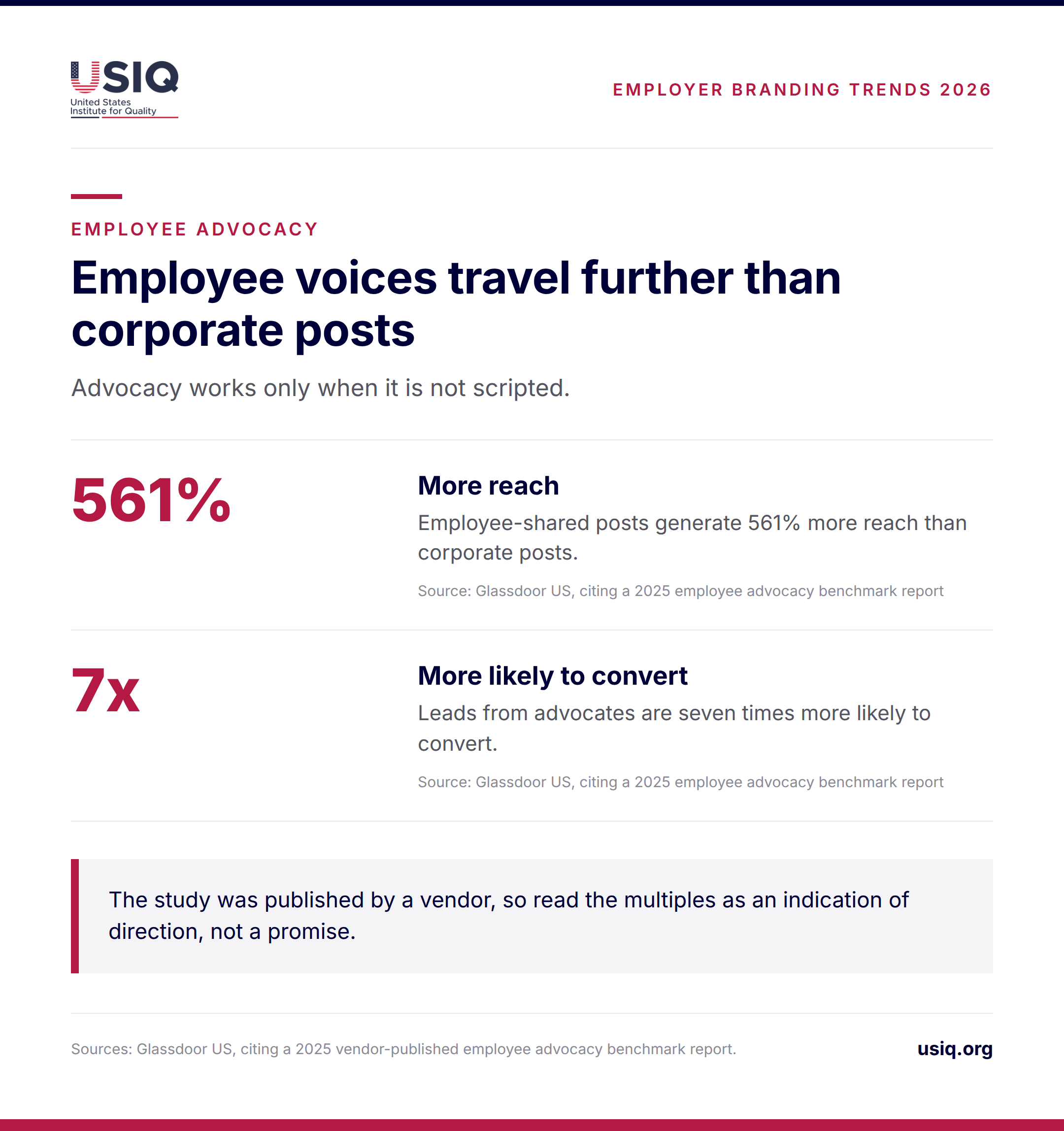
Yes, but only if they speak freely. Glassdoor, citing a 2025 employee advocacy benchmark report, says employee-shared posts generate 561% more reach than corporate posts and that leads from advocates are seven times more likely to convert. The study was published by a vendor, so treat the multiples as an indication of direction rather than a promise.
Candidates trust employee voices over corporate messaging, and they detect scripted posts quickly. Give people a safe way to give feedback, invite them to share experiences they would share anyway, and let a team member introduce their own work in their own words. Do not make posting a condition of anything.
What are the legal limits around employee reviews?
In August 2024 the Federal Trade Commission announced a final rule banning fake reviews and testimonials. It prohibits buying or selling fake reviews and allows the agency to seek civil penalties against knowing violators. It also bars insider reviews without disclosure of the material connection, review suppression through groundless legal threats or intimidation, and company-controlled sites posing as independent reviewers.
The rule addresses reviews of products and services, and the FTC announcement does not say it covers employer-review sites. Treat it as an adjacent standard, not as employment law. The practical conclusion is the same either way: do not fake reviews, do not pressure staff to post them and do not try to suppress negative ones. If a legal question arises about restricting what employees may say, ask an employment attorney.
Where do AI and video fit in a small-company strategy?
Both are tools for distribution, not sources of credibility. AI can speed up first drafts of job descriptions, help you adapt one story for several channels and make your careers content easier to find. It cannot supply the substance. Candidates still want to hear from the people they would work with.
The same applies to video. A short clip in which a team member explains what a normal week looks like usually tells a candidate more than a polished corporate film. A phone, decent audio and a manager willing to let employees speak honestly are enough to start. No reliable benchmark exists for the best video length or platform for employer content, so test a few formats and watch your own application data.
Candidates also put questions about employers to AI assistants as well as to search engines. USIQ has written about that in candidates asking AI about employers.
How do you measure employer branding without an HR analytics team?
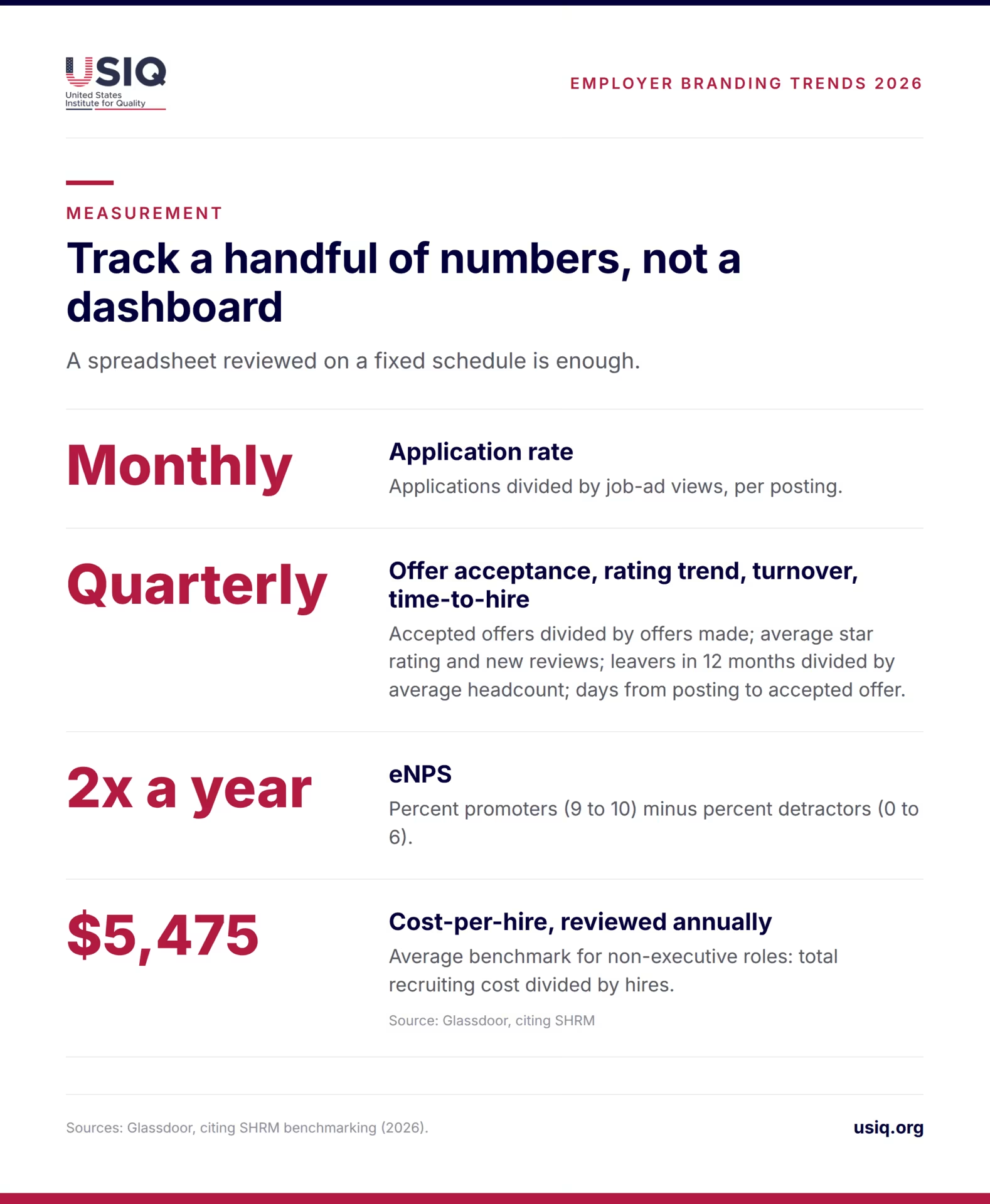
Glassdoor recommends tracking application rate, offer acceptance rate and rating trends. For a company of 10 to 250 employees, add employee net promoter score (eNPS), 12-month turnover, time-to-hire and cost-per-hire. A spreadsheet reviewed on a fixed schedule is enough. More detail on recruiting numbers is in this overview of the most important KPIs in recruiting.
| Metric | How to calculate it | How often |
|---|---|---|
| Application rate | Applications divided by job-ad views | Per posting, reviewed monthly |
| Offer acceptance rate | Accepted offers divided by offers made | Quarterly |
| Public rating trend | Average star rating and number of new reviews | Quarterly |
| eNPS | Percent promoters (9 to 10) minus percent detractors (0 to 6) on a 0 to 10 “would you recommend us as an employer” question | Twice a year |
| 12-month turnover | Leavers in 12 months divided by average headcount | Quarterly |
| Time-to-hire | Days from job posting to accepted offer | Per hire, reviewed quarterly |
| Cost-per-hire | Total recruiting cost divided by hires (average benchmark: $5,475 for non-executive roles, per Glassdoor citing SHRM) | Annually |
On budget, tier the work by effort, not by a fixed amount. The first tier costs time only: fix the hiring process, align job ads with reality and start asking employees for feedback. The second adds simple content such as employee-led videos and updated career pages. Paid tools and campaigns come last, once the first two tiers are working. The guide to building a strong employer brand on a small budget goes through these steps.
Does independent proof make an employer brand more credible?
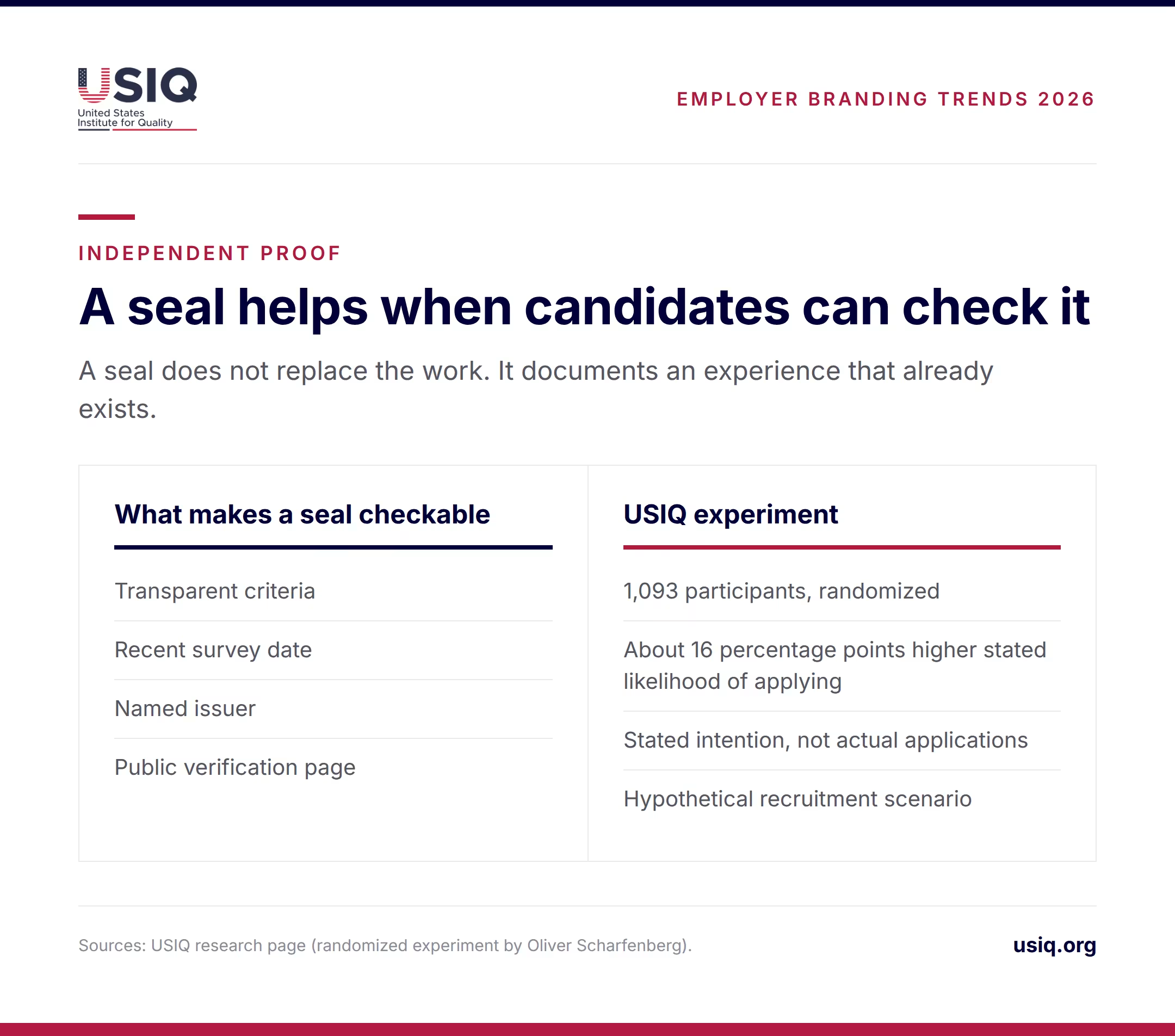
Because candidates distrust polished self-descriptions, more employers back up claims with something from outside the company. Reviews are one form. Certifications based on anonymous employee surveys are another. A seal on its own convinces nobody, but a seal with transparent criteria, a recent survey date and a named issuer gives job seekers something they can check.
USIQ, the publisher of this article, runs certification programs of this kind. Its Top Employer program combines a confidential online survey of all eligible employees with an HR assessment, and the full rules are published in the Top Employer methodology. Certificates are valid for 24 months, and each seal links to a public verification page.
On the candidate side, a randomized experiment with 1,093 participants by Oliver Scharfenberg found that an employer seal raised the stated likelihood of applying for a job by about 16 percentage points (see the USIQ research page). It measured stated intentions in a hypothetical recruitment scenario rather than actual applications. For a broader look at the evidence, read do employer seals work.
If you consider any program, check that it publishes its method, shows the survey date and lets anyone verify the result. A seal does not replace the work above. It documents an experience that already exists.
What are the limits and common misconceptions?
The first misconception is that branding can fix a pay, management or turnover problem. It cannot. If managers are the reason people leave, better content makes the gap between promise and experience more visible, and Glassdoor’s data on misalignment and distrust points the same way.
The second is that bigger budgets win. Several of the most cited figures in this field trace back to vendors or to older studies, and none shows that spending alone drives results. The third is that low quits mean branding matters less. Quits were 2.1% in September 2026, up from just below 2%, and the cost of each departure is still real for a small team.
What should a small employer do in the next 90 days?
For a fuller explanation of the basics, see what is employer branding.
Frequently asked questions
What is employer branding?
Employer branding is how current and potential employees perceive you as an employer. It is shaped by real experience at work, by your hiring process and by what employees and candidates say publicly. Messaging and careers content support it, but they cannot replace the experience itself.
How much should a small business spend on employer branding?
No reliable benchmark exists for companies with 10 to 250 employees. Start with measures that cost mainly time: a better hiring process, honest job ads and employee feedback. Add content and paid tools only after those work, and judge spending against your own cost-per-hire and turnover.
Can a small company have a strong employer brand?
Yes. A small company can often deliver what large employers struggle to prove: direct access to leaders, fast hiring decisions and real stories from named colleagues. Candidates check reviews and judge the hiring process regardless of company size, so consistency matters more than scale.
How long does it take to see results?
No reliable figure exists. Hiring-process fixes can show up within a few hiring cycles in response times and application rates. Changes in public ratings, turnover and offer acceptance take longer. Record a baseline first, then review the same metrics each quarter.
Do employer reviews matter if few people leave them?
They can matter more, because a few reviews carry a lot of weight. Glassdoor reports that 75% of job seekers evaluate an employer’s brand before applying. A small number of reviews cannot be averaged out by volume, so respond respectfully and never fake or pressure reviews.
Is it legal to ask employees to post positive reviews?
Avoid it. The FTC’s 2024 final rule on fake reviews bars undisclosed insider reviews and review suppression through groundless threats, though it addresses product and service reviews, not employer sites. Even so, pressure undermines credibility. If you want to restrict what employees may post, consult an employment attorney.
Which metrics show whether employer branding works?
Glassdoor recommends application rate, offer acceptance rate and rating trends. Add 12-month turnover, time-to-hire, cost-per-hire and an employee net promoter score. Record a baseline before you change anything, then compare quarterly so you can tell which action moved which number.
Sources

Related Articles
What research says about the effects of employer seals on current employees, potential applicants and employer image, from independent experiments and field data to the limits of the evidence.
Employee experience and customer experience are linked, but the link is weaker and more conditional than popular slogans suggest. This article reviews the evidence on staffing, training and workplace conditions and shows how employers can test the connection in their own business.
Most HR dashboards show too many metrics and trigger too few decisions. This guide defines ten employee experience metrics, shows a one-page layout and explains how to read your numbers against U.S. data.
A practical guide to calculating marketing ROI for small and mid-sized U.S. companies, including long B2B sales cycles, offline leads, a spreadsheet walkthrough and common errors.