

Most lists of employer branding examples read like a tour of corporate campuses. They describe free meals, famous cultures and glossy careers pages, then leave a 60-person manufacturer or a 150-person accounting firm to work out what applies. Very little applies directly, but several of the underlying ideas do.
This article looks at five well-known employers, corrects some claims that circulate about them, and sorts what a smaller company can borrow from what it should skip. It also shows how to check whether your own employer brand is working, using numbers you probably already have.
Quick answer: An employer brand is the reputation and day-to-day experience a company offers current and prospective employees. The strongest examples share one clear idea, such as a mission, a selective culture or a giving pledge, that policy and daily practice back up. Small firms can copy the discipline, not the budget.
Key takeaways
- An employer brand is the perception people have of you as a place to work, and it is built mostly by what employees actually experience.
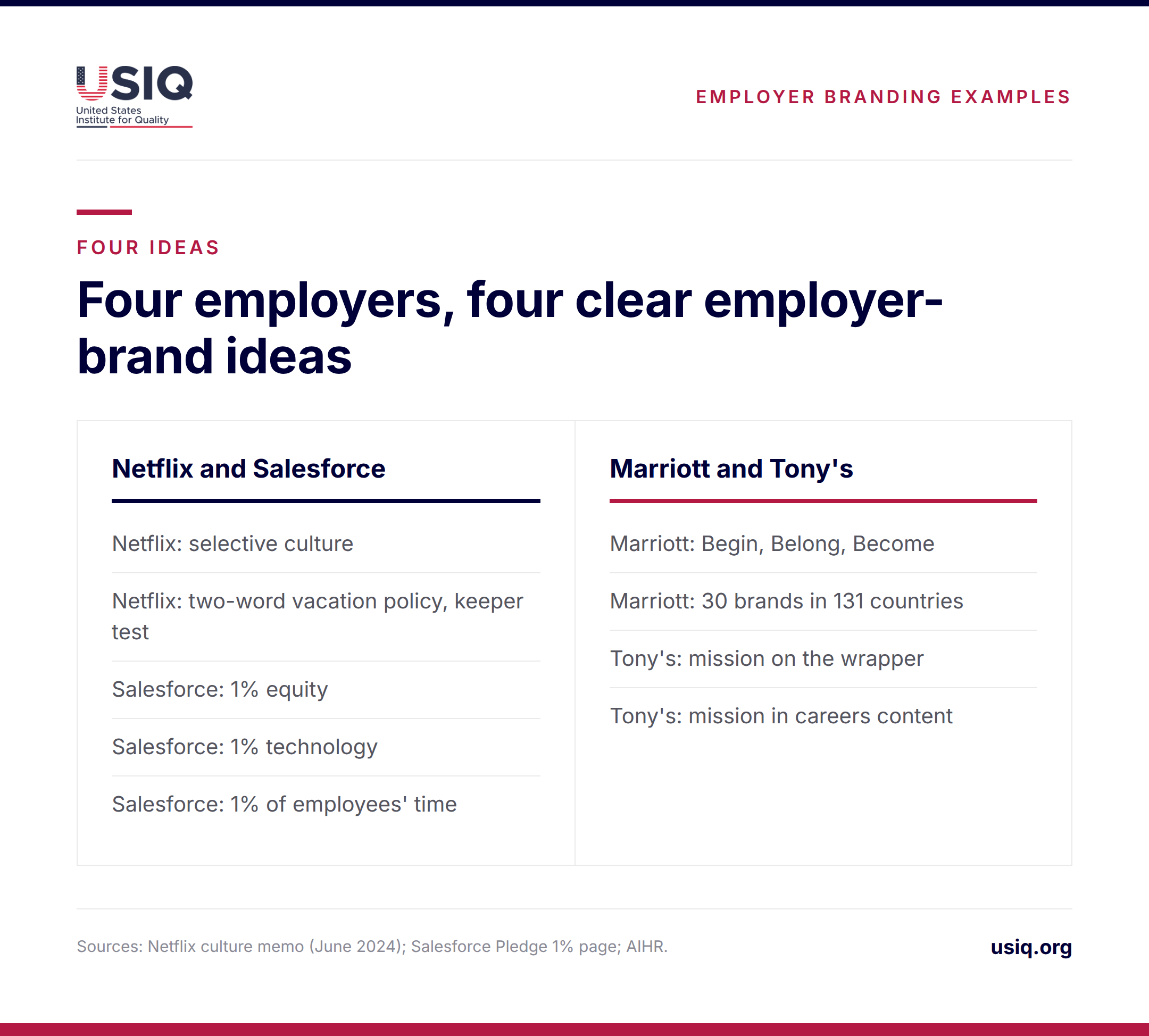
- The examples that last rest on one idea repeated consistently: Netflix’s selective culture, Salesforce’s 1-1-1 giving model, Marriott’s three-pillar promise, Tony’s Chocolonely’s mission.
- Perks are not the brand. Netflix’s own culture memo says people, not offices or perks, make a workplace.
- Google shows that a promise can age: some previously remote staff were told in 2025 to work from an office at least three days a week.
- Hiring has a real price. SHRM benchmarking put average cost per hire at nearly $4,700 (cited in 2022), so a stronger brand has a measurable payoff.
- Measure the brand with a few numbers: applications per opening, offer-acceptance rate, time-to-hire, 12-month turnover and an employee survey.
What is employer branding, and why does it matter for a company with 10 to 250 employees?
Employer branding is the reputation a company holds among its current employees and the people it hopes to hire. It is shaped by pay, management, daily working conditions, how openings are described and what former staff say. A company without a deliberate brand still has one, because candidates and employees form opinions either way. For a deeper definition, see USIQ’s guide to what employer branding is.
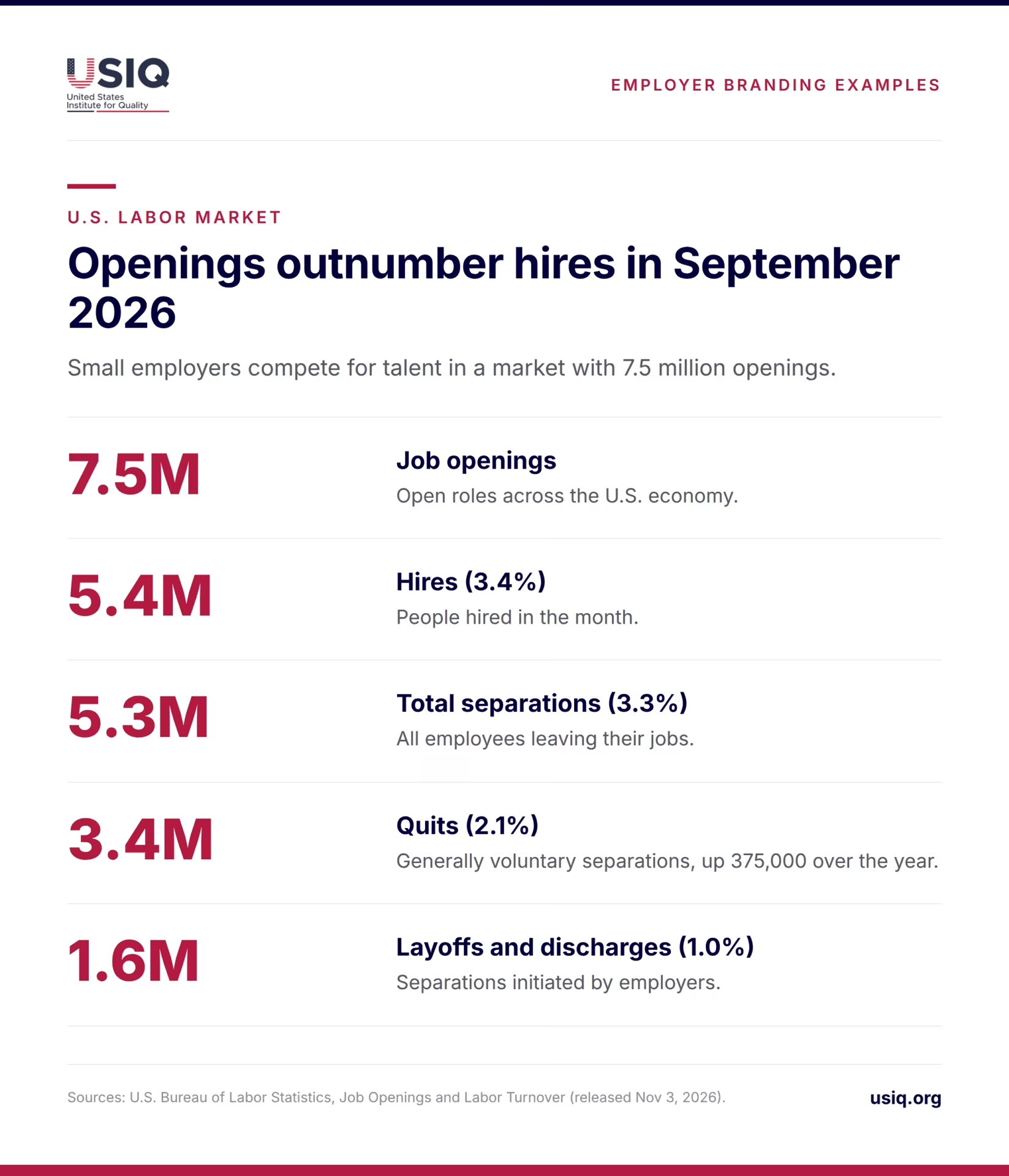
The labor market gives small employers reasons to care. In September 2026, the U.S. Bureau of Labor Statistics (BLS) counted 7.5 million job openings against 5.4 million hires, a hires rate of 3.4%. Total separations were 5.3 million (3.3%), and quits, which BLS describes as generally voluntary separations, reached 3.4 million (a rate of 2.1%), up 375,000 over the year. Layoffs and discharges came to 1.6 million (1.0%).
Replacing people costs money. SHRM benchmarking put the average cost per hire at nearly $4,700, a figure cited in 2022 and likely higher today. Some employers estimate the full cost of a hire at three to four times the position’s salary, but that is a consultant’s estimate rather than a measured average. Either way, an employer that keeps people longer and fills roles faster saves real dollars.
| Indicator (U.S., September 2026) | Level | Rate |
|---|---|---|
| Job openings | 7.5 million | n/a |
| Hires | 5.4 million | 3.4% |
| Total separations | 5.3 million | 3.3% |
| Quits | 3.4 million | 2.1% |
| Layoffs and discharges | 1.6 million | 1.0% |
Which companies have strong employer branding, and what can small firms copy?
The examples below are chosen for the clarity of their central idea, not their size. Each row also states what carries over to a firm with 10 to 250 employees and what does not.
| Company | Core idea | Evidence | What a small firm can copy |
|---|---|---|---|
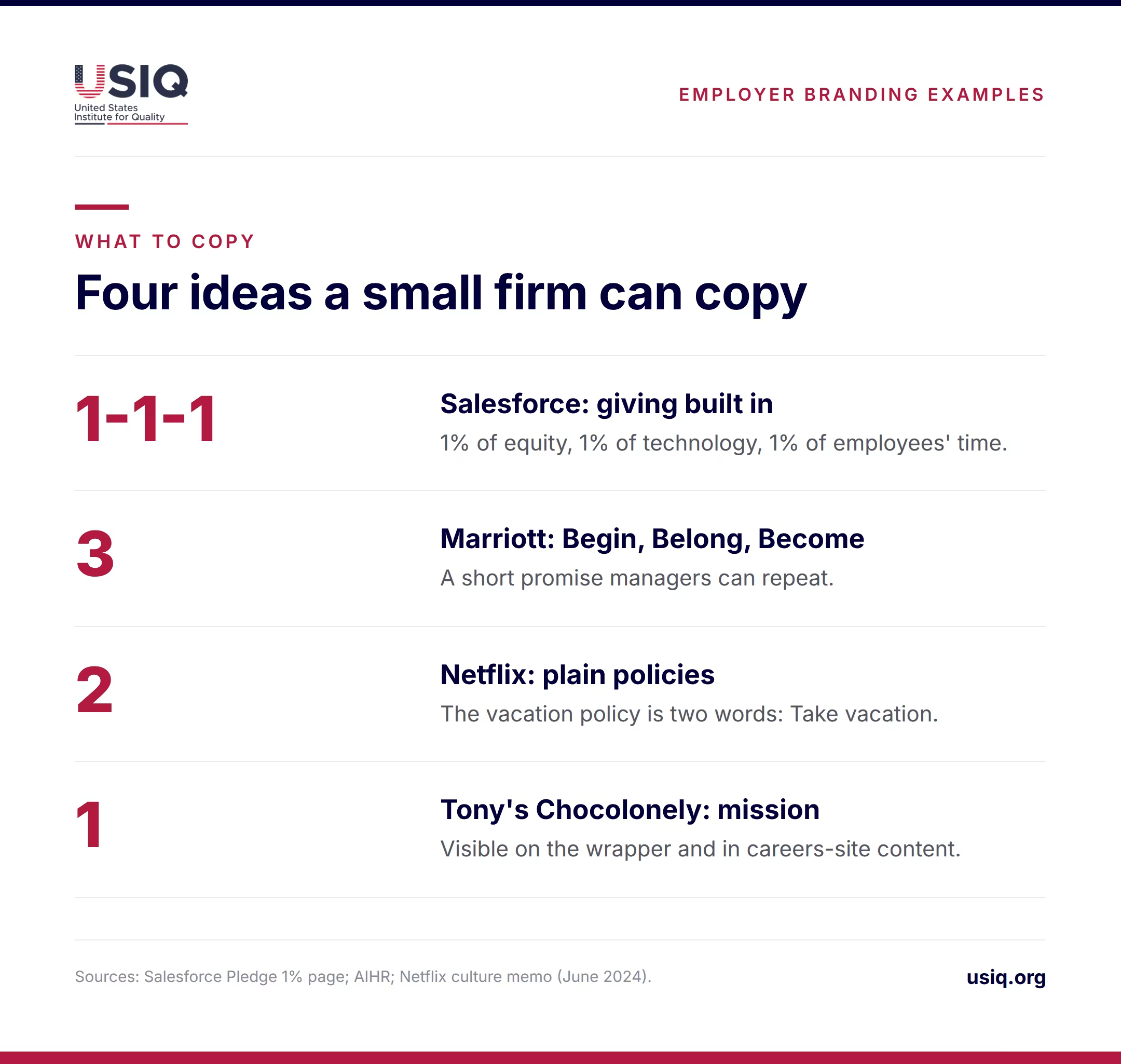
| Netflix | A selective, high-trust culture | Vacation policy: “Take vacation.” Expense policy: five words. A “keeper test” for managers. | Short, plain policies and honest talk about expectations. Skip the model if your business cannot support it. |
| Salesforce | Giving built into the business | 1-1-1: 1% of equity, 1% of technology, 1% of employees’ time. | Pledge one pillar, such as paid volunteer hours. |
| Marriott International | One promise for employees: Begin, Belong, Become | Message “Be you”; 30 hotel brands in 131 countries. | A short, memorable promise that managers can repeat. |
| Tony’s Chocolonely | Mission as the brand | Mission on the wrapper and in LinkedIn and careers-site content. | Make your purpose visible wherever candidates look. |
| Flexibility, later narrowed | Some remote staff told to work from an office at least three days a week in 2025. | Promise only what you can keep for years. |
Netflix: a selective culture, described precisely
Netflix is often summarized as “unlimited vacation and no expense rules.” Its own culture memo is more precise. The vacation policy is two words, “Take vacation.”, and the expense policy is five, “Act in Netflix’s best interests.” The memo also describes a “keeper test”: managers ask whether they would fight to keep a person or hire them again, and if not, Netflix says parting ways quickly is fairer to everyone.
That is a deliberate trade of security for freedom and high standards. It attracts people who want exactly that and repels people who do not, which is what a clear employer brand should do. Few small employers can replicate it, because a 40-person company often cannot afford to part ways quickly with a mid-level performer or fill the gap. The portable part is the clarity: say what you expect, in plain words, before hiring.
Salesforce: the 1-1-1 model, corrected
Salesforce’s 1-1-1 model commits 1% of equity, 1% of technology (product) and 1% of employees’ time. Pledge 1% is a separate global movement that Salesforce co-founded, and companies can begin by pledging a single pillar: time, product, profit or equity.
For a small firm, the practical version is modest. An 80-person engineering company could offer each employee paid volunteer hours, or a retailer could pledge a share of profit to a local cause. What makes it an employer-brand asset is that it is specific and verifiable, not that it is large.
Marriott and Tony’s Chocolonely: one idea, visible everywhere
According to AIHR, Marriott International’s employee value proposition rests on three pillars, Begin, Belong and Become, with the message “Be you.” The group runs 30 hotel brands in 131 countries, yet the promise to employees stays short enough to repeat. In a service business that clarity links the way staff are treated to the way guests are treated.
Tony’s Chocolonely takes a different route: the mission is the brand. AIHR notes that it appears on the wrapper and in the company’s LinkedIn and careers-site content, and that the bar’s uneven pieces symbolize unfair profit distribution. A candidate who meets the same idea on the shelf, on social media and on the jobs page has little doubt what the company stands for. A local brewery, clinic or contractor can do the same with a smaller idea, such as training apprentices or hiring from the neighborhood.
What do the best employer branding examples have in common?
Four patterns appear across the cases. Each rests on one idea that fits the business. The idea shows up in several places, from policy documents to product packaging to careers pages. It is specific: a percentage, three pillars, a two-word policy. And it excludes some people as well as attracting others.
None of this requires a large budget. A small company’s values that attract top talent can do the same job, provided they are concrete enough to test against daily behavior. A value such as “integrity” says little. A rule such as “we publish pay ranges in every job ad” says a lot.
Do big-company perks still work as employer branding after the return-to-office shift?
Perks work only as long as they last. Older articles described Google as letting staff choose between hybrid and remote work. In 2025, according to HR Grapevine citing CNBC, several Google business units told some previously approved remote employees to report to their nearest office at least three days a week or risk exit packages or role elimination. Some teams applied a 50-mile rule, and Google said decisions were made at the team level.
Flexibility is not the mistake here. A brand promise becomes a liability when practice changes and the story does not. Candidates who joined for one arrangement and found another tend to say so publicly. Netflix makes a related point in its memo: what makes a workplace is its people, not offices or perks.
For a smaller employer, the safe approach is to describe the arrangement you run today, state how decisions about it are made and avoid promising permanence. USIQ has covered the wider debate in its articles on the return to the office and on remote work.
How can a small or mid-sized company build an employer brand on a small budget?
Start from what is true. A brand built on employees’ real experience survives scrutiny, and one built on slogans does not. The steps below cost mostly time. USIQ’s guide to building an employer brand on a small budget goes further on each.
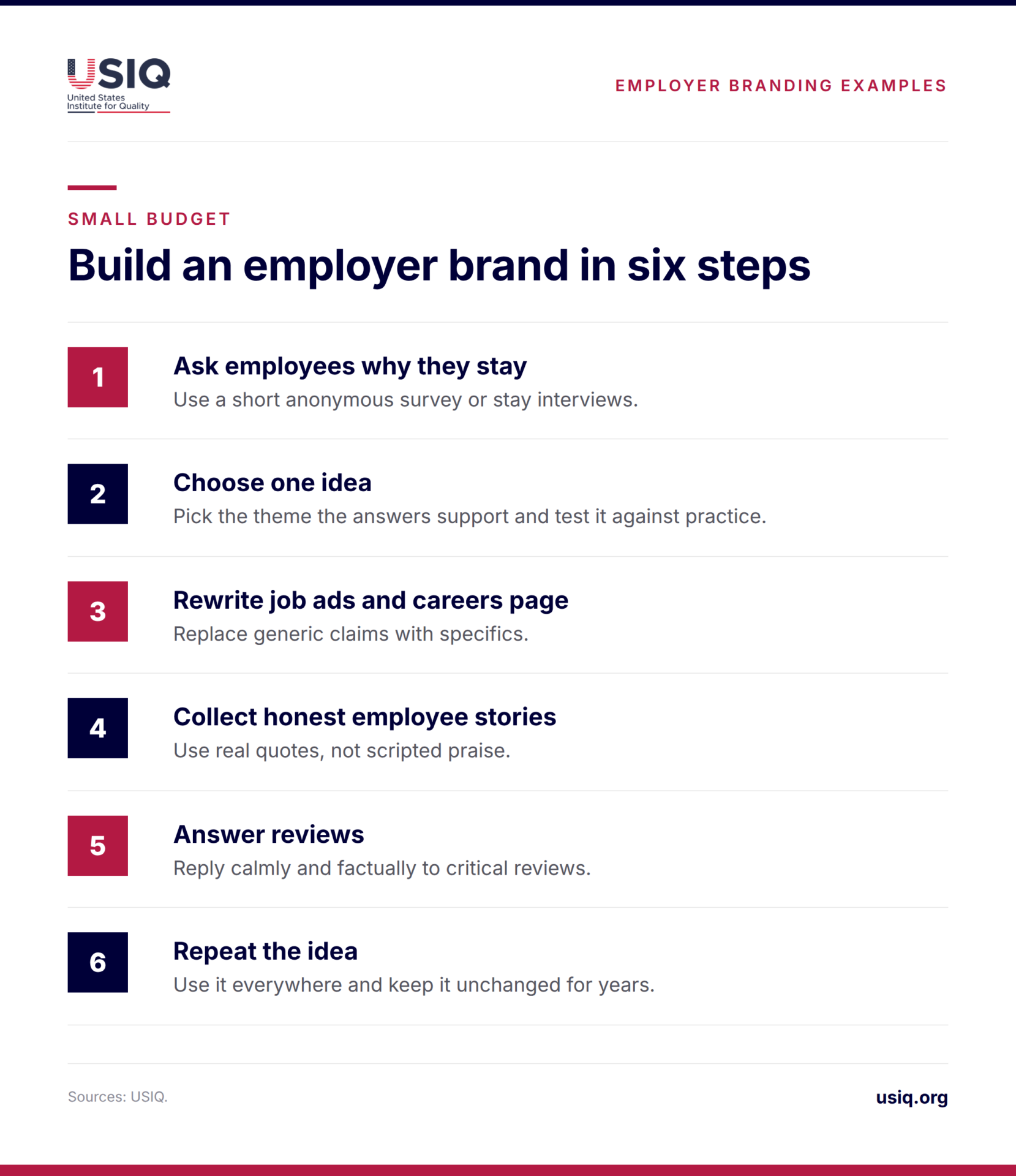
- Ask employees why they stay. A short, anonymous survey or a round of stay interviews shows what people value, which may differ from what leadership assumes.
- Choose one idea. Pick the strongest theme that the answers support, such as predictable schedules, training, local roots or a mission, and test it against actual practice.
- Rewrite job ads and the careers page. Replace generic claims with specifics: real schedule, real team, what the first 90 days look like.
- Collect honest employee stories. Short quotes, photos or videos from people who agreed to be featured work better than polished copy. Do not script them or offer incentives for praise.
- Answer reviews. A calm, factual reply to a critical review shows candidates how you handle disagreement.
- Repeat the idea. Use it in the job ads, onboarding, the website and manager conversations, and keep it unchanged for years.
On sensitive topics such as diversity programs or pay disclosure, describe only what your company does and can document. Have counsel review any claim about benefits, pay or inclusion programs before it goes into a job ad or onto a careers page.
Third-party proof can also help a smaller employer that lacks name recognition. In a randomized experiment with 1,093 participants, Oliver Scharfenberg found that an employer seal raised the stated likelihood of applying for a job by about 16 percentage points (USIQ research). USIQ, the publisher of this article, runs certification programs of this kind; its Top Employer program combines an employee survey with an HR assessment, and each seal links to a public verification page.
What are the limits of employer branding, and where does it go wrong?
The most common failure is a gap between promise and reality. A careers page that describes a close-knit team will not hold up if turnover is high and managers are overstretched. Candidates compare what they were told with what they find in the first weeks, and the experience of new hires feeds back into the brand.
A second problem is borrowing a model that does not fit. Netflix’s keeper test suits a company that can hire at the top of the market and accepts fast turnover at the margin. A family-owned distributor that depends on long-tenured drivers and warehouse staff needs a different promise, such as stable hours or visible advancement.
Third, branding does not fix pay or management. It can shorten the time it takes to be noticed, but it cannot keep a good employee whose manager is the reason to leave. USIQ’s pieces on employee experience and engagement cover that underlying work.
How do you measure whether employer branding works?
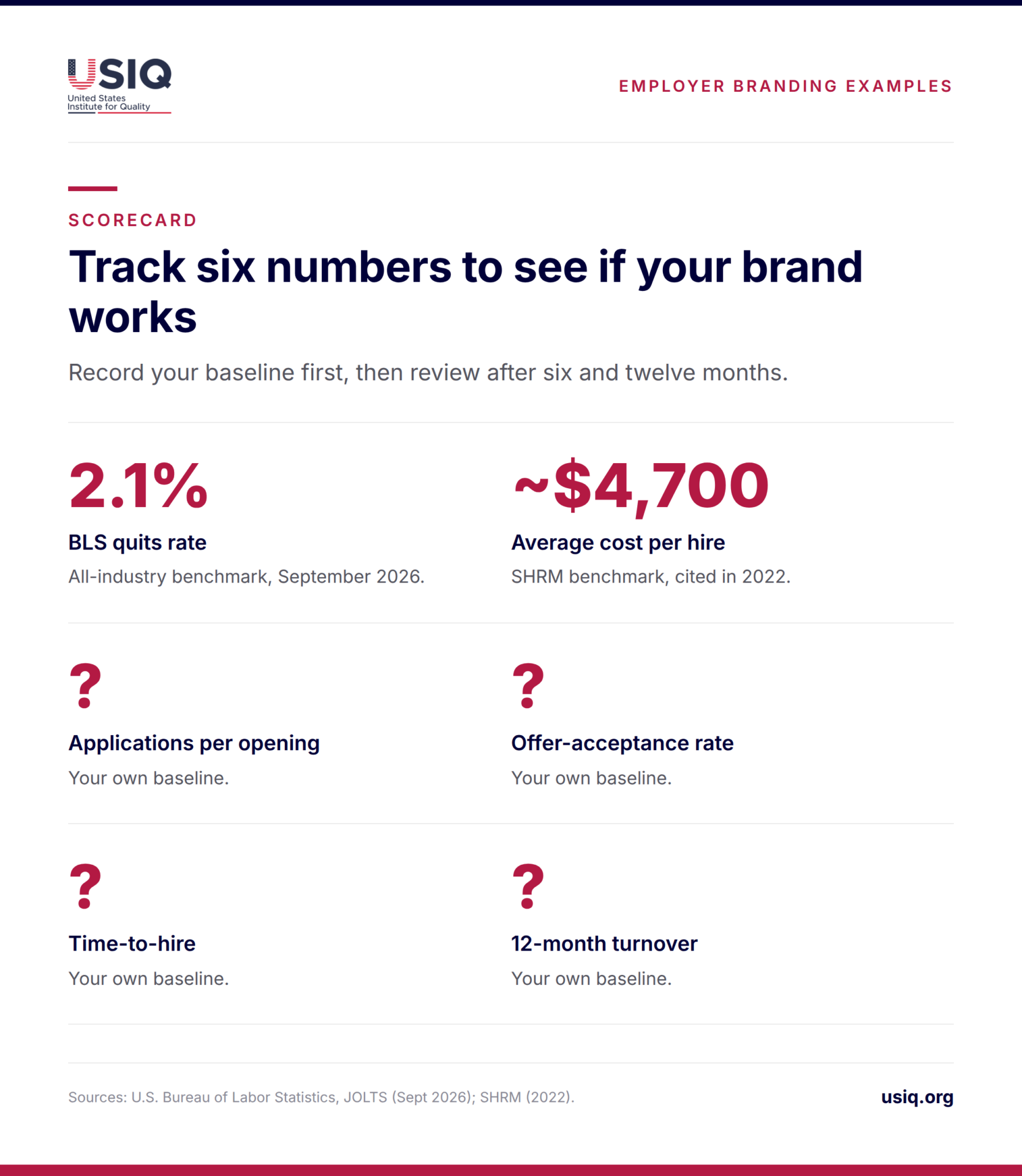
Slogans and images are easy to copy; results are what separate a brand from a campaign. A small firm can track a short scorecard quarter by quarter. Record the baseline before changing anything, then review after six and twelve months.
| Metric | What it shows | Where the data comes from |
|---|---|---|
| Applications per opening | Whether the employer is noticed | Applicant tracking or inbox count |
| Offer-acceptance rate | Whether the promise holds up at the offer stage | HR records |
| Time-to-hire | How long roles stay open | HR records |
| Cost per hire | Spend on recruiting; compare to SHRM’s figure of nearly $4,700 (2022) | Finance and HR |
| 12-month turnover | Whether new hires stay | HR records |
| Quit rate | Voluntary exits; compare with the BLS quits rate of 2.1% (Sept 2026) | HR records, BLS JOLTS |
| Employee survey results | How people rate the experience | Anonymous employee survey |
BLS publishes JOLTS data by establishment size class, which lets a company with 10 to 249 employees compare itself with similar-sized employers rather than the national average alone. The all-industry quits rate of 2.1% is only a starting point, since industries differ widely.
The employee survey supplies the context the other numbers lack. It shows why people stay or leave and gives a baseline for later comparison. USIQ explains the method in its guide to employee surveys, and its overview of recruiting KPIs covers the hiring metrics in more detail.
What is the outlook for employer branding?
The direction is toward proof over promise. Candidates have more ways to check what an employer says, from employee reviews to public verification pages, and policies such as office attendance change visibly, as Google’s case shows. Brands built on one honest idea and measured against results will hold up better than those built on a long perk list.
Candidates also increasingly use AI assistants to research employers, which makes consistency across a company’s own pages, job ads and third-party mentions more important. USIQ covers that shift in its article on candidates who ask AI.
Practical recommendations
- Write down your current baseline: applications per opening, offer-acceptance rate, time-to-hire, 12-month turnover.
- Run an anonymous survey before deciding what your brand says.
- Choose one idea you can prove, and state it in a sentence a manager can repeat.
- Remove any claim in job ads or on the careers page that you could not defend today.
- Review the scorecard every quarter and adjust the message only when the evidence changes.
Conclusion
The best employer branding examples succeed because one clear idea matches how the company really operates, not because of size or perks. A company with 10 to 250 employees can do the same by finding the true reason people stay, saying it plainly and tracking the results.
FAQ
What is the difference between employer branding and recruitment marketing?
Employer branding is the lasting reputation and experience an employer offers. Recruitment marketing is the set of activities, such as job ads and social posts, that promote open roles. Marketing can make a brand visible, but it cannot make it credible if daily experience at work contradicts it.
How much should a company with 50 employees spend on employer branding?
No reliable universal figure exists. A practical starting point is the cost you already carry: compare spending against your own cost per hire and turnover, and against SHRM’s cited figure of nearly $4,700 per hire (2022). Many of the useful steps, such as surveys, better job ads and stories, cost mainly time.
Can a Netflix-style culture work in a small firm?
Rarely in full. Netflix pairs a two-word vacation policy with a keeper test that favors fast separations when performance falls short. A small company that relies on stable teams may borrow the plain-language policies and honest expectations while keeping its own approach to performance and tenure.
What is Salesforce’s 1-1-1 model?
Salesforce’s 1-1-1 model commits 1% of equity, 1% of technology (product) and 1% of employees’ time to charitable causes. Pledge 1% is a separate movement that Salesforce co-founded, and a company can begin with a single pillar: time, product, profit or equity.
Is Google still a model for flexible work?
Not in the way older articles describe. In 2025, according to HR Grapevine citing CNBC, some Google units told previously remote employees to work from the nearest office at least three days a week. Google said decisions were made at the team level. It shows how quickly a workplace promise can change.
How do I know my employer brand is working?
Track applications per opening, offer-acceptance rate, time-to-hire, cost per hire and 12-month turnover against your own baseline. Compare your quit rate with BLS data, where the all-industry rate was 2.1% in September 2026, and add an anonymous employee survey to explain the changes.
Does an employer seal help with hiring?
In a randomized experiment with 1,093 participants, Oliver Scharfenberg found that an employer seal raised the stated likelihood of applying for a job by about 16 percentage points. A seal works as third-party proof for employers without name recognition. See employer seals explained for how they work.
Sources
- U.S. Bureau of Labor Statistics, “Job Openings and Labor Turnover – September 2026,” Nov 3, 2026. https://www.bls.gov/news.release/pdf/jolts.pdf
- SHRM, “The Real Costs of Recruitment,” Apr 11, 2022. https://www.shrm.org/topics-tools/news/talent-acquisition/real-costs-recruitment
- HR Grapevine, “Return to office or risk termination, Google tells remote workers,” Apr 24, 2025. https://www.hrgrapevine.com/us/content/article/2025-04-24-google-pressures-remote-staff-in-return-to-office-shift
- Salesforce, “Pledge 1% Movement.” https://www.salesforce.com/company/pledge/
- Netflix, “The Best Work of Our Lives, Culture Memo,” June 2024. https://jobs.netflix.com/netflix-culture.pdf
- AIHR, “13 Great Employer Branding Examples To Inspire You in 2026,” published Sep 15, 2023, modified Mar 19, 2026. https://www.aihr.com/blog/employer-branding-examples/
- USIQ, employer seal research (randomized experiment, 1,093 participants). https://www.usiq.org/top-employer/research/

Related Articles

What research says about the effects of employer seals on current employees, potential applicants and employer image, from independent experiments and field data to the limits of the evidence.
Employee experience and customer experience are linked, but the link is weaker and more conditional than popular slogans suggest. This article reviews the evidence on staffing, training and workplace conditions and shows how employers can test the connection in their own business.
Most HR dashboards show too many metrics and trigger too few decisions. This guide defines ten employee experience metrics, shows a one-page layout and explains how to read your numbers against U.S. data.
A practical guide to calculating marketing ROI for small and mid-sized U.S. companies, including long B2B sales cycles, offline leads, a spreadsheet walkthrough and common errors.


